


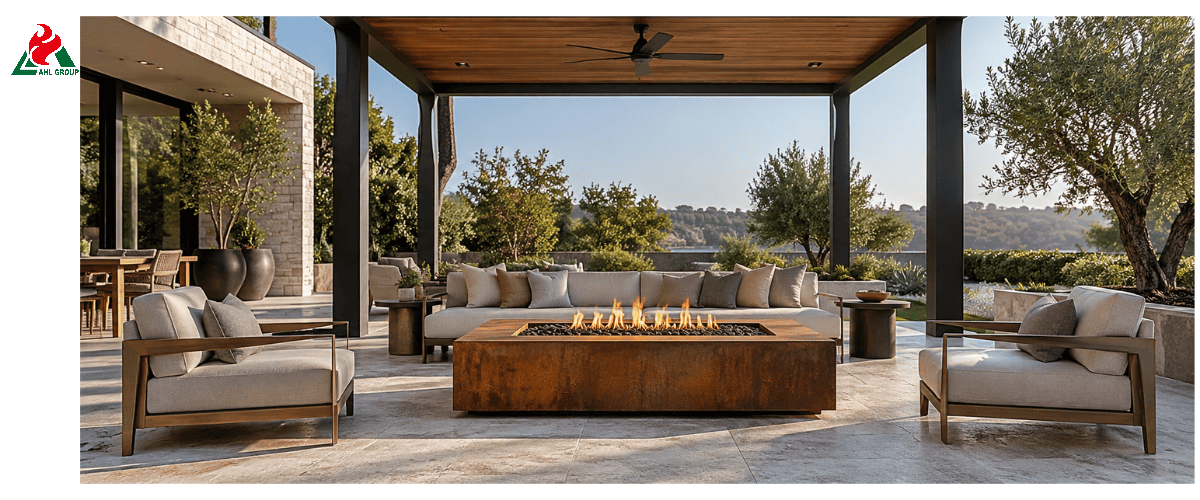
Can you safely use a Corten steel fire pit under a pergola or covered outdoor patio? Yes—but safety strictly depends on fuel choice, vertical clearance, and pergola roof construction. Clean-burning Corten steel gas fire pits (propane or natural gas) producing zero sparks and minimal soot can be safely placed under open-slat wood pergolas, louvered aluminum roofs, or open-sided covered patios, provided you maintain a minimum overhead clearance of 7 to 10 feet (2.1 to 3.0 meters) above the flame rim and keep at least two to three sides wide open for natural cross-ventilation. Conversely, traditional wood-burning Corten fire pits should never be operated under a low, combustible, or closed solid-roof pergola due to flying embers, smoke accumulation, carbon monoxide risks, and intense thermal updrafts; they require a minimum overhead clearance of 15 to 21 feet (4.5 to 6.4 meters) unless paired with an open-louver system, fire-rated spark arrestor screen, and non-combustible refractory heat shield.
When homeowners, landscape designers, and hospitality venues invest in custom Corten steel fire pits fabricated from rugged ASTM A588 / Corten-A weathering steel, the natural focal point is often right beneath an outdoor living structure: a cedar arbor, a modern motorized aluminum louvered pergola, or a poolside covered pavilion. Corten steel’s rich, organic rust-orange patina and dense thermal mass create an architectural centerpiece that only looks better with age.
However, bringing fire beneath an overhead structure combines radiant thermal energy, combustion gases, and combustible roof rafters in proximity. To protect your home, comply with residential building fire codes (such as NFPA 54 and local municipal open-burning bylaws), and safeguard your deck or stone pavers against rust runoff and extreme conductive heat, you need exact clearances, fuel comparisons, and substructure rules.
This comprehensive architectural and outdoor engineering guide breaks down the clearance formulas, compares wood versus propane operation, evaluates 4 different pergola roof types, reviews deck floor protection, and delivers a practical pre-installation safety checklist.
.png)
Are You a Contractor, Outdoor Retailer, or Distributor? Get Wholesale Pricing!
1. Direct Answer: Can You Put a Corten Fire Pit Under a Pergola?
The short answer is conditional on fuel type and structure design:
| Fuel Type & Fire Pit Model | Can It Be Used Under an Open-Slat Pergola? | Can It Be Used Under a Solid-Roof / Enclosed Patio? | Minimum Overhead Clearance Above Flame Rim* | Key Safety Conditions Required |
|---|---|---|---|---|
| Corten Gas Fire Pit (Propane / Natural Gas) (e.g., AHL-GF01 to AHL-GF14) | Yes (Safe) | Yes (With Adequate Cross-Ventilation) | 7 – 10 ft (2.1 – 3.0 m) |
Open sides (min. 50% wall area open), high-temp fire media (lava rock/fire glass), emergency gas shut-off valve. |
| Corten Wood-Burning Fire Pit / Bowl (e.g., AHL-FP01 to AHL-FP25) | Caution / Limited (High open slats only) | Strictly Prohibited (Extreme fire & smoke hazard) | 15 – 21 ft (4.5 – 6.4 m) |
Heavy-duty stainless spark screen, non-combustible floor pad, louvered roof opened 100%, seasoned hardwood only. |
| Smokeless Corten Fire Pit / Secondary Combustion | Possible with High Clearance | Not Recommended | 12 – 16 ft (3.6 – 4.9 m) |
Reduced visible smoke, but intense vertical heat jet updraft requires elevated ceiling clearance. |
| Corten Steel BBQ Grill & Plancha (e.g., AHL BG2 / BG4 / BG8) | Yes (Under Open Pergola / Louvers) | Only with Dedicated Range Hood | 8 – 12 ft (2.4 – 3.6 m) |
Grease management, spark protection, open ventilation for grilling smoke. |
(Note: Above overhead and side clearances are engineering and fire safety guidelines based on NFPA 54 / ANSI Z21.97 outdoor gas standards and municipal open-burning codes. Always consult local municipal fire regulations and your specific pergola manufacturer’s thermal tolerance ratings before installation.)
As detailed across AHL Group’s technical catalog, our modern Corten steel gas fire pits and Corten steel wood-burning fire bowls are built from 3.0 mm to 6.0 mm weathering steel. While Corten steel itself is completely non-combustible and withstands intense heat, understanding how that heat transfers upward into your pergola roof rafters is vital.
2. Wood vs. Gas Corten Fire Pits: Safety Under an Overhead Structure
Choosing between a wood-burning fire bowl and a gas fire table is the single most decisive factor when designing a fire feature under a pergola:
Corten Gas Fire Pits (Propane & Natural Gas): The Gold Standard for Covered Outdoor Spaces
For covered outdoor living areas, a Corten metal outdoor gas fire pit (such as the linear rectangular AHL-GF01 at 1500 × 600 × 400 mm or the square AHL-GF14 at 800 × 800 × 400 mm) provides optimal safety, control, and cleanliness:
- Zero Sparks, Flying Embers, or Ash: Gas burners combust cleanly without crackling or launching stray embers into dry timber rafters, outdoor fabric curtains, or acrylic roof panels.
- Instant Flame Modulation & Emergency Shut-Off: You can adjust the flame height from gentle ambiance (
30,000 to 50,000 BTU/hr) to robust warmth (60,000 to 100,000+ BTU/hr). If a sudden wind gust swirls through the pergola, you can instantly extinguish the flame by turning the valve knob or pressing an emergency shut-off switch. - No Creosote or Soot Residue: Wood smoke contains vaporized tar and unburned hydrocarbons (creosote) that coat overhead pergola beams with a dark, oily, highly flammable residue. Gas fires burn without depositing greasy soot onto your painted, stained, or powder-coated overhead canopy.
- Predictable Radiant Thermal Convection: Gas flame heights remain stable and predictable, making overhead clearance calculations straightforward and reliable.
Corten Wood-Burning Fire Bowls: Why Overhead Clearances Must Be Doubled
Traditional wood-burning Corten steel fire bowls (such as the round AHL-FP22 at D914 × H600 mm or AHL-FP24 at D914 × H200 mm) evoke an unmatched multi-sensory campfire atmosphere, but operating them beneath an overhead structure carries four inherent risks:
- Unpredictable Flame Spikes & Flying Embers: Poplar, pine, or resinous softwoods can pop aggressively, launching hot carbon sparks
6 to 12 feetinto the air. If those embers strike dry wooden purlins or settle into canvas pergola canopies, an ignition hazard occurs within seconds. - Smoke Accumulation & Thermal Trapping: Even in an open-slat pergola, rising hot air creates a thermal convection column. Under a solid or semi-closed roof, smoke gathers under the ceiling, stinging eyes and creating a hazardous buildup of carbon monoxide (CO).
- High Thermal Plume Temperatures: A roaring hardwood fire can generate temperatures exceeding
600°C to 800°C(1,100°F to 1,470°F) at the core. The upward thermal convection column can heat overhead timber beams beyond their critical ignition temperature (~250°C to 300°C) if adequate vertical distance is missing. - The "Smokeless" Secondary Combustion Reality: As investigated in our analysis on whether smokeless fire pits are fact or fiction, secondary-combustion double-wall fire pits dramatically reduce visible particulate smoke by pre-heating incoming air and burning off exhaust gases. However, they achieve this by creating an intense vertical thermal jet—meaning the upward heat plume is actually hotter and travels higher than that of a standard shallow fire bowl, requiring equal or greater vertical headroom!
3. Critical Clearance Formulas: Overhead, Lateral & Floor Distances
To safely integrate a Corten fire pit into a pergola layout, landscape architects follow three mandatory spatial dimensions:
1. Overhead Vertical Clearance (The Ceiling Rule)
Vertical clearance is measured from the top edge of the Corten fire bowl/flame burner bed to the lowest point of any overhead pergola beam, joist, louver, or hanging fixture (e.g., ceiling fan, pendant light, speaker):
- Gas Fire Pits (Propane / Natural Gas):
- Minimum standard:
7 feet(2.1 meters/84 inches) above the burner for outputs up to60,000 BTU. - Recommended for
70,000 to 100,000+ BTUburners:8 to 10 feet(2.4 to 3.0 meters) of unobstructed headroom. - Wood-Burning Fire Pits:
- Minimum clearance under open slats:
15 to 21 feet(4.5 to 6.4 meters). - If your pergola ceiling height is
8 to 10 feet, never burn wood underneath it. Relocate the wood fire bowl10 feetoutside the pergola footprint and enjoy the radiant warmth from comfortable seats positioned along the pergola edge.
2. Lateral & Perimeter Clearances (The 360° Radius Rule)
Horizontal clearance prevents radiant heat from blistering siding, scorching privacy screens, or igniting furniture:
- Distance to Combustible Walls / Siding: Maintain a minimum of
48 inches(1.2 meters/4 feet) between the outer Corten fire pit wall and any house siding (vinyl, cedar, stucco), timber posts, or glass sliding doors. - Distance to Outdoor Pergola Privacy Screens: When enclosing a patio with weathering steel privacy panels and garden dividers or custom decorative Corten screen panels, Corten panels are non-combustible and can sit within
24 to 36 inches(0.6 to 0.9 m) of a gas fire table without structural risk (though the metal screen will absorb heat). - Distance to Pergola Support Posts: Keep the fire pit centered between pergola columns, maintaining at least
36 to 48 inches(0.9 to 1.2 m) of open walking clearance between the fire pit perimeter and any wooden or wrapped aluminum column. - Seating Distance: Place patio armchairs, deep-seating sofas, and dining chairs at least
30 to 36 inches(0.75 to 0.9 m) away from the fire pit perimeter for safe, comfortable leg room and fire safety.
3. Open Ventilation Ratio (The Cross-Ventilation Rule)
To prevent toxic carbon monoxide (CO) accumulation and gas pocketing:
- At least two entire sides of the pergola (or 50% or more of the perimeter wall area) must remain completely open and unobstructed to the outdoors at all times.
- If your pergola features drop-down motorized weather screens, outdoor fabric curtains, or solid windbreak walls, never operate the fire pit while all screens are rolled down. Always leave at least two opposite sides wide open to establish a steady cross-breeze.
4. Pergola Material & Roof Styles: How Different Structures Handle Fire
Not all pergolas handle thermal updrafts the same way. Here is how 4 common pergola constructions perform:
1. Traditional Open-Slat Wood Pergolas (Cedar, Redwood, Pressure-Treated Pine)
- Combustibility: High. Wood exposed to repetitive radiant heat dries out through a process known as pyrolysis, gradually lowering its ignition temperature over years of use.
- Thermal Behavior: The open roof slats allow hot air, heat plumes, and combustion gases to rise and escape freely into the sky.
- Verdict for Corten Fire Features: Excellent for gas fire pits with
7 to 10 ftclearance. Suitable for wood burning only if the pergola beams are exceptionally tall (>15 ft) and a stainless spark screen is fitted at all times.
2. Motorized Louvered Aluminum Pergolas (Bioclimatic Roofs)
- Combustibility: Non-combustible aluminum structure. However, powder-coat finishes can blister or discolor if exposed to sustained temperatures above
90°C to 120°C(194°F to 248°F), and internal motor wiring/sensors can be damaged by concentrated hot air. - Thermal Behavior: When the louvers are rotated open to
45°–90°, rising heat drafts straight through like a chimney flue. When louvers are sealed shut during rain, heat traps immediately beneath the ceiling. - Verdict for Corten Fire Features: Highly popular combination with modern gas fire tables. Operating rule: Always rotate louvers open to at least
45°before igniting your fire pit to release trapped heat.
3. Polycarbonate or Acrylic Canopies & Fixed Glass Roofs
- Combustibility / Melting Risk: Extremely sensitive to heat. Standard polycarbonate sheets soften at
130°C to 140°C(266°F to 284°F) and can warp, sag, or discolor from radiant fire plume updrafts. - Verdict for Corten Fire Features: Do not operate a fire pit directly beneath polycarbonate or acrylic canopies unless the ceiling height exceeds
12 to 14 feetand the fire output is restricted to a small gas burner (≤40,000 BTU). Wood fire pits under plastic roofs are strictly prohibited.
4. Solid Wood-Ceiling Pavilions with Tongue-and-Groove Shiplap
- Combustibility / Smoke Trapping: Because the ceiling is solid, rising heat and smoke hit a flat barrier and mushroom horizontally across the entire ceiling plane.
- Verdict for Corten Fire Features: Suitable for gas fire pits only if ceiling height is
≥9–10 feet, all four walls are wide open, and an optional overhead exterior-grade ceiling fan is set to low reverse to gently disperse thermal pooling without disturbing the flame pattern.
5. Flooring, Decks & Heat Shields: Protecting What’s Under the Fire Pit
While overhead clearance prevents roof fires, what sits underneath your Corten fire pit is equally critical. Corten steel absorbs thermal energy rapidly and radiates it downwards, while unstabilized weathering steel can shed rust runoff during its initial weathering phase.
Heat Transfer onto Combustible Timber or Composite Decking
If you plan to place a Corten fire pit on a wooden deck (pressure-treated pine, cedar, ipe) or composite decking (Trex, TimberTech, Fiberon):
- The Conductive Heat Hazard: The steel bottom of a shallow wood fire bowl can reach temperatures of
200°C to 400°C(390°F to 750°F). If placed directly onto timber or composite boards, thermal conduction can scorch, char, melt, or ignite the deck framing beneath. - Elevated Fire Tables vs. Shallow Bowls:
- Taller Gas Fire Tables: Models like the
AHL-GF02(1200 × 500 × 600 mm) orAHL-GF08(600 × 600 × 600 mm) stand600 mm(24 inches) off the floor, housing an insulated stainless steel burner pan and propane cylinder enclosure inside. The base remains completely cool to the touch and can safely rest on a deck without a heat pad. - Low Fire Bowls: Low wood bowls like the
AHL-FP23(800 × 800 × 200 mm) sit just200 mm(8 inches) above the deck boards. These require a dedicated non-combustible heat barrier.
- Taller Gas Fire Tables: Models like the
- Approved Non-Combustible Deck Heat Shields:
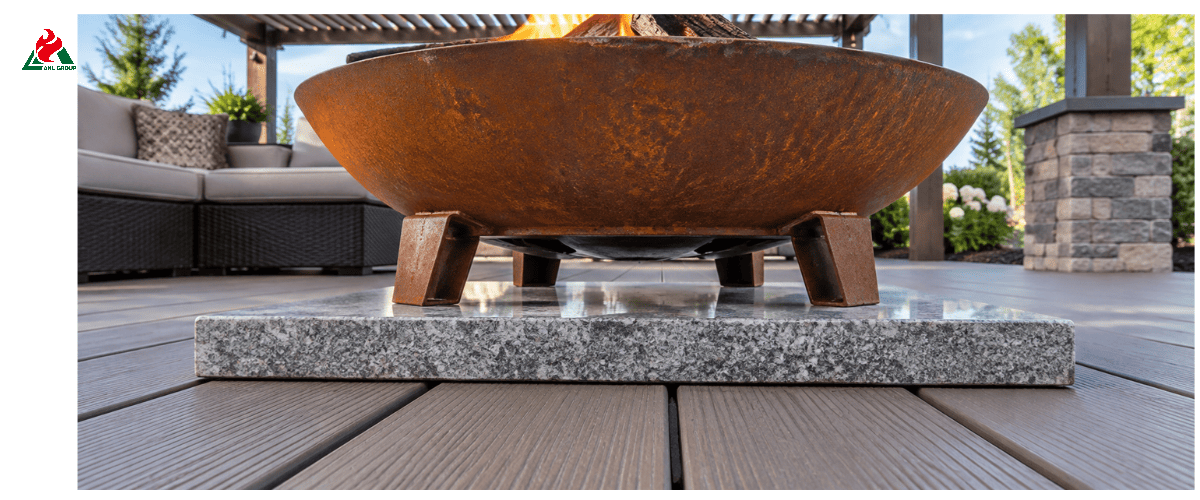
- Option A (Refractory Hearth Pad): Install a non-combustible hearth base made from natural bluestone, granite pavers, concrete patio slabs, or a certified multi-layer thermal deck protector pad (
silicone-coated fiberglass + volcanic rock thermal core). The heat pad must extend at least12 to 18 inches(300 to 450 mm) beyond the perimeter of the fire pit in every direction. - Option B (Elevated Steel Pedestal Stand): Mount the fire bowl on an elevated Corten steel ring base or legs that elevate the fire bed at least
12 to 16 inchesoff the ground, allowing ambient air to circulate beneath.
- Option A (Refractory Hearth Pad): Install a non-combustible hearth base made from natural bluestone, granite pavers, concrete patio slabs, or a certified multi-layer thermal deck protector pad (
Managing Corten Rust Runoff on Decking & Pavers
During the first 6 to 12 months of outdoor exposure, unweathered Corten steel develops its protective patina by shedding small amounts of water-soluble iron oxide (rust runoff) during heavy rain.
- If placed directly onto porous limestone, pale sandstone, light concrete pavers, or unsealed timber decking, rusty rainwater can leave reddish-brown stains.
- The Solution: Order your AHL fire feature with our Factory Pre-Weathered (
accelerated patina) finish, or apply a non-staining Corten protective seal. Alternatively, set the fire pit atop a darker slate or bluestone paver pad during the first season until the dense, non-runningalpha-FeOOHgoethite patina fully stabilizes.
6. Accessories & Engineering Upgrades for Pergola Fire Pit Installations
To maximize safety and comfort when using a Corten fire pit under a pergola, incorporate these engineered accessories:
- Heavy-Duty 304 Stainless Steel Spark Arrestor Mesh Screen: If operating a wood-burning bowl under an open-slat structure, a domed or hinged spark arrestor screen woven from heavy-gauge stainless steel mesh is mandatory. It catches escaping embers before they enter the thermal updraft.
- Tempered Glass Wind Guard / Flame Shield: For gas fire tables, adding a
4-piece tempered glass wind guard(150 mm / 6 inches high) prevents swirling cross-winds from blowing the flame toward one side of the table, stabilizes the flame geometry, and prevents heat from washing horizontally onto pergola columns. - Stainless Steel Snuffer Lid / All-Weather Corten Table Cover: A flush-fitting Corten steel or stainless snuffer cover serves two functions: it immediately smothers lingering coals at the end of the evening, and when the fire pit is unlit, converts the bowl into a practical outdoor coffee table.
- Emergency Gas Shut-Off & Push-Button Spark Ignition: Equipping your propane or natural gas line with a clearly labeled, accessible quarter-turn manual ball valve located outside the immediate fire zone ensures that anyone can shut off the fuel supply within two seconds if an unexpected flare-up occurs.
7. 10-Point Pre-Installation Pergola Fire Pit Safety Checklist
Review this checklist before positioning your Corten fire pit beneath any outdoor structure:
- 1. Fuel Type Verified: Selected a clean-burning gas fire pit (propane / natural gas) for pergolas with standard ceiling heights (
7–10 ft), or verified high clearance (≥15 ft) and spark screens for wood-burning bowls. - 2. Overhead Clearance Measured: Confirmed a minimum of
7 to 10 feet(2.1 to 3.0 m) of unobstructed vertical clearance between the burner rim and the lowest roof joist, ceiling fan, or light fixture. - 3. Cross-Ventilation Ensured: Verified that at least two sides (≥50% of the perimeter wall area) of the pergola remain open and unenclosed to prevent carbon monoxide accumulation.
- 4. Lateral Clearances Checked: Maintained at least
48 inches(1.2 m) of horizontal clearance to combustible walls/siding and36 inches(0.9 m) to pergola support posts and patio furniture. - 5. Roof Material Compatibility Evaluated: Confirmed that the pergola roof is open-slat wood, operable aluminum louvers, or high timber framing—not heat-sensitive polycarbonate or acrylic panels.
- 6. Floor / Deck Protection Installed: Installed a non-combustible stone, paver, or refractory thermal heat shield beneath the fire pit if installing on a combustible wood or composite deck.
- 7. Rust Runoff Protection Prepared: Provided a dark stone hearth pad or specified AHL’s Pre-Weathered finish to protect light-colored patio stones during initial patina formation.
- 8. Louver Operating Protocol Established: For motorized aluminum pergolas, established a firm household rule to open roof louvers to at least
45°before igniting the fire feature. - 9. Fire Extinguisher & Shut-Off Access: Placed a certified
Class B/C(for gas) orClass A/B/C(for wood) fire extinguisher within15 to 20 feetof the pergola, with an accessible gas shut-off valve. - 10. Local Fire Code Compliance: Checked local municipal open-burning regulations, HOA bylaws, and property insurance guidelines regarding open-flame features near residential dwellings.
8. Frequently Asked Questions (FAQ)
Q1: Is a gas or wood Corten fire pit safer under a pergola?
A: A gas Corten fire pit (propane or natural gas) is significantly safer under a pergola. Gas fires produce zero flying sparks, zero ash, zero creosote soot, and feature adjustable flame heights with instant emergency shut-off valves. Wood fires generate unpredictable flame spikes, smoke pooling, and hot embers that can easily ignite overhead rafters.
Q2: What is the minimum ceiling clearance required above a fire pit under a pergola?
A: For gas fire pits, fire codes and engineering guidelines recommend a minimum overhead clearance of 7 to 10 feet (2.1 to 3.0 meters) from the flame rim to the lowest overhead joist or fixture. For wood-burning fire pits, the minimum safe overhead clearance increases to 15 to 21 feet (4.5 to 6.4 meters) under an open-slat arbor, and wood burning should never take place under a solid or low roof.
Q3: Can I use a Corten fire pit under a motorized louvered aluminum pergola?
A: Yes, particularly with gas fire pits. However, you must rotate the aluminum louvers open to at least 45° to 90° while the fire pit is running. This creates an open chimney flue that allows hot convection plumes to vent upward into the atmosphere, preventing heat buildup that could discolor the powder coating or damage motorized actuators.
Q4: Will smoke from a fire pit ruin or stain my pergola ceiling?
A: Wood smoke contains soot, unburned particulate matter, and sticky creosote oils that will gradually darken, stain, and discolor overhead wood, vinyl, or aluminum beams. In contrast, clean-burning propane and natural gas fire pits release only carbon dioxide and water vapor, leaving zero soot or discoloration on overhead structures.
Q5: Can I put a Corten fire pit on a wooden or composite deck under a pergola?
A: You can, provided you take appropriate thermal precautions. Tall Corten gas fire tables (H400–600 mm with an elevated internal burner pan) stay cool at the base and can safely sit on a deck. However, low Corten wood fire bowls (H200–350 mm) radiate intense heat downward and must be placed on a non-combustible hearth pad (bluestone, granite, or certified fire-resistant deck mat) extending 12 to 18 inches beyond the fire bowl edge.
Q6: Can a fire pit be enclosed with outdoor curtains or motorized drop-down screens?
A: Never fully enclose a fire pit. For fire safety and healthy air quality, at least two full sides (≥50% of the wall area) of the pergola must remain wide open to the outdoor air. If you close all weather screens or curtains, carbon monoxide gas and radiant heat will rapidly build up to hazardous levels.
Q7: Does AHL Corten steel need painting or sealing to withstand outdoor patio use?
A: No. Corten steel (ASTM A588 / Corten-A) is specifically formulated with copper, chromium, nickel, and phosphorus alloys that form a dense, self-healing oxide patina when exposed to natural weather. This natural rust layer seals the steel against progressive atmospheric corrosion—eliminating the need for painting, staining, or regular maintenance for decades.
Q8: What sizes of Corten fire pits does AHL manufacture for pergola living spaces?
A: AHL manufactures a wide range of standard and custom models, including rectangular gas fire tables (1200 × 500 × 400/600 mm up to 2500 × 500 × 400 mm), square fire tables (600 × 600 mm to 1000 × 1000 mm), round gas fire bowls (D762 mm to D914 mm), and classic wood-burning bowls (D600 mm to D1000 mm+). Custom dimensions, burner kit configurations, and pre-weathered surface finishes can be precision-fabricated to match any architectural project.
Conclusion: Designing a Safe, Stunning Corten Fire Feature Under Your Pergola
A Corten steel fire pit integrated into a pergola setting creates one of the most inviting outdoor gathering spaces imaginable. By pairing a clean-burning Corten gas fire pit with an open-slat or operable louvered pergola, maintaining 7 to 10 feet of vertical clearance, ensuring robust two-sided cross-ventilation, and protecting combustible decks with elevated bases or stone hearth pads, you achieve a flawless blend of architectural warmth, comfort, and uncompromising safety.
At AHL Corten Group, we design and manufacture commercial-grade modern Corten steel gas fire pits, wood-burning fire bowls, and custom Corten steel BBQ planchas in premium ASTM A588 / Corten-A weathering steel. Available in standard sizes and custom architectural configurations with factory pre-weathered patinas, our fire features are trusted by landscape designers, architects, and hospitality venues worldwide. Contact our engineering team today to review your outdoor patio drawings and select the perfect fire feature for your pergola.
Manufactured from genuine weathering steel with pre-rusted patina options and global FOB/DDP delivery.
» Corten Steel Fire Pits | Outdoor Corten Wood Fire Pits | Contact AHL Engineers

