


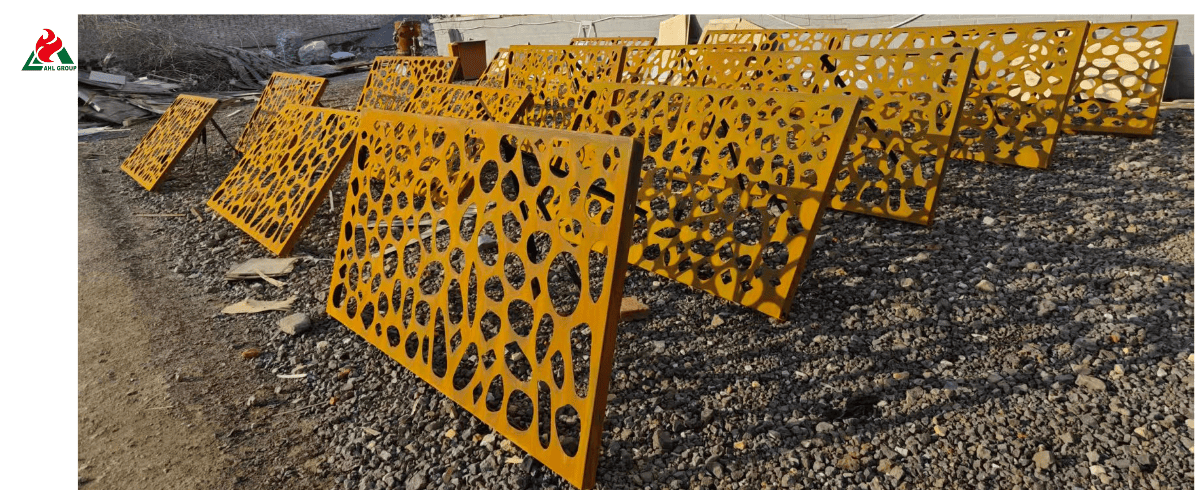
Whether outdoor privacy screens are prone to cracking depends on their material, panel geometry, exposure to the elements, and installation system. Screens made of rigid PVC, vinyl, acrylic, and low-grade resins can become brittle after prolonged exposure to UV radiation and may bend and crack when subjected to freezing temperatures, hail, or strong winds. Wooden screens, on the other hand, often develop cracks, splits, or warping due to repeated cycles of wetting and drying. Weathering steel (Corten steel) is a structurally sound metal with good ductility that does not experience brittle cracking under normal garden temperatures; however, if improperly designed—such as with panels that are too thin or inadequately supported—it may still bend, arch, or suffer fatigue fractures at narrow laser-cut joints.
1. Why “Cracking” Means Different Things Across Screen Materials
When buyers search for “Do privacy screens crack easily?”, they are usually influenced by obvious damage they’ve seen in residential yards: cracked vinyl lattice panels along lawn edges, cedar slat screens split at screw holes, or decorative resin panels broken at installation corners after winter storms. To make a reliable purchasing decision, it’s important to clarify from the outset that this guide focuses primarily on privacy screens for outdoor structures, patios, and gardens—not on tempered glass smartphone screen protectors, which are often searched for using the same keywords.
In outdoor landscaping, the term “cracking” is often used as a general term that encompasses a variety of distinct mechanical failure modes. Brittle polymers and cast acrylic panels can fracture suddenly when UV radiation causes molecular chains to degrade or when low temperatures reduce impact resistance. Natural wood fibers can separate along the grain when moisture enters and exits the wood at uneven rates. Fiber-cement and masonry inserts can spall or fracture when rigid fasteners prevent slight frame movement.
Metal screens, on the other hand, behave differently. Ductile structural metals, such as weathering steel (Corten steel), neither shatter like cold-plastic materials nor crack along grain boundaries like dry wood. Instead, the engineering risks associated with metal privacy screens include elastic bending during strong gusts, the “tank effect” (wave-like deformation on wide flat surfaces), localized fatigue at the joints of ultra-thin laser-cut patterns, or columns deviating from the vertical due to foundation displacement. Understanding the failure modes of different materials will help you select a screen that meets local wind conditions, climatic characteristics, and maintenance expectations.
2. Why Do Some Outdoor Privacy Screens Crack Easily
Outdoor privacy panels endure more severe mechanical and environmental stresses than typical indoor partitions. Because both sides of garden screens are exposed to sunlight, wind, rain, and temperature fluctuations, even minor defects in the base material or fastener layout can quickly develop into damage visible to the naked eye.
UV Degradation and Polymer Brittleness
Sunlight is the primary enemy of screens made from unstabilized or low-cost polymers. After several seasons of direct sunlight, UV rays break down the polymer chains near the surface of thin PVC, polypropylene, and molded resin panels. The plasticizers and impact modifiers that give new panels their flexibility gradually migrate or degrade, causing the outer layer to become stiffer and significantly more brittle than when first installed.
Homeowners can usually detect UV-induced embrittlement before the first full crack appears. The surface loses its original luster, produces a powdery film when rubbed, and shows uneven fading between shaded and sun-exposed areas. Once brittleness sets in, even everyday wind vibrations or minor impacts from gardening tools can trigger fine, radiating cracks at sharp cut-out corners or screw holes.
Freeze-Thaw Cycles and Low-Temperature Impact
Weather conditions below freezing can increase material brittleness in two distinct ways. First, when temperatures drop below freezing, the impact strength of many plastics decreases sharply. A vinyl or resin fence panel that withstands bending without damage in the summer may shatter completely in January if struck by snow removal equipment, falling branches, wind-blown gravel, or debris flung by a rotating edger.
Second, water expands as it freezes. When rain or melting snow seeps into hollow vinyl fences, the interiors of uncovered posts, porous masonry anchors, or deep cracks in wood that lack drainage channels, the expansion of ice creates internal wedging forces. Through repeated freeze-thaw cycles, the trapped ice can tear apart joints, widen cracks in wood, and loosen anchor holes in concrete curbs or brick walls.
Water Cycle, Expansion, and Contraction
Hygroscopic materials—that is, materials that absorb and release moisture from the surrounding air and rain—undergo constant dimensional changes in outdoor environments. As moisture content fluctuates, wood undergoes uneven contraction and expansion along the growth rings, generating internal drying stresses that lead to surface cracking and end splitting.
When one side of an outdoor wooden screen is exposed to hot afternoon sunlight while the other side remains in the damp shade of a garden, the drier side contracts faster than the wood core. This moisture gradient causes longitudinal cracks in the wood slats and leads to end splitting where screws are driven too close to the edge. Although wood-plastic composite (WPC) panels absorb less moisture than solid wood, they still expand and contract due to changes in temperature and humidity; if installers do not leave gaps in the perimeter guide channels, the panels may become jammed, warp, or crack around the constrained ends.
Wind Loads, Panel Flutter, and Stress Concentration at Fasteners
Even perforated decorative screens can act as partial sails. Gusts of wind push and pull against the panel surface, transferring bending moments to the perimeter frame and mounting brackets. When the panel thickness is mismatched with its span, flutter occurs repeatedly during storms, causing the panel to bend back and forth around its most rigid constraint points.
If installers bolt rigid or brittle panels at all four corners without providing slot holes, spacer washers, or edge supports, all wind loads and thermal expansion forces will concentrate on the small area of material surrounding each screw. In acrylic, resin, fiber-cement, and thin composite panels, this stress concentration is the single most common cause of diagonal cracks at the corners.
3. Outdoor Privacy Screen Materials Compared: Which Ones Crack and Why
A comparison of various materials used for outdoor privacy screen panels reveals that no single product can completely eliminate the risk of improper installation; however, the risk of cracking varies significantly among different material categories.
PVC, Vinyl, and Molded Resin Screens
Extruded vinyl and injection-molded polypropylene screens are popular in large retail stores because they are lightweight, easy to rinse with a garden hose, and do not produce rusty water. In mild, sheltered yards, high-end PVC formulations containing UV inhibitors can provide reliable visual screening for light residential use.
Their main limitations lie in insufficient mechanical rigidity and long-term polymer aging. Wide decorative resin panels often sag or warp under high summer temperatures and gradually become more brittle and prone to cracking after several years of intense sunlight. In cold climates or windy environments, thin lattice beams and corner mounting clips are prone to sudden breakage.
Wooden and Cedar Slatted Screens
Natural, durable softwoods—such as western red cedar—and dense tropical hardwoods not only have a warm texture and provide good sound insulation but are also easy to customize on-site. Carpenters can trim the slats to fit irregular patio niches or stepped garden walls without having to order factory-made panels.
However, wood is an organic material that is affected by humidity. Without periodic application of protective oil, wood stain, or sealant—even in climates with intense sunlight and heavy rainfall—the surface of the slats will crack, the ends near fasteners will split, and the slats will gradually warp or arch. Posts or bottom rails in prolonged contact with damp soil or leaf litter will also face the risk of biological decay over time.
Wood-Plastic Composite (WPC) and Fiber-Cement Boards
Composite privacy screens combine wood fibers with thermoplastic resin, reducing rot and eliminating the need for routine staining. Fiber-cement building boards are made from mineral-based materials, offer fire resistance, and, when painted, provide clean, modern edges.
Both materials require rigorous structural support. Unreinforced WPC slats may creep or bend when spanning wide horizontal distances under intense sunlight; driving screws directly into the ends of the panels without pre-drilling may cause the composite flanges to crack. Fiber-cement panels are dimensionally stable but brittle under point loads or bending; if posts settle or a heavy object strikes an unsupported span, the fiber-cement panels will fracture rather than flex elastically.
Cast Acrylic, Polycarbonate, and Glass Panels
When property owners want to block natural light while providing wind protection and privacy—such as in narrow side yards, pool enclosures, or balcony windbreaks—they often choose frosted cast acrylic, double-wall polycarbonate, and laminated safety glass.
In terms of installation, cast acrylic and glass are rigid materials with low ductility. If bolted directly to metal posts without elastic sleeves, neoprene gaskets, and oversized clearance holes, thermal expansion and contraction or post deformation can cause immediate cracking along the edges. Polycarbonate offers far superior impact resistance to acrylic; however, if not protected by a co-extruded UV-protective layer, its surface remains susceptible to scratches, abrasion, clouding, and yellowing caused by prolonged UV exposure.
Aluminum and Powder-Coated Low-Carbon Steel Screens
Aluminum and powder-coated low-carbon steel for architectural use allow buyers to move away from “brittle fracture” materials and opt for ductile metals instead. Neither material will shatter upon impact in cold weather, nor will they crack along the grain of the wood. Aluminum is lightweight and naturally resistant to red rust, making it suitable for balconies and wall-mounted decorative panels in coastal areas.
The trade-off between the two primarily lies in rigidity and coating integrity. Since aluminum has a lower modulus of elasticity than steel, thin laser-cut aluminum sheets will flex more noticeably in the wind unless processed using thicker gauges or deeply folded trays. Powder-coated low-carbon steel offers greater rigidity, but its corrosion resistance depends entirely on the integrity of the factory coating; if the coating peels due to shipping damage, on-site drilling, or impact from stones, moisture can seep beneath the coating, leading to blistering, rust, and peeling.
Weathering Steel (Corten Steel) Privacy Screens
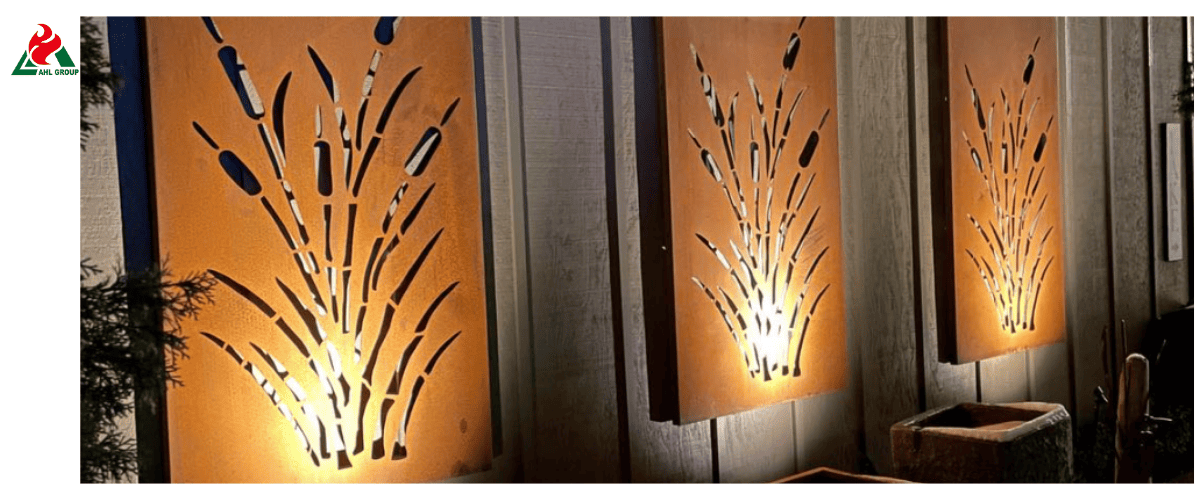
Weathering steel—a general term for structural steel alloyed with elements such as copper, chromium, and nickel—prevents both polymer embrittlement and paint film peeling. When exposed to alternating wet and dry conditions outdoors, weathering steel reacts with the atmosphere to form a dense, strongly adherent oxide layer. Compared to ordinary carbon steel, this oxide layer effectively slows further atmospheric corrosion.
Because Corten steel is a structural steel with high ductility and tensile strength, Corten steel privacy screens will not crack due to UV exposure, frost, or minor impacts in the garden. Instead, their long-term performance depends on sound sheet metal engineering design: selecting the appropriate sheet thickness; folding edges or adding perimeter frames to prevent wind-induced bending; ensuring no water accumulates at the bottom edge; and directing any early rust runoff onto light-colored paving surfaces.
4. Material Durability Comparison Table
The table below compares the performance of common materials used for outdoor privacy screens in terms of crack resistance, wind resistance, and performance in typical garden environments.
| Screen Material |
Primary Failure Mode | Brittle Cracking Risk | Wind-Flex / Warping Risk | Maintenance Profile | Best Residential Use Case |
| Thin PVC / Molded Resin |
UV embrittlement & cold-impact fracture | High after multi-year sun exposure | Moderate to High (thermal sag & flutter) | Periodic washing; replace when brittle | Temporary or sheltered low-budget patio screening |
| Natural Timber (Cedar / Hardwood) |
Grain checking, end splitting & rot | Moderate (fastener & end splits) | Moderate (cupping, twisting, bowing) | Re-staining, oiling, or sealing every few seasons | Traditional gardens where natural wood aging is desired |
| WPC Composite |
Thermal expansion bowing & end-hole splitting | Low to Moderate | Moderate without rigid metal subframe | Occasional washing; check expansion gaps | Modular perimeter fencing with full aluminum channels |
| Cast Acrylic / Frosted Glass |
Fastener stress cracking & point impact breakage | High without gasketed glazing mounts | Low (rigid until fracture limit) | Regular cleaning for water spots & scratches | Sheltered decks or daylight-preserving windbreaks |
| Powder-Coated Mild Steel |
Coating chip & under-film blister corrosion | Very Low (ductile metal) | Low to Moderate (depends on sheet gauge) | Inspect & touch up scratched coating promptly | Contemporary spaces requiring a fixed painted color |
| Corten Steel (Weathering Steel) |
Panel flex or narrow-bridge fatigue if underspecified | Very Low (ductile structural steel) | Low when folded with return edges or framed | Clear wet debris; inspect drains & post bolts | Long-term architectural & landscape privacy screening |
Switching from brittle polymers or high-maintenance wood to weather-resistant steel eliminates the risk of shattering and grain cracking caused by UV exposure. However, buyers should not view “steel” as a universal guarantee—the thickness of the panels, edge flanges, geometric patterns, and post bases still determine how sturdy the structure will be in actual use.
5. Do Corten Steel Privacy Screens Crack Outdoors
In typical residential and commercial landscape design, properly fabricated weathering steel privacy screens will not crack due to sun exposure, rain, or seasonal temperature fluctuations. When property owners express concern that weathering steel might crack, this concern typically stems from a misunderstanding of the behavioral characteristics of structural steel or the appearance of its rust patina as it forms over time.
Why Weathering Steel Resists Brittle Cracking
Unlike hard plastics, whose molecular chains degrade under UV exposure, or wood, whose cellular fibers separate due to moisture evaporation, weathering steel is a crystalline metal alloy with significant ductility. When a strong wind or accidental impact acts on a Corten steel panel, the steel absorbs the energy through elastic deformation—and, in cases of extreme overload, localized bending—rather than fracturing directly into fragments.
Standard architectural-grade weathering steel is specifically designed for outdoor structures such as bridges, building facades, and landscape retaining walls. Solar radiation does not weaken the metal matrix, and minor impacts from routine garden maintenance—such as a kicked-up pebble or tilted garden furniture—will leave only superficial marks at most. These marks will quickly re-oxidize and blend seamlessly with the surrounding rust.
Surface Rust Flaking and Structural Cracking
One of the most common questions asked by first-time buyers of weathering steel products is whether the loosening and flaking of the rust layer means the screen is “cracking” or disintegrating. During the early stages of outdoor exposure, as the rolled scale gradually oxidizes, fine powdery or flaky oxide particles naturally shed from the surface. Subsequently, under repeated wet-dry cycles, the denser inner rust layer gradually stabilizes.
This surface flaking is a chemical phenomenon occurring at the surface and does not constitute structural cracking of the steel plate. However, thick, layered, and crust-like flaking is a warning sign of environmental issues: it indicates that the steel is in a persistently damp state (for example, buried under damp coverings, in close contact with wet wood, or exposed to intense salt spray), preventing the protective rust layer from forming properly. Improving drainage and ventilation can prevent abnormal flaking while keeping the underlying structural steel intact.
Can Extreme Cold Make a Corten Screen Crack
Homeowners living in northern climates often ask whether winter frost can cause Corten privacy screens to crack, just as it does with vinyl trellises or ceramic planters. Within the normal range of outdoor residential temperatures, thin-gauge weathering steel sheets used in construction—when subjected to garden wind loads—will not experience brittle fracture.
When winter damage occurs to a Corten privacy screen installation, the failure almost always occurs in the surrounding components rather than in the steel panels themselves. If the tops of the hollow square support posts are left uncovered and the bottoms are sealed without drainage holes, rainwater can seep into the posts and freeze, causing the joints to bulge or crack. Similarly, shallow concrete foundations poured above the local frost line may crack due to frost heave, causing the screen line to deviate from its intended position.
6. What Can Go Wrong with a Corten Privacy Screen Instead of Cracking
To choose a durable product, it is essential to objectively understand the potential issues with metal panels. When buyers are disappointed by poor-quality or improperly installed weathering steel screen panels, the problem almost always stems from one of the following four types of mechanical failures, rather than material cracking.
Panel Bending, Warping, and the “Oil Drum Effect”
A large, thin sheet of metal has surprisingly little inherent resistance to outward bending. If a supplier cuts a full-height privacy screen directly from a thin sheet of metal without folding the perimeter edges or welding it into a rigid frame, the center of the screen will arch, become wavy, or exhibit the “oil drum effect” (i.e., slight inward and outward bulging) when pushed by wind or subjected to uneven heating from the sun.
Although elastic bending does not immediately cause the steel to fracture, panels that creak with every gentle breeze give the impression of fragility and exert continuous prying stress on the mounting brackets at their corners.
Fatigue Issues in Ultra-Thin Laser-Cut “Bridging Structures”
Laser cutting enables manufacturers to process steel sheets into complex floral patterns, geometric designs, or striped motifs. Structural risks arise when decorative patterns prioritize visual refinement over mechanical continuity—resulting in hair-thin metal “bridge structures” (connecting ribs) between adjacent openwork sections, or slender, cantilevered “blades” connected on only one side.
During transportation, handling, or under the cyclic wind-induced vibrations over time, stress concentrates at the sharp corners of internal cutouts and on narrow connecting bridges. If a panel is both too thin and densely populated with narrow connecting bridges, these tiny bridges may bend away from the surface or eventually develop localized metal fatigue cracks.
Cracking of Welds or Tearing at Corners at Installation Points
Even with sturdy weathering steel panels, failures can occur at the perimeter connections if fabrication details are handled carelessly. Common issues include: insufficient spot weld depth at folded corners that have been ground flush with the surface (leaving almost no weld metal), mounting tabs welded on only one side, or punch holes positioned too close to the panel edge.
If installers force panels into misaligned columns, the pre-tensioned corner bolts will continuously pull on the thin edges, leading to weld separation or elongation of the holes over time.
Post Tilting and Foundation Failure
Privacy screens are subjected to significant horizontal wind forces, especially when installed in long, continuous runs or on elevated decks. If the posts are undersized, anchored to thin wooden deck boards without underlying support blocks, or set in shallow soil foundations, strong gusts can cause the posts to bend or the foundation to rotate on the ground. When homeowners see rows of tilted or warped privacy screens, they often blame the screen panels, when in fact the true cause of the failure is an inadequately designed post and foundation system.
7. How to Choose a Corten Privacy Screen That Will Not Warp or Fail
To select a durable Corten metal privacy screen, it is essential to verify the following five engineering details before placing an order.
Select Panel Thickness Based on Span and Installation Method
There is no one-size-fits-all steel plate thickness for privacy screens, as rigidity depends on the panel’s height, width, edge profile, and support spacing. A compact decorative insert installed within a four-sided steel frame has a much shorter bending span than a tall, freestanding garden screen bolted only to side posts.
As a general engineering principle, flat, frameless steel panels require thicker material to resist bending compared to panels reinforced with folded edges or welded box frames. When comparing suppliers, never accept vague terms like “heavy-duty steel”—instead, request precise steel plate thickness (in millimeters or specifications), complete panel dimensions, and the maximum unsupported span between mounting points.
Choose Flanged or Perimeter-Framed Panels Instead of Flat Panels
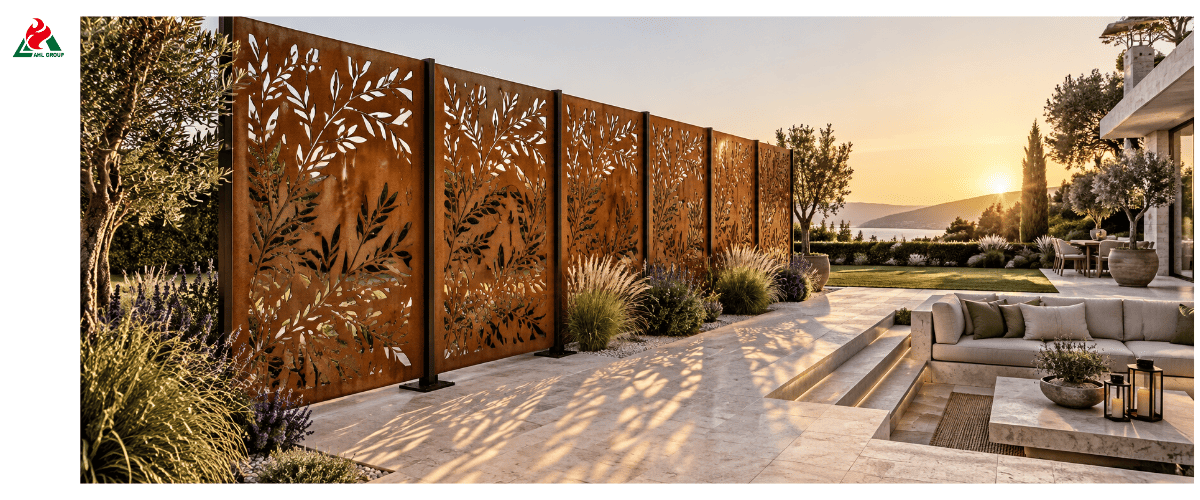
The most effective way to prevent weathering steel privacy screens from bending is through geometric reinforcement. When manufacturers bend the outer perimeter of the panel at a 90-degree angle to form a flange—transforming the flat panel into a shallow box-shaped tray, typically with welded corners—that edge acts as a structural beam.
For high-wind areas, freestanding privacy screens, or long-span structures, flanged panel designs—or panels welded into specialized rectangular tube frames—offer significantly greater rigidity than flat panels of equivalent thickness—without adding unnecessary weight to the posts.
Balancing Privacy and Air Permeability
Every laser-cut privacy screen represents a trade-off between visual privacy and wind load resistance. Manufacturers typically express this as an open area ratio or coverage ratio: for example, a screen with 80% solid steel plate and 20% open area provides strong visual privacy, while a screen with a 50% open area ratio offers filtered privacy and dappled light.
The key point is that the higher the coverage ratio, the greater the wind resistance. During storms, nearly solid screen panels behave more like solid walls; therefore, compared to perforated patterns with more openings, they require heavier posts, closer post spacing, and deeper foundations. Choose the lowest screening percentage that comfortably blocks the specific views you wish to obscure, rather than defaulting to nearly solid steel panels in areas exposed to wind tunnels.
Please Check the Laser-Cut Geometry Before Placing an Order
Before approving a laser-cut pattern, please carefully review the construction drawings or product photos. Structurally sound patterns form an interconnected mesh that allows loads to be distributed in multiple directions across the panel surface.
The following designs should be avoided: long, unsupported finger-like projections (which can snag clothing and are prone to bending); large open voids bordered only by a narrow steel strip; and razor-sharp internal cut corners. Rounded internal cut corners and generous bridge widths between cuts reduce stress concentration and ensure the pattern remains flat during shipping, handling, and in high-wind conditions.
Specify Compatible Posts, Brackets, and Fasteners
The reliability of Corten panels depends on the hardware used to erect them. Confirm that the dimensions of the support posts meet the full height and wind resistance requirements of the screen, and verify whether the system uses concrete footings embedded in the ground or a structural base plate bolted to a reinforced concrete slab.
Fasteners also require special attention. When used with unpainted weathering steel components, incompatible coated fasteners may cause premature rusting or unsightly bimetallic staining. Specify fasteners compatible with weathering steel, or—if recommended by the manufacturer—use appropriate stainless steel fasteners with isolation washers. Ensure that mounting brackets have slotted holes to allow for horizontal adjustment and free thermal expansion of the panels without jamming.
8. Maintenance Guide: Keeping Corten Privacy Screens Sound for Years
Although weathering steel eliminates the need for the repeated cycle of stripping old paint and repainting that is required for painted fences, conducting brief seasonal inspections will not only maintain the aesthetic appeal of its rusted surface but also ensure that the structural hardware is functioning properly.
Seasonal Visual and Structural Inspections
Twice a year—preferably after the winter frosts have passed (in the spring) and after the leaves have fallen (in the fall)—walk the perimeter of the fence to check that the posts are vertical and that the base plate anchor nuts and panel bracket fasteners are secure. Verify that the notched joints have not shifted and that no water has accumulated inside the hollow posts. If a severe storm occurs, immediately inspect the installation clips and corner welds so that any loose bolts can be retightened before vibration causes wear.
Clear Debris from Openwork Areas and Bottom Gaps
Laser-cut patterns and folded bottom flanges are prone to accumulating wind-blown leaves, grass clippings, spider webs, and splashed dirt. Moist organic debris clings to the steel surface like a wet sponge, hindering the wet-dry cycle necessary for the formation of a stable rust layer. Use a soft-bristled broom or a low-pressure garden hose to clean out the openwork areas and the gaps beneath the bottom rail.
How to Handle Bends, Scratches, or Water Marks Caused by Accidents
One advantage of unpainted weathering steel is that even if the surface is scratched by branches, furniture, or gardening tools, there is no need to touch up the paint; the exposed, shiny metal will naturally oxidize during subsequent wet-dry cycles and blend back into the surrounding brown rust patina. If the decorative openwork finger-like structures or installation clips become bent due to an impact, carefully inspect the bent area for hairline cracks, then gently straighten them and check the adjacent paving surface for fresh water streaks that need to be rinsed off promptly.
Treatments and Modifications to Avoid
Never apply clear paints, varnishes, or unapproved sealants—commonly found at hardware stores—to outdoor Corten screens in an attempt to “prevent cracking or rusting.” Film-forming coatings prevent the formation of natural rust and almost always yellow, crack, and peel when exposed to outdoor UV light, resulting in uneven patina and maintenance challenges. Similarly, avoid drilling new structural mounting holes near panel corners or cutting the perimeter flanges on-site, as this removes the panel’s primary reinforcing elements.
9. Frequently Asked Questions About Privacy Screen Cracking and Corten Steel
Q1: Can Laser-Cut Metal Privacy Screens Break in Strong Wind?
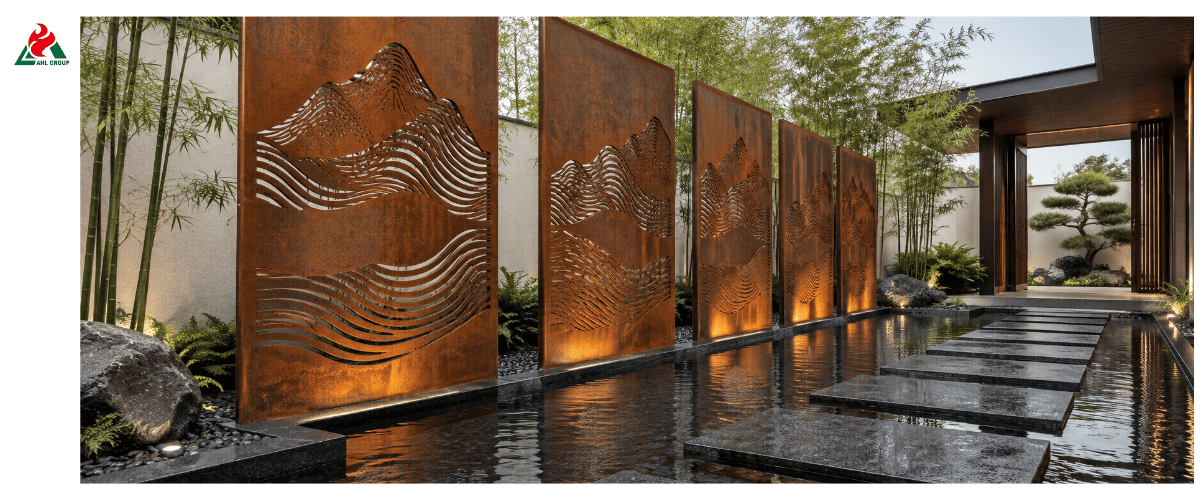
A properly designed weathering steel screen will not shatter in the wind. However, if the panels are cut from sheets that are too thin and their edges are not folded, or if the laser-cut pattern features metal bridges as thin as paper and sharp internal corners, repeated wind vibrations may cause the panels to bend or lead to localized metal fatigue at the narrowest cut points.
Q2: Why Is My Privacy Screen Flaking—Is the Steel Cracking?
During the first few months of outdoor use, the appearance of a fine powdery substance or small flakes of oxide on the surface is a normal part of the rust layer formation process and does not indicate that the steel sheet has cracked. In contrast, thick, flaking rust scales indicate that the panel has been exposed to prolonged moisture—typically caused by accumulated fallen leaves, contact with soil, or exposure to salt—and requires improved ventilation and drainage so that the rust layer can stabilize.
Q3: What Thickness of Corten Steel Is Best for a Privacy Screen?
There is no single thickness that suits all installation scenarios. The required thickness depends on the panel’s height and width, whether it has folded edges or a welded perimeter frame, the open area ratio of the laser-cut pattern, and the level of wind exposure at the installation site. Panels with frames or folded-edge trays achieve higher rigidity while being lighter in weight, outperforming flat, frameless steel panels.
Q4: Will a Corten Privacy Screen Stain My Patio or Fence Wall?
Yes, during the initial weathering process, weathering steel releases iron-rich runoff that may leave orange-brown stains on porous, light-colored concrete, natural stone, stucco, and wooden patio decking. You can prevent unsightly stains by elevating the screen panels above a gravel drip line, keeping them away from light-colored walls, or ordering pre-weathered screen panels and promptly rinsing adjacent surfaces.
Q5: Do Corten Privacy Screens Need to Be Sealed to Stop Cracking?
No. Corten steel does not crack due to a lack of surface sealant, and applying a standard film-forming clear coat outdoors is generally counterproductive, as UV rays and moisture will eventually cause the clear coat to crack, yellow, and peel, while also hindering the formation of a natural rust patina.
Q6: How Long Do Corten Steel Privacy Screens Last Outdoors?
Service life cannot be simplified to a single, universal number of years, as durability depends on the steel grade, sheet thickness, drainage conditions under alternating wet and dry conditions, exposure to chlorides, weld quality, and the stability of the foundation. When installed in an inland garden environment with good drainage and appropriate ground clearance, weathering steel screens can provide long-term structural service with virtually no routine maintenance.
Conclusion: Choose a Ductile Structure Over Brittle Panels
If you want to avoid outdoor privacy screens that fade in the sun, crack in extreme cold, or split along the grain, weathering steel (Corten steel) is fundamentally a more durable choice than PVC, resin, acrylic, or untreated wood. Because weathering steel is a ductile structural metal that naturally forms a protective atmospheric rust layer in environments with alternating wet and dry conditions, it eliminates the brittle fractures and paint peeling that shorten the lifespan of ordinary garden screens.
At the same time, choosing weathering steel does not mean you can overlook engineering details. A durable installation plan should combine genuine weathering steel with folded flanges or perimeter frames, appropriately laser-cut bridge widths, balanced ventilation open area ratios, an elevated bottom drainage gap, and properly anchored posts.
Before ordering privacy screens, please compare the following five specifications specifically for your site: panel thickness, edge flange depth, ventilation opening ratio, post foundation specifications, and rainwater drainage protection solutions. Verifying these five specifications in advance will ensure that your screens remain flat, stable, and crack-free throughout the changing seasons.

