


Why does Corten steel fail, rust through, or flake off prematurely? Corten steel fails when its essential wet/dry atmospheric oxidation cycle is interrupted, preventing the formation of a dense, protective alpha-FeOOH (goethite) patina. The seven fatal mistakes that cause weathering steel failure are: (1) permanent moisture retention in submerged basins or unventilated cavities; (2) exposure to high-chloride coastal salt air within 2 to 5 km of breaking surf; (3) galvanic corrosion caused by improper zinc-plated or unisolated fasteners; (4) direct anaerobic burial in acidic, damp soil; (5) clogged planter drainage leading to standing water against unlined steel; (6) chemical contamination from de-icing salts, pool chlorine, or acid cleaners; and (7) unmitigated rust bleed staining porous hardscape pavers. By engineering proper drainage, specifying Grade 304/316 stainless hardware with EPDM washers, applying protective internal polyurea or bituminous liners in submerged zones, and utilizing factory pre-weathering, architects and contractors can ensure a realistic 50 to 100+ year service life.
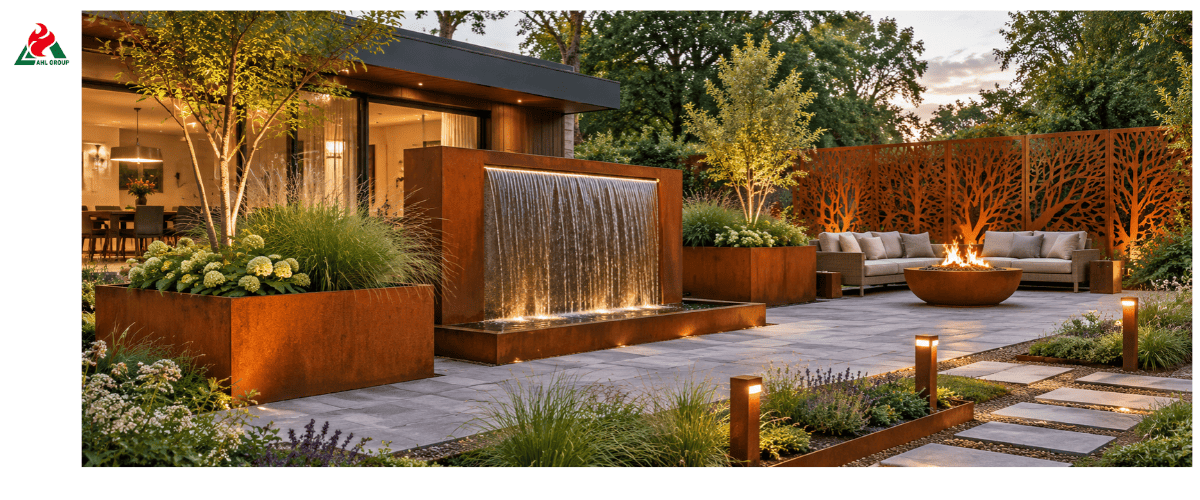
Over the past two decades, weathering steel—commonly referred to by its generic trademark Corten steel (encompassing ASTM A588, ASTM A242, and EN 10025-5 S355J2W)—has surged in popularity across modern architectural and landscape design. From commercial rainscreens and sculptural custom decorative Corten steel privacy screens to heavy-duty outdoor Corten steel planters, custom Corten steel fire pits, and architectural fountains and water features, its warm, organic earth tones and maintenance-free reputation make it a premier choice for architects, developers, and homeowners alike.
However, a dangerous myth has taken root within the design and contracting community: the misconception that Corten steel is an indestructible, rust-proof metal that can be installed anywhere, in any condition, without engineering thought.
This assumption leads to catastrophic failures. Across coastal residences, poorly drained planters, and submerged water basins, untreated weathering steel projects frequently suffer from severe structural perforation, deep pitting, flaking scale, unsightly rust-stained stonework, and premature collapse within 3 to 10 years—far short of its expected 50 to 100-year design life.
Understanding why Corten steel fails requires unpacking the exact chemical, environmental, and mechanical conditions that govern its protective oxide film. This comprehensive technical guide details the metallurgy of weathering steel, analyzes the seven fatal installation mistakes that doom outdoor projects, and provides field-tested architectural fixes to guarantee perpetual durability.
Looking for a Reliable Corten Product Supplier? Get Wholesale Pricing!
1. The Metallurgy of the Patina: The "Wet/Dry" Rule & Goethite vs. Rust
To comprehend how Corten steel fails, one must first understand how it succeeds.
Mineral Phase: Crystalline α-FeOOH (Goethite).
Oxide Layer: Dense, non-porous, self-sealing barrier.
Corrosion Rate: Drops to <0.003 mm/year.
Lifespan: 50 to 100+ years outdoors.
Mineral Phase: Porous γ-FeOOH (Lepidocrocite) & Fe3O4.
Oxide Layer: Brittle, layered, micro-fissured flaking scale.
Corrosion Rate: Aggressive continuous attack (0.10–0.35 mm/year).
Lifespan: Perforation in 3 to 7 years.
1. The Chemistry of Atmospheric Passivation
Ordinary structural mild carbon steel (such as standard ASTM A36) corrodes in outdoor air because the iron oxide layer it generates—primarily porous lepidocrocite (γ-FeOOH) and unstable magnetite (Fe3O4)—is mechanically fragile and laden with micro-fissures. Moisture, oxygen, and atmospheric pollutants penetrate these fissures unimpeded, continuously corroding the base steel underneath until the member is completely consumed.
In contrast, genuine weathering steel is alloyed with precise metallurgical percentages of specific noble elements:
- Copper (Cu,
0.25% to 0.55%): Forms insoluble basic copper-iron sulfates that clog micro-pores in the corrosion layer. - Chromium (Cr,
0.40% to 0.65%): Enhances atmospheric passivity and tightens the oxide crystal lattice. - Nickel (Ni,
0.30% to 0.65%): Promotes uniform grain growth and resists chloride pitting. - Phosphorus (P,
0.07% to 0.15%): Accelerates the precipitation of dense, amorphous protective iron oxyhydroxides.
When subjected to outdoor weather, these alloying elements catalyze the conversion of early rust into a continuous, tightly adherent, crystalline inner barrier layer composed of α-FeOOH (alpha iron oxyhydroxide, known mineralogically as goethite). Once fully developed, this microcrystalline goethite patina has near-zero porosity, sealing the underlying steel core against atmospheric oxygen and water molecules. The corrosion rate drops from 40–70 microns/year down to less than 1–3 microns/year.
2. The Non-Negotiable Prerequisite: The Wet/Dry Cycle
The formation of protective goethite requires one mandatory physical condition: an unhindered, alternating cycle of atmospheric wetting followed by thorough drying.
- During the Wetting Phase: Rain, dew, or high humidity initiates mild superficial iron ionization and oxidation.
- During the Drying Phase: Solar radiation, ambient warmth, and air circulation evaporate surface water, drawing dissolved copper, chromium, and iron ions toward the drying boundary where they crystallize into an impenetrable, dense goethite matrix.
If the steel remains continuously damp, submerged, or buried, the drying phase never occurs. Deprived of atmospheric oxygen and dry evaporation, the chemical reaction stalls in the active corrosion phase, generating destructive, sheet-like rust flakes that expand up to 8 times the original steel volume and eat through thick plates at an alarming rate.
Healthy Protective Patina vs. Pathological Flaking Corrosion
| Evaluation Metric | Healthy Protective Patina | Pathological Flaking Corrosion (Failure) |
|---|---|---|
| Dominant Mineral Phase | α-FeOOH (Goethite) + Basic Copper Salts | γ-FeOOH (Lepidocrocite) + Fe3O4 (Magnetite) |
| Microscopic Structure | Compact, nano-crystalline, hermetic barrier | Spongy, layered, micro-fissured, highly porous |
| Physical Appearance | Velvety, smooth, dark amber to purplish-brown | Coarse, powdery, bubbling blistered orange scale |
| Surface Adhesion | Tenacious; cannot be scraped off with fingernail | Brittle sheets and large flakes peel away by hand |
| Corrosion Rate | Drops to < 0.003 mm/year after maturation |
Continuous at 0.10 to 0.35 mm/year |
| Expected Lifespan | 50 to 100+ years (outdoors inland) |
3 to 10 years before structural perforation |
AHL Corten Group manufactures precision weathering steel assemblies to exact site specifications. Contact our senior metallurgy and design engineers for direct technical support.
2. Fatal Mistake 1: Permanent Moisture Retention & Ponding Water (Water Features & Basins)
The most widespread cause of premature Corten steel failure occurs in water feature design.
Perpetual water immersion prevents atmospheric drying. Silt and debris trigger differential aeration pitting cells, boring pinholes through 3.0mm plate in 3–5 years.
Interior basin is grit-blasted and sealed with 2.0mm–3.0mm seamless waterproof polyurea or Grade 316 stainless liner. Corten provides architectural envelope with 50+ year lifespan.
The Mechanism of Submerged Failure
Architects frequently specify custom Corten steel water walls, rain curtains, and fountains because the contrast between weathered rust-orange steel and crystalline flowing water is visually breathtaking. However, when the lower catch basin, pond liner, or internal water reservoir is fabricated from raw, unprotected weathering steel, disaster is guaranteed.
Under continuous immersion:
- Zero Oxygen Diffusion for Passivation: The steel surface is perpetually saturated with water. Without an atmospheric drying phase, goethite cannot precipitate.
- Differential Aeration Cells: Suspended silt, organic debris, and microscopic stagnant zones at the bottom of the basin create micro-environments with varying oxygen concentrations. Areas with lower dissolved oxygen become active anodes, while surrounding areas act as cathodes, initiating severe differential aeration pitting.
- Pitting Velocity: While atmospheric weathering steel corrodes uniformly at microscopic rates, submerged anaerobic pitting can bore pinholes through
3.0mmheavy-gauge Corten plate in as little as 36 to 60 months.
The Engineering Fix: Internal Hermetic Barrier Liners
Corten steel should provide the structural and architectural envelope, not the submerged hydraulic container:
- Factory-Applied Elastomeric Polyurea / Epoxy: In all high-end water features—such as the Corten Steel Rain Curtain Water Feature & Pond (WF05)—the interior of the catch basin is grit-blasted to SSPC-SP 10 (Near-White Metal) and lined with a
2.0mm to 3.0mmseamless, waterproof polyurea, polyurethane, or heavy-duty marine epoxy coating. This completely isolates the steel from submerged contact. - Stainless Steel Sump Inserts: Alternatively, construct the outer visual frame from Corten steel while fabricating the internal wet basin from Grade 304 or Grade 316 stainless steel, separated by non-conductive isolation gaskets.
- Slope to Drain: Design the basin floor with a minimum
2% slopetoward an active bottom drain to prevent residual water ponding when the fountain is switched off for seasonal maintenance.
3. Fatal Mistake 2: Severe Marine Salt Environments (The 2–5 km Coastal Trap)
A common inquiry from coastal property owners is whether Corten steel can be installed directly on an oceanfront cliff or beachfront boardwalk.
The Chemistry of Chloride-Induced Breakdown
Sodium chloride (NaCl) aerosols carried by ocean breezes represent the ultimate enemy of weathering steel:
- Hygroscopic Moisture Retention: Salt crystals deposited on metal surfaces are highly hygroscopic; they absorb water vapor from the air at relative humidities as low as
75%. Consequently, steel in marine environments stays perpetually moist even on clear, dry afternoons, completely suppressing the essential drying cycle. - Chloride Lattice Destruction: Chloride ions (Cl-) are small, highly mobile, and aggressive. They penetrate the developing oxide film and chemically replace hydroxide ions, forming soluble iron chloride complexes (FeCl2). When rain rinses the surface, these soluble complexes wash away, perpetually exposing virgin steel to renewed attack.
- Flaking Delamination: The resulting rust does not form a tight patina; instead, it develops into thick, brittle, stratified rust layers (often called "lamellar rust flakes") that crack, blister, and peel away in large sheets.
Understanding ISO 9223 Atmospheric Corrosivity Categories
Engineers categorize environmental corrosivity under international standard ISO 9223:
- C1 & C2 (Very Low / Low): Dry interiors, arid desert climates, rural inland areas. Excellent performance; patina matures in 2–3 years.
- C3 (Medium): Standard urban and light industrial inland areas. Optimal environment for Corten steel; 80–100+ year lifespan.
- C4 (High): Coastal areas with moderate salt deposition (
15 to 60 mg/m²·daychloride), located roughly2 to 5 kilometersfrom breaking surf. Requires careful engineering. - C5 & CX (Very High / Extreme): Direct shoreline exposure (
< 1 to 2 kmfrom the ocean), offshore structures, and coastal zones subject to dense marine spray. Unprotected Corten steel should NOT be used here without special protective coatings or substantial thickness allowances.
The Engineering Fix: Coastal Protocols & Setbacks
If designing for a marine-influenced project:
- Setback Buffer: Maintain a minimum distance of
2 to 5 kilometers(1.2 to 3 miles) from breaking surf for raw, unsealed Corten installations. - Increase Structural Plate Thickness: In C3/C4 coastal transition zones, specify heavy-duty
4.0mm to 6.0mmplate thickness (instead of standard2.0mm–3.0mm) to provide an adequate sacrificial corrosion allowance over the building's lifespan. - Mandatory Freshwater Rinsing: Schedule biannual or quarterly high-pressure freshwater wash downs to strip accumulated salt crusts from exterior surfaces, allowing the underlying patina to breathe and dry.
- Architectural Sealing: In proximity to saltwater, apply specialized breathable, penetrating silane/siloxane clear sealers formulated specifically for weathering steel.
4. Fatal Mistake 3: Galvanic Corrosion & Incompatible Fastener Hardware
Galvanic corrosion is the silent killer of architectural metal assemblies. When two dissimilar metals are placed in electrical contact in the presence of an electrolyte (such as rainwater, dew, or coastal humidity), a natural battery is created.
- Zinc is highly anodic (-1.05 V) relative to Corten (-0.65 V).
- Tiny zinc screw head acts as small sacrificial anode to vast steel sheet.
- Zinc plating dissolves within 12–24 months.
- Unprotected screw core shears under wind load; panels detach.
- Stainless steel is cathodic (-0.08 V) with highly favorable area ratio.
- EPDM / neoprene isolation washer breaks electrical contact.
- Completely eliminates galvanic current and crevice corrosion.
- Guarantees 50+ years of structural fastening integrity.
The Anode-to-Cathode Potential Difference
In the galvanic series (measured in millivolts against a Saturated Calomel Electrode in atmospheric moisture):
- Zinc (Galvanized Steel): Highly Anodic (≈ -1.05\, V)
- Corten Weathering Steel: Moderately Anodic (≈ -0.60\, V to -0.70\, V)
- Mild Carbon Steel: Anodic (≈ -0.65\, V)
- Grade 304 / 316 Stainless Steel: Passive Cathodic (≈ -0.05\, V to -0.10\, V)
- Copper & Brass: Cathodic (≈ -0.20\, V to -0.35\, V)
The Two Catastrophic Fastener Scenarios
- The Zinc Screw Failure (Small Anode / Huge Cathode): Contractors frequently install Corten facade cladding or privacy screens using standard zinc-plated or hot-dip galvanized self-tapping screws. Because zinc is significantly more electrochemically active than weathering steel, the zinc coating acts as a sacrificial anode. Due to the disastrous unfavorable area ratio (a tiny zinc screw head surrounded by a massive sheet of Corten steel cathode), the microscopic zinc layer is consumed violently within 12 to 24 months. Once the zinc is stripped, the unalloyed mild steel screw core rusts rapidly, corroding into dust and resulting in catastrophic fastener shear and panel detachment during windstorms.
- Unbuffered Aluminum Contact: Directly fastening raw aluminum trims, brackets, or subframes to Corten steel creates severe galvanic attack against the aluminum. In the presence of moisture, the aluminum oxidizes into a chalky white powder, losing all structural holding power.
The Engineering Fix: Stainless Fasteners & Dielectric Isolation
- Mandatory Fastener Specification: Fasten Corten steel components exclusively with Grade 304 (inland) or Grade 316 (marine/industrial) stainless steel screws, carriage bolts, and blind rivets.
- The Favorable Area Rule: Why does stainless steel work? Although stainless steel is cathodic to Corten, the area ratio is highly favorable: a tiny stainless screw head surrounded by an expansive Corten plate results in an imperceptible, negligible galvanic current distributed across the massive steel plate.
- Dielectric Isolation Washers: Always install UV-stabilized EPDM, neoprene, or nylon isolation washers beneath stainless steel screw heads and nuts. This breaks direct electrical contact between the two metals, completely eliminating galvanic exchange and preventing crevice corrosion around pre-drilled holes.
5. Fatal Mistake 4 & 5: Direct Soil Burial & Clogged Planter Drainage
Landscape applications represent the largest market for Corten steel, yet soil and planter design harbor two of the most destructive operational traps:
Acidic, damp potting soil pressed directly against bare steel. Tiny 10mm drain holes clog with roots, creating standing water swamps. Planter floor corrodes and collapses within 4–6 years.
Dimpled HDPE membrane provides an 8mm continuous air gap for wall breathing. Oversized 25mm–32mm drain holes prevent choking, and 15mm–25mm bottom risers allow full underside ventilation.
Fatal Mistake 4: Direct Ground Embedding (Fence Posts & Edging)
Installing Corten fence posts, retaining walls, or decorative screens by burying the raw steel directly into topsoil or subgrade clay is an engineering disaster:
- Acidic Subterranean Environment: Organic topsoils frequently have a low pH (
4.5 to 6.0) rich in humic acids and active anaerobic microbes. - Continuous Moisture Sponge: Soil retains moisture for weeks after rainfall, depriving the underground steel of atmospheric oxygen.
- The "Soil-Line Necking" Effect: The most severe corrosion occurs exactly at the soil-to-air transition zone (
50mm above and below grade). Here, high oxygen levels meet constant soil moisture, causing aggressive localized thinning ("necking") that snaps posts at ground level within 5 to 8 years.
The Fix for Ground Contact:
- Bituminous Tar / Coal-Tar Epoxy Coating: Coat any section of Corten steel that extends below grade (plus
100mmabove the finished soil line) with two coats of heavy-duty bituminous mastic or brush-applied coal-tar epoxy. - Concrete Piers with Drainage Gravel: Set structural posts inside concrete footings crowned above grade to shed water, surrounded by a
100mm–150mmcollar of washed drainage crushed rock. - Engineered Edging Systems: For garden borders, utilize purpose-engineered systems like AHL Corten steel landscape edging, which feature heavy-gauge sections and interlocking stakes designed with sacrificial corrosion margins.
Fatal Mistake 5: Clogged Drainage & Water Ponding in Planter Boxes
Nothing destroys an outdoor Corten planter box faster than stagnant, saturated soil pressing directly against an unventilated steel bottom:
- When a planter lacks sufficient drainage, excess irrigation water accumulates at the bottom, creating a perpetual anaerobic swamp. The base plate corrodes from the inside out, while the owner remains completely unaware until the bottom collapses under root weight.
The Fix for Planter Boxes:
- Oversized Drainage Holes: Specify minimum
25mm to 32mm(1 to 1.25 inch) diameter drain holes spaced no more than300mmapart across the planter floor. Never rely on tiny8mm–10mmholes, which quickly choke with soil and root mass. - Internal Air-Gap Dimpled Membranes: Line the interior vertical walls with dimpled high-density polyethylene (HDPE) drainage sheets (such as Platon or Delta-MS). This creates a permanent
8mm–10mmcontinuous air gap between the damp soil and the Corten steel, allowing atmospheric air to circulate and preserve the protective patina. - Welded Base Risers (Air Circulation Beneath): All AHL premium square and rectangular Corten planters are manufactured with integrated
15mm–25mmwelded bottom riser feet. These lift the planter base off the ground, ensuring water flows freely out of drain holes without pooling under the steel plate.
6. Fatal Mistake 6 & 7: Chemical/Acid Attack & Runoff Staining Liabilities
The final two failure modes stem from improper maintenance chemicals and failure to manage rust runoff during the initial weathering phase:
AHL accelerates the initial 6–18 month leaching phase in the factory, stabilizing the goethite patina prior to job-site delivery and eliminating messy site runoff.
Install a 150mm–200mm recessed trench filled with dark river rock or volcanic stone beneath Corten edges, directing drainage into subgrade French drains.
Coat light-colored concrete, travertine, or marble with penetrating silane/siloxane sealers. Any accidental iron stains clean effortlessly with 5%–10% oxalic acid.
Fatal Mistake 6: Chemical & Industrial Contamination
Corten steel’s protective patina is an inorganic mineral layer that is highly vulnerable to chemical dissolution:
- De-Icing Road Salts: Placing Corten planters, signage, or light bollards adjacent to parking lots or walkways where calcium chloride or rock salt is applied in winter causes aggressive localized pitting and rapid rust flaking.
- Chlorine & Pool Splashes: Installing a Corten rain curtain or fire pit within splash distance of a chlorinated swimming pool strips the patina overnight. Chlorine acts as an aggressive oxidizer that breaks goethite into soluble chlorides, turning the steel a blotchy, dirty charcoal gray.
- Acidic Masonry Cleaners: When masonry contractors clean surrounding brickwork or stone paving using muriatic acid (hydrochloric acid), acid fumes or overspray etch Corten steel instantly, causing violent rust bleeding and permanent surface ruin.
The Chemical Protection Fix:
- Maintain a minimum
3-meter (10-foot)buffer between Corten features and chlorinated swimming pools or de-icing salt runoff zones. - Use only copper-safe, biological pond enzymes for algae control in Corten water features—never chlorine tablets or household bleach.
- Thoroughly mask Corten installations with heavy polyethylene plastic before acid-washing adjacent stonework.
Fatal Mistake 7: Runoff Stain Destruction on Surrounding Hardscapes
While rust runoff does not technically cause the steel itself to structurally fail, it is the #1 cause of client dissatisfaction, contract disputes, and costly warranty claims in architectural projects:
- During the first
6 to 18 monthsof outdoor exposure, unpassivated weathering steel sheds microscopic, water-soluble iron hydroxide particles every time it rains. - When this runoff water flows onto porous light-colored hardscapes—such as limestone, travertine, cast concrete, or light timber decking—the iron permanently absorbs into the stone pores, leaving indelible dark orange rust stains.
The Runoff Mitigation Fix:
- Specify Factory Pre-Weathering (Pre-Oxidized Treatment): Rather than installing raw, blue-gray mill-finish steel that bleeds uncontrollably on site, order Corten products pre-passivated. AHL Corten Group utilizes a proprietary multi-stage chemical oxidation and stabilization process that matures the patina into a stable, non-leaching goethite layer before the product leaves the factory.
- Incorporate Gravel Catchment Trenches: In hardscape design, never terminate Corten facade cladding or freestanding screens directly onto flush concrete. Place a
150mm–200mmwide recessed trench filled with dark volcanic rock or washed river gravel directly beneath the steel edge to capture and filter runoff water into underground French drains. - Apply Penetrating Stone Sealers: Coat surrounding concrete or pavers with an oil- and water-repellent silane/siloxane impregnating sealer prior to steel installation.
- Rust Stain Remediation: If staining occurs on concrete, clean immediately using a warm solution of
5% to 10%oxalic acid or citric acid, followed by a high-pressure freshwater rinse and baking soda neutralization.
7. Master Engineering Matrix: 7 Fatal Mistakes & Permanent Fixes
To serve as a quick reference for architectural specifications, structural calculations, and field site audits, the table below synthesizes the seven failure modes:
| Fatal Mistake | Primary Failure Mechanism | Visual Symptoms on Steel | Typical Time to Failure | Permanent Engineering Fix |
|---|---|---|---|---|
| 1. Continuous Submersion | Anaerobic differential aeration cell pitting; zero drying cycle | Pinholes, localized cavity perforations, water leaks | 3 to 7 years |
Factory-applied polyurea/epoxy liner; Grade 316 S/S internal sump |
| 2. Severe Marine Salt Spray | Chloride lattice disruption; hygroscopic 24/7 moisture trapping | Thick lamellar rust sheets, blistering, delamination | 5 to 10 years |
Minimum 2–5 km coastal buffer; increase plate to 4–6mm; freshwater wash |
| 3. Galvanic Hardware Mismatch | Electro-potential voltage gradient; zinc sacrifices rapidly | Sheared screws, detached panels, red rust around holes | 12 to 36 months |
Grade 304/316 stainless steel fasteners + UV-stable EPDM isolation washers |
| 4. Direct Soil Burial | Acidic soil attack (low pH), anaerobic moisture & microbes | Severe localized thinning ("necking") at ground line | 4 to 8 years |
Bituminous coating below grade + 100mm above; gravel drainage collar |
| 5. Clogged Planter Drainage | Standing water saturation; anaerobic root-bed corrosion | Collapsed planter floors, weeping rust seams, foul odors | 4 to 6 years |
25–32mm oversized drain holes; dimpled HDPE wall liners; welded risers |
| 6. Chemical / Acid Attack | Chemical stripping of goethite patina by halides or acids | Blotchy black/gray discoloration; aggressive flaking | Weeks to months |
Zero chlorine/bleach; biological water treatments; 3m buffer from road salts |
| 7. Unmitigated Rust Bleed | Soluble iron runoff absorbed into porous stone pavers | Unsightly dark rust stains on luxury light paving | Immediate (1st rain) | Factory pre-weathering; gravel runoff trenches; silane stone sealers |
8. 10-Point Architectural & Installation Quality Checklist
Before signing off on architectural submittals, fabrication drawings, or job-site installations involving Corten steel, verify every point on this engineering checklist:
- 1. Wet/Dry Environmental Cycle Guaranteed: Ensure the installation environment allows the steel to dry completely between rain events; no unventilated, perpetually damp pockets.
- 2. Coastal Distance Assessed: Site is confirmed >2 to 5 km from active ocean surf, or plate thickness has been upgraded to 4.0mm–6.0mm with a scheduled freshwater washing protocol.
- 3. Fasteners Specified as Stainless Steel: 100% of mounting hardware is specified as Grade 304 (inland) or Grade 316 (marine) stainless steel. Zero zinc-plated or carbon screws permitted.
- 4. Dielectric Isolation Equipped: EPDM or neoprene isolation washers and bushings are detailed between stainless fasteners and Corten panels to prevent galvanic contact.
- 5. Water Features Internally Lined: All submerged water reservoirs, basins, and fountain troughs feature an internal polyurea, polyurethane, or stainless steel barrier.
- 6. Direct Soil Contact Sealed: Posts and panels embedded in earth are coated with two coats of bituminous mastic extending 100mm above finished grade.
- 7. Planter Drainage Engineered: Planters possess ≥25mm drain holes, internal dimpled air-gap liners, and minimum 15mm welded bottom riser feet for underside ventilation.
- 8. Runoff Catchment Planned: Architectural drawings include dark gravel drainage trenches, drip deflectors, or sealed pavers to manage first-year iron runoff.
- 9. Chemical Buffers Enforced: Installation maintains a minimum 3-meter separation from swimming pool chlorine splash zones and winter de-icing salt application paths.
- 10. Factory Pre-Weathering Specified: Where rapid stabilization or reduced site staining is required, panels are specified with AHL factory pre-oxidation and passivation treatments.
9. Frequently Asked Questions (FAQ)
Q1: Can rusted Corten steel be restored if it has started flaking?
A: Yes, provided the structural plate thickness has not been critically compromised by deep pitting. To restore failing Corten steel: (1) abrasive-blast the surface to SSPC-SP 7 (Brush-Off Blast) to strip away all loose, brittle lamellar rust flakes down to sound metal; (2) pressure-wash thoroughly with fresh water to remove residual chloride salts; and (3) allow the steel to undergo a fresh, natural wet/dry cycle in an unshaded, well-ventilated area, or apply a professional chemical passivating converter to initiate a healthy goethite patina.
Q2: Why does Corten steel rust unevenly with blotchy stripes?
A: Uneven weathering is almost always caused by differential moisture exposure or surface contamination. Sections sheltered under building eaves or overhanging trees do not receive natural rain washing, while vertical grease marks, mill scale remnants, or adhesive residue from protective shipping films create barriers that prevent uniform oxidation. Specifying abrasive sweep-blasting prior to installation ensures uniform, flawless patina development.
Q3: How thick should Corten steel be for outdoor architectural projects?
A: Minimum recommended thicknesses:
- Garden Edging & Border Strips:
1.5mm to 2.0mm(sufficient for typical garden lifespans). - Decorative Laser-Cut Screens & Fencing:
2.0mm to 3.0mm(balances wind load rigidity with laser precision). - Planter Boxes & Retaining Walls:
3.0mm to 4.0mm(resists wet soil hydrostatic pressures). - Structural Cladding & Bridges:
4.0mm to 8.0mm+(accommodates multi-decade structural corrosion allowances).
Q4: Can you weld Corten steel using standard welding wire?
A: No. Welding weathering steel with standard E7018 mild carbon steel wire creates a weld seam that lacks copper, nickel, and chromium. Within 12 months, the weld seam will weather a completely different color, and the galvanic difference will cause the weld bead to corrode faster than the surrounding parent plate. Always specify matching weathering steel filler metals, such as AWS E8018-W2 electrodes or ER80S-G / ER80S-W MIG wire.
Q5: Is Corten steel safe for edible vegetable garden beds?
A: Yes, Corten steel is completely safe for organic vegetable gardening. The core alloying elements (iron, copper, chromium, and phosphorus) are naturally occurring mineral micronutrients. Plant roots selectively absorb iron and trace copper without toxicity. At normal soil pH levels (6.0 to 7.0), the leaching rate is negligible. For added peace of mind, lining the planter walls with food-grade geotextile fabric or pond-grade EPDM prevents direct soil contact entirely.
Q6: How fast does Corten steel form its full protective patina?
A: Under normal outdoor atmospheric conditions with regular rain and sun exposure:
- Months 1–3: Rapid orange surface oxidation; moderate rust runoff during rain.
- Months 6–12: Transition to a deeper reddish-brown; runoff begins to diminish significantly.
- Years 2–3: The dense, stable, dark purplish-brown goethite patina is fully consolidated; rust bleed ceases entirely.
(In arid, dry climates, the process can take 5+ years unless accelerated using factory pre-weathering treatments.)
Q7: Can Corten steel be installed in indoor lobbies or atriums?
A: Untreated Corten steel will never form a protective patina indoors because indoor HVAC environments lack rain, humidity fluctuations, and outdoor wet/dry cycles. Indoors, raw weathering steel remains a dirty, powdery orange that sheds dust onto clothing and floors. For indoor installations, Corten steel must be fully pre-weathered at the factory and finished with a durable, non-yellowing polyurethane or wax matte clear sealer.
Q8: Does AHL Corten Group provide engineering support and custom manufacturing?
A: Yes. As a globally recognized architectural weathering steel manufacturer, AHL Corten Group provides end-to-end technical support. We supply certified ASTM A588 and A242 plate, precision CNC laser cutting, press-brake folding, certified code welding, factory pre-weathering passivation, internal polyurea basin sealing, and custom architectural fabrication for landscape contractors, commercial developers, and architects worldwide.
Conclusion: Engineering Guaranteed Durability with AHL Corten Group
Corten steel is not an indestructible miracle metal—it is a sophisticated, precision-engineered metallurgical alloy that demands respect for the laws of fluid dynamics, electrochemistry, and atmospheric physics.
By eliminating the seven fatal mistakes—ensuring thorough wet/dry cycling, sealing submerged water basins, avoiding extreme coastal salt zones, isolating stainless fasteners with EPDM washers, engineering oversized planter drainage, avoiding chemical contaminants, and managing early rust runoff—architects and landscape contractors can unlock the full, magnificent 50 to 100+ year potential of weathering steel.
At AHL Corten Group, we combine high-purity structural weathering steel with decades of architectural manufacturing expertise. Whether you require custom outdoor Corten planters, architectural rainscreens and siding, engineered water walls and rain curtains, or laser-cut privacy panels, our technical engineering team is ready to review your project elevations, provide material test reports (MTRs), and fabricate custom solutions built to last for generations. Contact AHL Corten Group today to discuss your next landmark architectural project.

