


The most widely used Corten steel screen fence designs include: solid privacy panels, laser-cut screens, vertical panels, plant-integrated trellis screens, wall-top extensions, and backlit decorative panels. Each design strikes a different balance between privacy, ventilation, and visual weight. When making a selection, it is essential to comprehensively consider sightlines, wind exposure, structural support, drainage conditions, and the amount of rust runoff the site can safely accommodate.
Weathering steel—more accurately referred to as “patina steel”—forms an adherent oxide layer after repeated cycles of wetting and drying. This ever-evolving surface is precisely what gives it its charm, but simply selecting a pattern from a product catalog is far from sufficient to achieve the desired effect. Decorative steel panels do not constitute a complete fence, and perforated panels do not guarantee privacy; furthermore, using them in unsuitable coastal areas or persistently humid environments may compromise the material’s expected performance.
This guide compares six practical design solutions and details the appropriate applications for each, the level of privacy they provide, and the technical details to consider before fabrication.
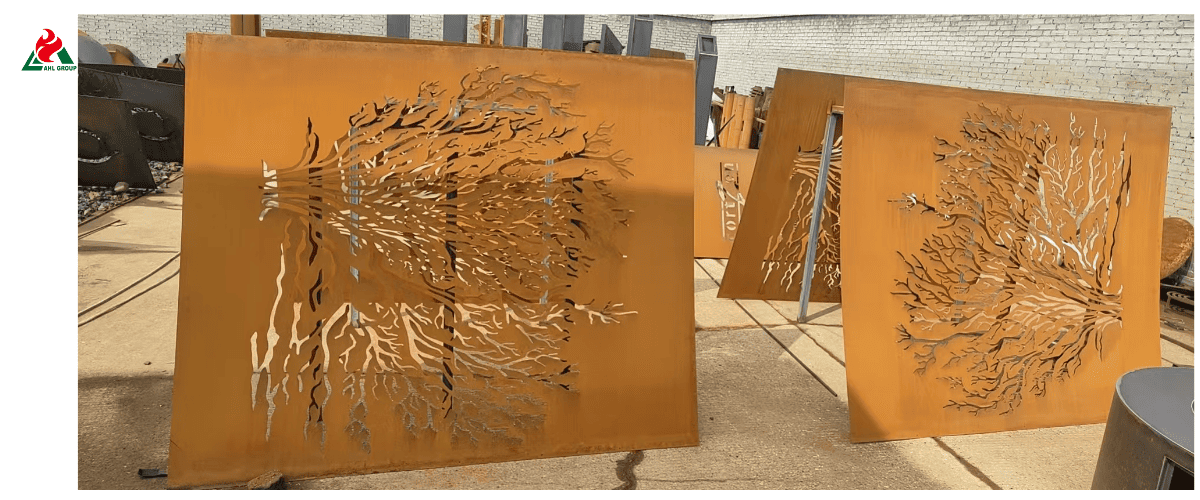
Weathering steel—more accurately referred to as “patina steel”—forms an adherent oxide layer after repeated cycles of wetting and drying. This ever-evolving surface is precisely what gives it its charm, but simply selecting a pattern from a product catalog is far from sufficient to achieve the desired effect. Decorative steel panels do not constitute a complete fence, and perforated panels do not guarantee privacy; furthermore, using them in unsuitable coastal areas or persistently humid environments may compromise the material’s expected performance.
This guide compares six practical design solutions and details the appropriate applications for each, the level of privacy they provide, and the technical details to consider before fabrication.
1. Before Choosing a Design: Fence, Privacy Screen or Garden Screen
The terms “fence,” “privacy screen,” and “garden screen” are often used interchangeably, but they refer to different types of structures. A fence is a continuous boundary system that may require posts, foundations, and gates, and must comply with local regulations regarding height or pool safety barriers. Privacy screens are primarily used to block or filter views—for example, when installed next to a patio, hot tub, or utility area. Garden screens, on the other hand, may be freestanding decorative elements used to divide spaces but do not serve a boundary-protection function. Filler panels refer to weather-resistant steel panels installed within other structures, such as masonry piers, wooden posts, or steel frames.
These distinctions affect engineering design, permitting procedures, and costs. The laser-cut panels displayed on the showroom walls may not, by themselves, be capable of withstanding wind loads in a garden setting. Steel panels used as decorative infill panels may require flanges, crossbars, or structural framing if used as fencing. Gates introduce dynamic loads and require separate posts and hardware.
What Level of Privacy Do You Actually Need
Before selecting materials, determine the field of view. A trash bin enclosure or equipment yard may require complete visual screening. A dining patio, on the other hand, may be better suited for a “filtered” privacy design that allows light and air to circulate while still ensuring privacy. A garden room, meanwhile, may only require partial screening.
Check the line of sight from both sides of where you plan to install the screen panel, while sitting and standing. Be sure to take into account nearby upstairs windows, elevated patios, and slopes. Even if the screen blocks the view at ground level, your outdoor dining table may still be fully exposed when viewed from above. This simple check is more reliable than choosing a generic panel height based solely on product photos.
2. Quick Comparison: Six Corten Privacy Screen Designs
The table below compares six design concepts as planning options. This table is not a substitute for structural calculations or local approval requirements specific to a given project.
| Design |
Privacy level | Best application | Main advantage | Key consideration |
| Solid panels |
High | Boundaries and service zones | Maximum visual block | Wind load and runoff |
| Laser-cut screens |
Low to medium | Patios and feature walls | Pattern, light and airflow | Open-area percentage |
| Vertical slats |
Adjustable | Side gardens and terraces | Directional screening | Sightline angle |
| Planted screens |
Medium, increasing over time | Gardens and courtyards | Softens the steel | Moisture and plant access |
| Wall-top panels |
Medium to high | Existing masonry walls | Adds height efficiently | Wall capacity and fixings |
| Backlit feature screens |
Low to medium | Entrances and entertaining areas | Strong night-time identity | Glare and privacy reversal |
Designs with more openings typically let in more light and air, but privacy depends on more than the open area. View angles, distance, lighting, and contrast all affect a person’s field of vision. Solid panels provide the best visual screening but also face the highest wind loads. Vegetation can soften boundaries, but its density varies with the seasons and the maturity of the vegetation. Wall-top panels can save ground space, provided that the existing walls can support the additional load.
Non-negotiable functional constraints—such as complete shading, air circulation, or a restricted foundation area—should be identified first, followed by narrowing down the range of aesthetic options. This sequence helps avoid selecting panels that are visually appealing but fail to meet functional requirements.
3. Design 1 — Solid Corten Steel Panels for Maximum Privacy
Solid weathering steel fence panels create the cleanest visual barrier. They are ideal for property boundaries, screening pool equipment, garbage storage areas, utility yards, and any other areas where gaps might compromise functionality. The wide, continuous surface also highlights the evolving rust patina, making color and texture—rather than decorative cutouts—the focal point.
The most effective layouts deliberately address panel joints. Narrow modules create a rhythmic pattern, lending a more architectural quality to long perimeters. Wider steel panels present a more subdued appearance but may appear imposing and require greater structural rigidity. Posts can be left exposed as part of the design or concealed behind the panel line, provided that structural and drainage details have been properly addressed.
How to Prevent Solid Panels from Appearing Too Heavy
Divide long sections of fencing into proportionate segments rather than creating a visually continuous wall. Shadow gaps, recessed joints, and planting recesses can create visual layers without compromising privacy. Wooden posts add warmth to the color palette; dark steel posts make weathering steel appear sharper; and stone imparts a stronger sense of volume to the boundary.
Avoid arbitrarily changing panel heights. A staggered layout can accommodate slopes or frame views, but random variations will make the screen appear hastily pieced together. The top line should harmonize with the site, surrounding buildings, and any planning restrictions.
Structural and Drainage Considerations
Solid screens block wind more effectively than perforated panels or spaced slats. The dimensions of the posts, foundation design, panel thickness, flanges, crossbars, and fasteners must be determined based on the actual height, width, exposure, and soil conditions. Never simply copy the foundation depths used in other gardens.
Ensure that the bottom edge is kept clear of soil, moist mulch, and accumulated leaves. Install drainage channels to direct runoff toward gravel or other corrosion-resistant surfaces, rather than light-colored pavers, stucco walls, or areas surrounding swimming pools. Technical guidelines for weathering steel recommend implementing proactive drainage measures and avoiding rainwater runoff over surfaces made of materials that are difficult to clean.
4. Design 2 — Laser-Cut Corten Screens for Patterned Privacy
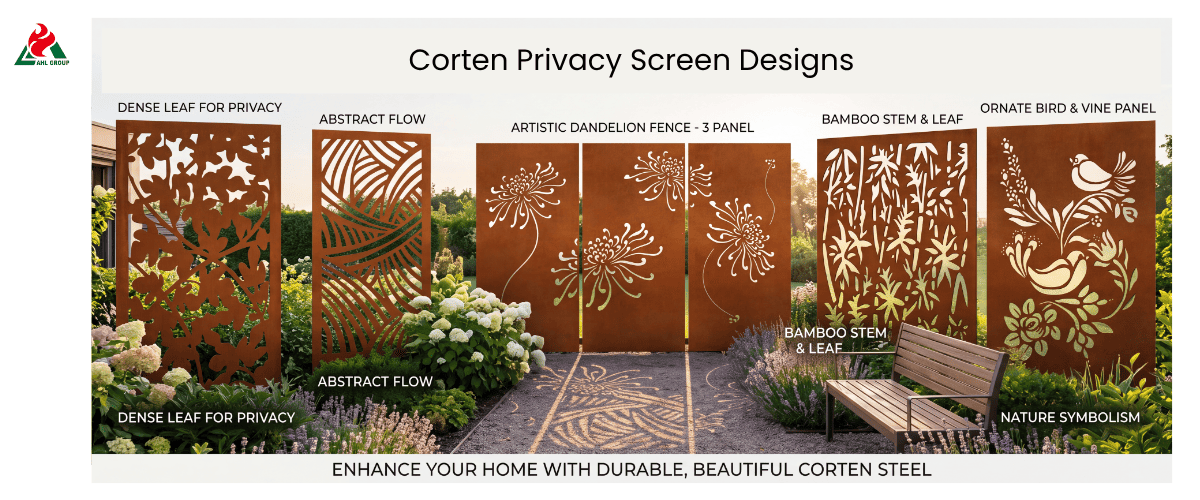
Laser-cut Corten steel screens strike a balance between privacy, natural light, air circulation, and aesthetics. In spaces such as patios, entryways, outdoor kitchens, and garden rooms—where solid panels would create an overly enclosed feel—these screens prove particularly effective. Geometric, botanical, or site-specific patterns can integrate the screens seamlessly into the architecture; however, functionality should take precedence over mere aesthetics when selecting a pattern.
The key variable is the open area ratio—that is, the proportion of open space to metal. Patterns with a dense, fine mesh and narrow gaps can soften the view while allowing light to pass through; conversely, patterns with larger openings function more like decorative frames and offer virtually no real privacy. Manufacturers should also check the width of the metal connecting bridges between the openings, as slender connectors may deform during cutting, handling, or maintenance.
Choose Patterns Based on Function, Not Just Decorative Effect
Place areas with denser patterns where the line of sight passes directly through the metal screen. Larger openings can be placed above eye level or near the planting edges, as airflow is more important than screening in these locations. Avoid sharp, protruding elements near paths, seating areas, and gates. The scale of the pattern should match the viewing distance: fine, intricate patterns may disappear when viewed from the other end of the garden, while large, repeating patterns may appear coarse when viewed up close.
Before approving custom cuts, request physical samples or full-scale printed proofs. A small-scale digital rendering alone cannot convey the actual line of sight, edge quality, or how the pattern appears against a bright sky.
What Does “Privacy” Mean in Perforated Screens
Test the design’s effectiveness from both sides of the screen during the day and at night. A screen that appears opaque when the garden is brighter than the interior may become transparent at night when occupants are backlit. Distance is also a key factor: when viewed at an angle, overlapping shapes provide more coverage than when viewed head-on.
If privacy is critical, quantify the open area and test the proposed lighting conditions rather than relying on labels such as “privacy patterns.” Where a single screen cannot provide the desired coverage, combine screens with plants or staggered structures.
5. Design 3 — Vertical Corten Slats for Adjustable Screening
Vertically arranged weathering steel privacy screens provide directional privacy protection. Viewed from the front, the gaps between the slats allow light to pass through and maintain a sense of space; viewed from the side, the overlapping slats block the view. This makes these privacy screens particularly suitable for narrow, elongated side gardens, along the edges of patios, or in situations where it is only necessary to block the view from a neighbor’s single window (rather than from all directions).
The slats can be designed as straight, folded, or deeply recessed. Narrow, straight slats create a delicate sense of rhythm but may require intermediate supports. Folded or bent slats enhance rigidity and cast deeper shadows, making thin materials appear more substantial. Dark frames highlight the recurring weathering steel elements, while concealed tracks create a more understated appearance.
Louver Angle, Spacing, and Line of Sight
There is no one-size-fits-all spacing that guarantees privacy. Determine the actual field of view you need to block, and mark the eye levels of people sitting, standing, and walking along nearby paths. Also consider the view from upper floors. Then adjust the louver depth, angle, and center-to-center spacing until the louvers completely block the view from these directions.
Tilted slats are particularly effective when a specific direction is critical, but the effect from the opposite direction may differ. Before ordering the complete system, build a simple model and walk around it to observe the view. Check the awning’s performance under morning light, sunset, and overcast conditions.
Why Hemmed or Folded Edges Are Critical
Hemmed edges increase rigidity, protect vulnerable panel edges, and allow each louver to cast a deeper shadow. They also form corners, which must be machined and finished consistently. Folded edges should not create dead corners where water or debris can accumulate, and exposed ends must be safe around pedestrian walkways.
Door panels require special coordination. Moving slats can alter finger gaps, weight distribution, and hinge loads; therefore, door panels should be designed as an integrated assembly rather than simply cut out from detail drawings of fixed panels.
6. Design 4 — Corten Screens Combined With Climbing Plants
When Corten steel garden screens are combined with vines, ornamental grasses, or layered shrubs, the visual effect becomes much softer. The warm steel provides structural support in winter, while the plants add texture, shade, and seasonal color. This design approach is particularly well-suited for courtyards, seating areas, and boundary zones—where an all-metal surface might appear too harsh.
Planting does not immediately provide absolute privacy. The density of vegetation depends on the species, climate, maturity of the plants, pruning methods, and the season. During installation, clients should be shown the screen’s current state and its expected form once the plants have matured. If immediate privacy is required, opt for a denser metal design and use greenery as an accent rather than the sole visual barrier.
Prevent Plants and Steel from Remaining Damp for Extended Periods
Weathering steel relies on alternating wet and dry conditions to form a stable rust layer. Surfaces that remain constantly damp, components buried underground, and areas covered by vegetation may corrode like ordinary structural steel because the protective rust layer cycle cannot form.
Keep soil and moist mulch away from the bottom of the panels. When watering, aim for the roots rather than the steel, and allow space for air circulation. Remove fallen leaves that accumulate in folds, along beams, and at wall joints. If dense vegetation obstructs inspection, design gaps that facilitate inspection or include removable support components.
Separate the Plant Support Structure from the Decorative Panels
Mature vines add weight and increase wind resistance and humidity. Use tension cables, netting, or trellises specifically designed to bear this load, rather than assuming that thin decorative panels can support it. The support structure should allow for pruning and replacement without dismantling the fence.
Select plants based on the local climate and maintenance capabilities. Vigorous climbing plants can fill gaps, support lightweight components, or conceal damage. Deliberately separating the plant structure from the weather-resistant steel surface makes both easier to manage.
7. Design 5 — Corten Wall-Top Panels for Extra Privacy
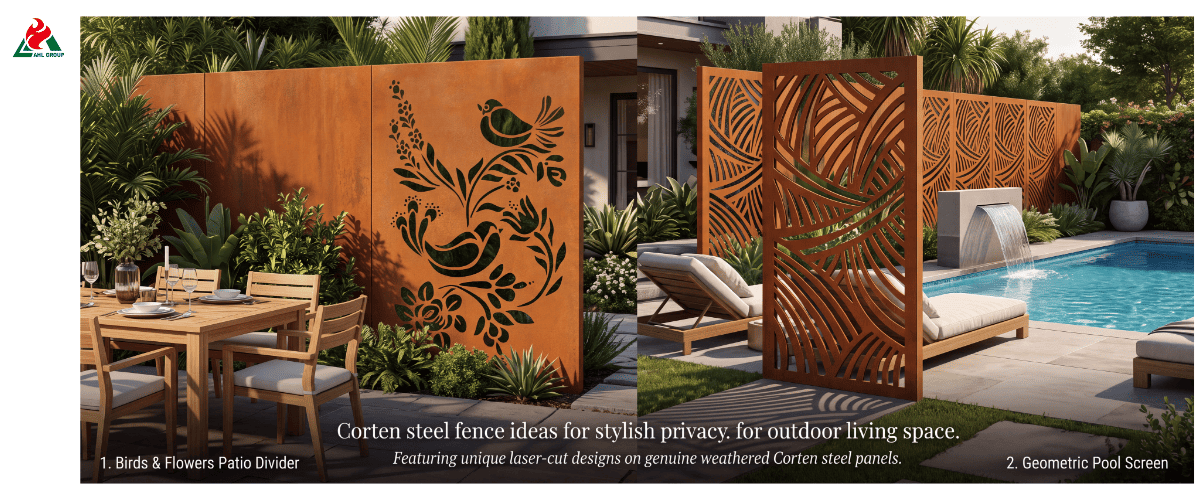
Corten steel panels installed at the top of walls can add a barrier above existing masonry or concrete walls without taking up additional space. They are particularly well-suited for open-view terraces, compact gardens, and locations where solid, low walls already provide security but are not tall enough to ensure privacy. The upper structure can be designed as solid, perforated, or slatted, depending on the balance required between privacy and natural light.
Visually, the substantial masonry base provides a solid foundation for the overall composition, while the thinner Corten steel screen panels add texture and warmth. Align panel joints with posts or architectural elements whenever possible. A continuous top line typically appears more stable than multiple panels with inconsistent shapes.
Can Existing Walls Support the Screen
Never make assumptions. Walls, copings, foundations, columns, and fasteners must be capable of withstanding the additional dead load and wind loads. Older masonry may suffer from issues such as insufficient mortar strength, hidden cracks, or loose copings. Even panels that appear lightweight can generate significant leverage forces at their base during strong winds.
When there is uncertainty regarding the condition, height, or wind exposure of existing walls, a review by a qualified professional is required. Fasteners should be embedded in verified structural materials, rather than simply secured to loose coping stones or thin cladding layers. Connection details must also account for tolerances and allow for future replacement.
Refine Joint Treatment to Prevent Stains
Rust-colored water stains can run down light-colored plaster, concrete, and porous brick surfaces. Spacers, drip edges, or controlled drainage channels should be used to prevent rainwater from flowing toward susceptible surfaces. Steel structure design guidelines specifically recommend strategically positioning joints to ensure that seepage does not run down the steel surface or contaminate materials that are difficult to clean.
Avoid creating narrow gaps between the wall netting and the wall to prevent the accumulation of fallen leaves. Ensure that the wall coping provides effective drainage, and use compatible separation details at the junctions of different materials.
8. Design 6 — Backlit Corten Feature Screens for Night-Time Gardens
Backlit weathering steel panels transform privacy screens into nighttime focal points. Hidden light sources shine through laser-cut holes, creating a three-dimensional effect, highlighting the rusted texture, and projecting patterns onto nearby surfaces. This design is ideal for entrances, courtyard walls, and entertainment areas—where screens are viewed just as frequently at night as they are during the day.
The ideal lighting design enhances the screen’s visual impact rather than conflicting with it. Warm, subdued light sources typically complement the steel’s reddish-brown tones. Uniform lighting works well with regular geometric patterns, while offset, oblique lighting highlights texture and casts longer shadows. Lighting should be planned in conjunction with the panel design to avoid having brackets, cables, and access panels become afterthoughts.
Controlling Glare and Ensuring Privacy
Hide light sources below the normal line of sight. Visible bright light bands can cause glare and distort patterns. In addition to designated seating areas, tests should also be conducted from adjacent properties.
Backlighting may lead to privacy issues. At night, people on the illuminated side may appear as silhouettes, clearly visible through openings that seem private during the day. If privacy is critical, minimize open areas, add an offset backing layer, or adjust the lighting position so that it evenly illuminates the steel panels rather than shining directly through them.
Electrical and Thermal Safety Precautions
Components that meet outdoor use standards must be used, and installation must comply with local regulations. Drivers, connectors, and luminaires must be properly ventilated, allow for unobstructed drainage, and provide access for maintenance. Never seal electrical equipment inside inaccessible, damp enclosures.
Prevent leaves from accumulating around heat-generating fixtures, and ensure that cable entries or brackets do not create areas where water can pool behind the panel. Providing a removable service access panel helps maintain a clean facade appearance while preventing damage caused by future maintenance work.
9. How to Choose the Right Corten Fence Design
Select a design solution based on the constraints in the following order:
► Determine the field of view and privacy level.
► Determine whether the component is a boundary fence, a privacy screen, or a decorative infill element.
► Measure the height and width of the exposed sections.
► Assess wind loads, foundation conditions, and structural support.
► Draw diagrams showing the flow of rainwater and rust water.
► Verify local boundary, pool, and zoning requirements.
► Only after clarifying the above information should you select patterns, modules, and surface treatments.
| Use case |
Recommended starting point |
| Complete boundary privacy |
Solid modular panels |
| Patio screening with daylight |
Dense laser-cut panels |
| Directional screening |
Angled vertical slats |
| Soft garden zoning |
Corten frame plus planting |
| Additional privacy above a wall |
Engineered wall-top panels |
| Night-time focal point |
Backlit feature screen |
Ensure that Weathering Steel Harmonizes with Surrounding Materials
Wood can soften an industrial style and is well-suited for residential gardens. Dark-colored steel can create a clean, crisp frame and appear less jarring to the eye. Stone or concrete can lend a sense of weight to the screen and provide contrast. Planting greenery helps the colors blend more seamlessly with the landscape.
Exercise caution when using light-colored, porous paving. Weathering steel outdoor screens may release reddish-brown efflorescence, causing staining of surrounding surfaces—particularly during the initial weathering process; this effect can be controlled through proper detailing. Planning a gravel strip, installing a controlled drainage system, or protecting surfaces before installation is far easier than making repairs after staining occurs.
Never overlook compatibility issues in favor of material color coordination. Fasteners, frames, sealants, and contact surfaces should be specified as part of the same system, while paying attention to issues such as dissimilar metal contact and water accumulation.
10. Installation, Patina and Maintenance Considerations
A weathering steel screen is considered successful when its detailed design allows the material to perform as intended. In environments where wet and dry conditions alternate, this material forms a rust layer that provides enhanced protection. Persistent moisture, accumulated debris, and high chloride ion concentrations can all hinder the formation of this stable state. Therefore, the details of the base and the local microclimate are just as important as the design pattern.
Maintenance Checklist
Remove dirt, debris, and fallen leaves from the panel bases. Keep drainage channels clear. Inspect fasteners, welds, gates, and joints between different materials. Redirect irrigation water flows that cause persistent surface moisture. Check adjacent paved areas for surface runoff. Photograph any pitting, flaking, or persistently damp patches to track changes over time.
Weathering steel generally requires minimal maintenance, but “minimal” does not mean “maintenance-free.” Regular observation can help detect drainage blockages and moisture issues caused by vegetation early on, preventing them from developing into hidden defects.
11. Frequently Asked Questions
Q1: Is Corten Steel Good for Privacy Screens?
When the panels, frames, posts, drainage system, and environmental exposure conditions are designed as an integrated system, weathering steel can serve as an effective material for privacy screens. It is available in a variety of styles—including solid, perforated, and slatted—and its surface develops a unique patina over time. However, it is less suitable for environments where the steel will be exposed to prolonged moisture or severe, uncontrolled chloride corrosion.
Q2: How Tall Should a Corten Privacy Screen Be?
The height of the screen should be determined based on the range of views to be blocked, local zoning or pool regulations, wind exposure, and structural design. Check the line of sight from both a seated and standing perspective, and consider the upper floors of neighboring buildings. Never choose the height based solely on appearance: taller solid panels generate greater wind loads and may require sturdier posts and foundations.
Q3: Do Corten Fence Panels Need a Frame?
In most cases, yes. Decorative panels may require flanges, crossbars, posts, or a complete structural frame to withstand wind loads and remain straight. The required support depends on the panel’s size, thickness, perforation pattern, environmental exposure, and mounting method. Fence panels and their supporting structures should be treated as a single engineering component rather than separate catalog products.
Q4: Can Corten Screens Be Used Near a Pool?
Installing Corten screens near a pool requires careful evaluation. Factors such as chlorinated water splashes, constant exposure to moisture, runoff stains, electrical equipment, screening regulations, and maintenance access are all critical. Water should not be allowed to pool at the bottom of the panels or flow into the pool. Please verify local privacy barrier requirements and consult material recommendations specific to your actual installation environment.
Q5: How Much Privacy Do Laser-Cut Corten Panels Provide?
Privacy depends on light transmittance, pattern density, viewing angle, distance, and lighting conditions. A panel that blocks the view from the side may still appear transparent when viewed directly from the front. Backlighting at night may reveal outlines. Before finalizing a pattern design, test full-size samples from both sides under the expected daytime and nighttime conditions.
Q6: Can Plants Grow Directly on a Corten Screen?
Plants can be incorporated with weathering steel, but mature vines typically require dedicated support such as wire, mesh, or trellises. Keep irrigation water, soil, and moist mulch away from the steel base, maintain good air circulation, and ensure easy access for pruning. Dense vegetation that continuously traps moisture on the surface of the weathering steel may interfere with the formation of a stable rust layer.
Conclusion: Choose the Screen by Performance, Then Refine the Pattern
Solid panels provide complete visual obstruction; laser-cut panels filter light and regulate the field of view; vertical louvers offer directional privacy; green screens soften boundaries; top panels add height; and backlit panels become focal points at night. Therefore, the optimal weathering steel fence solution is not necessarily the most decorative design, but rather the one that meets the site’s requirements for sightlines, structure, drainage, and sunlight.
Begin by conducting on-site line-of-sight studies and rainwater drainage planning. Determine whether the installation will be a fence, screen, or infill structure, then coordinate the panel design with posts, foundations, fasteners, and surrounding materials. When line-of-sight or nighttime transparency is critical, create a full-scale pattern model. If uncertainties arise due to wind loads, existing walls, coastal environments, or pool regulations, seek project-specific professional advice before manufacturing.
Compare Corten outdoor privacy screen design options to evaluate privacy levels, pattern density, and installation types. For a project-specific layout plan, please provide on-site dimensions, photographs, sightline information, and material environment details to request a panel layout or technical specification review.

