


What is the best wood and charcoal for a Corten plancha BBQ grill, and how do you achieve perfect ring heat zones and clean smoke? The ultimate fuel setup for a Corten steel plancha BBQ is a two-tier hybrid system: high-density hardwood lump charcoal (such as Quebracho or dense oak lump) provides a clean-burning, high-temperature ember foundation (450°C–500°C firebox core), while well-seasoned split hardwood logs with less than 20% moisture content (specifically European Beech, Kiln-Dried White Oak, Hickory, or Applewood) provide responsive flame boosts and clean, aromatic wood smoke. Dense hardwoods produce 24 to 28 million BTUs per cord, ensuring the thick 10mm–12mm carbon steel cooking ring stabilizes at ideal temperature gradients: 300°C–350°C at the inner sear rim, 220°C–270°C at the mid-ring, and 150°C–180°C on the outer holding perimeter. Never use softwoods like pine, fir, or cedar, and avoid chemically bound charcoal briquettes, which emit toxic creosote, bitter acrolein, and excessive ash that chokes draft flow.
Over recent years, architectural Corten steel plancha BBQ grills have revolutionized luxury outdoor entertaining, commercial restaurant patios, and private estate gardens. Fabricated from industrial-grade weathering steel (ASTM A588 / EN 10025-5 S355J2W), units such as the AHL BG4 Corten BBQ Grill with 10mm Carbon Steel Ring, the AHL BG19 Large Commercial Plancha Grill, and circular modern outdoor rusted fire bowl grills seamlessly integrate culinary performance with architectural beauty. Often showcased alongside outdoor Corten steel fire pits and custom Corten privacy screens, these plancha units turn open-fire cooking into a 360-degree social event.
However, cooking on a solid steel teppanyaki-style plancha disc is governed by very different thermodynamic rules than grilling over traditional wire grates or inside enclosed smokers. On a plancha, heat transfer is predominantly conductive—transferred directly from the firebox coals through heavy 8mm to 12mm solid steel—while food flavor is influenced by the delicate convective currents of wood smoke swirling across the plate.
Using wet logs, resinous pine, or inferior briquettes suffocates the fire, leaves cold spots across the cooking ring, coats premium ingredients in bitter soot, and ruins the steel plate's cured oil polymer patina. This comprehensive culinary engineering guide examines wood combustion physics, evaluates premier hardwood and lump charcoal species, details spatial ring zone temperature management, and delivers professional food-smoke pairing protocols to elevate your open-fire cooking.
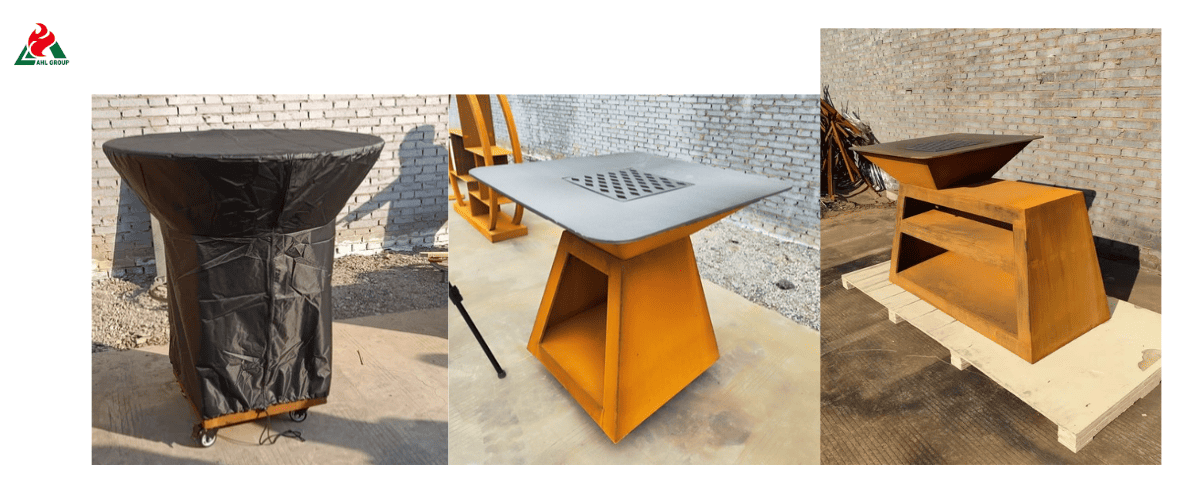
Explore Corten Steel Plancha BBQ Grills!
1. Culinary Thermodynamics: The Physics of the Circular Plancha Ring
To select the correct fuel, one must first understand how heat travels through a circular plancha cooking plate:
1. Conductive Heat Transfer vs. Direct Flame Radiant Exposure
On a conventional BBQ grate, food rests suspended over open flames and direct radiant embers, receiving heat primarily via radiation and convection. On a plancha:
- The food sits directly on a heavy
8mm to 12mmsolid carbon steel plate. - The plate acts as a massive thermal battery, absorbing thermal energy from the central fire bowl and conducting it radially outward toward the rim.
- To maintain intense thermal momentum during continuous cooking—such as searing dozens of cold steaks or smash burgers simultaneously without chilling the steel—the firebox requires a high-BTU, long-duration fuel source that maintains stable conductive heat.
2. The 3 Concentric Ring Cooking Zones
A properly fueled circular plancha establishes three distinct, self-regulating thermal zones:
- The Inner Sear Zone (
300°C to 350°C/572°F to 662°F): Located within80mmof the central fire opening. Here, temperatures instantly trigger the Maillard reaction, vaporizing surface moisture and locking in caramelized crusts on thick ribeyes, duck breasts, and scallops in seconds. - The Mid-Ring Sauté Zone (
220°C to 270°C/428°F to 518°F): The primary cooking engine. Perfect for smash burgers, poultry thighs, salmon fillets, sliced bell peppers, and asparagus. Food cooks through evenly without burning the exterior before the core reaches safe serving temperatures. - The Outer Holding Zone (
150°C to 180°C/302°F to 356°F): Positioned near the cool outer edge. Ideal for resting seared meats, melting cheese onto burger buns, gently simmering sauces, and keeping grilled vegetables warm while the next course finishes.
If your fuel yields fluctuating, low-energy heat, these concentric zones collapse into a lukewarm, muddy temperature profile where food stews in its own moisture instead of crisping.
Get our complete OEM/Wholesale package (2D/3D CAD drawings for 10mm/12mm carbon steel cooking plates, double-wall airflow schematics, food-contact steel Mill Test Certificates & FOB wholesale price list):
>> WhatsApp BBQ Engineer (+1 213-729-4677) >> View Plancha BBQ Models >> Request Wholesale Catalog & Quote
2. Wood Science for Plancha Grilling: Moisture Content, BTU & Combustion Chemistry
Not all firewood is created equal. Using the wrong wood species or unseasoned timber is the single most common cause of plancha failure:
- 2.26 MJ of energy wasted per kg of water boiled away.
- Firebox temperature collapses from 800°C to below 450°C.
- Steel plate drops to lukewarm 160°C; meats boil in juices.
- Releases acrid creosote, bitter acrolein, and greasy soot.
- Instant, clean ignition with zero thermal lag or spitting.
- Sustains roaring 450°C–500°C firebox ember foundation.
- Plate stabilizes at 320°C+ for flawless Maillard searing.
- Emits fragrant guaiacol and syringol thin blue wood smoke.
1. The < 20% Moisture Content Mandate
The absolute golden rule of firewood for plancha grilling is: moisture content must measure below 20%, ideally between 12% and 18%.
When green or partially seasoned wood (moisture 25% to 45%) enters the firebox:
- A massive portion of thermal energy is wasted simply boiling away internal sap and water (requiring 2.26\, MJ of latent heat per kilogram of water vaporized).
- Combustion temperature plummets from an optimal
800°Cdown to less than450°C. - As a consequence, your
10mmcarbon steel plancha disc fails to reach searing temperatures, hovering around an ineffective160°C to 180°C. Cold meat placed on the plate drops the temperature further, causing steaks to bleed juices and boil rather than sear.
2. The Chemistry of "Dirty Smoke" vs. "Thin Blue Smoke"
In outdoor cooking chemistry, the visual character of the smoke directly reflects combustion quality:
- White / Yellow Billowing Smoke ("Dirty Smoke"): Caused by wet wood or starved oxygen. Volatile organic compounds fail to combust, condensing into bitter creosote, acrolein, and polycyclic aromatic hydrocarbons (PAHs). This deposits an acrid, chemical-tasting black film on food and damages your cooking plate's seasoned oil layer.
- Thin Blue / Transparent Smoke ("Clean Smoke"): Achieved only when dry hardwood burns above
650°Cwith adequate airflow. Organic lignins break down cleanly into desirable aromatic phenolics—specifically guaiacol (spicy, woody aroma) and syringol (sweet, fragrant smoke note)—imparting a refined outdoor essence to your cuisine.
3. Toxic Woods: Species to Strictly Ban from Your Plancha
Never burn the following materials inside your Corten BBQ grill:
- Resinous Softwoods (Pine, Fir, Spruce, Cedar): Contain high concentrations of terpenes, turpentine resins, and soft sap. They spark explosively, flare uncontrolled flames, and coat food in toxic, oily black soot.
- Treated, Painted, or Pressure-Treated Lumber: Releases deadly arsenic compounds (copper chrome arsenate), heavy metals, and formaldehyde resins that will permanently contaminate food and poison guests.
- Pallet Wood & MDF/Plywood: Pallets are frequently treated with toxic chemical pesticides (methyl bromide) or soaked in industrial spills. Plywood emits phenol-formaldehyde adhesives.
3. In-Depth Hardwood Species Evaluation: BTU Heat Yield & Smoke Profiles
Mastering wood selection requires matching hardwood density, BTU thermal yield, and aromatic smoke intensity to your cooking goals:
Smoke: Clean, neutral-sweet. Ideal for 360° all-around grilling and seafood.
Smoke: Pungent, savory, bacon-like. Perfect for thick ribeyes and smash burgers.
Smoke: Sweet fruity aroma & rosy mahogany color for poultry, pork, and scallops.
1. European Beech (Fagus sylvatica) — The Plancha Gold Standard
In European open-fire gastronomy (such as Basque and Alpine plancha traditions), Beech is considered the benchmark plancha wood:
- Heat Output: Very high (
27.5 million BTU per cord). - Combustion Characteristics: Burns with a quiet, lively flame, generates zero sparks, and breaks down into a remarkably dense, glowing ember bed that holds steady for hours.
- Smoke Profile: Clean, mild, and softly sweet. It complements everything from delicate fish fillets to whole beef rib roasts without overpowering natural ingredient flavors.
2. Oak (White Oak, Red Oak, Post Oak) — The Universal Thermal Powerhouse
Oak is the most reliable, widely available hardwood worldwide:
- Heat Output:
24.0 to 28.0 million BTU per cord. - Combustion Characteristics: Dense, heavyweight grain delivers exceptionally long burn times and heavy coals.
- Smoke Profile: Medium, smooth, and earthy. Oak provides the classic foundational wood smoke profile that pairs effortlessly with all red meats, poultry, and root vegetables.
3. Hickory & Pecan — The High-Heat Searing Champions
For high-impact searing of steaks, lamb chops, and burgers:
- Heat Output:
28.0 million BTU per cord(among the highest thermal densities). - Combustion Characteristics: Reaches intense firebox temperatures rapidly, maintaining roaring heat against cold ambient winds.
- Smoke Profile: Bold, pungent, savory, and distinctly bacon-like. Use sparingly on delicate fish, but utilize aggressively when cooking thick ribeyes, venison, or blackened pork chops on the inner
320°Csear ring. Pecan offers a milder, sweeter variation of hickory with subtle nuttiness.
4. Fruitwoods (Applewood & Cherrywood) — The Sweet Finishers
Prized by pitmasters for their unique aromatic esters:
- Heat Output:
24.0 to 25.5 million BTU per cord. - Combustion Characteristics: Moderate burn rate with gentle, fragrant coals.
- Smoke Profile: Applewood delivers sweet, fruity, and subtle smoke that makes pork belly, chicken skewers, and scallops unforgettable. Cherrywood imparts a distinctive, rich reddish-mahogany glaze to meats and a gentle tart-sweet aroma.
Comprehensive Hardwood Evaluation Matrix for Corten Plancha Cooking
| Hardwood Species | Heat Output (Million BTU/Cord) | Coal Longevity | Spark Level | Smoke Intensity | Aromatic Flavor Profile | Ideal Plancha Food Pairings |
|---|---|---|---|---|---|---|
| European Beech | 27.5 | Excellent | Zero / Minimal | Mild-Medium | Clean, delicate sweet wood | Fish, prawns, steaks, flatbreads, vegetables |
| White Oak | 28.0 | Superior | Very Low | Medium | Balanced, smooth, classic oak | Beef, lamb, burger patties, charred onions |
| Hickory | 28.2 | Superior | Low-Medium | Strong | Pungent, savory, bacon-like | Thick ribeyes, brisket, smash burgers, pork ribs |
| Sugar Maple | 25.5 | Very Good | Very Low | Mild-Sweet | Subtle sweet maple sugar | Pork chops, chicken breasts, wild mushrooms |
| Applewood | 24.0 | Good-Medium | Very Low | Mild-Fruity | Sweet, dense fruity aroma | Pork belly, chicken skewers, salmon, stone fruit |
| Cherrywood | 24.5 | Good-Medium | Minimal | Mild-Sweet | Rosy, tart-sweet, color enhancer | Duck breast, scallops, lamb cutlets, root veg |
| Birch (Silver Birch) | 20.5 | Fair (fast burn) | Moderate | Medium | Peppery, bright flame | Fast pre-heating; must strip thick bark |
| Pine / Cedar (BANNED) | 14.0–16.0 | Very Poor | Extreme | Harsh | Acrid, toxic resinous soot | DO NOT USE (Toxic food contamination) |
4. Lump Charcoal vs. Briquettes vs. Hardwood Logs: The Fuel Showdown
Choosing the right physical form of fuel is just as crucial as selecting the tree species:
Pros: Reaches 450°C–500°C fast; <3% ash keeps central draft vents clear.
Pros: Living flame theater; releases aromatic wood oils across the steel ring.
Cons: Coal dust & borax emit chemical odor; 15% ash chokes cone airflow.
1. Dense Hardwood Lump Charcoal (The Essential Base Engine)
High-grade natural lump charcoal (such as South American Quebracho Blanco, dense oak lump, or African Marabu) is manufactured by burning hardwood logs in an oxygen-deprived kiln, driving off water, volatile gases, and sap to leave nearly pure carbon:
- Instant High-Heat Foundation: Reaches
450°C to 500°Cwithin 20 minutes without emitting acrid starting smoke. - Zero Binders or Chemicals: Contains no petroleum additives, starches, or mineral coal.
- Minimal Ash Accumulation: Yields less than
2% to 3%residual ash by volume. This is vital for Corten plancha grills: excessive ash fills the central cone and blocks the lower airflow vents, starving the fire of oxygen during long cooking sessions.
2. Natural Hardwood Firewood Logs (The Flavor & Flame Layer)
Split hardwood logs (cut to 250mm to 300mm in length and split to 50mm to 75mm thickness) provide the dynamic theater and essential cooking oils that charcoal alone lacks:
- Visual & Atmospheric Centerpiece: A burning log fire in the center of a Corten cone creates a mesmerizing visual flame vortex that draws guests around the grill.
- Radiant Lick & Direct Smoke: Natural wood oils vaporize, sweeping across the hot steel ring to impart authentic wood-fired flavor to steaks, flatbreads, and grilled seafood.
3. Commercial Charcoal Briquettes: Why You Must Avoid Them
While popular in inexpensive kettle grills, standard commercial briquettes should never be used on a Corten plancha:
- Chemical Additives: Standard briquettes are formed by compressing anthracite coal dust, petroleum coke, cornstarch binders, and borax. As they burn, they emit offensive chemical odors that transfer directly into delicate cooking oils and meats on the plate.
- Suffocating Ash Volume: Briquettes yield up to
10% to 15%dense, powdery ash. In a conical fire bowl, this thick ash blanket quickly covers the coals, cutting thermal conduction to the plate and choking the ash drawer vents.
5. Fire Management & Spatial Temperature Control
A master plancha chef does not merely build a fire; they sculpt and position the ember bed to command precise temperatures across the cooking plate:
1. The Two-Tier Hybrid Firing Protocol
The most reliable, fuel-efficient method used by professional caterers and private chefs is the Two-Tier Hybrid Method:
- Light a Charcoal Chimney: Fill a standard chimney starter with premium hardwood lump charcoal. Ignite with non-toxic natural wood shavings or wax-coated wool firelighters.
- Establish the Coal Base: Once glowing red (approx.
15 to 20 minutes), pour the lump charcoal into the center of the Corten cone directly above the bottom grate. - Add Split Hardwood Logs: Place two split logs (approx.
60mmthick) of seasoned European Beech or White Oak across the charcoal base in a "Log Cabin" criss-cross arrangement. - Airflow Regulation: Open the bottom ash drawer and aeration vents (as engineered on the AHL BG4 Corten Grill with Draft Control) to draw clean combustion air upward through the center. Within
15 minutes, the logs will catch cleanly, heating the entire10mmcooking disc to operating temperatures in30 to 35 minutestotal.
2. Central Firing vs. Off-Center Hot-Cold Stationing
Depending on your menu, you can configure fuel placement for different culinary workflows:
- Concentric 360° Symmetrical Firing (Standard): Keep the coals centered. This creates identical temperature gradients around the entire circumference, allowing 4 to 8 people to cook simultaneously from all sides.
- Offset Split-Station Firing: Push the glowing coal bed toward one side of the fire bowl using an ash rake. The side directly above the coals reaches
340°C+(intense sear station), while the opposite side stays at130°C to 160°C(low-temperature slow-roast / warming station). This allows you to reverse-sear thick steaks or slowly confit duck legs alongside fast-searing vegetables.
6. The Food & Smoke Pairing Guide: Culinary Mastery on the Plancha
Matching hardwood smoke profiles with specific culinary ingredients turns outdoor plancha cooking into a Michelin-level experience:
| Food Category | Target Plate Zone & Temp | Recommended Fuel & Wood Species | Culinary Rationale & Flavor Synergy |
|---|---|---|---|
| Thick Steaks & Ribeyes | Inner Ring (300°C–340°C) |
White Oak + Hickory splits | Intense sear creates deep Maillard crust; pungent savory hickory smoke complements rich marbling |
| Smash Burgers & Sliders | Inner-to-Mid Ring (260°C–300°C) |
Quebracho Charcoal + Beech logs | High thermal momentum crisps edges without burning onions; clean beech smoke lets aged beef shine |
| Whole Fish & Scallops | Mid-Ring (220°C–250°C) |
Alder or European Beech | Delicate, sweet, non-resinous smoke perfumes tender seafood flesh without bitter creosote masking |
| Pork Belly & Sausages | Mid-to-Outer (200°C–240°C) |
Applewood or Cherrywood | Sweet fruit esters cut through rich pork fat; cherrywood imparts a gorgeous mahogany glazed finish |
| Chicken Skewers / Thighs | Mid-Ring (220°C–260°C) |
Sugar Maple or Pecan | Gentle caramelized sweetness pairs with chicken skin; steady heat renders fat cleanly |
| Grilled Vegetables & Mushrooms | Mid-to-Outer (180°C–220°C) |
Oak Charcoal + Light Applewood | Light fruitwood smoke accentuates natural sugars in bell peppers, zucchini, and wild chanterelles |
| Flatbreads & Neapolitan Dough | Inner Rim (280°C–320°C) |
European Beech or Post Oak | Rapid high-temperature dough blistering (leopard spotting) with clean, authentic wood-oven aroma |
7. 10-Point Plancha Fuel & Fire Safety Protocol
Before lighting your Corten plancha grill, follow this engineering and safety audit:
- 1. Moisture Content Verified: Hardwood logs tested with a digital pin moisture meter; reading is strictly < 20\%.
- 2. Correct Log Dimensions: Firewood cut to 250\text{mm}–300\text{mm} length and split to 50\text{mm}–75\text{mm} diameter (prevents oversized logs choking the bowl).
- 3. Toxic Woods Excluded: Zero softwoods (pine, fir, cedar) and zero pressure-treated, painted, or pallet timber on site.
- 4. Chemical Briquettes Prohibited: Only natural, unadulterated hardwood lump charcoal used for the ember foundation.
- 5. Ash Drawer Cleared: The lower slide-out ash pan emptied before lighting to ensure unobstructed combustion draft.
- 6. Airflow Vents Checked: Central aeration vents and floor openings free of compacted soot or grease buildup.
- 7. Food-Grade High-Smoke-Point Oil Applied: Cooking disc seasoned with avocado oil, refined grapeseed oil, or beef tallow (smoke point > 240°C).
- 8. Thermal Expansion Clearance: Cooking plate inspected to confirm it sits centered on supporting lugs, allowing natural radial expansion when heated.
- 9. Fire Extinguisher & Gloves Ready: Heavy heat-resistant leather BBQ gloves and an ABC dry chemical extinguisher or fire blanket accessible.
- 10. Safe Natural Cooldown: Fire allowed to burn down to ash naturally; never pour cold water into a hot Corten fire bowl, which causes thermal shock and plate warping.
8. Frequently Asked Questions (FAQ)
Q1: How much wood and charcoal do I need for an evening of plancha cooking?
A: For a standard 3 to 4-hour cooking session on a 1000mm Corten plancha (such as the AHL BG19 Outdoor Plancha Grill), you will typically consume 3 to 5 kg (6–11 lbs) of dense hardwood lump charcoal to establish and maintain the central ember bed, supplemented with 4 to 6 small split hardwood logs (added one at a time every 25–35 minutes) to sustain visual flames and active surface heat.
Q2: Can I use olive oil to season and cook on my Corten plancha?
A: No, avoid extra virgin olive oil. Extra virgin olive oil has a very low smoke point (approx. 160°C to 190°C) and degrades rapidly on a hot plancha, burning into a sticky, bitter black residue. Instead, use high-smoke-point oils with neutral flavors: avocado oil (270°C / 520°F), refined grapeseed oil (215°C / 420°F), high-oleic sunflower oil (230°C), or clarified beef tallow.
Q3: Why does my plancha smoke excessively and make my eyes burn?
A: Heavy, eye-stinging white smoke is almost always caused by wood with excessive moisture content (> 22%) or starved firebox airflow. When wet wood smolders without enough heat to combust cleanly, it releases high levels of acrolein, formaldehyde, and creosote vapor. Switch immediately to kiln-dried hardwood (< 18% moisture) and open the bottom ash drawer vents to increase intake draft.
Q4: Can I burn wood pellets or compressed sawdust logs in my plancha?
A: Commercial 100% natural compressed hardwood briquettes (without chemical glues) can be used, but standard heating pellets should be avoided. Heating pellets disintegrate into a suffocating mound of fine sawdust inside an open fire bowl, smothering airflow and blowing fine ash across the cooking plate. Split natural logs remain vastly superior for heat distribution and culinary aroma.
Q5: Does the Corten steel fire bowl get damaged by high fire temperatures?
A: No. Corten steel (ASTM A588) is a structural weathering alloy developed for heavy industrial and bridge engineering. Its high copper, chromium, and nickel content provides exceptional resistance to thermal degradation up to 550°C–600°C. Normal wood and charcoal fires inside the firebox will not compromise structural plate integrity, though natural heat cycles will accelerate the characteristic copper-brown patina development on the exterior cone.
Q6: How do I control the temperature if the cooking plate gets too hot?
A: If the inner ring exceeds your target temperature, you have three quick controls: (1) Push ingredients outward toward the cooler mid or outer ring; (2) Close the bottom ash drawer air damper to reduce intake draft; or (3) Use an ash rake to push glowing coals toward the center or away from one sector of the disc, immediately lowering localized plate conduction.
Q7: Can I cook on my Corten plancha grill during sub-zero winter temperatures?
A: Yes, absolutely. Corten steel performs flawlessly in sub-zero winter climates. However, because cold ambient air and freezing metal conduct heat away rapidly, pre-heating will take 10 to 15 minutes longer, and you will require approximately 20% to 30% more fuel (preferring high-BTU White Oak or Hickory) to maintain inner ring searing temperatures at 320°C.
Q8: What accessories make fire management easier on an AHL Corten BBQ Grill?
A: AHL Corten Group engineers a complete suite of commercial-grade BBQ accessories designed specifically for circular planchas, including central stainless steel raised grill grates, circular food bumpers (preventing food from slipping into the center fire), stainless steel spatula scrapers, custom weather covers, and heavy-duty ash scrapers.
Conclusion: Mastering Open-Fire Cuisine with AHL Corten Group
A Corten steel plancha BBQ grill is far more than a standard backyard cooker—it is a calibrated piece of culinary engineering that rewards precision fire management and material understanding.
By building a stable high-heat foundation with dense hardwood lump charcoal, feeding dry kiln-seasoned hardwoods (< 18% moisture content), avoiding toxic softwoods and synthetic briquettes, and orchestrating your menu across the inner, mid, and outer ring zones, you transform outdoor entertaining into an unforgettable gastronomic spectacle. The marriage of solid carbon steel conductive heat transfer and clean wood smoke phenolics allows you to execute Michelin-caliber sears, tender vegetables, and delicate seafood with effortless social grace.
At AHL Corten Group, we manufacture premier architectural weathering steel cooking systems, ranging from the popular BG4 Corten Steel BBQ Grill with precision airflow control to heavy-duty commercial-scale planchas and fire pits. Our factory-direct engineering team provides certified ASTM A588 weathering steel test reports, precision CNC laser-cut 10mm to 12mm cooking plates, and fully integrated modular components tailored for high-end hospitality venues and private estates worldwide. Explore our complete outdoor living collection, request custom CAD shop drawings, or consult directly with our manufacturing specialists to bring world-class Corten craftsmanship and culinary performance to your upcoming project.
Request an Engineering Consultation & Custom Plancha BBQ Quotation
Planning an outdoor hospitality project, residential patio upgrade, or commercial BBQ installation? Connect directly with the AHL Corten engineering team. We provide certified ASTM A588 weathering steel material test reports (MTRs), CAD shop drawings, and factory-direct wholesale pricing within 24 hours.
- Heavy-gauge 10mm to 12mm food-grade carbon steel cooking discs.
- Architectural ASTM A588 weathering steel cones and fire bowls.
- Integrated slide-out ash drawers with precision draft air dampers.
- Modular three-part design for effortless installation and cleaning.

