


How do you choose the best Corten steel bollard lights for outdoor garden paths and landscape walkways? Selecting the ideal Corten steel path light requires balancing four critical engineering and design factors: fixture height (40cm, 60cm, or 80cm), optical light distribution (downward glare-free wash vs. 360-degree decorative laser-cut shadow art), electrical configuration (12V/24V low-voltage systems with warm white 2700K–3000K LEDs delivering 200–450 lumens), and structural anchorage paired with an IP65 moisture-sealed light engine. For residential garden paths, standard 50cm to 60cm bollards placed in a staggered pattern every 2.5 to 3.5 meters (8 to 12 feet) provide seamless pedestrian wayfinding without excessive glare or dark voids. For commercial plazas or snow-prone regions, taller 80cm to 100cm bollards offer expanded illumination perimeters and clear visibility above groundcover.
Over the past decade, landscape architects, luxury homebuilders, and commercial developers have increasingly transitioned away from generic powder-coated aluminum and fragile plastic garden lights in favor of heavy-duty Corten steel bollard lights and outdoor LED lighting. Fabricated from structural weathering steel (ASTM A588 / Corten-A), these architectural fixtures develop a self-protecting, organic rust-orange patina that deepens in character year after year. Rather than clashing with natural surroundings, Corten steel bollards harmonize effortlessly with gravel paths, timber decking, natural stone pavers, and lush ornamental plantings.
However, choosing the right fixture involves far more than simply selecting an appealing exterior silhouette. A poorly sized bollard can cause harsh eye-level glare, inadequate footway illumination, tripping hazards, or water-ingress failures during seasonal rainstorms. Furthermore, improper spacing can make a private walkway resemble an airport runway, while neglecting low-voltage wire sizing can cause noticeable dimming at the end of the lighting run.
This comprehensive architectural and electrical guide walks you through the core material advantages of weathering steel, compares the three primary height classes, breaks down optical beam distributions and lumen targets, details the bollard spacing formula, explains 12V low-voltage wiring safety, and outlines best practices for installation and rust runoff management.
Planning an Outdoor Lighting Project? Request a Custom Lighting Quote!
1. Why Choose Corten Steel Bollard Lights Over Conventional Materials?
Before evaluating dimensions and wattages, it is essential to understand why weathering steel has become the preferred material for high-end landscape illumination:
Material Metallurgy: The Science of ASTM A588 Weathering Steel
Unlike conventional mild carbon steel, which rusts continuously until structural failure occurs, Corten steel is a specialized low-alloy architectural steel engineered according to international standards such as ASTM A588 Grade A/B, ASTM A242, or EN 10025-5 (S355J2W).
The base alloy incorporates precise trace additions of copper (0.25%–0.55%), chromium (0.40%–0.65%), nickel (0.30%–0.65%), and phosphorus (0.07%–0.15%). When exposed to natural outdoor alternating wet-and-dry cycles, these alloying elements catalyze the formation of an exceptionally dense, microscopic barrier layer composed primarily of alpha-iron oxyhydroxide (goethite, alpha-FeOOH).
- Self-Healing Oxide Barrier: If a lawnmower, weed trimmer, or gravel pebble scratches the outer surface, the exposed steel doesn't flake away; it simply re-oxidizes in air and moisture, automatically regenerating the protective patina.
- Elimination of Maintenance & Repainting: Powder-coated aluminum and painted carbon steel fixtures inevitably chip, chalk under intense solar UV exposure, or blister around fastener holes after 3 to 7 years in outdoor conditions. Corten steel requires zero painting, zero chemical refinishing, and zero periodic sealing, achieving an exterior design lifespan of
25 to 50+ years. - Heavy-Gauge Structural Rigidity: AHL Corten bollards are manufactured from heavy-gauge plate, typically
2.0 mm to 3.0 mmthick (unlike mass-market stamped aluminum bollards with wall thicknesses of merely0.8 mm to 1.2 mm). This solid steel construction delivers exceptional vandalism resistance, withstands direct impacts from garden equipment or pets, and resists deformation under high wind loads.
Material Comparison: Corten Steel vs. Alternative Landscape Light Fixtures
| Material Type | Typical Wall Thickness | Lifespan in Outdoor Soils | Maintenance Required | Resistance to Scratches & Lawn Care Tools | Aesthetic Integration with Plants |
|---|---|---|---|---|---|
Corten Weathering Steel (ASTM A588) |
2.0 mm – 3.0 mm |
25 – 50+ Years |
None (Self-protecting patina) | High (Scratches self-heal into patina) | Superior (Warm, organic earth tones) |
| Powder-Coated Extruded Aluminum | 1.0 mm – 1.8 mm |
8 – 15 Years |
Regular cleaning; touch-up paint | Low (Chips reveal bright silver metal) | Industrial / Modern monochrome |
| 316 Marine-Grade Stainless Steel | 1.5 mm – 2.0 mm |
30 – 50 Years |
Periodic washing to prevent tea staining | Moderate (Shows scratches; hard to repair) | Contemporary / Reflective metallic |
| Cast Iron | 4.0 mm – 6.0 mm |
20 – 40 Years |
Needs periodic painting/rust-proofing | Moderate (Prone to brittle impact fracture) | Traditional / Victorian historic |
| Die-Cast ABS Plastic / Resin | 2.0 mm – 3.5 mm |
3 – 6 Years |
None (Degrades under solar UV) | Very Low (Cracks easily; embrittles) | Cheap / Artificial appearance |
As shown above, Corten steel provides an optimal balance of extreme structural longevity, zero maintenance, and warm architectural texture that elevates garden borders, walkways, and entrance courtyards.
2. Choosing the Right Bollard Height: 40cm, 60cm, or 80cm?
Fixture height determines the diameter of the illuminated pool of light on the ground, the angle of direct sightlines into the light source, and how the fixture integrates with surrounding garden flora. AHL manufactures standard and custom bollard models across three primary height tiers:
- Ground-hugging soft wash
- Subtly nestles into low flower beds
- Effective Footprint: Ø 1.5 - 2.5m
- e.g. AHL 200x200x200mm Cube
- Balanced pedestrian reach
- Eye-level glare completely eliminated
- Effective Footprint: Ø 2.5 - 4.0m
- e.g. AHL 150x150x600mm Linear
- Wide panoramic optical throw
- Visible above winter snowpack
- Effective Footprint: Ø 4.0 - 6.5m
- e.g. AHL 150x150x800mm Path Light
1. Low-Profile Bollards & Light Cubes (20cm to 40cm / 8 to 16 inches)
- Popular Models: The Corten Steel Square Light Box (200×200×200mm) and custom
400mmpedestals. - Lighting Characteristics: Creates an intimate, ground-skimming pool of light with an effective illumination diameter of approximately
1.5 to 2.5 meters(5 to 8 feet). - Ideal Applications:
- Defining stepping stone pathways through low moss lawns or groundcovers (e.g., creeping thyme, sedum).
- Highlighting perimeter edges of sunken courtyards, wooden decks, and swimming pool perimeters.
- Flanking rockeries, architectural boulders, and Japanese zen gardens where towering vertical posts would disrupt visual serenity.
- Limitation: In lush perennial borders, tall ornamental grasses or summer blooms can quickly overgrow the fixture and obstruct light throw.
2. Mid-Height Standard Path Bollards (50cm to 60cm / 20 to 24 inches)
- Popular Models: The Corten Steel Outdoor Linear Light Box (150×150×600mm) and Corten Steel Recessed Bollard Light Box (150×150×500mm).
- Lighting Characteristics: The quintessential industry standard for pedestrian pathways. Generates an even, comfortable ground illumination footprint of
2.5 to 4.0 meters(8 to 13 feet) in diameter while remaining safely below the direct sitting and walking eye-level of adults (120cm to 170cm). - Ideal Applications:
- Residential front entrance walks, garden paths, and flagstone patio corridors.
- Pathways winding through mixed shrub beds, lavender borders, and low hedging up to
30cm–45cmtall. - Commercial hospitality pathways (boutique resorts, vineyard trails, restaurant garden terraces).
- Why It is the Most Popular Choice: A
600mmtall square pillar (such as150×150mm) delivers substantial architectural presence by day and ideal downward beam coverage by night, striking the perfect ergonomic balance between visibility and glare prevention.
3. Tall Architectural Bollards (80cm to 100cm / 32 to 40 inches)
- Popular Models: The Corten Steel LED Path Light (150×150×800mm) and custom
1000mmcommercial driveway bollards. - Lighting Characteristics: Wide optical distribution throwing illumination across
4.0 to 6.5 meters(13 to 21 feet). Illuminates both the path surface and surrounding vertical foliage. - Ideal Applications:
- Broad residential driveways, vehicular turnaround courts, and parking entryways where pedestrians and vehicles share access.
- Commercial office parks, university campus walkways, and public urban waterfront promenades.
- Geographical regions with heavy seasonal snowfall: a
80cmbollard remains visible and operational above winter snowpack when shorter40cmlights would be buried. - High-traffic areas requiring an unmistakable physical barrier or traffic demarcation (anti-ram/traffic guidance).
3. Optical Design: Downward Wash vs. Laser-Cut Shadow Art
The aesthetic experience of path lighting depends on how the internal light source interacts with the Corten steel housing. The market features three primary optical styles:
Solid Corten housing with concealed downward LED emitter. Directs 100% of illumination onto path pavers.
Precision laser-cut patterns (floral, branch, geometric). Projects high-contrast decorative shadow tapestries across the ground.
Features vertical or horizontal slot with frosted optical polycarbonate diffuser. Delivers clean, architectural glowing lines.
Style A: Full Cut-off & Downward Recessed Louvers (The Functional Master)
- Optical Engineering: The LED emitter is hidden underneath an overhanging top cap or deeply recessed behind an angled internal reflector. Light is projected exclusively downwards and outwards onto the walkway surface.
- Dark-Sky Compliance: Eliminates upward light pollution and zero horizontal eye glare. Pedestrians see the illuminated walkway and plant textures without experiencing temporary blinding when looking toward the fixture.
- Best For: Primary navigation walkways, steep garden staircases where step treads must be crisply illuminated, and properties adhering to international Dark-Sky preservation standards.
Style B: Laser-Cut Decorative Shadow Art (The Ambient Sculptural Showpiece)
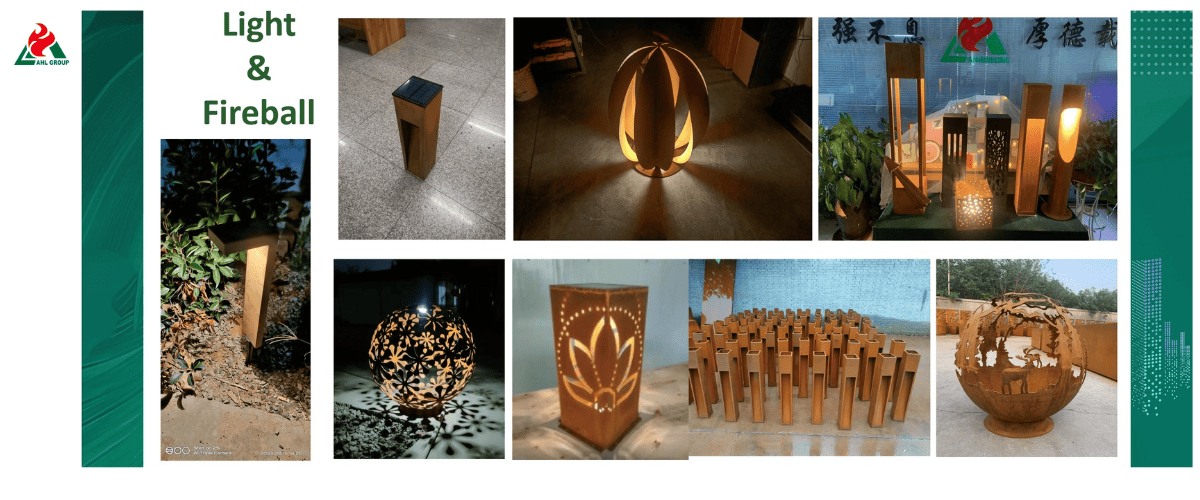
- Optical Engineering: The four weathering steel walls are precision laser-cut with artistic motifs—such as the Laser-Cut Corten Floral Garden Light, abstract geometric branches, or linear waveforms. An internal warm LED core casts dramatic, high-contrast light and shadow patterns across adjacent pavers, gravel beds, and timber boundaries.
- Atmospheric Impact: By day, the bollard appears as an organic rusty metal garden sculpture; by night, it transforms the ground into an intricate tapestry of light art.
- Best For: Entertaining patios, courtyard entryways, relaxing seating nooks, and accent positions where the primary goal is emotional ambiance and visual intrigue rather than commercial-grade foot-candle precision.
Style C: Linear Slot Diffused Lighting
- Optical Engineering: Features a vertical or horizontal open slot fitted with a frosted, impact-resistant polycarbonate or acrylic optical diffuser (such as the
150×150×600mm Linear Light Box). - Best For: Contemporary, minimalist architecture. Delivers a soft, glowing light line that defines path edges cleanly without harsh shadows.
4. Light Quality: Lumens, Wattage & Color Temperature (CCT)
Landscape lighting is an art of subtlety. One of the most frequent mistakes made by homeowners and contractors is over-lighting a tranquil garden path, turning a cozy outdoor sanctuary into a harsh commercial environment.
Recommended Lumen Output & Wattage per Fixture
Modern high-efficiency LED modules produce between 80 to 110 lumens per watt. For pathway bollard lights, recommended targets are:
| Bollard Height & Class | Recommended LED Wattage | Lumen Output per Fixture | Effective Ground Footprint Radius | Primary Visual Purpose |
|---|---|---|---|---|
Low-Profile (20cm – 40cm) |
2W – 4W |
150 – 250 Lumens |
0.8 – 1.2 meters |
Soft step demarcation, subtle edge glow |
Mid-Height (50cm – 60cm) |
3W – 6W |
250 – 400 Lumens |
1.2 – 1.8 meters |
Standard pedestrian walkway navigation |
Tall Architectural (80cm – 100cm) |
5W – 9W |
450 – 700 Lumens |
2.0 – 3.0 meters |
Wide driveways, public plazas, security paths |
The Critical Rule of Color Temperature: Stick to Warm White (2700K – 3000K)
The rich, warm, reddish-brown tones of Corten steel's natural patina interact profoundly with the color spectrum of light:
2700K (Warm / Amber White) — Highly Recommended:The gold standard for residential landscape lighting. The warm amber spectrum complements the copper and iron oxide tones of the Corten steel, evoking the cozy glow of incandescent light or a crackling fire pit. Foliage appears lush, stone looks natural, and outdoor spaces feel welcoming.3000K (Soft Warm White) — Recommended for Modern / Commercial:Slightly crisper while maintaining warmth. Excellent for modern architectural estates, commercial restaurant courtyards, and sharp geometric landscaping.4000K – 6000K (Neutral / Cool Blue-White) — Strongly Discouraged:Cool white light reflects off Corten steel with an unappealing, chalky, clinical glare. It flattens the rich depth of the rust patina and makes natural gardens feel stark and inhospitable.
5. The Spacing Formula: How Far Apart Should You Place Corten Bollards?
Determining the distance between bollard lights is critical. Place them too close together, and you create visual clutter and wasteful energy consumption; place them too far apart, and pedestrians must navigate between blinding bright spots and disorienting pitch-black voids.
The Standard Golden Spacing Formula
In professional landscape lighting design, the baseline rule of thumb for bollard spacing is:
Recommended Spacing = 3 to 5 x Fixture Height
For example, for a standard 600mm (0.6m) tall bollard:
Spacing = 0.6m x 4 ≈ 2.4 to 3.0 meters (8 to 10 feet)
For an 800mm (0.8m) tall bollard:
Spacing = 0.8m x 4.5 ≈ 3.6 to 4.2 meters (12 to 14 feet)
Layout Patterns: Staggered (Zig-Zag) vs. Single-Sided In-Line
Alternating fixtures along opposite sides of the path (2.5m – 3.5m spacing). Produces overlapping pools of warm light that illuminate both edges smoothly without harsh airport-runway glare.
Fixtures aligned along one border only (2.5m – 3.2m spacing). Ideal when one side is flanked by a Corten steel retaining wall, dense hedge, or garden edging.
- Staggered / Zig-Zag Pattern (The Professional Standard):
- By alternating bollards along opposite sides of the path, you create overlapping pools of light that illuminate both left and right edges.
- This layout guides the natural walking eye forward smoothly, prevents optical monotony, and requires fewer total fixtures compared to opposing pairs.
- Recommended Spacing: Place fixtures
3.0 to 4.0 metersapart on alternating sides for a standard1.2m to 1.8mwide path.
- Single-Sided In-Line Pattern (Narrow or Retaining Wall Paths):
- When a path runs directly against a lawn on one side and a Corten steel retaining wall or garden edging on the other, align fixtures along one side only.
- Recommended Spacing: Reduce spacing slightly to
2.5 to 3.2 metersto ensure smooth continuity without dark gaps.
Spacing & Layout Matrix
| Path Type & Width | Bollard Height | Recommended Spacing | Optical Style | Recommended Layout | Target Surface Foot-Candles |
|---|---|---|---|---|---|
Garden Meandering Path (0.9m – 1.2m) |
50cm – 60cm |
2.5 – 3.2 meters |
Downlight / 180° Wash | Staggered (Zig-Zag) | 0.5 – 1.0 FC (Subtle) |
Formal Entry Walkway (1.5m – 2.0m) |
60cm – 80cm |
3.0 – 3.8 meters |
Full Cut-off / Diffused | Staggered or Dual In-line | 1.0 – 2.0 FC (Crisp) |
Driveway / Vehicular Route (3.0m – 4.5m) |
80cm – 100cm |
4.0 – 5.5 meters |
Downward 360° | Opposing or Staggered | 1.5 – 3.0 FC (Navigational) |
| Patio / Entertaining Perimeter | 20cm – 40cm (Cubes) |
2.0 – 2.8 meters |
Laser-Cut Shadow Art | Perimeter Accent | 0.2 – 0.6 FC (Ambient) |
6. Electrical Engineering: Low-Voltage (12V/24V) vs. Line Voltage (120V/230V)
Selecting the proper electrical architecture is essential for safety, system longevity, and ease of maintenance:
Why Low-Voltage 12V / 24V AC/DC is the Industry Standard for Garden Paths
For residential landscapes and the vast majority of commercial garden paths, low-voltage 12V or 24V systems powered by a dedicated outdoor step-down transformer are vastly superior to 120V/230V mains voltage:
- Life Safety in Wet Outdoor Soils: Garden paths are continuously exposed to rain, lawn irrigation sprinklers, and damp earth. A severed 12V cable (from a misplaced shovel, aerator, or rodent) will merely trip the secondary circuit breaker—it carries zero risk of lethal electric shock to children, pets, or gardeners.
- Shallow Direct-Burial Installation: While mains voltage (120V/230V) electrical cables typically require rigid metal/PVC conduit buried
45cm to 60cm(18 to 24 inches) deep under building electrical codes, low-voltage direct-burial cable (UF-rated) can be safely installed at depths of just15cm to 20cm(6 to 8 inches), dramatically reducing trenching costs and tree root disruption. - Flexible Relocation: As garden shrubs mature, moving a low-voltage Corten bollard
50cmto accommodate plant growth requires only a few minutes of hand-digging and a waterproof splice connector.
Voltage Drop Management & Cable Sizing
On long garden paths (>30 meters / 100 feet), electrical resistance causes voltage to drop along the line. If a 12V system drops below 10.5V at the furthest fixture, LED drivers can flicker or dim prematurely. Landscape electricians prevent this through two rules:
- Use Heavy-Gauge Copper Wire: Never use cheap 16-gauge or 18-gauge wire for long runs. Standardize on
12/2(12-gauge, 2-conductor) or10/2low-voltage direct-burial copper landscape cable. - Utilize Center-Feed or Loop Wiring Topology: Rather than running one long daisy-chain from the transformer to the end of the path, connect the main feed cable to the center of the run and split outwards in both directions (the "T-Method" or "Center-Feed"). This cuts effective wire distance in half, virtually eliminating voltage drop.
- Transformer Sizing: Calculate total fixture wattage, add a
25% to 30%safety buffer for line resistance and future expansion, and select a magnetic or electronic outdoor transformer with a multi-tap output (12V, 13V, 14V, 15V) to compensate for longer distances.
Waterproof Ingress Protection: Demand IP65 or Higher
Garden bollards endure severe weather: lawn irrigation spray heads firing horizontally, torrential downpours, high humidity, and morning frost.
IP65 Rating (Mandatory Minimum):Protects fully against dust ingress and low-pressure water jets from any angle.- Sealed Internal LED Light Engine: In quality Corten bollards, the weathering steel exterior acts as a rugged protective enclosure, while the internal LED module, driver, and wiring are housed in a hermetically sealed aluminum/polycarbonate casing with silicone rubber gaskets and waterproof IP68 cable glands.
7. Structural Anchorage & Rust Runoff Management
Because Corten steel bollards weigh between 8 kg to 25+ kg each and stand upright along high-traffic footways, proper mechanical mounting ensures stability while safeguarding surrounding pavers:
Concrete Pad Anchorage Specification:
- Poured Concrete Footing: 300 x 300 x 400mm deep pad below frost line.
- Fasteners: M8 or M10 Grade 304/316 stainless steel expanding wedge anchors.
- Isolation: EPDM rubber washers between baseplate and concrete to prevent galvanic corrosion and allow drainage.
- Electrical Conduit: Central PVC conduit sleeve bringing 12V/24V cable directly into bollard interior cavity.
[2] Welded Base Flange with slotted bolt holes
[3] M8/M10 S/S Anchor Studs & Locking Nuts
--------------------------------- Ground Level
[4] Poured Concrete Footing Pad (400mm depth)
[5] Direct-Burial 12/2 Low-Voltage Cable in Conduit
1. Three Approved Anchorage Methods
Depending on the soil and path construction:
- Poured Concrete Footing Pad (Best for Walkways & Driveways): Pour an isolated concrete footing pad (
300 × 300 × 400mm deep) below the frost line. Set three or four304/316 stainless steelthreaded rods or expanding wedge anchor bolts into the cured concrete to bolt the Corten bollard baseplate securely in place. - Heavy-Gauge Soil Anchor Spikes (Best for Soft Garden Beds): For unpaved dirt trails or mulch garden borders, fixtures can be equipped with a
300mm–400mmwelded Corten cross-spike that presses deep into compacted sub-base gravel, providing solid stability without requiring wet concrete. - Paver / Deck Surface Flange Mounting: On existing stone patios or timber decks, the internal baseplate is bolted directly through the pavers or deck joists using stainless steel lag screws with EPDM isolation washers.
2. Managing Initial Rust Runoff on Paved Walkways
During the initial weathering stage (6 to 12 months), unstabilized Corten steel releases small amounts of water-soluble iron oxide during rainfall:
- The Problem: If placed directly on porous white limestone, pale travertine, or light-colored concrete pavers, rusty runoff water can leave permanent reddish-brown drip stains around the base.
- Three Proven Solutions:
- Specify Factory Pre-Weathered Treatment: Order your AHL bollards with an accelerated chemical patina treatment. AHL initiates and deepens the patina under factory conditions, delivering fixtures with an established, stable oxide layer that drastically reduces initial leaching.
- Install on a Dark Gravel / River Rock Collar: Create a
100mm–150mmmargin of dark crushed granite, Mexican beach pebbles, or volcanic lava rock around the base of each bollard. Any runoff drips invisibly into the gravel rather than contacting light paving stones. - Apply a Breathable Polyurethane / Wax Matte Sealer: Once the desired rustic patina shade is achieved, treat the exterior with a specialized penetrating Corten sealer to lock in the patina while maintaining a non-reflective matte finish.
8. 10-Point Pre-Purchase & Installation Checklist
Before finalizing your bollard light order and breaking ground, review this essential engineering checklist:
- 1. Bollard Height Matched to Application: Selected
20–40cmfor stepping stones/borders,50–60cmfor standard pedestrian walkways, or80–100cmfor driveways and snow regions. - 2. Optical Style Confirmed: Opted for full-cutoff downlights for glare-free pathway safety, or laser-cut motifs for decorative patio ambient shadows.
- 3. Color Temperature Standardized: Specified warm white
2700K(or soft warm3000K) to flatter the earth-toned Corten steel patina. - 4. Lumen Levels Calculated: Kept individual fixture output between
200 to 450 lumensto avoid blinding nighttime glare. - 5. Spacing Formula Applied: Spaced fixtures at
3 to 5 times height(approx.2.5 to 3.5 metersapart in a staggered layout for a 60cm bollard). - 6. Low-Voltage 12V/24V Power Selected: Sized an outdoor multi-tap transformer with
≥25%headroom wattage and specified12/2or10/2direct-burial cable. - 7. Voltage Drop Calculated: Verified that the furthest fixture receives at least
10.8Vunder full system load using center-feed layout. - 8. IP65 Wet-Location Rating Verified: Ensured internal LED modules and drivers are hermetically sealed against lawn sprinklers and driving rain.
- 9. Anchorage Details Prepared: Concrete pads or direct-burial ground stakes specified according to local wind load and soil conditions.
- 10. Paver Rust Protection Addressed: Specified factory pre-weathered finish or planned dark gravel perimeter borders around baseplates on light stone walkways.
9. Frequently Asked Questions (FAQ)
Q1: Are Corten steel bollard lights Dark-Sky compliant?
A: Yes, when equipped with full cut-off downward louvers or recessed top-mounted LED emitters. In these configurations, 100% of the light output is directed downward at the ground plane, producing zero upward light spill into the night sky and minimizing horizontal glare for approaching pedestrians.
Q2: What is the ideal height for residential garden path bollards?
A: For most residential garden walkways, 50cm to 60cm (approx. 20 to 24 inches) is considered the optimal height. It provides broad light distribution (2.5 to 3.5m diameter), stays below human eye level to prevent glare, and remains elevated enough that low flowers and groundcovers do not block the light beam.
Q3: Can the LED bulb or driver be replaced inside a Corten bollard?
A: Yes. High-quality Corten bollards, including AHL’s architectural range, feature a modular design. The top cap or service access hatch can be unbolted using concealed stainless steel fasteners, allowing quick maintenance or replacement of the internal LED board, driver, or standard G4/MR16 bi-pin bulb without disturbing the anchored steel post.
Q4: Why is low-voltage 12V lighting preferred over 120V mains voltage for garden paths?
A: Low-voltage 12V/24V systems provide complete electrical safety in wet outdoor soil, eliminating any risk of lethal shock if a cable is accidentally cut by garden tools or pets. Furthermore, low-voltage wiring requires shallow trenching (15–20cm deep) without metal conduit, significantly reducing installation labor and avoiding tree root damage.
Q5: How far apart should I place 60cm Corten bollard lights?
A: For a standard 1.2m to 1.5m wide garden walkway, space 60cm bollards approximately 2.5 to 3.5 meters (8 to 11.5 feet) apart in a staggered (zig-zag) pattern along alternating sides of the path. This creates continuous, overlapping pools of gentle light without dark zones or runway-like glare.
Q6: Will Corten steel bollard lights stain concrete or stone walkways?
A: During the initial 6 to 12 months of natural outdoor weathering, bare Corten steel sheds tiny amounts of rust runoff during rainfall. To prevent staining light pavers, order fixtures with AHL’s Factory Pre-Weathered treatment, apply a clear matte protective sealer, or install the bollards in a narrow border of dark decorative gravel.
Q7: Can Corten steel garden lights withstand freezing winter frost and snow?
A: Absolutely. Unlike plastic that cracks in freezing temperatures or thin aluminum that corrodes from road de-icing salt, thick 2mm to 3mm Corten weathering steel is virtually impervious to frost, heavy snowpack, and freeze-thaw cycles. In snow-prone areas, select a 80cm bollard height so the light emitter stays above typical snow accumulation.
Q8: Does AHL provide custom laser-cut patterns, dimensions, and voltage options?
A: Yes. As a direct manufacturer, AHL Corten Group offers complete custom fabrication services. We can customize bollard heights from 300mm to 1200mm, execute custom laser-cut brand logos or botanical motifs, provide optional 12V/24V AC/DC or 110V/230V commercial drivers, and supply matching Corten steel junction boxes and mounting plates for any architectural project.
Conclusion: Crafting Safe, Sculptural Illumination with AHL Corten Group
Choosing the right Corten steel bollard light transforms a simple garden path into an evocative nocturnal journey. By harmonizing proper height selection (40cm to 80cm), glare-free downward or decorative optics, warm 2700K low-voltage LED efficiency, and precise spacing calculations, your landscape achieves an exquisite balance of safety, architectural drama, and lifelong reliability.
At AHL Corten Group, we design and fabricate commercial-grade weathering steel lighting solutions—including the Corten Steel Square Light Box, Linear Light Box, Recessed Bollard Light, and Laser-Cut Floral Garden Lights. Precision-engineered from certified ASTM A588 steel with factory pre-weathered patina options, our fixtures illuminate premier botanical gardens, hospitality resorts, and luxury residential estates worldwide. Contact our engineering team today to review your pathway drawings and request custom sample specifications for your upcoming project.
Manufactured from genuine weathering steel with pre-rusted patina options and global FOB/DDP delivery.
» Corten Steel Fire Pits | Outdoor Corten Bollard Lights | Contact AHL Engineers

