


What is the best material for outdoor (outside) planters? When evaluated across structural lifespan, freeze-thaw survival, maintenance cost, and plant root health, Corten steel (2.0 mm to 3.0 mm ASTM A242 / A588 weathering steel) is the best overall material for permanent residential and commercial outdoor planters, delivering a 30 to 50+ year service life, complete immunity to winter frost cracking and UV degradation, and a self-healing russet-bronze patina that never requires repainting. However, the ideal container material always depends on your specific installation constraints: fiberglass (FRP) and marine-grade aluminum (10–20 years) are the best choices for weight-restricted rooftop decks and high-rise balconies; untreated Western Red Cedar or redwood (5–10 years) is the best budget material for DIY vegetable beds where natural wood grain and low initial cost outweigh eventual soil-line rot; precast concrete (15–30 years) excels as immovable security ballast in mild climates; while terracotta/ceramic (3–10 years) and rotomolded LLDPE resin (3–8 years) serve seasonal or portable patio arrangements.
Whether you are a homeowner searching for "the best material for outside planters" that will not split after the first January freeze, or a landscape architect specifying 200 linear meters of trough dividers for a hotel terrace, this engineering guide compares all six outdoor planter materials head-to-head using real structural data, root-zone thermal physics, and verified factory specifications.

Whether you are a homeowner searching for "the best material for outside planters" that will not split after the first January freeze, or a landscape architect specifying 200 linear meters of trough dividers for a hotel terrace, this engineering guide compares all six outdoor planter materials head-to-head using real structural data, root-zone thermal physics, and verified factory specifications.
1. The 5 Engineering Forces That Destroy Outdoor Planters Prematurely
Most outdoor flower pots and planter boxes look great on the day they are delivered to a patio. The true test begins 12 to 36 months later, after the container has endured saturated winter soil freezes, summer solar radiation, root expansion pressure, and constant microbial moisture from the inside out.
Before comparing materials, you need to understand the five mechanical and chemical failure mechanisms that destroy inferior outdoor planters:
Freeze-Thaw Hydrostatic Expansion (9% Ice Volume Growth in Wet Soil)
In any climate where winter night temperatures drop below 0°C (32°F)—including the northern United States, Canada, the UK, central/northern Europe, and southern Australia/New Zealand highlands—freeze-thaw expansion is the 1 killer of outdoor planters.
Here is the physics of why pots shatter in winter:
► Internal Root-Ball Expansion: Moist potting soil holds up to 40% to 60% water by volume. When that saturated soil core freezes solid, the phase change from liquid water to crystalline ice expands its volume by approximately 9%, exerting massive outward hydrostatic pressure against the rigid container walls.
► Wall Pore Delamination (Spalling): In porous materials like unglazed terracotta, clay, and standard cast concrete, water also soaks directly into microscopic capillaries within the container wall itself. When that trapped wall moisture freezes, it wedges the material apart from within—causing ceramic glazes to flake off and concrete corners to crack open.
► Why Ductility Wins Over Brittleness: Brittle materials with low tensile strain capacity (terracotta, ceramic, cast stone, and cold-embrittled plastic) fracture catastrophically once ice expansion exceeds their elastic limit. By contrast, structural metals like Corten A and ASTM A588 weathering steel possess a minimum yield strength of 345 to 355 MPa (50,000 psi), a tensile strength of 470 to 630 MPa, and 20% minimum elongation—meaning the steel wall absorbs freeze-thaw expansion elastically without ever cracking.
Lateral Wet-Soil Pressure & Mid-Span Bowing on Long Troughs (1,000mm–2,000mm)
Homeowners and specifiers routinely underestimate how heavy wet soil actually is. While dry potting mix weighs roughly 650 to 800 kg/m³, fully saturated garden soil and root mass after a rainstorm weighs 1,600 to 1,800 kg/m³ (100 to 112 lbs/ft³)—nearly 1.8 metric tons per cubic meter.
In rectangular trough planters—such as 1,200-millimeter-to-2,000-millimeter privacy screens—wet soil acts like a high-density fluid, working in tandem with the ever-expanding woody root system to push outward against the long side walls:
► In planters made of thin plastic, unreinforced fiberglass, or 0.8-millimeter-thick metal sheets, an unsightly “baby bump”-like bulge will quickly appear in the center of the long side walls.
► In wooden planters, as the wood fibers soften in the wet soil, screws or nails at the corners will be pushed out.
► To prevent architectural planters—such as our Large Rectangular Corten Steel Trough Planter (CP08, 1200 × 400 × 550 mm) or the 2,000-millimeter commercial planter (AHL-CP16, 2000 × 500 × 600 mm)—from arching at the midspan, the container must be constructed from structural steel plate with a thickness of 2.0 mm to 3.0 mm or greater, featuring a double-folded top edge (25 mm to 50 mm wide), and welded with internal vertical C-channel stiffeners and transverse tie rods at the midspan.
UV Photodegradation & Thermal Expansion Cycling (-20°C to +65°C Surface Temperatures)
Outdoor planters placed on south- or west-facing stone patios are not only exposed to intense solar ultraviolet (UV-A and UV-B) radiation but also experience daily temperature fluctuations ranging from 30°C to 50°C:
► Polymers and Resins: UV photons break down the polymer chains in polypropylene, polyethylene, and polyester fiberglass gel coats (chain scission). Within 3 to 6 summers, unstabilized plastic planters will fade, turn white, and become extremely brittle, cracking even upon minor contact with a lawn mower or edger.
► Painted and Powder-Coated Low-Carbon Steel: Because metals undergo slight thermal expansion and contraction with temperature changes (approximately 1.2 mm/m per 100°C), any scratches or pinholes in the paint on low-carbon steel can allow moisture to penetrate beneath the paint film (filiform corrosion and under-coat corrosion), leading to blistering of the coating in patches.
► Unpainted weathering steel (Corten A / A588): Since Corten steel planters rely on an inorganic crystalline iron oxide rust layer rather than organic polymer coatings or resin binders, ultraviolet rays from the sun have no damaging effect on them—in fact, the drying effect of sunlight after rain actually accelerates the formation of the protective rust layer.
Constant Soil Moisture, Humic Acid & Microbial Rot
Inside the planting container, the inner walls are in constant contact with moist soil, organic humic acid (pH 5.5 to 6.8), chemical fertilizers, and soil fungi:
► Untreated wood: Soil fungi and moisture-loving bacteria colonize the wood’s cell walls at the interface between air and soil (known as the decay zone, typically located 50 to 150 millimeters below the soil surface). Even heartwood that is naturally resistant to decay, such as western red cedar, will eventually soften and rot from the inside out after 5 to 10 years of contact with moist soil.
► Weathering steel with well-drained soil: As long as the bottom of the planter is equipped with appropriately sized drainage holes and a 50-millimeter layer of clean gravel is laid at the bottom to prevent water accumulation, a protective oxide layer will form on the inner surface of the weathering steel, providing resistance to perforation for decades. (For marsh plantings or bottom-irrigated reservoirs that remain constantly wet, apply asphalt or a two-component epoxy pond liner to hidden interior areas to add a layer of permanent waterproof protection.)
Root-Zone Thermal Conductivity (Summer Overheating & Winter Root Freeze)
Compared to thick wood or foam-core fiberglass, any metal planter—whether made of weathering steel, aluminum, or galvanized steel—presents an engineering trade-off: thermal conductivity. Exposed steel conducts ambient heat (λ ≈ 50 W/m·K) much faster than cedar wood (λ ≈ 0.12 W/m·K).
Does this mean plants will be “baked” in Corten steel planters? Not necessarily, provided the specifications are chosen appropriately:
1. First, the weathered surface of Corten steel is covered with a matte, porous layer of iron oxide rust, which has a lower specular reflectance than polished metal; furthermore, the moist soil inside large planters (400 mm to 1,000 mm wide) provides significant thermal mass.
2. Second—and this is particularly important for hot desert summers (Texas, Arizona, Australia) or freezing winters (Canada, Northern Europe)—the four interior vertical walls of the Corten steel planters are lined with 15-millimeter- to 25-millimeter-thick closed-cell extruded polystyrene (XPS) foam insulation boards (λ ≈ 0.030 W/m·K). As a result, before adding soil, the pot’s root zone insulation performance will exceed that of a 50-millimeter-thick solid cedar box, while the exterior retains the Corten steel shell—designed to last 50 years!
2. Head-to-Head Comparison Matrix: The 6 Outdoor Planter Materials Ranked
To give you an objective, engineering-backed overview, the table below compares the six primary outdoor (outside) planter materials across lifespan, frost survival, weight, structural rigidity, maintenance, and 20-year lifecycle cost:
| Evaluation Metric |
1. Corten Steel (2.0mm–3.0mm ASTM A242/A588) | 2. Cedar / Hardwood Timber (25mm–45mm) | 3. Precast Concrete / GFRC | 4. Commercial Fiberglass (FRP) | 5. Terracotta & Glazed Ceramic | 6. Rotomolded LLDPE Resin / Plastic |
| Expected Outdoor Lifespan |
30–50+ Years (Best Overall) | 5–10 Years (Cedar/Redwood) 12–20 Years (Ipe/Teak) |
15–30+ Years (If steel-reinforced & sealed) | 10–20 Years (Structural shell; gel-coat fades in 5–8 yrs) | 3–10 Years (In frost zones) 20+ Years (Frost-free zones) |
3–8 Years (Standard) 8–12 Years (UV-stabilized LLDPE) |
| Freeze-Thaw & Frost Resistance (<0°C / 32°F) |
10 / 10 — Immune: ≥345 MPa yield ductility; zero cracking | 8 / 10 — Good: Wood flexes, but wet freezes loosen corner fasteners | 6 / 10 — Moderate: Absorbed moisture causes hairline spalling | 7 / 10 — Good: Resists light frost; corners can crack under ice heave | 2 / 10 — Poor: Absorbs water and shatters in freezing winters | 5 / 10 — Fair: Becomes brittle and impact-prone at sub-zero temps |
| Empty Tare Weight (Benchmark 1000×500×500mm Trough) |
Moderate (30–45 kg): Heavy enough to resist wind; movable by 2 people | Moderate (25–40 kg): Increases significantly when waterlogged | Extremely Heavy (150–320 kg): Requires forklift/crane; exceeds many deck limits | Ultra-Light (10–18 kg): Best for weight-restricted rooftops | Heavy (60–120 kg): Fragile to handle; rarely available in long troughs | Ultra-Light (6–12 kg): Blows over in wind until filled with wet soil |
| Resistance to Long-Span Wall Bowing |
Excellent: Reinforced with double-folded rims & internal C-channel ribs | Fair: Warps, cups, and separates at joints after 3–5 wet seasons | Excellent (Rigid): Zero flex, but fails by cracking if overloaded | Fair to Good: Thin FRP walls bow unless ribbed internally | Rigid but Brittle: Cannot be cast in thin, long-span troughs | Poor: Bulges outward noticeably on spans over 800 mm |
| Annual Maintenance Required |
Zero: Self-protecting patina; never needs painting or staining | High: Annual sanding, oiling/sealing, and tightening rotted corner boards | Low to Moderate: Periodic breathable silane/siloxane sealer to prevent efflorescence | Moderate: Automotive wax or UV polyurethane repainting every 5–7 years | High in Winter: Must be emptied and stored indoors before hard freeze | Low (Until Failure): Wash dirt; cannot be repaired once UV-chalked or cracked |
| Root-Zone Thermal Insulation |
Moderate (Bare) → Excellent (With 20mm XPS Liner) |
Excellent Naturally: Low thermal conductivity of timber | Moderate: High thermal mass slows quick swings, but stays cold in winter | Good (If Foam-Cored): Thin single-skin FRP conducts heat; foam core insulates | Good (Evaporative Cooling): Porous clay cools roots but dries soil 3× faster | Fair (Single-Wall) to Good (Double-Wall Foam): Dark plastic overheats roots |
| 20-Year Total Cost of Ownership (TCO) |
Lowest TCO (1× Purchase): Buy once, lasts 30–50+ years | High TCO (2–4× Replacements): Replacing rotted beds every 6–8 years costs more | Moderate to High: High freight, crane rigging & slab reinforcement costs | Moderate: High initial price + refinishing/replacement at Year 12–15 | High in Cold Climates: Frequent winter breakage replacements | Moderate to High: Cheap upfront, but replaced 2–4 times in 20 years |
[CAD & MTC SPEC PACK] Need Project-Ready CAD Shop Drawings or Mill Test Certificates (ASTM A588 / A242)?
Download our engineering specification package (2D/3D DWG details, thickness calculation sheet & FOB wholesale price list) or talk to an AHL Corten structural engineer within 12 hours:
>> WhatsApp Engineer (+1 213-729-4677) >> Request Free CAD & Factory Quote
3. Material 1: Corten Steel (ASTM A242 / A588 Weathering Steel) — Best Overall for 30–50+ Year Lifespan
If your goal is to buy or specify an outdoor planter once and never worry about winter cracking, wood rot, or peeling paint for the next three to five decades, Corten steel planters are the undisputed engineering benchmark.
How the Self-Healing Cu-Cr-P Patina Works Against Soil & Rain
Unlike ordinary low-carbon steel garden troughs or thin-walled galvanized water basins—which turn chalk-white and rust through once acidic substances in the soil scratch their thin galvanized coating—genuine architectural-grade Corten planters are made from weathering steel (Corten A/ASTM A242 or Corten B/ASTM A588).
As detailed in our Corten steel cladding life expectancy guide, the addition of alloying elements such as copper (0.25%–0.55%), chromium (0.40%–1.25%), phosphorus, and nickel causes the metal to react with rainwater and dew, forming a two-layer oxide scale when subsequently exposed to sunlight. Within 4 to 12 weeks of outdoor exposure (or immediately upon delivery if factory pre-weathering is selected), the bright orange surface will transform into a dense, deep reddish-brown crystalline protective layer of goethite (α-FeOOH).
Why is this rust layer superior to any paint or powder coating on outdoor planters? Because it is self-healing. If a gardener scratches the side of a Corten steel planter with a steel trowel, wheelbarrow, or lawn mower, the exposed scratch will simply react with the next rain shower to reform the protective rust layer until the mark disappears completely.
Structural Gauge Selection (1.5mm vs 2.0mm vs 3.0mm–6.0mm) & Verified AHL Planter Series (AHL-CP01 to AHL-CP18)
Not all Corten planters are built to the same structural standard. Mass-market online retailers frequently sell 0.8 mm to 1.0 mm bolt-together sheet-metal boxes that leak rusty soil water out of their corner seams and bow outward as soon as they are filled with wet soil.
At AHL Group, our commercial and residential planters are 100% fully seam-welded at the corners, ground smooth, and fabricated in 1.5 mm to 6.0 mm plate thicknesses matched to the exact soil volume and span of each model:
1. 1.5 mm Precision Gauge (For Compact Wall-Hanging & Patio Accent Pots): Used on small, low-soil-pressure decorative containers where light handling weight is preferred—such as the Corten Wall-Hanging Planter, AHL-CP09 (32 × 9 × 24 cm, empty weight 2 kg), and the compact round AHL-CP10 (D40 × H40 cm, empty weight 1.5 kg).
2. 2.0 mm Architectural Standard Gauge (For Residential & Commercial Cubes, Cylinders & Braced Troughs up to 2,000 mm): The sweet spot for strength-to-weight ratio across most patio, rooftop, and hospitality installations:
► Architectural Long Troughs (CP08, AHL-CP03, AHL-CP11, AHL-CP16, AHL-CP17): Our flagship Large Rectangular Corten Steel Trough Planter (CP08, 1200 × 400 × 550 mm) combines 2.0 mm walls (customizable up to 6.0 mm) with a reinforced double-folded top rim and a welded mid-span vertical C-channel brace. Our AHL-CP16 commercial trough series scales across four standard lengths in 2.0 mm steel: 100 × 45 × H45 cm (31 kg), 120 × 50 × H60 cm (45 kg), 150 × 50 × H60 cm (53 kg), and 200 × 50 × H60 cm (68 kg), while narrow divider troughs include AHL-CP03 (60×30×50 cm at 25 kg, 50×30×80 cm at 30 kg, 80×30×50 cm at 32 kg), AHL-CP17 (88×30×H75 cm at 20 kg, 90×30×H80 cm at 37 kg), and extra-tall privacy screen troughs like AHL-CP11 (80 × 30 × 120 cm, 40 kg).
► Modern Square Cubes (AHL-CP02, AHL-CP07, AHL-CP08): As featured on our Modern Square Corten Steel Planter Box page, the AHL-CP02 series covers seven true cube sizes in 2.0 mm steel—30 cm (8 kg), 40 cm (14 kg), 50 cm (22 kg), 60 cm (30 kg), 70 cm (41 kg), 80 cm (53 kg), and 100 cm (82 kg)—while heavy-duty cube series AHL-CP07 (25 cm at 7 kg, 50 cm at 26 kg, 80 cm at 70 kg, and 100 × 100 × 100 cm at 110 kg) and AHL-CP08 (25/50/80 cm) handle deep-rooted specimen shrubs.
► Tall Tapered Columns & Rolled-Rim Squares (AHL-CP01, AHL-CP04, AHL-CP05): Includes Corten Tall Square Planters with Rolled Rim (300 × 300 × 450 mm), AHL-CP01 (45×35×50/75/100 cm, 16–29 kg), AHL-CP04 (30×30×45 cm at 14 kg, 40×40×60 cm at 25 kg), and AHL-CP05 (30×30×60 cm to 50×50×100 cm, 14–37 kg).
► Cylindrical Round Planters (AHL-CP06, AHL-CP13, AHL-CP14, AHL-CP15): As seen on our AHL Corten Round Planter Wholesale page, 2.0 mm round cylinders span AHL-CP06 (D40×H40 cm at 11 kg, D50×H50 cm at 17 kg, D60×H60 cm at 24 kg, D80×H80 cm at 43 kg) plus tall rounds AHL-CP13 (D35×H80 cm, 17 kg), AHL-CP14 (D50×H60 cm, 19 kg), and AHL-CP15 (D50×H50 cm, 17 kg).
3. 3.0 mm to 6.0 mm Heavy Commercial & Streetscape Gauge (AHL-CP12, AHL-CP18 & Custom Plazas): For large public-realm planters, municipal tree pits, and multi-meter retaining planters where aggressive tree roots or pedestrian/vehicular impacts occur, we step up to 3.0 mm to 6.0 mm plate—exemplified by our AHL-CP12 (3.0 mm thick, 150 × 50 × H70 cm, 57 kg) and AHL-CP18 (3.0 mm thick, D80 × H60 cm, 30 kg).
Solving the 3 Common Metal Planter Concerns (Root Heat, Early Rust Runoff & Food Safety)
1. Root Temperature Protection: Order your Corten planter with 15 mm to 25 mm internal XPS foam insulation panels (available as a factory-fitted option on models like CP08 and AHL-CP16) and line the interior with breathable non-woven landscape geotextile fabric. This keeps summer soil temperatures 8°C to 12°C cooler and shields roots from rapid winter freeze spikes.
2. Preventing Rust Stains on Light-Colored Patio Stone: During the first 4 to 8 weeks of raw Corten weathering, rainwater can carry minor soluble iron oxide off the exterior walls. To protect pale limestone, travertine, or composite decking:
► Choose factory pre-weathered planters (so the initial loose-oxide stage is finished before delivery) or custom RAL powder-coated Corten (Rust or coating as customized);
► Specify 15 mm to 25 mm concealed riser feet (which lift the flat bottom floor off the stone deck so trapped moisture cannot pool underneath);
► Route bottom drainage holes into concealed drip trays or a recessed gravel bed.
3. Are Corten Steel Planters Safe for Growing Vegetables, Herbs & Fruit Trees? Yes. Iron (Fe) is an essential plant micronutrient required for chlorophyll synthesis (in fact, gardeners routinely add chelated iron to soil to cure leaf chlorosis!). Under normal garden soil pH (6.0 to 7.5), the trace amounts of iron, copper, and manganese present in a stabilized Corten patina are completely non-toxic and safe for organic vegetables, culinary herbs, and citrus trees in Corten Metal Raised Planters.
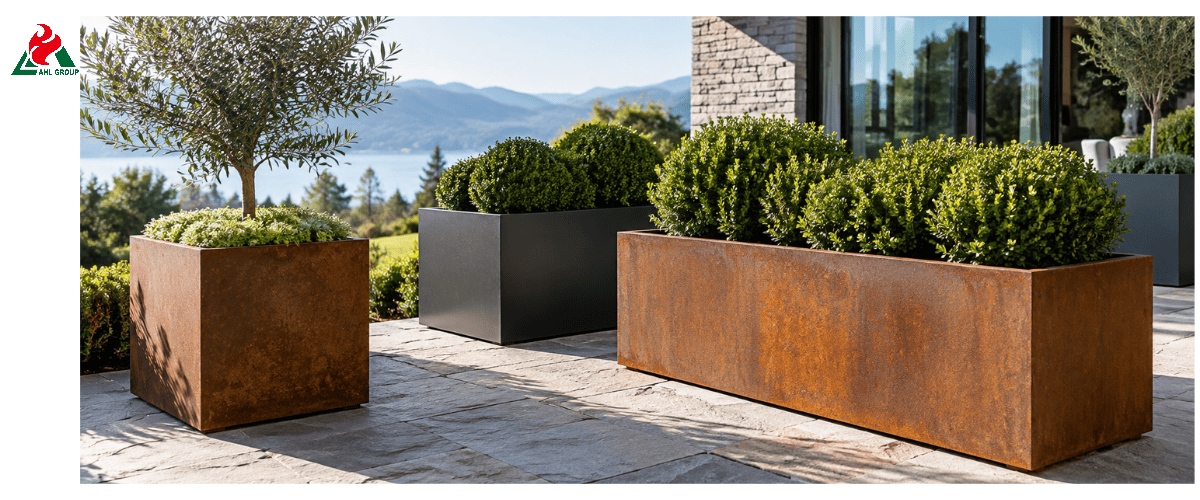
4. Material 2: Wood (Cedar, Redwood, Teak & Pine) — Best for DIY Warmth, Weakest Against Rot
Wood is the traditional material for backyard raised garden beds and rustic deck boxes—prized for its warm natural grain, easy carpentry with hand tools, and low thermal conductivity.
Natural Root Insulation & Rustic Aesthetics vs Fungal Decay at the Soil Line
Because dry wood has a cellular structure filled with tiny pores, a 38-millimeter (1.5-inch) thick cedar board can serve as a natural insulator for plant roots. However, wood has an unavoidable biological weakness in outdoor environments: it is an organic food source for soil fungi and insects.
When you fill a wooden planter with soil and water it weekly, the inner wooden surface remains damp for extended periods—creating the ideal environment of oxygen and moisture for brown rot and white rot fungi to thrive:
► Untreated fir, pine, or spruce: Within 2 to 3 years, the bottom corners and areas in contact with the soil will rot completely and collapse outward under the weight of the soil.
► Western red cedar and California redwood: These contain natural antifungal compounds (lignin and tannins) that can extend the lifespan of outdoor planters to 5 to 10 years. However, unless oiled annually, cedar will turn silver-gray within 12 months, and the bottom board will still soften and rot within a decade.
► Tropical hardwoods (Ipe, teak, kumaru): These high-density hardwoods, rich in silica and oils, can last 12 to 20 years outdoors. However, the cost of the raw materials and joinery is often comparable to or higher than that of 2.0-millimeter welded weathering steel—and they still require regular oiling and reinforcement with stainless steel brackets to prevent corner warping.
Why Pressure-Treated Timber (ACQ / Copper Azole) & Plastic Liners Require Caution
To extend the lifespan of inexpensive pine wood, builders often choose green pressure-treated wood or nail black polyethylene plastic sheets into wooden planters:
► Although modern ACQ (alkaline copper quaternary ammonium) and CA (copper azole) treated lumber no longer contains arsenic (CCA), many organic vegetable growers still avoid using wood that contains high concentrations of chemical preservatives; furthermore, pressure-treated pine is prone to severe warping, cracking, and splitting when dried in the sun.
► Securing an airtight plastic sheet to the inside of a wooden planter with staples can trap moisture between the plastic and the wood walls, which often accelerates wood rot—this creates an anaerobic “steam chamber” that causes structural rot in hidden areas.
5. Material 3: Precast Concrete & GFRC (Glass Fiber Reinforced Concrete) — Best for Security Ballast, Hardest to Move
When municipalities or commercial plazas need an immovable barrier planter to block vehicle access along a sidewalk, precast architectural concrete is a traditional contender.
Extreme Dead Weight (150–320+ kg Empty) & Structural Rooftop Load Limits
Standard precast concrete planters require relatively thick walls (40 millimeters to 75 millimeters / 1.5 inches to 3.0 inches) to prevent cracking during casting and transportation. Consequently, an empty 1,000 × 500 × 500-millimeter concrete planter can weigh as much as 150 to 320 kilograms (330 to 700 pounds) before a single shovel of soil is added—in contrast, a weathering steel planter (AHL-CP16) of the same dimensions weighs only 31 to 45 kilograms.
This extreme dead weight presents two major engineering challenges:
► Unsustainable structural deck loads: Residential wooden decks, apartment balconies, and commercial green roofs all have strict structural dead load limits (typically 2.0 to 4.8 kN/m² / 40 to 100 psf). Once 350 kilograms of wet soil is added to a 250-kilogram concrete planter, the resulting concentrated point load often exceeds the limits of the roof structure’s design.
► Forklift and crane installation costs: Unlike weathering steel planters weighing only 22 to 45 kilograms—such as the AHL-CP02 50-centimeter cube or the AHL-CP16 120-centimeter-long trough— which can be carried by hand through garden gates or elevators by two installers—concrete planters require the use of pallet jacks, boom trucks, or cranes.
(Note: GFRC—glass-fiber-reinforced concrete—reduces wall thickness to 15 to 25 millimeters through the use of alkali-resistant glass fibers, cutting its dead weight by about half. However, it is still significantly heavier than 2.0-millimeter-thick welded weathering steel and is more prone to breakage when subjected to corner impacts.)
Alkaline Lime Leaching (pH > 8.5) & Hairline Frost Spalling
Fresh cement paste is strongly alkaline (pH 11 to 12). Unless the interior of the concrete planter has been thoroughly sealed with an asphalt or epoxy barrier:
► Irrigation water will leach free calcium hydroxide (lime) from the concrete walls into the potting mix, causing the soil pH to exceed 8.0. This results in iron deficiency symptoms (interveinal chlorosis) in acid-loving plants such as hydrangeas, camellias, blueberries, Japanese maples, and azaleas.
► At the same time, the dissolved lime will pass through the concrete walls and crystallize on the outer surface, forming chalky white efflorescence streaks.
► In regions with alternating freeze-thaw cycles, unsealed concrete will absorb rainwater into its surface pores; after 10 to 15 winters, repeated freeze-thaw cycles will cause microcracks to appear on the surface and spalling in the corners.
6. Material 4: Commercial Fiberglass (FRP) & Marine Aluminum — Best for Weight-Restricted Balconies
When a project demands the crisp, modern geometric silhouette of metal or painted architecture on a weight-sensitive balcony or penthouse roof deck, specifiers typically look at commercial fiberglass (FRP — Fiber Reinforced Polymer) or marine-grade aluminum.
Commercial Fiberglass (FRP): Ultra-Light Weight (10–18 kg) vs UV Gel-Coat Fading & Corner Delamination
The manufacturing process for fiberglass-reinforced plastic flower pots involves laying woven fiberglass mat impregnated with polyester or vinyl ester resin into a mold for shaping, followed by applying a colored, automotive-grade gel coat to the surface:
1. Advantages of FRP: An empty 1,000 × 500 × 500 mm FRP trough weighs only 10 to 18 kilograms, making it effortless to carry up stairs. Additionally, it is non-porous and will not corrode in coastal salt fog environments.
2. Disadvantages of FRP compared to weathering steel:
► UV-induced chalking and fading of the gel coat (5–8 years): Just like an unwaxed fiberglass boat hull exposed to sunlight, the outer polymer gel coat will age under UV radiation. Deep charcoal gray, black, and bronze fiberglass planters will lose their luster, develop chalking, and fade within 5 to 8 years, requiring professional sanding and recoating with automotive-grade polyurethane paint.
► Brittle Fracturing and Corner Cracking in Extreme Cold: If drainage holes become clogged by tree roots and standing water freezes inside a square fiberglass planter, this rigid resin-glass laminate—which lacks the ductility of steel—will often crack along the vertical molded corner seams.
► Surface Scratch Susceptibility: Unlike rust spots on weathering steel, which have self-healing properties, once deep scratches appear on colored fiberglass planters, they expose the underlying white fiberglass and cannot repair themselves.
Powder-Coated Marine Aluminum (5052 / 6061): Corrosion Resistance vs. Cost & Denting
Aluminum planters for architectural use (made from 2.0 mm to 3.0 mm thick 5052-H32 marine-grade aluminum alloy and finished with an architectural-grade powder coating) are another sturdy and lightweight option (weighing about one-third as much as steel) that performs well in salt-fog areas directly adjacent to the coast, where the use of bare weathering steel is not recommended. However, aluminum has a lower modulus of elasticity (E ≈ 69 GPa, compared to 200 GPa for steel)—which means it requires thicker sheet metal or more extensive internal reinforcement to prevent deformation caused by soil. It is also more prone to denting when subjected to impact, and its raw material and welding costs are 35% to 60% higher than those of Corten steel planter boxes.
7. Material 5 & 6: Terracotta / Glazed Ceramic & LLDPE Plastic / Resin
Rounding out the six materials are the two most common retail garden-center categories: traditional clay pottery and molded plastic/resin containers.
Terracotta & Glazed Stoneware: Breathable Root Walls vs Winter Frost Shattering
Unglazed terracotta (clay fired at approximately 1,000°C): Beloved for its classic, warm Mediterranean feel and highly porous walls (with a water absorption rate of 8% to 15%), this material allows air to reach the roots and prevents cacti, rosemary, and citrus plants from being damaged by overwatering. However, this high water absorption rate can lead to disastrous consequences during harsh winters—unless the moist terracotta pots are emptied and stored indoors every fall, just one to three freeze-thaw cycles will cause them to crack and flake. Furthermore, in the high heat of summer, they cause the potting soil to dry out two to three times faster.
High-temperature glazed stoneware/ceramics (1,200°C–1,300°C): The water absorption rate of vitrified stoneware is significantly lower than that of terracotta (<2% to 3%), and it is more durable than terracotta under moderate frost conditions—provided the pots are placed on pot stands to ensure that the drainage holes at the bottom do not freeze due to contact with patio tiles. However, ceramic planters cannot be manufactured in elongated shapes (1,200 mm to 2,000 mm) weighing between 50 kg and 120 kg; if knocked over by the wind or struck by gardening tools, they will shatter permanently.
Rotational-Molded LLDPE Plastic & Resin: Budget Portability vs UV Brittleness & Wall Bulging
Thin-walled injection-molded polypropylene/PVC planters: The cheapest containers on the market, suitable only for temporary seedling propagation or growing annual flowers for 1 to 3 seasons; after that, UV radiation causes the plastic to become so brittle that it will break in your hands.
Double-wall rotomolded LLDPE (linear low-density polyethylene) resin: High-end commercial resin planters feature a thick, double-wall structure stabilized with HALS (hindered amine light stabilizers), offering a service life of 8 to 12 years and good frost-resistant flexibility. Even so, plastic resin still lacks true structural rigidity in right-angled rectangular planters—they tend to bulge outward under the pressure of wet soil—and they always retain the appearance of synthetic molding, which cannot compare to the genuine architectural dignity of weathered, weather-resistant steel, stone, or wood.
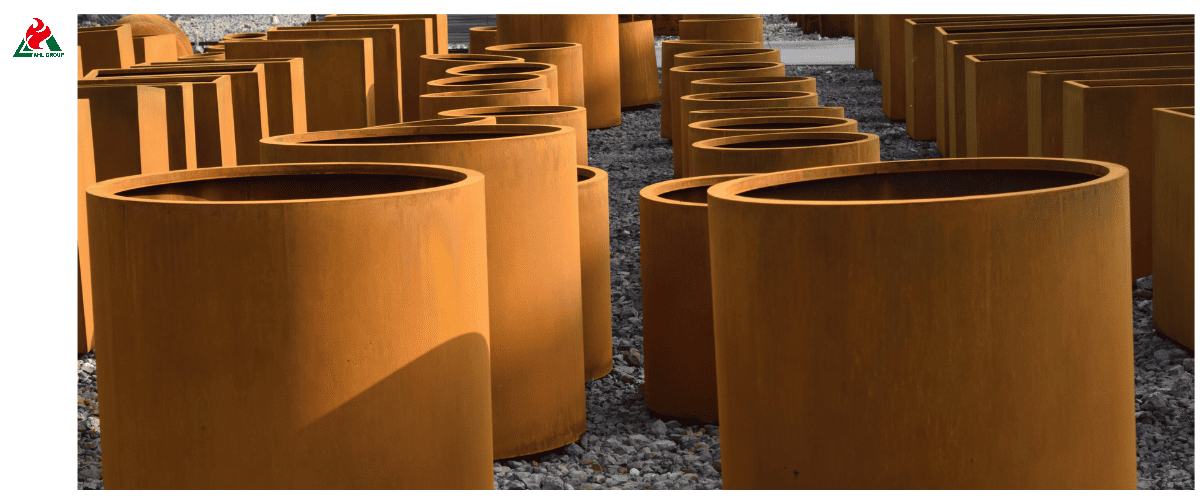
8. Engineering Reference Table: Sizing & Specifying Corten Steel Planters by Plant Type (AHL-CP Series)
Once you choose Corten steel for its 30–50+ year lifespan and zero-maintenance patina, selecting the right root depth, span geometry, and plate thickness (1.5 mm, 2.0 mm, or 3.0 mm–6.0 mm) ensures healthy plant growth and zero wall deflection.
The table below maps common landscape plant categories directly to verified AHL Corten Steel Planter (AHL-CP01 to AHL-CP18 & CP08) production specifications:
| Plant Category & Root Depth Requirement |
Recommended Planter Geometry & Minimum Depth | Verified AHL Model Numbers (AHL-CP Series) | Standard Dimensions (cm/mm) | Plate Thickness (mm) | Empty Tare Weight (kg) |
| Succulents, Alpine Perennials, Trailing Ivy & Wall Greens (Shallow fibrous roots: 150–350 mm) |
Compact wall-hanging troughs, shallow bowls, or low patio cylinders | AHL-CP09 (Wall/Window Box) AHL-CP10 (Compact Round) AHL-CP04 (Small Square) |
32 × 9 × 24 cm D40 × H40 cm 30 × 30 × 45 cm |
1.5 mm 1.5 mm 2.0 mm |
2.0 kg 1.5 kg 14.0 kg |
| Ornamental Grasses, Boxwood Hedges, Bamboo & Culinary Herbs (Medium root ball: 400–600 mm) |
Narrow rectangular divider troughs with folded rim & mid-span stiffening rib | CP08 (Flagship Long Trough) AHL-CP03 (Patio Troughs) AHL-CP16 (Commercial Troughs) |
1200 × 400 × 550 mm 60×30×50 / 80×30×50 cm 100×45×45 / 120×50×60 cm |
1.5–6.0 mm (2.0/3.0 std) 2.0 mm 2.0 mm |
~32–47 kg 25 / 32 kg 31 / 45 kg |
| Tall Balcony & Restaurant Privacy Screen Plantings (Elevated screen height: 750–1,200 mm) |
High-profile narrow rectangular troughs (can use false bottom shelf to reduce soil weight) | AHL-CP17 (Balcony Divider) AHL-CP01 (Tall Tapered) AHL-CP11 (1.2m Screen Trough) |
88×30×H75 / 90×30×H80 cm 45×35×50 / 75 / 100 cm 80 × 30 × 120 cm |
2.0 mm 2.0 mm 2.0 mm |
20 / 37 kg 16 / 22 / 29 kg 40.0 kg |
| Medium Shrubs, Hydrangeas, Roses & Dwarf Citrus Trees (Deep symmetric root zone: 500–800 mm) |
Medium-to-large square cubes and deep cylindrical round planters | AHL-CP02 (Cube Series) AHL-CP06 (Round Series) AHL-CP13 / CP14 / CP15 (Cylinders) AHL-CP05 (Tall Square Columns) |
50 / 60 / 70 / 80 cm Cubes D50×H50 / D60×H60 / D80×H80 cm D35×H80 / D50×H60 / D50×H50 cm 40×40×80 / 50×50×100 cm |
2.0 mm 2.0 mm 2.0 mm 2.0 mm |
22 / 30 / 41 / 53 kg 17 / 24 / 43 kg 17 / 19 / 17 kg 24 / 37 kg |
| Specimen Street Trees, Olive Trees, Japanese Maples & Commercial Plazas (Heavy woody root flare: 600–1,000 mm+) |
Heavy-gauge 3.0 mm+ oversized troughs, 100 cm cubes, and wide tree rings | AHL-CP12 (Heavy Trough) AHL-CP18 (Heavy Tree Cylinder) AHL-CP16 (1.5m–2.0m Troughs) AHL-CP07 (1.0m Mega Cube) |
150 × 50 × H70 cm D80 × H60 cm 150×50×H60 / 200×50×H60 cm 80×80×80 / 100×100×100 cm |
3.0 mm 3.0 mm 2.0 mm (3.0+ custom) 2.0 mm (3.0+ custom) |
57.0 kg 30.0 kg 53 / 68 kg 70 / 110 kg |
9. Frequently Asked Questions (FAQ)
Q1: What is the single most durable material for outdoor (outside) planters in all four seasons?
A: Corten steel (2.0 mm to 3.0 mm+ ASTM A242 / A588 weathering steel) is the most durable all-season material for outdoor planters, offering a 30 to 50+ year service life. Unlike terracotta, ceramic, and concrete (which crack when wet soil freezes and expands by 9%), or wood and plastic (which rot or turn brittle under UV sunlight), Corten steel flexes elastically under freeze-thaw loads and protects itself with a self-healing oxide patina.
Q2: Do Corten steel planters get too hot for plant roots in summer?
A: In mild to moderate climates, the generous soil volume inside a 400 mm to 1,000 mm wide Corten planter buffers root temperatures naturally, and the matte rust patina reflects less glare than shiny metal. For hot summer climates (south/west exposures above 32°C / 90°F) or sub-zero winter zones, lining the inside walls with 15 mm to 25 mm closed-cell XPS foam insulation board (available as a factory option on AHL troughs like CP08 and AHL-CP16) provides better root insulation than thick cedar wood.
Q3: How long do Corten steel planters last compared to cedar wood and fiberglass?
A: A 2.0 mm to 3.0 mm fully welded Corten steel planter lasts 30 to 50+ years with zero painting or structural maintenance. By comparison, untreated Western Red Cedar planters typically last 5 to 10 years before soil-line fungal rot weakens the boards, while commercial fiberglass (FRP) planters last 10 to 20 years structurally but require UV gel-coat waxing or repainting after 5 to 8 years of direct sun exposure.
Q4: Are Corten steel planters safe for growing organic vegetables, herbs, and fruit trees?
A: Yes, completely safe. Iron is an essential micronutrient that plants require for healthy green foliage. Once the inner patina forms in free-draining garden soil (pH 6.0 to 7.5), iron leaching is minuscule and beneficial, with zero toxic synthetic preservatives—making Corten Metal Raised Planters far safer for edibles than chemically pressure-treated lumber or alkaline-leaching unsealed concrete.
Q5: What wall thickness (gauge) should I choose for a Corten steel planter box?
A: Match the plate thickness to the planter's span and soil volume:
► 1.5 mm (16 ga): Ideal for small wall-hanging boxes and compact round patio pots up to 400 mm (AHL-CP09, AHL-CP10).
► 2.0 mm (14 ga): The architectural standard for residential and commercial cubes (300 mm to 1,000 mm, AHL-CP02/07/08), cylinders (AHL-CP06), and internally ribbed troughs up to 2,000 mm (AHL-CP08, AHL-CP16).
► 3.0 mm to 6.0 mm (11 ga to 3/16"): Recommended for deep streetscape tree planters (AHL-CP12 150×50×70 cm, AHL-CP18 D80×H60 cm), retaining planter walls, and high-traffic public plazas.
Q6: Do outdoor planters need drainage holes in the bottom?
A: Yes—always. Every outdoor planter (except dedicated aquatic water-lily bowls) must have unobstructed bottom drainage holes (Ø20 mm–30 mm) elevated slightly on riser feet, covered internally with a 50 mm washed gravel layer and breathable geotextile fabric. Only when a planter is used as a Corten Steel Bottomless Flower Pot set directly over native garden soil is a perforated floor plate omitted.
Conclusion: Invest Once in Architectural Corten Steel Planters Built for Decades
When you compare all six materials side by side—Corten steel, wood, precast concrete, fiberglass, ceramic/terracotta, and plastic resin—the lifecycle math is unmistakable. Wood rots from the inside out within a decade; terracotta and unsealed concrete crack under winter freeze-thaw expansion; plastic and fiberglass gel-coats chalk under relentless summer UV; while Corten steel planters grow richer in character with every passing season and deliver 30 to 50+ years of maintenance-free structural performance.
At AHL Group, we manufacture a full architectural line of Modern Square Corten Steel Planter Boxes (AHL-CP02 / CP07), Large Rectangular Corten Steel Trough Planters (CP08 & AHL-CP16), Corten Round Planters (AHL-CP06 / CP18), and Corten Metal Raised Planters in 1.5 mm to 6.0 mm weathering steel—complete with double-folded rims, internal C-channel stiffening ribs, optional 15–25 mm riser feet, internal XPS root insulation, and factory pre-weathering. Contact our team today for custom project dimensions, CAD drawings, and factory-direct wholesale pricing.
Need Custom Corten Steel Planters or Landscape Edging?
Factory-direct 2mm-5mm Corten steel planter boxes and flexible lawn borders with pre-drilled drainage and stake anchoring systems.
» Custom Corten Planter Boxes | Corten Landscape Edging | Request a Factory Quote
Factory-direct 2mm-5mm Corten steel planter boxes and flexible lawn borders with pre-drilled drainage and stake anchoring systems.
» Custom Corten Planter Boxes | Corten Landscape Edging | Request a Factory Quote

