


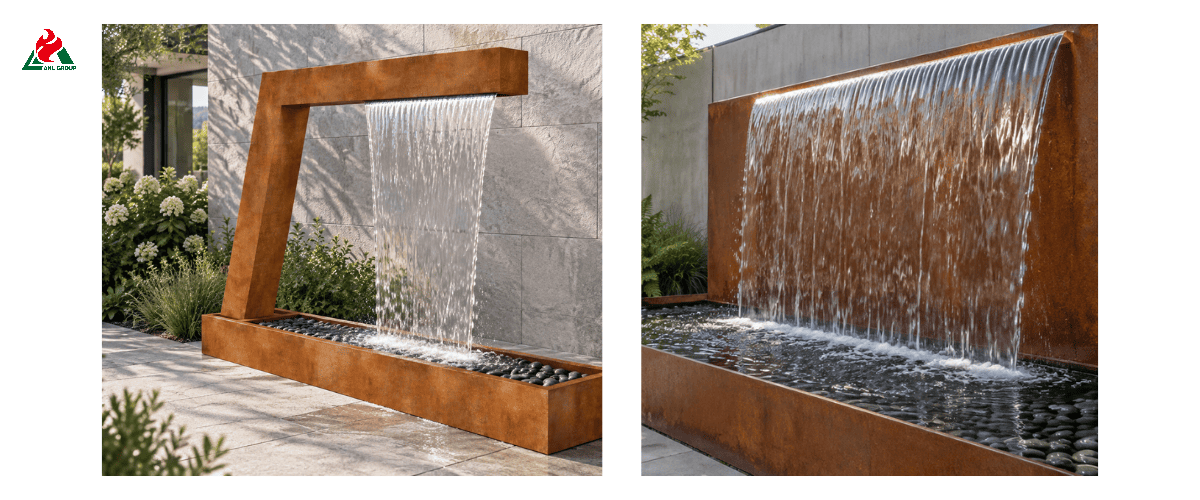
The Corten Steel Water Feature operates by combining two independent engineering systems: a self-contained closed-loop hydraulic circuit and a self-protective weathering steel oxide layer (patina). Within the base reservoir (300 to 500 millimeters deep), a silent submersible pump draws water from the reservoir through a pre-filter cage, conveying it upward via concealed internal piping and flow control valves. The pressure is balanced in the upper collection chamber before the water is released through a precision stainless steel overflow weir, a multi-nozzle rain curtain, or a central water meter bubble nozzle, thereby enabling continuous water circulation without relying on a permanent municipal water supply. Meanwhile, copper-chromium-phosphorus alloy weathering steel (Corten A / ASTM A588, typically 2.0 to 3.0 millimeters thick) reacts during repeated cycles of wetting and drying, transforming the surface iron oxide into a dense, water-insoluble goethite (α-FeOOH) rust layer, thereby protecting the underlying structural steel from perforation and rust.
For property owners, landscape architects, and specifiers in the hospitality industry, understanding the interaction between the two components of this system—mechanical pump circulation and electrochemical rust layer formation—explains why well-designed weathering steel fountains can operate outdoors for decades with virtually no maintenance, while poorly piped carbon steel imitations leak water, stain surrounding stone, and corrode prematurely.
For property owners, landscape architects, and specifiers in the hospitality industry, understanding the interaction between the two components of this system—mechanical pump circulation and electrochemical rust layer formation—explains why well-designed weathering steel fountains can operate outdoors for decades with virtually no maintenance, while poorly piped carbon steel imitations leak water, stain surrounding stone, and corrode prematurely.
1. The Closed-Loop Hydraulic Circuit: How Water Circulates Without Mains Plumbing
One of the most common questions buyers ask before ordering an architectural fountain is: Do I need to dig up the patio to connect to permanent municipal water and sewer lines? The answer is no. Modern Corten steel water features utilize a self-contained, closed-loop circulation system—meaning the same volume of water continuously circulates from the base basin to the top spout and back to the base basin. They require only a standard weatherproof outdoor electrical outlet (or power from a low-voltage transformer) and periodic water refills to compensate for losses due to natural evaporation.
Each closed-loop Corten steel fountain relies on four hydraulically coordinated stages:
Stage 1 — The Base Reservoir & Sump Volume (300mm–500mm Freestanding Trough vs In-Ground Basin)
The base reservoir serves as the hydraulic foundation for the entire water feature system. It fulfills three functions:
1. Storing the operating water volume required to keep the submersible pump fully submerged at all times (to prevent cavitation caused by air locks and dry running).
2. To accommodate “flowing” water—that is, water that temporarily remains in the vertical riser, upper collection chamber, and waterfall or rain curtain while the pump is running.
3. To provide a sufficiently wide and long geometric flow area to catch water droplets blown off course by the wind, preventing them from splashing onto adjacent patio pavers.
Depending on your chosen architectural style, the water collection basin can be configured in one of the following two ways:
► Integrated, freestanding weathering steel catch basin (depth 300 mm to 500 mm): In self-contained vertical water curtain structures such as the AHL Corten Steel Outdoor Water Wall (WF04-01, 1500 × 1000 × 200 mm), a 300-mm-high catch basin (with a base projection area of 400 mm) is directly welded to the bottom of the unit. In larger gantry- and cantilever-style rain curtain structures—such as the WF05-01 (featuring a 3,050 mm long × 500 mm wide × 300 mm high collection basin supporting a structure 2,000 mm high with a 2,000 mm cantilever) or the AHL-WF02 / WF04 / WF06 series (an 1,800 × 250 × 1,800-millimeter frame housed within a 2,000 × 500 × 500-millimeter weathering steel container)—the exposed weathering steel trough serves both as structural ballast and as an architectural reflection pool.
► Concealed Underground Water Collection Tanks (“Tankless” Pebble Reservoirs): For low-profile sculptural spheres, overflow lotus basins (AHL-WF18, 800 mm in diameter × 500 mm in height), or ground-level courtyard water platforms (AHL-WF11/12/13), the weathering steel components can be placed atop heavy-duty stainless steel or fiberglass support grids, with a buried retention basin filled with washed river pebbles beneath. Water flows down the outer surface of the Corten steel, seeps into the decorative stone bed, and ultimately collects in the underground retention basin for recycling.
Stage 2 — Submersible Pump Intake, Mechanical Pre-Filtration & Dynamic Lift
An energy-efficient submersible circulation pump is quietly positioned at the lowest point of the water feature (typically mounted on rubber shock-absorbing feet to prevent low-frequency humming caused by contact between the pump body and the steel floor).
When powered on, the magnetically driven or asynchronous impeller inside the pump rotates within the volute, drawing water from the feature through a slotted mechanical pre-filter cage and perforated foam sponge. In weathering steel water features, this intake pre-filtration system is crucial: during the first few weeks of “aging” outdoors, as a rust layer gradually forms, the new steel surface sheds microscopic iron oxide particles; furthermore, outdoor breezes inevitably blow leaves, pollen, and dust into the water basin. The pre-filtration sponge intercepts these particles before they enter the impeller chamber or flow upward to clog the rain curtain nozzles at the top.
From the volute outlet, the pump pressurizes the water column to overcome the total dynamic head (TDH)—that is, the sum of the vertical static head (e.g., 1.5 meters for the WF04-01 model, 1.8 meters for the AHL-WF02/03 models, and 2.3 meters for the WF05-01 model) and the frictional resistance of the internal piping and fittings.
Stage 3 — Internal Riser Piping, Check Valves & Inline Flow Throttling
A key feature of weathering steel structures in building construction is that no hoses or wires are visible from the outside. After water flows out of the discharge port of the submersible pump, it travels upward through a flexible PVC or reinforced silicone riser with a smooth, kink-free inner wall; this hose is completely routed inside the hollow weathering steel structure:
► In the vertical water curtain (WF04-01 or WF08), the riser extends upward through a separate internal conduit channel located behind the wet waterfall face.
► In the cantilevered L-shaped arch (WF05-01), the water supply line rises from the left-side basin inlet platform through a 250-millimeter × 250-millimeter hollow, beveled structural column and extends along the inner side of the 2,000-millimeter horizontal cantilever beam.
► In the reflective water curtain (AHL-WF11/12/13 or AHL-WF17), a short riser rises straight up from the center of the base and enters the upflow inlet on the top deck.
Two small piping components installed on this internal riser have had a significant impact on daily operations:
1. In-line ball valve (flow control valve): Since wind conditions, distance from the terrace, and sound preferences vary at each installation site, the in-line throttle valve (or variable-speed direct-flow pump controller) allows you to precisely adjust the flow rate. Simply turn the valve down slightly, and the turbulent, lively flow of a waterfall transforms into gentle, laminar ripples as soft as a whisper.
2. Check valve (for towering fountains with a height of ≥1,500 millimeters): In taller fountains such as the AHL-WF23 (height: 2,000 mm) or WF05-01 (total height: 2,300 mm), a swing-type or spring-loaded check valve installed directly above the pump outlet prevents the vertical water column in the riser from flowing back into the pump and overflowing into the lower basin when the system is shut down each night.
Stage 4 — The Upper Header Chamber, Diffuser Baffle & Stainless Steel Weir
If you simply pumped water out of an open pipe at the top of a steel wall, it would jet out in a turbulent, narrow stream that pinches inward and splashes erratically. To create a glass-smooth sheet of water or a uniform curtain of rain droplets, the top of a Corten water feature contains a calming header chamber (plenum) and a precision stainless steel outlet:
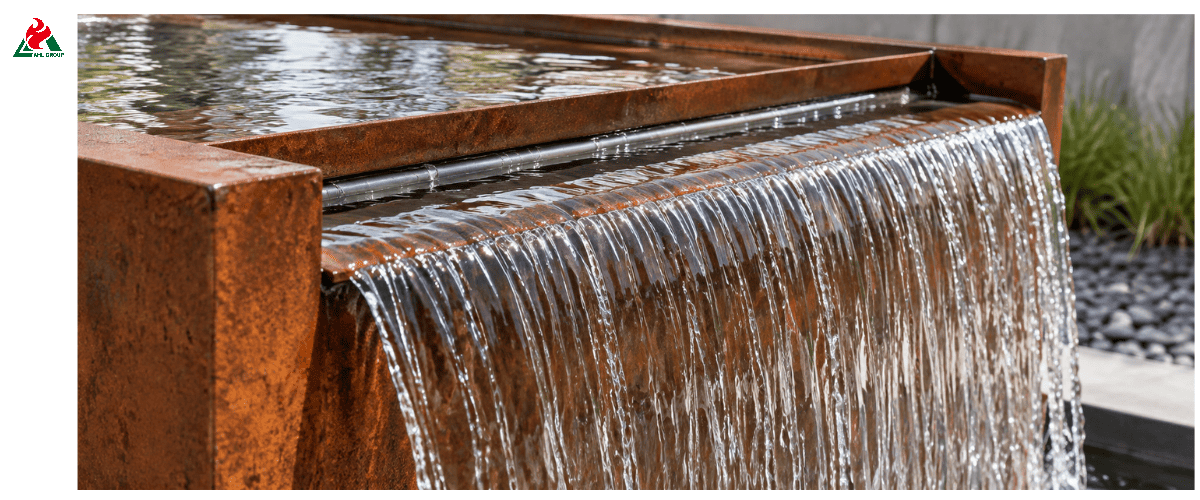
► Inside a Sheet-Flow Water Wall (WF04-01, WF08, WF09-01): On the WF04-01, the top 300 mm Header Tank acts as a pressure-equalizing reservoir. Pressurized water from the riser hose enters a perforated diffuser pipe at the bottom of the header tank, rises calmly through an internal baffle plate that kills eddy currents, and spills over a precision-machined 25 mm stainless steel weir (or across the full 1,471.5 mm stainless weir on the 1500 × 1500 mm WF09-01). Because the weir lip is CNC-machined from corrosion-proof 304/316 stainless steel with a sharp front drip edge, water exits at uniform depth across the entire width—forming a continuous, unbroken sheet across the 900 mm Waterfall Zone below.
► Inside a Rain Curtain Overhang (WF05-01, AHL-WF02, AHL-WF03): Inside the overhead horizontal beam (2000 mm long on WF05-01, 1800 mm on AHL-WF02, or 2400 mm on AHL-WF03), the riser feeds a sealed stainless steel manifold fitted with a linear row of calibrated drip nozzles. Once the manifold fills and equalizes pressure, every nozzle releases a discrete, parallel thread of water simultaneously—creating the shimmering visual effect of a suspended curtain of rain.
2. The Metallurgical Paradox: How Corten Steel Works in Water Without Rusting Through
Once buyers understand the closed-loop pump circuit, their immediate next question is metallurgical: "If Corten steel looks rusty, why doesn't flowing water eat right through the metal like an old tin bucket?"
The answer lies in the fundamental difference between porous carbon-steel rust and passivating weathering-steel patina—and in how water features are engineered to give the steel daily breathing room.
Carbon Steel vs Corten A / ASTM A588 (Cu-Cr-P-Ni Alloying Chemistry)
Ordinary low-carbon steel (Q235 / A36) consists almost entirely of iron and carbon. When exposed to water and dissolved oxygen, it forms hydrated iron(III) oxide—a rough, spongy crystalline layer that expands, cracks, and flakes off (exfoliation). As fresh water and oxygen continuously seep into these microcracks, ordinary steel corrodes inward at a linear rate until the plate is perforated.
In contrast, architectural Corten steel water feature structures are made from specialized weathering steel alloys (Corten A / ASTM A242 Type 1 or Corten B / ASTM A588 Grade A) with plate thicknesses ranging from 2.0 mm to 3.0 mm (14 to 11 gauge). These alloys contain precise trace amounts of four corrosion-resistant elements:
► Copper (Cu: 0.25% to 0.55% in Corten A; 0.25% to 0.40% in ASTM A588): Acts as the primary electrochemical catalyst during the wetting and drying processes, helping to form a fine-grained, strongly adherent internal oxide film.
► Chromium (Cr: 0.50% to 1.25% in Corten A; 0.40% to 0.65% in ASTM A588): Displaces iron within the hydroxy iron oxide lattice (chromium-doped goethite), resulting in a dense, cation-selective inner barrier that resists erosion by dissolved ions.
► Phosphorus (P: 0.07% to 0.15% in Corten A/ASTM A242): Accelerates uniform passivation of the surface of architectural steel sheets (2.0 mm to 3.0 mm thick) and seals the micropores in the rust layer during the drying process.
► Nickel (Ni: up to 0.65% in Corten A; up to 0.40% in ASTM A588) and silicon (Si: 0.25% to 0.75%): These elements stabilize the alloy matrix and improve the adhesion between the steel substrate and the developing oxide scale.
The Two-Layer Oxide Mechanism: From Porous Lepidocrocite (γ-FeOOH) to Dense Goethite (α-FeOOH)
A Corten steel water fountain does not stop rusting on the first day—instead, it undergoes a two-stage phase transition process at the metal-water interface:
1. Initial wetting phase (formation of the outer layer of scaly hematite (γ-FeOOH)): When water first flows over exposed or slightly pre-weathered Corten steel, iron ions dissolve at anodic microsites and oxidize in the presence of dissolved oxygen, forming a bright amber-orange outer layer of scaly hematite (γ-FeOOH). During this early stage, small amounts of loose iron oxide may be washed into the tank, causing the circulating water to temporarily appear tea-colored or amber.
2. Dehydration and Consolidation Stage (Formation of the Inner Layer of Goethite (α-FeOOH)): When the water flow stops and the steel surface dries in the air, the moist outer layer of γ-FeOOH dehydrates and reorganizes at the alloy interface, forming an ultra-dense, amorphous inner layer of goethite (α-FeOOH) rich in copper and chromium. Unlike ordinary rust, this inner layer of α-FeOOH acts as a pore-free barrier that bonds tightly to the base metal—thereby preventing water molecules and dissolved oxygen from coming into contact with the bare steel beneath.
Why Alternating Wet-Dry Cycles Are Mandatory (And Why a Smart Timer Is Your Best Friend)
Please note the key requirement in Step 2 above: The oxide layer must be dried periodically so that it can transform from porous, orange-colored potassite into protective, dark brown goethite.
If a weathering steel water bowl or water feature operates continuously 24 hours a day, 7 days a week, the vertical steel surfaces will be constantly covered by a flowing water film. Without dry intervals to allow oxygen exposure, the alloy cannot complete the dehydration process—meaning it will continue to shed loose orange oxide layers, and its corrosion rate will approach that of ordinary carbon steel.
How do professional landscape designers solve this problem? Simply install a basic 24-hour automatic outlet or a smart Wi-Fi timer in the water pump circuit:
► Daytime/Evening Enjoyment Mode (On for 8 to 14 hours): The pump runs during daytime and evening hours when the patio is in use (e.g., 8:00 a.m. to 10:00 p.m.), creating a sparkling, refreshing waterfall.
► Nighttime Drainage Cycle (off for 10 to 16 hours): At night (10:00 PM to 8:00 AM), the timer shuts off the pump. Within 30 to 90 minutes, the thin film of water on the vertical weathering steel walls (WF04-01, WF08) or the horizontal water platform (AHL-WF11) drains completely into the lower pool. Exposed to the night air and morning breeze, the moist oxide layer dehydrates, shrinks, and forms a dense, deep chocolate-brown layer of α-FeOOH patina.
Exposed Wet-Dry Splash Faces vs Permanently Submerged Basin Interiors
This physical phenomenon of wet-dry cycles also explains why high-end weathering steel water features employ different treatment methods for surfaces above the waterline compared to the interior of permanently submerged pools:
► Exposed surfaces above the waterline (water curtain walls, cantilever beams, spillway surfaces, and external channel walls): These surfaces undergo natural wet-dry cycles (influenced by daily pump timers and weather conditions) and should remain unpainted, exposing the weathering steel (or factory-pre-weathered) to allow its “living” rust layer to form naturally.
► Permanently submerged interior of the pond (inside the 300-millimeter to 500-millimeter collection basin): Since water accumulates 250 millimeters to 450 millimeters below the bottom of the lower collection basin around the clock—even when the pumps are turned off at night—the pond floor and submerged interior walls will never experience a drying cycle. As outlined in our Corten cladding environmental suitability guide, permanently submerged weathering steel should be protected with pond-safe two-component epoxy, polyurea, or elastic asphalt linings/coatings (or manufactured with a concealed stainless steel/high-density polyethylene liner). Sealing only the concealed interior of the tank prevents the continuous leaching of iron underwater, keeps the circulating water clear and transparent, and extends the service life of the tank’s welds by decades—all while preserving the 100% naturally weathered Corten steel appearance on the exterior.
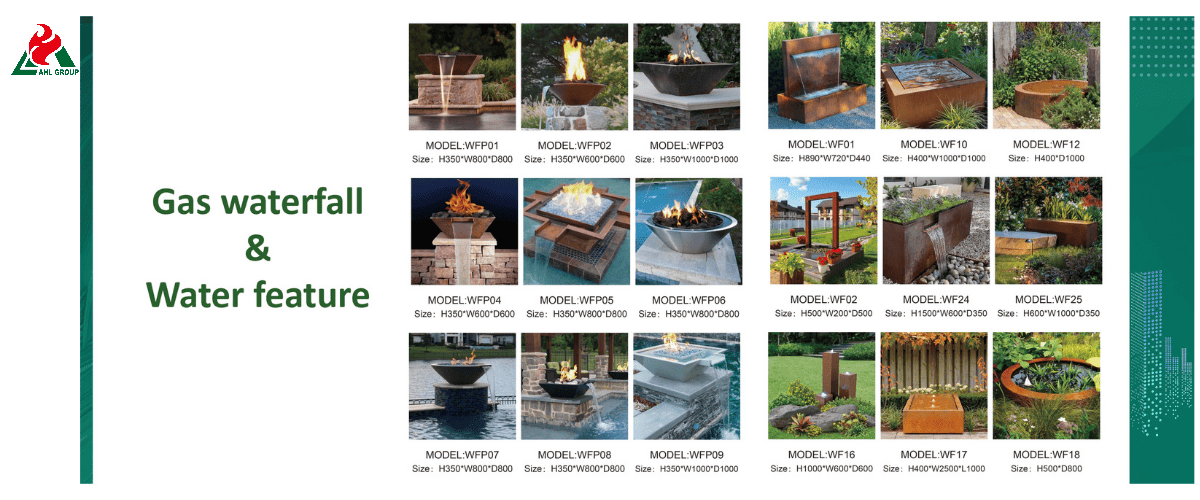
3. How the 5 Main Types of Corten Steel Water Features Work (With Verified AHL Models)
While every model shares the same closed-loop pump and patina principles, the hydraulic delivery mechanism at the top of the fountain changes how the water looks, sounds, and interacts with wind. As outlined in our design guide for Corten water features, here is how the five primary architectural styles work in practice:
1. Vertical Sheet-Flow Water Walls (WF04-01, WF08, WF09-01, AHL-WF20/22/23)
Vertical Corten steel water walls are designed to create a continuous, shimmering water film or thin water curtain that adheres closely to (or falls directly in front of) a vertical weathering steel structure.
Operating Principle (using the WF04-01 as the engineering reference): In the AHL Corten Steel Outdoor Water Wall (WF04-01), this column—measuring 1,500 mm high × 1,000 mm wide × 200 mm in cross-sectional thickness—is divided into three integrated sections: a 300-mm-high lower water basin (with a base footprint of 400 mm to ensure independent stability), a 900-millimeter-high vertical waterfall zone, and a 300-millimeter-high top water collection tank. A submersible pump draws water into the 300-millimeter-high collection tank, where a precision-engineered 25-millimeter stainless steel overflow weir distributes the water evenly across the entire 1,000-millimeter width. On wider square water curtain walls (such as the WF09-01, 1500 × 1500 mm), a precision-machined stainless steel overflow weir spanning 1471.5 mm creates a seamless water curtain; whereas vertical water curtain walls with integrated LEDs (such as the AHL-WF20, 1750W × 400D × 1800H mm), AHL-WF22 (1,750W × 400D × 1,200H mm), and AHL-WF23 (1,000W × 100D × 2,000H mm, equipped with a 2,000 × 500 × 500 mm water basin), among others, cascade water and light together onto textured reddish-brown steel plates.
Acoustic and Splash Characteristics: Because the water curtain lies flush against the vertical weathering steel plate, wind-induced displacement is minimal, producing a calm, velvety-soft murmur—ideal for narrow courtyard walls, as a backdrop for patio dining areas, and in hotel lobbies.
2. Cantilevered & Portal Frame Rain Curtains (WF05-01, AHL-WF02/03/05/06/21/26/27/29)
Unlike a solid water wall, a rain curtain water feature uses an open architectural frame—either a cantilevered "7"-shaped overhang or a 4-sided portal gate—to suspend individual falling water droplets in mid-air like a sunlit summer rainstorm.
How It Works:
► Cantilevered Overhang Architecture (WF05-01): In our WF05-01 cantilevered model, a 3050 mm long × 500 mm wide × 300 mm high rectangular catch basin anchors an angled 250 mm × 250 mm hollow box-beam column that rises 2000 mm above the basin rim (2300 mm total height) and cantilevers 2000 mm horizontally over the water. Water pumped up the hollow angled column fills an overhead nozzle manifold recessed into the underside of the 2000 mm beam, dropping a continuous 2-meter curtain of rain droplets into the 3050 mm trough below.
► Portal Gate Frame Architecture (AHL-WF02, AHL-WF03, AHL-WF05, AHL-WF21, AHL-WF26, AHL-WF29): In gate-style models such as AHL-WF02 / WF06 (1800W × 250D × 1800H mm arch with a 2000W × 500D × 500H mm base pot), AHL-WF03 (2400W × 250D × 1800H mm with a 2500 × 400 × 500 mm pot), AHL-WF05 (800W × 250D × 1800H mm with a 1000 × 500 × 500 mm pot), or compact freestanding frames like AHL-WF21 (1200 × 1200 × 180 mm) and AHL-WF29 (1500 × 1500 × 450 mm), two vertical side columns support the overhead rain bar, creating a see-through garden window framed by Corten steel.
► Acoustic & Splash Profile: Produces a crisp, rhythmic pattering rain sound that masks urban street traffic. Because free-falling droplets descend 1,200 mm to 2,000 mm through open air, rain curtains pair best with elongated 500 mm-wide catch pots (2000 mm to 3050 mm long) and an inline flow valve to control breeze deflection.
3. Low-Profile Reflection Water Tables (AHL-WF11/12/13, AHL-WF14/15/16, AHL-WF17)
A pond crafted from weathering steel transforms a vertical drop into a tranquil, mirror-like surface that reflects the sky and the surrounding trees.
► How it works: For example, the square AHL-WF11/WF12/WF13 series (800 × 800 × 400 mm, 1000 × 1000 × 400 mm, and 1200 × 1200 × 400 mm), the pedestal-column AHL-WF14/WF15/WF16 series (base dimensions 600 × 600 mm, with heights of 700 mm, 1000 mm, or 1300 mm), and the linear rectangular AHL-WF17 (Length 1000L × Width 2500W × Height 400H mm), all feature a recessed top tray design that conceals the base water tank beneath it. A submersible pump gently pushes water to one to three central bubbling nozzles (typically equipped with LED ring lights). The water column forms a dome 20 to 40 millimeters high above the nozzles, creating a reflective water film 5 to 10 millimeters thick on the completely horizontal weather-resistant steel top plate, before flowing down the vertical edges on all sides and into a narrow perimeter drainage channel.
► Acoustic and Splash Characteristics: It emits a soft, whisper-like gurgling sound and produces virtually no wind-driven spray—making the water feature an ideal choice for windy rooftop terraces, small courtyard relaxation areas, and wildlife- and bird-friendly gardens.
4. Sculptural Water Bowls, Round Fountains & Herb Planter Cascades (AHL-WF18, AHL-WF28, AHL-WF33, AHL-WF01)
For organic flower beds and compact patios, these sculptural weathering steel water basins and circular fountains combine curved steel geometries with gentle-edged overflow or internal waterfall effects:
► How They Work: In circular models such as the AHL-WF18 weathering steel lotus-shaped basin (diameter 800 mm × height 500 mm) and the AHL-WF33 basin (diameter 1000 mm × height 800 mm), water gushes from a central spout to form a deep reflecting pool, or overflows from a flat rim into a pebble-lined catch basin below. In the AHL-WF28 Circular Waterfall Fountain (diameter 1,250 mm × height 1,250 mm), an internal overflow weir creates a closed circular waterfall within a sculptural drum-shaped ring. Meanwhile, multifunctional designs such as the AHL-WF01 Waterfall Herb Planter (H 890 × W 720 × D 440 mm) integrate side planting troughs with a central stepped overflow.
5. Hybrid Fire-and-Water Features (GFW021 & Custom Flame Water Curtains)
How does a fountain combine roaring flames with flowing water on the same Corten steel structure?
► How It Works: As demonstrated in our Fire Water Curtains & Custom Flame Water Feature (GFW021), the fixture physically isolates the hydraulic loop from the gas combustion chamber. In the GFW021 Modern Geometric Gas Fire Bowl (356 mm × 316 mm main structure, 650 mm overall design height, 32 mm thick profile walls), a dedicated 26 mm diameter gas supply pipe feeds natural gas or propane into a 204 mm deep fire chamber filled with lava rock or fire glass above the water line, while the recirculating water plenum operates independently below or around the burner bulkhead.
4. Engineering Reference Table: Comparing Corten Water Feature Mechanisms & AHL Specifications
Use the reference matrix below to compare how each Corten water feature style operates and select the right architecture for your project:
| Water Feature Architecture |
Verified AHL Models & Standard Sizes (mm) | Hydraulic Delivery Mechanism | Acoustic Profile (Sound Level) | Wind & Splash Sensitivity | Best Landscape Application |
| Vertical Sheet-Flow Water Wall |
WF04-01 (1000W×200D×1500H; 300 header + 900 fall + 300 basin) WF08 (800W×400D×1000H) WF09-01 (1500×1500; 1471.5 weir) AHL-WF20/22 (1750W×400D×1800/1200H) |
Submerged pump → internal riser → 300 mm calming header tank → 25 mm stainless steel weir sheet flow |
Low to Moderate: Smooth, continuous laminar sheet murmur | Low: Water clings to or hugs the vertical Corten panel | Courtyard walls, patio dining backdrops, hotel entrances, narrow side yards |
| Cantilevered & Gate Rain Curtain |
WF05-01 (3050L×500W×2300H; 2000 overhang, 250×250 beam, 300H basin) AHL-WF02/06 (1800×250×1800; pot 2000×500×500) AHL-WF03 (2400×250×1800; pot 2500×400×500) AHL-WF21 (1200×1200×180) |
Submerged pump → hollow column riser → overhead stainless steel multi-nozzle rain manifold → free-falling droplet curtain | Moderate to Lively: Crisp summer-rain pattering sound ( masks street noise) | Moderate: Requires 500 mm wide × 2000–3050 mm long basin + flow valve in breezy sites |
Lawn vistas, framing garden trees, luxury villa driveways, commercial plazas |
| Low-Profile Reflection Water Table |
AHL-WF11/12/13 (800/1000/1200 sq ×400H) AHL-WF14/15/16 (600×600 × 700/1000/1300H) AHL-WF17 (1000L×2500W×400H) |
Submerged pump → central standpipe → low-plume upwell bubbler(s) → 4-sided perimeter sheet overflow | Whisper-Quiet: Gentle bubbling dome & soft edge trickle | Very Low: Virtually zero free-fall drop; ideal for high-wind zones | Windy rooftop gardens, modern minimalist patios, meditation zones, seated courtyards |
| Sculptural Bowls & Round Fountains |
AHL-WF18 Lily Bowl (800D×500H) AHL-WF28 Round Waterfall (1250D×1250H) AHL-WF33 Bowl (1000D×800H) AHL-WF01 Herb Planter (890H×720W×440D) |
Center upwell standpipe or internal ring weir inside circular drum/bowl | Low: Soft gurgling upwell or contained inner cascade | Low: Contained within bowl rim or pebble sump | Garden beds, gravel Zen gardens, compact residential entryways |
| Hybrid Fire & Water Feature |
GFW021 (356L×316W×650H; 26 mm gas pipe, 204 mm fire chamber) & Custom Fire Water Curtains | Dual isolated plenums: submersible water pump loop + 26 mm NG/LPG gas manifold with ignition burner | Moderate: Soothing waterfall paired with warm flame crackle | Low to Moderate: Requires wind guard / recessed 204 mm fire media bed | Poolside lounges, resort cabanas, evening entertainment terraces |
5. Step-by-Step Timeline: How a New Corten Water Feature Evolves Over Its First 90 Days
Whether your fountain arrives in its unrusted mill-scale state or factory pre-weathered, a Corten steel water feature is a living material that matures over its first three months of outdoor operation. Knowing what happens at each stage prevents unnecessary worry during initial commissioning.
Days 1–7: Initial Fill, Mill-Scale Rinse & First Amber Oxide Film
When a rust-free weathering steel water feature is unpacked for the first time and filled with clean tap water:
► Changes to the steel surface: Within 24 to 72 hours after the first wet-to-dry pump cycle, moisture and oxygen react with the exposed Corten A/A588 surface to form a bright, fresh film of iron hydroxide oxide ranging in color from golden yellow to vivid orange. If you ordered a factory-pre-weathered product, this initial surface transformation was completed at our factory before packaging.
► Changes in the water basin: During the first week, loose dust, machining residues, and initial free iron ions from the surface will be washed into the basin, causing the water to appear slightly cloudy or take on a pale amber color (similar to light tea).
► Recommended steps for owners: Run the fountain for 5 to 7 days according to your daily timer settings (8–12 hours on / 12–16 hours off), then drain the pond once, rinse the submersible pump’s foam pre-filter sponge with a garden hose, and refill with fresh water.
Weeks 2–6: Active Orange-to-Russet Patina Maturation & Initial Runoff Control
During Weeks 2 through 6, the diurnal rhythm of daytime water flow and nighttime drying prompts the alloying elements (Cu, Cr, P, Ni) to take effect:
► Changes on the steel surface: The bright orange early oxide layer (γ-FeOOH) gradually deepens, taking on a warm cinnamon and reddish-brown hue. Compared to the drier side panels, areas in direct contact with flowing water (such as the 900-millimeter waterfall surface on WF04-01 or the top trays of the AHL-WF11/12/13 water tables) typically develop a slightly deeper, satin-smooth bronze hue, creating an authentic two-tone architectural contrast.
► Changes in the water within the basin: A slight amber tint may still appear after heavy rain, but this occurs far less frequently than in Week 1.
► Recommended actions for the owner: Change the water again around Week 4 and clean the pump’s intake filter. Do not use a wire brush or pressure washer to scrub the developing patina—doing so will strip away the forming goethite protective layer, causing the water to revert to the orange-colored flow stage.
Weeks 6–12+: Stabilized Dark-Bronze Patina & Crystal-Clear Recirculating Water
From Week 6 to Week 12 (the exact timeframe depends on local humidity, sunlight conditions, and the frequency of use of the nighttime drying timer):
► Changes to the steel surface: The internal amorphous hematite (α-FeOOH) barrier becomes fully dense and adheres firmly to the steel substrate. Surface flaking is reduced to nearly zero, and the steel develops its signature rich, multi-layered rust patina ranging from dark reddish-brown to deep coffee brown. As our Weathering Steel Coating Service Life Guide documents, once this passivated rust layer stabilizes under appropriate wet-dry conditions, the atmospheric corrosion rate drops to a negligible level of only a fraction of a millimeter per decade.
► Conditions in the pool: As the interior of the 300- to 500-millimeter-deep pool seals and the external rust layer stabilizes, the circulating water stays crystal clear.
Timeline Reference Table: Patina Color, Water Appearance & Owner Actions by Stage
| Maturation Stage |
Exterior Patina Color & Texture | Recirculating Water Appearance | Recommended Owner Action |
| Stage 1: Days 1–7 (Initial Activation) |
Gunmetal mill skin rapidly shifts to bright golden-yellow and vibrant orange (γ-FeOOH) | Light amber / tea-colored tint with minor fine sediment | Run daily timer (8–12h ON / 12–16h OFF); drain basin at Day 7, rinse pump filter sponge, and refill with fresh water |
| Stage 2: Weeks 2–6 (Active Alloy Consolidation) |
Vibrant orange matures into warm terracotta, cinnamon, and medium russet-brown | Slight amber tint gradually clearing; minimal new sediment | Keep overnight dry cycle active; perform one second basin drain & refill around Week 4; do not pressure-wash the steel |
| Stage 3: Weeks 6–12 (Goethite Passivation) |
Deepens to dense, velvety dark russet and chocolate-bronze (α-FeOOH); wet zone shows rich satin tone | Clear water; oxide shedding ceases | Rinse pump pre-filter sponge once a month; top up evaporated water as needed |
| Stage 4: Month 3 to Decades (Mature Self-Healing Patina) |
Stable, multi-layered deep bronze-brown patina that self-heals if scratched | Crystal-clear recirculating water | Routine seasonal care only (monthly filter check, autumn leaf netting, winter drain in freezing zones) |
6. How Integrated LED Lighting & Acoustic Tuning Work Inside a Corten Fountain
Modern Corten steel water features are designed to operate as 24-hour landscape sculptures—combining daytime sunlight reflections with dramatic nighttime illumination and customizable soundscapes.
Top-Down Curtain Illumination vs Submerged Basin Uplighting (Warm White, Cool White, RGB)
Because weathered Corten steel has a warm, matte iron-oxide surface rich in red, amber, and brown undertones, how you position and select the waterproof IP68 / IP65 low-voltage (12V/24V DC) LED lighting completely transforms the nighttime effect:
1. Overhead Downlighting (Recessed into the Top Header or Cantilever Beam): On vertical water walls (AHL-WF20, AHL-WF22, AHL-WF23, WF04-01) and cantilevered/portal rain curtains (WF05-01, AHL-WF02/03), a sealed linear LED bar can be recessed immediately behind the 25 mm stainless steel weir lip or along the underside of the 2000 mm cantilevered box beam. Because light enters the falling water sheet or rain droplets from above, internal refraction turns each falling droplet into a glowing fiber-optic bead while grazing the textured Corten face below.
2. Submerged Basin Uplighting (Inside the 300mm–500mm Trough or Water Table): On reflection water tables (AHL-WF11/12/13, AHL-WF17) and sculptural bowls (AHL-WF18, AHL-WF33), submersible IP68 LED puck lights or ring nozzles sit underwater inside the basin or directly around the central upwell bubbler. Light shines upward through the moving surface ripples, casting dancing water caustics onto surrounding trees and walls.
3. Choosing the Right Color Temperature (CCT):
► Warm White (2700K–3000K — Most Popular for Corten): Enhances the natural amber, copper, and russet-brown tones of the weathering steel patina, creating an inviting resort or fireplace-like glow.
► Cool White (5000K–6500K): Emphasizes the crisp silver-white sparkle of air bubbles and falling rain droplets against dark foliage.
► Programmable RGB Color-Changing: Allows commercial plazas, hotels, and poolside lounges to shift hues seasonally via remote or smart controller.
Controlling Sound Decibels: Drop Height, Valve Throttling & Anti-Splash Pebble Grates
How loud is a weathering steel water feature? Its acoustic output is not a fixed value but is determined by three physical variables that you can adjust at any time:
► Pump flow rate (adjusted via pipeline ball valves or DC controllers): Opening the valve increases the thickness of the water curtain and the impact velocity, producing a powerful waterfall sound (55–65 decibels at a distance of 1 meter), sufficient to mask traffic noise from nearby roads. Closing the valve by 25%–40% thins the water curtain, creating a quiet, contemplative trickling sound (40–48 decibels).
► Free-fall height and operating water level: A 2,000-millimeter open-air rain curtain (WF05-01) or an 1,800-millimeter gantry fountain (AHL-WF02) naturally produces richer acoustic effects than a low 400-millimeter water basin (AHL-WF11). Even in tall fountains, maintaining the water level in the bottom basin at 300 to 500 millimeters—at 75%–85% of the total depth (rather than leaving it half-empty)—can shorten the fall distance and soften the tone of the splashing sound.
► Water Impact Surface (Open Water Surface and River Pebble Diffusion Layer): When falling water strikes the open water surface in a deep trough, it produces a deeper, resonant sound. Placing a removable, perforated 304 stainless steel splash-guard tray at the waterline and covering it with 40–70 mm of washed river pebbles dissipates the impact energy of the water droplets—eliminating splashing while transforming the sound into the gentle murmur of a mountain stream.
7. Water Chemistry, Paver Protection & Four-Season Operation
To ensure that the submersible pump and the weathering steel structure remain in perfect working order for decades, please follow these three simple guidelines regarding pavement separation, water treatment, and winter freeze protection:
Protecting Light-Colored Stone, Concrete & Porcelain Pavers During Early Weathering
In self-contained weathering steel fountains equipped with integrated collection basins (such as the 3050 × 500 × 300 mm basin on the WF05-01 or the 300 mm lower basin on the WF04-01), all circulating fountain water remains within a closed loop. However, during the initial 4- to 8-week weathering period of a brand-new Corten steel basin, when natural rainwater strikes its outer walls, a small amount of external rainwater runoff may seep in along the outer bottom edge.
If your fountain is installed directly on light-colored limestone, travertine, granite, or light-colored concrete paving bricks, please use one of the following three proven architectural detailing solutions:
1. Order a base with factory-applied weathering treatment + transparent exterior sealant: AHL can apply a weathering treatment to the fountain before shipment so that it arrives with a natural reddish-brown rust patina, or apply a breathable matte sealant or powder-coat the base (rust-treated and powder-coated) to prevent initial surface seepage.
2. Use concealed 15 mm–20 mm shims on the gravel/drainage border: Place the base tray on concealed polymer or stainless steel leveling shims within a 100 mm–150 mm wide perimeter border composed of clean, dark river pebbles. This prevents capillary action from causing water to pool beneath the steel base plate and safely diverts external rainwater away from the stone pavers.
3. Install an overflow drain: Connect the basin’s pre-welded overflow riser to a concealed French drain or flower bed so that heavy rainwater can drain smoothly rather than overflowing from the top edge of the trough.
Safe Water Treatments (pH 6.5–7.8) vs Corrosive Pool Chemicals to Avoid
Since Corten outdoor water features rely on a stable layer of iron oxide rust and submersible pumps with rubber seals, never treat Corten steel fountains the same way you would treat a chlorinated swimming pool:
► Never use chlorine tablets, bromine, hydrochloric acid, or salt-water chlorinators: High concentrations of chloride ions and acidic water (pH < 6.0) will chemically erode the protective α-FeOOH hematite rust layer, strip the coating from the internal waterproof basin, and corrode the pump shaft seals.
► Please maintain neutral water quality (pH 6.5 to 7.8) and use fountain-safe biological clarifiers: Use standard municipal tap water (not softened ion-exchange water), and add a non-chlorinated, non-acidic enzymatic fountain clarifier or beneficial bacterial tablets designed specifically for ornamental ponds once a month. These measures prevent algae and biofilms from forming on the stainless steel overflow weir without damaging the patina on the Corten steel.
How Winterization Works in Freezing Climates (0°C / 32°F)
In freezing-point regions such as Canada, the northern United States, the United Kingdom, or Northern Europe, can weathering steel water features remain outdoors all winter? Yes—weathering steel structures themselves will not crack due to sub-zero temperatures, unlike cast stone, ceramic, or concrete fountains, which shatter when the moisture they absorb freezes.
However, since water expands by about 9% when it freezes, trapped water in narrow pump volutes, internal PVC risers, or sealed catch basins can cause pipe joints to crack. Each fall, before the first cold snap (0°C / 32°F) arrives:
1. Unplug the pump and LED transformer, then unscrew the threaded drain plug at the bottom of the 300-millimeter to 500-millimeter catch basin to drain all standing water.
2. Disconnect the submersible pump by quickly disconnecting the couplings, rinse the pre-filter sponge, and store the pump indoors in a frost-free garage or utility room (it can be placed in a dry location or submerged in a bucket of clean water to maintain the flexibility of the rubber impeller seal).
3. Keep the drain valve open during the winter (or cover the open collection basin with a breathable, weatherproof cover) so that melting snow and winter rain can drain immediately, preventing the collection basin from refilling with water.
8. Frequently Asked Questions (FAQ)
Q1: Do Corten steel water features need to be connected to a mains water pipe?
A: No. All standard AHL Corten steel water features—including vertical water walls (WF04-01, WF08), cantilevered rain curtains (WF05-01), and reflection water tables (AHL-WF11–WF17)—work as self-contained closed-loop systems. A submersible pump inside the base reservoir continuously recirculates the same water, so you only need an outdoor electrical outlet and occasional garden-hose top-ups to replace natural evaporation.
Q2: Why doesn't a Corten steel water feature rust all the way through?
A: Unlike ordinary mild steel, Corten A and ASTM A588 weathering steel contain copper (0.25%–0.55%), chromium (0.40%–1.25%), and phosphorus/nickel. When the fountain runs during the day and shuts off on a timer at night, these alternating wet-dry cycles transform the outer oxide into a dense, insoluble inner layer of goethite (α-FeOOH) that seals the underlying metal against further corrosion. Meanwhile, the permanently submerged interior of the catch basin is protected with a pond-safe waterproof coating.
Q3: How is the water distributed so evenly across a Corten water wall or rain curtain?
A: Water is never discharged directly from an open pipe. On vertical water walls like the WF04-01 (1500 × 1000 × 200 mm) and WF09-01 (1500 × 1500 mm), water first enters a 300 mm calming header tank that equalizes pressure before spilling over a precision-machined 25 mm stainless steel weir (1471.5 mm wide on WF09-01). On rain curtains like the cantilevered WF05-01 (2000 mm overhang) or AHL-WF02 (1800 mm width), water feeds a pressurized stainless steel overhead manifold fitted with calibrated multi-point drip nozzles.
Q4: Can I add chlorine or pool tablets to keep the fountain water clean?
A: No—never use chlorine, bromine, muriatic acid, or pool salt in a Corten steel water feature. Chlorides and strong acids strip the protective goethite patina and damage submersible pump seals. Instead, use non-chlorine enzymatic fountain clarifiers or pond-safe biological tablets and maintain a neutral water pH between 6.5 and 7.8.
Q5: How loud is a Corten steel waterfall or rain curtain, and can I adjust the sound?
A: Yes, the sound is fully adjustable. Every AHL submersible pump kit includes flow adjustment (via pump speed control or an inline throttling ball valve), allowing you to tune the feature from a whisper-quiet laminar trickle (40–45 dB) to a lively cascading rain curtain (55–65 dB) that masks street noise. You can also place a stainless steel anti-splash pebble grate inside the catch basin to soften droplet impact.
Q6: How do I protect a Corten steel water feature in freezing winter weather?
A: The 2.0 mm to 3.0 mm Corten steel body is completely freeze-thaw resistant and stays outdoors year-round. Before temperatures drop below freezing (0°C / 32°F), simply unplug the pump, open the bottom drain plug to empty all water from the basin and internal pipes, and store the submersible pump indoors for the winter.
Conclusion: Specify a Turnkey Corten Steel Water Feature Engineered for Decades of Flow
Understanding how Corten steel water features work comes down to respecting both halves of their engineering: a precision-plumbed closed-loop pump and stainless steel weir system that delivers effortless, mains-free water flow, and a copper-chromium weathering steel alloy that builds an impenetrable, self-healing patina through daily wet-dry cycles.
At AHL Group, we engineer and manufacture a complete range of architectural Corten steel water features—from slim freestanding water walls (WF04-01, WF08, WF09-01, AHL-WF20–WF23) and dramatic cantilevered rain curtains (WF05-01 3050 × 500 × 2300 mm, AHL-WF02–WF06) to tranquil reflection water tables (AHL-WF11–WF17) and hybrid fire-and-water curtains (GFW021). Every unit is fabricated from genuine 2.0 mm to 3.0 mm+ Corten A / ASTM A588 steel and supplied with a matched submersible pump, stainless steel water distribution manifold, optional IP65/IP68 LED lighting, and factory pre-weathering options. Contact our engineering team today for custom CAD drawings, pump specifications, and factory-direct wholesale quotes.
Planning a Residential Garden Waterfall or Commercial Corten Water Feature?
Share your spillway width, vertical drop height, and hardscape layout with our engineering team. We provide matched pump flow calculations, internal baffle shop drawings, and pre-sealed reservoir kits.

