


No single Corten steel grill is the best choice for every household. For many families, the most well-rounded option is a grill designed specifically for barbecuing, featuring a certified stainless steel or cast-iron cooking surface, adjustable temperature settings, an effective drainage system, a sturdy base, and a cooking area large enough to meet the needs of an average family meal. A gas grill offers fast, consistent cooking; a charcoal grill allows for hands-on heat control and delivers traditional barbecue flavor; a wood-fired grill is ideal for gatherings featuring an open fire; and a plancha is perfect for social, interactive cooking. While a Corten steel frame is certainly important, the fuel system, food-contact surfaces, installation method, and ease of maintenance are even more critical.
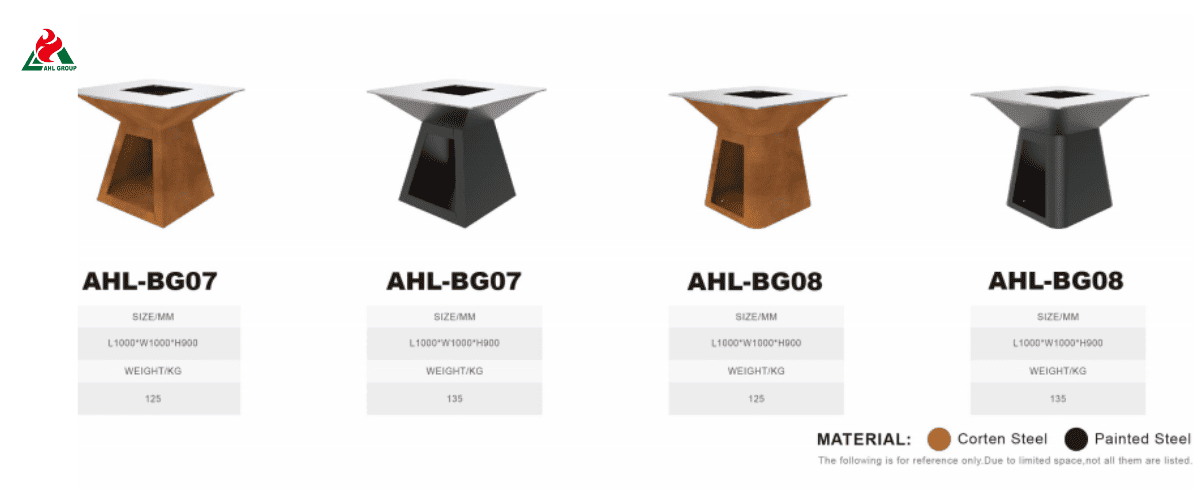
1. Choosing a Corten Grill by Use, Not Appearance Alone
A barbecue grill weathered to an orange-brown hue can be an eye-catching focal point in your garden, but its appearance should serve only as a starting point for comparison—not the ultimate reason for purchase. The right home barbecue grill must suit your cooking style, available space, the number of guests you typically entertain, and the effort you’re willing to put into cleaning and managing the fire.
Start by asking yourself five questions. Which fuel type do you prefer? Do you mainly grill steaks, cook meals for the whole family, or entertain guests around a campfire? How much net cooking space do you have available? How many people do you typically entertain? Are you able to inspect, clean, and replace wear-and-tear parts?
It’s also crucial to break down the grill into its individual systems. The weathering steel body provides structural support and architectural appeal. The firebox or burners are responsible for controlling combustion. The grill grates or baking pans, come into direct contact with the food. The drainage system, ash collection system, grease management system, control system, and support base each serve distinct functions. Even the most beautiful weathering steel exterior cannot compensate for poorly designed cooking surfaces, hard-to-reach grease pans, poor airflow, or ill-conceived fuel installation.
This guide provides a comparative analysis of these systems to clarify what “best” means: a grill that can safely perform the required cooking tasks and be properly maintained in real-world conditions.
2. What Is a Corten Steel Grill
A weathering steel grill is a type of outdoor cooking appliance in which certain structural or exterior components are made of weathering steel. It can be a compact charcoal grill, a gas grill installed in a custom cabinet, a wood-fired griddle with a dedicated grilling surface, or a flat griddle built around a central heat source. The name alone does not indicate the cooking method used by the appliance, nor does it allow one to determine whether each component is suitable for its intended function.
Weathering Steel vs. Ordinary Carbon Steel
Weathering steel contains alloying elements that, under the right atmospheric conditions, help form a strongly adherent, relatively non-porous layer of rust on its surface. Environments with alternating wet and dry conditions promote the formation of this rust layer, whereas persistently damp conditions may prevent it from functioning as intended.
Ordinary carbon steel also rusts, but its corrosion products tend to remain porous and flake off over time. This does not mean that every orange-colored surface is protective, nor does it mean that every rust-colored product meets the specifications for a weathering steel grade. A responsible supplier should clearly specify the type of steel used, rather than relying solely on appearance or the term “Corten.”
Which Parts of a Grill Can Be Made from Corten
Weathering steel can be used to manufacture the outer casing, base, cabinet, firebox, side panels, shelves, and decorative screens. In certain specially designed products, it can also be used to manufacture specific components of the firebox. The combination of heat, moisture, food residue, grease, ash, and mechanical stress varies for each component.
Grates, griddle plates, gas burners, valves, hoses, pressure regulators, ignition systems, and grease management components should be evaluated individually. The mere fact that these components are located inside a weathering steel enclosure does not mean they are suitable for this material. Be sure to understand the material specifications and maintenance instructions for every surface that comes into contact with food or controls fuel.
What Corten Steel Can—and Cannot—Guarantee
In the appropriate environment, Corten steel offers resistance to atmospheric corrosion and a unique surface finish. However, it does not make the grill fireproof, does not provide certification for gas systems, does not certify a surface as suitable for food contact, does not prevent deformation during each heat cycle, and does not establish a single safe installation clearance.
Durability depends on design details. Standing water must have a drainage path. Wet ash should not remain on the steel surface for extended periods. High-temperature areas may require replaceable liners or other protective measures. Welds, fasteners, doors, trays, and transitions between different materials should be easily accessible for inspection. Please evaluate the entire unit and its accompanying documentation—rather than focusing solely on the steel grade.
3. Which Corten Steel Grill Is Best for Most Homes
For the average household, the best overall design should be a practical and durable outdoor grill, rather than the most artistic model in the catalog. When shopping, pay attention to whether the unit is sturdy, whether the cooking surface is replaceable and comes with instructions, whether the temperature is adjustable, whether ash and grease are easy to remove, whether the drainage channels are unobstructed, and whether the operating instructions are clear. As for which fuel to choose, that depends on your cooking style.
The Best Overall Configuration for the Average Household
A practical, all-purpose grill should have a main cooking area large enough to meet daily dining needs without taking up most of the patio space. Its grill grate or griddle should be removable for cleaning or replacement. Ash, grease, and rainwater should not accumulate inside the sealed chamber. Control panels and fuel components should be easily accessible without removing decorative panels.
A lid can expand the range of cooking methods, while adjustable vents or burner controls make it easier to regulate heat. Side racks are very practical as long as they do not create an unstable load or reduce the required clearance. If two products perform equally well in terms of cooking results, choose the one that offers superior ease of operation, drainage performance, availability of replacement parts, and instructional documentation.
Ideal for Quick Cooking on Weekday Evenings
A well-designed Corten steel gas grill is typically a good fit for families who value speed and consistent cooking results. It preheats quickly, offers separate cooking zones, and reduces the amount of ash cleanup required. This makes cooking after work or preparing multiple dishes simultaneously at different temperatures much easier.
Convenience does not mean no maintenance. Burners, hoses, regulators, valves, ignition systems, gas cylinder placement, shut-off valves, and enclosure vents must comply with the manufacturer’s design specifications. Before each season of use, inspect the entire system according to the instruction manual. Never install burners haphazardly inside a decorative weather-resistant steel enclosure.
Best for Traditional Barbecue Flavors
Charcoal grills are ideal for cooks who enjoy adjusting vents, arranging the charcoal layout, controlling direct and indirect heat zones, and mastering the smoking process. Charcoal produces intense searing heat and offers a familiar grilling experience, but it takes longer to light and cool down. Additionally, charcoal produces ash, which must be allowed to cool completely before disposal.
Flavor comes from the fuel, heat, smoke, ingredients, and cooking techniques—not from a Corten steel shell. Choose a charcoal grill that features controllable airflow, secure fuel supports, a removable ash tray, and remains stable even when adjusting the charcoal arrangement.
Perfect for Outdoor Gatherings
A wood-fired Corten steel grill or a dedicated fire pit equipped with a specialized cooking system can serve as an excellent centerpiece for any gathering. A large, flat-bottomed grill ring allows guests to gather around the central fire source while food cooks in different heat zones. However, this visual openness also increases the need for supervision, ample space to move around, splash protection, and proper fuel handling.
Never convert a decorative fire pit grill simply by placing a makeshift rack on top of it. The fire pit, grill grate, support structure, surface finish, airflow design, and operating instructions must all be specifically engineered for cooking.
Best for Small Patios
Compact gas or charcoal grills are only suitable for small patios if the entire operating area—not just the dimensions listed in the product catalog—fits within the space. Allow sufficient space to open the lid, operate the controls, add fuel, remove the drip tray, and move around hot surfaces, while adhering to the manufacturer’s clearance requirements.
A small size does not automatically mean the grill is suitable for placement on a balcony, a covered patio, or in a narrow space adjacent to flammable structures. Even if the grill meets the physical size requirements, building codes, rental or homeowners’ association restrictions, and local fire regulations may prohibit its use in that location.
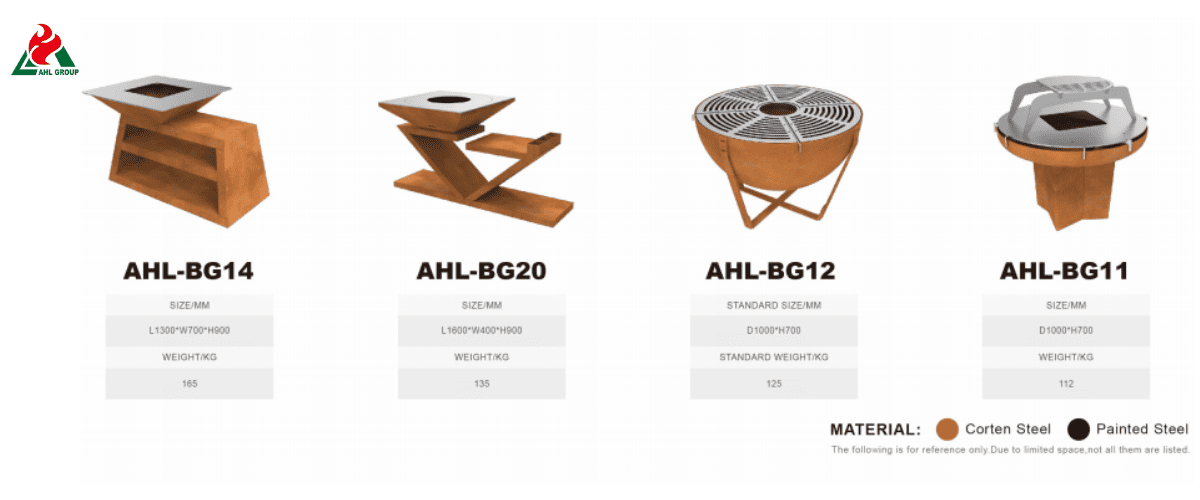
4. Charcoal, Gas, or Wood: Which Fuel Is Right for Home Use
The type of fuel determines the ignition time, temperature control, residue, smoke, and most of the user experience. Make this choice before comparing colors, shapes, or accessories.
Charcoal Weathering Steel Grill
Charcoal allows cooks to directly control the placement of the fuel. Coals can be piled on one side for indirect cooking, spread out for even heat distribution, or concentrated in one area for searing. Adjustable top and bottom vents help control the burning process inside a covered grill. This type of grill requires some practice to master and is ideal for users who value both the cooking process and speed.
The trade-offs include longer ignition times, smoke, ash, and a longer cooling-down period. Ash retains heat and moisture, so the ash collection system should be removable and rainproof. Dispose of the ash only after it has completely cooled, and follow local fire safety guidelines.
Gas Grills with Weathering Steel
For frequent home cooking, gas is typically the most convenient option. Multiple burners create controllable cooking zones and can be turned off more quickly than waiting for solid fuel to burn out. Equipped with a lid, a thermometer, and appropriate grates, these grills allow for both direct and indirect grilling.
The gas delivery system is key. Inquire about the unit’s ventilation method, the location of the gas cylinder or fixed gas inlet, how the shut-off valve operates, and which components have been certified or approved for your target market. Weathering steel cladding around gas appliances is merely a design choice for the exterior and does not replace the engineering design of the gas appliance itself.
Charcoal Grills
Charcoal grilling not only allows you to see the open flame, but also creates varied heat zones and fosters a rich social experience. This cooking method is particularly well-suited for spacious gardens and laid-back gatherings, especially when the grill combines a central fire source with a flat griddle or adjustable grates.
In addition, charcoal grilling produces more variable heat, smoke, sparks, and ash. Dry, suitable fuel must be stored safely, and there needs to be sufficient open space around the grill to add charcoal and monitor the fire. Users seeking “one-touch” convenience may not appreciate the extra effort required to manage the fire.
Hybrid and Modular Systems
Hybrid grills can use either charcoal or firewood, or come equipped with interchangeable grates, rotisserie spits, and griddles. Modular designs offer significant value when each configuration is engineered by the manufacturer with detailed instructions; however, risks may arise if users arbitrarily switch fuel types, block vents, or add unsupported cooking surfaces.
Be sure to verify the approved fuel types, maximum load, required accessories, and operating instructions for each configuration. Even if a component can be physically installed, it may alter heat flow or structural loads in ways not anticipated by the original design.
5. Corten Grill Comparison Table
The table below summarizes the main household choices. It is a decision aid, not a replacement for a product manual. The table below summarizes the main options for home use. This table is intended solely as a decision-making guide and is not a substitute for product manuals.
| Grill type |
Best for | Heat control | Startup | Cleanup | Typical space needed | Documentation to check |
| Gas |
Frequent home cooking | High with separate burners | Fast | Grease and burner care | Varies | Burner, regulator, shutoff, ventilation, clearances |
| Charcoal |
Traditional barbecue | Manual through fuel and vents | Moderate | Ash-intensive | Varies | Approved fuel, vents, ash tray, firebox, clearances |
| Wood-fired |
Live-fire entertaining | Manual and variable | Slow | Ash-intensive | Usually larger | Approved wood, loading, spark, ash, and clearance guidance |
| Plancha/griddle |
Social cooking and mixed ingredients | Zone-based | Varies | Plate cleaning and seasoning | Medium to large | Plate material, finish, cleaning, drainage, heat source |
| Hybrid |
Flexible cooking styles | System-dependent | Varies | Usually higher | Medium to large | Approved combinations, accessories, loads, and setup instructions |
If quick weekday meals are a priority, a gas grill is typically the best choice. If you value the ritual of cooking and the flavor of charcoal, a charcoal grill is the way to go. If the grill is part of an outdoor gathering and the venue can accommodate smoke and open flames, a wood-fired grill may be more suitable. A plancha grill is particularly well-suited for cooking vegetables, seafood, small pieces of food, and group cooking—provided that the griddle is specifically designed for this purpose and is properly maintained.
6. How Large Should a Home Corten Grill Be
The right size should be based on your daily needs, not on a single large gathering you might host once a year. A grill that’s too large will take up space, consume more fuel, and increase cleaning time; a grill that’s too small will result in overcrowded cooking space and make it difficult to maintain different heat zones.
Choose Cooking Area Based on Household Size
Make a list of the foods you cook most often and estimate the number of servings you need to prepare at one time. A couple who mainly grills vegetables and two protein dishes will need a smaller main cooking area than a family that prepares full meals outdoors. Focus on the area of the main grill or cooking surface, rather than the total area inflated by warming racks.
Shape is also important. Round griddles offer ample space around the edges but have a smaller traditional grilling area. Rectangular grills can be divided into two practical cooking zones but may require more room to maneuver. Compare actual usable dimensions and layouts, rather than relying solely on a single nominal figure.
Measure the Entire Operating Area
Record the grill’s footprint, then add the space needed to open lids and doors, remove ash or drip pans, reach gas cylinders or shut-off valves, refuel, and stand safely next to the control panel. Include the clearances specified for the specific product and installation.
Placing a paper template on the patio can reveal conflicts with doors, steps, furniture, railings, eaves, and walkways. The cook should not be forced to walk backward into a passageway, nor should they have to carry hot utensils past seated guests.
Portable vs Fixed Corten Grills
While wheeled grills offer flexibility, they require locking casters, a stable center of gravity, and a level surface for movement. Move the grill only after it has cooled down and the power has been disconnected according to the instructions. Due to their tall and bulky design, weathering steel grills may not be as portable as shown in product photos.
When the base is level and properly secured, freestanding models simplify installation. Built-in grills can blend seamlessly into an outdoor kitchen, but require careful consideration of ventilation, heat management, drainage, utility access, and ease of future maintenance. Decorative masonry should not trap heat or obstruct fuel components.
When Large Barbecues Become Less Practical
A larger cooking area not only takes longer to clean but may also consume more fuel to heat the unused portions. It can limit activity space on a compact patio and result in higher costs for protective covers or replacement grates. Large wood-burning barbecues also require more fuel storage space and involve more cumbersome ash disposal.
Choose the smallest grill that comfortably meets your needs for everyday cooking and occasional entertaining. For large gatherings that occur only rarely, cooking in batches is often more practical than maintaining an oversized unit year-round.
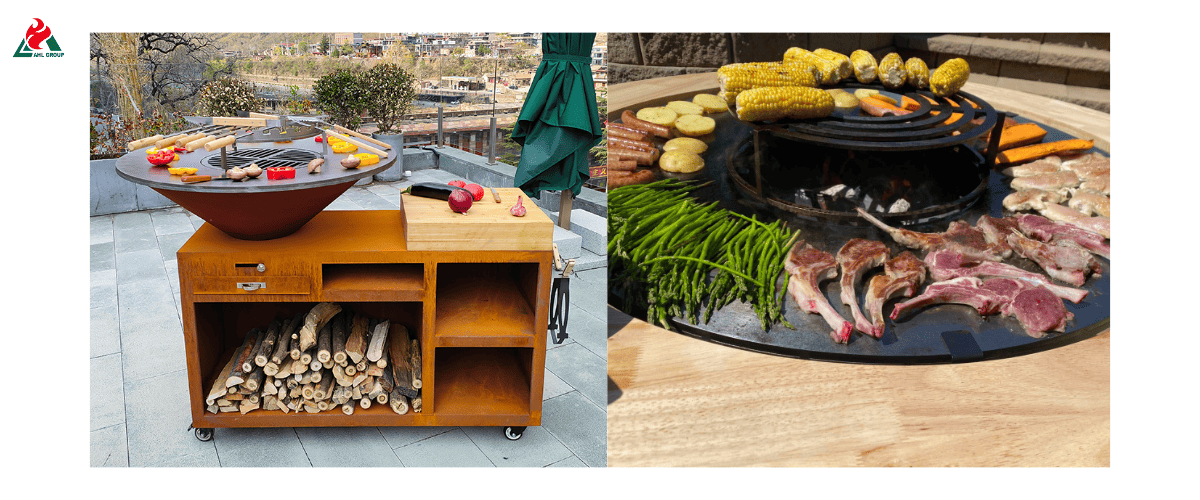
7. Is a Corten Steel Cooking Surface Safe
Do not assume that an exposed weathering steel surface is necessarily suitable for use as a cooking surface. The term “weathering steel” describes its corrosion behavior in the atmosphere; this characteristic alone does not determine whether the component is suitable for food contact, how its surface should be treated, how it should be cleaned, or whether it meets the compliance requirements of a specific market.
The Grill Body Is Not the Cooking Surface
A Corten steel cabinet may enclose a stainless steel grill. A weathering steel base may support a cast-iron cooking grate. A fire pit may accommodate a separately certified flat-bottomed baking pan. These are distinct systems, and their materials should be listed separately.
This distinction is particularly important when decorative fire pits are sold as optional accessories. Unless the manufacturer explicitly identifies it as a cooking appliance and provides relevant documentation for the grill or griddle, placing food directly over the flames constitutes an unsupported use.
Common Cooking Surface Materials
Stainless steel grills are typically chosen for their corrosion resistance and relatively simple maintenance. Cast iron effectively retains heat and enables intense searing, but usually requires drying and seasoning to prevent corrosion. Specialized steel griddle plates can create broad temperature zones but may also require seasoning and prompt cleaning.
Regardless of the material, the user manual is essential. Ask how to preheat, clean, season, store, and replace the component. Confirm whether there are restrictions on the use of detergents, brushes, scrapers, and cooking oil. Removable cooking surfaces make it easier to inspect both sides.
Items to Verify Before Food Comes into Contact with the Grill
Please confirm in writing the specific material, surface treatment, and intended use of the grill or baking pan. Verify that it is supplied specifically for that grill or has been approved for use with it. Inquire whether the factory coating needs to be removed before first use, and follow the manufacturer’s commissioning procedures.
Unless explicitly permitted in the product documentation, do not use external rust accelerators, decorative sealants, paint, or harsh cleaning agents on food-contact surfaces. Use separate tools when cleaning the Corten body and the BBQ grill grates. When handling food, follow recognized guidelines: use clean utensils, keep raw and cooked foods separate, and use a food thermometer to determine doneness rather than relying solely on surface color changes.
Warning Regarding Coatings and Unknown Metals
Avoid using unidentified paints, decorative sealants of unknown origin, undocumented alloys, repurposed scrap materials, or parts with an unknown prior use in high-temperature areas. If galvanized parts, electroplated layers, or coatings are present in high-temperature or food-contact areas, ask the seller for clarification.
If a seller simply describes the entire grill as “metal” or “weathering steel” without specifying the exact materials used for the grates, fasteners, burners, or surface treatments, they have failed to provide sufficient information for consumers to make an informed purchasing decision.
8. What Features Matter Most in a Corten Home Grill
Good design solves foreseeable problems: instability, water accumulation, poor temperature control, residue buildup, and maintenance difficulties. Decorative complexity is meaningful only when it does not interfere with these functions.
Stable Base and Structural Support
Whether opening the lid, heating heavy flat pans, or placing food on the side racks, the grill should remain level and wobble-free. Check the reinforcements, legs, casters, welds, and the relationship between the center of gravity and the base. Adjustable legs may help on slightly uneven hard surfaces, but they are no substitute for a proper foundation.
Drainage and Weather Protection
Rainwater should drain from the unit through visible and easily maintained channels. Choose drain openings that are large enough to inspect and unlikely to become clogged by ashes, grease, or leaves. Level eaves and sealed compartments require special attention.
Covers can reduce debris buildup and direct rainwater flow, but covering a damp or warm grill may cause moisture to become trapped. Covers should fit the product’s dimensions and comply with the manufacturer’s storage instructions. Patina requires an exposed environment where it can dry; prolonged dampness is not a maintenance strategy.
Ash, Grease, and Drip Management
Charcoal and wood grilling equipment must be equipped with removable ash pans or utilize other controllable cleaning methods. Gas grills and flat griddles must be equipped with easily accessible grease collection devices, and these devices must not drain grease onto high-temperature components or porous paving surfaces. Collection pans should remain stable when removed, and cleaning procedures should be simple enough to prevent residues from causing fires or hygiene issues.
Airflow and Heat Control
Charcoal grills should be equipped with adjustable air intakes and exhaust vents. Gas grills require responsive burner controls and an appropriate ventilation system within the unit. Flat-bottomed pan systems rely on predictable temperature gradients. Decorative perforations are not intended as ventilation ports, and closing openings to block the wind may alter combustion conditions.
Replaceable Grates, Burners, and Wear Parts
Cooking surfaces, burners, ignition components, trays, handles, wheels, gaskets, fasteners, and firebox liners may wear out sooner than the weather-resistant steel exterior. Verify whether parts are labeled, how long they are expected to be available, and whether special tools are required for replacement.
Wind Protection Measures Should Prevent Heat Buildup
Wind can disrupt the flame, carry away sparks, cool one side of a flat-bottomed pan, or blow smoke toward people. Choose the grill’s location carefully and use only wind shields certified for this product. Never surround the grill with makeshift barriers that trap heat or restrict combustion air, and do not place the high-temperature exhaust vent near flammable structures.
9. Where Should You Place a Corten Grill at Home
Site selection is a critical step in choosing a BBQ grill. If a particular model cannot be installed in the available space as specified in the manual, it is not a suitable barbecue grill, regardless of its cooking performance.
Patio Placement
A level patio typically provides the most practical workspace. Follow the manufacturer’s instructions to ensure that the ground and underlying structure can support the load and withstand the expected heat. Ensure that the control panel, fuel fill port, drain outlet, and cleaning access are unobstructed.
Plan for two types of drainage: cooking residue and iron-rich water runoff from weathered surfaces. Early patina formation may stain porous, light-colored materials. Direct water away from walls, pools, and prominent paved areas, and take appropriate protective measures as needed.
Garden Placement
In the garden, avoid areas with chronically damp soil, irrigation sprinklers, overhanging vegetation, dry and flammable vegetation, and pathways where guests might walk near the cooking area. Compared to bare ground, a treated, stable base is generally easier to level and maintain.
Before determining a fixed location, consider the prevailing wind direction. Smoke or heat should not be directed toward doors, windows, play areas, neighboring areas, or stored fuel.
Placement on Decks
Never assume that a grill is suitable for placement on a wooden or composite deck. Its suitability depends on the specific product, surface structure, heat conduction, fuel type, safety clearances, and any protective measures approved by the manufacturer. Please follow the equipment manual as well as applicable fire and building codes.
A universal barbecue mat cannot compensate for installation methods expressly prohibited by the manufacturer. It also cannot control radiant heat transferred to railings, flying sparks, grease, or heat emitted from other surfaces of the appliance.
Restrictions on Balconies, Pergolas, and Covered Areas
“Outdoors” does not equal “approved location.” Balconies may have regulations regarding solid fuels, gas cylinders, smoke, and open flames. Pergolas, eaves, roofs, walls, curtains, and window screens may alter safety distances and ventilation conditions.
Fire department barbecue guidelines typically emphasize that barbecues should be used outdoors and kept away from buildings, railings, eaves, and overhanging tree branches. Please follow the safety distances specified on the product label rather than relying on distances from other barbecues. If there are conflicting guidelines, seek guidance from the manufacturer and the property management responsible for the premises.
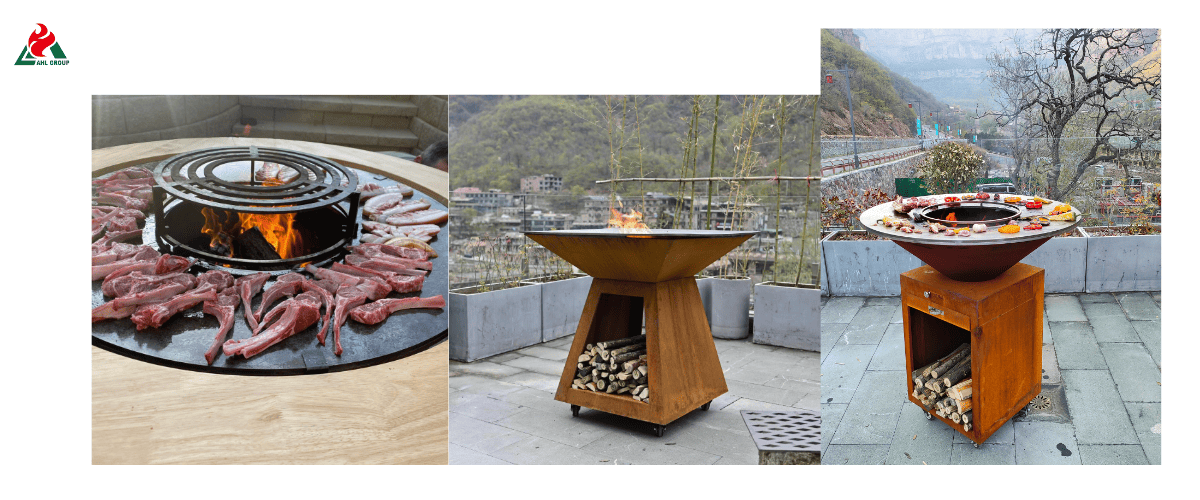
10. Frequently Asked Questions About Corten Steel Grills
Q1: Is Corten Steel Good for a BBQ Grill?
Yes, weathering steel can serve as a high-quality material for the body or housing of outdoor barbecue grills. Its architectural appearance and natural patina are well-suited to many garden settings. However, the finished product must still be equipped with appropriate cooking surfaces, heat management, drainage systems, structural design, and fuel systems. The use of weathering steel alone does not guarantee that the equipment meets safety standards.
Q2: Can You Cook Directly on Corten Steel?
Do not assume this is the case. You should confirm with the manufacturer which specific surfaces are intended for food contact and verify their intended use, surface treatment, preparation before first use, and cleaning methods. In the absence of product-specific documentation, weathering steel enclosures or decorative fire pits should not be considered approved cooking surfaces.
Q3: Can a Corten Grill Stay Outside All Year?
Many models designed specifically for outdoor use are intended for long-term outdoor placement, but this depends on the product itself, climatic conditions, drainage, removable parts, canopy design, and the manufacturer’s instructions. Special attention should be paid to environmental factors such as salt corrosion, prolonged moisture, snow accumulation, and freeze-thaw cycles.
Q4: Will a Corten Grill Stain My Patio?
It might. During the initial rusting process, iron-containing runoff is common and may leave marks on porous concrete, stone, stucco, and other light-colored surfaces. Plan drainage routes before installation, and use only heat-resistant surface protection materials that do not allow water to pool around the grill.
Q5: How Long Does a Corten Steel Grill Last?
There is no one-size-fits-all service life. Its service life depends on the specifications of the steel and components, thermal cycling, drainage conditions, prolonged exposure to moisture, salt corrosion, manufacturing processes, replaceable parts, and maintenance practices. It is recommended to consult the warranty terms and review verifiable design details rather than relying on fixed marketing data.
Final Recommendation: Choose the Right Grill for Your Family
For most families, the best Corten BBQ grill isn’t a one-size-fits-all model, but rather a configuration that has been thoroughly evaluated and tailored to your specific needs. If you prioritize cooking speed and consistency, opt for a gas grill; if you prefer a hands-on grilling experience, choose a charcoal grill; if you want to host a party with an open flame, select a wood-fired grill; and if you’d like to enjoy social cooking across different temperature zones, choose a flat-top grill.
Regardless of the fuel source you choose, you should adhere to the following five basic principles: a proven and replaceable cooking surface, controllable heat, effective drainage, a sturdy structure, and easily replaceable wear-and-tear parts. Next, ensure that the grill can be installed in the intended location in accordance with its instruction manual and relevant regulations.
Weathering steel (Corten) lends outdoor grills a unique character and charming ambiance, but it should never be equated with food safety, gas safety, or unlimited durability. Before requesting a quote, compare the specific fuel systems, cooking surface specifications, dimensions, drainage designs, installation instructions, warranty terms, and spare parts support for each shortlisted grill. It is this comprehensive comparison—rather than relying solely on the appearance of the rust—that will help you select the grill best suited for your family.

