


The best Corten steel outdoor lighting depends on the specific location and intended use. Shielded post lights or path lights are suitable for sidewalks; wall sconces are ideal for entrances and patios; step lights are used to mark elevation changes; and spotlights can highlight trees or architectural features. Before selecting lighting fixtures, be sure to check their beam control, glare, color temperature, suitability for humid environments, protection rating, drainage performance, power source, and local climate conditions.
“Best” does not mean the brightest light or the highest wattage. It refers to fixtures that can project sufficient light where people need it, limit glare and light spill, withstand the rigors of the actual environment, and be safely installed and maintained. Corten provides only the weathering steel housing and its distinctive rusted appearance; it does not guarantee the performance of the internal LEDs, drivers, seals, connectors, or cable entries.
“Best” does not mean the brightest light or the highest wattage. It refers to fixtures that can project sufficient light where people need it, limit glare and light spill, withstand the rigors of the actual environment, and be safely installed and maintained. Corten provides only the weathering steel housing and its distinctive rusted appearance; it does not guarantee the performance of the internal LEDs, drivers, seals, connectors, or cable entries.
1. What Type of Corten Steel Outdoor Light Is Best
No single Corten light suits every outdoor space. First, determine the desired lighting effect; second, select a luminaire series; and only after fully understanding the exposure environment and installation conditions should you consider using a weathering steel luminaire.
| Area or task |
Best starting fixture | Preferred light effect | Main risk to avoid |
| Walkway or garden path |
Shielded bollard or path light | Low, downward, overlapping pools | Eye-level glare and runway-style spacing |
| Driveway edge |
Robust bollard or marker | Controlled lateral guidance | Vehicle impact and excessive brightness |
| Steps or level changes |
Recessed step or wall light | Even light across treads | Bright points with dark risers |
| Entrance or gate |
Wall light or integrated column light | Clear threshold and facial visibility | Backlighting that silhouettes visitors |
| Patio or dining area |
Wall light or indirect feature light | Warm, layered ambience | One harsh overhead source |
| Trees and planting |
Adjustable spotlight | Narrow or medium accent beam | Spill into windows or the night sky |
| Corten screen or sculpture |
Grazing or backlighting | Texture, silhouette and shadow | Hotspots and exposed wiring |
| Large service area |
Shielded area light or floodlight | Broad, controlled functional light | Glare, spill and overlighting |
Therefore, the primary question is not “Which Corten lighting looks the best?” but rather “What do people need to see here after dark?” A path requires guidance; an entrance requires visibility of faces and thresholds; a set of steps requires clearly defined tread edges; and a notable tree requires carefully positioned accent lighting. Rarely does a single luminaire excel at all four of these tasks simultaneously.
Weathering steel should be viewed as just one component of a complete luminaire. Before purchasing, verify the light distribution, rated power, tested installation locations, drainage paths, and maintenance access—not just the shape and rusted appearance.
2. Are Corten Bollard Lights Best for Paths and Driveways
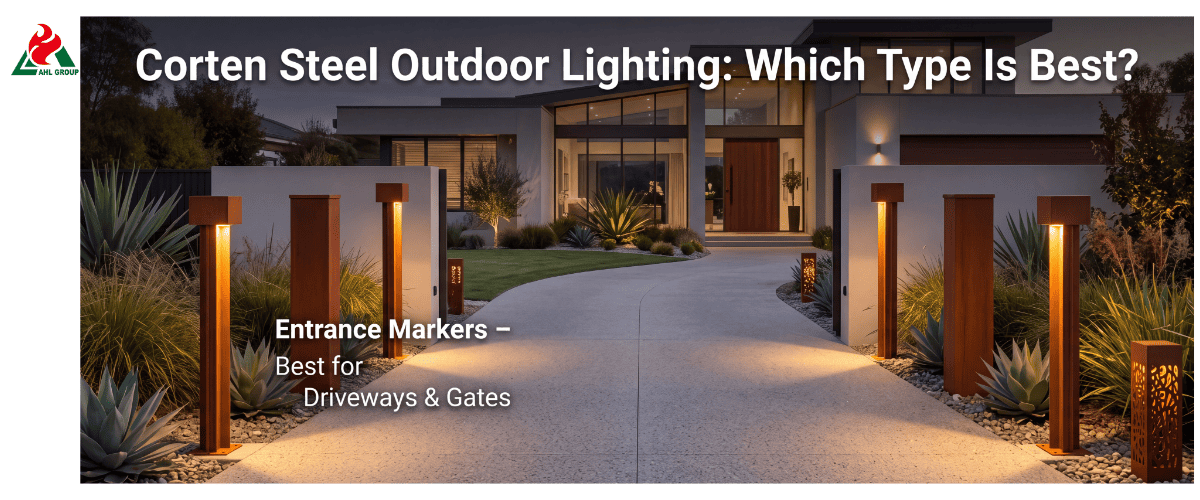
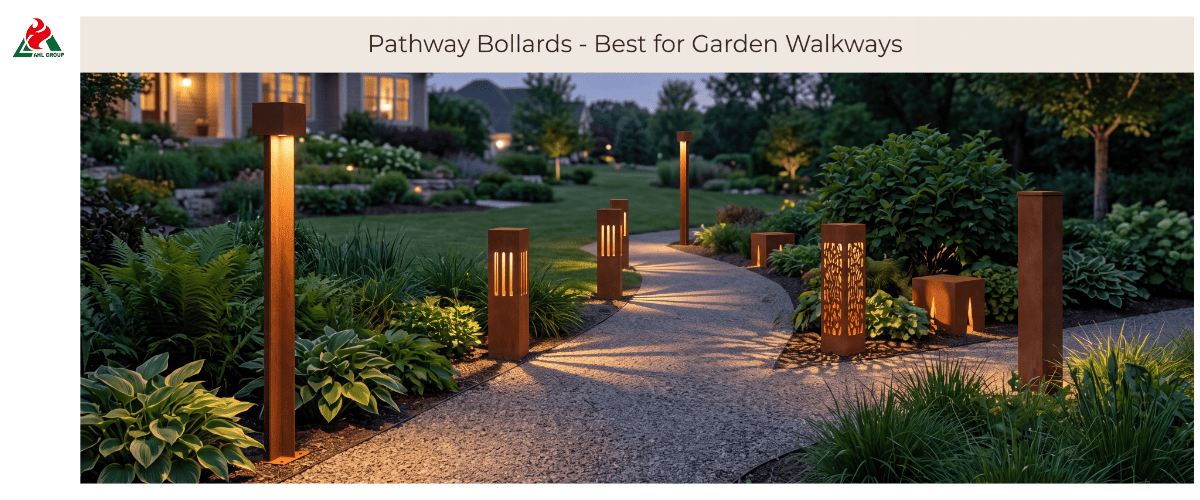
Weathering steel bollard lights are typically the best all-around choice for small paths, driveway edges, garden borders, and commercial walkways. Their vertical design is clearly visible during the day, blends seamlessly with weathering steel planters or curbstones, and can be equipped with adjustable optical systems to direct light toward the ground.
A high-quality bollard light should shield the LED light source from standard viewing angles and direct light downward or to the sides. Single-sided lighting designs are suitable for boundary areas; double-sided designs are ideal for central pathways; and asymmetrical optical systems prevent light from shining on plants, windows, or neighboring areas. Compared to decorative openings that expose the LEDs, louvers or deep shades typically provide better glare control.
Do not assume that taller or brighter streetlights provide safer illumination. Exposed light sources located near eye level can actually make it harder to see in darker areas. The goal is to achieve overlapping illumination along the path while avoiding turning the garden into a uniformly bright area.
The installation method determines the service life of the light fixture. The base must be secure, the base should not be submerged in standing water, and the cable entry point should be protected and easily accessible for maintenance. Ensure that the light fixture is located away from vehicle traffic paths, lawn mower paths, door swing zones, and areas where snow removal or leaf cleanup operations take place. For driveways, assess the risk of collisions and direct the light away from oncoming traffic.
The spacing between luminaires should not be determined solely by their height. It depends on the light distribution, lumen output, path width, surface reflectance, curves, obstacles, and the required illuminance. For major roads, refer to the photometric data provided by the manufacturer or conduct tests on a sample section after dark.
3. When Should You Choose Corten Path Lights Instead
When lights need to blend into a residential garden setting rather than serve as eye-catching architectural elements, choose lower-profile weathering steel path lights. Path lights typically feature short poles and downward-facing lamp heads or shades, whereas streetlight poles are generally taller and appear more substantial. Since product names vary, it is recommended to compare dimensions and light distribution rather than relying solely on category labels.
Path lights are ideal for installation alongside stepping stones, natural-style flower beds, and narrow paths. Their wide, diffused shades illuminate both the walking surface and adjacent low-growing vegetation, while the rust-brown finish blends seamlessly with tree bark, soil, ornamental grasses, and weathering steel borders.
However, the low installation height also presents some limitations. Vegetation may obscure the fixtures or alter the direction of the light beam. The lightweight poles may be damaged during pruning or mowing. Fixtures with poor light control may still cause direct glare, especially when pedestrians approach from below.
Unless you are intentionally creating a regular, rhythmic pattern, avoid arranging identical fixtures at short, perfectly uniform intervals. Alternating the placement of fixtures or positioning them around key points, curves, and hazardous areas can create a more natural effect. The path must remain clearly visible, but not every square meter requires the same level of brightness.
Before finalizing the layout, check the lighting coverage in conjunction with the actual paving conditions. Light-colored stone reflects more light than dark-colored gravel, and wet surfaces may produce additional reflections. On-site testing at night provides a more reliable indication of these effects than product catalog images taken during the day.
4. Are Corten Wall Lights Better for Entrances and Patios
Corten steel wall lamps are often the best choice for entryways, front gates, patios, garages, and outdoor kitchens because they illuminate both vertical and horizontal activity areas without taking up planting or paving space. The correct light distribution depends on the function the wall lamps are intended to serve.
Downlights direct effective light toward the ground, minimizing upward light spill. Asymmetrical wall lights illuminate thresholds or walkways while limiting light spill. Dual-directional fixtures can create visually striking facade patterns, but the upward component may not be necessary in areas where “responsible lighting” rules or local regulations restrict upward illumination. Diffused lantern-style lights create ambiance but require effective glare control to prevent visual discomfort.
At the entrance, door handles, locks, steps, house numbers, and visitors’ faces should be illuminated. Never place the sole light source behind a visitor, as this can create a silhouette for residents or security cameras. The placement of fixtures should be coordinated with the direction of door swing, the porch, intercoms, and security equipment.
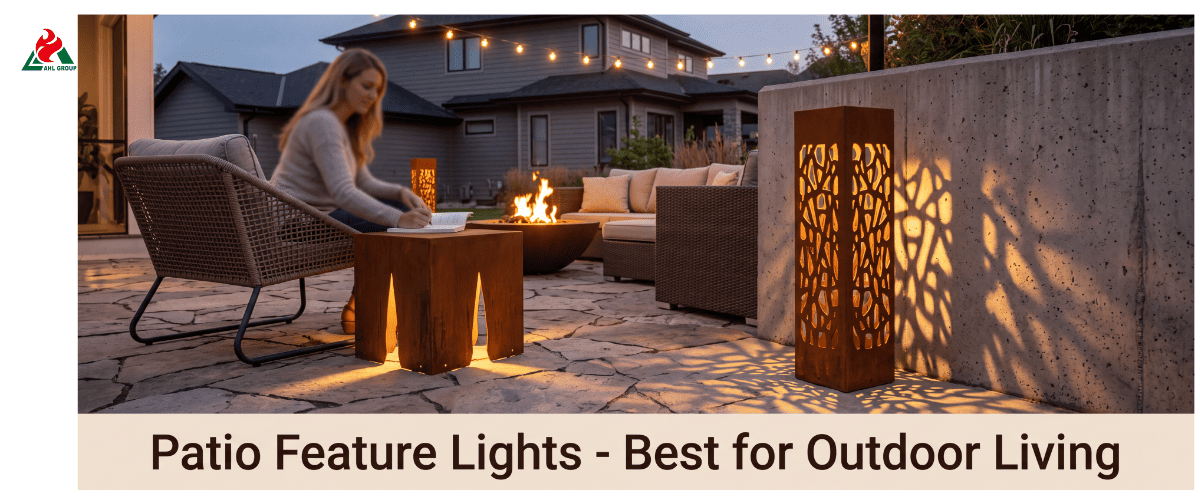
For patios, low-mounted wall sconces should be combined with subtle landscape lighting or table-height lighting, rather than relying solely on a single, bright overhead fixture. Color temperature and dimming characteristics should be consistent throughout the design. Avoid placing bright light sources within the line of sight of seated guests.
Mounting surfaces and junction boxes must be waterproofed. Using decorative weather-resistant steel panels alone does not ensure that wall penetrations are waterproof. Flashing, gaskets, cable entries, and fully certified luminaires must be suitable for both exposed and covered installations. Luminaires located near swimming pools, cooking areas, or in saline environments require additional project-specific review.
5. Are Step and Deck Lights Best for Level Changes
Step lights and landing lights are the best starting point for illuminating stairs, ramps, retaining walls, terrace edges, and areas with changes in paving elevation. Their purpose is to highlight the edges of steps, the boundaries of landings, and the direction of travel—rather than placing a bright, decorative light source on every step.
Use recessed or shaded fixtures to ensure light is evenly distributed across the walking surface. Check the lighting effect from both the top and bottom of the staircase: a light source that is invisible from one direction may cause glare when viewed from the other. The darkest step should remain visible, while avoiding situations where users are forced to look directly at exposed LED chips.
Before construction, the recessed positions of the fixtures must be coordinated with the structure, waterproofing layer, diaphragm, and drainage system. Cutting openings in walls or staircases after they have been completed may compromise the waterproofing layer. Access for maintenance is equally important, as drivers, LED modules, gaskets, or connectors may eventually require servicing.
Corten steel panels can visually connect step lights to nearby planters, walls, or landscape boundaries. However, custom steel panels must not interfere with the listed or certified enclosure behind them. Installing Corten steel covers around indoor luminaires does not convert those luminaires into outdoor luminaires.
For public, commercial, or accessible pathways, local regulations may specify requirements for lighting and illuminance uniformity. Project-specific lighting calculations and qualified electrical designs are more reliable than the general rule of “one light per step.”
6. When Are Corten Spotlights and Uplights the Best Option
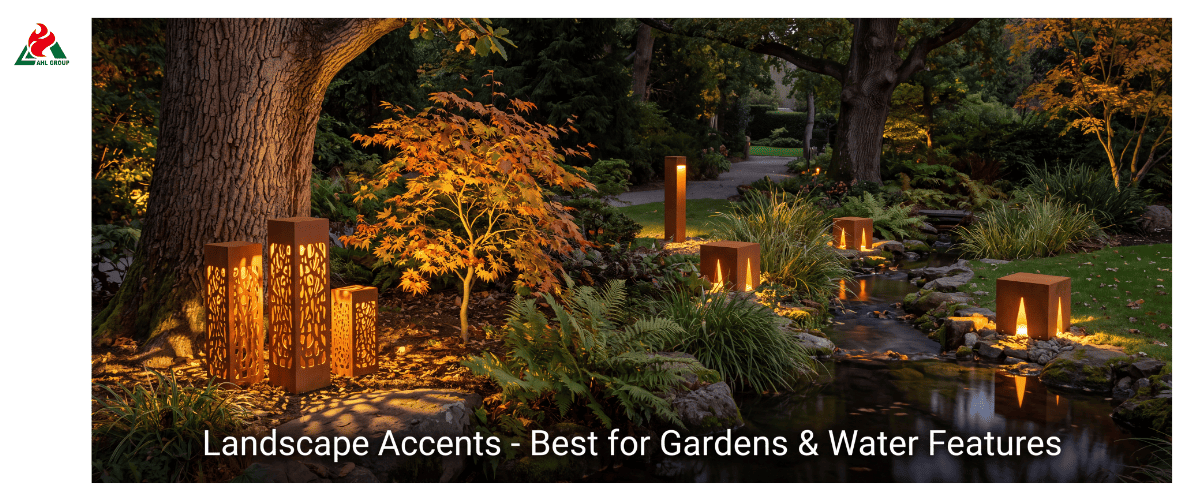
Weathering steel spotlights are best suited for illuminating trees, sculptures, textured walls, columns, ornamental plants, and architectural features. They should not be used solely to increase overall brightness; each fixture should have a specific target to illuminate.
Use a narrow beam for tree trunks, small sculptures, or columns; a medium beam for tree canopies or facade elements; and a wider flood beam for large surfaces. Angling the light close to stone or weathering steel to cast it obliquely can highlight their texture. Backlighting can transform plants or perforated weathering steel screens into silhouettes.
The direction of the light beam is more important than the style of the fixture. Glare affecting residents and neighbors should be controlled; light should not enter bedroom windows; and unused light should not be directed toward the sky. Therefore, downward lighting should be the default choice whenever it achieves the desired effect with less spill.
When upward lighting is required, select the narrowest practicable beam, carefully adjust the direction of illumination, and control the operating time. Once trees and shrubs have grown, recalibration will be necessary, as branches and foliage may block, scatter, or alter the direction of the light.
Ground-mounted spotlights also face harsh operating conditions. Avoid exposing them to standing water and direct irrigation. Ensure that the tested installation location aligns with the intended illumination angle, and maintain proper drainage around the light fixture and at the cable entry points.
7. Are Decorative Corten Light Boxes and Lanterns Practical
Decorative Corten steel light boxes and lanterns are highly practical for creating ambiance, marking entrances, designing welcoming landscapes, enhancing courtyards, displaying brands, and providing wayfinding signage. They have a strong visual presence during the day and can be coordinated with weathering steel screens, planters, fire pits, and garden structures.
Perforated weathering steel can project patterns onto paved surfaces or walls, while the warm light complements the orange-brown patina. Custom perforated patterns can incorporate numbers, logos, or landscape elements. These designs work best when the light source is concealed, and an internal diffuser creates an even glow.
The primary risk lies in confusing decorative lighting with functional lighting. While openwork light boxes are visually appealing, they may not provide sufficient illumination for paths or steps. Additionally, glare may occur when LED lights are visible through the openings; if the light source is too close to the steel plate, it can create areas of excessive brightness.
Large enclosed spaces require drainage, ventilation, and pest control measures. These spaces may accumulate condensation, fallen leaves, or heat around the drive. Custom manufacturing must ensure proper electrical clearances, grounding, cable protection, and accessibility to serviceable components.
Separate design layers: Use light boxes to create ambiance and highlight features, then add task lighting with shades in areas where people walk, open doors, or use stairs. This approach keeps decorative elements understated while ensuring safety isn’t compromised by uncontrolled brightness.
8. Should You Choose Solar or Low-Voltage Corten Lights
If you need accent lighting or a simple retrofit in remote areas and can tolerate fluctuations in light output, choose a solar Corten lamp. If you have high requirements for reliable lighting, dimming, automation, and long-term maintainability, you should choose a solution designed specifically for wired systems.
| Power option |
Best for | Main advantage | Main limitation |
| Integrated solar |
Remote accents and simple retrofits | No trenching for a supply cable | Runtime depends on sun, battery and season |
| Low-voltage wired |
Residential landscape systems | Consistent output and flexible controls | Needs transformer, rated cable and voltage-drop planning |
| Line-voltage wired |
Building-mounted and larger systems | Permanent infrastructure and substantial loads | Stricter code requirements and qualified installation |
| Portable battery |
Temporary ambience | Movable and simple | Charging and inconsistent long-term output |
Solar-Powered Corten Lights
Evaluate the solar panel separately from the decorative housing. Check its orientation, potential for shading, battery type, ease of replacement, and actual performance after several hours of operation—not just immediately upon startup. Winter sunlight, overcast conditions, and foliage can all reduce charging efficiency. Freestanding solar panels may receive better sunlight exposure than those embedded in the top of a luminaire located in the shade.
Solar lighting is suitable for low-priority accent lighting, where occasional dips in brightness do not pose a safety hazard. However, solar lighting is not an ideal choice when steps, entrances, or security pathways must remain reliably illuminated throughout the required time period.
Low-Voltage Wired Lighting
A central transformer provides a stable power supply for multiple landscape lights and supports timers, light sensors, dimming, or zone control. During the design phase, it is still necessary to correctly determine cable specifications, run lengths, transformer capacity, and outdoor-rated connectors, as well as to evaluate voltage drops.
“Low voltage” does not mean “no rules.” Products, cable routes, installation methods, and connections must comply with local requirements and manufacturer instructions. If necessary, hire a qualified installer.
Line-Voltage Lighting
Line-voltage systems are suitable for certain wall sconces, commercial installations, and fixtures connected to building circuits. Such systems require that the fixtures and wiring methods used be certified for the specific installation location. Regulations stipulate that line-voltage landscape lights and outdoor fixtures must be evaluated in accordance with standards, including applicable requirements for damp locations.
Do not apply installation instructions universally to all countries. Electrical codes, certification marks, and requirements for qualified personnel vary by market.
9. What Technical Features Matter Most in Corten Outdoor Lights
Key features include: a controllable optical system, locally recognized outdoor certifications, an ingress protection rating that meets environmental requirements, a drainage design, reliable electrical components, and easy-access service openings for maintenance. The weather-resistant steel housing is only one part of this comprehensive solution.
Suitability for Humid Environments and IP Protection Ratings
The International Electrotechnical Commission defines the IP protection rating as a classification of an enclosure’s resistance to dust or liquid ingress. While IP codes are useful as a reference, they cannot serve as a universal statement that a luminaire is suitable for all outdoor environments.
Conditions vary significantly between sheltered walls, open gardens, ground splash zones, areas exposed to high-pressure water jets, and underwater environments. The installation orientation is critical, as are the cable entry points, mounting hardware, and on-site wiring. The tested enclosure protection rating and locally approved certifications should be matched to the actual operating environment.
Never select a product based solely on the “highest IP rating” without considering maintainability, condensation issues, and product documentation. Even in tightly sealed luminaires, moisture can accumulate internally if assembly and thermal cycling are not properly managed.
Drainage and Condensation Management
Outdoor designs should account for the possibility of rainwater, splashing water, or condensation coming into contact with the garden lights. Water must have a safe drainage path, and this path must not cross electrical connections or paved surfaces susceptible to staining. Ensure that drivers, cable entries, and connectors are kept away from standing water.
At the base of the luminaire, soil, mulch, and fallen leaves may block drainage channels. Hollow decorative enclosures may mask this problem until the luminaire fails. Maintenance plans should specify how to inspect and clean drainage and ventilation openings.
Electrical Isolation from Weathering Steel Enclosures
Unless the entire luminaire is designed and tested as such, a weathering steel housing should not be used as a substitute for a certified electrical housing. Wiring, LED circuit boards, drivers, insulation materials, connectors, and grounding or neutral connections must comply with the luminaire’s design requirements and local codes.
Custom perforations or added weathering steel panels may alter temperature, water ingress, and clearances. Manufacturer approval must be obtained before modifying a certified product.
LED Modules, Drivers, and Optical Components
Compare actual luminous flux, maintained luminous flux, color rendering index, color temperature, beam distribution, dimming compatibility, driver operating temperature, surge protection under relevant conditions, and warranty disclaimers. Inquire whether the LED modules, drivers, lenses, batteries, and seals are replaceable.
Photometric data sheets reveal where light actually falls. Wattage alone does not indicate beam shape, glare, or effective illuminance.
Glare Control and Control Devices
Prioritize recessed light sources, baffles, shades, louvers, asymmetric optical systems, and precise adjustment of light direction. Installation and commissioning should be performed after dark, and areas with excessive light should be dimmed.
Timers, astronomical clocks, photosensors, motion sensors, and timed dimming functions prevent luminaires from operating at full brightness throughout the night. Separate safety lighting, ambient lighting, and accent lighting circuits so that each circuit can operate according to its respective schedule.
10. What Colour Temperature Is Best With Corten Steel
Warm white light is typically the best aesthetic starting point for Corten steel, as it highlights amber and rust tones and complements wood, stone, and greenery. The final choice should still be determined through testing in conjunction with the actual materials and lighting tasks.
| Colour appearance |
Typical effect with Corten | Best use | Potential drawback |
| Very warm white |
Strong amber and rust emphasis | Intimate patios and hospitality | Some plant colours may appear muted |
| Warm white |
Balanced and welcoming | Paths, entrances and gardens | Quality and output still need verification |
| Neutral white |
Crisper visibility | Work areas and selected commercial tasks | Can weaken the warm material character |
| Cool white |
High visual contrast | Limited task-specific uses | Can appear harsh and add blue-rich light |
Related guidelines recommend selecting light sources with higher color temperatures whenever possible and limiting shorter-wavelength blue-violet light to the minimum necessary level. This supports the use of the lowest color temperature and illuminance levels required to safely fulfill the lighting task, while complying with local regulations.
Color temperature is not the only factor. Color rendering affects the visual appearance of plants, paving, and skin. Beam direction, dimming, the level of surrounding darkness, and surface reflectance also influence visual perception. In the evening, observing samples with actual Corten steel surface finishes is more reliable than comparing nominal Kelvin values on a screen.
Maintain consistency in visual hierarchy. General lighting for paths and patios can use warm tones, while work areas may use slightly clearer light sources if the task requires it. Avoid a haphazard mix of colors, which can make the landscape appear disjointed.
11. How Do You Plan a Corten Outdoor-Lighting Scheme
Planning should be based on the task, distribution, control, and lighting effects, rather than simply purchasing pre-packaged lighting fixtures. By following a seven-step process, you can distinguish between safety and ambiance while creating a cohesive and unified design.
Step 1: Map Out Functions and Safety Hazards
Mark entrances, exits, walkways, driveways, stairs, ramps, seating areas, gates, locks, house numbers, security cameras, swimming pools, irrigation systems, and nearby windows. Identify trees, artwork, and building facades worthy of accent lighting, as well as areas that should remain unlit.
Step 2: Determine Fixture Types
Use bollard lights or path lights to illuminate walkways; step lights for areas with elevation changes; wall sconces for entrances; spotlights to highlight key landscape features; and indirect lighting for patios. Reserve wide-area flood lighting for truly functional needs.
Step 3: Prioritize Light Distribution Over Style
Clearly specify downward-facing, asymmetrical, narrow-beam spot lighting, wide-beam diffused lighting, grazing light, backlighting, or patterned lighting effects. Two fixtures with similar weather-resistant steel housings can produce completely different effects simply because of differences in their optical systems.
Step 4: Select Power Sources and Control Methods
Choose solar, low-voltage, or utility-grid power based on reliability, wiring conditions, and required output power. Divide the installation area into multiple zones and configure timers, light sensors, motion sensors, dimming, and manual override functions.
Step 5: Verify the Installation Environment and Conditions
Confirm certification qualifications, suitability for humid environments, IP protection rating documentation, installation location, mounting bases, drainage, connectors, corrosion risks, impact risks, and maintenance access. Swimming pools and water feature installations require a site-specific electrical review.
Step 6: Test Samples After Dark
Evaluate glare, shadows, beam coverage, material colors, reflections off wet surfaces, light spill into windows, and the view from the main interior rooms. If custom light boxes are used, test their actual perforation patterns.
Step 7: Document Commissioning and Maintenance
Document luminaire models, light output, dimming levels, beam direction, control schemes, driver locations, cable routing, and spare parts. Take photographs of the final beam directions to prevent accidental changes to the design during future maintenance.
12. Frequently Asked Questions
Q1: Are Solar Corten Lights Worth Buying?
These outdoor lights are worth purchasing for accent lighting in remote areas and for non-critical locations where operating time is not a major concern. Be sure to check for obstructions, solar panel orientation, seasonal charging conditions, battery replacement requirements, and output after several hours of operation. Do not rely on these lights for safety-critical applications unless documented performance data proves their suitability.
Q2: What IP Rating Is Best for Outdoor Lights?
No single IP rating is suitable for all outdoor environments. Select a tested IP rating based on the actual exposure conditions (e.g., sheltered, exposed to rain, susceptible to splashes, requiring high-pressure water jet cleaning, or submersion), and verify that it meets local certification requirements, installation orientation, and wiring specifications.
Q3: What Colour Temperature Looks Best With Corten Steel?
Warm white light is typically the best starting point, as it complements the orange-brown patina of rust, wood, stone, and vegetation. Very warm light can create an intimate atmosphere, while neutral light may be more suitable for specific functional areas. It is recommended to test the actual materials after dark.
Q4: How Far Apart Should Corten Path Lights Be?
There is no universal spacing standard. It depends on the installation height, beam shape, lumen output, path width, curves, surface reflectance, obstacles, and the required illuminance. Please refer to photometric data or conduct tests on a representative section of the path.
Q5: Can Corten Outdoor Lights Be Used Near the Coast?
They may not be suitable for environments with severe salt corrosion. Chlorides can trap moisture, affecting the stability of the weathering steel’s surface oxide layer, while fasteners, connectors, and electronic components may also corrode. Please conduct a material and electrical assessment specific to the installation site, rather than basing your decision solely on distance.
Q6: How Do You Maintain Corten Steel Outdoor Lights?
Keep drainage and ventilation openings clear, remove dirt and debris from the base, and inspect the lenses, seals, cable entries, and fasteners. Avoid aggressive cleaning methods that could strip away the stable rust layer or damage the seals. Disconnect the power supply before performing maintenance, and have qualified personnel perform the work if necessary.
Conclusion: Which Corten Outdoor Light Should You Choose
Select lighting fixtures based on their intended use: post lights or path lights with shades for walkways; wall sconces for entrances and patios; step lights for areas with elevation changes; spotlights for illuminating trees and architectural features; and decorative light boxes for creating ambiance rather than serving as primary safety lighting.
Request a Weathering Steel Outdoor Lighting Solution: Please provide a site plan, photos, fixture installation locations, power supply details, and lighting conditions to receive recommendations tailored to your specific needs.
Before comparing prices, familiarize yourself with the beam angle, glare control, color temperature, certifications for use in humid environments, drainage design, power source type, availability of replacement parts, and warranty terms. Relevant resources may include Corten steel garden design inspiration, weathering steel maintenance, and measures to prevent rust stains.

