


When Corten steel is installed as part of a rain screen system with drainage or ventilation features, and is equipped with a continuous insulation layer and carefully designed details, it is suitable for hot climates. However, it is not necessarily the coolest or most energy-efficient cladding wall panel. Its dark rust patina absorbs a significant amount of solar heat, and severe coastal salt fog or persistent high humidity may affect its weather resistance. The right decision depends on the entire wall structure—not just the metal panels themselves.
“Corten” is commonly used in the architectural field to describe weathering steel, a material specially formulated to form an adherent rust layer under suitable atmospheric conditions. This rust layer can slow the rate of further corrosion, provided the steel is able to drain water and undergo cycles of wetting and drying.
For projects in tropical climates, two issues must be considered simultaneously: Can weathering steel perform effectively under these microclimatic conditions? And can the complete wall system effectively control heat, air, and moisture? This guide will evaluate both aspects.
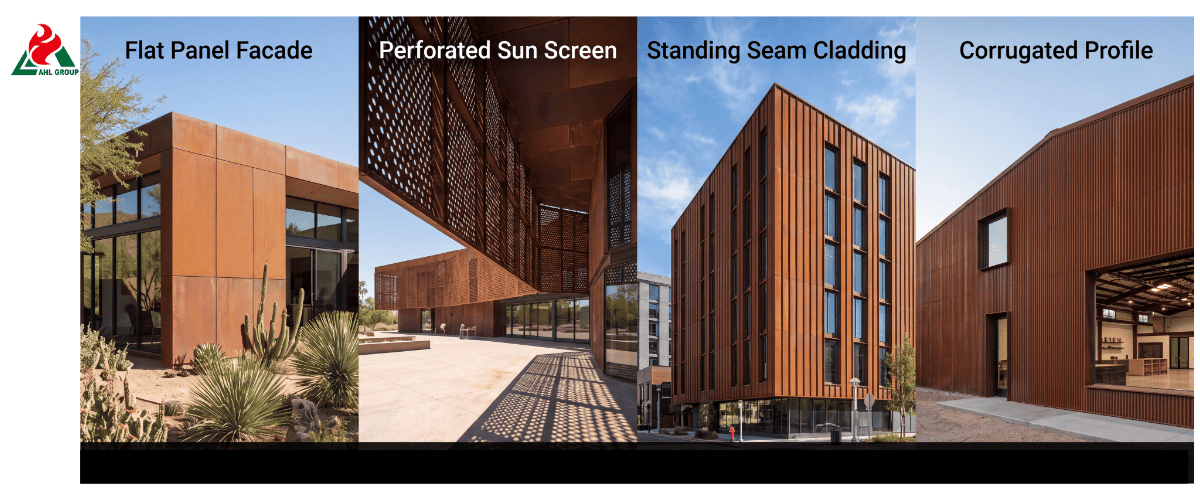
“Corten” is commonly used in the architectural field to describe weathering steel, a material specially formulated to form an adherent rust layer under suitable atmospheric conditions. This rust layer can slow the rate of further corrosion, provided the steel is able to drain water and undergo cycles of wetting and drying.
For projects in tropical climates, two issues must be considered simultaneously: Can weathering steel perform effectively under these microclimatic conditions? And can the complete wall system effectively control heat, air, and moisture? This guide will evaluate both aspects.
1. What Makes Corten Cladding Suitable for a Hot Climate
In hot climates, the optimal exterior wall cladding is not determined solely by the cladding material itself, but rather by the thermal performance and moisture resistance of the entire wall structure. Even if a particular cladding material can withstand high surface temperatures, it will still result in poor wall performance if there are gaps in the insulation layer, if metal fasteners create significant thermal bridges, or if air leaks allow hot, humid air to enter the building structure.
The evaluation should begin with quantifiable criteria: solar radiation absorption, thermal conductivity of the entire wall, drainage performance, drying capacity, UV exposure, wind-driven rain, risk of corrosion or decay, fire resistance, structural wind resistance, accessibility for maintenance, and installation costs. While aesthetics are certainly important, they should not replace a technical assessment.
The characteristics of different hot climate zones also vary significantly:
| Climate |
Main siding challenge | What the wall must do |
| Hot–dry |
Intense sun and large day–night temperature swings | Limit heat gain and accommodate thermal movement |
| Hot–humid |
Solar heat plus high ambient moisture | Control rain, air leakage, vapour and drying |
| Hot coastal |
Heat, humidity, wind-driven rain and chlorides | Manage salt, corrosion, drainage and maintenance access |
| Hot urban |
Heat-island effects, pollution and limited airflow | Control surface heat, runoff and difficult façade access |
In hot, dry inland environments, while a robust water barrier system can drain and dry quickly, west-facing panels may still be subjected to intense afternoon sunlight. In hot, humid regions, the same wall system must also contend with inward water vapor migration, air leakage, and slowed drying rates. In coastal areas, salt deposition may become a key factor in determining durability.
No single label—such as “heat-resistant”—can address all of these issues. Design teams should compare candidate exterior wall finishes based on identical wall construction, orientation, insulation goals, support systems, and maintenance assumptions. Only then can the comparison be meaningful.
2. How Does Corten Steel Siding Perform in Heat
Weathering steel is an architectural cladding material, not a thermal insulation layer. Compared to a specifically designed thermal insulation layer, the thermal resistance provided by thin metal sheets is negligible. Its primary functions are to form the outer layer of the building envelope, shed most rainwater, resist wind and impact, and achieve the intended architectural appearance.
Behind this outer skin, a successful wall system typically requires a drainage and ventilation cavity, a suitable supporting structure, a vapor barrier, an air control layer, a thermal insulation layer, and a structural back wall. The specific sequence depends on the climate, materials, building use, and local building codes.
Solar Radiation Absorption and Surface Temperature
A mature, brown patina is darker than many reflective or light-colored finishes. When exposed to direct sunlight, Corten steel panels can become very hot. West-facing exterior walls may face particularly severe challenges, as intense afternoon solar radiation coincides with higher ambient temperatures.
An increase in panel temperature does not necessarily mean that indoor temperatures will reach the same level. Heat transfer also depends on shading, orientation, cavity airflow, insulation, thermal mass, thermal bridges, airtightness, and cooling strategies. Ventilated cavities help isolate the sun-heated outer layer from the protected wall structure, but they are not a substitute for insulation measures or project-specific energy consumption analysis.
When reducing solar radiation absorption is the primary objective, light-colored or highly reflective finishes may offer inherent advantages. Weathering steel can still be used selectively—for example, on shaded facades, entrance features, or areas protected by deep eaves—while other materials should be used for the most exposed wall surfaces.
Continuous Insulation Layers and Thermal Bridges
A continuous exterior wall insulation layer can reduce heat flow through wood or metal framing. The U.S. Department of Energy’s “Buildings for America” Solutions Center explicitly states that a continuous rigid insulation layer is an effective method for reducing thermal bridges in framed exterior walls.
Sub-framing remains critical. Metal clips and horizontal and vertical studs may bypass the insulation layer, thereby reducing the effective thermal performance of the entire wall. Therefore, the nominal insulation value does not equate to the actual insulation value of the installed wall. Thermal calculations should account for representative clips, tracks, window perimeters, floor slab edges, parapets, and other transition areas.
Thermal Expansion and Panel Displacement
Steel expands and contracts with temperature changes. Large panels, long folded sections, and dark-colored facades exposed to sunlight require displacement allowances at joints and fastening points. If displacement is restricted, it may lead to panel buckling, the “oil drum” effect, damage to fasteners, or misalignment at windows and corners.
The correct allowance depends on the steel grade, panel dimensions, design temperature range, support spacing, and fastening method. There is no universal displacement value applicable to all curtain walls. Manufacturers and curtain wall engineers should coordinate panel dimensions, notches, joint widths, fasteners, and connection details.
The Function of a Ventilated Curtain Wall
A ventilated curtain wall separates the wall cladding from the structure it protects by incorporating a cavity that provides drainage and ventilation. It is recommended to use such a cavity to separate the exterior wall cladding from the building structure, including in wall designs for environments with high temperatures and high humidity.
For this cavity to function effectively, it must maintain sufficient continuity. Insect screens must be installed at its openings, and cavity barriers and fire-resistant seals must be installed as necessary. Flashing, drain holes, and base details must be designed to direct water outward. If the nominal gap is blocked by insulation, mortar, sealant, or improperly positioned tracks, the intended performance cannot be achieved.
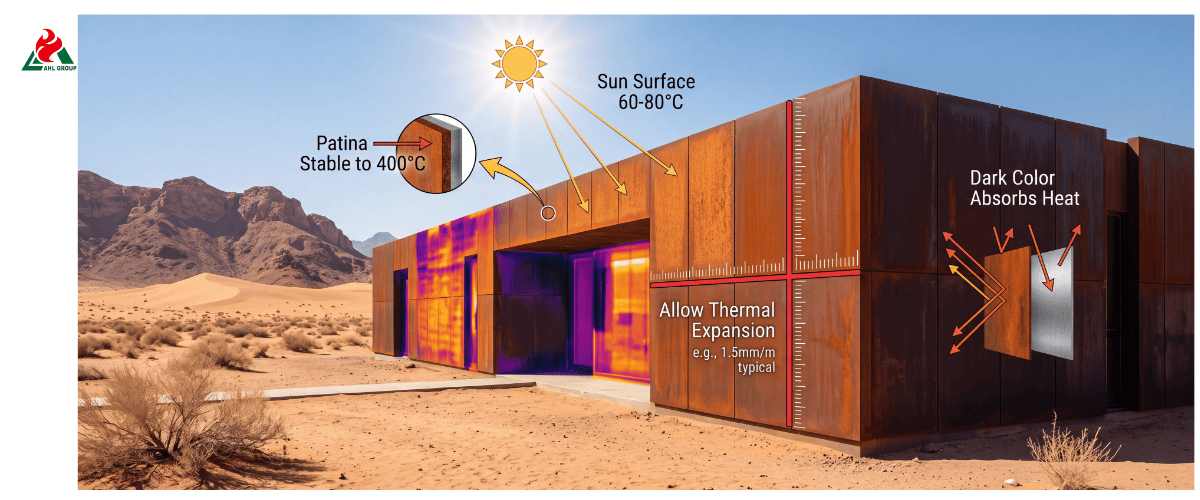
3. What Are the Advantages of Corten Siding in Hot Climates
Corten steel cladding panels feature a unique unpainted surface and a sturdy metallic outer layer, and may require little maintenance in suitable environments. While these advantages are genuine, their actual effectiveness depends on technical specifications and construction details.
No Need for Traditional Coatings in Suitable Environments
Initially, Corten steel corrodes just like other low-alloy steels, but its alloying elements form a more stable, strongly adherent, and less porous rust layer. Alternating wet and dry conditions are key to this process. Technical guidelines explain that when the rust layer forms under suitable conditions, it acts as a barrier against further intrusion of oxygen, moisture, and contaminants.
Eliminating the traditional painting process may eliminate the need for periodic repainting. However, this does not mean that the exterior walls require no maintenance: drainage systems, joints, fasteners, flashing, debris screens, and rainwater flow paths still require regular inspection.
Distinctive Architectural Style
Weathering steel gradually changes from a dark rolled scale or fresh gray metal through shades of orange and reddish-brown, eventually forming a deeper brown patina. This surface finish complements concrete, stone, wood, glass, and greenery. It also lends visual depth to large facades—a quality that uniformly coated panels may not be able to provide.
Change is an inherent characteristic of this material. Different orientations, levels of rain exposure, panel geometries, and installation methods will all result in varying colors and rates of rusting. Owners should approve full-scale samples or on-site prototypes rather than expect every panel to be identical from the first day of installation.
Durable and Repairable Building Envelope
Properly specified steel panels can form a robust building envelope. However, its performance depends on the steel grade, thickness, panel shape, support spacing, edge details, fasteners, and exposure conditions. The term “Corten” alone does not constitute a complete specification.
A comprehensive procurement document should clearly specify the standards, grades, thicknesses, fabrication processes, weld treatment, surface conditions, substructure, fasteners, and replacement procedures for weathering steel. For high-value or special projects, a service life or corrosion assessment may also be required.
Surface Maintenance May Be Minimal
Unlike some coating systems, unpainted Corten steel façades require no repainting to match colors. However, inspections remain important. Maintenance teams should remove debris, keep drains clear, inspect joints, document localized corrosion, and address oxide runoff.
It is important to note that low surface maintenance requirements do not mean the system is maintenance-free. Leaks in the cladding above unpainted panels are still considered defects, and blocked cavity drain pipes can lead to persistent moisture buildup.
Recyclability and Material Accounting
Although steel is recyclable, this alone does not prove that Corten steel is the exterior cladding material with the lowest environmental impact. A credible environmental comparison should comprehensively consider factors such as product-specific environmental declarations, panel weight, substructure, insulation, transportation, fabrication, service life, replacement frequency, and end-of-life recycling.
If panels lack the stiffness or corrosion resistance margin required for the application, thinner panels are not necessarily better. Similarly, while avoiding painting may reduce one maintenance burden, a complex support system will increase material usage in other areas. Complete curtain wall systems should be compared, rather than individual panel materials in isolation.
4. What Are the Drawbacks of Corten Siding in Hot Climates
Key limiting factors include solar heat gain, site-specific corrosion risks, oxidation and flaking, thermal bridging, and the need for specialized detailing. These factors do not necessarily preclude the use of Corten steel, but they may make other exterior cladding materials more suitable.
Dark Surfaces Absorb Solar Heat
Corten steel is not inherently a “cool wall” cladding material. Its dark surface absorbs more solar energy than light-colored or highly reflective cladding. Continuous insulation, ventilated cavities, thermal break detailing, external shading, and proper orientation can all mitigate its impact on the building, but they cannot eliminate the surface’s heat absorption.
An effective design strategy is to create a solar radiation map based on the elevation drawings. Weathering steel can be concentrated on north-facing or shaded walls, under eaves, or in small accent areas, while reflective exterior cladding is used on the west facade, which receives the strongest sunlight.
Exposure to Chlorides Can Interfere with the Weathering Process
Sea salt is an important warning sign. Chloride deposits absorb moisture and may interfere with the formation of a stable rust layer. It is noted that high concentrations of chlorides from sea spray, salt fog, or atmospheric salt in coastal areas can be destructive, while the actual risk depends on the site’s microclimate, topography, and prevailing winds (Weathering Steel Guidelines).
Never apply bridge design guidelines directly to residential buildings as a universal standard for a “safe distance from the sea.” Two buildings located at the same distance from the coast may experience vastly different salt loads. Factors such as exposure, elevation, shading, wind, rain wash, and access for maintenance are all critical. For harsh coastal sites, an assessment should be conducted by a corrosion specialist or a curtain wall consultant.
Persistent Moisture and Concealed Dampness
Drying following normal rainfall promotes natural rusting; persistent moisture, however, hinders this process. Sheltered base plates, narrow and unventilated cavities, leaking parapets, vegetation-covered base details, and eaves cluttered with debris may remain damp for extended periods even after exposed panels have dried.
The Weathering Steel Guidelines explicitly state that conditions of persistent dampness, submersion, burial, or vegetation coverage are not conducive to the normal performance of standard uncoated materials. In hot and humid climates, design details must promote drainage and drying, rather than merely concealing moisture behind the curtain wall.
Rust-stained Water May Cause Discoloration of Adjacent Materials
During the weathering process, water may carry iron oxide onto light-colored concrete, stone, plaster, and paved surfaces. The guidelines acknowledge this risk of discoloration and note the need for careful design of surrounding areas.
Drip edges, flashing, spacers, controlled drainage paths, and stain-resistant water-collecting surfaces should be used. Never allow rainwater to run along limestone window sills or pool decks. Although pre-weathering treatment can make early appearance changes more predictable and remove some loose oxides, it cannot guarantee that the facade will remain permanently free of stains.
Subframes Can Create Significant Thermal Bridges
Metal fastening systems conduct heat through the exterior wall insulation. Adding insulation without inspecting clips and tracks may result in lower-than-expected thermal performance. Insulated intermittent clips may be preferable to continuous, direct metal transoms, but they must simultaneously meet structural load-bearing capacity, fire code, and curtain wall load requirements.
Wall-wide calculations should account for fastener spacing and actual geometry. The thermal resistance value of the net wall alone is insufficient to meet high-performance code requirements.
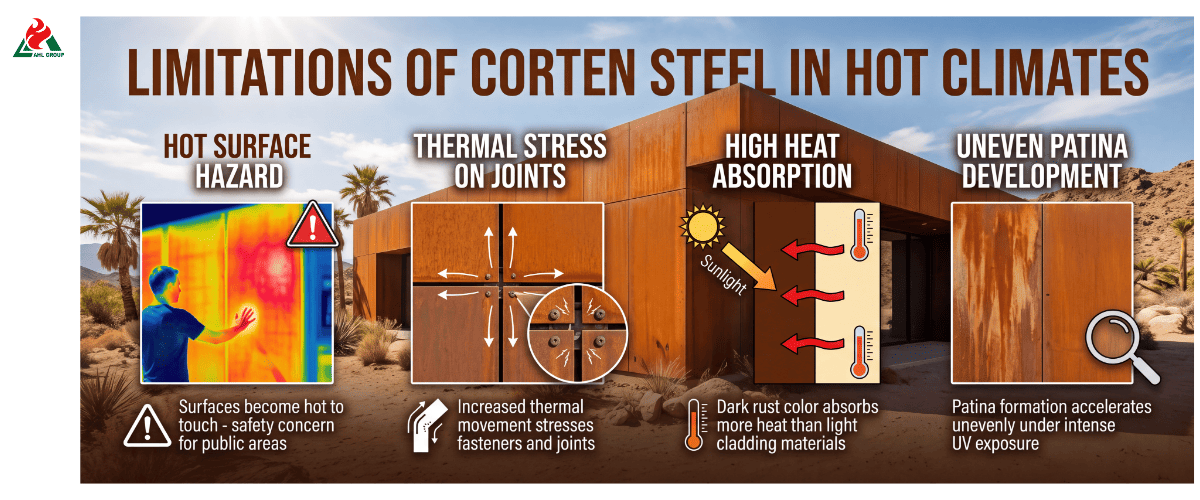
5. How Should Corten Siding Be Designed for a Hot Climate
In hot climates, weathering steel cladding walls should be designed as integrated rain screen systems, rather than having exposed steel panels directly attached to untreated walls. The final construction scheme must be developed based on specific climatic conditions, structural characteristics, fire protection strategies, wind loads, and energy efficiency goals.
Use a Drainage-Type or Ventilated Rain Screen System
The conceptual construction sequence from the exterior to the interior is as follows:
► Weathering steel panels.
► Designed with open, baffled, or closed joints.
► Cavities providing drainage and ventilation.
► Compatible tracks, clips, and fasteners.
► Continuous exterior wall insulation.
► Vapor barrier.
► Continuous air control layer and structural back wall.
► Inner layers selected based on climate and use.
These are not universal construction details. Water vapor control strategies and layering sequences must be verified by the project’s building science experts. In hot and humid climates, uncontrolled inward migration of water vapor and moist air can be just as significant a concern as rainwater.
Maintain the Continuity of the Insulation Layer
The insulation layer should be extended to the junctions between walls and roofs, walls and foundations, as well as balconies, canopies, and doors and windows. The guidelines note that a continuous rigid insulation layer can reduce thermal bridging and, when properly installed and sealed, facilitates the implementation of drainage, ventilation, and moisture control measures.
When modeling, representative joints should be considered, not just the middle sections of continuous walls. Floor edge details, angle irons, tracks, and dense fastener distributions can all undermine the effectiveness of high nominal R-values.
Reducing Thermal Bridges in Fastening Systems
Through structural and thermal analyses, compare continuous beams, intermittent clips, and thermally optimized support components. The support system must be capable of withstanding the panels’ dead weight, wind loads, applicable seismic loads, and displacements, while maintaining the continuity of the insulation layer.
Insulation pads or isolators are not necessarily effective simply by virtue of their presence. Their material, thickness, degree of compression, fastener paths, and coverage area all affect performance.
Selecting Compatible Fasteners and Adjacent Metals
Fasteners, tracks, flashing, and sealants must be compatible with weathering steel and the surrounding environment. Electrochemical corrosion may occur when different types of metals remain electrically connected in a humid environment. Improper selection of joints may also lead to discoloration and accelerated localized corrosion.
Written approval for auxiliary materials must be obtained from the exterior wall cladding supplier or a corrosion specialist. Where necessary, incompatible metals should be isolated, and one should never assume that fasteners of the same grade are suitable for both inland and harsh coastal environments.
Coordinating Fire Resistance and Wind Resistance
Steel exterior wall panels alone do not make the entire curtain wall a non-combustible structure or ensure compliance with code requirements. Insulation, waterproofing membranes, cavity barriers, substructures, fasteners, joints, and opening details are all critical components of a fire protection strategy.
Similarly, weathering steel panels and their supporting structures must be capable of withstanding the wind pressures to which the project is exposed, including at corners and perimeter areas. These decisions should be based on local codes, tested components, and qualified engineering designs—rather than relying on general marketing claims about the panels.
6. Corten Steel vs Other Siding for Hot Climates
The advantages of weathering steel are most evident when architectural distinctiveness, a robust metal skin, and the avoidance of traditional coatings are prioritized. However, it is not universally the best choice in terms of solar reflectance, resistance to seawater corrosion, or lowest initial cost.
| Material |
Solar-heat considerations | Moisture considerations | Maintenance | Main advantage | Main limitation |
| Corten steel rainscreen |
Dark surface can become hot; cavity and insulation are critical | Requires wet–dry cycling; salt and persistent dampness are risks | Inspect drainage, fasteners and runoff | Distinctive unpainted finish | Heat absorption, staining and exposure limits |
| Light-coloured metal |
Reflective finishes may reduce solar absorption | Joints, cut edges and coating need correct detailing | Inspect finish; eventual recoating may be needed | Potentially lower solar absorption | Coating durability and metal thermal bridges |
| Fibre cement |
Colour and wall build-up affect heat gain | Requires drained detailing and compatible fixings | Cleaning and finish care vary | Stable appearance and broad design range | Weight, cutting and finish requirements |
| Stucco or render |
Light colours can reduce solar absorption | Cracking and drainage strategy are critical | Repair cracks and coatings | Familiar regional construction | Highly dependent on substrate and moisture detailing |
| Brick or masonry veneer |
Thermal mass can delay heat flow | Needs flashings and cavity drainage | Inspect joints and flashings | Robustness and thermal mass | Weight, structure and embodied impacts |
| Timber siding |
Finish colour and cavity affect temperature | Drying, termites and decay vary by region | Regular coating may be required | Warm appearance and low weight | UV, fire, insects and moisture maintenance |
The design and installation quality of the wall system may be more important than the advantages of the material itself. A Corten cladding wall system with well-detailed construction may outperform a poorly installed “cool-look” exterior wall system; conversely, when cooling loads are a primary consideration, light-colored reflective panels installed on a thermally efficient support structure may perform better than weathering steel.
Before selecting weathering steel, please confirm the following ten points:
► Local humidity and chloride ion exposure have been assessed.
► The facade includes properly functioning drainage or ventilation cavities.
► A continuous thermal insulation layer has been specified.
► Thermal bridging effects of the fastening system have been quantified.
► Panels and joints can accommodate thermal expansion and contraction.
► Rainwater drainage is routed away from surfaces prone to staining.
► The entire assembly meets fire, wind, and energy efficiency requirements.
► Natural color variations are acceptable.
► Access for inspection and maintenance has been provided.
► The steel grade, thickness, fabrication process, and warranty terms have been documented.
7. Where Does Corten Siding Work Best—and Where Is It Risky
Generally speaking, Corten steel is better suited for hot, dry inland locations rather than sites with persistent moisture and high salt exposure—provided that the wall structure can control solar heat gain and limit panel movement. The specific on-site exposure conditions are more important than mere climate classification.
More Suitable Applications
Ideal applications include: ventilated curtain walls with continuous insulation, buildings where a natural rusting effect on the facade is desired, and sites where rainwater runoff can be directed to stain-resistant surfaces and effectively managed. For folded panels, complex joints, and large-scale facade projects, experienced manufacturers and curtain wall consultants are particularly important.
Hybrid curtain wall solutions also perform well. Weathering steel can be used to define entrances, courtyards, or shaded areas, while lighter exterior cladding is employed to protect walls exposed to the strongest sunlight.
Conditional Applications
In environments with high temperatures and humidity, the building’s drainage, air control, and drying performance must be verified. West-facing facades require solar radiation and structural movement analyses. Walls adjacent to swimming pools, water features, or irrigation systems require splash assessments, while urban sites may require additional review for pollution, restricted airflow, and construction access.
These are not automatic exclusion criteria, but rather indicate the need for more detailed design and testing.
High-Risk Application Scenarios
Risks increase under the following conditions: severe marine salt damage, persistent moisture, hidden leaks, steel embedded in soil, vegetation growing directly against exterior walls, blocked cavities, and rainwater running down light-colored, porous surfaces. Naturally weathered steel is also not an ideal choice for projects that require a completely uniform color from day one.
The following three scenarios illustrate these differences:
► Hot, dry inland residential buildings: Corten steel may be a viable option if continuous insulation, ventilated cavities, shading measures, and details to accommodate movement are incorporated.
► Hot, humid commercial buildings: Rainwater control, moisture ingress, condensation risks, and drying conditions should be verified through wet-heat analysis and facade analysis.
► Hot coastal resorts: Unless the project has been verified to include targeted corrosion-protection measures, issues such as salt, wind-driven rain, and staining may make coated metals, fiber-cement, masonry, or other systems more suitable.
► The lesson to be learned is not that a particular climate category is always suitable or unsuitable, but rather that microclimates and wall construction determine the level of risk.
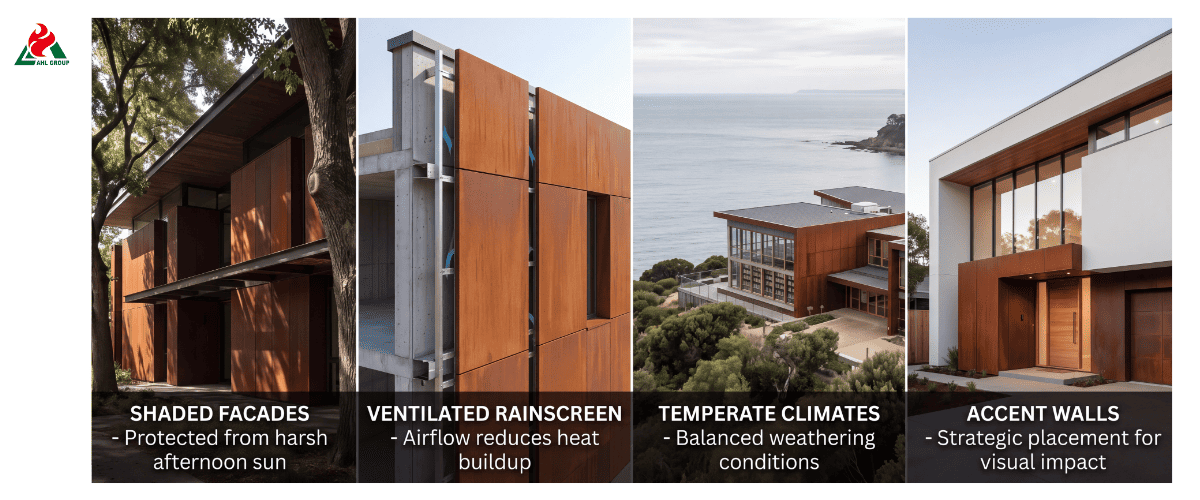
8. Frequently Asked Questions
Q1: Does Corten Steel Siding Make a House Hotter?
Under direct sunlight, exterior cladding panels may become hot, especially after the rust layer has darkened. However, the heat gain inside the building depends on the building’s orientation, shading, cavity ventilation, continuous insulation, airtightness, and thermal bridging. Weathering steel should be evaluated as part of the entire wall system, rather than as an independent insulation layer.
Q2: Does Corten Steel Need Insulation Behind It?
Yes, insulation should be installed when a building’s energy consumption and comfort requirements call for an insulated wall system. Weathering steel itself provides negligible thermal insulation. The type, location, and amount of insulation material depend on climate, usage, local codes, fire protection strategies, and energy consumption goals.
Q3: How Long Does Corten Siding Last in a Hot Climate?
There is no reliable, universal data on service life. Alloy grade, thickness, fabrication methods, exposure conditions, chloride levels, drying treatments, detailing, and maintenance all affect service life. Please request project-specific durability justifications and product documentation rather than relying on unsubstantiated service life claims.
Q4: Is Corten Siding Fire-Resistant?
Steel panels themselves are non-combustible, but exterior walls are not composed solely of steel panels. Components such as insulation layers, waterproof membranes, cavity barriers, substructures, joints, and openings must function as an integrated assembly to meet applicable fire safety requirements.
Q5: What Is the Best Alternative in a Hot Coastal Climate?
Possible alternatives include coated metal, fiber cement, masonry, or other proven rainscreen systems. Their chloride resistance, solar reflectance, fastener corrosion, drainage performance, maintenance requirements, and the installation experience of local contractors should be compared. In the absence of site-specific and wall-specific data, no single material can be considered a one-size-fits-all solution.
Conclusion: Is Corten Steel the Best Choice for Your Project
In certain hot climates, where architectural aesthetics, naturally weathered surfaces, and a robust rain screen system are primary considerations, Corten steel is a highly competitive choice for exterior walls. However, it is not necessarily the best option when the priority is minimal solar radiation absorption, the lowest initial cost, or exposure to harsh coastal environments.
Request Climate-Specific Technical Specifications for Weathering Steel Exterior Cladding: Please provide the project location, elevation drawings, proposed wall construction, and environmental exposure conditions to enable a comprehensive evaluation of the panels, support structure, insulation, and drainage solutions.
Before comparing prices, carefully review panel grades and thicknesses, secondary framing, ventilation cavities, continuous insulation layers, thermal bridges, rainwater drainage details, and warranty terms. For related planning guidance, please refer to our guides on Corten steel rust formation, rust runoff, and the application of weathering steel in coastal environments.

