


In the ever-evolving field of architectural design, the selection of privacy screens and building partition materials has shifted from a purely aesthetic decision to a rigorous financial assessment. Building owners and commercial developers are increasingly looking beyond the initial price tag to focus on the total cost of ownership (TCO). While wood has historically been the “default” choice due to its lower upfront cost, weathering steel—a specialized type of steel—has emerged as a strong competitor.
The core question is no longer simply “What can I afford today?” but rather “Which material will deliver the highest return on investment (ROI) over the next twenty years?” This guide will delve into the economic, mechanical, and environmental realities of these two materials to determine which is truly more cost-effective.
.png)
The core question is no longer simply “What can I afford today?” but rather “Which material will deliver the highest return on investment (ROI) over the next twenty years?” This guide will delve into the economic, mechanical, and environmental realities of these two materials to determine which is truly more cost-effective.
1. Upfront Cost Comparison
For many projects, the initial investment is the primary obstacle. There is a significant gap in “day-one” pricing between luxury metal products and traditional organic materials.
Initial Investment in Corten Steel Screens
Corten privacy screens are a high-end architectural product. Their cost depends primarily on the alloy's purity—specifically, the content of copper, chromium, and nickel —since the ratio of these elements determines the formation of the protective rust layer. By 2026, driven by fluctuations in the raw materials market and the energy-intensive laser cutting processes required for complex designs, the price of weathering steel will remain at the high end of the market. What you are paying for is not merely a partition, but an engineered material designed for an exceptionally long service life.
Pricing for Wooden Partitions
Wood offers the widest range of entry-level options. From affordable pressure-treated pine to mid-range cedar, and on to premium hardwoods like ipe or teak, the upfront cost is often significantly lower than that of steel products. For many “budget-first” projects, people choose wood because it covers a larger area with a smaller initial investment. However, the quality of the wood determines its future costs; cheap wood often hides a “maintenance debt” that must be paid off later.
Differences in Installation Labor Costs
Installation costs depend on weight and complexity. Wooden screens are lightweight and can usually be installed using standard carpentry tools, thereby reducing labor hours. In contrast, Corten screens are heavy and structurally robust, requiring specialized installation hardware, reinforced foundations, and sometimes a two-person team for handling or the use of professional lifting equipment. While a skilled carpenter can install a wooden screen, installing a Corten metal screen typically requires a contractor familiar with metal thermal expansion and contraction as well as mechanical fastening.
2. 10-Year Total Ownership Breakdown
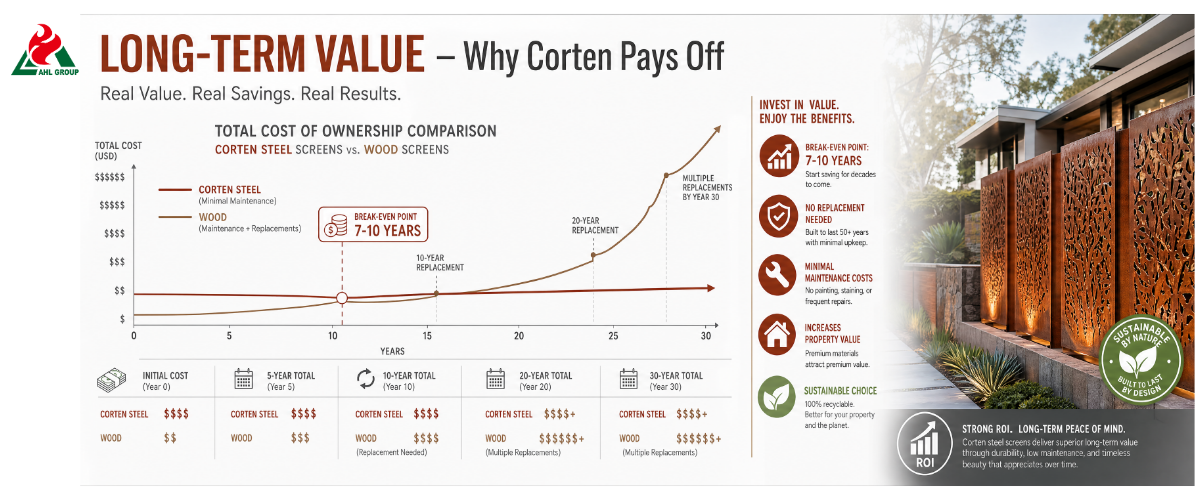
To understand the cost-effectiveness, we must look at a 10-year timeframe. Over this period, steel’s “maintenance-free” nature begins to offset its higher initial price.
Over a typical 10-year cycle, wooden screens require at least three major maintenance sessions (sanding, staining, or sealing). When factoring in the cost of high-quality UV-resistant wood stain and professional labor, the cumulative cost of wood rises sharply. By the seventh or eighth year, the total cost of a high-quality wooden screen often equals the original purchase price of a Corten steel screen.
| Year | Corten Steel Cumulative Cost | Wooden Screen Cumulative Cost |
| Year 0 | High (Initial Purchase) | Low-Medium (Purchase) |
| Year 3 | $0 (Self-Protecting) | + Stain/Labor Cost |
| Year 6 | $0 (Patina Matures) | + Stain/Labor/Minor Repair |
| Year 9 | $0 (Stable) | + Replacement Parts/Rot Repair |
| Year 10 | Total = Initial Investment | Total = Initial + 150% Maint |
3. Maintenance Cost Reality
The true “hidden cost” of landscape materials lies in the time and money spent preventing them from deteriorating.
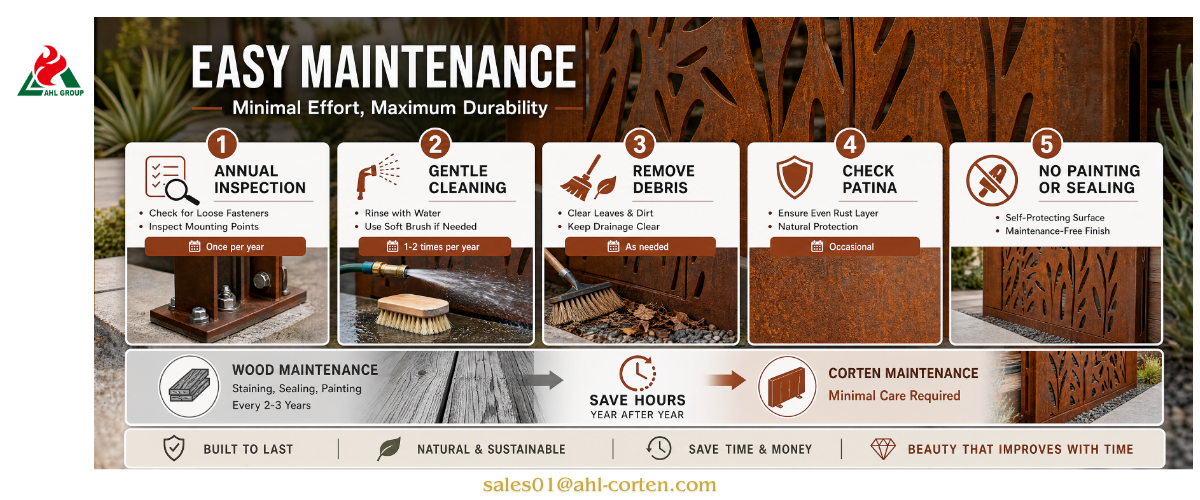
Corten Steel: Virtually Maintenance-Free After the Second Year
The appeal of Corten steel lies in its “metabolic” reaction with the environment. During the first 18 to 24 months, as an oxide layer forms, the steel undergoes a “bleeding” process. Aside from occasionally rinsing the surrounding area, no active maintenance is required. There is no peeling paint, no need to apply rust inhibitors, and no structural treatments are necessary. It is a “set-it-and-forget-it” solution.
Wood: Annual Sealing + Pest Control
As an organic material, wood is constantly in a state of decay. To slow this process, homeowners must commit to annual or biennial treatments. By 2026, the price of high-quality, eco-friendly sealants had risen, making this a costly, recurring expense. Additionally, wood is susceptible to damage from wood-boring insects, such as termites and wood-boring beetles; in certain climates, professional pest control may be required.
Unseen Costs: Stain, Paint, Rot Repair
In addition to regular maintenance, the parts of the wood that come into contact with the floor are prone to localized rot. Replacing a rotted post or a warped slat not only incurs material costs but also requires labor to partially dismantle the screen. Over time, these “minor repairs” can disrupt the visual continuity of the screen panel and add hundreds of dollars to its total lifecycle cost.
4. Lifespan & Replacement Frequency
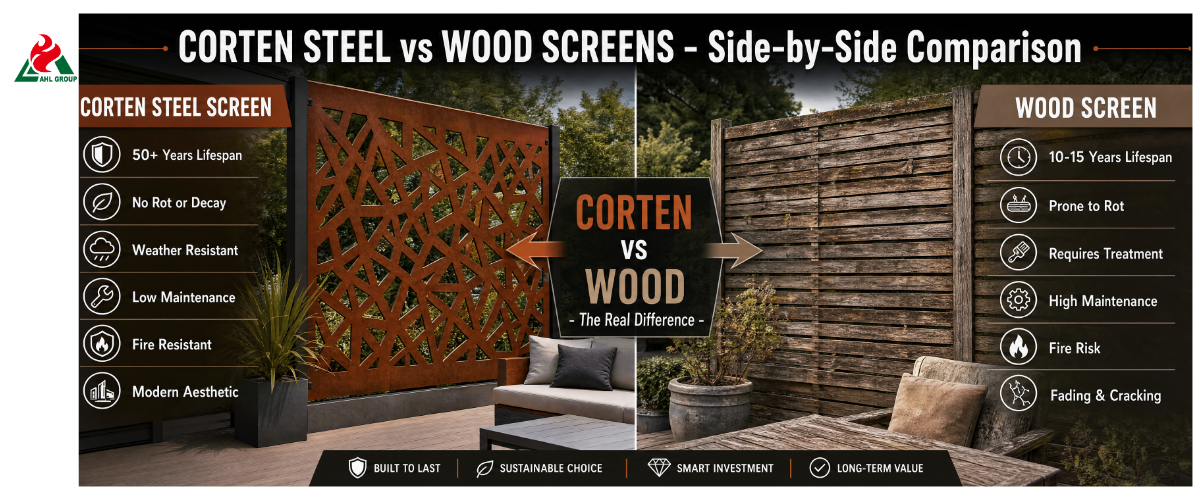
Durability is the ultimate value multiplier. A product with a service life three times longer than that of its competitors effectively has a 66% “discount” on its cost over its entire lifecycle.
Corten Steel: 25–50+ years
There is a good reason why Corten steel is widely used in bridge construction and high-rise buildings. Once a protective rust layer forms, the corrosion rate drops to nearly zero. In a typical residential or commercial landscape, a Corten steel screen panel is a generational asset, with a lifespan that is likely to outlast the property’s ownership cycle.
Wood: 7–15 years (Pressure-Treated)
Pressure-treated pine is the most common wood choice, but it has the shortest lifespan. Even after chemical impregnation, it remains prone to severe warping and internal rot. By the 10th year, most pressure-treated screens look “worn out,” may exhibit noticeable structural wobble, and require complete replacement.
Cedar/Redwood: 12–20 years (Premium)
Cedar and redwood contain natural oils that repel insects and resist moisture, giving them a longer lifespan than pine. However, they remain susceptible to UV degradation. Without the continuous application of UV-protective wood stain, the wood fibers will break down, causing the surface to turn white and eventually leading to structural “splitting” (cracks).
5. Aesthetic Longevity Comparison
Compared to outdoor screens that appear neglected, those that remain straight and attractive can significantly increase a property’s resale value.
Corten Steel: Aged by Time, Growing More Charming
Weathering steel undergoes a process of “graceful aging.” It initially appears as a raw, deep gray metal, gradually transforms into a vibrant orange, and eventually settles into a deep, textured chocolate brown. This color is an integral part of the metal itself and will not fade. In modern and industrial design, this evolving patina is regarded as an architectural feature rather than a flaw.
Wood: Fading, Warping, and Cracking
By its fifth year of use, wood often looks far less attractive than it did in its first year. As humidity fluctuates, wood expands and contracts. Because the grain runs in different directions, expansion is uneven, causing panels to warp, arch, or twist. These structural deformations not only affect aesthetics but also frequently prevent doors or sliding mechanisms from functioning properly.
Resale Value Impact
Prospective homebuyers are extremely sensitive to the issue of “delayed maintenance.” Homes featuring weathering steel convey the message to buyers that the property uses high-quality, low-maintenance materials. However, a weathered, gray wooden fence suggests that buyers will need to tackle weekend repair projects right away or face costly replacement expenses, which often leads to lower offers.
6. Environmental & Hidden Costs
Cost-effectiveness also includes the “environmental cost” and the risk of hazardous materials in your property.
Corten Steel: No Chemical Treatments Required
Corten steel is 100% recyclable. It requires no chemical sealants, VOC-based stains, or pesticides. The only “leachate” produced by Corten steel is iron oxide—the same substance found in natural soil. This makes it an ideal choice for eco-friendly development projects.
Wood: Requires Annual Sealing/Pesticide Application
Most affordable wooden screens are “pressure-treated” using chemicals such as ACQ (alkali copper quaternary). While safer than the older CCA (chromated copper arsenate), this process still results in copper leaching into the soil. Additionally, the volatile organic compounds (VOCs) released during the annual painting process contribute to local air pollution.
Disposal/Recycling Costs
When wooden screens reach the end of their useful life, they are typically sent to landfills because chemically treated wood is not suitable for incineration or composting. In contrast, if a Corten garden screen is dismantled, it still retains scrap value. Essentially, you have “stored” a portion of your investment in the weight of the steel.
7. Installation Cost Differences
Although we mentioned labor costs earlier, the mechanical requirements are quite different.
Foundation: In strong winds, weathering steel screens act like “sails” under the force of the wind. Therefore, compared to ordinary wooden fences, they require deeper foundations and sturdier steel posts.
Precision: Metal materials allow absolutely no “tolerance.” If the post position deviates by as little as 1/4 inch, the laser-cut panels cannot be bolted into place. This requires surveying-grade precision during the initial excavation phase, which may increase the cost of professional installation.
Hardware: Wooden fences use galvanized screws (which are less expensive). Weathering steel, however, requires stainless steel or weathering steel fasteners to prevent electrochemical corrosion (i.e., the phenomenon where two different metals corrode each other when they come into contact).
8. Decision Matrix by Priority
| If your priority is... | Choose... | Why? |
| Immediate Cash Flow | Wood | Lowest day-one price. |
| Long-Term ROI | Corten | Zero maintenance and 50-year life. |
| DIY Installation | Wood | Easier to cut and screw by hand. |
| Modern Aesthetics | Corten | Clean lines and architectural patina. |
| Sustainability | Corten | 100% recyclable and chemical-free. |
9. Real-World Case Studies
Coastal Homes: Weathering Steel Outperforms by 300%
In salt-fog environments, wood rots and “silvering” occurs twice as fast as under normal conditions. Stainless steel is expensive, while ordinary steel rusts through. However, weathering steel performs exceptionally well in coastal environments. The salt-laden air actually helps form a rust layer more quickly and densely. Over 20 years, coastal homeowners may need to replace wooden screens three times, while Corten landscape screens remain as good as new.
Budget Rentals: Wood Is the Smart Choice
For developers renovating homes for resale, or for short-term rental projects aiming for a “refresh” before sale, wood provides the necessary visual privacy at the lowest cost. Since owners have no intention of taking on the responsibility of replacement after 10 years, wood is the more “sensible” short-term choice from a financial perspective.
Luxury Real Estate: Weathering Steel as a Status Symbol
In high-end construction projects, weathering steel is chosen not only for cost considerations but also for its durability. It is viewed as an “investment in the property’s structure,” holding equal status to stone or masonry.
Conclusion: Corten Wins Long-Term
If you plan to live in your current home or manage the property for more than seven years, weathering steel is the more cost-effective choice. The high upfront cost of weathering steel essentially serves as an “insurance policy” against future labor costs, inflation in material prices, and the natural aging of landscaping features. It provides a fixed cost and guarantees a long service life.
From an investment perspective, weathering steel qualifies as a “capital expenditure” (CapEx) that adds tangible value to a property’s equity. Wood, on the other hand, constitutes an ongoing “operating expenditure” (OpEx) that requires a continuous cash flow to maintain its value. In the realm of property management, steel is the wise choice.

