


Corten steel fire pits become extremely hot during use, especially inside the fire bowl, where the flames and burning fuel directly heat the weathering steel. For wood-burning fire pits, temperatures in the combustion zone typically reach 600–900°C (1,100–1,650°F), while gas-fired fire pits generally operate at lower, more easily controlled temperatures, depending on the burner design and fuel input.
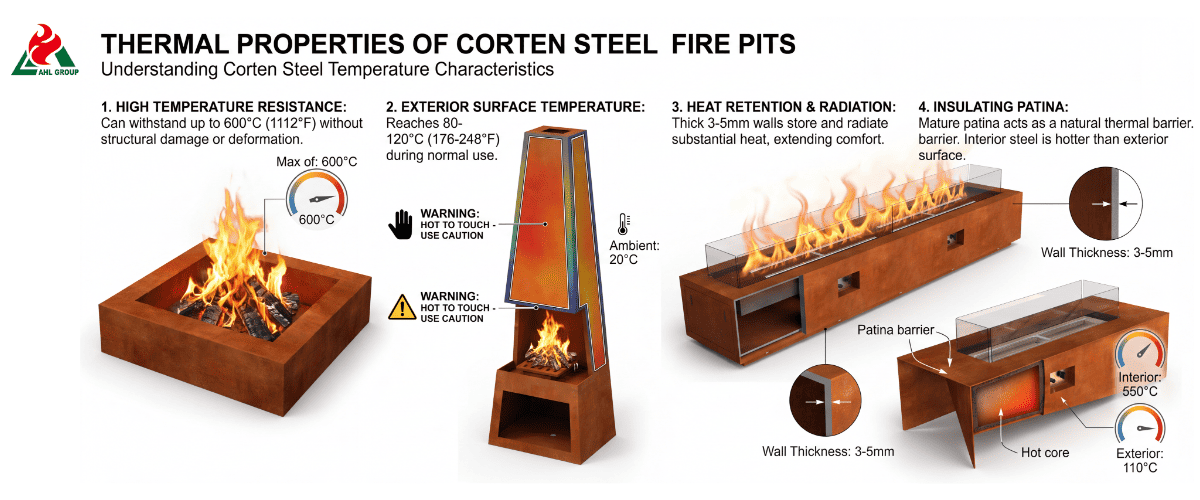
However, there is a significant difference between the temperature of the flame itself and the temperature of the fire pit’s outer surface. The temperature of the fire pit’s inner walls may exceed 500°C, while the temperature of the edges, side walls, base, and legs may be much lower. These temperature differences are critical when assessing safety around patios, yards, furniture, children, pets, and nearby structures.
Understanding the maximum temperature of a Corten steel fire pit also aids in daily maintenance. For a well-designed fire pit, repeated heating and cooling are normal; however, excessively high temperatures, poor drainage, improper fuel, or inadequate ventilation can accelerate deformation, scaling, or premature damage to the fire pit.
However, there is a significant difference between the temperature of the flame itself and the temperature of the fire pit’s outer surface. The temperature of the fire pit’s inner walls may exceed 500°C, while the temperature of the edges, side walls, base, and legs may be much lower. These temperature differences are critical when assessing safety around patios, yards, furniture, children, pets, and nearby structures.
Understanding the maximum temperature of a Corten steel fire pit also aids in daily maintenance. For a well-designed fire pit, repeated heating and cooling are normal; however, excessively high temperatures, poor drainage, improper fuel, or inadequate ventilation can accelerate deformation, scaling, or premature damage to the fire pit.
1. Quick Answer
Typical Internal Temperatures
Inside the main combustion chamber, when firewood burns completely, the core combustion temperature of the weathering steel fire pit typically remains between 600°C and 900°C (1,112°F and 1,652°F). Localized peak flame temperatures generated by burning high-density hardwood can exceed 1,000°C (1,832°F).
Surface Temperatures
Due to thermal gradients, surface temperatures vary across different parts of the fire bowl:
► Inner walls and lower walls of the fire bowl: Over 500°C to 700°C (932°F to 1,292°F).
► Outer rim and middle outer walls: During intense combustion, temperatures can reach 250°C to 450°C (482°F to 842°F), dropping to 65°C to 95°C (149°F to 203°F) along the extended outer insulated edge.
► Support base and legs: Provided there is sufficient air clearance, their operating temperatures will be significantly lower, ranging from 40°C to 90°C (104°F to 194°F).
Cooling Time
Due to the high thermal mass of the structural weathering steel (3.0 mm to 6.0 mm thick), complete cooling takes a relatively long time:
► Internal ash bed and core bowl: It takes 12 to 16 hours to cool down to room temperature.
► Outer rim and walls: They cool to a safe-to-touch temperature (<45°C) within 4 to 8 hours.
► Elevated base: It cools to ambient temperature within 1 to 2 hours after the fire is extinguished.
Key Safety Precautions
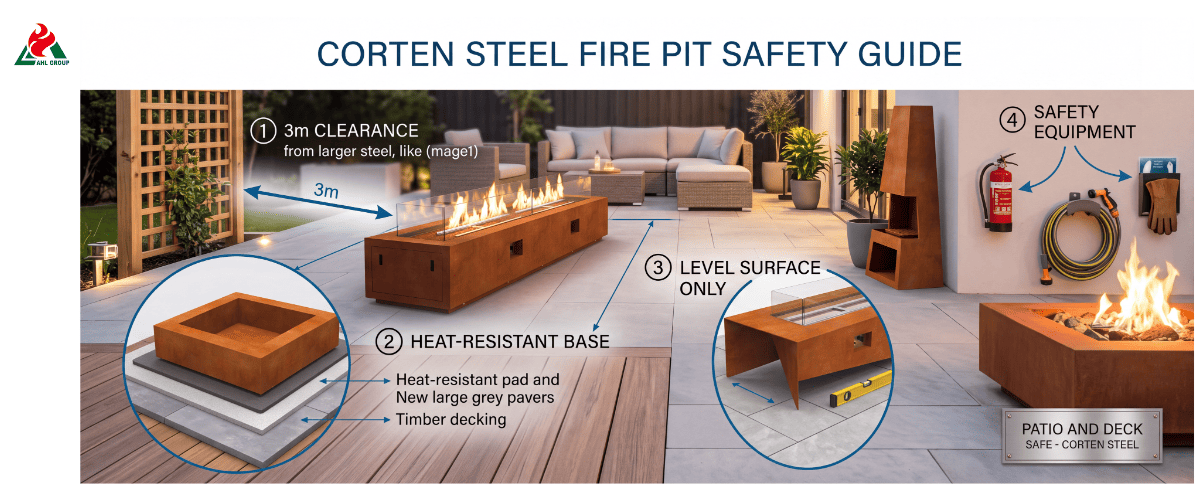
Until you are certain it has cooled down, treat every part of the Corten fire pit as a high-temperature hazard area. Always maintain a distance of at least 10 feet (3.0 meters) from combustible structures; if placing the fire pit on a composite or wooden deck, lay a non-combustible heat-resistant mat beneath the unit; never leave a burning fire unattended around children or pets.
2. Understand Temperatures
How Corten Steel Withstands High Temperatures
Weathering steel (compliant with ASTM A588 and ASTM A606-4 standards) is a weathering alloy steel containing copper, chromium, nickel, and phosphorus. Compared to ordinary low-carbon steel, these alloying elements give weathering steel exceptional structural stability at high temperatures. When repeatedly heated to 800°C, a protective oxide layer fuses with the steel surface, preventing structural deformation and metal flaking.
Comparison of Wood-Burning and Gas Fire Pits
► Wood-burning Type: Produces higher and more fluctuating temperature peaks (600°C to 1,000°C). The burning embers are located directly on the bottom tray, resulting in intense localized heat concentration.
► Gas-Fired (Propane/Natural Gas): Produces a predictable and uniform heat output (400°C to 650°C). The combustion ring, suspended above a layer of volcanic rock or fire-resistant glass, distributes heat evenly, thereby reducing extreme hot spots on the steel shell.
Factors Affecting Heat Output
► Fuel Density and Moisture Content: Dry hardwoods (oak, hickory, beech) with a moisture content below 15% burn at significantly higher temperatures than softwoods (pine, spruce).
► Airflow Design: Fire pits featuring a double-walled secondary combustion vent design deliver preheated oxygen to the fire, increasing combustion temperatures while minimizing smoke.
► Steel Sheet Thickness: Weathering steel sheets 5.0 mm or 6.0 mm thick absorb and retain heat longer than thinner 2.0 mm sheets.
► Ambient Wind Velocity: Strong winds act like the blower in a forge, both raising the combustion temperature of the firewood and blowing heat sideways toward the outer edges.
3. Internal Temperatures
Normal Range
Under standard operating conditions, when the firewood load is moderate, the air and wall temperatures inside the Corten steel fire bowl will fluctuate between 600°C and 750°C (1,112°F and 1,382°F).
Peak Temperatures
If an excessive amount of dense hardwood, kiln-dried wood, or lump charcoal is added to the outdoor fire pit, the core temperature of the firebed will rise to 900°C to 1,050°C (1,652°F to 1,922°F).
Wood-Burning: 600–900°C
A wood fire pit produces intense radiant heat. The red-hot bed of embers (above 900°C) comes into direct contact with the base plate, transferring heat through conduction and raising the surface temperature of the internal steel plates.
Gas Fire Pits
Propane and natural gas fire pits with a rated heat output ranging from 40,000 BTU to 100,000 BTU provide controllable flame temperatures. The internal heating element typically operates between 450°C and 600°C, delivering consistent warmth without the extreme localized hot spots associated with wood burning.
Effects on Steel
When heated to temperatures above 500°C, standard structural carbon steel loses more than 50% of its yield strength, leading to sagging of the base plate and deformation of the side walls. Weathering steel maintains its structural integrity at high temperatures. Repeated thermal cycling actually hardens and stabilizes the outer layer of the protective oxide scale rather than damaging it.
4. Surface Temperatures
Inside the Firebox: >500°C
The surface temperature of the firebox floor and inner walls, which are in direct contact with glowing firewood or charcoal, typically exceeds 500°C to 700°C. Direct contact will immediately cause severe burns.
Edges and Side Walls: 65–95°C
Due to the thermal conductivity of steel, the outer walls and upper edges near the fire source can reach temperatures of 250°C to 450°C. An extended horizontal flange or cantilevered safety ledge helps dissipate heat, reducing the temperature of the outer edges to 65°C to 95°C. Although cooler than the core area, these outer edges are still hot enough to cause instantaneous skin burns.
Base and Legs: 40–50°C
Well-designed Corten metal fire pits are equipped with a raised base, leg supports, or internal heat shields. These design features help maintain the base temperature at a lower level (40°C to 90°C), thereby reducing the amount of heat conducted downward to the ground.
Temperature Gradient
Steel is a good conductor of heat. Heat spreads rapidly from the central fire bowl toward the outer edges. Understanding these temperature gradients helps highlight the importance of maintaining a safe distance between seating, footrests, and equipment and the outer steel walls.
5. Cool-Down Times
Fire Bowl: Over 12 hours
A thick layer of ash and glowing embers act as insulation, trapping heat within the fire bowl at the bottom long after the flames have died out. If a wood-burning fire pit is allowed to burn out naturally, its core temperature (>100°C) will remain for 12 to 16 hours.
Edge: 4–8 hours
Because the outer edge is higher and exposed to ambient airflow, it cools down faster than the base. After the flames die out, the steel edge of the outer rim typically cools to below the safe-to-touch threshold (<45°C) within 4 to 8 hours.
Base: 1–2 hours
The raised leg assembly and base will cool to ambient temperature within 1 to 2 hours after the fire has gone out, as they do not store direct heat from the coal bed.
When It Is Safe to Touch
Never touch any metal parts of the Corten steel fire pit with bare hands until you have confirmed that they have cooled down. Use an infrared non-contact laser thermometer (<40°C) to measure the temperature, or wear gloves and hold your hand near the surface to test for radiant heat to confirm that it has cooled down.
6. Deck and Patio Safety
Clearance Requirements
► Combustible Surfaces (Wood and Composite Decks): Leave an air gap of at least 100 mm to 150 mm beneath the backyard fire pit base, and use a heat-insulating, fire-rated ground isolation mat.
► Non-combustible Surfaces (Concrete, Paving Bricks, Natural Stone): Decks made of stone or concrete can directly support elevated Corten outdoor fire pits; however, it is still recommended to install a base pad to catch flying sparks and prevent rust stains during the initial rusting process.
Fire-Resistant Mat
When installing a fire pit on a wooden or composite deck, use an industrial-grade, multi-layer fire-resistant mat made of fiberglass, aluminum thermal foil, and high-density silicone. This fire-resistant mat must have a UL 94 V-0 flame-retardant rating and be able to withstand sustained temperatures of up to 550°C (1,022°F).
Ember Mat Dimensions
Select a heat-resistant ember mat that extends at least 400 to 600 millimeters (16 to 24 inches) beyond the fire pit’s outer rim on all four sides. This additional coverage effectively intercepts sparks, flying embers, and falling ash when adding or moving firewood.
Precautions for Composite Decking
Composite decking (such as Trex or TimberTech) contains plastic polymers (polyethylene or PVC) that can soften, warp, and deform at temperatures as low as 65°C to 80°C (149°F to 176°F). If radiant heat from a flat-bottomed metal fire pit is directed at composite decking that is not elevated on a raised base and not padded with an insulating mat, the decking may be damaged.
Non-Combustible Substrate
For Corten garden fire pits, the safest substrate is a dedicated patio area constructed with concrete pavers, granite slabs, or a 50-millimeter-thick layer of compacted dark-colored crushed stone.
7. Safe Distances
Keep a Distance from Buildings: 10 feet
Maintain a clear distance of at least 10 feet (3.0 meters) between the garden fire pit and any exterior walls of a house, wooden sheds, garages, or covered structures.
Distance from Railings and Fences
Place the fire pit at least 3.0 meters away from property line fences, wooden screens, and porch railings to prevent burns from high temperatures or accidental ignition by sparks.
Vertical Safety Distances
Ensure a vertical safety distance of at least 20 feet (6.0 meters) from overhanging tree branches, patio umbrellas, covered gazebos, and eaves.
Safety Distances for Wood-Burning and Gas-Fired Fire Pits
► Wood-burning fire pits: Due to unpredictable sparks, flying embers, and wind-borne smoke, a horizontal distance of 3.0 meters and a vertical distance of 6.0 meters must be strictly maintained.
► Gas-fired fire pits: Since they do not produce sparks or flying embers, they can generally be used safely within a smaller safety distance (1.5 to 2.0 meters horizontally), as certified by manufacturer testing.
Local Regulations
Please consult local municipal fire codes and homeowners’ association (HOA) regulations before installation. Many towns require a minimum safety distance of 15 to 25 feet between outdoor wood-burning fire sources and buildings, and mandate the installation of a spark arrestor screen.
8. Safety During Use
Treat All Surfaces as Hot
Whether the weathering steel outdoor fire pit is in use or has just been used, treat all parts as if they are scorching hot. While the fire pit is in use, never lean against, step on, or rest your feet on the outer steel ring.
Use Protective Equipment
When adjusting firewood or moving the splash guard, use long-handled stainless steel fire tongs (at least 600 millimeters long), heavy-duty multi-layer cowhide welded gloves, and a long-handled fire hook.
Supervise Children and Pets
Maintain a strict safety distance of 1.5 meters (5 feet) around the fire pit while it is in use. Never allow children or pets to play near the scorching steel walls.
Keep Safety Equipment Nearby
Please keep fire extinguishing equipment within arm’s reach in the seating area:
► A/B/C-class multi-purpose dry powder fire extinguisher.
► A garden hose connected to a valid water source and equipped with a nozzle.
► A 20-liter bucket filled with clean construction sand (ideal for extinguishing sudden fires caused by gas or wood, and will not damage high-temperature steel).
Proper Fire Extinguishing Methods
When extinguishing a wood fire, allow the fuel to burn out naturally until it turns to fine ash. If you must extinguish the fire quickly, never pour cold water onto hot weathering steel. A sudden thermal shock (a rapid drop in temperature from 800°C to 20°C) can cause structural steel plates to deform and welds to crack. Use a metal fire hook to scatter the embers and gradually sprinkle small amounts of
9. Maintenance
Wait Until Completely Cool
Before cleaning out the ashes, installing the protective cover, or moving the fire pit, be sure to let the ash layer and the steel shell cool completely for 12 to 16 hours.
Safely Remove Ashes
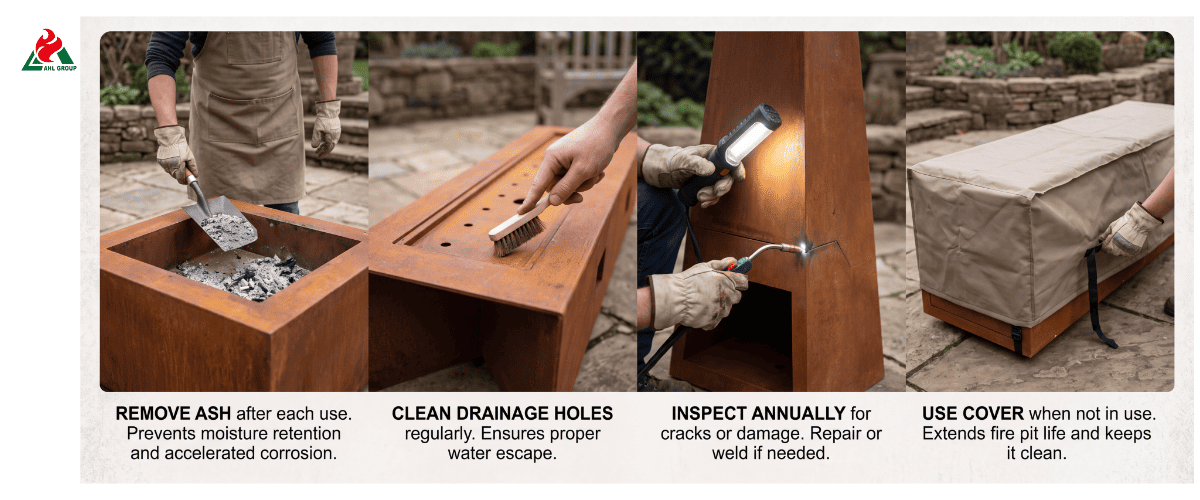
Use a steel shovel to scoop the cooled wood ashes into a sealed metal ash pail. Never pour warm ashes into plastic trash cans, paper bags, or wooden compost bins, as residual embers may reignite days later.
Check for Damage
Please inspect the structural welds, burner tubes (for gas appliances), drainage holes, and support legs seasonally for debris buildup, clogged drains, or mechanical wear.
Clean After Cooling
Use a stiff nylon brush and clean water to clean the exterior surface of the Corten steel, removing leaves and ash residue. Avoid using chemical degreasers, acidic cleaners, or wire brushes, as these may scratch the protective patina.
10. FAQs
Q1: How High Is the Internal Temperature?
The internal temperature of burning wood ranges from 600°C to 900°C (1,112°F to 1,652°F), and the temperature of the bed of embers can reach over 1,000°C.
Q2: Is the External Temperature Too High?
Yes. During combustion, the outer walls and edges can reach temperatures ranging from 65°C to 450°C—contact will cause severe burns.
Q3: What Is the Safe Distance?
Maintain a horizontal distance of at least 10 feet (3.0 meters) from all buildings, walls, fences, and combustible materials.
Q4: How Long Does It Take to Cool Down?
The steel rim takes 4 to 8 hours to cool, while the layer of ashes below takes 12 to 16 hours to reach room temperature.
Q5: Is a Fire Mat Required?
Yes. A fire mat is essential when placing a fire pit on a wooden deck, composite decking, or artificial turf to block heat radiation and catch flying sparks.
Q6: Distance From the House?
Place the landscape fire pit at least 10 feet (3.0 meters) away from the house’s walls, eaves, and connected porches.
Q7: Child Security?
Establish a strict 1.5-meter (5-foot) safety buffer zone around the fire pit, supervise children at all times, and install a spark guard over the open flame.
Conclusion: Safety of Corten Steel Fire Pits
Corten backyard fire pits can easily withstand wood-burning temperatures ranging from 600°C to 900°C without structural deformation or metal fracture. However, due to their high thermal conductivity, the temperature of the steel’s outer surface can reach 65°C to 450°C, which is sufficient to cause severe burns. By maintaining a 10-foot structural clearance, using elevated stands and fire-resistant mats to protect your patio, using long-handled tools, and allowing 12 to 16 hours for the fire pit to cool completely, you can safely and reliably enjoy warmth in your outdoor living space—an experience that will last for decades.

