


When selecting a Corten steel fire pit, many buyers first focus on the material name. They ask whether the product is made of “genuine Corten steel” or “weathering steel,” but the steel's thickness often has a greater impact on durability, heat resistance, and service life.
Weathering steel is known for its ability to form a protective rust layer that slows further corrosion. However, this weather resistance does not mean that every weathering steel fire pit performs the same. Thin-walled weathering steel fire pits made from low-grade steel may still warp, deform, or even burn through after repeated exposure to high temperatures. A well-designed fire pit should combine the appropriate steel thickness with high-quality manufacturing processes, a good drainage system, sturdy seams, and proper proportions.
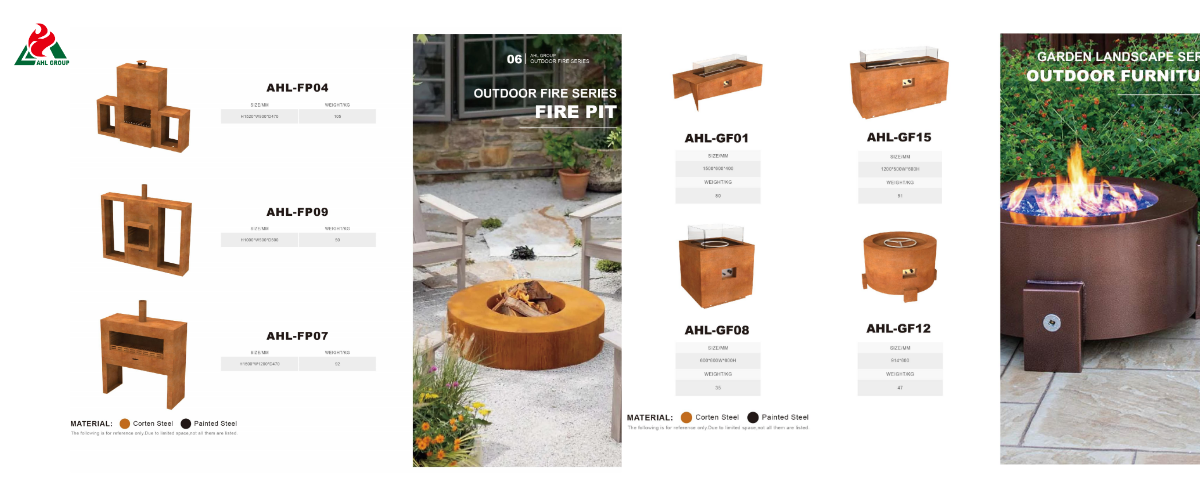
Weathering steel is known for its ability to form a protective rust layer that slows further corrosion. However, this weather resistance does not mean that every weathering steel fire pit performs the same. Thin-walled weathering steel fire pits made from low-grade steel may still warp, deform, or even burn through after repeated exposure to high temperatures. A well-designed fire pit should combine the appropriate steel thickness with high-quality manufacturing processes, a good drainage system, sturdy seams, and proper proportions.
1. Introduction
Why Wall Thickness Matters More Than the Brand of Material
When shopping for outdoor fire pits, consumers often focus more on aesthetic design or brand recognition. However, structural wall thickness is the most critical factor determining a fire pit’s lifespan. Weathering steel—known for its rustic, copper-colored patina—relies precisely on its physical properties to withstand severe thermal expansion, chemical corrosion from ash, and continuous outdoor exposure.
What “Best” Means: Durability vs. Portability vs. Cost
No single thickness works for every scenario. The “best” thickness represents the ideal balance among the following three factors:
► Durability: The ability to resist high-temperature oxidation and deformation.
► Portability: Total weight, which determines whether the fire pit can be moved around the patio.
► Cost: The quality of raw materials directly determines manufacturing and shipping costs.
Quick Answer Preview (3 mm, 4 mm, 6 mm and above)
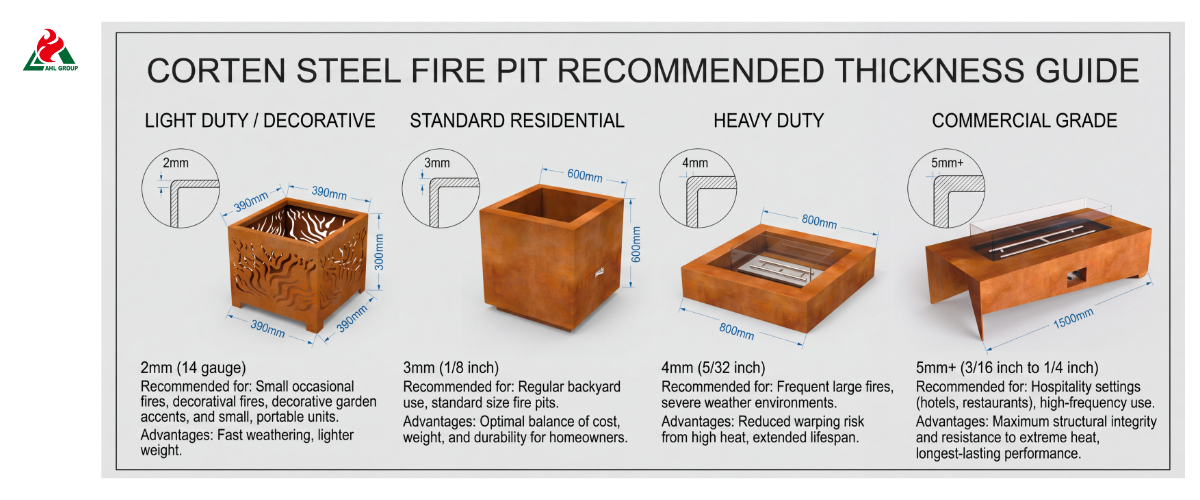
► 3 mm (No. 11): The minimum standard for small, affordable residential fire pits (diameter < 60 cm).
► 4 mm (No. 8): The best all-around choice for residential fire pits (60 cm to 90 cm in diameter), offering a service life of up to several decades.
► 5 mm–6 mm+: Suitable for large installations (>90 cm), commercial settings, or built-in fire pit grills requiring maximum heat retention.
2. How Corten Steel Works in a Fire Pit
Weathering Steel and the Protective Rust Layer
Weathering steel is an alloy rich in copper, chromium, and nickel. When exposed to moisture and oxygen, a dense layer of hematite oxide forms on its surface. This dense outer layer isolates the inner steel core from moisture, thereby preventing deep structural corrosion without the need for synthetic high-temperature coatings.
The Effects of Heat and Thermal Cycling on Corten Steel
The internal temperature of a wood fire pit can easily reach 600°C to 900°C (1,100°F to 1,650°F). Rapid heating followed immediately by exposure to cool nighttime ambient air generates intense thermal expansion stresses within the metal matrix. Thinner steel sheets experience uneven expansion at their surfaces, leading to permanent buckling, the “oil drum effect,” and structural warping.
Why Thickness Acts as a “Thermal Sink”
Thicker steel plates (4 mm to 6 mm) act as a thermal buffer. They absorb the intense heat released by glowing embers and distribute the energy evenly across the fire pit’s surface. This thermal mass not only eliminates localized hot spots that cause metal fatigue but also radiates gentle, soothing warmth to people gathered around the fire pit long after the flames have died down. Corrosion Allowance and Long-Term Structural Safety
Corrosion Allowance and Long-Term Structural Safety
All weathering steels undergo slight surface loss during the initial stabilization phase (typically 0.05mm to 0.15mm during the early weathering cycle). Thicker wall thicknesses provide structural corrosion allowance, ensuring that surface oxidation does not compromise the load-bearing integrity of the vessel or puncture the bottom of the fire pit.
3. Recommended Thickness Ranges
2 mm and Below: Why It’s Too Thin for Formal Occasions
Metal sheets less than 2 mm thick are commonly used in mass-market, flat-pack fire pits sold online. When burning hardwood continuously, thin steel sheets quickly lose their structural yield strength. The metal sheet will deform, the seams will lift, and the acidic, damp ash that accumulates at the bottom will burn through the fire pit within 1 to 3 seasons.
3 mm (11G): Entry-Level Backyard Fire Pits
A 3-mm wall thickness offers a practical entry-level option for small residential fire pits. It meets the structural requirements for light weekend use while maintaining a moderate overall weight, making it easy to install on a patio with basic foundations. However, under high-temperature burning conditions, unreinforced flat sheets may still experience slight thermal warping over time.
4 mm: Professional Standard for Most Homes
For most residential landscapes, 4 mm weathering steel is the ideal thickness. It offers excellent resistance to thermal warping and deep corrosion while maintaining a balanced overall weight. A 4 mm fire bowl can withstand intense hardwood burning for several weekends in a row without warping.
5–6 mm and Above: Heavy-Duty and Commercial-Grade Fire Pits
Made from 5 mm to 6 mm (3/16 inch to 1/4 inch) steel plates, these products are virtually indestructible. Designed specifically for public parks, luxury resorts, and custom architectural landscapes, 6 mm weathering steel withstands high-temperature stress, impacts from large logs, and continuous weathering.
When to Use Sheets Thicker Than 6 Millimeters
For extra-large custom fire bowls (diameter > 120 centimeters), one-piece heavy-duty cast-iron combination cooktops, or installations in harsh marine environments subject to severe saltwater corrosion, it is recommended to use sheets thicker than 6 millimeters (8 to 10 millimeters).
4. Best Thickness by Fire Pit Size
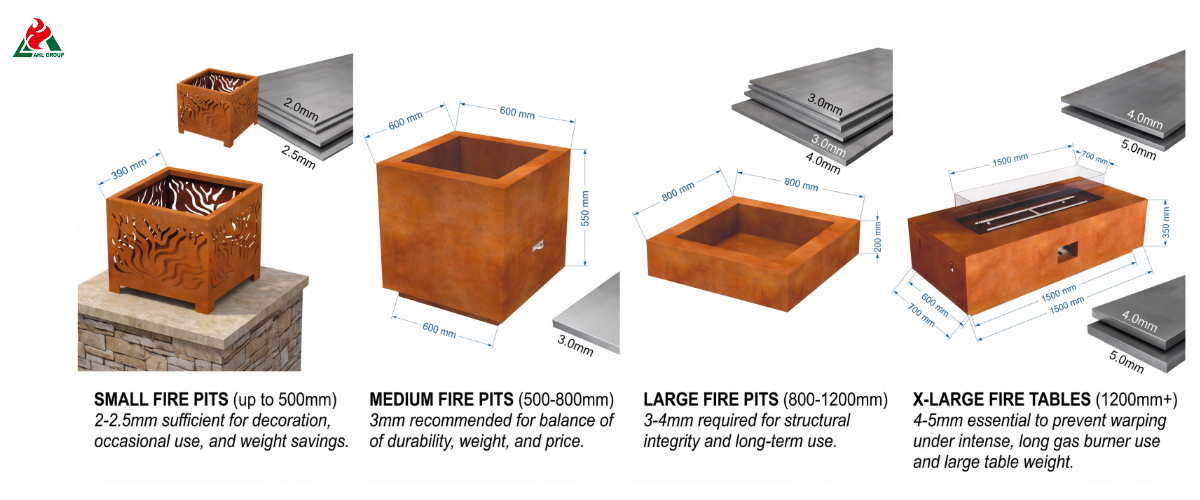
Small Fire Pits (under 60 cm / 24 inches): Wall thickness of at least 3 mm
Compact fire pits with a diameter of less than 60 cm hold less fuel, so the overall thermal expansion forces generated on their surfaces are smaller. A wall thickness of 3 mm provides sufficient structural support while keeping the fire pit lightweight and easy to reposition.
Medium-sized Fire Pits (60–90 cm / 24–36 inches): 4 mm Recommended
Metal fire pits in this standard size category can hold larger amounts of fuel, resulting in higher core temperatures. A wall thickness of 4 mm prevents large-area surface sagging, the “oil drum effect,” or warping when filled with burning wood.
Large Fire Pits (90 cm and above / 36 inches and above): 5–6 mm or thicker
When a fire pit’s diameter exceeds 90 cm, the mechanical leverage caused by thermal expansion increases significantly. Large fireplaces made of thin metal will deform into an oval shape over time. A wall thickness of 5 mm to 6 mm is essential for maintaining the structure’s circular shape.
Extra-large Models or Public Installations: 6 mm or Thicker, with a Reinforced Base
Commercial fire pits with a diameter exceeding 120 cm must be manufactured from 6 mm-thick heavy-gauge steel plate. In addition to thick steel walls, such units require internal structural ribs, a heavy-duty base ring, and a reinforced drainage well to withstand severe thermal expansion and high structural loads.
5. Best Thickness by Use Case
Occasional Fires in the Backyard
For infrequent use—such as lighting a fire just a few times a month—a Corten fire pit with a thickness of 3 to 4 millimeters is not only highly reliable and easy to maintain but also develops an attractive natural patina at an affordable price.
Frequent Weekend Use and Charcoal Grilling
Homeowners who use their fire pits weekly—or those who need to burn high-temperature charcoal briquettes for outdoor cooking—should opt for steel structures that are 4 to 5 millimeters thick. The thicker walls can withstand continuous thermal cycling without weakening or warping.
Permanent Installation and Landscape Elements
If the outdoor fire pit is to be permanently embedded in a stone patio, brick retaining wall, or custom outdoor lounge area, choose weathering steel that is 5 to 6 millimeters thick. Replacing a warped fire pit in a custom hardscape is both difficult and expensive, so selecting a material thickness designed for long-term durability is a wise initial investment.
High-Temperature Cooking and Fire Pit/Grill Combo Designs
Fire pits equipped with heavy-duty cast-iron griddles (plancha-style cooking surfaces) require a weathering steel body that is 5 mm to 6 mm thick. This substantial construction not only supports heavy cooking accessories but also distributes heat evenly across the entire cooking surface.
Coastal or Harsh Environments
Salt spray accelerates the oxidation of iron. In coastal areas (within 5 kilometers of the shoreline), fire pits with wall thicknesses of at least 5 to 6 millimeters should be selected. The additional metal thickness provides ample corrosion resistance, ensuring a service life of several decades even in environments with high atmospheric salinity.
6. Bowl vs. Base: Do They Need Different Thickness
Why the Combustion Chamber Endures the Most Heat and Wear
Of all the components, the combustion chamber is subjected to the greatest thermal and chemical stresses. It directly absorbs the heat from the flames, holds the red-hot embers, and accumulates acidic, damp wood ash after rain; therefore, over time, it is the component most susceptible to wear.
Selecting Thicker Steel (4–6 mm) for the Combustion Chamber
To maximize product lifespan while controlling total weight, the engineering design prioritizes the material thickness of the combustion chamber itself. Manufacturing the durable fire bowl from 4- to 6-millimeter-thick steel prevents the bottom from burning through while maintaining structural stability in areas of concentrated thermal stress.
Optimal Thickness for Legs and Ring Base (3–4 mm)
Since the support legs, base, and ground-contact ring are located beneath the primary heat-exposed area, their thermal expansion is significantly lower. A wall thickness of 3–4 mm provides excellent load-bearing capacity without adding unnecessary weight to the overall structure.
Hybrid Design: Weathering Steel Shell + Stainless Steel Combustion Chamber
Some luxury fire pits feature a double-layer structure: a decorative 3-millimeter weathering steel shell paired with a removable 3- to 4-millimeter Grade 304 stainless steel or heavy-duty cast iron inner fire basin. This hybrid design preserves the aesthetic appeal while protecting the outer frame from direct contact with flames.
7. How Thickness Affects Lifespan
2–3 MM: Typical Service Life and Failure Modes
Modern fire pits made from 2- to 3-millimeter-thick steel typically last 3 to 10 years, depending on climatic conditions and frequency of use. Common failure points include pinholes in the base caused by water accumulation in damp ash, as well as wall deformation along welded seams.
4MM: Expected Service Life of Several Decades
Corten fire bowls with a thickness of 4 mm are expected to last 15 to 25 years or more. Their thick-walled construction resists bending caused by heavy firewood and easily withstands continuous thermal cycling without flaking or structural failure.
5–6MM and Above: Service Life of 30–50 Years or More
These heavy-duty fire pits, manufactured from 5mm to 6mm or thicker steel plates, have an expected service life of 30 to 50 years or more. They offer true heirloom-level durability and are ideal for long-term outdoor installation.
How Warping and Burn-Through Occur Over Time
Burn-through occurs when high temperatures combine with moisture and acidic substances in wood ash, gradually eroding the metal over time. In thin steel sheets (<2 mm), localized hot spots can cause rapid oxidation, leading to corrosion that penetrates the base material. Thicker steel sheets (4 mm and above) distribute heat evenly, thereby preventing localized high-temperature corrosion.
The Role of Drainage and Ash Removal in Extending Service Life
Even thick weathering steel can suffer premature wear if wet wood ash accumulates at the bottom. When mixed with rainwater, wood ash forms an alkaline paste that erodes the protective oxide layer on the metal surface. Ensuring the fire pit has unobstructed drainage holes and regularly removing wood ash will significantly extend its service life.
8. Common Mistakes and Misconceptions
Purchasing Ultra-Thin “Decorative” Weathering Steel Fire Pits
Many mass-market outdoor retailers sell thin (1.2 mm to 1.5 mm) metal fire pits labeled as “weathering steel.” Although these fire pits may appear attractive at first glance, they are relatively lightweight and, when used frequently, are prone to warping due to heat and can quickly burn through.
Assuming All Weathering Steel Has the Same Durability Regardless of Thickness
Material grade alone does not guarantee a structure’s durability. Under high-temperature combustion conditions, a 1.5-millimeter-thick sheet of genuine ASTM A588 weathering steel will still deteriorate much faster than a container made from a well-designed 4-millimeter- or 6-millimeter-thick steel plate. Steel thickness remains the primary factor determining structural performance.
Neglecting the Design of the Support Structure and Base
A heavy 6-millimeter fire pit requires a sturdy base. Mounting a heavy steel fire pit on thin, loosely welded wire legs creates a top-heavy combination that may tip over or collapse over time.
Neglecting Drainage and Water Accumulation Issues
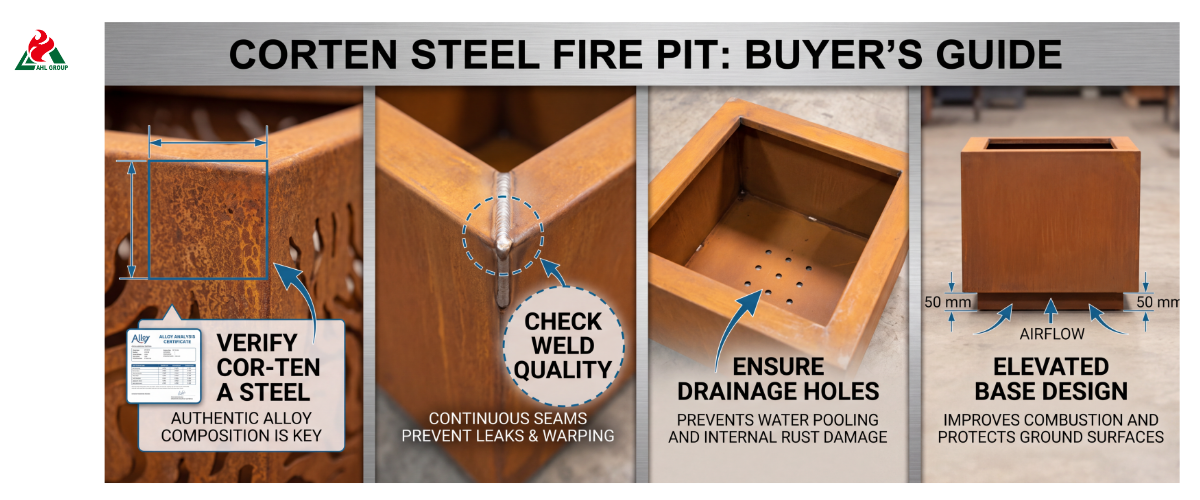
Never purchase a Corten metal fire pit that lacks a central drainage hole. Accumulated rainwater traps moisture inside the fire pit, causing damp ash to oxidize continuously—which can even shorten the lifespan of thick steel plates.
Confusing Material Thickness with Overall Manufacturing Quality
While wall thickness is crucial, you should also inspect the overall structural details. Check whether the welds are continuous, the edges are smoothly ground, the base mounting points are reinforced, and there is adequate ventilation to ensure superior overall manufacturing quality.
9. Practical Buying Tips
How to Check Thickness in Product Specifications
Carefully review the manufacturer’s technical specifications. Look for dimensions clearly listed in millimeters (mm) or structural steel plate specifications (1/8“, 3/16”, 1/4").
Risk Warning: Missing Thickness Information, Unusually Low Prices
If the seller omits the metal thickness from the product specifications—or is selling a large 80-centimeter fire pit at a surprisingly low price—the product is likely made of thin (<2 mm) steel plate, which will warp when heated.
When to Prioritize Weight and Portability Over Thickness
If you plan to take the fire pit camping or move it frequently around your lawn, choose a 3-millimeter-thick model. A 60-centimeter fire pit made from 3-millimeter-thick steel plate weighs approximately 15 to 20 kilograms (33–44 pounds), making it much lighter than a bulky 6-millimeter-thick version (over 40 kilograms).
Balancing Budget, Aesthetics, and Long-Term Value
► Economy Option: 3-mm weathering steel (5–10-year lifespan, low initial cost).
► Best Value Option: 4-mm weathering steel (15–25+ year lifespan, best value for money).
► High-End/Lifetime Option: 5-mm–6-mm or thicker weathering steel (30–50+ year lifespan, highest structural durability).
10. FAQs
Q1: Is 3 mm Weathering Steel Thick Enough for a Fire Pit?
Yes. For small to medium-sized residential fire pits (diameter < 60 cm) used for weekend leisure fires, a wall thickness of 3 mm (No. 11 steel plate) is sufficient. However, for larger fire pits or applications involving frequent high-temperature use, 4 mm steel plate offers superior long-term resistance to warping.
Q2: For a Backyard Fire Pit, Is 4 mm or 6 mm More Suitable?
For most residential backyards, 4 mm weathering steel is the ideal balanced choice. It offers excellent resistance to deformation and a service life of over 20 years, without making the fire pit overly bulky. A 6 mm fire pit is best suited for large custom installations, commercial settings, or permanent landscape features.
Q3: Will a 2mm-thick Weathering Steel fire pit last a long time?
No. A 2mm-thick fire pit typically lasts only 1 to 3 seasons under normal use. The high temperatures generated by burning hardwood can cause thin steel sheets to warp, while acidic wet ash can quickly corrode and penetrate the thin base plate.
Q4: Does Thicker Steel Mean Less Warping?
Yes. Thicker steel (4 to 6 millimeters) acts as a thermal buffer, distributing heat evenly across the entire container. This additional mass prevents localized thermal expansion stresses, thereby avoiding warping, twisting, or buckling that occurs with thinner steel.
Q5: What is the Most Suitable Steel Plate Thickness for Large Outdoor Fire Pits?
For fire pits with a diameter of 90 centimeters (36 inches) or larger, a wall thickness of 5 to 6 millimeters (3/16 to 1/4 inch) should be selected. This thick-plate construction ensures that large fire pits remain round and structurally stable during decades of outdoor use.
Conclusion: Final Rule of Thumb for Choosing Corten Fire Pit Thickness
When evaluating Corten outdoor fire pits, structural strength should take precedence over brand recognition. Investing in a fire pit with a wall thickness of 4 to 6 millimeters will ensure it can withstand thermal stress, resist severe-weather corrosion, and continue to provide warm, reliable performance for decades to come.

