


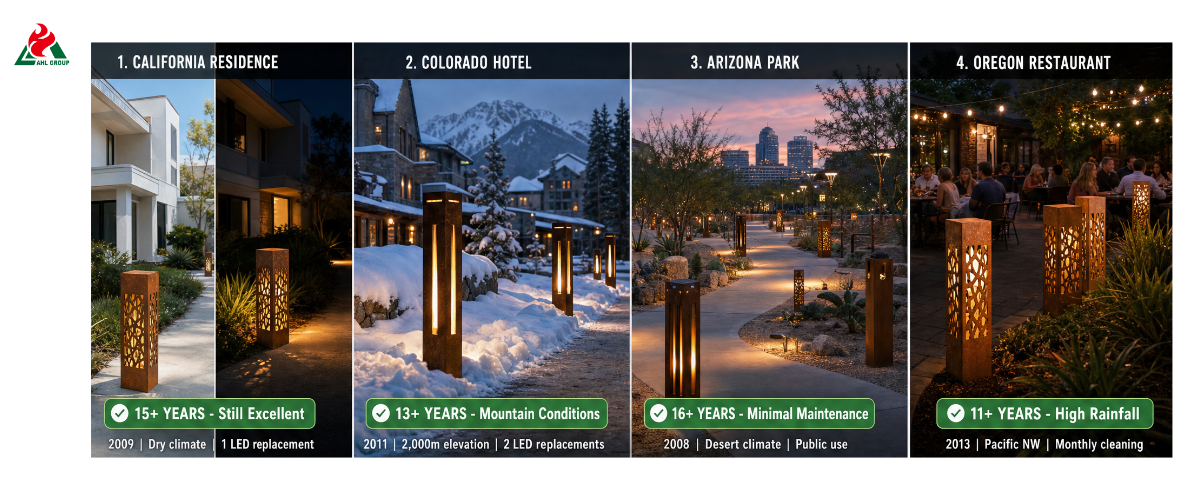
Outdoor lighting is a long-term investment. Unlike indoor fixtures, garden lights and landscape lighting systems must withstand years of exposure to wind, rain, humidity, temperature fluctuations, sunlight, and seasonal weather conditions. When selecting high-end outdoor lighting, many homeowners, landscape designers, and architects ask, “How long will Corten steel outdoor lights last?” The answer depends on more than just the metal itself. Their lifespan is influenced by a variety of factors, including the quality of the Corten steel lamp body, the LED components, the installation method, climatic conditions, and maintenance practices. Generally speaking, high-quality Corten steel outdoor lights can last 25 to 50 years or longer, while electrical components may need replacement sooner, depending on their quality and operating conditions.
1. Introduction
Why Do People Ask About Outdoor Lifespan
When investing in high-end landscape architecture, specifiers, lighting designers, and property owners all prioritize the durability of the structures. Weathering steel—often specified for architectural bollards, path lights, and custom wall sconces—is highly appealing due to its rugged, natural aesthetic. However, since its iconic appearance is essentially a layer of surface rust, buyers naturally ask a key question: Is this metal gradually corroding, or can these fixtures withstand decades of harsh outdoor conditions? Understanding their true lifespan is crucial for calculating the long-term return on investment (ROI) and preventing premature system failure.
What is Corten Steel Lighting
Corten steel lighting is outdoor fixtures whose structural housings are made from a special Corten steel alloy. Unlike traditional aluminum or carbon steel fixtures that rely on paint or powder coatings to block moisture, weathering steel fixtures are designed to be installed in their natural state. After months of outdoor exposure, the alloy reacts with elements in the atmosphere to form a dense, self-healing layer of iron oxide. This stable rust layer provides a permanent protective barrier for the structural steel beneath while also safeguarding the modern, sealed electrical components inside.
What This Guide Covers
This comprehensive engineering analysis report provides an in-depth study of the long-term durability of weathering steel in outdoor lighting applications. We will examine its actual service life, analyze atmospheric factors that affect the material’s lifespan, identify the internal electrical components most prone to premature wear, and provide field-proven maintenance plans. In addition, we will compare weathering steel with other structural metals to help you select the most suitable material for your specific landscaping project.
2. How Long Does Corten Lighting Usually Last
Typical Outdoor Service Life
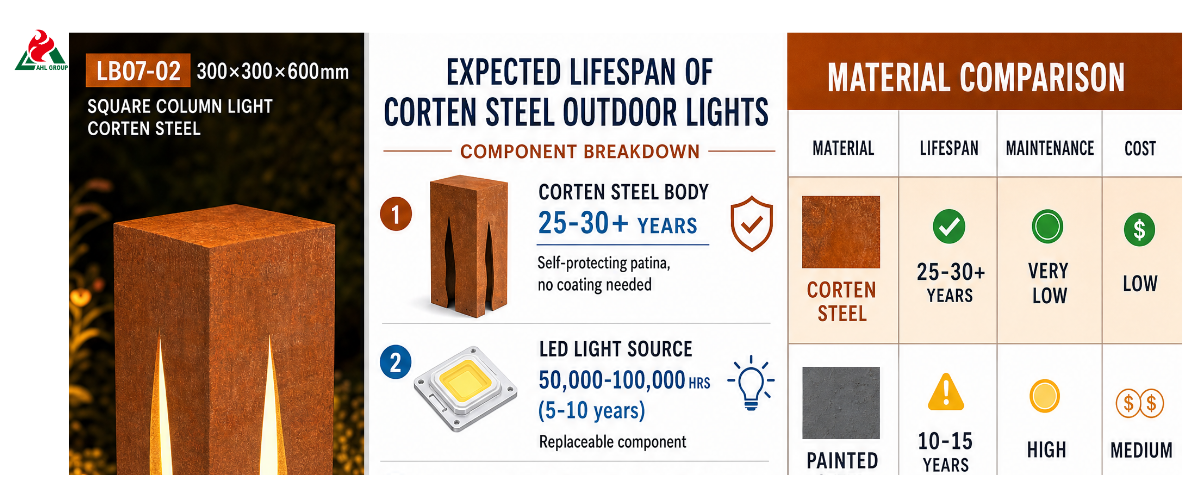
Under ideal to moderate atmospheric conditions, high-quality Corten outdoor lighting fixtures can easily last 40 to 60 years or more. Since these commercial-grade lights are typically made from thick metal sheets (ranging from 2 to 3 millimeters in thickness, or No. 11 grade), the natural, microscopic material loss that occurs during the early weathering stages is negligible. The structural enclosures of streetlight poles or bollards typically outlast the buildings or landscapes they were originally designed to illuminate.
Why Steel Luminaires Are More Durable Than Many Alternatives
Traditional outdoor luminaires made of low-carbon steel or low-grade aluminum rely entirely on surface coatings such as powder coatings or paint. Once UV radiation, lawn mowers, or seasonal temperature fluctuations cause the outer coating to crack, scratch, or peel, moisture seeps in. This triggers rapid and hidden electrochemical or structural corrosion, which destroys the luminaire from the inside out. Weathering steel eliminates this risk. It has no fragile paint layer that can be easily scratched or peeled off; its protective barrier is the outer surface itself, which can self-repair even when subjected to physical scratches or wear.
The Difference Between the Luminaire Housing and Electrical Components
Although thick-gauge weathering steel enclosures can last virtually indefinitely under the right conditions, a strict distinction must be made between the structural enclosure and the optoelectronic system. Internal components—including LED modules, drivers, circuit boards, and silicone gaskets—are subject to different physical and engineering tolerances. While a steel enclosure can easily last half a century, the standard commercial lifespan of the internal electrical components is 10 to 15 years, after which maintenance, upgrades, or replacement will be required.
3. What Affects Lifespan
Climate and Weather Effects
The geographic coordinates of a project site play a decisive role in determining the rate at which a rust layer forms and stabilizes on steel. The formation of weathering steel depends on an optimal and rhythmic balance between sunlight, wind, and rainfall. In arid desert environments where rainfall is near zero, the formation of the rust patina is extremely slow, causing the steel to retain its original appearance for a very long time. Conversely, in climates where seasonal rainfall is well balanced with sunny days, the steel is able to rapidly and efficiently form an inert, dark brown protective oxide layer.
Coastal Air and Salt Fog
Atmospheric salt is the primary threat to the service life of unsealed weathering steel. If Corten outdoor lighting is installed within 2 to 5 kilometers (1.2 to 3 miles) of a saltwater coastline, sodium chloride ions in the air will continuously deposit on the metal housing. Salt is highly hygroscopic; it absorbs moisture from the environment and traps it on the steel surface. This disrupts the stable ferritic oxide structure, replacing it with a highly porous and soluble layer of iron chloride, which leads to deep pitting corrosion and shortens the lifespan of the luminaire.
Rain, Humidity, and Standing Water
Persistent relative humidity exceeding 75%, combined with nearly constant rainfall, can hinder the dry-wet cycle necessary for Corten steel. If the steel housing remains damp for several weeks in a row and cannot dry completely in sunlight, a stable rust layer will not form. Furthermore, if path lights or bollards are installed in low-lying flower beds prone to water accumulation, or buried directly in saturated, poorly drained soil without a proper concrete foundation, the submerged portions will corrode rapidly at the same rate as ordinary carbon steel.
Sunlight and Temperature Fluctuations
Although ultraviolet (UV) radiation triggers polymer degradation, thereby damaging plastic, painted, and powder-coated luminaires, it has no adverse effect on untreated weathering steel. In fact, direct sunlight accelerates the critical drying phase that hardens the rust layer. However, severe thermal cycling—that is, extreme temperature differences between freezing winter nights and scorching summer days—can generate mechanical stress. This stress primarily acts on the luminaire’s internal joints, causing expansion and contraction, which over time may compromise the integrity of waterproof silicone seals and electrical connectors.
Installation Quality
Even premium-grade lights can fail prematurely if installed improperly. If a landscape contractor bolts a Corten steel light pole directly to a flat concrete base where water pools, without using standpipe gaskets or concealed drainage channels, crevice corrosion will occur at the base plate. Similarly, if the electrical conduit joints inside the luminaire are not completely sealed to prevent rising ground moisture, the internal cavity will become a damp greenhouse, leading to electrical short circuits before the steel luminaire body even corrodes.
4. Why Corten Steel Performs Well Outdoors
Protective Rust Layer
Corten steel’s exceptional outdoor durability stems from its unique metallurgical properties. Copper (Cu), chromium (Cr), nickel (Ni), and phosphorus (P) are precisely added to this alloy. When exposed to the natural environment, these elements form a special iron oxide structure on the surface of the base material. Compared to the loose, flaking rust layer found on ordinary steel, this oxide layer is denser and adheres more firmly. Once fully cured, this protective rust layer seals the underlying steel, preventing further penetration of oxygen and moisture.
Resistance to Atmospheric Corrosion
Thanks to this dense oxide layer, Corten steel exhibits a significantly lower rate of atmospheric corrosion than standard structural steel. Long-term exposure test data show that after the initial oxidation process during the first few years, the material loss curve levels off sharply, dropping to less than 1 to 2 micrometers per year. This extremely high corrosion resistance allows thin-walled architectural components to maintain their structural integrity and quality for decades without the need for secondary corrosion protection.
Lowest Maintenance Requirements Compared to Other Metals
Unlike stainless steel, which must be wiped down regularly to prevent tea stains from setting in, or powder-coated aluminum, which requires periodic cleaning to remove chalking, untreated weathering steel lighting fixtures require virtually no structural maintenance. There is no need to scrape, sand, prime, or recoat any surfaces. For municipal parks, public squares, and expansive private estates, this maintenance-free durability translates to significant savings in labor and lifecycle maintenance costs.
Strength Advantages for Long-Term Outdoor Use
In addition to corrosion resistance, weathering steel features a robust structure with tensile strength comparable to that of low-alloy structural steel. This structural rigidity is a significant advantage for outdoor light poles installed in high-traffic public spaces. It effectively withstands vandalism, high wind loads, and accidental minor impacts from lawn equipment or bicycles—situations that can easily cause dents or cracks in thin-walled aluminum lamp bodies.
5. Parts That May Wear Out First
LED Modules
In modern landscape lighting, the primary wear-and-tear component is the LED light source itself. High-efficiency LED arrays for architectural use are typically rated for 50,000 to 100,000 hours of operation. If operated for an average of 10 hours per night, these light sources could theoretically last 13 to 27 years. However, if excessive heat builds up inside a poorly ventilated housing, the module’s service life will be drastically shortened, leading to color temperature drift and sustained lumen depreciation.
Wiring and Connectors
The wiring path that carries low-voltage or line-voltage power through the interior of Corten steel bollard lights is a highly vulnerable weak point. If installers use standard electrical tape or screw-type wire caps instead of factory-sealed, IP67/IP68-rated waterproof gel-filled connectors, moisture will seep into the joints. Once moisture enters the interior, capillary action will draw it upward along the twisted copper strands, causing invisible oxidation, which results in high resistance, voltage drops, and ultimately circuit failure.
Drivers and Power Supplies
LED drivers—electronic components that convert input alternating current (AC) into the direct current (DC) required by LEDs—are the most common point of failure in any outdoor lighting system. Electronic drivers are extremely sensitive to voltage surges caused by lightning strikes, grid fluctuations, and thermal stress. A high-quality outdoor driver typically has a service life of 5 to 8 years under continuous thermal load, which means the driver will need to be replaced multiple times over the lifespan of the weather-resistant steel housing.
Mounting Hardware and Seals
To prevent rainwater from seeping into the internal electronic components, luminaires rely on die-cut silicone or EPDM rubber gaskets. After more than a decade of temperature fluctuations and exposure to environmental ozone, these organic polymers lose their elasticity and become brittle. If these seals are not inspected, rainwater can seep inside, damaging the internal electronic components. Furthermore, if the mounting screws securing the access panel are made of low-grade carbon steel rather than high-grade stainless steel, they may seize up due to rust, making it impossible to perform maintenance on the interior.
6. Maintenance That Extends Lifespan
Regular Cleaning
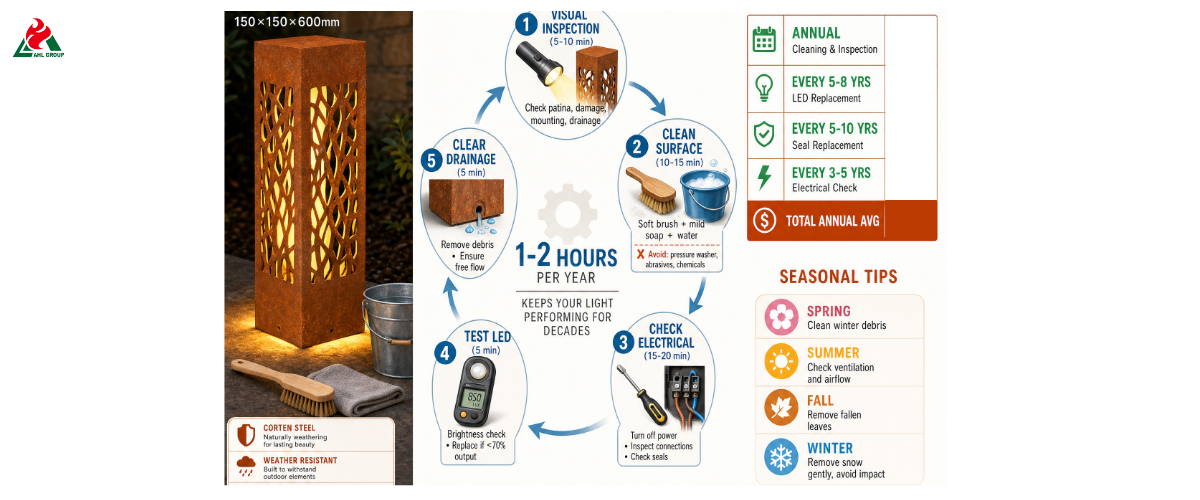
Although weathering steel casings do not require painting, it is still highly beneficial to rinse them with clean water once or twice a year. This rinsing is particularly effective in the early stages of rust layer formation. Rinsing the exterior surface with a standard garden hose removes accumulated bird droppings, sticky tree sap, air pollutants, and dry dust—substances that trap moisture unevenly and cause the rust layer to appear patchy.
Warning: Never use chemical cleaners, abrasive scouring pads, or pressure washers on untreated weathering steel. Doing so will strip away the protective oxide layer that is forming, forcing the metal to restart the stabilization process from the beginning.
Check Drainage and Water Accumulation
For any ground-mounted lights, the most critical maintenance task is to ensure that all integrated drainage holes remain completely unobstructed. Over time, wind-blown dirt, debris, and fallen leaves may clog the tiny drainage holes at the base of bollard lights or path lights. During seasonal landscape cleanup, use a thin wire or brush to clear these holes, ensuring that any water that seeps into the light fixture can drain freely.
Inspect Electrical Components
To ensure your lighting system is as durable as the steel housing, schedule an electrical inspection every few years. Open the access panel, check the condition of the internal rubber gaskets, and replace any seals that show signs of cracking or hardening. Check that all wire connections are dry, clean, and secure, and confirm that the internal ground wire is still firmly attached to the steel frame.
Protect Adjacent Surfaces from Rainwater Runoff
During the initial 12 to 18 months of natural weathering, rainwater running off the light fixture will carry loose iron oxide particles. If this water flows onto porous hard surfaces, such as light-colored concrete, limestone pavers, or wooden decks, it will leave permanent orange rust stains. To prevent this problem, you can pre-weather the fixtures before installation, use a specialized color-resistant clear sealant, or incorporate a drainage gravel layer around the fixture base to collect and safely direct rainwater away.
7. Signs a Fixture Is Reaching End of Life
Severe Corrosion Beyond the Scope of Normal Patina
There is a clear distinction between healthy architectural patina and catastrophic structural corrosion. Healthy patina has a smooth, fine-grained surface and adheres tightly to the metal substrate. If thick, bulging rust crusts are found that flake off with just a light touch of the finger, or if the metal plate begins to show visible holes, or if the edges become jagged and thinned, this indicates that the steel can no longer maintain its structural integrity. This suggests that the environment is excessively humid or acidic, and that the service life of the architectural component is nearing its end.
Cracked Seals or Moisture Intrusion
If, upon inspection through the protective glass lens of a streetlight or bollard light, you observe persistent condensation, fogging, or water accumulation inside, it indicates that the internal environment has been compromised. If left unaddressed, this moisture intrusion will rapidly damage the internal LED arrays and drivers, cause corrosion at electrical connections, and lead to the failure of the luminaire long before the steel housing deteriorates.
Flickering or Malfunctioning Lights
When outdoor lights begin to flicker, dim for no apparent reason, or fail to turn on at dusk, it indicates a malfunction in their internal electronic components. Although this problem is usually caused by a faulty driver or aging LED modules (components that can be easily replaced), it may also indicate a faulty internal wiring connection or a ground fault resulting from prolonged exposure to moisture inside the luminaire.
Structural Instability
If a tall landscape light pole or path light feels loose or wobbles when gently shaken, carefully inspect the connection at its base. If the anchor bolts are severely corroded or if the bottom edge of the weather-resistant steel lamp body has thinned due to prolonged exposure to standing water or damp soil, the fixture’s structure has been compromised and should be repaired or replaced to avoid safety hazards.
8. Comparing Corten to Other Materials
Corten Steel vs. Aluminum
Aluminum used in construction is lightweight, highly ductile, and naturally corrosion-resistant. When surface-treated with high-quality fluoropolymer or powder coatings, it can have a service life of 20 to 30 years in outdoor environments. However, aluminum lacks the high tensile strength and impact resistance of weathering steel. Furthermore, any deep scratches or dents that penetrate the coating may cause blistering and filiform corrosion, whereas scratches on weathering steel will heal on their own over time.
Corten Steel vs. Stainless Steel
Marine-grade 316 stainless steel is the most corrosion-resistant material available, making it the material of choice for harsh coastal environments. However, stainless steel requires regular cleaning to maintain its bright, modern appearance and prevent the formation of tea-stain-like discoloration on the surface. Weathering steel, on the other hand, offers a distinctly different aesthetic—warm, natural, and rustic—and requires minimal cleaning, as its entire design is built around a controlled layer of surface rust.
Corten vs Painted Steel
For harsh outdoor environments, ordinary carbon steel treated with paint or powder coating is a high-risk choice. Once moisture penetrates the outer coating through microscopic scratches or pinholes, rust can rapidly spread beneath the surface, causing the paint to peel and the metal to corrode. Weathering steel eliminates this vulnerability by transforming the oxidation process into its primary defense mechanism.
Which Material Has the Longest Service Life in Different Environments
The ideal material choice depends largely on the environment where your project is located:
| Environment | Best Material Choice | Expected Housing Lifespan |
| Inland Urban / Parks | Corten Steel | 40 to 60+ Years (Zero Maintenance) |
| Arid / Desert Landscapes | Corten Steel | 60+ Years (Slow Patina Formation) |
| High-Humidity / Tropical | Coated Aluminum / Fiber Cement | 20 to 30 Years (Avoids Constant Dampness) |
| Coastal / Within 2km of Ocean | Marine-Grade 316 Stainless Steel | 50+ Years (Resists Chloride Pitting) |
9. Best Applications for Corten Lighting
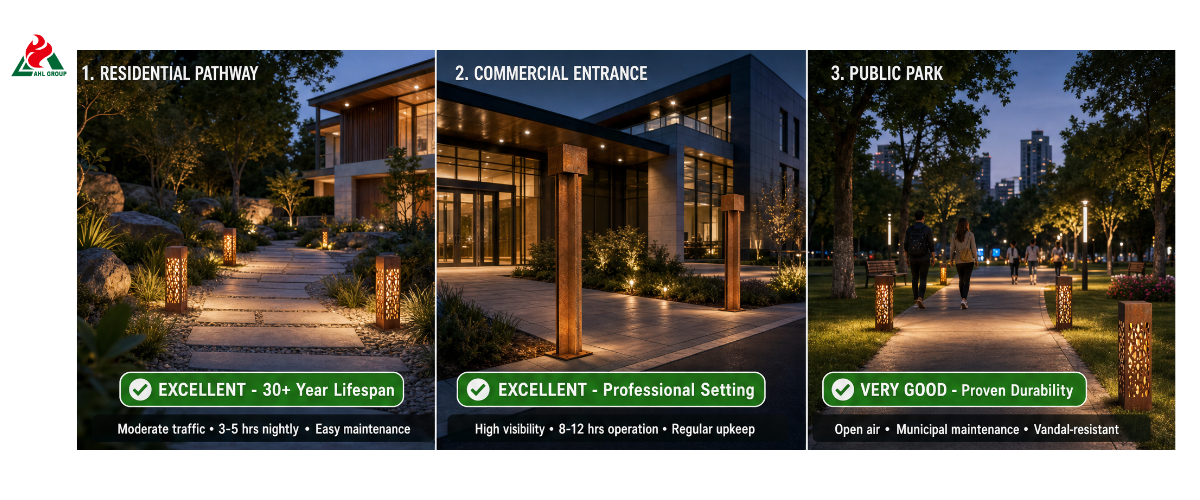
Garden Lights
Weathering steel is an excellent choice for accent lights hidden among lush flower beds. Its deep, earthy rust tones blend perfectly with mulch, bark, and foliage, making the lights unobtrusive by day while casting a beautiful, focused beam at night.
Pathway Lights
Low-profile pathway lights made of weathering steel add a clean, modern aesthetic to sidewalks and driveways. Their sturdy steel bodies can easily withstand accidental impacts—such as lawn mowers, accidental trampling, or a stray basketball—and maintain their alignment and structural integrity for decades.
Streetlight Poles
Tall, structurally striking streetlight poles represent one of the most popular applications of weathering steel in commercial and public projects. They seamlessly integrate path lighting, structural boundary markers, and architectural style, creating clean lines that complement modern concrete structures, natural stone pathways, and urban plazas.
10. FAQ
Q1: Will Corten Steel Lights Rust Completely?
No, high-quality weathering steel lights will not rust completely. Although a layer of rust will initially form on their surface, this reaction is highly controllable. The addition of copper and chromium allows the metal to form a dense, non-porous rust layer that seals the steel inside, thereby reducing the corrosion rate to near zero and maintaining the structural strength for decades.
Q2: Will the Electrical Components Last as Long as the Steel?
No. While the heavy-duty steel housing typically lasts 40 to 60 years, the standard service life of the internal electrical components (LED modules, drivers, and wiring) is 10 to 15 years. Fortunately, commercial lights are designed with easy-access doors, allowing you to easily replace the internal components without having to replace the steel housing.
Q3: Are Corten Steel Lights Suitable for Use in Coastal Areas?
Generally speaking, no. Installing unsealed weathering steel lights within 2 to 5 kilometers of a saltwater coastline poses a risk. Salt ions in the air attract moisture, preventing the steel from forming a dense, protective rust layer, which leads to rapid pitting corrosion. In coastal environments, it is recommended to use marine-grade stainless steel or powder-coated aluminum luminaires.
Q4: How Can I Extend the Lifespan of Outdoor Lights?
Make sure to install the lights on a raised concrete base or a gravel bed to prevent water from pooling around the light fixture. Check that all built-in drainage holes are unobstructed, ensure that the wires use IP67/IP68-rated gel-filled connectors, and replace any internal rubber gaskets that show signs of cracking as soon as possible.
Conclusion: Key Points Regarding Outdoor Lights Service Life
The structural housings of high-quality Corten steel outdoor lights are designed to last 40 to 60 years or more. Corten steel utilizes its own controlled oxidation process as an impenetrable protective barrier, providing unparalleled structural durability that far exceeds that of painted carbon steel or standard aluminum housings in most inland environments.
For projects that prioritize long-term durability, low maintenance costs, and a modern industrial aesthetic, Corten steel lighting represents an excellent investment. It is ideally suited for locations such as municipal parks, commercial walkways, and private estates—places that require minimal routine maintenance and need to ensure that landscape features remain visually appealing for decades.
When purchasing weathering steel lighting fixtures, ensure that the luminaire body is made of genuine weathering steel with a thickness of at least 2 to 3 millimeters, rather than cheap low-carbon steel that has merely been temporarily rusted. By combining these sturdy luminaire bodies with high-quality, IP-rated internal components and carefully planning the drainage layout to prevent water accumulation, you can enjoy a stunning landscape that stands the test of time.

