


Outdoor lighting has become an increasingly important part of landscape design, but concerns about light pollution are also growing. Today, property owners, architects, and municipal authorities are placing greater emphasis on compliance with “Dark Sky” standards when selecting path and garden lighting.
Laser-cut Corten steel bollard lights are popular because they combine architectural beauty with durability. Their warm, rusted surfaces and decorative patterns create striking visual effects, but many buyers question whether these fixtures meet modern “Dark Sky” standards.
The answer is not a simple “yes” or “no.” The material Corten steel alone does not determine compliance with the standards. Instead, optical design, color temperature, glare control measures, and the amount of upward light play a more critical role. This guide will explain in detail under what circumstances laser-cut Corten steel pathway lights can support “Dark Sky” objectives and how to select the appropriate fixtures.
Laser-cut Corten steel bollard lights are popular because they combine architectural beauty with durability. Their warm, rusted surfaces and decorative patterns create striking visual effects, but many buyers question whether these fixtures meet modern “Dark Sky” standards.
The answer is not a simple “yes” or “no.” The material Corten steel alone does not determine compliance with the standards. Instead, optical design, color temperature, glare control measures, and the amount of upward light play a more critical role. This guide will explain in detail under what circumstances laser-cut Corten steel pathway lights can support “Dark Sky” objectives and how to select the appropriate fixtures.
1. Introduction
The Meaning of “Dark Sky Standards”
“Dark Sky Standards” refer to outdoor lighting fixtures and design practices that minimize light pollution, glare, light intrusion, and sky glow. These standards are promoted globally by organizations such as DarkSky International (formerly the International Dark-Sky Association, or IDA) and aim to protect the night sky, preserve the ecosystems of nocturnal wildlife, and reduce energy waste. To meet this standard, garden lights must precisely control the direction of light emission, ensuring that light is not directed upward or sideways into the atmosphere, nor into neighboring areas.
Why Bollard Lights Often Draw Attention
Bollard lights are short, vertical light poles used to illuminate sidewalks, building perimeters, and landscapes. Because they are located near eye level for pedestrians and are typically installed in open outdoor spaces, they can become a major source of glare and light pollution if poorly designed. Traditional bollard lights typically use 360-degree omnidirectional glass reflectors or louvres that project light outward at a wide horizontal angle, directly into people’s eyes or upward into the lower atmosphere—a direct violation of the Dark Sky Principles.
What Are Laser-Cut Corten Bollards
Laser-cut Corten bollards are outdoor architectural lighting fixtures made from weathering steel (known by the registered trademark “Corten”). This alloy forms a stable, self-protective oxide layer (patina) that shields the underlying metal from atmospheric corrosion. Through precision CNC laser cutting, manufacturers can engrave complex geometric patterns, organic designs, or custom abstract motifs onto the steel surface. An internal light source—typically integrated LEDs or lighting assemblies—projects light through these perforations, creating dynamic patterns of light and shadow on the surrounding surfaces.
2. Are Corten Bollards Dark-Sky Compliant
The Difference Between the Material of Crash Bars and the Light Source
Material properties and lighting principles are independent of one another. Weathering steel is purely a material enclosure that serves both structural and aesthetic functions; aside from its surface reflectance, it possesses no inherent optical properties. Compliance with regulations does not depend on the material of the luminaire housing, but rather on how the internal optical system, light source, luminaire geometry, and glare control design regulate the luminous flux (lumens) emitted from the luminaire.
Why the Steel Itself Does Not Determine Compliance
If the internal luminaire lacks glare control or has improper beam guidance, the level of light pollution caused by Corten steel lights can be just as severe as that from acrylic or aluminum luminaires. The metal housing merely serves as an opaque physical barrier. Whether the luminaire causes skyglow or light intrusion depends entirely on the design of the internal light source, the arrangement of the LEDs, and the configuration of the laser-cut openings.
When Can Corten Steel Bollards Be Considered “Dark Sky Friendly”
A Corten garden bollard light meets “dark-sky-friendly” standards when its structural shell works in conjunction with a fully light-shielded, downward-facing optical system. If the laser-cut patterns are strategically placed only in the lower portion of the bollard, or if the internal light source is deeply recessed and directed toward an internal baffle, the luminaire can safely illuminate the ground path while ensuring that no light escapes above the 90-degree horizontal plane.
3. What Dark-Sky Standards Usually Require
No Upward Light or Extremely Low Upward Light
The core principle of Dark Sky Certification is the elimination of upward light. In the “Luminaire Classification System” (LCS), which classifies light sources based on their BUG rating (Backlight, Upward Light, and Glare), lighting fixtures that meet Dark Sky standards should ideally maintain a U0 rating for upward light. This means that, relative to the zenith (the point directly below the luminaire), the proportion of total luminous flux emitted in the 90-degree horizontal plane and above is 0%.
With a Shade or Total Cut-Off Optical System
The outdoor light must employ a fully cut-off optical system, meaning that the luminaire body or integrated shield must completely obscure the filament, light-emitting diodes, or refractive lenses so that they cannot be seen directly from the horizontal direction. The light must be directed entirely downward. Any side windows or perforations must be fitted with shading panels to ensure that the light source is invisible when viewed from a distance, thereby preventing direct visual contact with the original light source.
Warm Color Temperature Requirements
High-energy blue light is scattered more easily in the atmosphere than longer-wavelength warm light, which exacerbates sky glow and disrupts the circadian rhythms of humans and animals. Dark Sky Standards strictly stipulate that the correlated color temperature (CCT) must be 3000K or lower. For ecologically sensitive areas, the preferred specification is 2200K to 2700K, or the use of pure amber LEDs with zero luminous flux in the blue light spectrum.
Glare Control and Beam Direction
Controlling glare requires limiting high-angle luminance within a range of 60 to 90 degrees vertically from the zenith. The Dark Sky Standard requires the use of precise optical guidance technologies—such as directional reflectors, total internal reflection (TIR) lenses, or deep physical reflectors—to bend and shape the light beam toward the target ground rather than allowing it to scatter horizontally across the landscape.
4. How Laser-Cut Designs Affect Light
Light Leakage Caused by Openwork Patterns
Laser cutting fundamentally undermines the sturdy, light-blocking characteristics of the metal bollard casing. When intricate patterns are engraved on the upper or middle sections of a bollard’s surface, these patterns create pathways for light to escape. If the internal light source is omnidirectional, light will leak through these cutouts in all directions—including horizontally and diagonally upward—which is a major contributor to light pollution.
Decorative Patterns vs. Controlled Lighting
There is an inherent functional conflict between decorative, pattern-projecting landscape art and lighting that complies with “Dark Sky” standards. Decorative patterns typically require high-angle horizontal light projection to cast distinct shadows on nearby walls or expansive lawns. In contrast, controlled lighting strictly confines the light path to the pedestrian area directly beneath the light pole and reduces the beam angle to prevent light from escaping into the atmosphere.
When Laser-Cut Openings Lead to Compliance Issues
Compliance issues arise when laser-cut openings extend to the top of the light pole or encircle its entire perimeter without internal directional control. If an observer viewing the light pole from a distance can see exposed LED chips or frosted glass diffusers through the laser-cut patterns, the luminaire fails to meet Dark Sky standards due to excessive light pollution and high horizontal glare.
5. Design Features That Help Compliance
Concealed Light Sources
To ensure harmony with the nighttime environment, LED modules or light engines should be securely mounted inside the top cover of the bollard, oriented downward and deeply recessed into architectural grooves. This concealed design ensures that light travels downward through the internal cavity, completely obscuring the original light source so that it cannot be seen directly from the horizontal plane.
Internal Shutters and Baffles
Integrating internal metal shutters, matte black baffles, or custom directional louvers directly behind the laser-cut patterns allows designers to block specific light paths. These internal components permit light to pass through the decorative cutouts below to illuminate the path, while intercepting and absorbing light that would otherwise escape horizontally or upward through the upper patterns.
Downward-Facing Illumination
The use of internal reflectors with precisely parabolic-angled baffles ensures downward illumination. When light strikes the reflective inner panels, it is redirected downward through the open bottom or specially designed low-level cutouts. This configuration creates a well-defined light spot on the path below, strictly confining all light output to the ground.
Low Color Temperature LED Options
Equipping laser-cut Corten bollard lights with specialized warm-toned LED modules—such as 2200K, 2700K, or monochromatic amber chips—can significantly reduce the emission of short-wavelength blue light. This choice softens the contrast with the night sky and ensures the luminaires comply with strict ecological and dark-sky protection regulations.
Dimming Capabilities
By integrating dimming protocols—such as 0–10V, DALI, or phase dimming—and pairing them with motion sensors or astronomical timers, bollard lights can operate at lower lumen outputs during quiet nighttime hours. Reducing brightness minimizes the contribution to overall sky glow while still providing adequate safety and navigational lighting when needed.
6. Common Problems That Break Compliance
Exposed Light Bulbs
Using standard modified LED corn lights or high-output omnidirectional bulbs inside an open, laser-cut weathering steel housing will result in immediate non-compliance with code requirements. If the light bulb is fully visible through the laser-cut openwork pattern from any standing position, it will act as an unshielded light source, causing intense visual glare and uncontrolled light spill.
Excessive Uplight Caused by Open Patterns
If the laser-cut pattern extends to the edge of the top cover or features upward-sloping cuts without an internal top shield, light will inevitably escape into the sky. This uncontrolled upward projection violates the basic requirements of the U0 BUG rating, rendering the streetlight ineligible for Dark Sky Certification programs.
Excessively Bright Luminaires
The use of overly powerful light sources or uncalibrated high-lumen LED arrays inside decorative bollards produces extreme surface glare and causes light to bounce severely off nearby paved pathways. Even if the luminaire itself is directed downward, the high-intensity light reflected from light-colored concrete or stone pathways will still bounce back into the sky, resulting in secondary light pollution.
Use of Cool-White LEDs
Specifying the use of cool-white light sources (4000K, 5000K, or higher color temperatures) inside weathering steel bollards severely undermines the “Dark Skies” initiative. Cool-white light contains a high concentration of blue light wavelengths, which scatter easily in the atmosphere and suppress melatonin secretion in local wildlife, thereby disrupting their natural nocturnal behavior.
7. Best Applications for Dark-Sky Friendly Bollards
Garden Paths
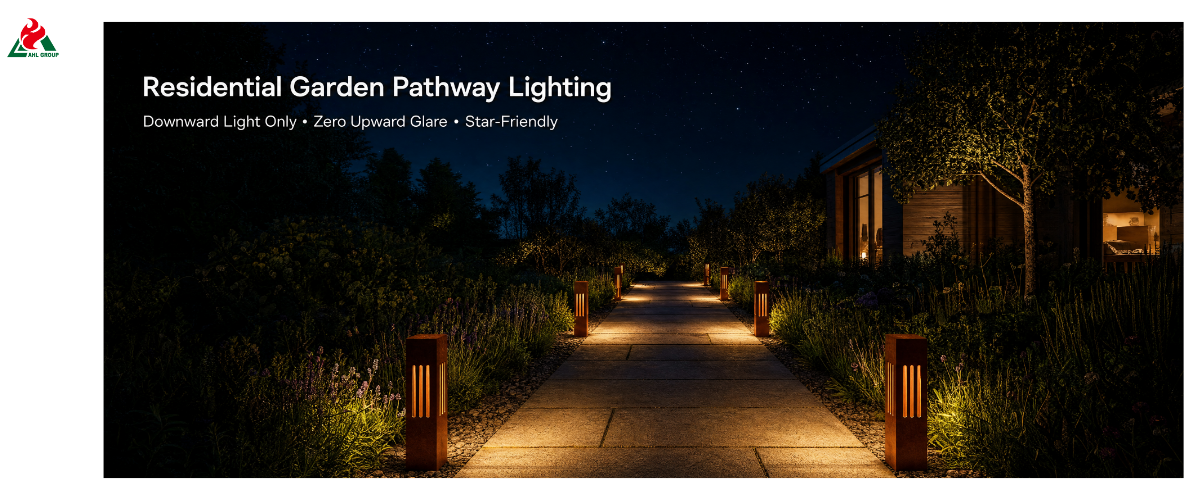
Low-lumen, downward-shading, laser-cut weathering steel bollard lights are an ideal choice for garden paths. They cast soft, glare-free patterns of natural light and shadow directly onto the walkway, ensuring safe passage through residential or public gardens while keeping the surrounding area dimly lit.
Residential Driveways
Installing Dark Sky-compliant Corten pathway lights along residential driveways helps define the boundaries of vehicle traffic without casting glaring light into neighbors’ windows or the night sky. Their richly textured patina blends naturally with residential landscape elements.
Landscape Boundaries
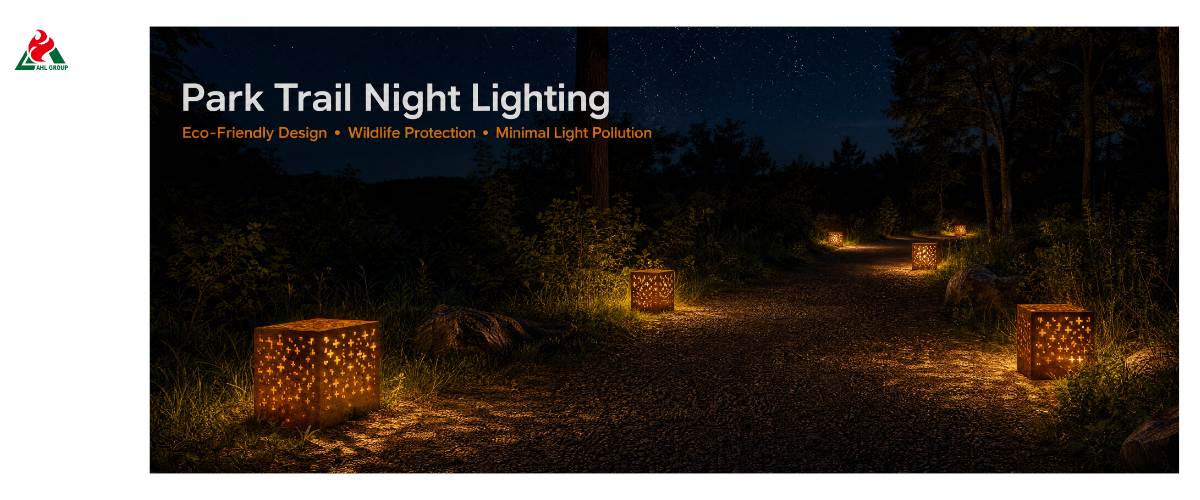
Placing Corten lights with light shields in the transition zone between manicured lawns and native vegetation helps define landscape boundaries. By directing all light downward, they protect nesting birds, beneficial insects, and local wildlife from the effects of disruptive light pollution.
Commercial Outdoor Walkways
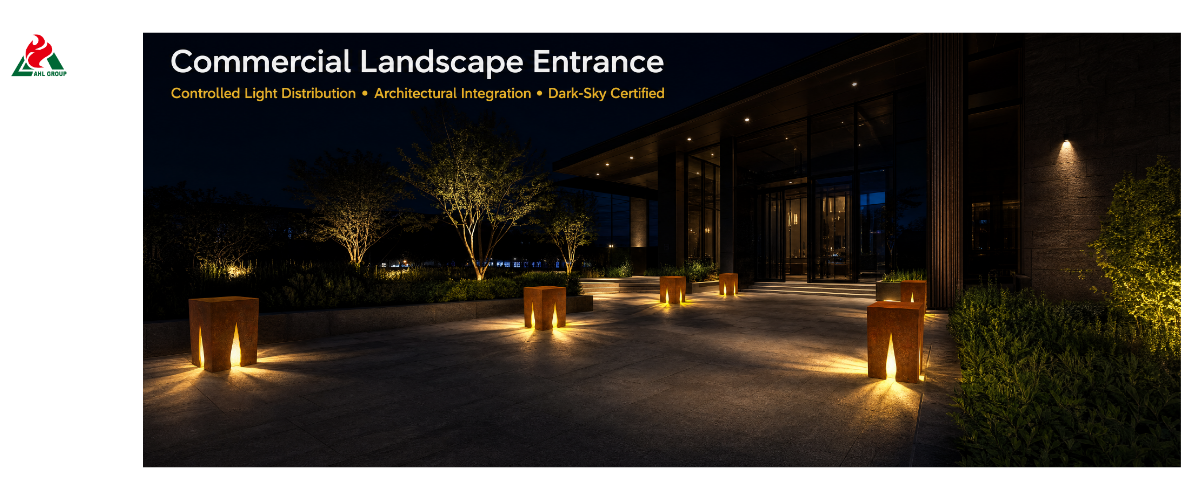
For corporate office buildings, nature centers, and resort hotels committed to achieving LEED certification or complying with municipal green building codes, weathering steel bollards that meet “Dark Sky” standards offer a durable and low-maintenance pedestrian guidance solution that also meets stringent environmental standards.
8. How to Evaluate a Product
Check the Optical Design
Review the cross-sectional engineering drawings of the streetlight pole to verify the mounting position of the optical engine. Confirm whether the light source is deeply recessed into the upper lamp housing and directed downward, or whether a precision downward reflector is used. Avoid selecting luminaires that rely on simple, centrally mounted omnidirectional glass tubes.
Check the Color Temperature
Review the manufacturer’s technical specifications to confirm the specified correlated color temperature (CCT). Ensure that you explicitly select 2700K, 2200K, or a dedicated wildlife-friendly amber LED option when ordering the product. Avoid luminaires that do not specify a color temperature or that offer only the standard 4000K option.
Check Dimming and Glare Control Features
Confirm that the streetlight pole supports smart controls, timers, or tiered dimming systems to reduce light output during late-night hours. Check for an internal physical shield or anti-glare baffle to prevent light from escaping through high-angle laser-cut slits.
Request Compliance Documentation
Request official IES files, BUG rating reports (confirming a U0 rating), and official Dark Sky certification documents from the manufacturer. Reputable suppliers can provide photometric test data to verify that there is no light emission above the 90-degree horizontal plane.
9. Corten Bollards vs Other Materials
Weathering Steel vs. Aluminum Bollards
Powder-coated aluminum bollards feature a clean, modern appearance, but their smooth, man-made surface lacks the distinctive texture of weathering steel. Weathering steel develops a rugged, textured oxide patina that naturally reduces specular reflection (surface gloss), thereby minimizing the visual impact of the structure on the landscape.
Weathering Steel vs. Stainless Steel Guardrails
Stainless steel has a highly reflective, bright silver surface that reflects ambient light, creating secondary glare. Weathering steel’s rustic, non-reflective matte surface absorbs stray light, making it a more natural and visually unobtrusive choice for sensitive outdoor environments.
Prioritizing Decorative vs. Functional Lighting
Aluminum and stainless steel are commonly used for purely functional, high-intensity lighting in commercial areas. Weathering steel bollards truly shine when design teams seek to balance functional path safety with artistic, low-impact landscape aesthetics.
Material Selection Takes a Back Seat to Luminaire Design
Ultimately, the choice of material is secondary to optical engineering design. Whether it’s a laser-cut weathering steel bollard or a standard aluminum post, either can fully comply with Dark Sky standards—or fail to do so entirely—depending entirely on its internal light-shielding structure, light direction, and lumen management.
10. FAQ About Corten Bollard Lights
Q1: Can Laser-Cut Bollards Meet the Dark Sky Standards?
Yes. If the internal light source assembly of a laser-cut bollard is installed facing downward at the top and deeply recessed, and is equipped with an internal baffle or shield that directs all light downward onto the path—thereby maintaining a U-value of U0—then the bollard will fully comply with the Dark Sky Standards.
Q2: Does the Weathering Steel Surface Treatment Affect Light Pollution?
Yes, and in a positive way. Weathered steel (Corten steel) has a natural matte finish and texture, and its surface is highly diffuse and non-reflective. Unlike polished stainless steel or glossy painted aluminum, it does not produce secondary glare nor reflect scattered light into the night sky.
Q3: What Color Temperature Is Best Suited for Dark Sky Lighting?
The ideal color temperature ranges from 2200K to 2700K. While dark sky standards strictly require a color temperature of 3000K or lower, selecting a warmer “super-warm white” or amber spectrum can significantly reduce blue light scattering and minimize the impact on the environment.
Q4: How Do Unlit Weathering Steel Road Bollards Relate to Dark Sky Standards?
Unlit weathering steel road bollards primarily serve as architectural barriers or daytime landscape elements. Since they do not emit artificial light, their light pollution footprint is zero, and they are inherently compliant with dark sky standards.
Conclusion: When to Choose Corten Steel Bollard Lights
For projects that need to balance structural durability, natural aesthetics, and ecological responsibility, weathering steel road bollards are an excellent choice. Their natural weathering properties are particularly well-suited for residential gardens, eco-resorts, public parks, and historic sites where protecting the natural night sky is a top priority.
When selecting laser-cut weathering steel bollards for dark-sky-sensitive areas, do not focus solely on their appearance as steel art pieces. Prioritize fixtures equipped with downward-facing LED bulbs, internal anti-glare shields, and warm-toned light sources, and ensure they have undergone certified photometric testing. This ensures that your outdoor lighting protects the night sky while highlighting the natural beauty of the landscape.

