


Corten steel cladding panels are widely used in contemporary architecture due to their unique weathered appearance and long-term durability. However, they are not a one-size-fits-all solution. Under certain environmental conditions, their performance may be compromised, leading to premature corrosion, staining issues, and erratic rust formation.
This guide will explain the situations in which the use of Corten cladding should be avoided, why these environments can cause problems, and which alternatives may perform better.
This guide will explain the situations in which the use of Corten cladding should be avoided, why these environments can cause problems, and which alternatives may perform better.
1. Introduction
Why Corten Steel Exterior Cladding Isn’t Suitable for Every Application
Weathering steel—commonly known as “Corten steel”—has become a favorite in the architectural world due to its rugged, industrial aesthetic and its iconic, ever-changing amber-brown rust patina. Under ideal conditions, this alloy forms a stable protective layer, eliminating the need for paint or ongoing maintenance. However, there is a widespread misconception among architects and developers that weathering steel is an “indestructible” material capable of enduring indefinitely under any climatic conditions. In reality, weathering steel requires specific atmospheric conditions to activate its self-protective chemical reaction. If blindly selected for the wrong location, it may suffer from uncontrolled, severe corrosion, structural thinning, and ultimately, wall failure.
Which Environmental Conditions Are Most Critical
The fundamental mechanism of weathering steel relies on periodic cycles of wet and dry exposure. For the material to form a dense, non-porous, and firmly adherent layer of iron oxide (i.e., rust), it must undergo periods of wet exposure followed by periods of complete atmospheric drying. Environmental factors that determine whether this protective barrier will form—or whether the metal will simply rust away—include local relative humidity, distance from marine salt spray, prevailing wind direction, levels of air pollution, and surface microclimates that trap moisture.
This Guide Will Help You Avoid the Following Problems
Using Corten steel exterior cladding in unsuitable microclimates can turn an architectural masterpiece into a costly legal and structural liability. This technical guide is designed to provide risk mitigation guidance for code makers, hardscape engineers, and building owners. It will clearly identify geographic and structural conditions where weathering steel is fundamentally unsuitable, analyze potential chemical failure modes, outline early warning signs of failure, and recommend high-performance alternative materials for problematic climates.
2. Environments to Avoid
Coastal and Salt Fog Areas
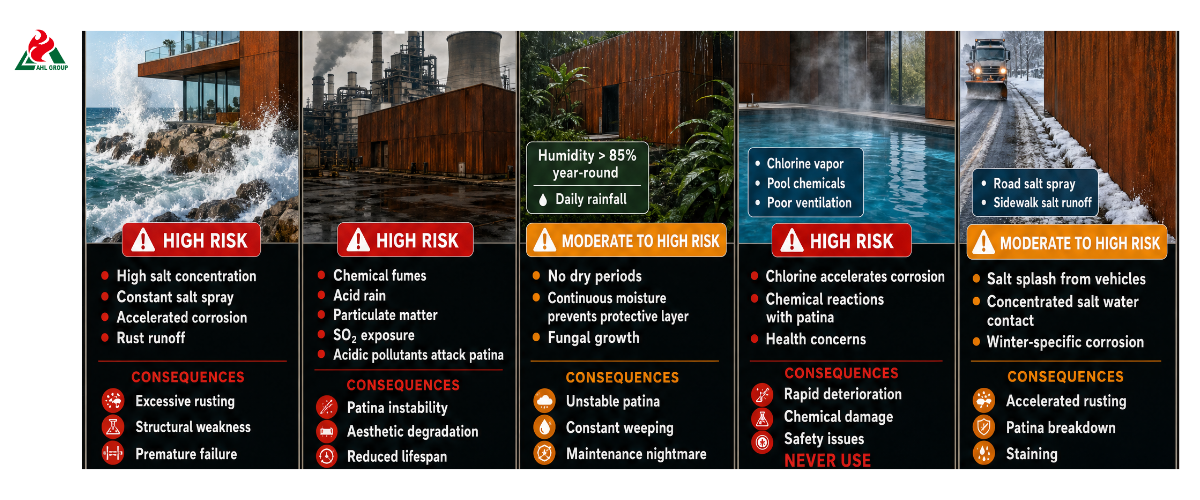
The number one enemy of weathering steel is sodium chloride (salt) in the air. Any environment exposed to sea salt fog or high-salinity coastal winds is extremely unsuitable for the use of unsealed Corten exterior wall panels. Generally, any site located within 2 to 5 kilometers (1.2 to 3 miles) of a saltwater coastline should be designated as a high-risk area. Salt in the air deposits on the steel surface, forming a highly hygroscopic crystalline layer that keeps the metal constantly damp and greatly accelerates the process of pitting corrosion.
Extremely Humid Climates
Environments with persistently high relative humidity (consistently exceeding 70%–80%) pose a severe challenge to weathering steel. In these regions, the air contains large amounts of water vapor, making it extremely difficult for the metal surface to reach a completely dry state—a condition necessary for iron oxide to dehydrate, crystallize, and harden into a stable protective layer. Instead, the rust layer remains soft, porous, and chemically active.
Areas Prone to Frequent Heavy Rainfall
Although rainfall is necessary to wash away loose impurities from the atmosphere and initiate the oxidation process, excessive or nearly continuous rainfall can disrupt the chemical equilibrium. In geographic regions where heavy rains occur frequently or where the monsoon season is prolonged, continuous washing can strip away the oxide film before it has firmly bonded to the steel substrate. This leads to a continuous loss of mass and rapid thinning of the clad steel.
Areas with Persistent Fog or Condensation
Low-lying valleys, mountainous cloud forests, and humid river valleys—where morning fog or severe nighttime condensation occurs over extended periods—are hidden “trap zones” for weathering steel cladding. Fog forms a fine, permeable mist that settles in panel seams, folded edges, and fastener holes. Since fog typically occurs during periods of low solar radiation and light winds, trapped moisture can linger for hours or even days, preventing the steel from undergoing a critical drying period.
Areas with Poor Drainage or Standing Water
From a structural perspective, any environment or detail that leads to standing water, puddles, or direct contact with soil can cause weathering steel panels to fail. When weathering steel is continuously submerged in water or remains damp for extended periods due to saturated soil, a damp leaf litter layer, or clogged drainage channels, its performance is no different from that of ordinary carbon steel. Without a dry phase rich in oxygen, the steel will remain in a state of active and unchecked corrosion.
3. Why These Conditions Are a Problem
The Effects of Prolonged Moisture Exposure on Corten Steel
To understand the failure mechanism, it is helpful to understand the underlying principles of corrosion chemistry. When weathering steel is exposed to moist air, a typical electrochemical reaction occurs: iron reacts with oxygen and water to form iron hydroxide. Under ideal conditions, this compound undergoes a dehydration reaction, forming a stable and tightly packed crystalline phase such as goethite. However, if the steel remains in a humid environment for an extended period, it remains in the amorphous, porous phase known as lamellar siderite. This flaky and unstable rust layer allows water and oxygen to continuously penetrate, creating a vicious cycle of structural oxidation.
Why Do Salts Accelerate Corrosion
Chlorides from marine environments act as powerful catalysts, compromising the integrity of the metal. When chloride ions adhere to the steel surface, they penetrate the initially formed oxide film and react directly with the exposed iron to form ferric chloride. Ferric chloride is highly soluble in water. Rainwater or moisture dissolves this layer, causing it to hydrolyze on the steel plate’s surface and form hydrochloric acid. This locally formed acidic environment destroys the surrounding protective rust layer and causes deep, unpredictable pitting corrosion, which can even completely penetrate a 2-millimeter-thick steel plate within a very short period of its expected service life.
What Happens When the Rust Layer Cannot Stabilize
When the environment prevents steel from entering the drying phase, the rust layer can never reach a state of structural equilibrium. Instead of forming a tough, smooth-to-the-touch, deep purple or deep bronze “armor,” the surface remains a bright, fiery orange-yellow. This vivid color serves as a warning sign: it indicates that the outer rust layer is loose, highly prone to powdering, and constantly flaking off in the form of dust or granular scales. The steel is unable to form a protective barrier, leaving the exposed metal vulnerable for extended periods.
How Trapped Moisture Shortens Service Life
Corten siding systems rely on overlapping panels, mechanical joints, and concealed structural subframes. In unsuitable environments, capillary action draws moisture into these tight, unventilated spaces. Once moisture enters the seams or overlaps, it cannot evaporate. This creates highly localized differences in potential—the oxygen-deprived metal inside the seam acts as an anode, while the oxygen-rich outer surface acts as a cathode. This triggers rapid, electrochemical-corrosion-like degradation within the seam, leading to fastener failure, panel warping, and the gradual disintegration of the exterior wall cladding from the inside out.
4. Specific Risk Locations
Near the Ocean or Coastline
Coastal cliffs, beachfront villas, and harbor structures are the most common locations where Corten steel fails prematurely. The continuous exposure to high relative humidity, surf spray, and wind-borne sea salt causes the exterior panels to remain constantly covered by a highly corrosive electrolyte solution. If designers install unsealed weathering steel in locations exposed to splashing waves, the panels are expected to experience severe thinning and significant structural spalling within less than 5 to 10 years.
Around Saltwater Pools
Modern landscape design often seeks to pair the rustic orange tones characteristic of Corten steel privacy screens or pool house exterior cladding with the turquoise waters of a pool. If the pool uses a salt chlorinator, this environment becomes extremely hazardous. Wind, water spray, and foot traffic can carry salt-laden water directly to the base of the cladding panels. High temperatures, high humidity, and the intense localized microclimate created by chlorine and salt ions can lead to rapid, localized deterioration at the bottom edges of the metal components.
In Tropical or Rainforest Environments
Tropical regions pose a threefold threat to weathering steel: extremely high average annual rainfall, persistently high relative humidity, and warm temperatures that accelerate chemical reaction rates. In equatorial or rainforest regions, the atmospheric drying potential is virtually zero. Corten cladding wall installed in these locations behaves no differently from inexpensive low-carbon steel, rusting severely and never stabilizing into an architectural patina.
In Shaded and Persistently Damp Areas
Microclimates can vary significantly across different facades of the same building. Walls located beneath dense tree canopies, north-facing walls (in the Northern Hemisphere), and walls tucked away in narrow urban alleys or deep under building eaves are all high-risk areas. These areas receive no direct solar radiation whatsoever and have very little air circulation. If dew, rain, or condensation accumulates on panels in these shaded areas, they may remain damp for several days, leading to uneven and uncontrolled corrosion.
For Walls Exposed to Runoff from Roofs or Road Surfaces
Corten steel cladding can only withstand direct, even rainfall. It is completely unsuitable for withstanding concentrated water flow. Facades located directly beneath eaves, ridge flashings, or drain outlets where no downspouts are installed are subjected to concentrated water flow cascading down specific paths. This continuous hydraulic scouring erodes grooves into the developing rust layer, hindering its stabilization and causing dark “rust bleed” marks, thereby compromising the building’s appearance.
5. Signs Corten Cladding May Fail Early
Excessive Corrosion
The most obvious indicators of environmental incompatibility are the physical volume and texture of the corrosion. A healthy weathering steel facade produces very little loose debris after the initial stabilization period. If, two or three years after installation, the exterior cladding continues to shed thick, rough, potato-chip-like rust flakes or forms a thick layer of powdery dust, this indicates that the rust layer has not adhered firmly and the underlying steel is undergoing severe corrosion.
Mottled or Uneven Rust Layer
Although a certain degree of color variation is a normal and desirable characteristic of weathering steel, extreme and persistent visual contrasts on a single wall indicate an unsuitable environment. If some areas of the exterior wall remain a bright, chalky orange while others have turned dark brown, this suggests uneven moisture absorption or localized chemical contamination on that wall, preventing the rust layer from curing uniformly.
Stains on Adjacent Surfaces
During the first year of weathering, slight iron oxide seepage is normal. However, if, after several seasons, the exterior wall continues to seep deep orange and red stains onto the surrounding concrete foundation, stone sidewalks, or glass windows, this indicates that the rust layer has not yet stabilized. This persistent seepage indicates that the outer layer of iron oxide is being continuously washed away due to excessive moisture or an acidic environment, exposing the underlying steel to relentless corrosion.
Surface Runoff Issues
If the architectural design fails to include proper flashing, drip edges, and drip channels at the bottom of the metal cladding, runoff will accumulate around the bottom track. If water is observed pooling along the lower edge of the metal panels—rather than draining away—within minutes after a heavy rainstorm, crevice corrosion will rapidly develop at the bottom fasteners and panel edges.
Visible Deterioration at Seams and Fasteners
When a weathering steel exterior wall system begins to experience structural failure, damage first appears at the connection points. Carefully inspect joints, rivet lines, and screw holes. If you observe panel bulging (caused by “rust swelling,” where an expanded layer of iron oxide pushes the metal panels apart) or severe pitting on fastener heads, this indicates water accumulation behind the rain screen system, which threatens the structural support network.
6. When Corten May Still Be Possible
If Partial Site Shading Is Present
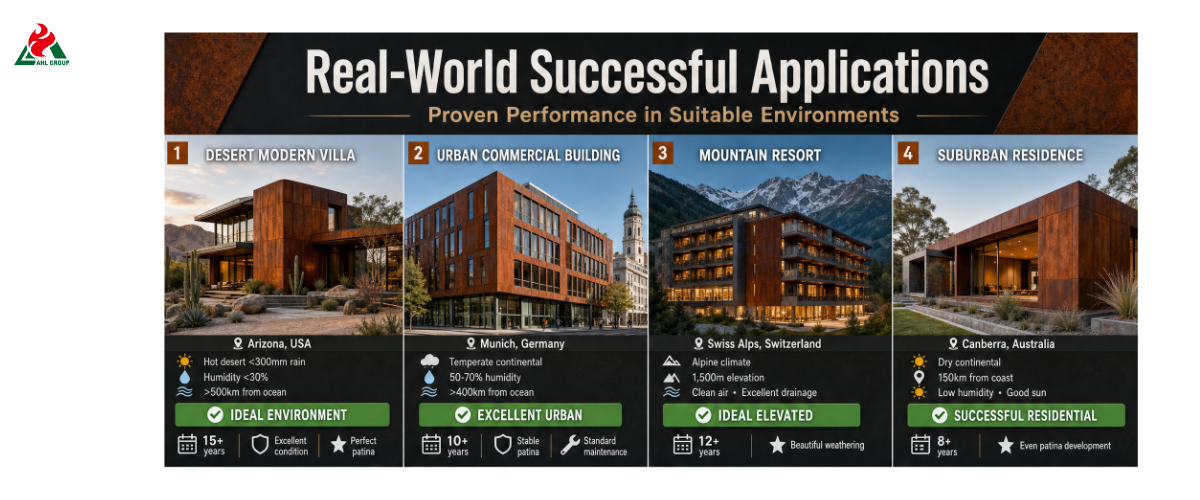
In borderline environments—such as buildings located a few kilometers inland from the coastline, or in regions with moderate seasonal humidity—weathering steel can still be used if the building’s layout shields the panels from direct exposure to extreme environmental conditions. Designing deeper eaves to minimize direct rain exposure, or installing the panels on building facades with optimal sunlight and wind conditions, can help ensure the necessary wet-dry cycle is maintained.
If Rainwater Runoff and Drainage Are Properly Managed
Weathering steel can function properly even near critical areas, provided the mechanical details are flawlessly executed. This requires establishing a continuous ventilation cavity behind the exterior cladding (using an open-curtain wall system), employing wide, open joints rather than tight lap joints, and specifying heavy-duty, oversized drip flashings to completely divert rainwater away from the building’s base.
If the Design Ensures Good Air Circulation
Good air circulation can mitigate the risks associated with moderate humidity. Installing Corten steel panels on a subframe made of engineered aluminum or galvanized steel, with an air gap of at least 20 to 40 millimeters on the back, creates a natural chimney effect. This convective airflow continuously draws air upward from the back of the steel panels, quickly drying the rear surface even when the front is exposed to morning dew or dense fog.
If Protective Coatings or Other Surface Treatments Are Used
If architects insist on using Corten steel for its aesthetic appeal in high-risk environments, the steel must undergo a chemical sealing treatment. Applying a high-performance, UV-resistant, transparent matte polyurethane or aliphatic acrylic sealer isolates the metal surface from salt ions and persistent moisture. However, designers must understand that transparent sealers are not a permanent solution; they age under solar radiation and require reapplication every 3 to 5 years, thereby transforming a low-maintenance material into a high-maintenance one.
7. Better Alternatives for Problem Climates
Powder-Coated Steel
For marine or high-humidity projects where weathering steel (Corten) cannot be used, standard carbon steel treated with an architectural-grade powder coating is an excellent alternative. Modern powder-coating technology enables manufacturers to create unique textures and mottled colors that mimic the warm tones of natural rust, achieving the desired industrial aesthetic while relying on a durable polymer barrier to block moisture and salt.
Aluminum Cladding
Aluminum is the material of choice for coastal development projects. It forms a natural, invisible protective oxide layer and is highly resistant to chloride-induced pitting corrosion. Aluminum cladding panels can be anodized or coated with an ultra-durable fluoropolymer (PVDF) coating to simulate the appearance of weathered metal, delivering the same aesthetic as metal while weighing only a fraction as much and eliminating the risk of rust seepage.
Stainless Steel
In highly corrosive environments—such as around saltwater pools or in industrial areas subject to acid rain—switching to upgraded alloys like 316 marine-grade stainless steel is the safest choice for structural design. Although the initial cost is higher, the molybdenum content in marine-grade stainless steel effectively prevents chloride pitting, ensuring the structure will not degrade for decades.
Fiber-Cement
If a project requires a rustic, natural texture but is at risk of tropical humidity or prolonged exposure to moisture, fiber-cement exterior wall panels are a practical choice. These composite panels are resistant to rot and rust and can be pre-stained or painted at the factory in deep iron oxide tones, providing a stable appearance that remains unaffected even in humid, shaded microclimates.
Wood or Composite Exterior Walls
For designs aimed at blending industrial architecture with natural elements, using high-density hardwoods (such as ipe or teak) or high-quality wood-plastic composites is an excellent alternative to weathering steel. Over time, these materials weather to reveal beautiful silver-gray or soft brown tones that complement modern landscapes, while eliminating the risk of heavy metal leaching or structural rust and flaking.
8. How to Evaluate a Site Before Choosing Corten
Check Precipitation and Humidity Levels
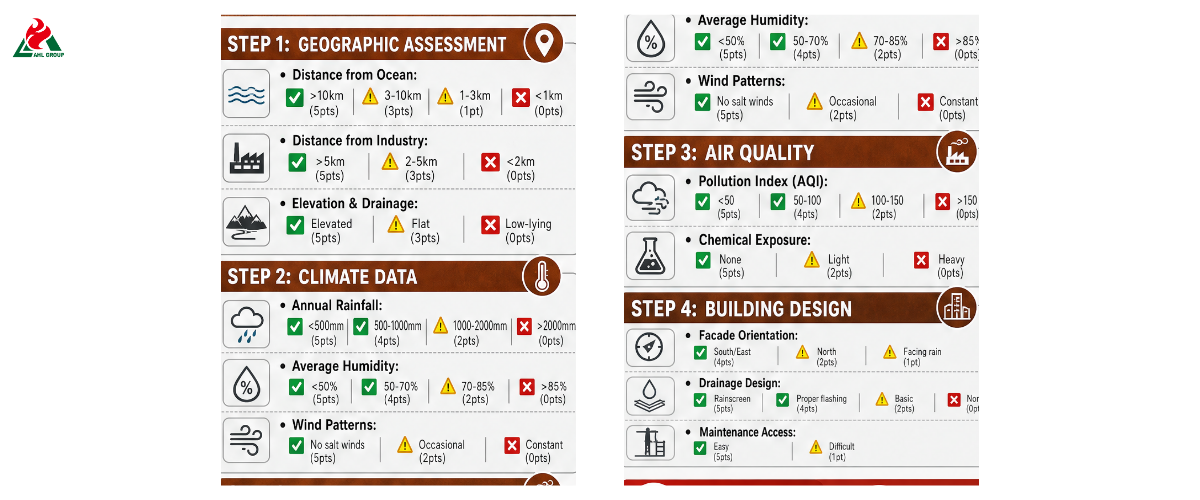
Before selecting weathering steel, consult historical climate data for the project’s exact coordinates. Analyze trends in average relative humidity across different seasons and record the total annual precipitation. If the local microclimate shows that relative humidity consistently exceeds 75% and the dry season is extremely short, standard unsealed Corten steel should be excluded from consideration.
Assess Salt Fog Exposure
Accurately calculate the distance from the construction site to the nearest saltwater coastline or tidal estuary. Consider prevailing wind directions; if coastal winds blow directly from the sea toward the building facade without being blocked by hills or dense urban structures, the site must be classified as a high-salinity area.
Assess Drainage and Water Exposure
Examine the actual topography of the installation site. Ensure that the exterior wall panels are located well above any local floodplains, areas prone to standing water, or irrigated lawns. If the building design causes significant roof runoff or surface water from hard surfaces to flow toward the exterior wall panels, drainage routes must be thoroughly redesigned before weathering steel is used.
Check Ventilation and Drying Conditions
Analyze the effects of solar shading and wind resistance on each facade throughout the year. If a wall is completely blocked by adjacent buildings or dense trees and has no exposure to wind or sunlight, it will be difficult to dry. Ensure that each panel receives sufficient natural heat and airflow to break the cycle of persistent moisture.
Refer to Local Installation Guidelines
Consult regional building codes and review historical installation examples in the vicinity. If other buildings in the surrounding area have successfully used weathering steel for more than ten years, the local environmental conditions are likely suitable for this material. If local structural engineers or building codes issue warnings or require the use of heavy-duty corrosion barriers, alternative materials should be selected.
9. Common Mistakes to Avoid
Using Corten Steel in Environments Where Moisture Never Completely Dries Out
Perhaps the most destructive mistake a contractor can make is installing weathering steel in applications where the material will be exposed to moisture for extended periods. Whether due to a lack of ventilation in wall structures, installing panels below ground level, or placing them directly beneath a building’s drainage outlets, failure to provide a dry gap will rapidly deteriorate this high-quality, heavy-gauge steel.
Ignoring the Impact of Coastal Environments
Never assume a construction site is safe simply because it is only a few blocks away from the beach. Sea salt particles can easily be carried inland for several kilometers by coastal winds. Failure to account for this atmospheric salt deposition is the primary cause of premature failure in weathering steel used in construction projects worldwide.
Failure to Plan for Rust Runoff
Selecting weathering steel solely for its appearance while ignoring its early chemical reactions will result in significant property damage. Installing untreated weathering steel directly above expensive white marble floors, exposed aggregate concrete, or porous wooden decks—without establishing a clear rust runoff management system—will cause permanent staining and necessitate costly restoration work.
Selecting Weathering Steel Solely for Aesthetic Reasons
Architectural design decisions must never take precedence over engineering realities. Specifying weathering steel solely because it fits a visual design concept—without verifying local climate, humidity levels, and structural airflow details—is tantamount to courting disaster. It will inevitably lead to premature material failure and raise structural liability issues.
10. Frequently Asked Questions
Q1: Are Corten Steel Exterior Panels Suitable for Coastal Homes?
No, they are not. For homes located within 2 to 5 kilometers of a saltwater coastline, standard, unsealed Corten Steel exterior panels are highly unsuitable. Chlorides in the air caused by sea spray prevent the steel from forming a stable, protective rust layer, leading to severe pitting corrosion and rapid thinning of the material.
Q2: Can Weathering Steel Be Used in Tropical Climates?
Generally, no. The persistent combination of high relative humidity, seasonal heavy rainfall, and warm temperatures prevents weathering steel from entering the dry phases necessary for the formation of its protective oxide layer. Without these dry periods, the material will continue to rust just like ordinary low-carbon steel.
Q3: Can Sealing Weathering Steel Solve the Problem of Moisture?
Yes, but this introduces a maintenance cycle. Applying a high-quality, transparent, matte polyaspartate or acrylic sealer can isolate the steel from moisture and salt ions. However, these coatings degrade when exposed to UV radiation and must be reapplied every few years, thereby negating the original steel’s low-maintenance advantage.
Q4: What is the Best Alternative in Humid Climates?
The best alternative is powder-coated aluminum sheeting or fiber-cement panels with a rust-effect textured finish. These materials offer the same industrial-style appearance while completely avoiding issues such as rust flaking, pitting, and structural thinning caused by moisture.
Conclusion: Final Recommendations for Building Owners and Specifiers
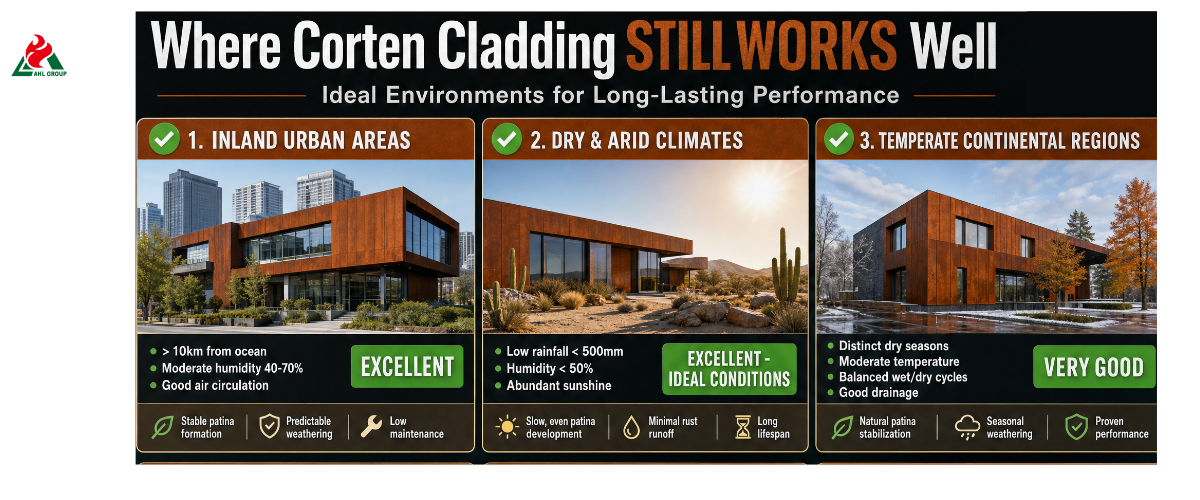
Architects, builders, and code writers need to understand that weathering steel is an environmentally friendly product that requires specific atmospheric conditions to function effectively. Without regular and complete cycles of wet and dry conditions, it cannot form a protective rust layer. Therefore, tropical regions with high humidity, coastal areas, dark and damp corners, and poorly drained sites are fundamentally unsuitable for the use of untreated weathering steel.
If a site assessment reveals persistent coastal salt fog, constant relative humidity, or moisture retention due to structural constraints, the use of unsealed Corten steel must be avoided. In these environments, selecting high-performance alternative materials—such as powder-coated aluminum, marine-grade stainless steel, or textured fiber cement panels—will achieve the desired aesthetic while avoiding the risk of premature structural failure.
Never treat a Corten metal cladding as purely decorative cladding. Before finalizing the project design, conduct a rigorous review of local rainfall patterns, salt fog dispersion, and facade ventilation conditions. By ensuring that the exterior wall panels have good airflow, an unobstructed drainage system, and regular drying periods, you can ensure that the project will be aesthetically pleasing, low-maintenance, and durable for decades to come.

