


Corten steel fire pits are becoming increasingly popular in modern outdoor design, but many buyers still question whether this rust-like material can safely withstand high temperatures. This concern is understandable—fire pits can reach extremely high temperatures, and not all metals behave the same way under thermal stress.
This guide will detail how Corten steel performs at high temperatures, analyze whether it is structurally safe as a fire pit material, highlight risks to avoid, and explain how to ensure its long-term durability and safety in real-world settings.
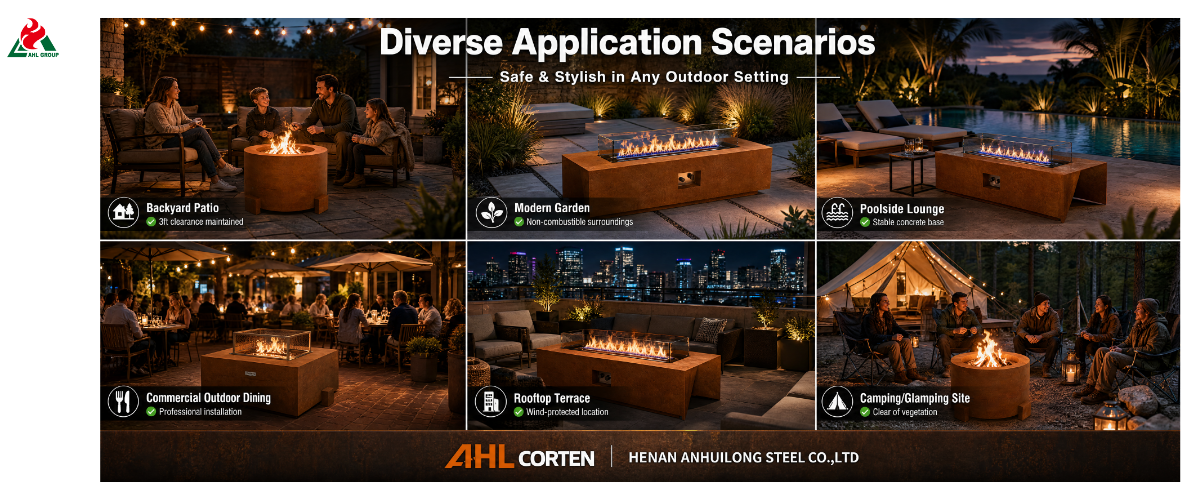
This guide will detail how Corten steel performs at high temperatures, analyze whether it is structurally safe as a fire pit material, highlight risks to avoid, and explain how to ensure its long-term durability and safety in real-world settings.
1. Introduction
Why Do People Ask If Corten Steel Is Suitable for Fire Pits
As outdoor living spaces have gradually evolved into high-end structural extensions of architectural design, weathering steel (commonly known as Corten steel) has become the mainstream material of choice for high-end fire pit installations. However, its distinctly industrial, raw, and rust-covered appearance often raises a fundamental safety concern among homeowners, landscape contractors, and designers: Is this material—characterized by active surface oxidation—structurally safe when subjected to intense thermal stress? Consumers often worry: Will the oxidized surface release toxic chemical gases when heated? Will this metal deteriorate rapidly like ordinary rusting iron? Or will the intense heat generated by burning hardwood compromise the fire pit’s structural integrity or even cause it to collapse?
The Difference Between Corten Steel and Ordinary Steel
Traditional low-carbon steel relies on external synthetic coatings—such as high-temperature-resistant powder coatings or silicon-based coatings—to prevent atmospheric corrosion. In the event of a fire, these surface coatings inevitably blister, crack, and peel off, exposing the underlying iron, which is prone to rapid rust formation that thins the metal substrate. Korten steel, on the other hand, functions through a completely different metallurgical mechanism. It is carefully alloyed with precise proportions of copper (Cu), chromium (Cr), nickel (Ni), and phosphorus (P). When exposed to cyclical weather changes, these elements react to form a dense, microcrystalline oxide layer—known as “patina.” Far from damaging the metal, this stable patina seals the underlying steel substrate, blocking the diffusion of oxygen and forming a complete barrier against deep atmospheric corrosion.
What This Guide Covers
This guide is a comprehensive, data-driven technical guide that evaluates the safety, thermal performance, and long-term durability of Corten steel when used as the primary structural material for high-temperature metal fire pits. We will analyze the physical properties of weathering steel under extreme thermodynamic loads, examine thermal expansion and structural warping vectors, discuss critical landscape safety clearance requirements, and directly compare the performance of Corten steel with that of other iron-based metals. Ultimately, this document will provide purchasers and designers with precise technical specifications to ensure the safe selection, installation, and operation of Corten steel fire pits.
2. Is Corten Steel Safe in High Heat
Performance of Weathering Steel at Fire Pit Temperatures
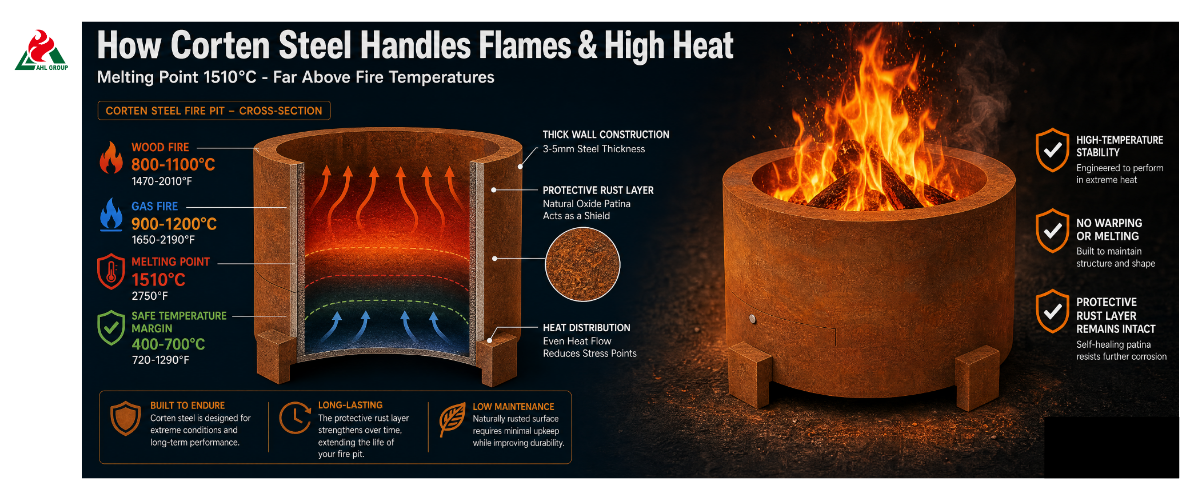
From a strictly thermodynamic perspective, weathering steel exhibits exceptional safety and stability at the operating temperatures generated by standard residential and commercial fire pits. When burning standard hardwood, the main structure of the fire pit experiences significant temperature gradients; typically, the temperature of the outer structural walls is approximately 260°C (500°F), while the core area directly exposed to radiant heat from the coal bed can reach 537°C (1,000°F). At these temperatures, weathering steel retains its high tensile strength and structural integrity. Unlike many metals that rapidly develop scale or experience grain boundary weakening when heated, the structural matrix of weathering steel remains metallurgically stable, ensuring that the unit will not undergo unexpected deformation or fracture while supporting the weight of heavy firewood.
The Meaning of “High Temperature” in Practical Applications
To accurately assess safety, it is essential to distinguish between “high temperature” in residential settings and industrial melting thresholds. In practical outdoor design, a “high temperature” scenario refers to a fully developed wood fire fueled by dense hardwoods (such as oak, hickory, or ash) that burns continuously for several hours. The sustained temperatures generated by such fires fall entirely within the safe operating limits of weathering steel. Since residential fire pits are completely non-pressurized and do not serve as load-bearing structural members, these operating temperatures pose no risk of structural failure.
Why Corten Steel Is Often Used for Fire Pit Structures
Industrial engineers and custom hardscape manufacturers specify Corten steel as the material for fire pit structures precisely because of its exceptional thermal fatigue resistance. In industrial applications, weathering steel is commonly used in exhaust stacks, heavy-duty flue gas ducts, and economical preheaters—applications that require continuous exposure to high-temperature gases. It can withstand repeated thermal cycling—that is, heating to high temperatures and then cooling back to ambient temperature—without losing its protective oxide layer, making it far more durable than standard low-carbon steel, which would suffer severe oxide layer loss under the same conditions.
3. How Corten Reacts to Fire and Heat
Weathering Layer and Heat Exposure
When a Corten steel fire bowl is lit, the intense heat alters the chemical properties of localized areas of the rust layer. In areas in direct contact with the layer of glowing charcoal, the dark brown iron oxide is slightly transformed into a more stable, darker-colored magnetic iron oxide. This thermal passivation process typically deepens the color inside the fire bowl, giving it a rich, deep charcoal black hue. High temperatures do not strip away or weaken the protective properties of the rust layer; on the contrary, as long as the steel is exposed to atmospheric oxygen during the cooling phase, high temperatures actually accelerate the stabilization of the oxide film.
Will Corten Steel Crack, Warp, or Lose Strength
Whether a metal fire pit will warp or deform depends on two factors: material thickness and unconstrained thermal expansion. Any metal expands when heated. If the fire pit is made of ultra-thin weathering steel (less than 2mm or 14 gauge), the extreme temperature difference between the high heat inside the fire pit and the low temperature outside may cause localized warping. However, when high-end commercial-grade thicknesses are used—such as 3 mm (11 gauge) or 6 mm (1/4 inch)—weathering steel possesses sufficient structural quality and cross-sectional strength to withstand internal thermal stresses. It will not crack under thermal loads and is therefore highly resistant to structural cracking failure.
What Happens During Repeated Heating and Cooling
The service life of an outdoor fire pit depends on thermal cycling. When the flames are burning brightly, the steel expands; when the flames die down, the steel contracts. The alloy matrix of Corten steel has been uniquely optimized to withstand these microstructural stresses. Compared to high-carbon steel, the added copper and nickel elements form a more ductile grain structure, thereby minimizing the internal microstrains that lead to metal fatigue. The protective rust layer expands and contracts in sync with the base material, ensuring that the protective layer remains firmly bonded to the steel substrate throughout years of seasonal, repeated use.
4. Safety Factors to Consider
Surface Temperature and Safety Precautions
Because steel is an excellent conductor of heat, the outer walls of any weathering steel fire pit will become extremely hot to the touch during use. Within 30 minutes of lighting the fire, the temperature of the outer surface can easily exceed 200°C (392°F).
Important Safety Warning: Contact will immediately result in severe burns. When using a Corten backyard fire pit, the same precautions must be taken as when operating any open-flame heater. Children, pets, and unsupervised visitors must maintain a safe distance, and the fire pit must never be moved or adjusted while the unit is in operation.
Clearances from Combustible Materials
To prevent accidental building fires or property damage caused by radiant heat, a strict safety clearance zone must be established around the unit.
► Horizontal Clearance: Maintain a perimeter clearance of at least 3 meters (10 feet) from any combustible structures, including residential vinyl siding, wooden fences, overhanging tree branches, pergolas, and dry storage sheds.
► Vertical Clearance: Ensure that the area directly above the fire pit is completely unobstructed by patio roofs, shade sails, or overhead utility lines.
Placement on Patios, Wooden Decks, and Lawns
Corten fire pits must never be placed directly on flammable or heat-sensitive surfaces.
Wooden or composite decks: Placement is strictly prohibited unless a structural reinforcement solution is implemented. Radiant heat emitted from the base can easily scorch or ignite the wood, and the fire pit’s heavy weight poses a risk of structural collapse.
► Natural Lawns: Intense downward heat radiation will completely scorch and kill the turf and root system beneath, resulting in permanent dead spots.
► Ideal Base: Place the fire pit only on non-combustible, high-density construction surfaces, such as natural stone pavers, dense concrete slabs, compacted gravel layers, or crushed weathered granite bases.
Wind, Sparks, and Embers Control
Because many Corten steel fireplaces feature open bowl-shaped or architectural designs, they are susceptible to aerodynamic wind currents. Strong winds can accelerate fuel combustion and carry light, burning charcoal embers into the air, creating a wildfire hazard. When using an open Corten steel fire pit, be sure to use a heavy-duty stainless steel or carbon steel spark guard to intercept escaping particles, and discontinue use when ambient wind speeds exceed 25 kilometers per hour (15 miles per hour).
5. Fire Pit Design Matters
Fire Pit Structure and Cooking Surfaces
It is essential to clearly distinguish between the use of weathering steel for the fire pit’s structural shell and its use for cooking surfaces that come into direct contact with food. While weathering steel is perfectly safe for the fire pit’s structural framework, it is not recommended for use on grill grates or baking pans that come into direct contact with food. Its weathered rust layer contains trace amounts of alloyed phosphorus and heavy metal oxides; while these components significantly enhance corrosion resistance, they should not be transferred directly to food through high-temperature contact. When used for cooking, ensure the appliance features a separate food-grade 304 or 316 stainless steel grill grate or a seasoned cast iron inner grate supported by a weathering steel frame.
Thickness and Structural Quality
The structural safety and service life of a fire pit are directly proportional to the thickness of the steel used in its construction. Cheap, mass-market imitations typically use standard carbon steel that is stamped to a fragile thickness of just 1 millimeter and coated with a temporary chemical rust spray to mimic the appearance of Corten steel. Genuine architectural-grade Corten fire pits, on the other hand, feature a sturdy, thick-gauge steel plate construction.
| Steel Gauge | Thickness (mm) | Thermal Warping Resistance | Expected Structural Lifespan |
| Light Gauge | 1.5 mm - 2.0 mm | Low (Prone to distortion) | 3 to 7 Years |
| Premium Gauge | 3.0 mm (11gauge) | High (Excellent stability) | 20 to 30 Years |
| Commercial Heavy | 6.0 mm (1/4 inch) | Absolute (Zero deformation) | 50+ Years |
Open Bowl, Enclosed Box, and Table-Top Designs
The geometry of the outdoor fire pit determines how heat is distributed throughout the space:
► Open Fire Bowl: Excels at radiating heat outward in a 360° radius, making it an efficient patio heater; however, it requires a larger horizontal safety distance.
► Enclosed Box/Pillar: The coal bed is positioned deep inside, allowing heat to conduct vertically and protecting the outer walls from direct exposure to the flames.
► Table-Style Design: Features an extended rim around the perimeter that remains cooler than the central fire core, creating a protective structural buffer zone between guests and the burning firebox.
Why Design Matters More Than Materials Alone
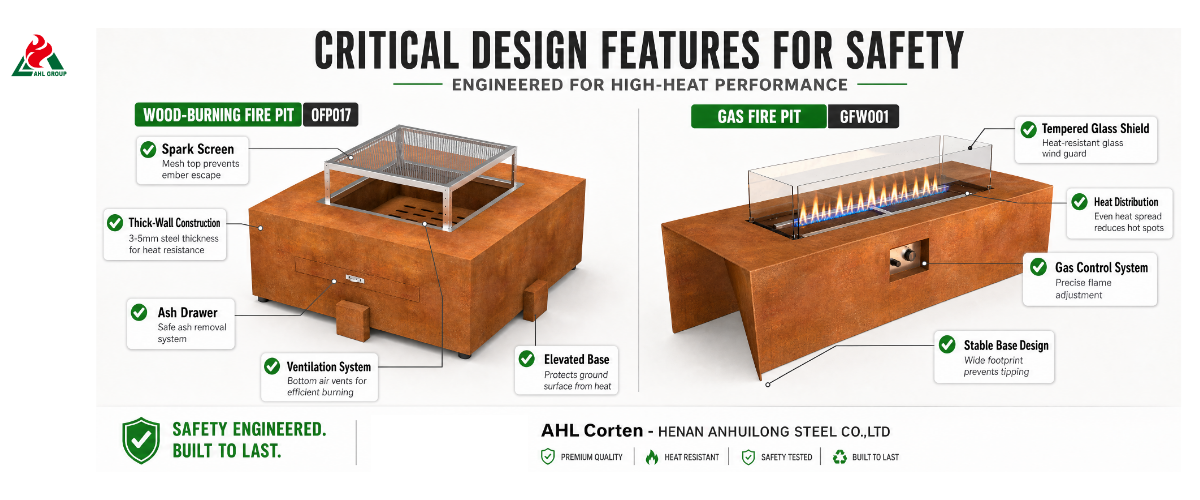
Even a fire pit made of genuine weathering steel (Corten steel) may perform poorly if it lacks basic engineering design features. A high-quality design must include dedicated drainage holes at the bottom to prevent rainwater from pooling and leaving the metal submerged in an anaerobic environment for extended periods. Additionally, the base of the unit must feature integrated air intakes to deliver oxygen directly beneath the coal bed, ensuring a clean, efficient, and low-smoke combustion process that maximizes heat output while minimizing unburned carbon particles.
6. Common Risks and Mistakes
Placing the Fire Pit Too Close to Flammable Surfaces
The most common hazard associated with outdoor fire bowl installations is improper placement driven by aesthetic considerations. Placing a burning, high-temperature weathering steel fire pit directly against a structural wooden retaining wall or under a synthetic canvas umbrella creates an immediate risk of flash fire due to continuous radiant heat transfer. Be sure to strictly adhere to the 3-meter clearance requirement.
Ignoring Rust Leakage and Staining Issues
During the initial 12- to 18-month atmospheric curing period, Corten metal fire pits will shed loose iron oxide particles whenever it rains. This “bleeding” process produces a thick, orange-brown liquid that, through chemical and mechanical bonding, will permanently stain porous stone, concrete pavers, and structural brickwork.
To prevent this aesthetic issue, be sure to place a temporary drip tray, a sacrificial concrete paver border, or a deep gravel bed beneath the fire pit until the rust has fully stabilized and is no longer shedding.
Firebox Overheating
Although weathering steel is extremely durable, it is not an industrial blast furnace. When users fill the firebox with high-density coal, wooden pallets, or fuel additives, “overheating” occurs, creating an uncontrolled heat load that causes flames to shoot several meters into the air. Overfiring can even cause localized thermal deformation in thick steel plates, while significantly increasing the risk of structural fires in the surrounding area caused by flying sparks.
Mistakenly Believing That All Weathering Steel Products Have the Same Heat Resistance
The market is flooded with low-priced imported products labeled as “weathering steel style” or “weathering steel finish.” Almost all of these products are made of standard thin-gauge low-carbon steel and have merely been immersed in a strong acid solution to create a rapid, artificial surface rust. These imitations lack the copper-chromium alloy matrix necessary to prevent internal corrosion. When exposed to high-temperature flames, these thin coatings burn away instantly, causing the surface to peel off rapidly, the structure to thin, and ultimately resulting in burn-through failure after just a few seasons of use.
7. Best Practices for Safe Use
Selecting the Right Installation Location
Choose a permanent, level installation site that is completely sheltered from strong winds and the prevailing wind direction. The site must be located away from high-traffic walkways, children’s play areas, or vehicle parking areas. Ensure that the surrounding area provides a clear line of sight from your primary outdoor living area so you can monitor the fire pit at all times while it is in use.
Use a Stable, Non-Combustible Base
Be sure to secure the durable fire pit to a sturdy, stable structural base. If installing on an existing stone patio, lay down a sacrificial pad or install a ring-shaped base with steel legs to elevate the hot bottom of the fire pit and prevent direct contact with the stone slabs. This air gap acts as a thermal barrier, protecting the patio slabs from localized thermal cracking or structural spalling.
Monitoring the Fire Source During Use
Under no circumstances should a burning fire source be left unattended. Designate an adult to serve as the “fire watch” and supervise the equipment from the moment it is lit until it is completely extinguished. Always keep a heavy-duty, commercial-grade ABC dry-chemical fire extinguisher, a fire blanket, or a fully pressurized garden hose within arm’s reach of the fire area to immediately respond to unexpected local flare-ups.
Proper Cooling After Use
The safest way to extinguish a hardwood fire in a rusted steel fire pit is to allow the fuel to burn out naturally until it turns to cold ash, thereby cutting off the system’s supply of new fuel.
Key Safety Rule: Never pour large amounts of cold water directly into a red-hot Corten steel fire pit. This extreme thermal shock can cause the structure to contract instantly, potentially deforming the heavy steel plates, tearing mechanical welds, and producing dangerous, scalding clouds of steam.
8. Maintenance and Longevity
How Heat Affects the Patina
The application of high-intensity heat to specific areas actually helps to consolidate the atomic structure of the Corten steel patina. While the unheated edges on the exterior of the fire pit continue to develop the classic amber-brown, velvety appearance through exposure to rain, the interior areas exposed to high temperatures transform into a high-density, deep purple-black outer layer of iron oxide. This two-tone appearance is a normal and healthy indication of the weathering steel undergoing a chemical reaction under thermal stress.
Key Points for Long-Term Maintenance Inspections
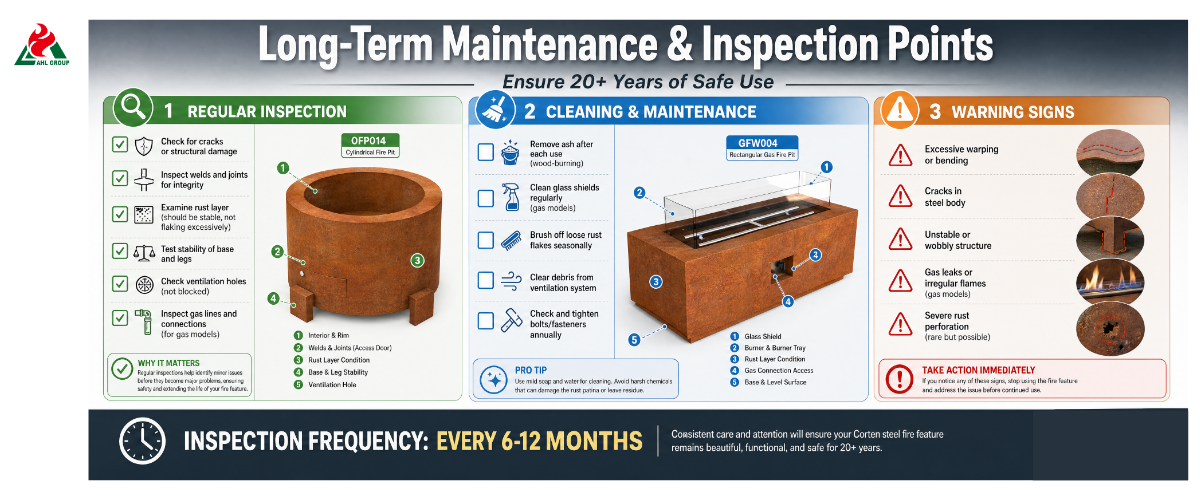
Please conduct a thorough structural inspection of your modern fire pit twice a year, ideally before the start of the summer season and before storing it for the winter:
► Drainage Channels: Clear accumulated ash, charcoal debris, and fallen leaves from the main drainage holes to ensure rainwater does not pool inside the fire pit.
► Welds: Inspect the structural welds around the perimeter for signs of microscopic stress cracks or separation caused by years of thermal expansion and contraction cycles.
► Base Stability: Check the ground beneath the heavy-duty fire pit for uneven settlement, as this could cause the fire box—with its high center of gravity—to tilt or tip over.
How to Clean and Maintain a Corten Steel Fire Pit
Corten steel fire pits require almost no maintenance, but it is essential to remove old ashes. Wet wood ash reacts chemically with rainwater to form a highly alkaline solution; if left to accumulate in the fire pit for several months, it can severely corrode the protective rust layer. Please periodically scoop out the cold, dry ashes into a sturdy metal container. Use a garden hose with clean water to rinse the inside of the empty fire pit, then let it air dry completely in the sun to restore its protective oxide layer.
When to Replace Due to Damage
If you are using a genuine, heavy-gauge (3 mm or thicker) weathering steel fire pit, structural replacement is generally not necessary for decades. However, if you notice the metal flaking off in large, structural pieces (flaking) or if the tip of a shovel can easily pierce the bottom wall of the combustion chamber, this indicates severe structural thinning of the metal. This situation typically occurs only with inexpensive, imitation low-carbon steel products. You must immediately stop using the fire pit to prevent structural failure that could cause burning coals to spill into the surrounding area.
9. Corten vs Other Fire Pit Materials
Weathering Steel vs. Ordinary Steel
While standard low-carbon steel fire pits have extremely low initial costs, their service life is very short. Without expensive, high-heat-resistant coatings that require frequent maintenance, ordinary steel will gradually rust. With each heavy rain or time the fire is lit, the structural material will gradually flake away until the bottom is completely burned through. Weathering steel eliminates this cycle of damage; it uses the rust layer that forms naturally as a permanent, self-healing protective coating, resulting in a service life that is several decades longer than that of ordinary steel.
Weathering Steel vs. Stainless Steel
Stainless steel (Grade 304 or 316) contains high proportions of chromium and nickel, making it completely rust-resistant and giving it a clean, ultra-modern aesthetic. However, when exposed to the intense heat of a wood fire, stainless steel undergoes a permanent chemical change known as “thermal color change” or “gold-blue color change.” The originally pristine silver surface develops an uneven, iridescent blue-gold discoloration; unless periodically polished with a specialized acid, the appearance can become disorganized. Corten steel, on the other hand, naturally embraces this thermal discoloration, integrating the unique imprint of the flame directly into its organic, ever-evolving earth-toned rust layer.
Weathering Steel vs. Cast Iron
Cast iron is an excellent heat-radiating material that retains residual heat for a long time even after the fire has gone out, making it the classic choice for traditional fire bowls. However, due to its high carbon content (>2%), cast iron is inherently brittle. If a hot cast-iron fire basin is accidentally struck by a heavy log or exposed to a sudden cold rain, it may fracture cleanly in two due to thermal shock. Weathering steel, as a low-carbon structural alloy with good ductility, possesses excellent impact toughness; it can expand, bend, and adapt to physical impacts and sudden temperature drops without the risk of catastrophic fracture.
Structural material breakdown
| Material Option | Thermal Shock Resistance | Rust & Corrosion Profile | Aesthetic Evolution | Average Lifespan |
| Corten Steel | Exceptional (Ductile alloy) | Self-Terminating (Protective patina) | Matures to deep earthy brown/black | 25 to 50+ Years |
| Regular Steel | High | Progressive (Flakes and thins) | Degrades into scaly orange rust | 2 to 5 Years |
| Stainless Steel | High | Immune | Develops iridescent gold/blue heat tint | 20 to 30 Years |
| Cast Iron | Low (Prone to cracking) | Progressive (Requires oil seasoning) | Retains dark, heavy textured finish | 10 to 20 Years |
10. Frequently Asked Questions
Q1: Does Weathering Steel Get Hot Enough to Burn Your Hands?
Yes. Weathering steel is an efficient conductor of heat. During use, the outer surface temperature can rise high enough to cause severe instantaneous burns. When using a fire pit, always assume that all metal parts are extremely hot, and establish a strict safety zone to keep children and pets away.
Q2: Will Weathering Steel Crack Due to the High Temperatures of a Fire?
No. Genuine commercial-grade weathering steel will not crack due to the high temperatures generated by a household wood or gas fire pit. Its low-carbon, highly ductile alloy composition allows it to seamlessly absorb intense thermal expansion stresses. Cracking is only observed in brittle cast iron products or in low-quality imitation steel with poor weld quality in mechanical structures.
Q3: Is Corten Steel Safe for Use in Wood-Burning Fire Pits?
Yes, weathering steel (Corten steel) is completely safe and ideal for use in wood-burning fire pits. It withstands the intense localized radiant heat generated by a hardwood charcoal bed exceptionally well and does not release any toxic fumes, synthetic chemicals, or volatile organic compounds (VOCs) when exposed to open flames.
Q4: Does Corten Steel Rust More Easily When Heated?
The high temperatures of the flames accelerate the chemical oxidation process on the steel’s surface, but in true Corten steel, this acceleration helps to quickly stabilize the rust layer. Although high temperatures may deepen the internal rust layer, forming a darker, charcoal-black surface of iron oxide, this does not cause the steel to corrode further or lose its protective properties.
Conclusion: When to Choose Weathering Steel for Fire Pits
The conclusion regarding safety is this: genuine, heavy-gauge weathering steel is one of the safest, structurally most stable, and longest-lasting materials for building outdoor fire pits. It is completely non-combustible, maintains its mechanical strength at residential fire temperatures, and does not release any toxic chemical gases. The primary safety concerns do not stem from material failure, but rather from standard hardscape operating guidelines: managing high temperatures on the outer surface, maintaining strict clearances from nearby flammable structures, and using a non-combustible foundation.
Weathering steel is an excellent choice for any outdoor project that prioritizes long-term durability, low maintenance costs, and a distinctive architectural style. It is particularly well-suited for modern minimalist gardens, rustic estate courtyards, and demanding commercial spaces—where traditional painted steel often becomes scratched, rusted, or even fails within just a few seasons.

