


For any outdoor design enthusiast, unboxing a luxury Corten steel fire pit is an exciting moment. When you purchased it, you likely envisioned it becoming a stunning focal point on your garden patio, its surface covered in rich, deeply textured rust in shades of copper brown and fiery orange. However, upon removing the protective shipping packaging, many homeowners are met with a surprise: the fire pit looks like ordinary industrial metal, appearing as a dull silver-gray.
This stark visual discrepancy often triggers initial panic, leading buyers to wonder if they’ve received the wrong product, a cheap imitation, or a defective batch of steel. This guide will delve into the metallurgical principles behind weathering steel, explain why the surface is always gray when it leaves the factory, outline the various stages of atmospheric oxidation, and guide you on how to safely help your new fire pit gradually develop its signature rustic patina.
.png)
This stark visual discrepancy often triggers initial panic, leading buyers to wonder if they’ve received the wrong product, a cheap imitation, or a defective batch of steel. This guide will delve into the metallurgical principles behind weathering steel, explain why the surface is always gray when it leaves the factory, outline the various stages of atmospheric oxidation, and guide you on how to safely help your new fire pit gradually develop its signature rustic patina.
1. Introduction
Why New Corten Steel Fire Pits Are Often Gray
The reason your new metal fire pit looks gray is simple: it’s brand new. When Corten steel is first manufactured, hot-rolled, and formed, it hasn’t yet had a chance to interact with the natural environment. That signature orange-brown rust patina isn’t applied in a factory paint booth; it’s a natural protective layer that can only be formed through the combined action of time, oxygen, and moisture in the atmosphere.
The True Appearance of Weathering Steel
When fully matured, weathering steel (also known as Corten steel) should display a colorful, matte, and velvety-smooth oxide protective layer. This surface effect shifts through warm tones, including deep ochre, rich terracotta, warm amber, and deep chocolate brown. This unique surface coating serves as a striking architectural backdrop, blending seamlessly with both modern minimalist courtyards and rustic natural gardens.
What This Article Covers
This article aims to provide a professional troubleshooting and knowledge guide for users who have recently purchased weathering steel. We will dissect the chemical principles behind the steel’s gray appearance at the time of manufacture, outline the various stages of the rusting process, analyze environmental factors that accelerate or delay color transformation, and offer safe and practical advice on how to accelerate the formation of the rust layer without compromising the integrity of the underlying metal structure.
2. Why Corten Steel Looks Gray at First
To understand why your outdoor fire pit looks like ordinary carbon steel when you receive it, it helps to know how steel mills produce the original industrial alloy.
The Metal Surface When New
Weathering steel is an engineered alloy composed of iron mixed with specific proportions of copper, chromium, nickel, and phosphorus. In their raw, unweathered state, these alloying elements are completely locked within the metal sheet’s internal crystal structure. Since the iron atoms on the surface have not yet oxidized, the raw metal sheet reflects light uniformly, presenting its natural industrial silver-gray appearance.
Why a Rust Layer Has Not Formed
Rusting is a chemical reaction known as iron oxidation, which requires prolonged exposure to oxygen and water in the atmosphere. Since high-quality fire pit manufacturers produce their products in climate-controlled fabrication shops, the raw steel sheets remain completely unaffected by rain, morning dew, and outdoor humidity during the cutting, bending, and welding processes. Due to the absence of the electrolyte (water) needed to trigger the chemical reaction, the steel remains in its original gray state.
How Transportation and Storage Affect Appearance
To ensure your products arrive free of pre-existing, irregular water stains or unsightly rust spots, manufacturers specifically store unweathered fire pits in dry indoor warehouses. These Corten fire pits are then tightly wrapped in protective plastic shrink wrap or placed in sturdy cardboard shipping crates for transport. This protective packaging keeps the steel dry and intact, ensuring that the weathering process begins only after the fire pit is officially installed in your backyard.
3. How Corten Changes Over Time
The evolution of weathering steel is a multi-stage biochemical process. Understanding what happens at each stage can help alleviate unnecessary concerns.
The Weathering Process
When Corten steel is finally placed outdoors, the iron atoms on its surface react with water and oxygen to form an initial layer of iron hydroxide. Unlike ordinary structural steel—which undergoes continuous, destructive rusting until the metal flakes off and the structure fails—Corten steel’s unique alloy composition causes the oxidation products to bind tightly together. This forms an impermeable, non-porous barrier known as “patina,” which seals the inner steel core and prevents further corrosion.
How Moisture and Oxygen Form the Patina
The formation of a stable rust crust depends largely on a cyclical environmental mechanism: alternating periods of wet and dry conditions. When the fire pit becomes damp from rain or dew, an oxidation reaction occurs, producing loose rust particles. When sunlight appears and thoroughly dries the steel, these loose rust particles crystallize and interlock to form a dense protective layer. If the steel remains in a persistently wet or dry state, this effective self-protective rust crust cannot form properly.
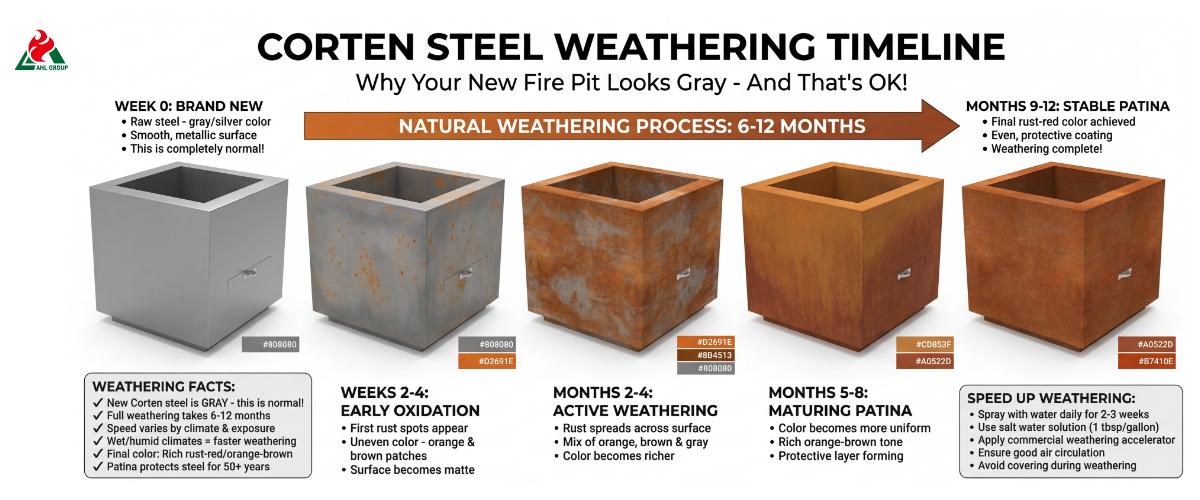
Typical Color-Changing Stages from Gray to Brown-Orange
The appearance of Corten metal fire pits undergoes several distinct color-changing stages:
► Stage 1 (Month 0): Factory condition—uniform industrial silver-gray.
► Stage 2 (Weeks 2–6): Flash-rust phase—a bright, powdery layer of neon orange or golden yellow appears on the surface. This layer easily transfers to skin or clothing.
► Stage 3 (Months 2–6): Transition phase—the bright orange gradually transforms into deeper, multi-layered ochre and amber tones. The texture changes from powdery to slightly rough.
► Stage 4 (12–24 months and beyond): Structural Maturity — The surface stabilizes into a uniform, velvety finish of deep chocolate brown and dark reddish-brown, no longer shedding loose rust particles.
How Long Does It Typically Take
Under standard outdoor atmospheric conditions, a gray fire pit typically takes about 6 to 12 months to develop a noticeable patina, while full color stabilization may take as long as 2 to 3 years. The exact pace of this transformation depends entirely on your local microclimate and the placement of the container in your yard.
4. Factors That Affect Patina Development
Climate and Humidity
Geographic location plays a crucial role in how quickly a backyard fire pit loses its gray patina. Humid subtropical climates, coastal regions, and areas with frequent but light seasonal rainfall naturally accelerate the oxidation process. Conversely, arid desert regions or high-altitude mountainous areas with extremely low humidity cause the initial gray phase to last longer.
Rainfall, Sprinkler Systems, and Wet-Dry Cycles
Frequent short showers followed immediately by direct sunlight are the perfect catalyst for the formation of patina. If your area receives little natural rainfall, place your metal fire pit near your backyard lawn sprinkler system—which typically runs automatically in the early morning—to simulate these crucial wet-dry cycles, thereby accelerating the chemical oxidation process.
Placement and Air Circulation
To ensure the outdoor fire pit develops an even patina overall, it is essential to ensure it receives ample natural airflow and is evenly exposed to the elements. If one side of the fire pit is pressed against a solid wall or shaded by dense, low-hanging garden shrubs, the sheltered area will remain gray or develop uneven rust spots due to a lack of exposure to heavy rain and strong winds.
Sunlight and Seasons
Direct sunlight helps the metal dry quickly after rain, which is crucial for baking the rust particles and crystallizing them into a stable layer. Installing a fire pit during the peak of a hot, dry summer often delays the formation of rust, whereas installing it during a rainy fall or humid spring will trigger rapid color changes within a matter of days.
5. Why Your Fire Pit May Stay Gray Longer
If your outdoor fireplace has been sitting in your backyard for months yet still retains its industrial gray finish, certain environmental factors may be hindering its natural weathering process.
Dry Weather or Indoor Storage
If your area is experiencing a prolonged seasonal drought, or if you’ve safely stored your newly purchased fire pit under a covered patio or covered it with a heavy, waterproof vinyl tarp, the steel cannot come into contact with the atmospheric moisture needed to initiate the oxidation process. To change the metal’s color, it must be fully exposed to the elements to get thoroughly wet and then completely dry.
Protective Coatings or Mill Scale
During the steel plate manufacturing process at steel mills, high-temperature rolling creates a deep blue-gray or nearly black magnetic layer on the metal’s surface, known as mill scale. While some manufacturers pre-treat and sandblast fire pits before shipment to remove this layer, others leave it intact. The residual mill scale acts as a temporary barrier, preventing oxygen and moisture from coming into contact with the raw steel core, thereby significantly delaying the onset of the weathering process until the scale naturally weathers and flakes off.
Insufficient Exposure to Moisture
Simply filling the fire bowl with water is not enough to allow the exterior to weather naturally. The outer surface requires continuous exposure to rain, mist, or morning dew. If your fire bowl is located in a completely dry area or under a covered walkway, the iron atoms on the surface will remain dormant for an extended period and retain a dull finish.
Surface Contamination Caused by Human Contact
During manufacturing, packaging, and home installation, workers and homeowners alike handle the fire pit with their bare hands. Human skin naturally leaves behind a thin layer of organic oils, sweat, and grease. Additionally, mechanical lubricants left behind by industrial welding and bending equipment may adhere to the steel surface. These invisible oil residues repel water, creating localized areas where the gray steel is less prone to rusting, resulting in a mottled appearance during the initial stages.
6. What Is Normal and What Is Not
The transformation from a sleek gray metal fire pit to a weathered outdoor ornament may seem a bit messy at first, but understanding the natural changes the material undergoes can put your mind at ease.
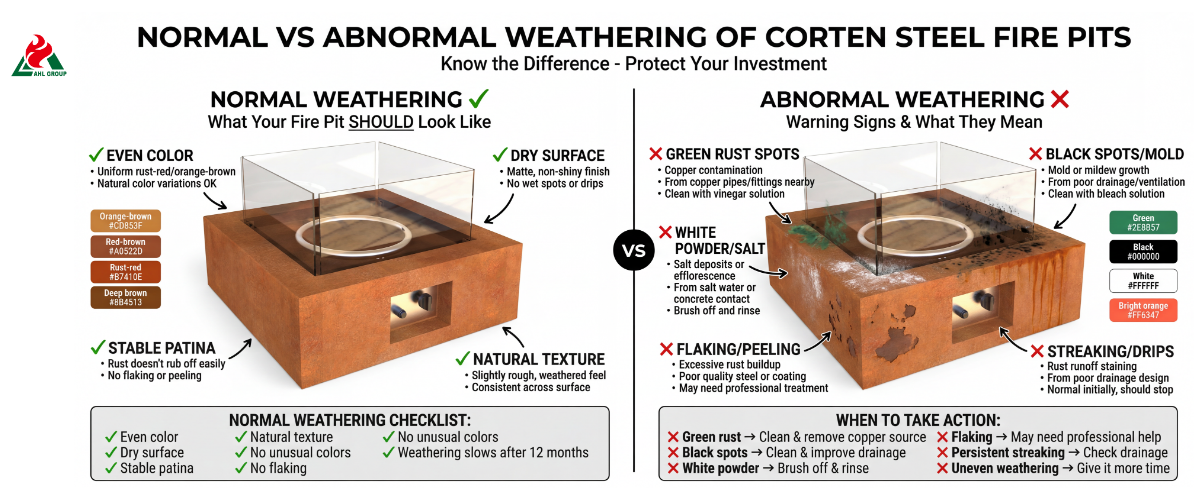
Normal Color Changes During Weathering
During the first two months of outdoor exposure, your durable fire pit may display a vivid, powdery, or even almost unnatural neon yellow or bright orange hue—this is entirely normal. While this stage may look a bit startling, it is an essential and integral part of the metal’s weathering process. Over the following year, the color will naturally deepen and darken, eventually settling into a rich, earthy brown tone.
Uneven Rust Formation
Please do not expect your fire pit to weather uniformly across every inch of its surface. The side of the pit exposed to prevailing winds and heavy rain will develop an orange hue due to flash rust weeks before the protected, leeward side loses its gray tone. This asymmetrical transformation is normal, and the difference will fully even out as the fire pit experiences a full cycle of seasonal weather changes.
Surface Marks, Streaks, and Spots
As rainwater runs down the sloped side walls of the transitional outdoor fire pit, it carries loose iron oxide particles along vertical paths, creating striking rust streaks and teardrop-shaped water stains. Additionally, in areas where processing oil remains on the metal surface, the gray coating may remain visible for a longer period. These wild, natural, and unpredictable streaks are part of the material’s aesthetic appeal and do not constitute a manufacturing defect.
When to Be Concerned About Actual Damage
You should only be concerned if you notice deep, structural rust flakes (which can be pried up with a screwdriver) or pinholes in the bottom of the fire pit. This type of destructive corrosion only occurs if you have purchased a cheap imitation—products typically made from thin-walled, low-quality carbon steel rather than authentic, heavy-gauge weathering steel (2 mm–3 mm+ thick).
7. How to Speed Up the Weathering Process
If you’re planning a big backyard party and want to get rid of that industrial gray finish as quickly as possible, you can safely catalyze the chemical reaction using some basic household items.
Exposure to Water and Air
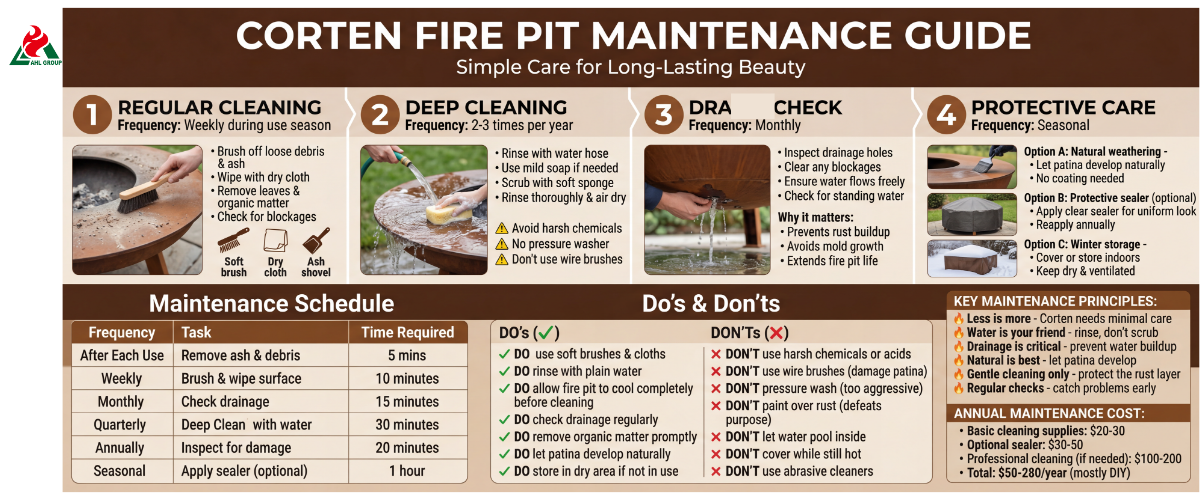
The simplest, safest, and most cost-effective way to speed up the process is to thoroughly rinse the fire pit with a standard garden hose every day after sunset. Let the water sit on the metal surface overnight, then let the morning sun dry the structure completely. Performing this simple rinse-and-dry routine daily will cut your patina formation time in half.
Safe Methods to Accelerate Patina Formation
If you want quick and even results in just a single weekend, you can mix a safe, non-toxic chemical aging solution using three common household ingredients:
► Recipe: Combine 16 ounces (about 473 milliliters) of standard 3% hydrogen peroxide, 2 tablespoons of white vinegar, and 1/2 tablespoon of regular table salt in a clean plastic spray bottle.
► Instructions: Lightly spray the solution over the entire exterior surface of the gray fire pit. Within minutes, the hydrogen peroxide and acetic acid will trigger a vigorous chemical reaction, causing the steel to rust instantly before your eyes and form a beautiful orange patina. Once completely dry, rinse thoroughly with pure water to stop the reaction.
Never Do This
Never use highly corrosive industrial acids (such as pure hydrochloric acid or pool chemicals) to age a Corten fireplace. These highly corrosive liquids are too powerful; they will corrode the steel surface, weaken structural welds, and disrupt the delicate chemical balance required for Corten steel to form its long-lasting protective layer.
When to Leave It As Is
If you are not in a hurry, the best design practice is to step back and let nature take its course. The rust layer formed through natural weathering is denser, structurally more stable, and visually richer—qualities that no artificial chemical acceleration method can replicate. Trust this material, embrace its initial gray phase, and let the local climate naturally color the steel.
8. Care and Maintenance
Proper Surface Cleaning
During the first year of the weathering process, avoid using abrasive brushes, steel wool, or pressure washers on the exterior surface of the fire pit. These harsh tools will strip away the delicate layer of iron oxide that is forming, forcing the steel to revert to its original gray state and causing the patina formation process to start over. To remove ashes or fallen leaves, use only a garden hose to gently rinse the surface and clean with a soft-bristled nylon brush.
Preventing Rust Stains on Your Deck
The greatest challenge of owning a weathering steel fire pit that is developing a rust patina is managing rust runoff. During the first year, rainwater will wash loose iron oxide particles off the gray metal surface. If the fire pit is placed on porous stone pavers, light-colored concrete pavers, or a natural wood deck, this rust runoff can permanently stain the underlying surface with deep terracotta-colored marks.
Protecting Surrounding Surfaces
To prevent seepage stains from damaging your high-end patio hardscape during the weathering phase, follow these protective layout strategies:
► Place a temporary, color-coordinated drip tray or low-profile steel tray beneath the fire pit to collect rust-containing water.
► Place the fire pit on a dedicated base made of dark river pebbles, black basalt gravel, or loose soil—materials that can absorb iron oxide runoff without leaving marks.
► Lay a sacrificial outdoor rug or thick rubber mat beneath the structure until the patina has fully formed and stabilized.
9. Common Questions About Corten Fire Pits
Q1: Why is Corten Steel Silver-gray at First?
Corten steel is silver-gray at first because it is shipped directly from the factory production line in a dry state and remains isolated from moisture and outdoor humidity throughout the shipping process. This material needs to be exposed to air, oxygen, and moisture to develop its distinctive rust patina.
Q2: How Long Does It Take to Turn Rust-Colored?
After 2 to 4 weeks of continuous outdoor exposure, your brazier will begin to develop a bright orange flash rust. This vibrant surface effect will gradually mature, deepening over 6 to 12 months to eventually form a rich, lasting chocolate brown and deep terracotta hue.
Q3: Will the Color Remain the Same?
No, the color will continue to evolve with environmental changes. During humid winters, the color will appear a brighter orange; during dry summers, it will shift to a deeper, richer brown. As the years pass, the rust tones will continue to deepen, gradually revealing an architectural texture and visual depth over time.
Q4: Is the Gray Surface a Defect?
Absolutely not. The silver-gray surface is an industry-recognized hallmark, confirming that you have received an authentic, high-quality, untreated industrial-grade Corten steel material. This confirms that your fire pit has not been treated with cheap synthetic paints or surface chemical sealants, which often mask the true qualities of the metal alloy.
Conclusion: Final Advice for New Corten Steel Fire Pit Owners
Over the coming weeks, the natural elements in your backyard will transform your durable fire pit into a vibrant, dynamic canvas. You’ll watch it rapidly shift from a dull silver-gray to a bright, neon-orange flash rust, followed by a long and beautiful maturation process where the metallic hue gradually deepens, ultimately becoming a highly stable, dark-brown structural masterpiece.
Seeing a gray metal box delivered to your doorstep might be a bit disappointing at first, but this is merely the beginning of your fire pit’s long outdoor journey. Weathering steel is highly prized precisely because it is a material that adapts to its surroundings and constantly evolves. As long as you ensure your fire pit has ample exposure to rain, direct sunlight, and natural airflow—or use a simple hydrogen peroxide solution to accelerate the transformation—you can sit back and watch as this industrial-gray container gradually evolves into a beautiful backyard centerpiece born of rust.

