


Landscape architects and garden designers often choose Corten steel (weathering steel) when they want to create clear, lasting edging in outdoor spaces. The material’s distinctive terracotta-colored patina creates a beautiful yet rustic contrast with green foliage, dark ground cover, and flagstone paths. While straight lines can convey a clean, minimalist aesthetic, natural landscapes often call for fluid shapes.
A common question during the planning phase is whether this industrial-grade steel can adapt to organic layouts. This guide details the mechanical properties of Corten steel edging, analyzes how thickness affects its flexibility, explains how to create perfect geometric curves, and provides precise, step-by-step techniques for installing curved garden edging, ensuring its structural stability lasts for decades.
A common question during the planning phase is whether this industrial-grade steel can adapt to organic layouts. This guide details the mechanical properties of Corten steel edging, analyzes how thickness affects its flexibility, explains how to create perfect geometric curves, and provides precise, step-by-step techniques for installing curved garden edging, ensuring its structural stability lasts for decades.
1. Introduction
Why Is Curved Corten Steel Edging So Popular?
Straight lines are rarely found in natural landscapes. Designers use organic curves, flowing arcs, and the perfect patterns of tree rings to mimic the earth’s natural flow, seamlessly guiding foot traffic and softening the harsh edges of residential or commercial buildings. Weathering steel edging is highly favored in these fluid layouts because it creates a permanent, ultra-thin boundary between different materials—such as gravel paths, manicured lawns, and layered flower beds—without appearing bulky.
What This Guide Covers
This guide is designed to provide an engineering and installation roadmap for creating fluid metal elements on-site. We will analyze the physical limitations of different steel thicknesses, explain manual and tool-assisted bending methods, outline how to construct perfect circular loops without flat sections, and highlight installation best practices to ensure your curved boundaries are securely anchored to the substrate.
When to Use Curves and Circles
Curved borders and circular rings are highly practical in spaces featuring mature trees, winding paths, asymmetrical planting beds, or undulating terrain. They allow the landscape to flow dynamically around existing natural obstacles, providing an eye-catching, clean border while significantly simplifying lawn mowing and edge maintenance.
2. Can Corten Edging Be Bent?
Are CORTEN Steel Edging Strips Flexible Enough?
Yes, Corten steel landscape edging offers excellent flexibility, but its bendability depends entirely on its structural specifications. Although weathering steel sheets feature high tensile strength and durable alloy compositions, thin-gauge (thin-type) weathering steel sheets retain inherent elasticity, allowing them to smoothly conform to large-radius curves right out of the box without requiring special heat treatment or industrial rolling equipment.
The Difference Between Gentle Curves and Tight Arcs
For gentle curves with large radii, the straight steel strips can be dynamically formed on-site simply by securing them to a ground layout during installation. Conversely, tight structural arcs with radii less than 3 feet (90 cm) or complex, meandering bends impose significantly greater mechanical stress on the steel. Such structures require careful, gradual manual shaping or prefabricated formed components to prevent the metal from warping or twisting.
The Effect of Edge Thickness on Bending
Thickness is an absolutely critical factor in determining flexibility. The thickness of Corten edging typically ranges widely, from thin residential strips of 1.5 mm to 2 mm (approximately 14-gauge to 12-gauge) to heavy-duty commercial retaining strips of 3 mm to 6 mm or more (1/8 inch to 1/4 inch). Thin-gauge profiles can be bent with minimal physical effort, while thick-gauge profiles offer significant structural resistance and require substantial leverage or a mechanical press to achieve a clean bend.
3. Best Uses for Curves and Circles
Understanding where streamlined designs deliver the best visual and functional results helps enhance the overall architectural value of a landscape design.
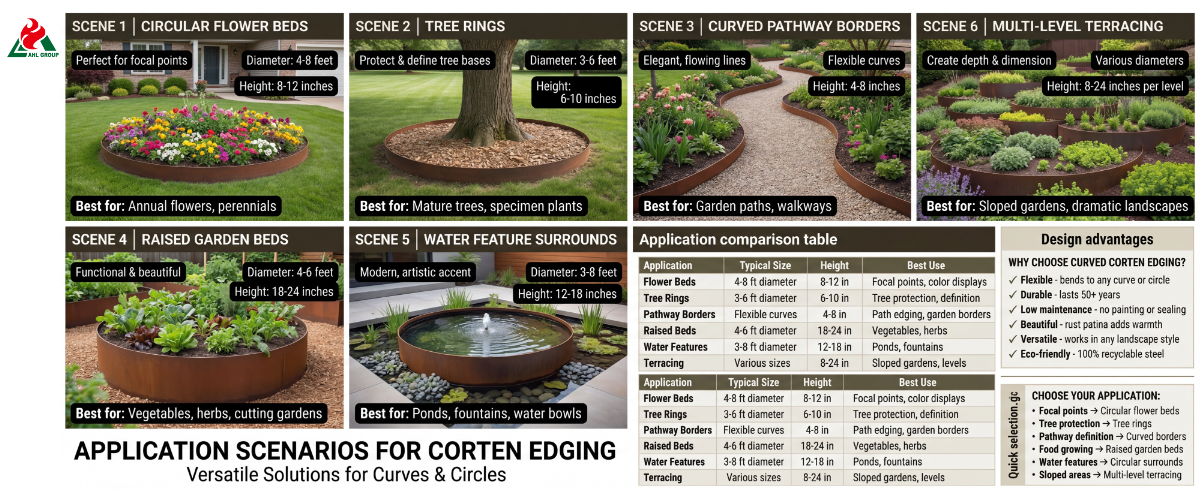
Flower Beds and Planting Rings
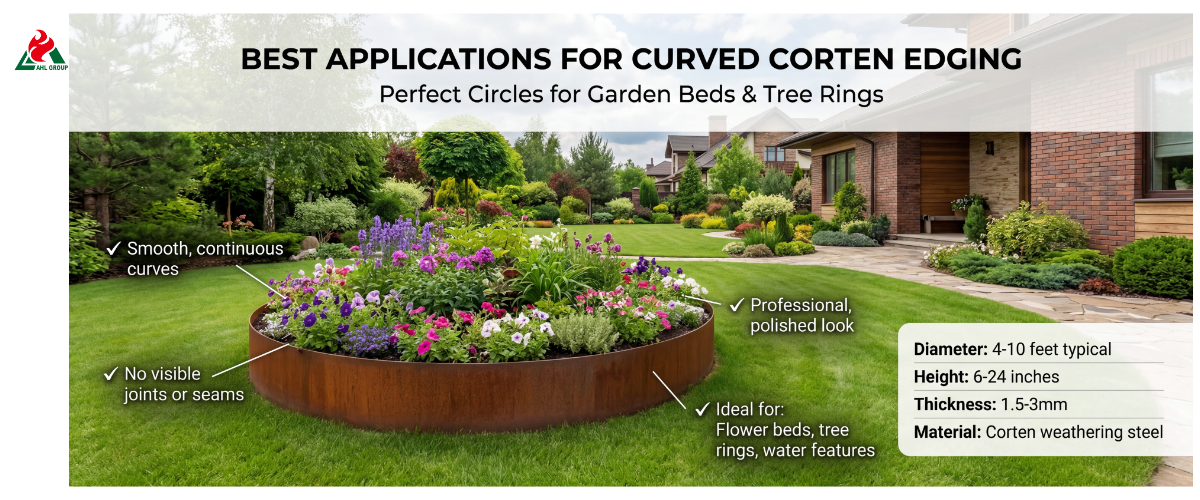
Curved Corten garden edging is ideal for outlining the contours of asymmetrical flower beds, effectively retaining a mixture of fertile soil and mulch while isolating it from encroaching lawns. Placing small circular planting rings around localized flower displays also creates striking visual focal points, breaking up flat, monotonous lawn areas.
Tree Perimeter Protection
Protecting the root zone of trees from lawnmowers and trimmers is a top priority in landscape design. Installing a perfectly fitted Corten steel ring edging at the base of a tree delineates a dedicated mulch area that retains necessary moisture, suppresses weed growth, and adds a clean, architecturally elegant accent to the landscape.
Pathway Edging
Winding paths paved with loose aggregate—such as weathered granite, river pebbles, or crushed slate—require sturdy structural edging to prevent the stones from shifting. Flexible weathering steel conforms perfectly to the path’s winding curves, securely holding the stones in place while blending seamlessly with the surrounding soil.
Decorative Landscape Elements
Beyond simple edging, curved Corten edging lawn can be layered in a stepped configuration to address gentle slopes, encircle water features to secure decorative boulders, or be used to construct custom spiral raised planters, adding artistic, three-dimensional geometric forms to both public and private gardens.
4. Factors That Affect Bendability
Material Thickness
Based on experience, weathering steel with a thickness of 1.5 mm to 2 mm offers high ductility and can be easily formed into shapes with small radii of curvature by hand or using basic on-site tools. Steel with a thickness of 3 mm (1/8 inch) exhibits significant rigidity; while it can still be cold-formed on-site into curves with large radii, forming arcs with small radii requires substantial mechanical force. Steel plates ranging from 5 mm to 6 mm (3/16“ to 1/4”) must be roll-formed using heavy-duty industrial machinery in a workshop before delivery to the construction site.
Edging Height
The vertical profile height of the garden edging directly affects its torsional resistance. A 4-inch (100 mm) high guardrail is relatively easy to bend horizontally. However, guardrails with a depth of 8 to 12 inches (200 mm to 300 mm) have a larger surface area and cross-sectional stability, making horizontal bending extremely difficult because the metal tends to tilt or warp, deviating from a perfectly vertical alignment.
Length
Longer continuous metal edging provides greater physical leverage, making manual bending easier. An 8- or 10-foot-long strip of 2-millimeter-thick Corten steel can be easily bent into a large arc because the force is distributed over a longer span. In contrast, achieving the same bend in a short 2-foot-long strip requires applying a greater and more concentrated force, as well as using more precise tools.
Pre-formed or Straight Edging
Straight edging strips offer you ultimate creative freedom, allowing you to sketch organic and unexpected shapes directly on the ground during installation. However, if your design requires precise, uniform geometric shapes—such as a series of identical tree rings, all 3 feet in diameter—purchasing factory-preformed or pre-rolled circular edging strips will not only save a significant amount of on-site labor but also ensure flawless geometric precision.
5. How to Bend Corten Edging Safely
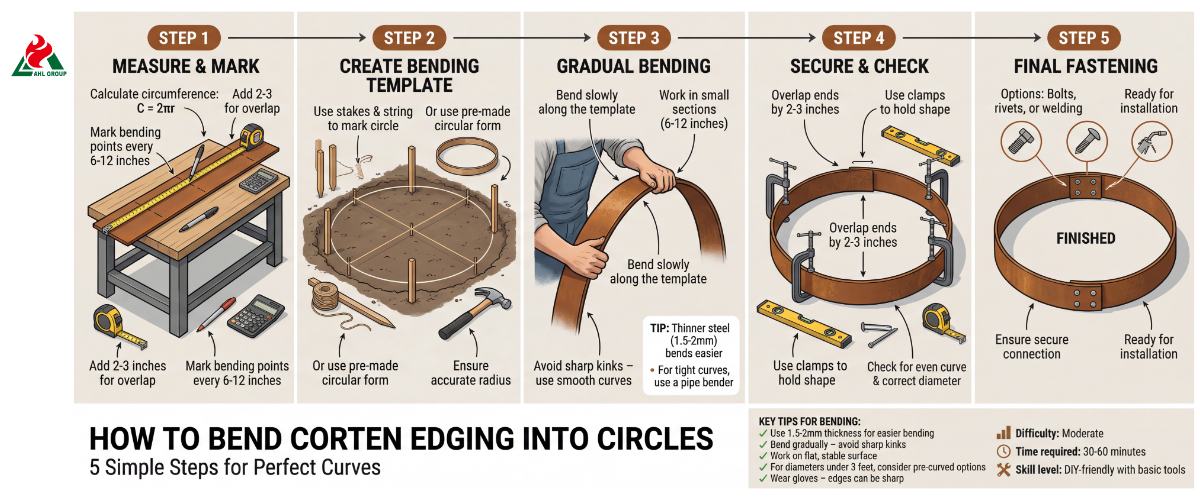
Hand-bending to Create Gentle Curves
To create wide, gently curved borders using 1.5 mm or 2 mm thick material, the process can be done entirely by hand. First, use the Corten steel strip’s built-in stakes or heavy-duty anchor bolts to securely fasten one end to the ground. Then, move gradually along the length of the strip, applying steady and even body weight to press the metal into the desired contour, securing it with stakes as you proceed.
Using Leverage Principles for Smoother Shaping
When working with thicker 3mm steel or attempting to shape a more precise curve, it is essential to maximize the use of the body’s leverage. You can construct a temporary bending jig on-site: drive three heavy-duty steel stakes deep into the ground in a staggered triangular pattern. Slide the weathering steel strip between these sturdy stakes, using them as fulcrums to apply tension, and leverage the mechanical advantage to distribute the stress smoothly across the metal surface.
Proceed Gradually to Avoid Creases
Never attempt to complete a sharp bend with a single, forceful motion. Applying pressure too quickly concentrates all dynamic stress at a single point, causing the metal to “crease”—forming a permanent structural fold that is difficult to smooth out. Always work back and forth across the entire cross-section, applying pressure gradually to form the bend slowly and evenly.
Avoid Repeated Bending at the Same Point
Like all metal alloys, weathering steel undergoes work hardening. If the steel is bent excessively in one direction and then immediately forced back in the opposite direction to correct the error, stress is introduced into the steel’s internal grain structure. Repeatedly bending the metal at the exact same location can cause the steel to become brittle, eventually leading to microcracks or complete structural failure.
6. Creating Circles
Selecting the Right Product Width and Thickness
To create a perfect circular ring on-site using straight strips of material, we recommend using flexible material with a thickness between 1.5 and 2 millimeters. For standard tree trunks with diameters between 3 and 5 feet, the ideal profile height is 4 to 6 inches. This ratio ensures a clear structure without making the material difficult to handle during bending.
Creating Full Circles and Partial Arcs
A full circle becomes self-supporting once the ends are locked together, as the outward tension stabilizes the entire ring. If your design requires only a partial arc or semicircle (such as a crescent-shaped retaining structure embedded in a slope), the open ends must be supported by heavy-duty structural piles. These piles must be deeply embedded in the subgrade to prevent the soil from flattening the arc over time.
Align the Sections Neatly
The seams at both ends of the circle must be visually flush and structurally sound. High-quality Corten metal edging systems typically feature integrated interlocking clips, pre-drilled sleeve connectors, or matching backing plates secured with weathering steel rivets or bolts. Avoid roughly overlapping panels, as this can create asymmetrical bulges that disrupt the circle’s perfect geometry.
Maintain the Ring’s Flatness and Stability
To ensure the ring does not deform into an irregular ellipse during installation, construct a simple wooden cross-braced form using scrap 2x4 lumber, sized to precisely match the ring’s inner diameter. Place this template inside the ring when setting the anchor posts. Once all perimeter anchor posts have been fully driven in and backfilled, remove the wooden guide template—at this point, the ring will permanently retain its true circular shape.
7. Common Mistakes to Avoid
Forcing Metal to Bend Excessively
Attempting to force straight, unslotted metal to bend at a sharp 90-degree angle or an extremely tight angle will inevitably damage the metal strip. If your design requires sudden, sharp turns, you must use specialized corner pieces or use an angle grinder to make a precise vertical cut halfway through the thickness of the metal’s inner surface, allowing the metal to fold neatly along the scored line.
Creating Flat Spots or Stress Points
If manual bending is performed carelessly, the steel often results in straight, flat sections interspersed with abrupt, sharp bends, rather than a smooth, continuous curve. This error typically occurs when pressure is applied only to the ends of the metal strip, rather than uniformly along the entire arc length.
Using the Wrong Support Method
If not properly secured, a beautifully curved landscape edging will quickly become distorted. Curved and circular structures are constantly subjected to lateral tension as they attempt to return to their original straight shape; this tension is further exacerbated by the weight of soil displacement. Compared to straight sections (where fence posts can be spaced 3 to 4 feet apart), the frequency of installing heavy-duty support posts along curves must be significantly increased—ideally one every 1.5 to 2 feet.
Failing to Lay Out the Site Before Bending
Never attempt to bend and install architectural steel edging by eye alone without first marking the ground positions. Without clear visual references on the ground, the bent sections will be uneven, resulting in an irregular border line. This not only makes the final edging look unprofessional but also creates difficulties for adjacent hardscape construction.
8. Tools and Techniques
Manual Bending Method
For lightweight residential metal panels, the human body is the best tool. Simply press your knee or boot against the center of the panel while gently pulling the outer edge to easily shape the metal into a smooth, natural curve without creating any structural stress points.
Essential On-Site Tools
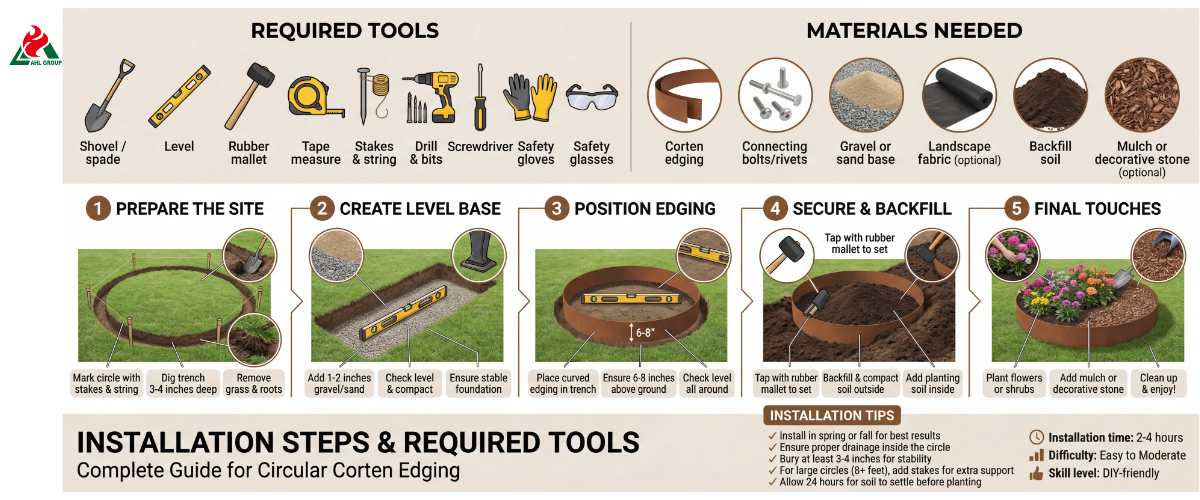
To complete curved installations, ensure your construction team has the following essential on-site tools:
► Heavy-duty rubber mallet/non-rebound hammer: Used to drive ground stakes and adjust the position of metal sheets, preventing scratches or visible hammer marks on the sheet surface.
► Reinforcing bar stakes (1/2-inch diameter): Driven into the subgrade to serve as temporary positioning pins.
► Clamping C-clamps / Jaw clamps: Used to keep seams flat and secure before installing permanent fasteners.
► Angle grinder: Equipped with a metal-cutting disc, used to trim lengths as needed or cut clean creases.
Measure and Mark the Curve
Before unpacking the steel, sketch the desired curve directly on the ground. For free-form, organic paths, use a heavy, flexible garden hose or a thick string to trace the line until the visual effect is perfect. To draw a perfect geometric circle, drive a temporary stake into the exact center point, tie a marking string to it that is exactly the length of the radius, and then rotate the stake 360 degrees while sprinkling high-visibility landscape chalk.
Shape Inspection During Construction
Step back frequently to observe the shape as you work. Stand 10 to 15 feet away from the installation area and assess the visual effect from multiple angles. Check for flat spots, abrupt bends, or vertical slopes, and use a rubber mallet to make fine adjustments while the anchor stakes are only partially driven into the subgrade.
9. Installation Tips
Site Preparation Before Installation
Using a square-headed shovel, dig a clean, level trench along the marked layout lines. Remove all large rocks, thick tree roots, and heavy clumps of clay that could obstruct the path of the metal edging or cause it to deviate from a vertical alignment. The bottom of the trench should be compacted to ensure a stable foundation and prevent uneven settlement of the steel strips over time.
Installing Anchors or Support Posts
Once the curved durable steel edging is perfectly positioned in the trench, begin driving in the structural support posts. For curved profiles, always start at the designated starting point and work sequentially along the line. Drive the support posts vertically into the undisturbed subgrade beneath the trench bottom, ensuring they are positioned slightly below the upper edge of the edging strip so they remain hidden after backfilling is complete.
Alignment of Curved Sections
When connecting multiple curved sections, ensure that the joints are located on smooth, continuous portions of the curve rather than at the apexes of sharp turns. Connecting panels at high-stress points makes alignment extremely difficult and increases the risk of the joints being pulled apart under lateral soil pressure.
Post-Installation Adjustments
Perform a final height check before backfilling the trench with compacted soil. If any section of the curve is too low, insert a small pry bar or lever beneath the bottom edge to raise it, and fill the space underneath with loose aggregate to secure the elevation. Once confirmed, backfill both sides of the metal border with soil or gravel and compact thoroughly using your feet or a hand tamper to permanently secure the curve assembly in place.
10. FAQ About Corten Edging
Q1: Can Corten Steel Edging Strips Form a Perfect Circle?
Yes, Corten steel edging can form a mathematically perfect circle. To achieve this effect on-site using straight strips, you must select thin-gauge material (1.5 mm to 2 mm) and use a centerline or circular wooden template during positioning to prevent any flat areas from forming along the circumference.
Q2: Will Sharp Bends Damage the Material?
Sharp bends will not damage weathering steel as long as the material thickness matches the bending radius and the bending process is gradual. However, if thick steel plates are forced to bend too quickly into extreme angles, it will cause cold work hardening, resulting in unsightly structural creases or surface cracks along the outer edge of the bend.
Q3: Are Prefabricated Borders Easier to Install?
Much easier. If your landscape design relies on precise, repetitive geometric shapes—such as identical 3-foot tree rings or uniform 90-degree angles—purchasing prefabricated components eliminates the need for on-site metal fabrication, thereby reducing installation time and ensuring structural consistency throughout the project.
Q4: How Do I Fix Warping or Bending?
If a section becomes twisted or unevenly bent, remove it from the anchor posts and lay it flat on a sturdy surface, such as plywood or a concrete base. Carefully tap out the uneven areas with a heavy rubber mallet. Work slowly from the warped edge toward the center until the edging is straight enough to gradually return to its original shape.
Conclusion: When to Choose Corten Steel Edging for Curved Installations
When you want to create a smooth, understated boundary that naturally follows winding, organic paths and dynamic landscape transitions, Corten steel landscape edging is an excellent choice for curved installations. Their high-strength material allows thin, highly flexible profiles—ranging from 1.5 to 2 millimeters in thickness—to maintain straight lines. They remain stable even when faced with shifting lawns and frequent foot traffic, while simultaneously forming a self-protective rust layer that ensures decades of durability without requiring maintenance.
While on-site hand-forming is ideal for fluid, free-form paths, prefabricated or factory-rolled components offer significant advantages when your design includes small, tight circles (with radii less than 3 feet) or highly repetitive, uniform geometric shapes. Investing in precast tree rings and factory-produced corner pieces not only eliminates human error during installation and significantly reduces on-site labor costs but also ensures that your sharp angles and circular features present a crisp, geometrically perfect visual effect from day one.

