


Outdoor landscape lighting has evolved from simple, functional spotlights into exquisite works of architectural art. Laser-cut and perforated garden lights—typically crafted from high-quality materials such as weathering steel (Corten), stainless steel, or architectural-grade aluminum—have become highly sought-after highlights in luxury estates, commercial plazas, and modern residential gardens. These lamps not only illuminate pathways but also project dramatic patterns of light and shadow, transforming outdoor spaces into vibrant art galleries at night.
However, because these fixtures are specifically designed with openings, slits, and intricate geometric cutouts to allow light to pass through, they interact with the elements differently than traditional, fully sealed glass or plastic spotlights. This guide addresses a critical yet often overlooked maintenance question: Do the internal components of laser-cut or perforated garden lights require regular cleaning? And what maintenance steps should be taken to ensure they maintain optimal performance over the long term?

However, because these fixtures are specifically designed with openings, slits, and intricate geometric cutouts to allow light to pass through, they interact with the elements differently than traditional, fully sealed glass or plastic spotlights. This guide addresses a critical yet often overlooked maintenance question: Do the internal components of laser-cut or perforated garden lights require regular cleaning? And what maintenance steps should be taken to ensure they maintain optimal performance over the long term?
1. Introduction
Investing in high-end outdoor lighting requires a clear understanding of long-term operation and maintenance to preserve the fixtures’ aesthetic value and structural integrity.
Why This Is Critical for Outdoor Lighting
Outdoor lighting operates in harsh environments characterized by extreme temperature fluctuations, heavy rain, high humidity, and airborne particulates. When lights feature custom laser-cut patterns or perforated designs, their internal components are particularly vulnerable to these environmental factors. Neglecting internal maintenance can lead to a significant drop in light output, sudden electrical failures, and accelerated wear and tear on internal components. For property managers and owners, mastering the proper maintenance methods for these specialized fixtures can prevent premature replacement and preserve the original lighting design.
What Are Laser-Cut and Perforated Garden Lights
Laser-cut and perforated garden lights are specialized architectural lighting fixtures—typically designed as streetlight poles, lighthouses, columns, or wall sconces—whose outer metal casings are structurally perforated using high-precision CNC laser equipment. These perforations form decorative geometric patterns, organic designs, or custom branding motifs. Inside this artistically crafted metal shell lies the light source—which may be an integrated LED module, a traditional bulb and shade, or a translucent acrylic diffuser—designed to soften the light and diffuse it outward through the perforations.
Guidance for Your Decisions
This document serves as a professional guide to help you evaluate existing or planned landscape lighting systems. After reading this guide, you will understand the physical and environmental mechanisms that cause dust accumulation inside luminaires, learn how to determine when maintenance is needed, master a safe and reliable step-by-step procedure for internal cleaning, and discover design-oriented strategies to significantly reduce maintenance frequency.
2. Short Answer
For homeowners who want a quick overview, the maintenance requirements for perforated outdoor lights can be summed up in one simple fact: the level of environmental exposure determines the need for routine maintenance.
Do They Need to Be Cleaned Inside?
Yes, laser-cut and perforated outdoor lights do require internal cleaning. However, the extent and frequency of cleaning depend entirely on the light’s internal structure. If the fixture is equipped with a sealed secondary inner housing or has a sturdy polycarbonate sleeve protecting the electronic components, then “cleaning” is primarily just a matter of removing debris blocking the light-transmitting holes—essentially cosmetic maintenance. If the fixture features an open internal design where the bulb or LED circuit board is directly exposed through the perforations, it must be cleaned regularly to prevent short circuits and maintain heat dissipation efficiency.
How Often Should Internal Cleaning Be Performed?
For standard residential installations in regions with mild climates, a thorough internal inspection and cleaning is typically required once or twice a year. The best times for this are during winterization preparations before the onset of winter and during spring cleaning in early spring. In environments with higher levels of exposure—such as coastal areas with heavy salt spray or arid regions prone to dust storms—the cleaning frequency may need to be increased to once every quarter to ensure that internal components do not deteriorate.
When Cleaning Is Optional and When It Is Essential
Internal cleaning remains optional as long as the luminaire’s light output remains bright, the internal protective diffuser shows no signs of clouding, and no large organic debris is visible through the external light pattern. However, cleaning becomes necessary if a significant drop in brightness is observed, the projected shadow appears uneven, insect nests are visible within the cutouts, or water accumulation and condensation marks are found behind the decorative panels.
3. Why Dirt Gets Inside Garden Lights
Understanding the physical mechanisms that cause debris to accumulate inside landscape fixtures will help you better predict and manage maintenance schedules.
Dust and Airborne Particles
Even the cleanest garden environments are constantly exposed to airborne dust, pollen, and fine soil particles. Because laser-cut lights feature built-in air inlets, airflow naturally carries these particles into the metal housing. After months of exposure, these fine particles settle on horizontal surfaces inside the luminaire, including the lens surface, the LEDs, and the internal reflector backplate, gradually forming a film that causes the light to dim.
Accumulation of Insects and Small Organic Matter
Outdoor lighting fixtures naturally attract nocturnal insects. Spiders, moths, beetles, and ants view the small, sheltered openings in perforated light poles or wall sconces as ideal, warm shelters. Spiders often spin webs within these geometric voids, which subsequently become traps for dust and small insects. Over time, this biological buildup can completely block the light path, creating unsightly and irregular shadows that compromise the original lighting design.
Moisture, Condensation, and Mineral Deposits
As nighttime temperatures drop, the air inside hollow metal lights cools. If the humidity is high, dew and condensation form on the inner walls. When the lights are turned on and the temperature rises, the moisture evaporates, leaving behind minerals or contaminants it carries. Through repeated cycles of evaporation, these substances form a cloudy and stubborn mineral deposit on the internal lens or acrylic diffuser, significantly reducing light transmission and projection distance.
Wind-blown debris in outdoor environments
During autumn storms or high-wind conditions, larger organic debris such as dry leaves, twigs, grass clippings, and seed pods may be blown into large laser-cut openings. Once inside the luminaire, this debris settles at the bottom. If debris accumulates around the base of the light source, it may cause moisture to pool at electrical connections or insulate the light source module, leading to dangerous heat buildup.

4. Internal Cleaning Depends on Light Design
Not all perforated luminaires are designed the same. The internal configuration of the lighting fixture determines your cleaning strategy.
Open-Back vs. Sealed-Back Luminaires
Open-back or non-sealed lights allow outdoor air to flow directly around the lamp holder or bulb assembly. Because the electrical components are directly exposed to the elements, these fixtures require careful internal maintenance. In contrast, high-end sealed designs use perforated metal solely as a decorative “rain shield” or aesthetic cover. Inside the cover is a fully sealed, waterproof light column. For this type of design, cleaning the interior simply involves wiping the outer surface of the inner light column, without the need to handle delicate electrical components.
Laser-Cut Patterns vs. Perforated Panels
The characteristics of the openwork structure determine how dust accumulates. Complex, intricate laser-cut patterns (such as delicate branch or leaf designs) feature narrow channels that easily trap cobwebs and lint, yet block larger debris like leaves. In contrast, rugged perforated panels with large geometric or circular holes allow dust and leaves to pass through directly. This means they rarely trap large debris, but internal components will accumulate dust more quickly.
Removable Covers and Access Panels
High-quality architectural landscape lights are designed with maintenance needs in mind. They typically feature concealed stainless steel hex screws, removable top covers, or hinged access panels, allowing technicians to open the luminaire without dismantling the entire landscape light base. If the luminaire lacks a clear access point, internal cleaning may require removing the luminaire from its concrete base, thereby increasing the maintenance workload.
Integrated LED Modules and Sealed Enclosures
Fixtures that use integrated LED modules rather than replaceable bulbs offer superior weather resistance. LEDs are typically mounted directly onto a heat sink and covered by a factory-sealed solid polycarbonate or glass lens, usually with an IP65 or IP66 protection rating. Cleaning the interior of these fixtures is extremely simple; you only need to clean the sturdy housing of the sealed module, without worrying about fragile filament bulbs or open lamp sockets.
5. Signs That Internal Cleaning Is Needed
Regular visual inspections can prevent minor dust buildup from leading to permanent damage to components. Keep an eye out for the following five telltale signs.
Diminished Light Output
The most common sign of internal dust accumulation is a gradual and widespread decrease in brightness. If your garden path or accent wall appears noticeably dimmer than when first installed, this is usually not a sign of LED failure; more often than not, it indicates that the internal lens has become coated with a thick layer of dust or mineral haze, which absorbs most of the emitted lumens.
Visible Shadows or Blocked Apertures
When observing the light patterns projected onto the ground or adjacent walls at night, look for dark, irregular patches within the geometric beam. If specific areas of the laser-cut pattern no longer project light clearly, it indicates that leaves, thick spider webs, or insect nests have physically blocked the internal openings.
Yellowing, Whitening, or Cloudiness Inside the Fixture
Inspect the light fixture in bright natural daylight. Look through the viewing port at the internal diffuser or protective cover. If the transparent or opaque plastic/glass inside appears yellowed, whitened, or covered with a layer of gray dust, the interior of the fixture must be thoroughly cleaned to restore its color temperature and light transmission efficiency.
Accumulation of Insects or Trapped Leaves
A glance through the openings may reveal biological residue accumulated at the base of the light fixture. If dead insects, fallen leaves, or cocoons are visible around the lighting element’s base, it is time to open the fixture. Allowing organic matter to remain inside creates a moisture-absorbing environment, which accelerates corrosion.
Wet Spots or Condensation Marks
Water droplets or dried “water stains” on the inside of the protective housing indicate that moisture is penetrating faster than it can evaporate or be expelled. If left untreated, this trapped moisture can cause corrosion of internal electronic components or premature clouding of the optical lens.
6. How to Clean the Inside Safely
When performing internal maintenance on outdoor electrical equipment, it is essential to prioritize personal safety and equipment protection. Please follow these professional, step-by-step instructions:
Power Off and Allow the Fixture to Cool
Before handling any tools, turn off the power to the landscape lighting system at the main circuit breaker panel or transformer switch. If your garden lights use traditional halogen bulbs or older LED bulbs, wait for them to cool completely—at least 20 to 30 minutes. Working on components while they are still hot can cause burns, or thermal shock may cause glass components to shatter when touched with a cool, clean cloth.
Carefully Remove the Cover or Access Panel
Using a properly sized tool (typically an Allen wrench or Torx screwdriver to prevent stripping the screws), gently unscrew the locking screws securing the top cover or access panel. Store the screws in a magnetic tray to prevent them from falling into the garden soil or gravel bed around the light fixture. Carefully lift the metal housing to expose the internal components.
Use a Soft-Bristled Brush, Microfiber Cloth, or Air Blower
First, remove loose debris. Use a can of compressed air or a cordless air blower to efficiently remove loose dust, leaves, and dry spider webs from intricate laser-cut openwork structures without coming into direct contact with the components. For stubborn cobwebs or insect remains, gently wipe the surface with a soft nylon brush or a clean, dry microfiber cloth.
Clean Lenses and Internal Surfaces Without Scratching
When cleaning protective glass lenses or acrylic diffuser sleeves, spray a small amount of mild, pH-neutral soapy water or a specialized anti-static lens cleaner onto a clean microfiber cloth. Never spray liquid cleaner directly onto internal components. Wipe the surface using gentle, straight-line motions. Avoid using abrasive scrub pads, paper towels, or dry, rough fabrics, as these can cause micro-scratches that lead to permanent light diffusion and reduced light output.
Ensure the Luminaire is Completely Dry Before Reassembly
Before resealing the luminaire, use a dry microfiber cloth to remove any residual moisture from the metal base and diffuser. If necessary, allow the disassembled luminaire to air dry in the sun for a short time. Before tightening the access screws, ensure that all rubber seals, gaskets, and O-rings are fully seated in their grooves to maintain the luminaire’s waterproof integrity.
.png)
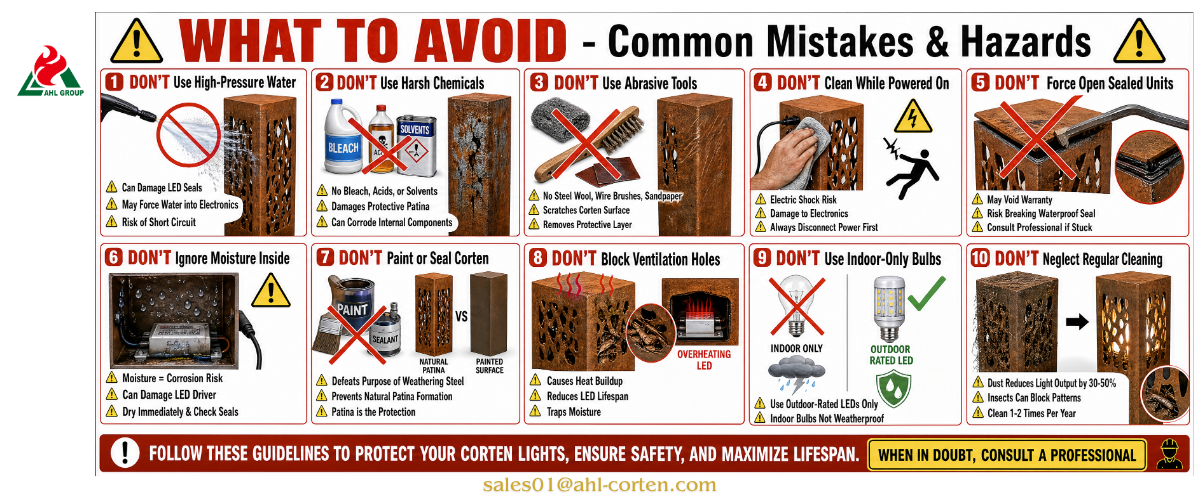
7. What Not to Do
Please avoid these common maintenance mistakes, as they may void the manufacturer’s warranty, damage the surface coating, or even cause permanent damage to the circuitry.
Avoid Using Pressure Washers
Under no circumstances should you direct the water stream from a pressure washer directly at the openings of laser-cut or perforated garden lights. The water pressure from a pressure washer is extremely high and can easily penetrate IP-rated rubber gaskets, tear through precision seals, and cause water to flood into electrical socket contacts, resulting in permanent short circuits on the circuit boards.
Avoid Using Harsh Chemicals or Abrasives
Do not use strong solvent cleaners, bleach, ammonia, glass cleaners containing high concentrations of alcohol, or acidic rust removers on internal components. If your garden light is made of special metals such as weathering steel, using chemicals on the interior will destroy the natural chemical composition of the protective rust layer. For aluminum or stainless steel components, strong chemicals will strip away the transparent coating that provides UV protection.
Do Not Damage Wires or LED Components
When cleaning or wiping the interior of the luminaire, avoid pulling, tugging, or applying tension to exposed low-voltage wiring harnesses or internal thermal paste joints. LEDs are sensitive surface-mount devices; scraping the yellow phosphor layer on the diodes with a stiff brush may permanently damage their light-emitting capability.
Do Not Force Open Sealed Components
If the light source inside a perforated light column is encapsulated in a factory-sealed glass capsule or within an epoxy-encapsulated module with no visible screws, do not attempt to pry it open. These components are sealed in a controlled factory environment to prevent moisture ingress. Breaking this factory seal will permanently compromise its protection rating, leading to inevitable future failure. Only the external surfaces of such modules may be cleaned.
8. Maintenance Frequency by Environment
The rate at which soil accumulates in open drainage systems is determined by the location and local topographical features.
| Environmental Zone | Recommended Inspection Interval | Primary Contaminant Concern |
| Dry / Arid / Desert | Every 3 Months | Fine airborne silt, sand buildup, and loss of thermal cooling. |
| Coastal / Marine | Every 3–6 Months | Salt crusting, accelerated galvanic tracking, mineral fogging. |
| Wooded / Heavy Foliage | Twice Annually (Spring/Autumn) | Leaf accumulation, spiderwebs, organic decomposition, and moisture. |
| Standard Urban/Suburban | Annually or Bi-Annually | Light atmospheric soot, pollen film, opportunistic insects. |
A Dry, Wind-Sheltered Location
If your perforated light is installed in a residential backyard—protected from strong winds and surrounded by well-maintained hard landscaping—it will require very little maintenance. Typically, an annual inspection is sufficient to ensure the fixture remains in optimal condition; the only factor to monitor is dust accumulation.
Coastal or Humid Environments
Properties located near the coast require close monitoring. Salt-laden air easily penetrates the perforated patterns. As moisture evaporates, a corrosive crust of crystallized salt forms on the internal metal brackets and optical lenses. In these areas, internal components should be rinsed with fresh water or wiped down every three to six months to prevent salt from causing pitting and fogging on the surfaces.
Dusty, Windy, or Pest-Prone Areas
If your landscape design includes dense flower beds, thick mulch, or open areas prone to wind, your bollard lights will face rapid accumulation of organic debris. Spiders are particularly drawn to these abundant “hunting grounds.” We recommend cleaning them quarterly with a leaf blower or compressed air to ensure that intricate laser-cut patterns are not completely obscured by spider webs.
Differences Between Commercial and Residential Installations
Commercial installations (such as public squares, corporate campuses, or hotel walkways) typically operate on a high-frequency schedule, running daily from dusk until dawn. Because the fixtures are in operation for longer periods, they generate continuous thermal cycles, which draw in air (and the dust it contains) through convection. Commercial properties should include internal fixture inspections as part of their quarterly facility management rounds to maintain public safety and ensure a clear, consistent brand image.
9. How to Reduce the Need for Internal Cleaning
Making forward-thinking design and layout decisions during the planning phase can significantly reduce long-term operational and maintenance workloads.
Choose Sealed or Maintenance-Friendly Designs
When purchasing laser-cut garden lights, prioritize models featuring a “double-layer” structural design. This design consists of an outer decorative laser-cut shell made of sturdy architectural-grade metal (such as 3mm Corten steel) and an inner, fully sealed lighting column with an IP66 protection rating. This design allows dust and insects to pass completely through the outer decorative patterns without coming into contact with the precision light source or causing the optical lenses to fog up.
Install Lighting Fixtures in a Sheltered Area
Avoid installing open-style lights directly next to automatic lawn sprinklers or beneath trees with dense foliage that shed large amounts of sap, sticky pollen, or dense fruit clusters. Position fixtures slightly away from unpaved dirt paths to prevent dust from being kicked up by pedestrians or garden carts.
Schedule Regular Exterior Cleaning
Keeping the exterior of the light fixture clean prevents dirt from seeping inside. Regularly rinse the exterior of weathering steel or aluminum posts with a low-pressure garden hose to remove dust, cobwebs, and pollen before wind or gravity can draw these particles into decorative openings.
Maintain Proper Drainage and Ventilation
Ensure that the concrete base or gravel bed supporting the garden light has unobstructed drainage. Many perforated lamp posts feature tiny drainage holes at the very bottom. If these holes become clogged with garden soil or mulch, rainwater will accumulate inside the post, creating a high-humidity environment that accelerates internal condensation and dirt buildup.
Selecting Corrosion-Resistant Materials
Choosing high-quality, stable base materials—such as professionally deep-treated weathering steel (Corten), anodized aluminum, or marine-grade stainless steel—ensures that the luminaire’s original structure will not deteriorate due to corrosion, even if moisture and air enter the internal cavity. This internal stability eliminates a major source of internal debris: self-corrosion.
10. When to Call a Professional
Although exterior cleaning is a simple task for most homeowners, in some cases, professional technical support from a licensed landscape lighting contractor is still required.
Electrical Safety Concerns
If you open an access panel and find water accumulation around wire connections, damaged or brittle low-voltage insulation, or scorch marks on plastic connectors, do not attempt to clean the fixture. This indicates a system design flaw or a serious electrical malfunction. Immediately turn off the system’s circuit breaker and contact a licensed technician to rewire and reseal the connection points.
Issues with Sealed LED Fixtures
If condensation forms inside the glass lens housing of a factory-sealed integrated LED light source, simply cleaning the module's exterior will not resolve the issue. This indicates that the factory seal has failed. A professional installer must assess whether the module can be replaced under warranty or if the entire internal light source needs to be hot-swapped.
Corrosion or Water Leaks
If you notice structural pitting or deep, flaking rust on the interior electrical mounting plate (as opposed to the healthy, uniform rust patina on the outer weathering steel shell), this indicates a water leak. A professional can determine whether water is seeping in from the ground via capillary action due to a missing moisture barrier, or whether the leak is caused by an aging roof seal.
Large-Scale Commercial Lighting Systems
For large properties with dozens of automated building light poles connected to centralized smart timers or DMX control systems, manual cleaning one by one is inefficient. Professional maintenance companies use specialized diagnostic equipment to monitor current consumption, automatically identify underperforming fixtures, and clean large arrays of lighting fixtures in accordance with standardized industrial safety protocols.
Conclusion: Best Practices for Ensuring Long-Term Performance
Laser-cut and perforated garden lights are unparalleled accents in modern landscapes, seamlessly blending structural artistry with functional lighting. Understanding their simple yet specific maintenance requirements ensures they remain visually appealing for decades.
When investing in new landscape elements, look beyond aesthetics and examine the internal construction carefully. Choosing high-quality materials, such as deeply treated weathering steel, paired with internally sealed LED components, minimizes maintenance needs. By opting for superior craftsmanship and dedicating just a few minutes each year to simple, safe cleaning, your architectural garden lights will continue to provide clear and beautiful illumination for your outdoor space, their glow lasting for generations.

