


1. Introduction: Redefining Privacy in Modern Landscaping
In contemporary landscape architecture, the concept of “privacy” has undergone a fundamental shift. It is no longer viewed as an all-or-nothing state—either completely exposed or utterly concealed—but rather as a nuanced spectrum of visual and spatial management. As urban density increases, outdoor living spaces become indispensable sanctuaries for mental well-being, driving unprecedented demand for sophisticated boundary solutions.
The Evolution of Boundaries
Traditionally, privacy relied on “hard” engineering solutions: thick brick walls, heavy wooden fences, or dense, high-maintenance hedges. While effective at blocking sightlines, these approaches often created stagnant air, oppressive shadows, and a sense of spatial confinement. Modern design now pursues “soft” boundaries—solutions that provide psychological security and visual separation while maintaining a connection to the natural environment.
Enter Corten Steel: The Living Material
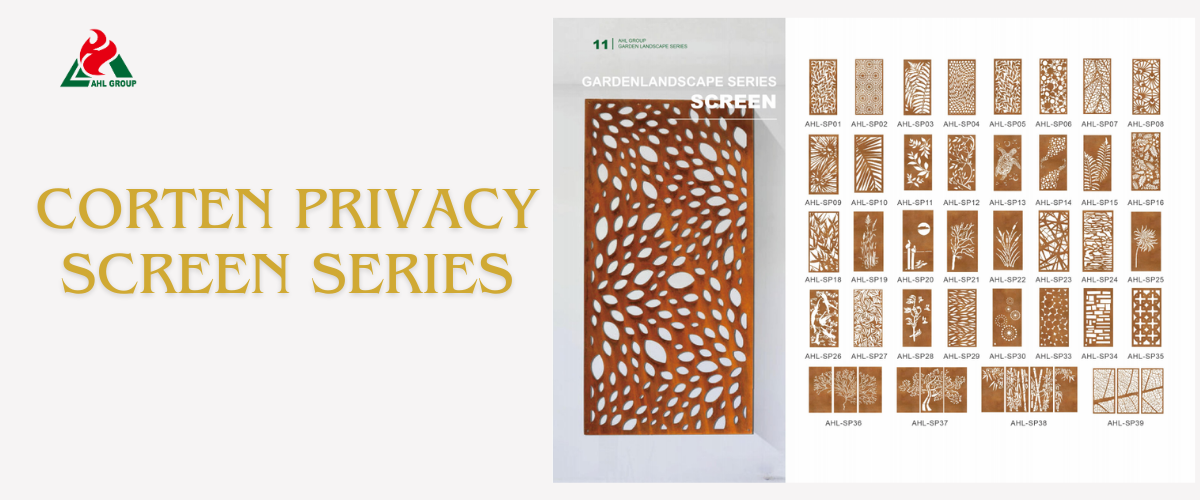
Weathering steel (ASTM A588) has emerged as the preferred medium for this new architectural concept. Its unique properties enable it to develop a rust-like protective patina over time, seamlessly integrating with organic environments while maintaining the structural integrity of industrial-grade metal. When paired with precision laser cutting technology, weathering steel transforms from a rugged industrial material into intricate “architectural lace,” becoming an artistic medium that filters light, air, and perspectives.
At AHL Group, we envision these screens not merely as barriers, but as dynamic light filters whose character evolves with the shifting sun. This guide delves into the multifaceted advantages of weathering steel privacy screens, offering owners and design professionals a practical resource that balances technical expertise with aesthetic value.
2. How Corten Privacy Screens Work: The Principle of “Screened Privacy”
The effectiveness of laser-cut screens lies in their breakthrough from the traditional mindset of “solid walls.” To understand why Corten steel screens are so efficient, one must grasp the physical properties of light and the psychological mechanisms of human vision.
The Science Behind Visual Transparency
Privacy screens operate on the principle of visual transparency. By engraving intricate perforated patterns onto the surface, we create an “optical interference” effect. When an observer gazes at the textured screen from a distance, the human eye naturally focuses on the high-contrast metal surface rather than the low-contrast details of the space beyond. This effect is particularly pronounced during daylight hours—the screen panel reflects ambient light, forming a “visual barrier” that renders the shadowed area behind the screen nearly invisible to passersby.
Controlling the “Light-to-Shade Ratio”
The “privacy level” of a screen is technically determined by its Open Area Percentage (OAP).
► Low Open Area (10%-20%): These designs feature tightly packed patterns with minimal gaps. Ideal for high-privacy areas like ground-floor balconies facing busy streets.
► Medium OAP (25%-40%): This represents the “golden range” for most residential gardens. It effectively blocks neighbors' sightlines, preventing clear views into dining areas, while ensuring sufficient light for surrounding plant growth.
► High OAP (45%+): Primarily used for decoration or interior zoning, these metal screens prioritize creating aesthetic light-and-shadow effects over absolute privacy protection.
Laminar Airflow and Microclimate Regulation
Unlike solid brick walls that force air to rise over them (often creating turbulent “vortex zones” on the opposite side), perforated Corten metal screens enable laminar airflow. Air slows but maintains direction as it passes through the patterns, providing continuous ventilation. This prevents the summer “oven effect,” ensuring your outdoor retreat remains consistently cool and comfortable.
3. Core Advantages: Why Choose Laser-Cut Corten for Privacy?
When evaluating materials for outdoor use, the criteria are clear: durability, maintenance costs, aesthetic value, and environmental impact. On these metrics, weathering steel outperforms nearly all other materials.
Metallurgical Innovation Delivers Unmatched Durability
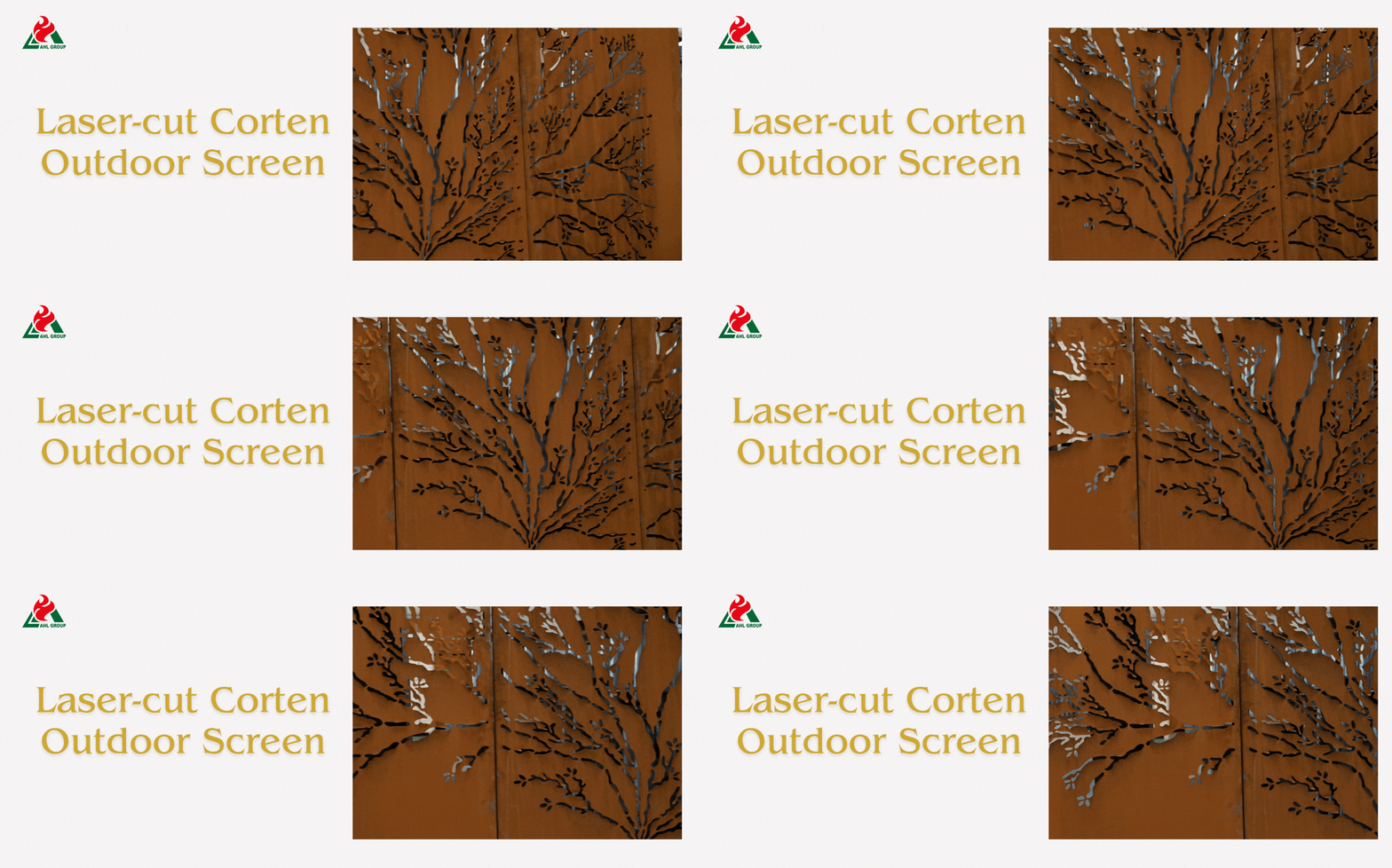
The secret to weathering steel's longevity lies in its chemical composition. By adding elements like copper, chromium, and nickel, the steel surface forms a stable, adherent oxide layer (commonly known as patina). Unlike ordinary rust, which is porous and prone to flaking—exposing more metal to corrosion—weathering steel's patina is completely impermeable. This layer seals the steel core, granting it near-immortality under most atmospheric conditions. While wooden fences may rot within a decade and vinyl fences crack from UV exposure after fifteen years, a 3mm-thick Corten garden screen can easily endure 50 to 80 years of service.
Zero-Maintenance Lifecycle
In a world where time is most precious, the “set-it-and-forget-it” nature of weathering steel offers a luxury experience.
► No Painting Required: Unlike ordinary steel or wood, which require periodic repainting or staining.
► No Cleaning Needed: The organic texture formed by rust naturally conceals dust, fingerprints, and water stains.
► Self-Repairing: If scratches appear on a Corten screen panel, the exposed metal surface naturally oxidizes, forming a new rust layer that heals the “wound.”
Aesthetic Evolution and Biophilic Design
Weathering steel is one of the few materials that grows more captivating with time. Starting as raw dark gray steel, it transitions through vibrant orange and ochre phases before settling into a deep chocolate brown. This palette possesses inherent “biophilic qualities”—mirroring the hues of soil, bark, and autumn leaves—making architectural structures feel like natural extensions of gardens rather than intrusions upon nature.
4. Design Strategies for Optimal Privacy with Corten Screens
To fully leverage the practical value of Corten screen panels, strategic design tailored to the site's specific geometry is essential—beyond merely selecting aesthetically pleasing patterns.
Pattern Selection: Beyond Aesthetic Considerations
Pattern choices should address core privacy threats:
► Horizontal Patterns: Exceptional at blocking elevated sightlines (e.g., second-story windows)
► Geometric Repetition: Ideal for creating a formal architectural aesthetic while achieving comprehensive coverage.
► Organic/Biophilic Patterns: Mimic the dappled light and shadow of forest canopies to effectively soften spatial ambiance. These designs also conceal minor installation misalignments.
Layered Design Technique
To create an ultimate luxury experience, we recommend layered spatial design. Replace uniform fencing with staggered arrangements of Corten freestanding screens throughout the landscape. For instance, install dense screens along boundaries while using transparent decorative screens near courtyards. This constructs a visually deep “privacy moat” that blocks external sightlines.
Backlit Illumination and “Nightscapes”
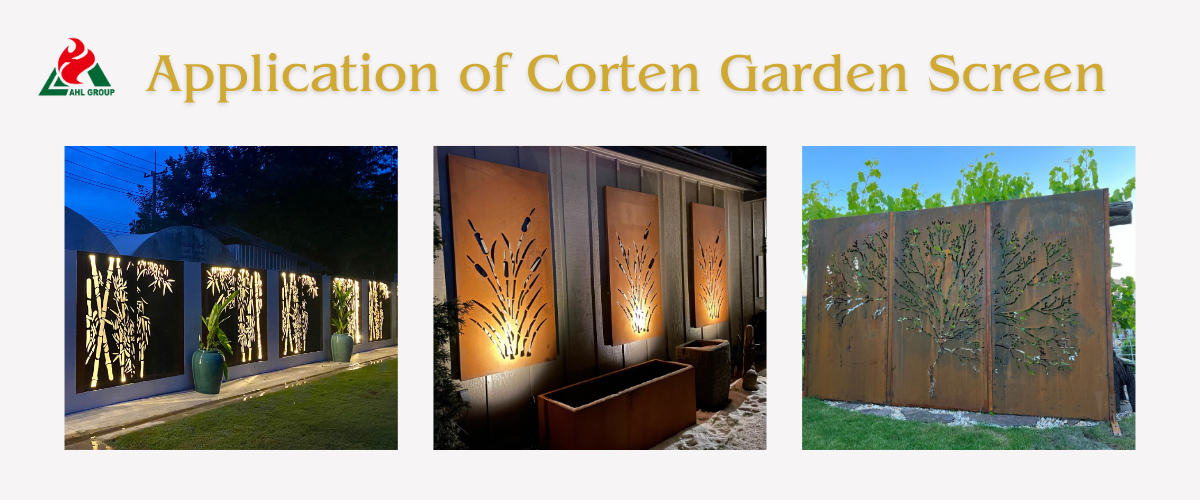
Privacy screens should not “disappear” at night. Installing low-voltage LED uplights at the base transforms them into luminous lanterns. This not only enhances security but also establishes a “visual boundary” for residents, making outdoor spaces feel as warm and inviting as indoor areas after dark.
5. Practical Considerations: Installation, Maintenance, and Longevity
To ensure your investment stands the test of time, meticulous attention to technical details during installation is essential.
Structural Engineering and Wind Loads
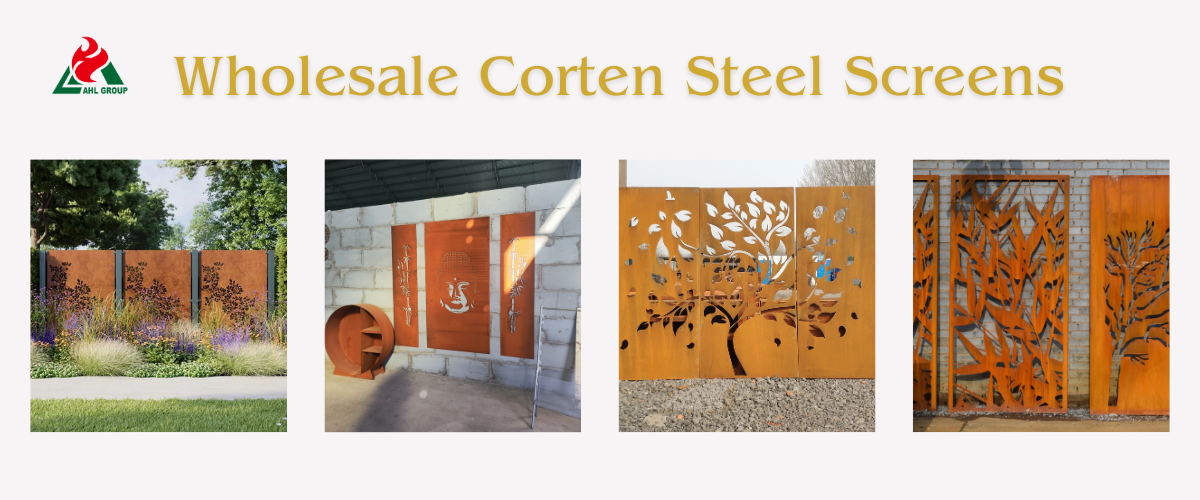
Laser-cut screens may exhibit a “sail” effect in strong winds. Support columns (recommended materials: weathering steel or powder-coated steel) must be precisely engineered to achieve proper embedment depth. AHL Group offers multiple installation solutions:
► Frame Column Mounting: Screens are welded within a frame for maximum rigidity.
► Cantilevered Installation: Screens bolt directly to existing walls via spacers, creating a suspended effect and supporting backlighting.
► U-Channel Installation: A minimalist design where screens slide into recessed channels.
Managing Ferric Oxide Leaching (“Bleeding” Phase)
During the initial 6 to 12 months of weathering, weathering steel releases small amounts of ferric oxide “bleed-out.” This may stain light-colored surfaces such as marble, limestone, or concrete. Professional Techniques for Managing Bleed-Out:
► Pre-Weathered Treatment: AHL offers “pre-weathered” screens that have completed the initial high-bleed phase.
► Drip Tray/Gravel Strip: Incorporate a narrow strip of dark river stones at the base of the garden screen to collect leaching.
► Sealing Treatment: Once the desired rust appearance is achieved, apply a specialized sealer, requiring periodic reapplication.
6. Corten Privacy Screens vs. Traditional Privacy Solutions
To understand the value proposition of Corten, we must compare it against the "status quo" of the fencing industry.
| Feature |
Corten Steel (AHL Group) | Natural Timber | PVC / Composite | Masonry (Brick/Stone) |
| Architectural Style |
High-End Modern / Industrial | Traditional / Rustic | Modern Utility | Classical / Heavy |
| Privacy Efficiency |
High (Customizable OAP) | Low (Gaps form over time) | High (Solid) | Absolute (Solid) |
| Wind Resistance |
Excellent (Perforated) | Variable | Poor (Prone to snapping) | High (But lacks airflow) |
| Sustainability |
100% Recyclable | Renewable but treated | Low (Non-recyclable) | High Carbon Footprint |
| Initial Cost |
Mid-High | Low-Mid | Mid | High |
| Total ROI |
High (Zero maintenance) | Low (High upkeep) | Low (Replacement cost) | High (Long life) |
Sustainability Factor: ESG Compliance
In the modern era of architecture, sustainability has become a non-negotiable principle. Weathering steel is a cradle-to-cradle material, incorporating a high proportion of recycled content in its production process and achieving 100% recyclability at the end of its service life. Furthermore, it does not leach toxic volatile organic compounds into the surrounding soil, as it requires no chemical dyes, coatings, or preservatives.
Conclusion: The Verdict on Privacy and Style
The Premier Choice for Modern Semi-Private Spaces
Can laser-cut weathering steel screens ensure privacy? The answer is YES—provided the right pattern density and on-site layout are employed. They seamlessly blend artistry and engineering, offering fortress-like security while exuding the refined elegance of a museum installation.
Realize Your Architectural Vision with AHL Group
AHL Group is not merely a manufacturer but your partner throughout the design journey. Equipped with cutting-edge laser-cutting technology capable of processing plates of varying thicknesses and dimensions, our design team offers bespoke CAD pattern services to help you tell your unique story.
Whether you're a homeowner reimagining your garden space or an architect designing multi-million-dollar commercial projects, our weathering steel solutions meet modern demands for durability, aesthetics, and privacy.
【Contact the AHL Group technical team today to request a material sample or a custom quote for your next project.】

