


Architectural design has always sought a balance between form and function, privacy and openness, and industrial strength and organic beauty. In contemporary landscape and facade design, Corten steel screens have become the material of choice for achieving this balance. Renowned for their signature velvety terracotta-colored patina—which gradually forms and stabilizes over time—these Corten steel panels serve as striking visual focal points in everything from residential courtyards to large-scale commercial projects.
However, because every property presents unique spatial challenges, structural requirements, and aesthetic themes, off-the-shelf privacy screens often fall short of expectations. This guide delves into the manufacturing and structural parameters of custom architectural metalwork, detailing how Corten steel decorative screens can be fully customized in pattern, shape, and size to transform ordinary spaces into highly design-driven engineering masterpieces.
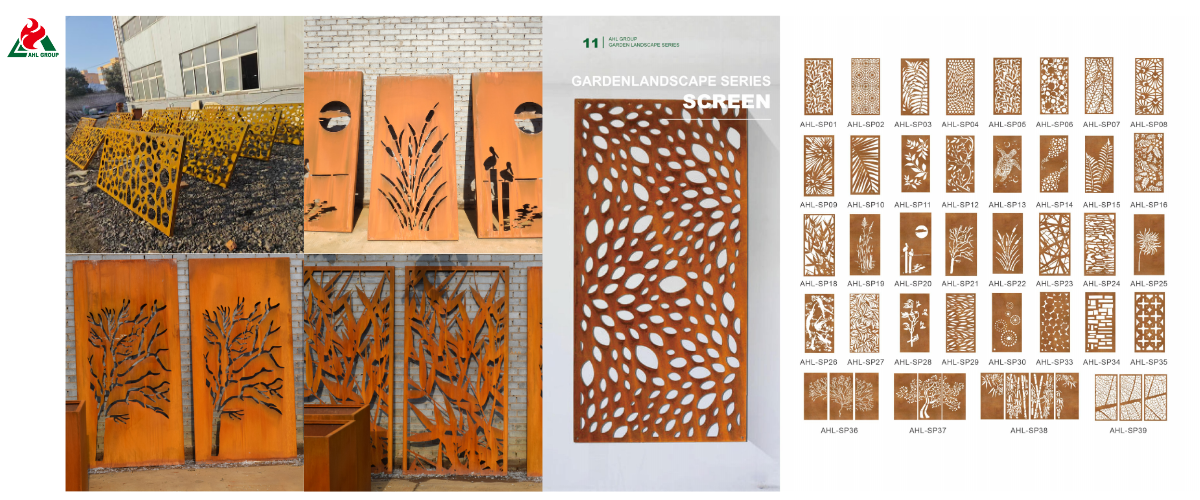
However, because every property presents unique spatial challenges, structural requirements, and aesthetic themes, off-the-shelf privacy screens often fall short of expectations. This guide delves into the manufacturing and structural parameters of custom architectural metalwork, detailing how Corten steel decorative screens can be fully customized in pattern, shape, and size to transform ordinary spaces into highly design-driven engineering masterpieces.
1. Introduction
Why Custom Corten Steel Screens Are So Popular
Custom Corten steel screens are highly sought after because they bridge the gap between heavy-duty structural engineering and refined artistic expression. Unlike wooden latticework that rots or plastic composites that warp under intense sunlight, Corten steel offers an exceptionally robust structural lifespan that can last for decades. Customization allows designers to precisely control sight-blocking effects, adjust light and shadow patterns, and create a unique thematic narrative that seamlessly integrates with the surrounding hardscape and architecture.
The Deeper Meaning of Custom Patterns and Shapes
Customization goes far beyond simply adjusting the height and width of metal panels. True customization gives you complete control over the screen’s perforation density, cut geometries, structural folding methods, and contour lines. This means architects can design panels that smoothly extend along curved masonry retaining walls, wrap around octagonal structural columns, or feature laser-cut openwork patterns that precisely replicate corporate logos or local plant motifs.
What This Guide Covers
This industry guide provides an in-depth assessment of the engineering capabilities, manufacturing processes, and artistic expression involved in custom Corten screens. We will explore the key differences between mass-produced and custom panels, detail how different pattern layouts affect performance, analyze how material thickness determines design complexity, and outline the custom design workflow from initial hand-drawn sketches to final on-site installation.
2. Can Corten Steel Screens Be Customized?
Standard vs. Custom Partitions
Standard prefabricated screens are mass-produced in fixed sizes and feature generic geometric patterns. While affordable, they lack structural flexibility and cannot accommodate uneven site slopes or precise boundary alignment. In contrast, custom screens are engineered to order. They are manufactured to the exact millimeter precision of your on-site measurements, ensuring a seamless fit within existing masonry recesses, wooden posts, or aluminum framing systems.
Commonly Customizable Components
Nearly all physical parameters of high-end weathering steel screens can be customized by a professional manufacturer:
► Perforation Patterns: The shape, density, and size of laser-cut holes.
► Outline Profile: Straight edges, compound radii, stepped heights, or irregular zigzag cuts.
► Structural Framing and Installation: Integrated flanges (folded edges), pre-punched bolt holes, or custom spacer brackets.
► Material Thickness: A wide range, from lightweight decorative cladding to self-supporting heavy-duty structural panels.
Limitations on Pattern and Shape Modifications
Although CNC laser cutting offers tremendous manufacturing flexibility, it is still subject to the physical laws of metallurgy and structural physics. The primary limitation lies in the “rib rule” (i.e., the solid metal remaining between two cut shapes). If the spacing between cut lines in a custom pattern is too narrow, or if the perforation rate exceeds 60% to 70%, the structural strength of the remaining steel will be compromised, causing the sheet to warp, sag, or vibrate violently under high wind loads.
3. Custom Pattern Options
The patterns cut into Corten steel panels determine not only their mechanical properties but also shape their artistic character within the landscape.
Geometric Patterns
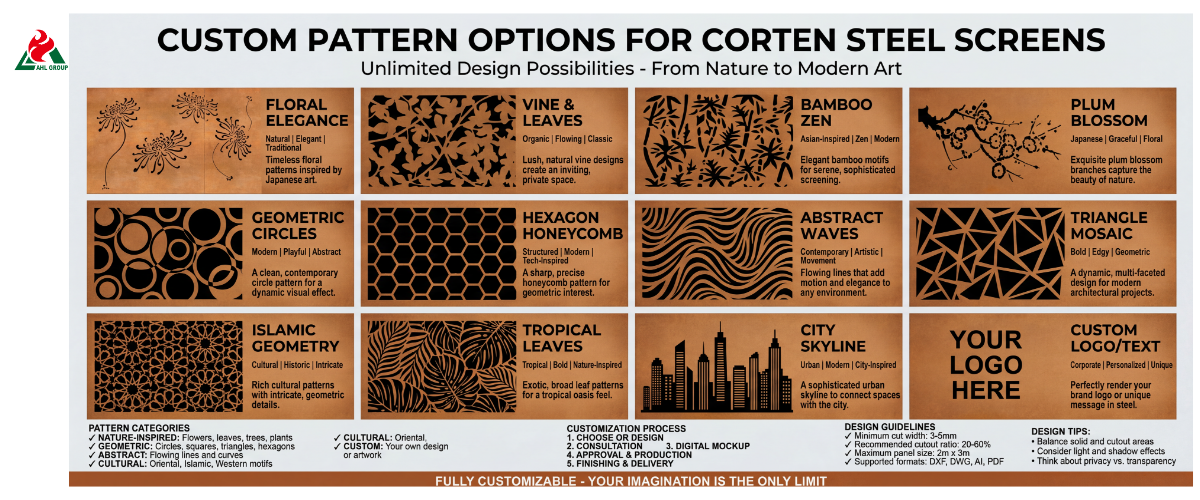
Geometric cut patterns are characterized by sharp minimalism, repetitive symmetry, and clean, crisp Mid-Century Modern lines. Common choices include intricate Moroccan latticework, angular hexagonal honeycombs, linear strip arrangements, and abstract mathematical grids. Geometric styles are well-suited for contemporary urban commercial plazas or minimalist residential facades, where order, precision, and clean alignment are primary architectural goals.
Organic and Nature-Inspired Patterns
For traditional gardens, cozy courtyards, and eco-conscious developments, organic patterns help soften the heavy, industrial feel of weathering steel. Manufacturers can program laser cutters to reproduce soft, abstract tree canopies, sprawling native grasses, slender bamboo stalks, or oversized tropical leaves. As these panels weather to a deep, earthy orange hue, the organic cut-out patterns will blend harmoniously with the surrounding vegetation.
Abstract Decorative Patterns
Abstract patterns utilize free-flowing, non-repetitive curves, asymmetrical wave networks, or “pixelated” digital compositions to create highly artistic, avant-garde pieces. These custom metal screens are often commissioned as standalone outdoor art sculptures, backlit feature walls, or decorative architectural cladding panels installed on plain concrete structures.
Logo- or Brand-Based Designs
For corporate office buildings, luxury boutique hotels, public parks, and residential developments, custom weathering steel screens can naturally integrate specific brand elements. Using precise vector files, manufacturers can seamlessly cut corporate logos, specific typographic elements, wayfinding maps, or custom crests into the surface of the weathering steel panels, perfectly combining functional spatial division with visually striking corporate branding.
4. Custom Shape Options
Rectangular Panels
Rectangular panels are a reliable mainstay in the field of architectural screening, making them ideal for creating continuous perimeter fences, horizontal balcony railings, or tall vertical privacy walls. Through customization, you can specify non-traditional aspect ratios, such as extra-wide horizontal strips that elongate narrow courtyards, or towering vertical strips that draw the eye upward.
Square Panels
Square panels present a highly balanced geometric silhouette. They are typically suspended between sturdy wooden posts in modular grid configurations or installed as recurring artistic accents along long, plain-faced masonry retaining walls to break up visual monotony.
Curved Panels
To accommodate winding paths, curved pool decks, or circular garden fire pit lounges, flat steel sheets are fed into a mechanical rolling machine for processing. This industrial process applies uniform pressure to roll weathering steel into precise, smooth curves (concave or convex) without distorting the details of laser-cut patterns or causing internal alloy grain boundary fractures.
Circular or Irregular Shapes
Custom fabrication allows you to completely eliminate right angles. Corten privacy screens can be formed through stamping or laser cutting into perfect geometric circles, flowing suspended ovals, angular triangles, or completely irregular polygons. These custom shapes are often used as artistic tree surrounds, decorative wall art, or integrated window louvers.
Tall, Narrow, or Oversized Dimensions
Standard sheet metal fabrication is typically limited to conventional commercial sheet sizes, but custom engineering allows for the production of oversized pieces. If your project requires a massive, single-piece screen up to 15 feet tall to shield a commercial machinery area, manufacturers can design internal reinforcement frames, thick-walled profiles, and concealed interlocking joints to create a giant metal structural canvas capable of withstanding extreme structural wind shear loads.
5. Factors That Affect Customization
To execute a custom project perfectly, the design must be adapted to key metallurgical and physical limitations.
Screen Thickness
Material thickness determines the structural effects that can be achieved during cutting and forming. For decorative accent screens installed on solid brick walls, lightweight steel with a thickness of 1.5 mm to 2 mm (14 to 12 gauge) can be used safely. However, self-supporting privacy fences or freestanding panels in open-air settings must use heavy-gauge steel sheets 3 mm to 6 mm thick (1/8 inch to 1/4 inch) to withstand physical impacts and sustained high wind pressures, preventing buckling or deformation.
Panel Size and Proportions
As the surface area of a screen panel increases, the risk of physical deformation (bending under wind loads) grows exponentially. When specifying large custom panel dimensions, balance must be maintained by reducing the perforation rate or increasing material thickness. Additionally, custom structural flanges (folded edges) can be added to the perimeter edges to provide deep mechanical rigidity to thin metal sheets.
Manufacturing Process
The quality of custom garden screens is closely tied to the equipment used in their manufacture.
► CNC Laser Cutting: This is the industry gold standard for weathering steel. It produces clean, micron-level precision edges without thermal distortion, enabling highly complex, razor-sharp geometric patterns.
► CNC Plasma Cutting: A faster, more cost-effective method for thick sheets, though it produces slightly rougher edge profiles and may leave trace amounts of slag, requiring manual finishing after cutting.
► Waterjet Cutting: An ultra-precise cold-cutting technology that eliminates the heat-affected zone, making it ideal for highly complex, intricate artistic commissions.
Installation Location and Function
The engineering and installation of a screen mounted on a highly exposed coastal rooftop terrace differ significantly from that of a screen installed in a small residential courtyard. The installation location dictates the need to calculate local wind load limits, which directly determine how much solid steel the manufacturer must retain in the pattern design, as well as the load-bearing capacity required for support columns and anchoring brackets.
Budget and Lead Time
Custom manufacturing is an investment in high-end engineering. Unlike off-the-shelf panels that can be shipped immediately from a distribution center, custom screen panels require dedicated architectural drafting time, individual CNC programming setups, custom metal cutting, and manual deburring or frame fabrication. This highly labor-intensive process results in a higher initial price and a typical lead time of 3 to 6 weeks or more.
6. How the Custom Design Process Works
Unveiling the mysteries of custom metal fabrication requires following a clear, highly collaborative commercial engineering process.
Starting with a Concept or Sketch
The customization journey begins with your initial inspiration. This could be a simple hand-drawn sketch on paper, a digital mood board filled with architectural photos, a photo of a natural leaf texture, or a formal vector design file created by a landscape architect.
Selecting a Pattern
The manufacturer’s design team will translate your vision into a digital library format. They will evaluate your chosen pattern against structural guidelines, adjusting line thickness, gap spacing, and rib width to ensure the pattern can be safely cut into the steel sheet without compromising its structural integrity.
Confirming Dimensions
We conduct precise on-site measurements. This includes determining the exact column spacing, floor-to-ceiling height, thermal expansion and contraction gaps per meter of panel (1 to 2 millimeters), and any changes in slope along the ground line to ensure that the finished metal panels are installed perfectly level.
Review Drawings or Models
Before the laser cutting head touches the high-quality weathering steel sheets, our engineering team generates formal CAD drawings or shop drawings (typically 2D PDFs or 3D models). These technical drawings detail the precise dimensions of the panels, bolt hole locations, and flange depths and provide an accurate preview of the final cutting pattern layout.
Approval of the Final Design
The client reviews, signs off on, and formally approves the construction drawings. Once approved, the CAD data is directly converted into CNC machine code (G-code). Unprocessed gray weathering steel plates are loaded onto the cutting table, and precision manufacturing begins immediately.
7. Design Considerations
Privacy and Decorative Appeal
You must determine the primary purpose of the landscape screen early in the design process. If your goal is to block the prying eyes of nosy neighbors or conceal an unsightly pool pump, choose a high-privacy design with a low perforation rate (10% to 30% open space). If the screen serves purely as an artistic accent, intended to subtly divide spaces or provide a trellis for ivy, feel free to choose a design with a high perforation rate (40% to 60% open space).
Airflow and Light Transmission
Outdoor screens must remain composed when exposed to strong winds. Solid or highly enclosed panels can act as giant sails, capturing wind energy and transferring immense pressure to the concrete foundation. Incorporating a balanced perforated design allows wind to pass safely through the screen, reducing structural stress while casting dynamic, flowing shadows across your lawn or patio throughout the day.
Structural Strength
Custom panels must retain their physical shape despite years of exposure to the elements. If you are cutting highly complex, lace-like organic patterns, it is advisable to leave a solid, uncut border of at least 2 inches (50 mm) around the entire perimeter of the panel. This solid border area provides a secure anchor for the panel, preventing the cut pattern from sagging, warping, or deforming over time.
Visual Balance in Landscaping
Ensure that the scale of the pattern harmonizes with the scale of the surrounding architecture. When tiny, highly repetitive micro-patterns are scaled up to cover the facade of a massive two-story commercial building, they can appear chaotic and visually confusing. Conversely, oversized, eye-catching patterns may overwhelm the walls of a small residential courtyard garden, making the space feel cramped.
8. Common Customization Mistakes
Choosing Designs with Excessive Light Transmittance
Homeowners often select exquisite, intricate designs online without realizing that the finished screen may have a light transmittance as high as 70%. Once installed, the decorative screen fails to provide the expected privacy, forcing them to add a backing fabric behind these high-end metal art pieces or replace the panels.
Choosing Shapes That Are Difficult to Install
Complex, multi-angled, jagged shapes look great on a computer screen, but without proper structural mounting points, your installation team will struggle to secure them safely on-site. When designing custom shapes, be sure to design a matching heavy-duty anchoring frame system at the same time.
Ignoring Panel Proportions
Designing custom screen panels that are extremely tall (e.g., 10 feet) but extremely narrow (e.g., 1 foot) using 2-millimeter-thick sheet metal will result in structurally unstable vertical strips that bend and warp under even slight physical pressure. Maintain reasonable, balanced proportions, or compensate for extreme dimensions by deepening the rear edge flange.
Neglecting Maintenance and Drainage
When designing custom horizontal flanges, laser-cut grooves, or frame channels, ensure that small pre-drilled drainage holes or channels are provided at the lowest points. If rainwater remains stagnant for extended periods in undrained bottom metal channels, the weathering steel will remain in a persistently damp state. This hinders the formation of a protective rust layer, leading to localized corrosion and accelerated failure.
9. Best Uses for Custom Corten Screens
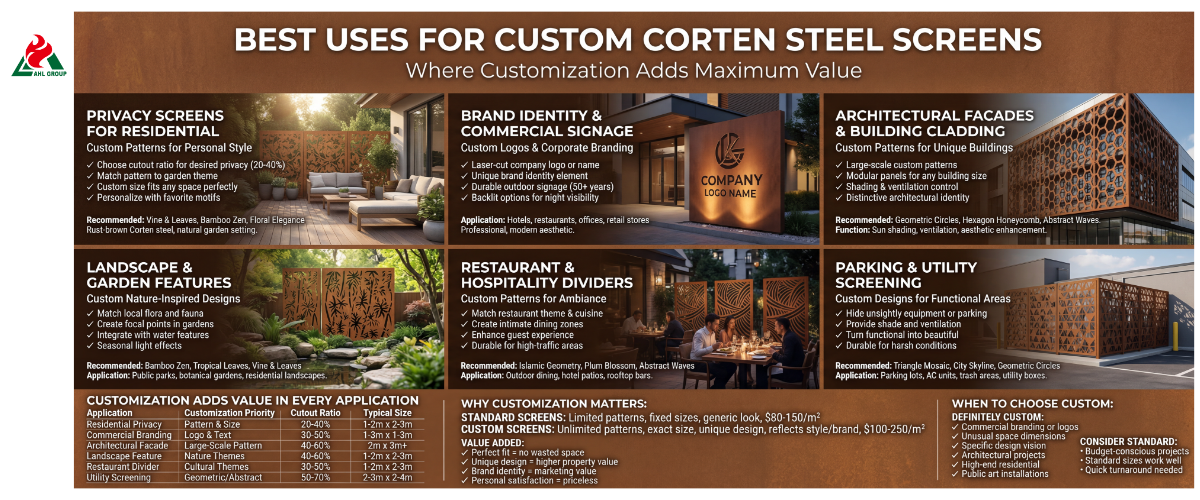
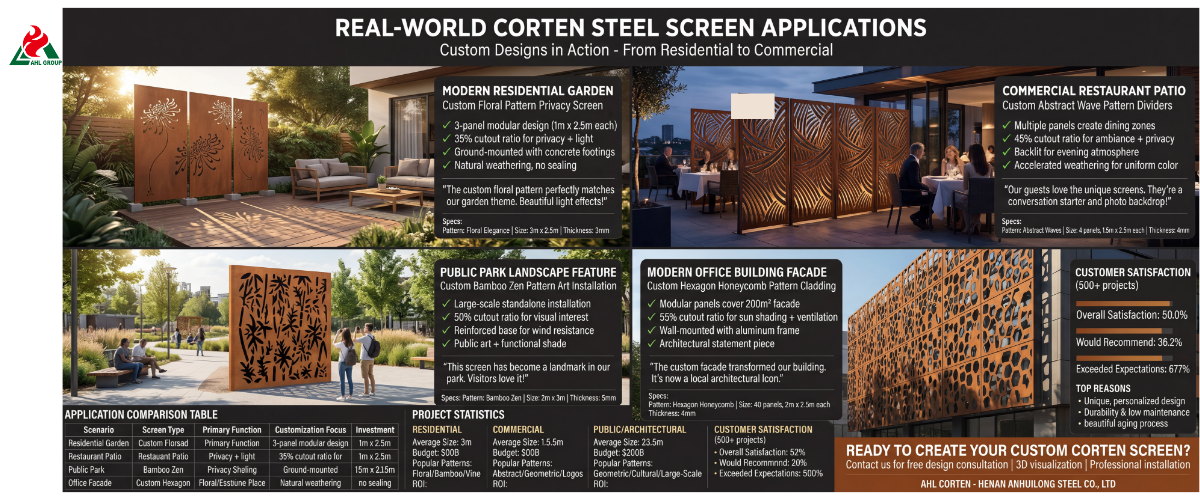
► Backyard Privacy Screens: Ideal for blocking neighbors’ view, creating a private space around an outdoor hot tub, or defining a cozy patio dining area.
► Garden Feature Panels: Can be installed as freestanding, backlit landscape sculptures, decorative accent walls, or rustic trellises for flowering vines to climb.
► Commercial Landscape Design: Ideal for delineating outdoor dining areas, defining public park pathways, or screening industrial waste fences.
► Entrance and Boundary Screens: Can serve as sturdy, secure driveway gates, custom pedestrian side gates, or decorative security railings.
► Decorative Wall Accents: Mounted directly onto plain interior or exterior concrete walls using structural brackets to add texture and visual depth to building facades.
10. Questions to Ask Before Ordering
Question 1: Can I Change the Design?
Yes. As long as it complies with basic structural rib guidelines, a professional manufacturer can convert any high-resolution image, hand-drawn vector sketch, or industrial CAD layout into a production file ready for cutting.
Q2: Can I Change the Shape?
Absolutely. Sheets can be laser-cut into custom shapes such as circles, irregular polygons, or stepped heights. They can also be mechanically rolled to form gentle curves or folded into rigid three-dimensional boxes with structural edges.
Q3: What Sizes Are Available?
The maximum manufacturing size for custom panels is determined by the maximum size of the original industrial sheet—typically a single, solid sheet measuring 5x10 feet (1500mm × 3000mm). For larger wall surfaces, we design multiple matching panels so that the pattern seamlessly connects when installed side by side.
Q4: How Long Does Customization Take?
The full customization cycle—including the creation of custom fabrication drawings, collaborative approval and revisions, laser cutting, deburring, and final packaging—typically takes 3 to 6 weeks, depending on seasonal backlogs at the fabrication facility.
Q5: Can I View a Design Preview?
Yes. Reputable commercial manufacturers will provide complete, scaled 2D construction drawings or 3D digital renderings for your review, allowing you to carefully verify and confirm precise dimensions, gaps, and visual balance before formal production begins.
Conclusion: Final Recommendations for Custom Corten Steel Screen Design
When your landscape design involves non-standard structural spans, specific privacy screening requirements, or high-end architectural themes that demand absolute precision, investing in custom Corten steel screens is highly valuable. Custom designs not only perfectly accommodate local wind loads but also seamlessly integrate with unique site boundaries, creating distinctive, personalized artistic landmarks that enhance the long-term design value of your property.
If your project involves only simple, low-impact decorative elements—such as a small trellis placed in the center of a spacious lawn or an interior mural—standard off-the-shelf screens remain a suitable choice. In such scenarios, where dimensional precision is not critical, generic and repetitive geometric patterns can cost-effectively meet your design objectives.
Custom Corten outdoor screens successfully transform rigid, industrial weathering steel into a vibrant, dynamic architectural canvas. Through a bespoke manufacturing process that carefully balances material thickness, pattern density, and structural edge framing from the outset, you’ll receive a highly customized, maintenance-free privacy screen that will grace your landscape for decades to come, aging gracefully over time.

