


Creating a private retreat in one’s own backyard is a top priority for many homeowners, but traditional options like solid wood fences or towering brick walls often feel heavy, cold, and visually stifling. As outdoor design trends shift toward lighter, more architecturally elegant structures, laser-cut Corten steel screens have emerged as the premier high-end solution.
These decorative panels combine structural durability with intricate, precision-cut designs, providing privacy for your outdoor living space without blocking natural light or the gentle summer breeze. This guide will thoroughly evaluate whether Corten laser-cut screens can offer the ideal privacy solution for your backyard and provide guidance on how to effectively integrate them into your landscape design.
These decorative panels combine structural durability with intricate, precision-cut designs, providing privacy for your outdoor living space without blocking natural light or the gentle summer breeze. This guide will thoroughly evaluate whether Corten laser-cut screens can offer the ideal privacy solution for your backyard and provide guidance on how to effectively integrate them into your landscape design.
1. Introduction
Why Homeowners Choose Laser-Cut Privacy Screens
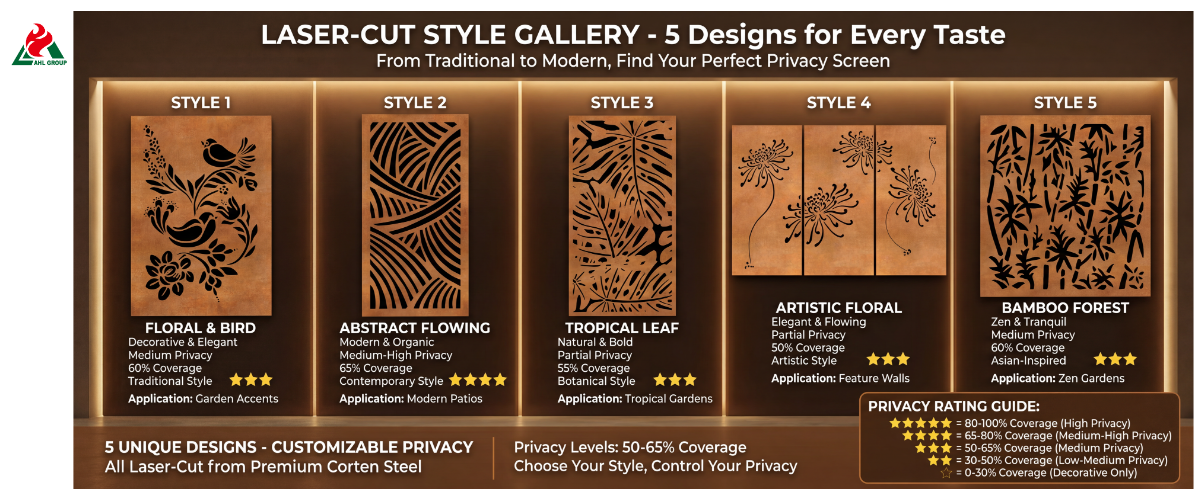
Modern backyards have become an extension of indoor living spaces—places for relaxation, dining, and entertainment. The popularity of laser-cut privacy screens has skyrocketed because they transform a functional need (privacy) into an artistic feature. Homeowners no longer have to face bare walls; instead, they can admire intricate geometric patterns, natural botanical motifs, or abstract modern forms—designs that capture the shifting light throughout the day.
The Unique Properties of Weathering Steel
Weathering steel, also known as Corten steel, is an industrial-grade alloy composed of copper, chromium, and nickel. Unlike ordinary carbon steel, which gradually deteriorates and fails due to rust, weathering steel forms a dense, self-protective oxide layer (a copper-brown patina) upon exposure to outdoor moisture. This deep copper-brown patina seals the underlying metal, thereby preventing further corrosion. It is a constantly evolving material whose color gradually shifts from bright orange to deep chocolate brown, creating a stunning backdrop for the vibrant greenery of a garden.
This Guide Will Help You Make an Informed Decision
While laser-cut screens are undeniably beautiful, using them as privacy barriers requires a careful balance between aesthetics and functionality. This guide serves as your expert resource, helping you understand exactly how much privacy these screens provide, how to choose the right pattern density, and how to install them safely—ensuring your investment remains secure for decades to come.
2. Do Corten Laser-Cut Screens Really Provide Privacy?
For any homeowner, the key question is: Can a perforated metal screen effectively prevent nosy neighbors from peering into private spaces?
Levels of Privacy at Different Distances
The level of privacy provided by a laser-cut screen panel depends on the distance between the observer and the screen. When viewed from a distance (for example, a neighbor looking out from a second-floor window across the yard), the intricate patterns blur into a solid mass, creating an effective visual barrier. However, if someone stands right up against the screen, they can see clearly through the openwork. Therefore, these screens are better suited for creating a sense of privacy in patio areas rather than providing absolute concealment.
The Role of Pattern Density in Privacy
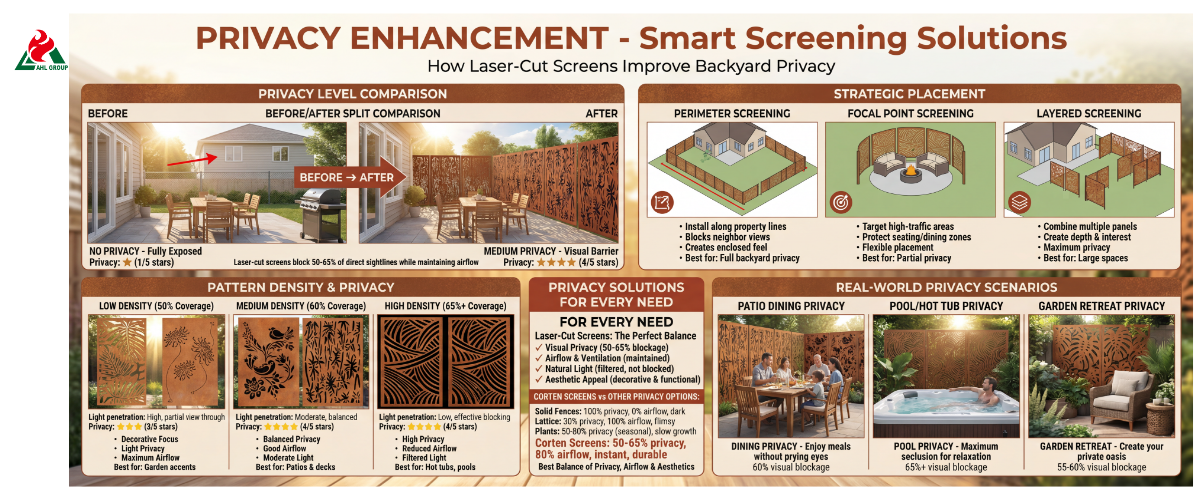
When purchasing or designing laser-cut garden screens, manufacturers specify the “open area ratio.” This metric precisely reflects the proportion of metal that has been cut away. A screen with a 20% open area features a dense, tight pattern that blocks 80% of the view, making it ideal for spa enclosures or boundary barriers. A screen with a 50% open area resembles a trellis, elegantly filtering light but offering only partial privacy.
Ideal Scenarios for Partial Privacy Screens
Corten steel screens work exceptionally well as partial barriers. They are perfect for blocking specific views—such as screening a neighbor’s driveway, concealing unsightly air conditioning units, or dividing an open patio into separate dining and lounge areas.
3. How Design Affects Privacy
To achieve your privacy goals, you must understand how the configuration, size, and layering of the panels affect the visual transparency of the metal.
Dense Patterns vs. Open Patterns
Organic patterns inspired by nature—such as dense branches, intertwining vines, or tight abstract mesh structures—naturally offer superior privacy protection because their irregular, crisscrossing lines disrupt the eye’s tracking path. In contrast, modern minimalist geometric designs featuring large grids or wide stripes typically have a higher open area ratio, allowing for more direct line-of-sight views.
Screen Height and Panel Width
Standard architectural panels are typically 6 feet (180 cm) tall and 3 to 4 feet wide. To create a true privacy barrier, panels are usually arranged in a series. When determining the height, calculate the line of sight from a neighbor’s perspective—such as an elevated terrace—rather than considering only the ground-level line of sight.
Single-Panel and Layered Screen Layouts
If you love open, airy patterns but also require absolute privacy, consider a staggered, layered layout. By installing two screen panels in parallel with a 6-inch gap between them and offsetting the patterns, you can completely block direct views while retaining a highly decorative, three-dimensional architectural effect.
Combining Screens with Greenery or Fences
Corten garden screens are not limited to standalone use. One of the most effective high-end landscaping strategies is to install laser-cut screens directly in front of standard dark wood fences or to integrate them into evergreen cedar hedges. The rusted metal creates a striking contrast against green or wooden backgrounds, concealing the solid wall behind while adding an extraordinary sense of depth.
4. Benefits of Corten Laser-Cut Screens
Compared to traditional outdoor screening materials, investing in high-quality Corten steel panels offers several significant advantages.
Combining Decorative Appeal with Practical Screening
Unlike standard chain-link fences or wooden screening panels, which serve purely practical purposes, weathering steel screens offer the artistic impact of outdoor sculptures. By day, they create striking silhouettes; by night, when illuminated by appropriate landscape lighting, they cast dramatic geometric shadows across surrounding paths and lawns, extending the design aesthetic of your home into the garden.
Durability in Outdoor Environments
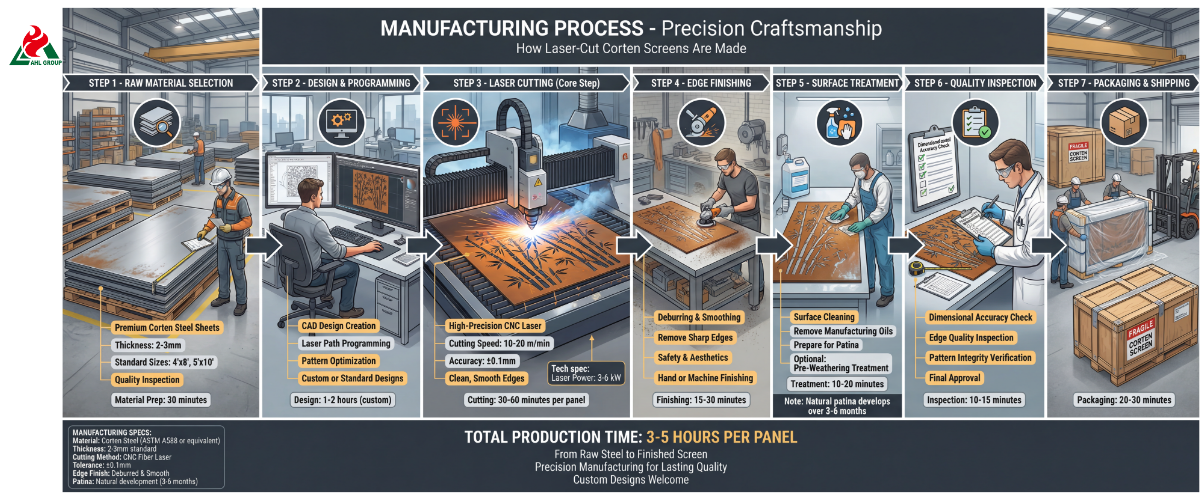
Weathering steel was originally developed for heavy-duty industrial applications such as bridge construction and railcar manufacturing. Its lifespan far exceeds that of wood, which is susceptible to rot, warping, and termite damage. It withstands strong winds, heavy rain, and intense UV exposure without structural degradation.
Low Long-Term Maintenance Costs
Once installed, Corten screens require virtually no structural maintenance. There is no need to worry about peeling paint, annual repainting, or applying rust-preventive chemicals. This material’s self-regulating properties save homeowners thousands of dollars in long-term maintenance costs and a significant amount of labor time.
Seamlessly Blends with Modern and Natural Landscapes
The deep, rustic reddish-brown tones developed on the surface of weathered Corten steel allow it to blend effortlessly into natural woodland gardens, rustic farmhouse landscapes, or angular, ultra-modern minimalist concrete courtyards. Like a chameleon, this material exudes refined elegance in virtually any setting.
5. Limitations to Consider
Although this material offers significant advantages, it is essential to understand its unique physical limitations before purchasing.
They Do Not Completely Block the View
If your definition of privacy is absolute concealment—such as completely blocking light and movement like a solid wall—then laser-cut screens are not the ideal choice. Because their design inherently features perforations, this means that outlines, movement, and light will always pass through the panels.
Gaps May Still Allow Side Views
Certain patterns may appear to provide complete privacy when viewed from the front, but when observed at a 45-degree angle, they may reveal a clear view. Before finalizing your pattern selection, walk around the perimeter of your property and check the common viewing angles from your neighbors’ windows.
Wind and Light Can Pass Through Open Patterns
While the passing wind helps mitigate the “sail effect” (preventing the privacy screen from being blown over like a kite during a storm), it also means these screens cannot provide absolute wind protection. If you want to shield a seating area from biting winds, an overly open pattern design will likely fall short.
Rust Bleeding and Rust Layer Changes During the First Year of Installation
During the first 6 to 12 months of outdoor exposure, heavy rain will wash loose iron oxide from the panel surfaces. This “rust bleeding” can leave permanent stains on porous surfaces such as light-colored limestone pavers, white concrete, or wooden decks.
Important Note: Before the rust patina stabilizes, be sure to install new Corten metal screens on a gravel bed or dark-colored soil, or set up a protective drainage channel to collect seeping rust water.
6. Best Backyard Uses
To fully showcase the aesthetic and functional qualities of weathering steel, we recommend installing it in the following garden areas where it will have the greatest visual impact:
Patio Privacy Screens
Erecting three to four connected screens along the edge of an outdoor dining patio creates a private, room-like atmosphere while effectively blocking views from neighboring homes, allowing you to feel completely at ease when entertaining guests.
Poolside Screens
Pool areas require a delicate balance: maintaining privacy without blocking the warm summer sun. High-density laser-cut screen panels provide excellent screening around outdoor shower areas, changing areas, or pool equipment bases, while avoiding an industrial look.
Boundary and Side Yard Screens
Side yards between modern suburban homes are often narrow and exposed. Installing Corten landscape screens along these narrow pathways effectively blocks direct eye-to-eye views between your windows and those of your neighbors.
Outdoor Dining and Relaxation Areas
In spacious, open backyards, use screens as architectural dividers. By using freestanding Corten screens to create dedicated fire pit lounges or outdoor kitchens, you can establish unique and more intimate zones within your landscape design.
7. How to Improve Privacy with Corten Screens
If you have already chosen a screen fence design but need to enhance its security or privacy, consider the following professional installation adjustments:
► Use taller fence panels: Opt for a custom 7- or 8-foot frame instead of the standard 5-foot height to block the view from neighbors on higher ground.
► Reduce panel spacing: Narrow the gap between adjacent metal panels to less than one inch, or slightly overlap the frames to create a continuous, seamless visual effect.
► Plant vegetation in front of and behind the screen: Plant slender, tall ornamental grasses (such as Miscanthus) or slender bamboo varieties right next to the panels. The plants will grow through the laser-cut openings and wrap around them, creating a stunning effect where the architectural steel seamlessly blends with organic textures.
► Incorporate a solid base design: Use a hybrid panel design where the bottom 3 feet of the screen feature solid, non-perforated weathering steel, while the top 3 feet display decorative laser-cut patterns. This design completely blocks low-angle views while maintaining an open, airy appearance at the top.
8. Comparing Corten Screens With Other Privacy Options
To choose the right material, it is necessary to evaluate the pros and cons of Corten steel compared to traditional residential building materials.
| Material | Maintenance Required | Lifespan | Visual Weight | Primary Downside |
| Corten Laser-Cut | Near Zero | 30+ Years | Light / Artistic | Rust runoff in Year 1 |
| Wood Latice | High (Stain/Paint) | 7–10 Years | Heavy / Traditional | Rots and warps easily |
| Powder-Coated Aluminum | Very Low | 20+ Years | Clean / Commercial | Can scratch; lacks natural warmth |
| Solid Sheet Metal | Low | 25+ Years | Severe / Industrial | Creates high wind resistance |
Although aluminum has a clean, modern appearance, it lacks the rich, natural color transitions found in weathering steel. While wood has a lower initial cost, it requires a lifetime of sanding, sealing, and maintenance, as well as the eventual cost of structural replacement.
9. Installation Tips
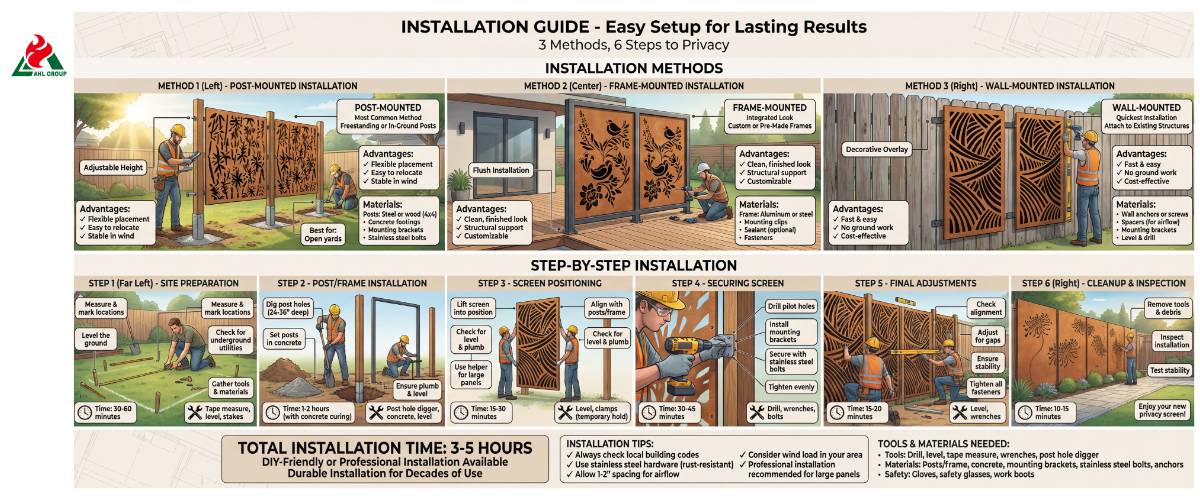
The effectiveness of a windbreak depends on the stability of its structural foundation. Because the metal screen panels are heavy and must withstand wind loads, installation must be performed by professionals.
Selecting the Right Installation Location
Ensure there are no shallow underground utilities (gas, water, or electrical lines) at the installation site. Install the windbreak in a location with balanced exposure to rain and sunlight; prolonged exposure to dark, damp conditions will prevent the weathering steel from drying properly, thereby delaying the normal formation of the protective rust layer.
Ensuring Structural Stability
Never insert the panels directly into the soil. The screen must be securely bolted to heavy-duty weathering steel or structural steel posts, which must be deeply embedded in a concrete foundation. For ground-level installations, follow standard fence post embedment guidelines: at least one-third of the post’s total length should be embedded in the concrete foundation.
Planning Drainage and Runoff
To prevent staining of high-end stone patios, a dedicated “drip zone” should be established beneath the screen. A narrow trench filled with dark river pebbles or black basalt gravel can safely capture iron oxide runoff during the first year, allowing water to infiltrate the soil while preventing marks on hardscape surfaces.
10. Maintenance and Long-Term Care
Although this material is known for its low-maintenance properties, basic daily monitoring and care will help maintain the visual clarity of the laser-cut patterns.
Expectations Regarding the Rusting Effect of Weathering Steel
If your metal outdoor screen arrives looking like untreated, bright silver-gray steel, don’t panic. Within a few days of exposure to rain, it will rust rapidly, taking on a bright orange hue. Over the next two years, this orange will gradually deepen, eventually settling into a stable, velvety-soft dark brown. This is normal and a sign that the steel is successfully protecting itself.
Clearing Debris from Openwork Patterns
Autumn winds can blow dry leaves, small twigs, or grass clippings into the narrow corners of laser-cut patterns. We recommend using a standard garden hose (set to a gentle spray) or a cordless leaf blower once a year to flush out debris from the openings. Keeping the openwork clear ensures that light casts crisp shadows and prevents irregular blockages.
Seasonal Inspection Tips
Each spring, take a few minutes to inspect the structure’s mounting bolts and connection points. Ensure that wind vibrations haven’t caused any hardware to loosen, and verify that the concrete base remains stable and level after undergoing winter frost heave.
Conclusion: Final Recommendations for Backyard Use
If you’re looking to elevate the architectural style of your backyard while creating a private, semi-enclosed outdoor living space, laser-cut weathering steel screens are an excellent choice. They excel at filtering harsh sunlight and blocking direct views from neighbors, while also providing a durable, maintenance-free support structure for your garden plants. If your goal is to achieve complete, unobstructed visual privacy—or if you need a solid windbreak to block biting winds—then a sturdy structural wall or a traditional high-density wooden fence remains the essential choice.
For modern homeowners, Corten laser-cut screens offer an unparalleled blend of functionality, artistry, and durability. By selecting a high-density pattern (with an open area of approximately 20% to 30%), securely anchoring the panels to a solid foundation, and properly managing rainwater runoff during the first year, you will create a privacy solution that is both aesthetically pleasing and fully functional—one that not only performs flawlessly but also develops a unique character as the seasons change.

