


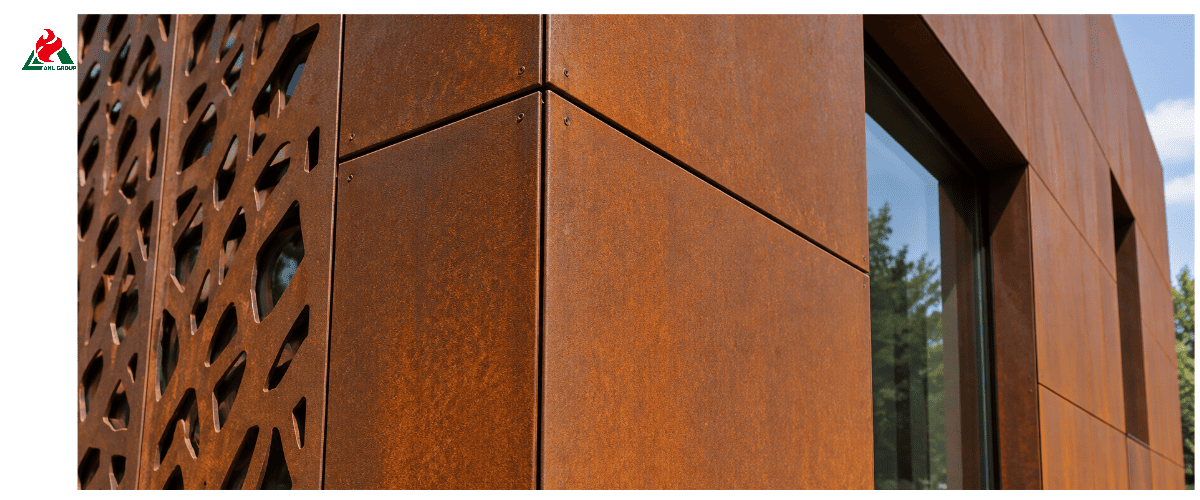
The choice between Corten A and Corten B weathering steel hinges on the following three metallurgical and structural parameters: phosphorus content (0.07% to 0.15% P for Corten A, and ≤0.030% to 0.04% P for Corten B), available sheet thicknesses (Corten A strip steel/sheet ranges from 0.5 mm to 12.5 mm, while Corten B ranges from 2.0 mm to over 50 mm, with custom-made heavy plates available up to 150 mm thick), and the toughness of load-bearing welds. Corten A (ASTM A242 Type 1 / ASTM A606 / EN 10025-5 S355J0WP / 09CuPCrNi-A) accelerates the formation of a fine, dense protective rust layer on architectural cladding, laser-cut privacy screens, planters, and landscape edging by increasing the phosphorus content. Weathering steel B (Corten B) (ASTM A588 Grade A/B / EN 10025-5 S355J2W / GB/T 4171 Q355GNH) has a restricted phosphorus content and includes added vanadium (0.02% to 0.10% V) and a higher manganese content (0.80% to 1.25% Mn) to ensure high impact toughness and crack-free structural welds in bridges, load-bearing columns, retaining walls, and thick-walled fire-resistant enclosures.
1. Executive Summary: The Core Metallurgical Difference Between Corten A and Corten B
Although architects, landscape contractors, and steel buyers often use the term "Corten steel" as if it were a single alloy, the family is divided into two distinct metallurgical formulations: Corten A and Corten B. Confusing the two on a structural blueprint or purchase order can result in either brittle weld joints on load-bearing members or slower, coarser patina formation on thin architectural facades.
Why Phosphorus (0.07%–0.15% vs≤0.035%) Divides Architectural Sheet from Structural Plate
The most significant chemical difference between Corten A and Corten B lies in phosphorus (P):
► Why does Corten A use a high phosphorus content (0.07% to 0.15% P): When exposed to alternating rain and dry sunlight, phosphorus dissolves into the thin surface water film and forms intermediate iron phosphate complexes. These complexes accelerate the transformation of the porous, initial orange rust layer into a dense, submicron-scale amorphous inner barrier layer—goethite (α-FeOOH)—which is rich in copper (0.25% to 0.55% Cu) and chromium (0.50% to 1.25% Cr). In thin architectural steel sheets (0.5 mm to 6.0 mm), this rapid self-sealing action is critical because thin sheets cannot withstand significant metal loss before stabilization occurs.
► Why is the phosphorus content strictly limited in Corten B (≤0.030% to 0.035% P, or ≤0.04% per the ASTM A588 Gr. A standard): In metallurgy, phosphorus is a potent solid-solution strengthening element; however, when its content exceeds 0.04%, segregation occurs along austenite grain boundaries during solidification and welding. In thick plates (>12.5 mm) or structures subjected to dynamic vibrations, wind fatigue, or sub-zero temperatures, high phosphorus content significantly reduces Charpy V-notch impact toughness and causes cold cracking (hydrogen-induced weld cracking) in the heat-affected zone (HAZ). Therefore, Corten B is designed as a low-phosphorus structural steel that can be safely used for heavy-duty multi-pass welding and to withstand dynamic structural loads.
Vanadium Microalloying (0.02%–0.10% V) & Manganese Strengthening in Corten B
Since Corten B eliminates the strengthening effect of high phosphorus content, this is compensated for by rebalancing the alloy composition:
► Higher manganese content (0.80% to 1.25% Mn in Corten B and ASTM A588 Gr. A, compared to 0.20% to 0.50% Mn in Corten A): This improves hardenability and full-thickness tensile strength (470–630 MPa, minimum 485 MPa) without compromising weldability.
► Vanadium microalloying (0.02% to 0.10% V): During hot rolling, vanadium precipitates in the form of fine vanadium carbides and vanadium nitrides, which stabilize the grain boundaries, thereby forming a fine-grained ferritic-pearlitic microstructure. This grain refinement ensures that Corten B / ASTM A588 steel plates maintain a minimum yield strength of 345 to 355 MPa (50,000 psi) and high low-temperature impact energy even at thicknesses of 40 mm to 50 mm.
Atmospheric Corrosion Resistance Index & Patina Color Evolution
► Relative Atmospheric Corrosion Resistance: Due to its higher phosphorus content (0.07%–0.15%) and a wider range of chromium content (0.50%–1.25%), Corten A exhibits 5 to 8 times the atmospheric corrosion resistance of ordinary non-alloy carbon steel, while Corten B exhibits approximately 4 times the atmospheric corrosion resistance of ordinary carbon steel.
► Visual Comparison of Rust Layers: During the first 1 to 6 months of outdoor exposure, Corten A typically develops a slightly finer, warmer-toned, orange-amber, velvety oxide layer, while Corten B exhibits a slightly darker, coarser initial oxide layer. After fully maturing over a period of 12 to 24 months, both grades of steel evolve into a distinctive architectural rust layer ranging from deep reddish-brown to deep bronze.
2. Chemical Composition & Mechanical Properties Comparison Table (Corten A, Corten B, ASTM A242, ASTM A588 & IRSM 41-97)
When reviewing a factory Mill Test Certificate (MTC EN 10204 3.1), use the two verified engineering tables below—compiled from our Corten steel plate and coil specification data and international standard tables—to audit alloy chemistry and mechanical strength.
Table 1: Chemical Composition Comparison (Weight %)
| Alloying Element (wt%) |
Corten A (Architectural / High-P) | ASTM A242 Type 1 (US High-Strength Weathering) | Corten B (Structural / Low-P) | ASTM A588 Grade A (US Heavy Structural) | EN 10025-5 S355J2W (EU Structural Equivalent) | IRSM 41-97 (Rail & Container Grade) |
| Carbon (C) |
≤0.12% | ≤0.15% (0.12% max typical) | ≤0.16% (0.12–0.20%) | ≤0.19% | ≤0.22% (0.16% ladle) | ≤0.10% |
| Manganese (Mn) |
0.20%–0.50% | ≤1.00% (0.50–1.25%) | 0.80%–1.25% (up to 1.50%) | 0.80%–1.25% | 1.00%–1.70% | 0.25%–0.45% |
| Phosphorus (P) |
0.07%–0.15% | ≤0.15% (or ≤ 0.035 % ≤0.035% low-P mod) |
≤0.030%–0.035% | ≤0.04% | ≤0.035% | 0.07%–0.11% |
| Sulfur (S) |
≤0.030% | ≤0.05% | ≤0.030% | ≤0.05% | ≤0.035% | ≤0.030% |
| Silicon (Si) |
0.25%–0.75% | 0.25%–0.40% | 0.30%–0.50% | 0.30%–0.65% | 0.25%–0.75% | 0.28%–0.72% |
| Copper (Cu) |
0.25%–0.55% | ≥0.20% (0.25–0.50%) | 0.25%–0.40% (0.20–0.50%) | 0.25%–0.40% | 0.20%–0.50% | 0.30%–0.39% |
| Chromium (Cr) |
0.50%–1.25% | ≤0.50% (optional) | 0.40%–0.65% (0.30–0.50%) | 0.40%–0.65% | ≤0.50% (0.30–0.80%) | 0.30%–0.50% |
| Nickel (Ni) |
≤0.65% | — | ≤0.40% (0.20–0.40%) | ≤0.40% | — | 0.20%–0.49% |
| Vanadium (V) |
— | — | 0.02%–0.10% | 0.02%–0.10% | — | 0.050% |
| Aluminum (Al) |
0.015%–0.060% | — | 0.020%–0.060% | Fine-grain practice | ≥0.020% | 0.030% |
Table 2: Mechanical Properties & Standard Rolling Thickness Limits
| Grade / Standard |
Minimum Yield Strength (ReL/ MPa) | Tensile Strength (Rm / MPa) | Minimum Elongation (A50/ %) | Standard Strip / Coil Thickness (mm) | Standard Plate Thickness Range (mm) | Primary Structural & Impact Rating |
| Corten A |
345–355 MPa | 470–630 MPa (485 min) | ≥20% | 0.5–12.0 mm | 6.0–12.5 mm (max 12.5 mm) | Architectural, non-dynamic & flue-gas structures |
| ASTM A242 Type 1 |
345–355 MPa | ≥480 MPa (470–620) | ≥18%–19% | 2.0–13.0 mm | 6.0–40.0 mm (up to 50–150mm custom) | Heavy load-bearing, vibration & welded structures |
| Corten B |
345 MPa (up to 100mm) | ≥485 MPa | ≥21% | 2.0–20.0 mm | 6.0–150 mm (full 345 MPa to 100mm) | Bridges, skyscrapers, retaining walls & heavy fire pits |
| ASTM A588 Grade A |
345 MPa (up to 100mm) | ≥485 MPa | ≥21% | 2.0–20.0 mm | 6.0–150 mm (full 345 MPa to 100mm) | Bridges, skyscrapers, retaining walls & heavy fire pits |
| EN 10025-5 S355J2W |
≥355 MPa (up to 16mm) | 470–630 MPa | ≥20% | 2.0–16.0 mm | 6.0–100 mm | 27 Joules Charpy V-notch impact tested at −20∘C |
| IRSM 41-97 |
≥340 MPa | ≥480 MPa | ≥21% | 1.6–12.0 mm | 6.0–25.0 mm | Railway coaches, shipping containers & outdoor enclosures |
3. International Equivalent Grades Cross-Reference Matrix (US ASTM, EU EN 10025-5, China GB/T & India IRSM)
Weathering steel specifications in public bidding documents and national building codes are based on regional standards (North America uses ASTM standards; Europe and the United Kingdom use EN 10025-5; China uses GB/T 4171; and Japan uses JIS G3125).
North American Equivalents: ASTM A242 Type 1, ASTM A588 Gr. A/B, ASTM A606-4 & A709-50W
► For Corten A (Thin Sheet, Coil & Architectural Cladding):
ASTM A242 Type 1: The classic U.S. specification for high-phosphorus, weather-resistant steel. Please note that in modern U.S. steel mill production practices, when ordered as structural steel plates, ASTM A242 is typically supplied in a low-phosphorus version (P ≤ 0.035%); whereas thin architectural steel sheets and coils (0.5 mm to 6.0 mm) are typically ordered as ASTM A606 Type 4 (cold-rolled and hot-rolled high-strength low-alloy steel sheets with atmospheric corrosion resistance at least four times that of ordinary steel).
► For Corten B (Heavy Structural Plate, Shapes & Bars):
ASTM A588 Grade A and Grade B: These are the direct structural equivalents of Corten B. Unlike ASTM A242—for which the minimum yield strength is reduced from 345 MPa (50 ksi) to 315 MPa (46 ksi) (for thicknesses exceeding 19 mm) and 290 MPa (42 ksi) for thicknesses exceeding 38 mm—ASTM A588 maintains its minimum yield strength of 345 MPa (50 ksi) even at plate thicknesses up to 100 mm (4 inches). For highway bridges requiring Charpy V-notch fracture toughness testing, the applicable specification is ASTM A709 Grade 50W.
European (EN 10025-5) & German DIN Equivalents: S355J0WP vs S355J0W / S355J2W (1.8945)
According to the European standard EN 10025-5, the designation codes clearly indicate the specific metal composition and impact test temperature:
► S355 = Structural steel with a minimum yield strength of 355 MPa (thickness ≤ 16 mm); J0 and J2 = Charpy V-notch longitudinal impact energy of at least 27 joules, with test temperatures of 0°C (J0) or -20°C (J2), respectively;
► W = weather-resistant steel (Wetterfester Baustahl);
► P = high-phosphorus grade (phosphorus content of 0.06% to 0.15%). Therefore:
► S355J0WP (as well as S355J2WP, material number 1.8946) is the exact European equivalent of Corten A;
► S355J0W (material number 1.8959) and S355J2W (material number 1.8965 / DIN WTSt 52-3 / 1.8945) are the European standard equivalents of Corten B.
Asian & Railway Standards: China GB/T 4171 (09CuPCrNi-A / Q355GNH), Japan JIS G3125 (SPA-H) & India IRSM 41-97
When sourcing factory-direct processed construction products or raw material coils/sheets internationally, you will also see the following verified mill designations on the Material Test Certificate (MTC):
► China (GB/T 4171): 09CuPCrNi-A and Q355GNH (high-weathering copper-phosphorus-chromium-nickel alloy, equivalent to Corten A / SPA-H, suitable for architectural sheets, edge trim, planters, and screens); Q355NH and Q450NQR1 (low-phosphorus structural weathering steel, equivalent to Corten B / ASTM A588 / S355J2W).
► Japan (JIS G3125): SPA-H (hot-rolled steel with exceptional atmospheric corrosion resistance, phosphorus content 0.07%–0.15%, yield strength ≥355 MPa—the global benchmark for Corten A hot-rolled coils and shipping containers) and SPA-C (cold-rolled sheet, thickness 0.5 mm to 3.2 mm).
Table 3: Global Weathering Steel Grade Cross-Reference Matrix
| Standard / Region |
Corten A Equivalent (High-P Architectural & Sheet Grade) | Corten B Equivalent (Low-P Heavy Structural & Impact Grade) |
| Brand Designation |
COR-TEN A | COR-TEN B |
| United States (ASTM) |
ASTM A242 Type 1 / ASTM A606 Type 4 (Sheet & Coil) | ASTM A588 Grade A / Grade B / ASTM A709 Gr. 50W |
| Europe / UK (EN 10025-5) |
S355J0WP (1.8945/1.8946) / S355J2WP | S355J0W (1.8959) / S355J2W (1.8965) / S355K2W |
| Germany (Legacy DIN / SEW 087) |
WTSt 37-3 / 1.8946 | WTSt 52-3 / 1.8945 |
| China (GB/T 4171) |
09CuPCrNi-A / Q355GNH | Q355NH / Q450NQR1 |
| Japan (JIS G3125) |
SPA-H (Hot-Rolled) / SPA-C (Cold-Rolled) | JIS G3114 SMA490AW / SMA490BW |
| India (IRS) |
IRSM 41-97 | IS 2062 E350 Cu / Weathering Structural |
4. Thickness & Gauge Guide: From 0.5mm Cold-Rolled Coils to 150mm Heavy Structural Plates
As shown in our Corten steel coil and plate inventory, AHL supplies weathering steel coils in thicknesses ranging from 0.5 mm to 20 mm (with widths from 600 mm to 2,000 mm), as well as heavy plates in thicknesses ranging from 6 mm to 150 mm (with widths from 1,500 mm to 3,800 mm, up to 27,000 millimeters in length). Understanding the distinction between Corten A and Corten B across different thickness ranges can help avoid unnecessary costs resulting from improper specification selection.
Thin-Gauge Cold-Rolled Sheet & Coil (0.5mm to 3.0mm / 24 Gauge to 11 Gauge): The Domain of Corten A
In the 0.5 mm to 3.0 mm range, Corten A (SPA-H / SPA-C / S355J0WP / ASTM A606-4 / 09CuPCrNi-A) is the standard grade:
► 0.5 mm to 1.2 mm (24 to 18 gauge cold-rolled): Suitable for corrugated roofing, standing seam wall cladding, micro-rib exterior wall panels, and lightweight interior decorative panels—applications that require low self-weight and crisp, clean forming results.
► 1.5 mm to 2.0 mm (16 ga to 14 ga): Primarily used for flexible landscape lawn edging (AHL-GE01 to GE10), residential rain-screen modules, lightweight garden planters, and outdoor bollard light boxes.
► 2.5 mm to 3.0 mm (12 ga to 11 ga): These are the primary thicknesses for architectural steel sheets, suitable for commercial modular curtain walls, laser-cut privacy screen panels, commercial trough planters, and residential fire pits.
Medium Architectural & Landscape Plate (3.0mm to 12.5mm / 11 Gauge to 1/2 Inch): The Overlap Zone
Both Corten A and Corten B are rolled in thicknesses ranging from 3.0 mm to 12.5 mm. Within this overlap range, the steel grade should be selected based on the stress conditions and fabrication methods:
► When components are primarily used for aesthetic decoration, are self-supporting, or are exposed to corrosive flue gas or garden moisture environments without severe dynamic impact, Corten A (3.0 mm to 12.0 mm) should be selected— for example, decorative laser-cut screens ranging from 3.0 mm to 6.0 mm, 4.0 mm water feature spillways, architectural planters ranging from 3.0 mm to 6.0 mm, and industrial exhaust flues.
► When components serve as primary load-bearing elements, bolted structural columns, retaining walls, or heavy-duty thermal storage tanks, Corten B / ASTM A588 (3.0 mm to 12.5 mm) should be selected —for example, 75×75×3.0 mm to 100×100×4.0 mm wind-resistant privacy screen posts, 4.0 mm to 6.0 mm driveway retaining edging, and commercial wood-burning fire pits with thicknesses of 4.0 mm to 5.0 mm or greater.
Heavy Structural Plate (12.5mm to 50mm–150mm): Why Only Corten B / ASTM A588 Applies
International rolling standards limit the maximum thickness of Corten A (S355J0WP) to 12.5 mm (1/2 inch) because, as plate thickness increases and triaxial confinement across the thickness grows, high-phosphorus steel becomes progressively more susceptible to brittle splitting fracture. For any steel plate thicker than 12.5 mm (14 mm, 16 mm, 20 mm, 25 mm, 40 mm, 50 mm, up to a maximum of 150 mm), Corten B (ASTM A588 Grade A/B or EN 10025-5 S355J2W) must be specified.
5. Application Mapping: Matching Corten A and Corten B to Architectural & Landscape Products
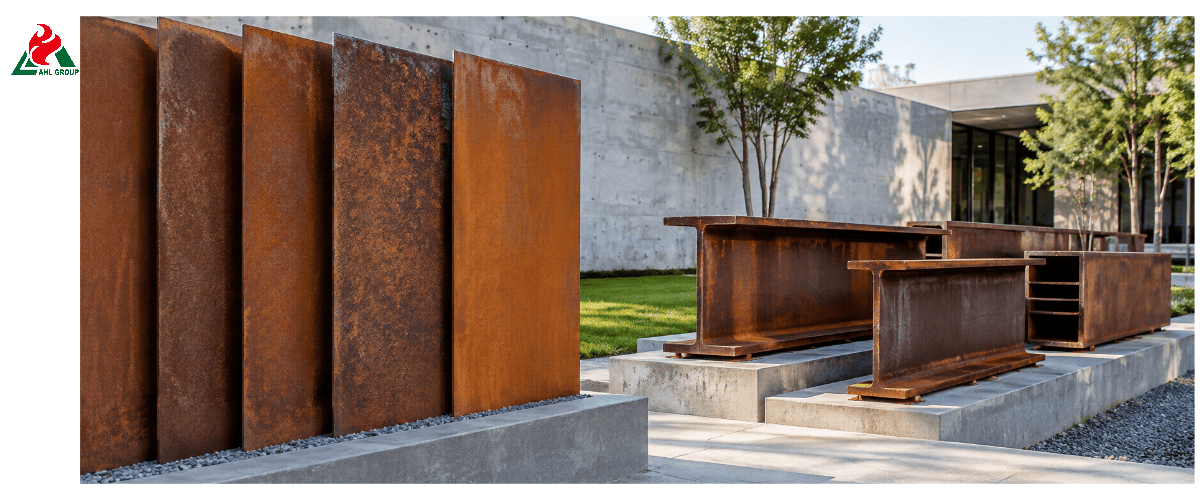
To translate alloy metallurgy into practical application guidelines, here are specific applications of Corten A and Corten B in building facades, landscape products, and civil infrastructure:
Architectural Rainscreen Cladding, Corrugated Siding & Cassette Facades (1.5mm–4.0mm Corten A)
For building envelopes—such as our durable Corten steel cladding and curtain wall systems—Corten A (S355J0WP / ASTM A242 Type 1 / ASTM A606-4) with a thickness of 1.5 mm to 4.0 mm is the industry standard:
► Why Corten A stands out in curtain wall applications: Its phosphorus content of 0.07% to 0.15% and chromium content of 0.50% to 1.25% enable the formation of a dense, fine-grained rust layer on vertical wall panels up to 3,000 mm × 1,500 mm in size, thereby minimizing long-term rust bleeding after the initial stabilization period of 6 to 18 months.
► Structural Substructure Load-Bearing Members: If concealed primary load-bearing supports or structural steel beams behind the ventilation cavity are required to withstand significant seismic or wind loads across multiple stories, Grade B weathering steel (ASTM A588 / S355J2W) or 316 stainless steel should be specified as the material for the structural substructure, while maintaining Grade A weathering steel for the visible cladding modules.
Landscape Lawn Edging (1.5mm–3.0mm) & Commercial Planter Boxes (2.0mm–6.0mm)
► Flexible and Durable Landscape Edging: Our flexible Corten metal landscape edging (AHL-GE01 through GE10) is available in thicknesses of 1.5 mm, 1.6 mm, 2.0 mm, and 3.0 mm. Made from weathering steel A (09CuPCrNi-A / SPA-H), it can be manually bent by contractors into smooth garden curves (elongation ≥20%) while offering exceptional resistance to corrosion at the moisture line. For edging structural terraces or driveway retaining walls with thicknesses ranging from 5.0 mm to 6.0 mm, specify the thicker-gauge Corten A or Corten B (ASTM A588) may be specified.
► Architectural and Commercial Planters: Across our Corten steel planter pot series (residential/commercial long-trough planters 2.0 mm to 3.0 mm thick, with double-folded edges and internal reinforcing ribs), Corten A steel allows for clean 90-degree bends and rapid formation of an external rust layer. For extra-large municipal tree planters manufactured from 4.0 mm to 6.0 mm or thicker steel sheets that must withstand impacts from forklifts or the load of vehicle crash barriers, Corten B (ASTM A588) provides exceptional impact toughness.
Laser-Cut Privacy Screens (1.5mm–6.0mm Corten A Panels + Corten B / A588 Structural Posts)
Engineered outdoor screen assemblies—such as our Corten steel garden screen and fencing systems—combine these two grades of steel to achieve optimal performance:
► Decorative laser-cut screen panels (1.5 mm to 6.0 mm): Specify Weathering Steel Grade A (SPA-H / S355J0WP / ASTM A606-4). Its low carbon content (≤0.12% C) and smooth cold-rolled/hot-rolled coil surface allow CNC fiber laser cutters to produce intricate geometric and botanical patterns without slag or burrs on the edges, ensuring the panels remain flat and stable.
► Wind-resistant structural support columns (75 × 75 × 3.0 mm to 100 × 100 × 4.0 mm square tubing and 8–12 mm base plates): Structural hollow-section columns and welded anchor base plates shall be specified to use Weathering Steel B (Corten B, ASTM A588 / S355J2W / Q355GNH) to ensure that the welds at the concrete foundation interfaces maintain good ductility and integrity under gust loads.
Wood-Burning Fire Pits (3.0mm–5.0mm+) & Plancha BBQ Grill Fire Cones (4.0mm Bowl + 10mm Carbon Steel Ring)
In outdoor heating equipment—such as our Corten steel outdoor fire pit and wood fire bowl (OFP0014 and AHL-FP01–FP25)— these two product grades each serve their own specific purposes:
► Bases, gas fireplace cabinets, and flues (2.0 mm to 3.0 mm): Corten A steel performs exceptionally well in vertical bases, wood storage bases, and outdoor fireplace flues because its high-phosphorus, high-chromium formulation is specifically designed to withstand sulfur-containing flue gas condensation and atmospheric weathering.
► Heavy-duty wood-burning fire pits (3.0 mm to 5.0 mm and above): Deep wood-burning fire bowls (OFP0014—customizable in 3 mm–5 mm thicknesses; AHL-FP20/21/22; and 4.0 mm barbecue fire cones) can be manufactured using Corten A or ASTM A588 / Corten B thick plates. In cold winter climates, welded square fire pits ranging from 4.0 mm to 6.0 mm+ in thickness are subjected to severe thermal cycling and impacts from firewood; in such cases, ASTM A588 / Corten B provides additional weld toughness. (Note: For flat-bottomed grills, the 10-millimeter food-contact cooking ring itself is always made of food-grade carbon steel or 304 stainless steel; untreated Corten steel is never used.)
Highway Bridges, Earth-Retaining Walls, Shipping Containers & Flue Gas Ducts
► Always use Corten A (S355J0WP / SPA-H / IRSM 41-97): corrugated sheets for multimodal ISO freight containers (1.6 mm to 2.0 mm), exterior panels for railway passenger car bodies, air preheaters for industrial boilers, chimney flues, and building facade modules.
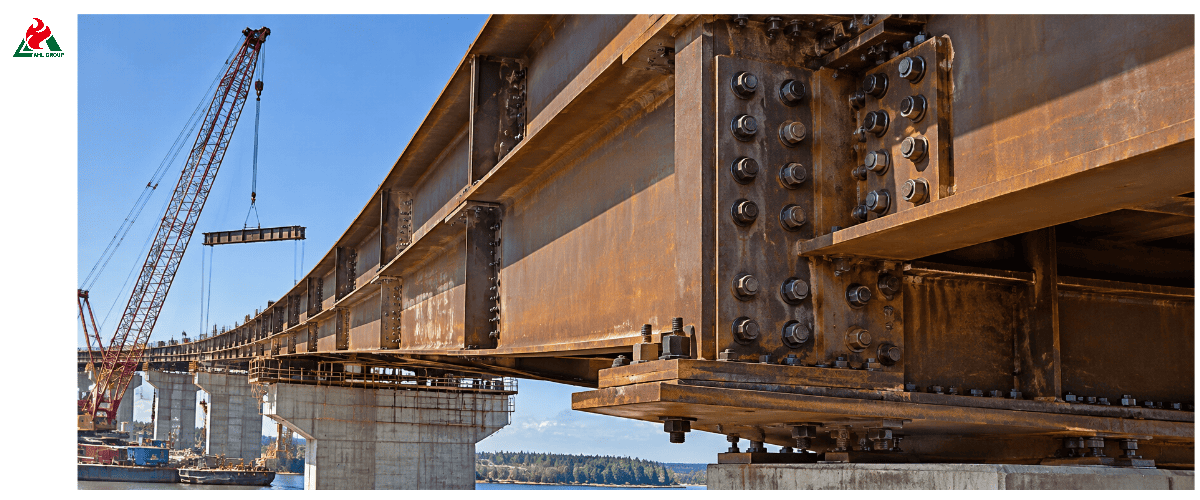
► Always use Corten B (ASTM A588 / ASTM A709-50W / S355J2W) for: unpainted highway and railway box-girder bridges, high-voltage transmission towers, crane booms, sheet pile retaining walls, and seismic-resistant building frames.
6. Fabrication, Bending, Laser Cutting & Welding Differences (Corten A vs Corten B)
Due to the higher yield strength of weathering steel (Corten)—345–355 MPa, compared to 235–250 MPa for ordinary low-carbon steel—and its different alloy composition, its processing parameters differ from those of ordinary low-carbon steel (A36 / S235JR).
Cold Bending & Press-Brake Forming Radii (1.5mm–6.0mm Sheet & Plate)
1. Springback Allowance: Since the minimum yield strength of both Corten A and Corten B is around 345 to 355 MPa, and their tensile strength ranges from 470 to 630 MPa, press operators must account for the fact that springback is greater than that of ordinary low-carbon steel and increase the press tonnage per meter accordingly.
2. Minimum Inner Bending Radius:
► For Corten A (1.5 mm to 3.0 mm thin sheets), if the bending direction is perpendicular to the rolling grain direction, the minimum inner bending radius should be 1.0× to 1.5× (1t–1.5t) of the sheet thickness; if the bending direction is parallel to the rolling grain direction, it should be 2.0t.
► For sheets ranging from 4.0 mm to 6.0 mm in thickness, the minimum inner die radius should be increased to 2.0× to 3.0× the sheet thickness (2t–3t)—or, when sharp architectural 90-degree corners are required for heavy-duty planters or steps, a CNC rear V-grooving process should be used.
► For steel sheets thicker than 6.0 mm (8 mm to 20 mm or more), Corten B (ASTM A588 / S355J2W) should always be specified for cold forming, as its lower phosphorus content (≤0.035%) prevents the formation of microcracks in the outer fibers during heavy-duty bending.
Welding Consumables (AWS E7018-W / ER80S-G / 0.5% Cu Wire) & Phosphorus Dilution Rules
Whether welding Corten A or Corten B, the following three shop rules must be followed:
► Single-pass welding of thin plates (Corten A with a thickness of 1.5 mm to 3.0 mm): For thin-walled architectural planters, frames, or screen frames, standard low-hydrogen carbon steel MIG wire (ER70S-6) may be used for short-distance single-pass welding, as the molten pool will absorb sufficient copper, chromium, and phosphorus from the surrounding weathering steel base material (base material dilution), thereby allowing weathering to occur at a similar rate. However, for exposed architectural welds, weathering steel welding wire containing 0.5% copper (such as ER80S-G / ER80S-Ni1 or ESAB OK Aristorod 13.26) ensures a perfect match with the rust color.
► Multi-pass structural welds (>4.0 mm weathering steel B / ASTM A588): Be sure to use specialized low-hydrogen weathering steel electrodes and welding wires (AWS A5.5 E7018-W / E8018-W, E8018-B2, or ER80S-Ni1 containing copper, nickel, and chromium) to ensure that the weld surface forms a protective oxide layer identical to that of the base metal and achieves a tensile strength of 485+ MPa.
► Preventing Hot Cracks/Cold Cracks When Welding Corten A: Since Corten A contains 0.07% to 0.15% phosphorus, moderate heat input should be maintained during welding (using low current and moderate travel speed to avoid excessive grain coarsening), and high-phosphorus Corten A must never be used in constrained multi-pass fillet welds (for dynamically loaded joints).
Compatible Fasteners (316/A4 Stainless Steel & Weathering High-Strength Bolts ASTM A325 Type 3)
As detailed in our engineering guide on what fasteners are compatible with Corten steel panels:
► Heavy-Duty Structural Weathering Steel B / ASTM A588 Connections: Please use ASTM A325 Type 3 (or ASTM F3125 A325 Type 3/A490 Type 3) weathering steel structural bolts, nuts (ASTM A563 Grade DH3), and washers (ASTM F436 Type 3). These fasteners are fully compatible with Corten B in terms of chemical corrosion resistance and rust patina.
► Weathering steel Type A panels, screens, and planters for architectural use: Use 316 (A4) marine-grade stainless steel bolts, blind rivets, or chamfered anchor bolts, along with EPDM/nylon spacer washers to prevent electrochemical discoloration caused by dissimilar metals and to allow for thermal expansion. Never use bright zinc-plated (BZP) carbon steel screws.
7. Environmental Boundaries: Where Neither Corten A Nor Corten B Should Be Used Bare
Although Corten A and Corten B offer 4 to 8 times the atmospheric corrosion resistance of ordinary low-carbon steel, both alloys rely on the same fundamental electrochemical mechanism: alternating wet and dry cycles in a chloride-free atmospheric environment.
Subtropical Marine Coastlines (<1–2 km Salt Spray & Airborne Chlorides)
As we noted in our analysis of environments unsuitable for Corten cladding, within 1 to 2 kilometers of the shoreline (or on road sections where rock salt is extensively used for winter deicing), sodium chloride (NaCl) in the air is hygroscopic. Even on sunny days, salt crystals embedded in the rust layer absorb moisture from the humid air, thereby preventing the oxide film from drying and converting stable goethite (α-FeOOH) into porous, flaking hematite (β-FeOOH). Within 1 kilometer of the ocean, exposed Weathering Steel A or B must be sealed or coated, or replaced with 316 stainless steel or marine-grade powder-coated aluminum.
Continuously Submerged Water Basins, Buried Soil & Non-Draining Crevices
Whether Corten A or Corten B, a protective rust layer cannot form when the material is permanently submerged in water, directly buried in wet clay without drainage, or trapped under wet wood ash:
► In water feature projects, submerged internal reservoirs should be lined with a 250- to 400-micron, two-component epoxy or polyurea coating specifically designed for ponds, while the external Corten A shell should be exposed to daily wet-dry cycles;
► In planters and retaining walls, the inner walls in contact with soil should be coated with a root-resistant asphalt-epoxy membrane, and a drainage mat with dimples should be installed along with a 20-millimeter XPS insulation layer;
► In concrete column bases, apply a two-component epoxy barrier primer to the embedded portion of the Corten B columns and the area 50 millimeters above the sloped concrete collar.
8. Frequently Asked Questions (FAQ)
Q1: What is the main difference between Corten A and Corten B?
The main differences lie in phosphorus content and structural applications:
► Corten A (ASTM A242 Type 1 / S355J0WP / SPA-H) has a higher phosphorus content (0.07% to 0.15% P) and a higher chromium content (0.50% to 1.25% Cr), which makes its atmospheric corrosion resistance 5 to 8 times greater than that of ordinary low-carbon steel and allows it to rapidly form a fine-grained rust layer. It can be rolled to a thickness of up to 12.5 millimeters and is suitable for architectural exterior cladding, screens, planters, edge trim, and flues.
► Corten B (ASTM A588 Gr. A/B / S355J2W) limits phosphorus content to ≤0.030%–0.04% and adds vanadium (0.02%–0.10% V) and a higher manganese content (0.80%–1.25% Mn) to ensure that steel plates ranging from 2.0 mm to 50 mm–150 mm in thickness possess high impact toughness and crack-free structural welds. It is suitable for load-bearing structures, bridges, retaining walls, and heavy-duty fire pits.
Q2: Is ASTM A588 equivalent to Corten A or Corten B?
ASTM A588 (Grades A and B) is the direct U.S. structural equivalent of Corten B, not Corten A. Both ASTM A588 Grade A and Corten B have restricted phosphorus content (≤0.030%–0.04%), with 0.80%–1.25% manganese, 0.40%–0.65% chromium, 0.25%–0.40% copper, and 0.02%–0.10% vanadium, and the entire range of heavy-gauge structural steel plates maintains a minimum yield strength of no less than 345 MPa (50 ksi). In contrast, Corten A is equivalent to high-phosphorus ASTM A242 Type 1 (and ASTM A606 Type 4 for thin sheets and coils).
Q3: Which is more suitable for exterior wall cladding and garden planters—Corten A or Corten B?
Corten A (S355J0WP / ASTM A606-4 / 09CuPCrNi-A) is more suitable for architectural exterior wall cladding, corrugated exterior wall panels, laser-cut privacy screens, landscape edging, and garden planters with thicknesses ranging from 0.5 mm to 6.0 mm. Its higher phosphorus content accelerates the formation of a dense, uniform reddish-brown rust layer and results in lower material wastage; its cold-rolled/hot-rolled strip steel (0.5–3.0 mm thick) can be neatly bent on CNC press brakes.
Q4: Why is Corten A limited to plates up to 12.5mm thick?
The maximum thickness for Corten A is 12.5 mm (1/2 inch) because its high phosphorus content (0.07%–0.15% P) raises the ductile-to-brittle transition temperature in thick steel sections. For thicknesses exceeding 12.5 mm, the internal triaxial stresses generated by welding and cold-weather loads require the use of a low-phosphorus, fine-grained alloy—which is why all heavy-gauge weathering steel plates thicker than 12.5 mm (14 mm to 150 mm) are produced in accordance with the Corten B / ASTM A588 / EN 10025-5 S355J2W standard.
Q5: Which grade should I specify for a wood-burning fire pit or BBQ grill?
► For fire pit bases, firewood storage bases, gas fire table housings (2.0 mm to 3.0 mm), and compact spun fire bowls, Corten A steel offers excellent resistance to atmospheric and flue gas corrosion.
► For large, thick-walled wood-burning fire bowls (4.0 mm to 6.0 mm and above) and welded square commercial fire pits that must withstand severe thermal shock and impacts from logs, ASTM A588 / Corten B (or heavy-gauge Corten A) is the ideal choice.
► For flat-bottomed grill rings (10-millimeter steel plates) that come into direct contact with food, be sure to specify food-grade carbon steel or 304 stainless steel—never use untreated Corten A or B.
Conclusion: Specifying the Right Weathering Steel Grade for Your Project
Understanding the boundary between Corten A (ASTM A242 Type 1 / ASTM A606-4 / EN 10025-5 S355J0WP / 09CuPCrNi-A) and Corten B (ASTM A588 Grade A/B / EN 10025-5 S355J2W / GB/T 4171 Q355GNH) ensures every outdoor project achieves both visual longevity and structural safety. Specify high-phosphorus Corten A (0.5 mm to 12.5 mm) whenever fine-grained patina aesthetics, press-brake formability, and thin-sheet corrosion resistance drive the design—across rainscreen facades, laser-cut privacy screens, landscape edging, and planter boxes. Specify low-phosphorus, vanadium-strengthened Corten B (2.0 mm to 50 mm–150 mm) whenever heavy plate thickness, multi-pass structural weld toughness, dynamic wind/seismic loads, or intense wood-fire thermal stresses govern the engineering calculation.
At AHL Corten Group, we supply both raw Corten steel plates and coils (0.5–20 mm coils and 6–150 mm heavy plates to ASTM, EN, JIS, and GB standards with full Mill Test Certificates) and factory-fabricated architectural solutions—including durable Corten steel cladding and curtain wall systems, flexible Corten metal landscape edging, Corten steel planter pots, Corten steel garden screens, and Corten steel outdoor fire pits and wood fire bowls.
For related technical guidance on fastener selection and environmental durability limits, read our engineering articles on what fasteners are compatible with Corten steel panels and what environments are not suitable for Corten cladding.
Sourcing Custom Corten Steel Cladding or Corten Panels?
AHL Corten Group fabricates custom ASTM A588/A242 architectural panels with pre-punched fixing holes and concealed clip systems.
» View Corten Cladding Specs | Custom Corten Steel Panels | Request a Free CAD Quote
AHL Corten Group fabricates custom ASTM A588/A242 architectural panels with pre-punched fixing holes and concealed clip systems.
» View Corten Cladding Specs | Custom Corten Steel Panels | Request a Free CAD Quote

