


The unique and natural aesthetic qualities of weathering steel (Corten steel) make it a highly sought-after material for contemporary building facades, roofs, and landscape design. However, it is precisely Corten steel's most distinctive characteristic—its ability to form a protective rust layer—that presents unique chemical and mechanical challenges during installation. The use of inappropriate installation hardware can lead to rapid structural failure, unsightly stains, and severe material degradation. This comprehensive guide details the key factors in fastener compatibility to ensure that your Corten steel panel installation remains structurally sound and visually flawless for decades to come.
1. Introduction
Why Fastener Compatibility Is Critical for Corten Steel Panels
When installing architectural metal panels, fasteners serve as the key mechanical connections that resist wind shear, gravity, and thermal expansion and contraction. For Corten steel, the selection of fasteners also involves chemical considerations. Because Corten steel undergoes dynamic interactions with the environment, the use of incompatible fasteners can trigger destructive chemical reactions, thereby compromising the safety and visual appeal of the entire installation.
The Difference Between Weathering Steel and Ordinary Steel Sheets
Ordinary carbon steel or low-carbon steel requires a continuous surface barrier coating (such as paint or powder coating) to be used in outdoor environments. Weathering steel is a special alloy rich in copper, chromium, and nickel. When exposed to cyclic wet-dry conditions, it forms a dense, stable, and self-protective oxide layer (commonly known as patina). This oxide layer seals the underlying steel, significantly slowing the corrosion rate without the need for any artificial coatings.
What This Guide Covers
This guide provides a roadmap developed by industry experts to help you successfully install weathering steel building components securely. We will explore the potential risks associated with standard hardware, evaluate high-quality, compatible metal alloys for fasteners, analyze the specific requirements of different applications (such as the differences between exterior wall panels and roofing), and detail installation best practices to eliminate electrochemical corrosion and rust.
2. Can You Use Regular Fasteners?
When to Use Standard Fasteners
Standard carbon steel, galvanized, or bright steel fasteners should rarely be used for permanent outdoor Corten cladding installations. Such fasteners are suitable only for short-term temporary installations, indoor environments with strictly controlled humidity, or non-exposed prototype assemblies where long-term environmental durability and moisture exposure are not factors.
Situations to Avoid
The use of standard, incompatible fasteners must be strictly avoided in all exterior cladding, roofing, structural framing, and retaining wall applications. Standard construction screws or standard galvanized fasteners cannot match the decades-long service life of weathering steel and will deteriorate rapidly when exposed to the natural environment.
Risks of Corrosion and Staining
Using standard fasteners exposes your project to two major risks: structural failure due to accelerated rusting and severe damage to the surface appearance. Incompatible fasteners will rust prematurely, creating a risk of Corten panel detachment. Furthermore, these failed fasteners will leach loose, low-quality iron oxide residues onto the Corten steel surface, forming patchy, dark red rust stains that disrupt the uniform, velvety texture of the mature rust patina.
3. Best Fastener Materials for Corten
Selecting the appropriate fastener material is a critical decision for ensuring the integrity of weathering steel components.
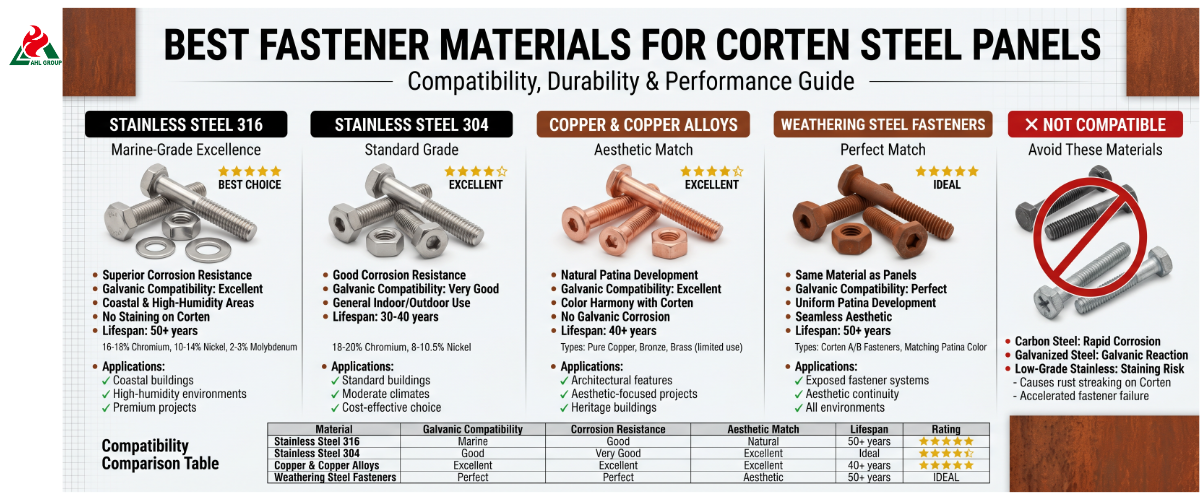
Stainless Steel Fasteners
High-quality stainless steel fasteners—particularly grades 304 or 316—are widely regarded in the industry as the standard for securing thin-gauge Corten exterior wall panels and roof panels. The surface of stainless steel features an ultra-stable chromium oxide passivation layer that resists corrosion, ensuring the fasteners’ service life far exceeds that of the surrounding panels. However, because stainless steel has a higher electrochemical potential than weathering steel, it must be used with non-conductive washers to prevent the formation of localized galvanic cells.
Weathering Steel Fasteners
For heavy-duty structural connections, structural bolts manufactured from weathering steel alloys (such as ASTM A325 Type 3 or ASTM A242) are the preferred choice. The metal composition of these fasteners is identical to that of the weathering steel sheets themselves. Over time, the bolts will weather at the same rate and develop the same deep chocolate-brown color, creating a visually seamless appearance while eliminating any risk of structural or chemical incompatibility.
Hot-Dip Galvanized Fasteners
Hot-dip galvanized (HDG) fasteners (compliant with ASTM A153) feature a thick, chemically bonded zinc coating. Although they provide good initial atmospheric protection, intense sacrificial corrosion occurs when the zinc comes into direct contact with weathering steel. The zinc layer actively sacrifices itself to protect the underlying metal, leading to premature depletion of the protective layer and subsequent rusting of the fastener core. These fasteners should only be used in dry, arid climates or in low-risk construction areas.
Applications for Coated Fasteners
Specialty engineering fasteners featuring multi-layer ceramic coatings, fluoropolymer resins, or organic zinc flake barrier coatings can be used in specific light-duty applications. These proprietary coatings form an effective barrier layer that isolates the base material from the weathering steel; however, care must be taken during installation to avoid scratching the coating with screwdriver bits, as this would expose the underlying steel to corrosion.
4. Compatibility by Application
The physical forces and environmental exposure conditions in the installation environment determine the type and material composition required for the fastener assembly.
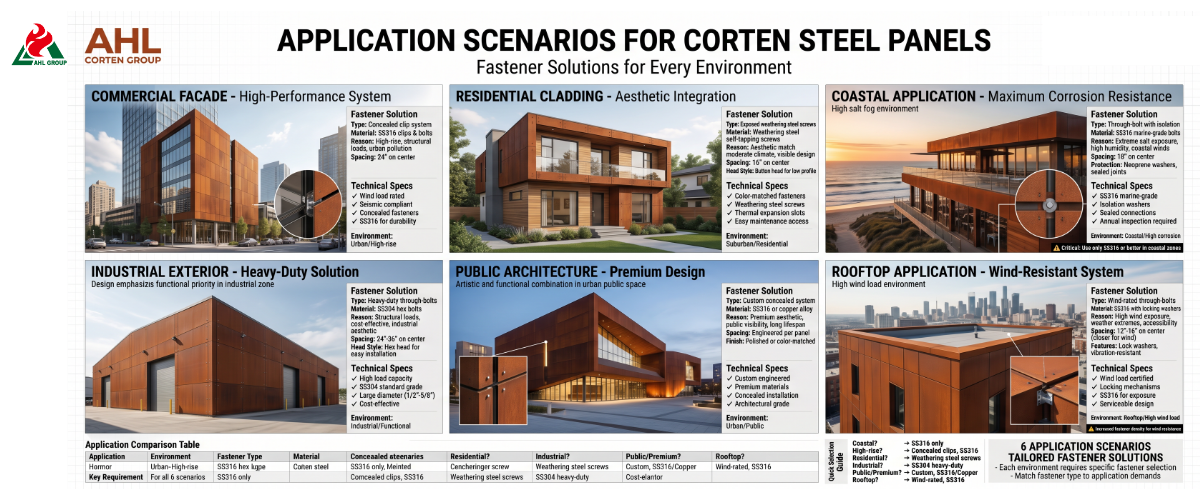
Fastener for Exterior Wall Cladding
Due to solar heat radiation, exterior wall cladding and building facade panels undergo continuous thermal movement (expansion and contraction) throughout the day. Fasteners used for such vertical applications should be equipped with integrated neoprene or EPDM rubber washers. These washers allow the weathering steel panels to slide slightly under thermal stress, thereby preventing friction with the fastener shank or delamination of the underlying substrate.
Fasteners for Roofing Panels
Corten steel roofing panels are subjected to the most severe environmental stresses, including snow loads, direct UV exposure, and water runoff. Roofing fasteners must be made strictly from corrosion-resistant materials (such as 316-grade stainless steel) and equipped with heavy-duty, UV-resistant sealing caps to prevent moisture from entering the guide holes, which could corrode the underlying roofing panels or structural framework.
Fasteners for Structural Support
Heavy-duty structural frames, retaining wall assemblies, and structural beams require extremely high tensile and shear strength. These high-load connections must use heavy-duty hexagonal weather-resistant structural steel bolts (ASTM A325 Type 3). These bolts ensure even load distribution, match the structural thermal expansion coefficient of the main building frame, and eliminate structural risks.
Concealed and Exposed Fasteners
Concealed fastening systems shield clips, brackets, and screws from direct exposure to rain and sunlight. Because moisture pathways are restricted, this approach offers greater flexibility in fastener selection. However, exposed installation leaves hardware directly exposed to the elements, making material compatibility and rust prevention top priorities in architectural design.
5. Factors That Affect Fastener Choice
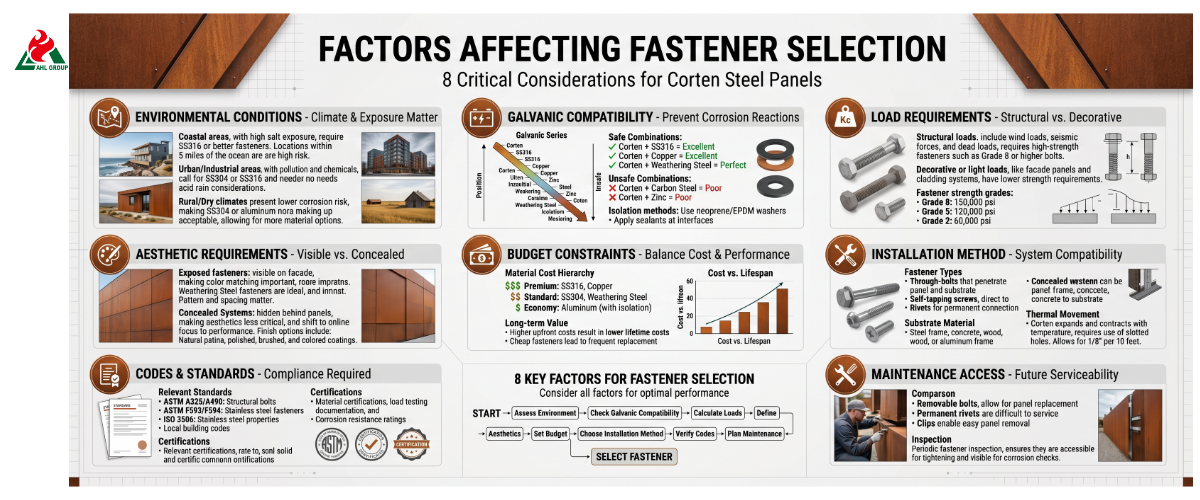
Moisture and Weather Conditions
Weathering steel relies on alternating wet and dry cycles to form its protective rust layer. If installed in areas with high humidity, coastal marine environments, or forested areas that remain in the shade for extended periods, the steel will remain damp for long periods of time. This prolonged moisture accelerates electrochemical reactions; therefore, high-quality 316-grade stainless steel must be used to withstand prolonged exposure to electrolyte corrosion.
Direct Contact with Dissimilar Metals
When two different metals come into contact in the presence of water, an electrochemical cell is formed. The less noble metal will corrode rapidly, while the more noble metal is protected. Weathering steel must be physically isolated from significantly dissimilar metals, such as aluminum, copper, and polished carbon steel, to prevent catastrophic structural failure.
Load Requirements and Sheet Thickness
Thin cladding sheets (1 mm to 2 mm) can be securely fastened using self-tapping stainless steel screws or rivets. In contrast, heavy structural steel sheets (3 mm to 6 mm and above) require large-diameter weathering steel bolts, which must be capable of withstanding significant dead loads and wind shear forces without shearing under load.
Aesthetic Considerations
If the architectural design objective is to create a seamless, unified wall surface with a consistent rusted texture, weathering steel fasteners should be prioritized, as they blend seamlessly with the wall. If the design style seeks to achieve a contrasting effect characteristic of a modern, high-tech industrial aesthetic, exposed polished stainless steel rivets or screws can be used to form a clean, grid-like pattern on the facade.
6. Common Fastener Problems
Electrochemical Corrosion
This occurs when incompatible metals, such as aluminum, are fastened directly to weathering steel plates without electrical isolation. The aluminum rapidly oxidizes, dissolves, and weakens, causing the plates to loosen and rattle, and eventually detach from the structural framework under wind loads.
Rust Streaks and Stains
If standard carbon steel screws are inadvertently used, they will corrode at an uncontrolled and rapid rate. The resulting low-quality iron oxide solution will run down the surface of the weathering steel sheet, leaving permanent black oil stains that destroy the velvety texture characteristic of mature weathering steel.
Loosening of Fasteners Over Time
Because Corten cladding panels undergo significant thermal expansion and contraction under direct sunlight, fastening holes may slightly elongate over time if fasteners are overtightened or if flexible washers are not used. This can cause panels to rattle and vibrate in the wind, allowing moisture to penetrate the building envelope.
Coating Failure and Peeling
When painted or coated fasteners are driven into hard weathering steel, physical friction often scratches or peels the coating. Once the coating is damaged, moisture penetrates the defect, causing hidden corrosion beneath the paint layer, which may subsequently lead to unexpected breakage of the fastener head.
7. Installation Best Practices
To ensure a perfect installation, isolation procedures and waterproofing techniques must be strictly followed.
Use Compatible Washers and Gaskets
Every exposed stainless steel or galvanized fastener must be used with an EPDM or neoprene adhesive washer. This washer serves a dual purpose: it seals the hole to prevent rainwater intrusion and acts as a physical, non-conductive barrier to prevent direct electrical contact between two dissimilar metals, thereby eliminating electrochemical corrosion.
Prevent Water Pooling
When designing fastening points, ensure that water does not accumulate around the fastener head. Avoid using countersunk fasteners that create small pools of water. Fasteners should always protrude from the panel surface and feature a slightly domed or flat head to allow for natural drainage.
Preventing Metal-to-Metal Contact
If weathering steel panels are installed on an aluminum or standard carbon steel sub-frame system, apply a barrier tape (such as heavy-duty butyl tape or EPDM rubber strips) along the entire surface of the sub-frame members before inserting fasteners. This ensures that the panels never come into contact with the underlying framework.
Consult Manufacturer Recommendations
Before specifying fasteners, be sure to consult the technical data sheets provided by the Corten steel sheet manufacturer. Engineering specifications may vary depending on regional wind loads, sheet profiles, and specific environmental factors. Following the manufacturer’s instructions ensures that the warranty remains valid.
8. Structural Fastener Options
► Screws: Heavy-duty self-drilling or self-tapping stainless steel screws with integral hex heads and EPDM washers, ideal for corrugated roof panels and thin-gauge exterior wall panels.
► Bolts: Heavy-duty hex head weathering steel bolts (A325 Grade 3) paired with matching weathering steel nuts and hardened washers are essential components for all structural frame joints and heavy-duty load-bearing assemblies.
► Rivets: 316-grade stainless steel large-flange rivets are particularly suitable for securing flat exterior wall panels to metal subframes, providing both a sleek, understated architectural appearance and exceptional shear resistance.
► Anchors and Brackets: When anchoring panels to concrete or masonry back walls, heavy-duty weathering steel or hot-dip galvanized steel spacer brackets should be used to effectively transfer self-weight loads.
9. How to Choose the Right Fastener
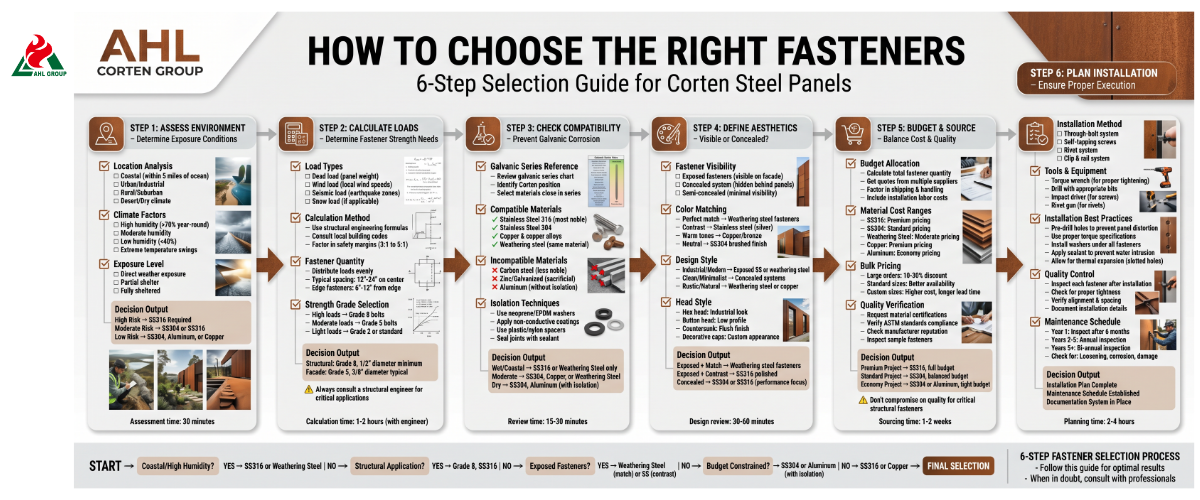
Selecting the Right Fasteners Based on the Environment
For coastal installations within 5 miles of the sea, choose 316-grade stainless steel with a thickened EPDM barrier layer. For inland, dry, or rural environments not affected by salt spray, weather-resistant structural bolts or high-quality coated fasteners perform exceptionally well.
Selecting Fasteners Based on Loads
Calculate the total dead weight of the panels and the local wind load requirements. Ensure that the shear strength and tensile strength of the selected screws or rivets exceed these requirements by at least a 2.5x safety factor, taking extreme weather events into account.
Selecting Fasteners Based on Surface Finish
Determine your aesthetic goals early on. If you want the fasteners to blend seamlessly with a rustic facade, choose weathering steel. If you wish to create a clean, crisp architectural highlight that provides a striking contrast, choose polished stainless steel rivets or hex head bolts.
Balancing Cost and Durability
Although high-quality stainless steel or genuine Type 3 weathering steel fasteners have a higher initial cost than standard architectural hardware, they eliminate the need for future structural maintenance or replacement. Investing in the right fasteners protects your investment in the primary materials while reducing the total cost of ownership.
10. Frequently Asked Questions About Corten Panels
Question 1: Are Stainless Steel Fasteners Always the Best Choice?
For thin architectural exterior wall panels and roof panels, yes, because they provide the best corrosion protection. However, for connections subjected to heavy structural loads, weathering steel structural bolts offer greater advantages because they have higher structural-grade tensile strength and their thermal expansion characteristics match those of the primary load-bearing frame.
Q2: Can Galvanized Fasteners Be Used with Weathering Steel?
They can be used, but with caution. The zinc coating acts as a sacrificial anode for the weathering steel, meaning the zinc will wear away much faster than it would on a standard building frame. It is best to use such fasteners only on lightweight, easily accessible components so they can be easily inspected and replaced when necessary.
Question 3: Do Fasteners Affect the Rusting Process?
Fasteners themselves do not alter the rusting process of weathering steel, but incompatible fasteners can cause low-quality rust to bleed onto the panel surface. This uneven rust bleeding forms dark streaks that disrupt the natural, uniform formation of the protective rust layer on weathering steel.
Q4: How Can Rust Streaks Be Prevented?
Using corrosion-resistant materials, such as 304/316-grade stainless steel or genuine weathering steel fasteners, can prevent rust streaks caused by fasteners. Additionally, ensuring that EPDM washers are properly seated prevents moisture from accumulating behind the fastener head, thereby eliminating localized oxidation marks.
Conclusion: Final Recommendations for Corten Steel Panels
To successfully implement a long-lasting Corten steel wall panel project, it is essential to ensure that the chemical composition of the panels is strictly matched to the metallurgical properties of the fastening system. For building facades and roofs, high-quality stainless steel fasteners paired with EPDM isolation washers provide exceptional service life and a reliable moisture-proof seal. For structural framing and heavy-duty load-bearing applications, Type 3 weathering steel structural bolts offer the perfect combination of mechanical performance and visual appeal.
Never cut corners on fasteners. Opting for cheap carbon steel or low-grade galvanized screws to save on upfront costs will inevitably lead to rust, structural loosening, and premature material replacement. By specifying high-quality stainless steel fasteners with isolation washers or weathering steel fasteners with matching metallurgical properties from the project’s inception, you will ensure both structural safety and enduring industrial aesthetics throughout the decades-long lifecycle of your weathering steel assets.

