


To design a Corten steel fire pit that retains its shape even under a blazing hardwood fire, minimizes harsh smoke, and protects the patio or deck below, three key engineering design decisions are essential: the wall thickness of the fire bowl (3.0 mm / ASTM A588 Grade 11 Corten-A steel—suitable for compact residential fire bowls and gas fire tables; whereas wide-body wood-burning fire bowls use plates 4.0 mm to 5.0 mm or thicker, which offer 2.37 to 4.63 times greater cubic bending stiffness against thermal deformation), smokeless secondary airflow matched to the fuel (combining a bottom primary air inlet with a preheated upper secondary air system—or using clean-burning propane or bioethanol burners), and platform thermal insulation (combining a raised base support, internal radiant heat shields, a base layer of lava rock or refractory brick—and laying 3- to 4-foot-wide non-combustible paving bricks or heat-insulating mats around the perimeter while maintaining 10- to 25-foot NFPA building safety clearances). Below is the complete guide to engineering and procurement specifications.
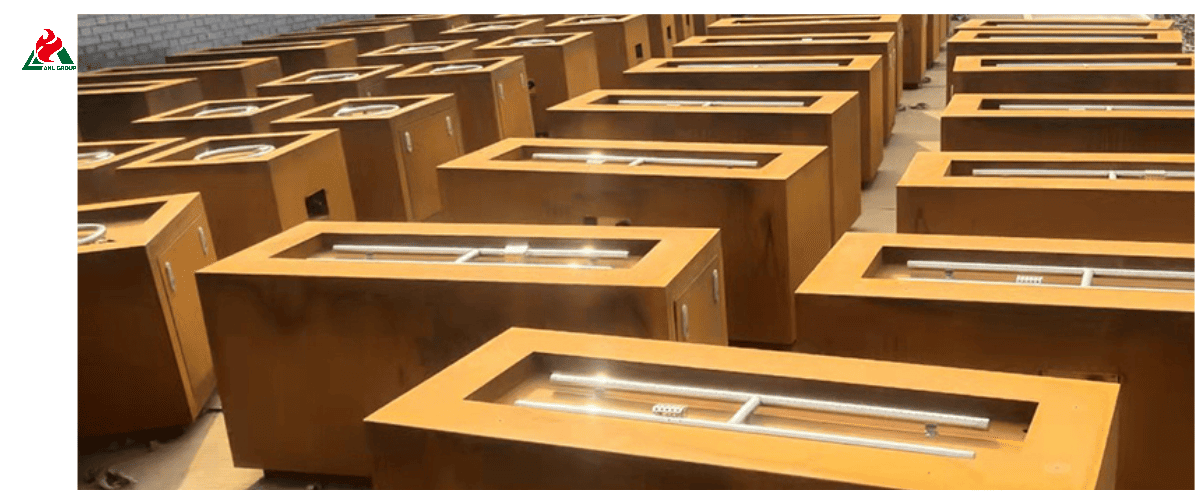
1. Material Metallurgy: Why ASTM A588 / Corten-A Outperforms Mild Steel & Cast Iron in Fire Pits
Outdoor fire bowls endure one of the harshest duty cycles in landscape architecture: rapid thermal cycling from freezing winter air to intense wood-ember temperatures (800°F / 425° and above), followed by rain, snow, and alkaline wood-ash exposure once the fire dies down.
High-Temperature Oxidation Resistance & Minimum 345 MPa Yield Strength
As discussed in our technical comparison analysis on whether Corten steel can be used for fire pits, genuine Corten-A/ASTM A588 weathering steel is a high-strength low-alloy (HSLA) structural steel containing copper, chromium, nickel, and silicon, with a minimum rated yield strength of 345 MPa (50,000 psi):
► Compared to ordinary carbon steel, it offers superior thermal and structural stability: Inexpensive fire pits stamped from painted ordinary carbon steel sheets ranging from 1.0 mm to 1.8 mm thick lose their paint coating at high temperatures during the very first use. When exposed to rain and damp conditions, non-alloy carbon steel forms porous, flaky iron oxide that flakes off after each use, eventually causing the bottom of the fire pit to perforate within 1 to 3 seasons.
► Compared to brittle cast iron, it offers ductility and resistance to thermal shock: Although heavy cast iron provides good heat retention, its high carbon content makes it prone to becoming brittle when subjected to sudden thermal shocks—such as cold rain splashing onto a red-hot fire pit, or frozen water expanding within micro-pores during winter. In contrast, ASTM A588 weathering steel retains its ductility even after extreme freeze-thaw and heat cycles, without cracking.
Exterior Patina Formation vs Interior Fire-Zone Oxide Scaling
Corten steel fire pits are simultaneously exposed to two distinctly different chemical environments:
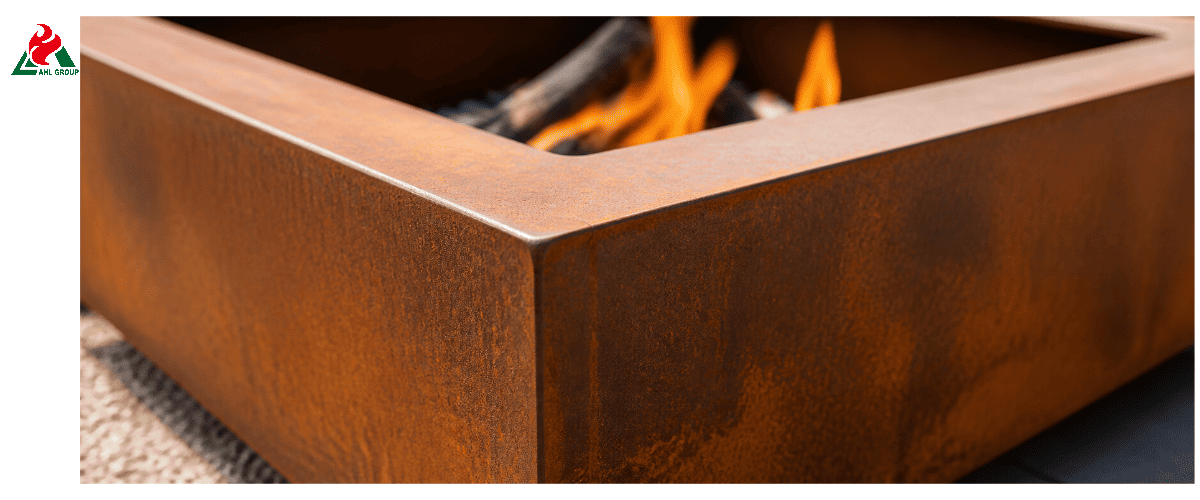
► Outer Shell (Atmospheric Dry-Rust Layer): Exposed to rain, morning dew, and dry sunlight, the exterior of the fire pit gradually changes from its original dark steel color to a warm orange-brown over a period of 6 to 18 months, eventually forming a dense, self-sealing layer of deep reddish-brown/bronze hematite (α-FeOOH) rust—all without the need for paint.
► Internal Fire Pit (Thermal Oxidation + Chemical Reactions with Ash): Inside the fire bowl, the steel comes into direct contact with red-hot hardwood charcoal and undergoes repeated expansion due to dry heat; meanwhile, wood ash retained in rainwater forms a moist, alkaline paste. Since the inner bottom is simultaneously subjected to the dual effects of thermal spalling and moisture from the ash, the fire bowl’s wall thickness (3.0 mm to 5.0 mm or more) and the bottom’s excellent drainage performance directly determine how many decades the fire bowl will last.
Comparing Corten Steel, 304/316 Stainless Steel, Cast Iron, Mild Steel & Aluminum
For a comprehensive comparison of these five metals, please refer to our materials guide on what type of metal is best for a fire pit:
► Weathering Steel (ASTM A588 / Corten-A): High heat retention; features a self-healing rust patina that eliminates the need for repainting; structural lifespan of several decades; however, initial rainwater management is required during the first 6 to 12 months.
► Stainless Steel (304 / 316): Excellent corrosion resistance, suitable for coastal patios and modern urban balconies; more expensive than weathering steel; develops a permanent blue-gold, heat-induced patina when exposed to wood fire.
► Cast Iron: High thermal mass and classic appearance, but bulky to handle; prone to rusting if not pretreated; susceptible to thermal shock cracking when doused with cold water.
► Low-carbon steel: Low initial cost and easy to customize, but it rusts rapidly once the paint coating is burned off.
► Aluminum: Lightweight and rust-resistant, suitable for portable gas dining tables, but it has a low melting/softening point and poor heat retention, making it unsuitable for use with intense wood fires.
2. 3mm vs 4mm vs 5mm+ Bowl Thickness: Structural Rigidity, Thermal Warping & Lifespan
When buyers compare Corten fire pits online, two bowls with the same 900 mm or 1,000 mm diameter can differ in price and weight by more than 100%. In almost every case, that difference comes down to steel plate thickness (3.0 mm vs 4.0 mm to 5.0 mm+).
The Cubic Stiffness Rule: Why Gauge Thickness Controls Thermal Distortion
When a wood fire burns in the center of a wide hemispherical or square steel basin, the center of the bowl expands faster than the cooler outer rim. Under plate mechanics, the flexural rigidity (resistance to out-of-plane warping, buckling, and "oil-canning" waves) of a steel wall is proportional to the cube of its thickness
► Baseline — 2.0 mm (14 Gauge, relative stiffness = 1.00×): Acceptable for vertical fire-pit pedestals and wood-storage bases (such as the 2 mm Corten base on our BG1–BG20 series) that do not hold live coals, but prone to warping if used as a wide, flat wood-burning basin.
► Standard Residential — 3.0 mm (11 Gauge, relative stiffness = 3.38× vs 2.0mm): Stepping up from 2.0 mm to 3.0 mm more than triples plate bending stiffness while providing a generous corrosion allowance for residential wood and gas fire pits.
► Heavy-Duty Wood Bowl — 4.0 mm (8 Gauge, relative stiffness = 2.37× vs 3.0mm; 8.00× vs 2.0mm): Used on our heavy 1,000 mm diameter BG12, BG13, and BG17 fire bowls (Bowl: 4mm), virtually eliminating rim distortion during multi-hour hardwood burns.
► Commercial & Oversized Bowl — 5.0 mm to 6.0 mm+ (3/16 in to 1/4 in, relative stiffness =4.63× to 8.00 × 8.00× vs 3.0mm): Specified on customizable architectural fire bowls and large commercial units (such as our customizable 3mm–5mm Corten steel outdoor fire pit and wood fire bowl series) where zero thermal deformation and multi-decade public-space durability are mandatory.
When 3.0mm (11 Gauge) Corten Steel Is Ideal: Compact Bowls (Ø600–800mm) & Gas Fire Tables
3.0-millimeter (11-gauge) Corten steel walls are the best choice when the following conditions are met:
► The bowl diameter or width ranges from 500 mm to 914 mm (20 inches to 36 inches) and features deep, curved geometry: hemispherical spin-formed or multi-bent bowls—such as our AHL-FP14A/B/C (D600 / D800 / D1,000 × H200 mm, 22 kg), AHL-FP23 (800 × 800 × 200 mm, 33 kg), and AHL-FP24 (914 × 200 mm, 32 kg)—their curved structures provide exceptional geometric shell rigidity, allowing just one or two people to reposition the fire pits on a patio.
► Propane or Natural Gas Patio Fireplaces (AHL-GF Series): Among our gas-fired products—such as our outdoor patio weather-resistant steel natural fire pits, models AHL-GF07 (600 × 600 × 400 mm, 27 kg), AHL-GF11 (D762 × 675 mm, 38 kg), AHL-GF12 (D914 × 600 mm, 47 kg), and AHL-GF14 (800 × 800 × 400 mm, 41 kg)— —The stainless steel burners are housed within an insulating layer made of volcanic rock or fire-resistant glass, ensuring that the outer weathering steel body does not come into direct contact with hardwood charcoal, thereby reducing the dead load on the deck.
When 4.0mm–5.0mm+ Heavy Plate Is Mandatory: Large Wood Bowls (Ø914–1,200mm+) & Commercial Venues
Be sure to specify the use of weathering steel sheets with a thickness of 4.0 mm to 5.0 mm (or custom-made sheets of 6.0 mm or greater) in the following situations:
► Large square or rectangular fire pits with long, straight side walls: Flat steel lacks the inherent arched rigidity of a hemispherical shape. For large-scale fire pits such as the AHL-FP21 (800 mm long × 800 mm wide × 600 mm high, 78 kg) and the AHL-FP20 (1,200 mm long × 1,200 mm wide × 500 mm high, 130 kg), heavy-gauge steel plates 4.0 mm to 5.0 mm thick, combined with 20 mm to 30 mm top-folded flanges, prevent the walls from bending inward or outward when loaded with split oak firewood.
► Deep-bowl base fire pits and tall outdoor fireplaces: In high-capacity models, such as the OFP0014 (total height 914 mm, body height 714 mm, fire bowl depth 530 mm, base detail 70 mm, with thickness customizable from 3 mm to 5 mm), AHL-FP22 (diameter 914 × height 600 mm, 80 kg), and AHL-FP01 (height 1,900 × width 600 × depth 400 mm, 86 kg)—as well as tall chiminea/fireplace towers such as AHL-FP02 (height 2,000 × width 1,200 × depth 400 mm, 113 kg) and the AHL-FP08 (2,000 × 1,500 × 450 mm, 175 kg). With combustion chambers ranging from 4 to 5 mm in thickness, these models provide the thermal mass and structural safety margins required for hotel, resort, and restaurant patios.
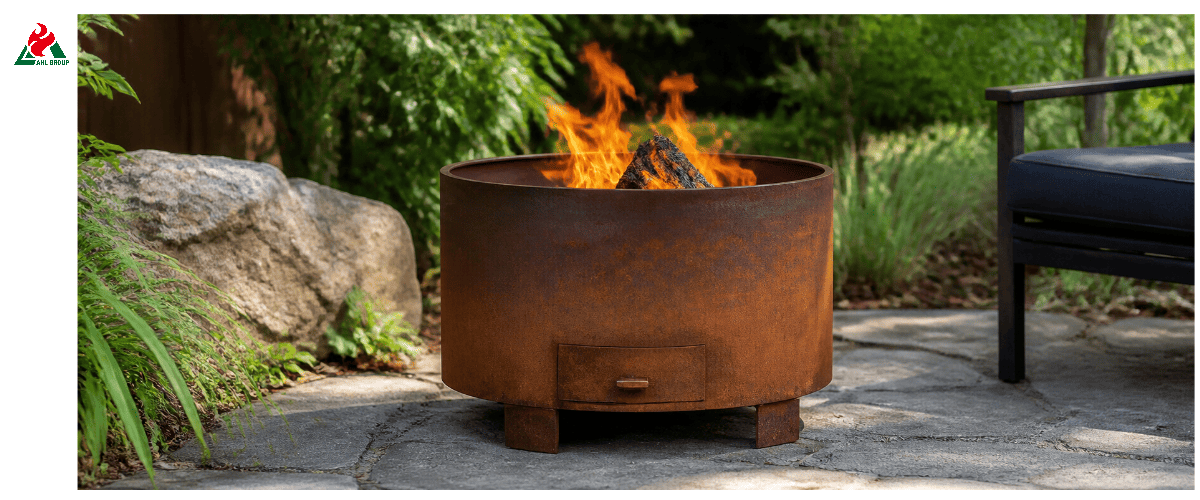
3. Corten Steel Fire Pit Thickness, Model Dimensions & Application Comparison Table
Use the verified engineering table below to match wall thickness, model geometry, and weight to your patio or deck project:
| Corten Wall Thickness |
Relative Bending Stiffness (t3 vs 3.0mm) | Verified AHL Model Examples & Dimensions (mm) | Verified Unit Weight (kg) | Primary Fuel Compatibility | Ideal Patio / Deck Application |
| 2.0 mm (14 Gauge) (Pedestal / Base Enclosure Only) |
0.30× (1.0× vs 2mm baseline) | Base pedestals on BG1–BG5, BG18–BG20 (1,000D × 820–1,000H mm) | 70–152 kg (complete unit with 10mm ring) | Structural base & log storage (non-ember zone) | Elevating fire bowls off stone patios while storing dry firewood underneath |
| 3.0 mm (11 Gauge) (Standard Residential Bowl & Gas Table) |
1.00× (3.38× stiffer than 2mm) | AHL-FP14A/B/C (D1000/800/600 × H200); AHL-FP23 (800×800×200); AHL-FP24 (D914×H200); AHL-GF07–GF14 (600×600 to D914×600) | 22–33 kg (wood bowls); 27–47 kg (gas tables) | Seasoned hardwood (compact bowls), Propane, Natural Gas, Bioethanol | Residential garden patios, rooftop terraces, and heat-shielded decks (gas models) |
| 4.0 mm (8 Gauge) (Heavy-Duty Hemispherical Wood Bowl) |
2.37× (8.00× stiffer than 2mm) | BG12 (1000D×700H); BG13 (1000D×530H); BG17 (1000D×300H); AHL-FP19 (600×600×600) | 50–125 kg | Heavy hardwood logs, lump charcoal, wood-fired plancha cooking | Large family backyards, frequent wood fires, dual-use fire pit + grill setups |
| 5.0 mm+ (3/16 in+ Custom) (Commercial & Wide Square Wood Pit) |
4.63× (15.6× stiffer than 2mm) | OFP0014 (H914, 530mm bowl depth, 3–5mm custom); AHL-FP21 (800×800×600); AHL-FP22 (D914×H600); AHL-FP20 (1200×1200×500); AHL-FP08 (2000×1500×450) | 78–175 kg | High-volume hardwood logs (commercial multi-hour burns) | Hotels, resorts, wineries, public plazas, and luxury landscape estates |
4. Smokeless Secondary Airflow Engineering & Fuel Selection: Fact vs. Fiction
“Smokeless fire pits” are among the most searched keywords in the outdoor living sector—yet buyers are often confused when fire pits fueled by firewood still emit thick smoke upon ignition. Understanding the physics of combustion is key to distinguishing genuine secondary air intake technology from marketing gimmicks.
Why Traditional Single-Wall Fire Bowls Produce Heavy Smoke
When firewood burns in a closed, ventless fire pit placed directly on the ground, three things happen simultaneously:
► Oxygen Deficiency in the Ember Layer: As ash accumulates at the bottom of the fire pit, incoming air cannot reach the bottom of the firewood, resulting in smoldering pyrolysis rather than clean, open-flame combustion.
► Volatile gases from unburned wood: When hardwood is heated, it releases volatile hydrocarbons, tar, and wood tar vapors. If the temperature in the upper flame zone is below the ignition threshold for these gases (or if there is a lack of fresh oxygen at the top of the bowl), these vapors condense into thick, acrid white and gray smoke.
► Excessive moisture in the fuel: When burning green wood that has not been air-dried or damp softwood, the fire will first evaporate the internal moisture before stabilizing, causing the firebox temperature to drop and significantly increasing smoke emissions.
How Double-Wall Secondary Combustion Air Plenums Work
To significantly reduce visible smoke after the initial 10- to 15-minute ignition phase, the high-performance Corten steel wood-burning fire pit employs a two-stage convection airflow design:
► Stage 1—Bottom Primary Air Inlets + Liftable Log Grate: Precision laser-cut air channels around the base or bottom ring deliver fresh, cool air directly beneath the removable, liftable weathering steel or cast iron log grate. Raising the logs above the ash layer ensures a 360-degree flow of primary oxygen into the core of the embers.
► Stage 2–Double-layer air chamber and top secondary air inlet: A sealed inner steel lining forms a rising airflow chamber between the high-temperature inner wall and the outer weathering steel shell. As the flame heats the inner wall, buoyancy draws fresh air into the bottom of the double-walled structure; the air is preheated as it rises through the chamber and is ejected through the annular secondary air inlet directly below the top edge. When this superheated oxygen meets the rising plume of unburned smoke, it triggers secondary combustion (afterburning)—transforming smoke particles into a clean, swirling secondary flame.
Comparing Fuel Sources for Low-Smoke Operation: Seasoned Hardwood vs Charcoal, Propane & Bioethanol
As we detailed in our field analysis report, “ Smokeless Fire Pits: Fact or Fiction?”, no combustion process can achieve 100% zero emissions, and the choice of fuel is just as important as the airflow geometry of the fire pit:
► Kiln-dried/thoroughly air-dried hardwood (oak, hickory, ash, maple): Even in a double-walled, weather-resistant steel fire pit with secondary combustion, you should always burn thoroughly air-dried hardwood with a moisture content below 15% to 20%. Compared to resinous softwoods (pine or fir), which produce sparks and release large amounts of soot, hardwoods burn at higher temperatures and produce cleaner flames.
► Chunks of charcoal and pressed charcoal briquettes: Since charcoal has been pyrolyzed in a low-oxygen kiln to remove moisture and volatile tars, it emits a steady radiant glow when burned and produces far less visible smoke than logs.
► Propane and Natural Gas (AHL-GF Series): Featuring clean gaseous combustion through a 304 stainless steel combustion ring equipped with a metering device, propane and natural gas fire pits eliminate wood smoke, flying sparks, and the hassle of cleaning up ashes.
► Bioethanol: Bioethanol fire pits, made from bioethanol fermented from renewable crops (corn, sugarcane, rice), burn with virtually no odor, no ash, and no visible smoke—making them the cleanest choice for enclosed courtyards and urban patios where wood smoke is restricted.
5. Deck Heat Shielding, Pedestal Clearance & Patio Surface Protection
One of the most common questions asked by homeowners and landscape designers is: Can a Corten steel fire pit be placed on a wooden deck, a wood-plastic composite (WPC) deck, or a tile/concrete deck without scorching or cracking the surface beneath it?
Risks Posed by Downward Radiant Heat and Conduction Heat to Wood, Composite Materials (WPC), Concrete, and Paving Tiles
As fire safety tests have shown, the temperature in the core embers of a wood-burning fire pit can easily reach 800°F (425°C+). Without a bottom insulation layer, this downward heat can damage the deck surface in the following three ways:
► Wood and Wooden Decks: Prolonged radiant heat dries out the fibers of a wooden deck (pyrolysis) and may cause the hidden joists directly beneath the boards and low-profile metal fire pits to char or catch fire.
► Composite (WPC) and PVC deck decking: Polymer-coated composite deck boards soften, sag, bubble, and become permanently discolored at temperatures far lower than those required to damage natural wood. This means that unshielded, low-profile wooden fire pits (H200 mm) must never be placed directly on composite deck decking.
► Cast-in-place concrete and natural stone slabs: Although concrete and stone are non-combustible, the intense conductive heat generated by a flat-bottomed steel fire ring can rapidly boil capillary moisture trapped within dense concrete or wet sandstone, resulting in thermal cracking or surface spalling (“blistering”).
Multi-Layer Bottom Heat Shielding: Pedestal Elevation, Air Gap, Radiation Baffles & Insulating Media
To isolate the ground surface from downward heat transfer, engineer a four-layer thermal barrier stack between the fire bed and the patio:
► Layer 1 — Elevated Pedestal or Log-Storage Base (H500 mm to H914 mm Total Height): Select a tall pedestal or cabinet-base model—such as OFP0014 (914 mm total height with 530 mm bowl depth and 70 mm base detail), AHL-FP21 (L800 × W800 × H600 mm), AHL-FP22 (D914 × H600 mm), or a wood-storage column base (BG1–BG5 at 900 mm to 1,000 mm height). Raising the bottom of the fire bowl several hundred millimeters above the ground allows ambient crosswinds to dissipate heat before it reaches the floor.
► Layer 2 — Internal Bottom Insulating Media Bed (Lava Rock, Vermiculite, or Firebrick): Before stacking firewood on the elevated grate, place a 50 mm to 100 mm (2 to 4 inch) layer of dry volcanic lava rock, coarse Silica sand, or refractory firebricks across the bottom floor of the Corten bowl (keeping the center drain hole clear with a raised mesh screen). This mineral bed acts as an internal thermal brake that cuts downward steel-shell temperatures dramatically.
► Layer 3 — Ventilated Radiant Heat Deflector Baffle: Inside pedestal bases, a suspended stainless steel or Corten sheet radiation shield mounted below the bowl apex with a clear air gap reflects infrared heat upward while allowing cool air to convect underneath.
► Layer 4 — Non-Combustible Base Pad & Deck Heat-Shield Mat: Under any wood-burning Corten fire bowl, install a non-combustible stone, concrete paver, or gravel pad extending 3 to 4 feet (0.9 to 1.2 meters) beyond the rim to catch stray embers. When placing an approved elevated fire unit on a deck, use a UL-listed / multi-layer fiberglass-silicone heat shield mat (with a 25 mm to 50 mm air-gap stand) on top of non-combustible stone pavers so heat cannot conduct directly into the deck boards.
Why Gas & Bioethanol Corten Fire Tables (AHL-GF Series) Are Safer for Elevated Decks
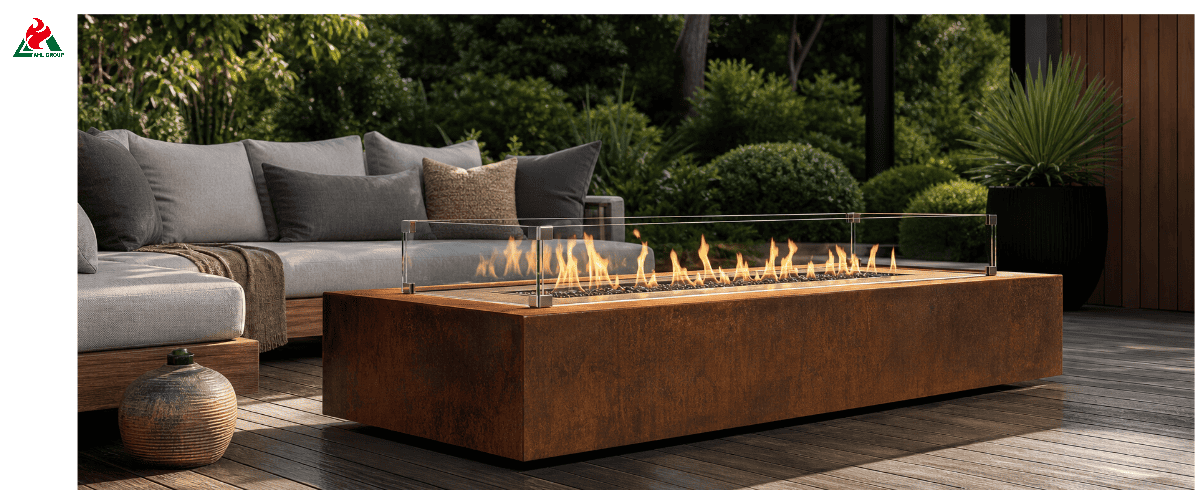
If your project is located on an elevated wooden deck, composite deck, or urban rooftop balcony, our outdoor deck Corten natural fire pit (AHL-GF01 to AHL-GF14) is specifically designed for deck safety:
► Hot air flows only upward: The gas combustion ring is located near the top of the weather-resistant steel enclosure, at a height of 350 mm to 675 mm, with a thick layer of insulating volcanic rock or fire-resistant glass beneath it. Since the gas does not form a sunken bed of glowing hardwood charcoal or produce flying sparks, the bottom edge of the enclosure always remains cool to the touch.
► Complies with NFPA 54 and NFPA 1 safety clearance requirements: Always comply with local fire codes and NFPA 1 / NFPA 54 guidelines: Maintain a horizontal distance of at least 10 feet (3.0 meters) between gas appliances and house walls, combustible railings, and fences (open wood-burning fire pits require a distance of 10 to 25 feet / 3.0 to 7.6 meters), and never use an open-flame fire pit under flammable low porch ceilings, awnings, or overhanging tree branches (NFPA 1 § 10.11). For a complete layout walkthrough, see our buyer guide on how to choose the best Corten steel fire pit for your outdoor space.
Preventing Early Rust Runoff Stains on Pale Stone, Travertine & Decking (Months 0–12)
During the first 6 to 12 months of outdoor use, rainwater running off a “maturing” Corten steel fire pit carries soluble iron oxide particles that may leave orange-brown ring-shaped stains on porous travertine, light-colored concrete, or wooden decking. To prevent staining:
► During the first two seasons of outdoor use, place the fire pit on a gravel bed, a dark-colored stone base, or a protective mat.
► Order a factory-weathered or pre-sealed base finish: AHL offers an accelerated factory weathering service (which completes the initial patina oxidation process before delivery), as well as an optional sealed base ring to prevent rainwater runoff from coming into contact with susceptible patio stone surfaces.
6. Patio & Deck Surface Protection Matrix (Wood, Composite, Concrete, Stone & Lawn)
Use this surface-compatibility matrix to match the right Corten fire pit style, fuel type, and heat-shield assembly to your outdoor flooring:
| Patio / Deck Surface Material |
Primary Heat & Stain Vulnerability | Recommended AHL Fire Pit Style & Fuel | Required Under-Pit Heat Shield & Barrier Stack | Minimum NFPA Clearance Guideline |
| Natural Timber Deck (Cedar, Pressure-Treated Pine, Hardwood) |
Char/ignition from downward heat & flying wood embers; orange runoff absorption | Propane / Natural Gas Table (AHL-GF02/07/11/14) or Bioethanol; elevated pedestal wood pit (H600–914mm) only if code-permitted | Non-combustible paver pad + air-gapped deck heat shield mat + 75mm internal lava rock bed + spark screen | ≥10 ft (3.0 m) gas; 10–25 ft (3.0–7.6 m) wood; zero combustible roof overhead |
| Composite (WPC) / PVC Decking |
Low polymer softening threshold (blistering/warping); grease & rust staining | Propane / Natural Gas (AHL-GF series) or Bioethanol ONLY (avoid low wood bowls on WPC) | Ventilated stand + stone paver thermal break + fiberglass-silicone mat to catch initial rust bleed | ≥10 ft (3.0 m) from walls/railings; check decking manufacturer warranty |
| Poured Concrete & Porcelain Pavers |
Thermal moisture spalling under low flat bowls; rust ring staining on pale grey concrete | All Wood-Burning (AHL-FP01–FP25, OFP0014) & Gas (AHL-GF01–GF14) models | Minimum 70mm–200mm pedestal base clearance + 75mm internal lava rock/firebrick layer + dark paver/mat for 6–12 mo runoff | 3–4 ft (0.9–1.2 m) clear non-combustible perimeter around bowl |
| Porous Natural Stone (Limestone, Travertine, Sandstone) |
High capillary absorption of early orange iron-oxide runoff; thermal cracking in wet stone | Elevated Pedestal Wood Bowls (OFP0014, AHL-FP21/22) or Factory Pre-Weathered Gas Tables | Factory pre-weathered finish + recessed washed gravel bed or removable drip mat during first 6–12 months | 10–25 ft from structures & overhanging trees |
| Crushed Gravel, Decomposed Granite & Lawn |
Scorching turf grass roots; soil moisture trapping rust on bottom rim | All Low-Profile Bowls (AHL-FP14/23/24) & Heavy Wood Fireplaces (AHL-FP01–FP22) | Set base ring on a 75mm–100mm deep compacted washed gravel pad (never sink bare steel into wet dirt or turf) | Remove dry grass/leaves within a 3–4 ft (0.9–1.2 m) radius |
7. Drainage, Ash Management & Year-Round Corrosion Protection
Even with weathering steel fire pits as thick as 4.0 mm or 5.0 mm, premature corrosion can still occur at the bottom if rainwater and wood ash are allowed to accumulate inside the pit for several months.
Why Wet Wood Ash Is the Cause of Bottom-Bowl Pitting
► As explained in our maintenance guide, “Corten Steel Fire Pit Care: 7 Best Practices to Stop Rust,” the protective rust layer on weathering steel only forms and is maintained when the metal alternates between wet exposure and complete atmospheric drying:
► The “Paste-Like” Trap of Wet Wood Ash: Cold wood ash is rich in hygroscopic potassium and calcium salts. When wood ash remains trapped at the bottom of the fire pit for extended periods during heavy rains in the fall and winter, it absorbs moisture like a sponge and forms a damp, paste-like sludge on the steel base plate.
► Anaerobic Corrosion: The bottom of the fire bowl, covered by wet ash, cannot dry due to a lack of oxygen. Under these anaerobic conditions, the stable ferritic rust protective layer breaks down, and the steel corrodes continuously, just like ordinary low-carbon steel.
Sizing Center Drainage Holes, Elevated Ash Grates & Rain Lids
To ensure a service life of 20 to 40 years or more for your wood-burning Corten steel fire bowl:
► Unobstructed Center Drainage Hole: Please ensure that the lowest point of the hemispherical or square bowl has an unobstructed drainage hole so that rainwater can drain immediately after every heavy rain.
► Removable, Elevated Charcoal/Firewood Grate: Place firewood and embers on the removable steel grate, raising them above the bottom drain hole. This prevents fine ash from falling into the main air intake channel, and the grate can be scooped out within 2 minutes once cooled.
► Fire-Extinguishing/Rain Cover: During the rainy and snowy seasons when the fire pit is not in use, cover the top edge with a snug-fitting weather-resistant steel or stainless steel lid (available in our custom fire pit series) to prevent leaves, snow, and rainwater from entering the ash area.
8. Step-by-Step Site Setup, First Burn-In & Patina Seasoning Protocol
Please follow the four-step installation process below to safely install your Corten steel fire pit and develop an even, rich patina from day one.
Step 1: Site Layout & NFPA 10–25 ft Horizontal / Overhead Clearance Check
► Choose an open, level location: For wood-burning fire pits, ensure a minimum distance of 10 to 25 feet (3.0 to 7.6 meters) from exterior walls, wooden fences, pergolas, and overhanging tree branches (according to NFPA 54 guidelines, propane/natural gas fire tables require a minimum distance of 10 feet/3.0 meters).
► Ensure the sky above is unobstructed: Verify that there are no combustible porch roofs, fabric awnings, or low eaves directly above the flame area (NFPA 1 § 10.11).
Step 2: Building the Non-Combustible Base Pad & Leveling the Pedestal
► Prepare a 3- to 4-foot non-combustible perimeter area: On a lawn or flower bed, remove a 75-millimeter- to 100-millimeter-thick layer of sod and lay down compacted gravel or stone pavers, extending them at least 3 to 4 feet (0.9 to 1.2 meters) around the fire pit. On a patio, install non-combustible paving brick heat shields and UL-certified heat shields.
► Level the base and add internal insulation: Adjust the weather-resistant steel base or ring base until it is perfectly level, ensure the bottom drainage holes are unobstructed, and lay a 50-millimeter to 75-millimeter-thick layer of dry volcanic rock or firebricks beneath the wood-burning grate.
Step 3: First Burn-In (to Remove Manufacturing Residues Before Food Contact)
► Initial Residue Burn-Off: During the first fire, residual rolling oil and factory dust on the new Corten steel will burn off, producing a faint metallic odor and light smoke for the first 20 to 30 minutes.
► Do not cook food during the first firing: As outlined in the technical specifications for our weathering steel outdoor fire pits and wood-burning braziers, after lighting a fire with medium-hardness hardwood for the first time, keep it burning for 45 to 60 minutes. Do not cook any food during this period to ensure that all manufacturing residues are thoroughly burned off. If you subsequently add a grill grate or flat griddle ring that comes into contact with food, ensure that the cooking surface is made exclusively of 304 stainless steel or seasoned 10-millimeter carbon steel—never cook directly on the untreated patina of the weathering steel.
Step 4: Optional Accelerated Patina Spray & Seasonal Ash Cleanout
► Accelerating Rust Formation on the Exterior Surface (if the product is shipped with its original factory finish): Although natural outdoor weathering typically takes 6 to 18 months to form a complete rust layer, you can initiate rapid surface oxidation by lightly spraying the exterior surface of the cold firebox with a simple household solution—a mixture of water, a small amount of white vinegar, and a pinch of salt. Once an even, orange, velvety layer has formed on the surface, rinse it off with clean water.
► Removing Ash After Burning: Once the ash has cooled completely (24 to 48 hours after burning), scoop out the layer of ash, scrub the interior walls with a stiff, non-metallic brush, and place the rain cover over the stove.
9. Frequently Asked Questions (FAQ)
Q1: Can you put a Corten steel fire pit on a wood or composite deck?
For compact residential fire pits (600 to 800 millimeters in diameter) and propane/natural gas fire tables, 3.0-millimeter (11-gauge) ASTM A588 weathering steel strikes an ideal balance between structural rigidity, corrosion resistance, and moderate weight (22 to 47 kilograms). For wide-mouth wood-burning fire pits (914 mm to 1,200 mm or more in diameter), square/rectangular fire pits with flat side walls (AHL-FP20/21), and commercial dining establishments, steel plates ranging from 4.0 mm to 5.0 mm or thicker outperform the former by a wide margin—with cubic bending stiffness 2.37 to 4.63 times higher—effectively resisting high-temperature deformation and providing additional thickness reserves lasting for decades.
Q2: Are smokeless Corten steel fire pits truly 100% smoke-free?
Never place a low, unprotected wood-burning fire pit directly on the exposed flooring of a wooden or composite (WPC) deck. For wooden or composite decks, the safest engineering solution is to use an elevated propane, natural gas (AHL-GF01–GF14), or bioethanol weather-resistant steel fire table, with an upward-firing burner situated above a deep, insulated bed of volcanic rock. If local fire codes permit the installation of an elevated wood-burning fire pit with a base (600 mm to 914 mm in height) on a deck, a non-combustible stone/ paving brick base must be laid underneath, along with a UL-certified insulating mat with an air gap, and a 50-millimeter to 100-millimeter-thick layer of volcanic rock or firebricks must be placed at the bottom of the fire pit.
Q3: How do you stop a new Corten fire pit from staining patio stones or pavers?
During the initial 6- to 12-month period when the rust patina is forming, rainwater may wash loose iron oxide particles onto the porous stone or concrete beneath the fire pit. To prevent staining, you can: (1) Order an AHL fire pit that is factory-aged or pre-sealed on the bottom; or (2) Place the fire pit on a sunken gravel bed, dark-colored flagstones, or a heat-resistant drip mat until the rust layer has stabilized into a deep brown layer that is insoluble in water.
Q4: How far should a Corten steel fire pit be placed from a house, fence, or pergola?
Open wood-burning fire pits should be kept 10 to 25 feet (3.0 to 7.6 meters) away from house walls, wooden fences, pergolas, and overhanging tree branches, and a 3- to 4-foot (0.9 to 1.2-meter) wide non-combustible buffer zone made of stone, concrete, or gravel should be established around the fire pit. Outdoor propane and natural gas fire pits typically require a minimum clearance of 10 feet (3.0 meters) from combustible walls, and open-flame fire pits must never be used beneath combustible roofs or porch ceilings (NFPA 1 § 10.11).
Q5: Can I use a Corten steel fire pit in freezing winter snow and ice?
Yes. Unlike terra cotta, cast stone, or brittle cast iron—materials that may crack due to the expansion of frozen water or when a bonfire is lit on nights below freezing—ASTM A588 weathering steel is ductile and completely resistant to freeze-thaw cycles. Before lighting a fire in winter, simply brush away any accumulated snow and ice from inside the fire pit and from the drainage holes.
Q6: Is the rust patina on a Corten fire pit safe if I add a cooking grate?
The mature iron oxide rust layer that forms on the outer surface of a Corten steel fire pit is stable and non-toxic; however, never cook food directly on the untreated, raw Corten steel rust layer. When grilling on a Corten steel fire pit, be sure to use a dedicated food-grade 304 stainless steel grill grate or a pre-treated 10-millimeter carbon steel flat-bottomed grill pan (such as those used in our BG1–BG20 barbecue series). Before cooking food, preheat a brand-new fire pit by burning it empty for 45 to 60 minutes.
Conclusion: Selecting the Right Corten Fire Bowl for Lasting Warmth & Deck Safety
A well-engineered Corten steel fire pit is a decades-long architectural centerpiece—provided its plate gauge, airflow geometry, and base thermal shielding are matched to how and where you burn. By specifying 3.0 mm ASTM A588 Corten steel for compact garden bowls and gas fire tables, stepping up to 4.0 mm to 5.0 mm+ heavy plate for wide wood-burning basins (OFP0014, AHL-FP20/21/22), pairing bottom primary intakes with double-wall secondary air plenums (or clean gas/bioethanol burners), and protecting patio or deck surfaces with elevated pedestals, internal lava-rock/firebrick thermal beds, and NFPA-compliant non-combustible pads, you eliminate thermal warping, acrid smoke, and deck heat damage from day one.
Whether you are specifying a sculptural wood-burning centerpiece from our Corten steel outdoor fire pit and wood fire bowl collection (AHL-FP01 through AHL-FP25) or a clean-burning propane/natural-gas table from our outdoor deck Corten natural fire pit range (AHL-GF01 through AHL-GF14), AHL's factory engineering team supports custom 3 mm to 5 mm+ plate thicknesses, accelerated pre-weathered finishes, and fitted rain covers for global residential and hospitality projects.
For deeper technical reading on material properties, fuel smoke comparisons, metal-to-metal selection, and seasonal care, explore our companion guides on whether Corten steel can be used for fire pits, Smokeless Fire Pits: Fact or Fiction?, what type of metal is best for a fire pit, how to choose the best Corten steel fire pit for your outdoor space, and Corten steel fire pit care: 7 best practices to stop rust.
Looking for a Custom Wood-Fired Corten Steel BBQ Grill?
Explore AHL Corten Group's heavy-duty weathering steel plancha grills with food-grade carbon steel cooking rings and integrated log storage.
» Browse All Corten BBQ Grills | BBQ Grates & Accessories | Get Wholesale Pricing
Explore AHL Corten Group's heavy-duty weathering steel plancha grills with food-grade carbon steel cooking rings and integrated log storage.
» Browse All Corten BBQ Grills | BBQ Grates & Accessories | Get Wholesale Pricing

