


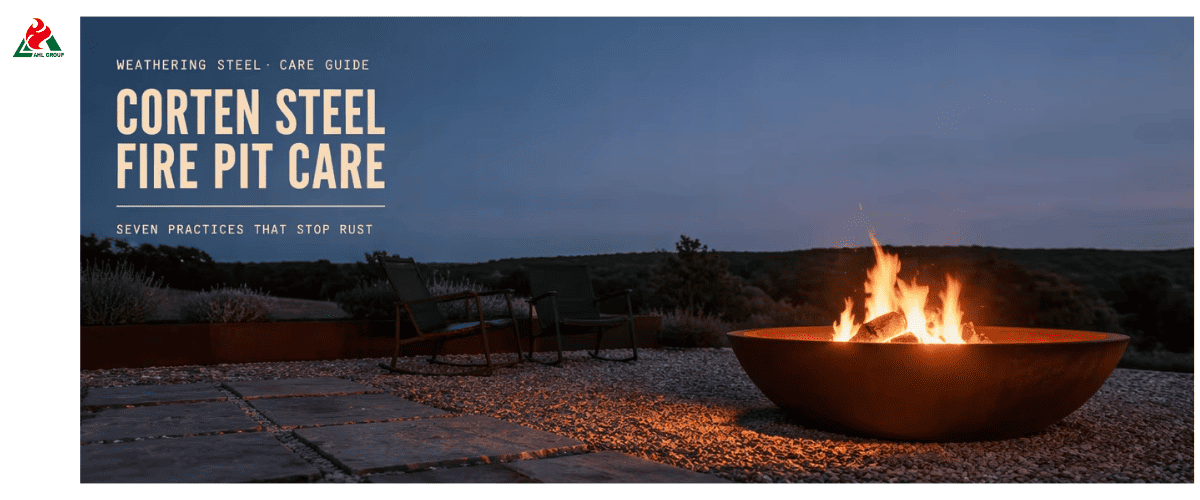
Will a Corten steel fire pit rust? Yes—but that’s precisely what makes it so special. Weathering steel is specially designed so that its surface oxidizes to form a dense, stable oxide layer—commonly known as “patina”—which protects the steel beneath. The rust you see on a new weathering steel fire pit is a sign that this protective layer is forming, not a problem with the metal itself.
Actual corrosion damage stems from three sources, and “being outdoors” is not the cause in itself: standing water in direct contact with the steel; chlorides from salty, humid air, pool water, or de-icing salt; and repeated abrasion that causes the patina to flake off before it has stabilized. Published research on weathering steel structures has reached the same conclusion—when patina formation is poor, the cause lies in poor drainage and exposure to chlorides, not the rainwater itself.
The following seven measures can help keep a weathering steel fire pit in a “stable rust layer” state and prevent it from entering a “pitting corrosion” state. These measures are listed in order of the severity of damage caused by each error, not the frequency with which the error is discussed.
Actual corrosion damage stems from three sources, and “being outdoors” is not the cause in itself: standing water in direct contact with the steel; chlorides from salty, humid air, pool water, or de-icing salt; and repeated abrasion that causes the patina to flake off before it has stabilized. Published research on weathering steel structures has reached the same conclusion—when patina formation is poor, the cause lies in poor drainage and exposure to chlorides, not the rainwater itself.
The following seven measures can help keep a weathering steel fire pit in a “stable rust layer” state and prevent it from entering a “pitting corrosion” state. These measures are listed in order of the severity of damage caused by each error, not the frequency with which the error is discussed.
1. Buy Real Weathering Steel, Not "Corten-Look" Steel
The primary reason for the phenomenon described as “my weathering steel fire pit is rusting and developing holes” is that the fire pit was not made of weathering steel in the first place. Weathering steel is a clearly defined family of alloys: it includes the original trademarked grades CORTEN A and CORTEN B, as well as ASTM standards A588, A242, A606-4, A847, A871-65, and A709-50W. These materials all contain added copper, chromium, and nickel, giving them significantly higher atmospheric corrosion resistance than ordinary carbon steel (ASTM Weathering Steel Specifications). A606-4 covers hot-rolled and cold-rolled plates, strips, and coils typically used in the manufacture of architectural and outdoor components.
Products commonly marketed as “Korten-style” are actually ordinary low-carbon steel that has been powder-coated or treated to mimic rust. This material looks reasonably authentic during the first season, but problems arise immediately once the coating is damaged—for example, at welds, at the substrate, or in any areas scratched during handling.
How to Tell Genuine Corten Steel From a Corten-Effect Imitation
► Require suppliers to clearly specify the standard name in writing. “A606-4” or “A588” are purchase order terms you can use to hold them accountable; whereas “weathering steel surface treatment” is not legally binding.
► Conduct a peel test on an inconspicuous edge. Coated counterfeits will reveal a different gray substrate beneath the surface treatment layer. Genuine weathering steel consists of the same alloy throughout its entire thickness, so no second material will be visible at the edges or welds.
► Inspect the welds and the base plate. Genuine weathering steel products are typically left uncoated at the welds and feature drainage holes at the bottom. Regardless of the alloy type, if the coating extends across the welds, or if the base plate is sealed without drainage holes, this constitutes a major safety hazard during installation.
► Check the wall thickness. The wall thickness of metal fire pits is typically specified within the range of 3–6 millimeters; thicker walls are more resistant to thermal deformation than thin decorative panels. Please verify the thickness based on the technical specifications rather than relying solely on photographs.
Corten Steel vs. Stainless Steel vs. Powder-Coated Mild Steel
| Corten/weathering steel | Type 304 stainless | Powder-coated mild steel | |
| Rust behaviour |
Stable patina; orange runoff while it forms | No surface rust, but vulnerable to chloride pitting | Rusts rapidly once the coating is breached |
| Appearance over time |
Darkens and matures | Stays bright | Coating chalks, then mottles |
| Care required |
Low, but moisture-aware | Rinse after salt exposure | Recoating every few years |
| Suitability |
Permanent outdoor fixture | Poolside and coastal use with rinsing | Short-term or covered use |
2. Let the Patina Form; Don't Fight the First Year
New weathering steel turns a vivid orange within a few days of its first exposure to rain, then gradually darkens until it eventually develops a matte, brownish-black surface. This transformation takes anywhere from several months to several years and progresses more quickly in humid or coastal areas than in dry, inland gardens. Human intervention is the most common cause of this process failing: every week spent “correcting” the color means one less week for the oxide layer to stabilize naturally.
Should a Corten steel fire pit be sealed or oiled
No, it should not. Sealants and oil-based products are designed to block moisture, whereas the rust layer requires the steel surface to remain in constant contact with air that alternates between wet and dry. The film formed by sealants traps condensation on the steel surface, creating an uneven, bubbly pattern that is often mistaken for poor-quality steel. Oil, on the other hand, will burn off during the first fire. Paint is even worse—it will peel off when the steel deforms under high temperatures.
Protecting the Surface Beneath the Fire Pit
Orange-colored seepage will occur during the first few seasons, so plan to avoid being caught off guard. Place the outdoor fire pit on “sacrificial” pavers, a steel or stone drip tray, or a layer of gravel that can be hosed down and raked back into place. If placing it on a wooden deck, be sure to install a non-combustible barrier underneath and maintain the required clearance—staining issues and fire safety concerns are two separate matters, both of which must be properly addressed.
.png)
3. Manage Moisture: Drainage, Tilt, and Dry-Out
The aforementioned bridge survey found that localized corrosion damage was caused by poor drainage, not by rainfall. A fire bowl is a small container with the same failure mode; as long as you know where to look, its failure mechanism becomes immediately apparent.
Why Standing Water Is the Only True Catalyst for Rust
Fire pit ash is hygroscopic: it absorbs moisture from the air and adheres to the base plate as a slightly alkaline paste. Combined with clogged drainage holes at the bottom, this creates a persistently damp area with unstable oxygen levels at the welded joints of the panels—the worst possible environment for steel when it is wet. Textbooks aside, simply tilting a used water basin after a rain shower and watching the water flow out says it all.
Drainage and Placement Checklist
► Confirm that the drainage holes in the base plate are present and not blocked by compacted ash.
► Check that the fire pit slopes slightly toward the drain, rather than sitting level or pooling water in a corner.
► Avoid placing it in low-lying patio areas already prone to water accumulation.
► Empty any standing water after heavy rain; do not leave a water-filled fire pit sitting with standing water throughout a damp week.
Covering During the Rainy Season
Use a loose, breathable cover, or move the backyard fire pit to a sheltered area; never wrap a damp fire pit in a sealed, waterproof tarp. Sealed covers trap condensation on the steel surface, disrupting the drying cycle necessary for patina formation. If the fire pit will be left unused for several months, empty the ashes first—the primary condition for dry storage is keeping the interior dry.
4. Control Salt and Chlorides
Existing literature confirms that chlorides are the cause of patina failure. When contact with chlorides prevents the formation of a protective oxide layer, the standard engineering countermeasure is to increase surface protection rather than rely on patina. For home fire pits, this means adopting three habits.
Coastal Installation and Salt Fog Protection Guidelines
In areas where you can hear the sound of the waves, rinse the steel with fresh water whenever onshore winds blow or after a storm, and allow it to air-dry outdoors. Frequency is more important than intensity: a gentle rinse every few weeks prevents chlorides from accumulating between exposures.
Never Use Bleach, Chlorine, or Acidic Cleaners
Household bleach, pool shock treatments, chlorine tablets, and acidic descaling agents will directly erode the patina. The fire pit’s surroundings can also cause erosion: a fire pit next to a pool will be exposed to splashing water, while one at the bottom of a salt-treated driveway will accumulate snowmelt runoff. Either move the fire pit or accept that the patina will become uneven, and pay special attention to the base plate.
5. Clean It Correctly
Cleaning a Corten outdoor fire pit is a task where “less is more.” The goal is to remove ashes, soot, and organic debris while preserving the patina that took a year to form.
End-of-Season Cleaning Process
► Let the fire pit cool completely—this takes overnight, not just two hours.
► Scoop the ashes into a metal container and dispose of them outdoors.
► Wipe the interior walls with warm water and a few drops of mild dish soap.
► Use only a soft nylon brush for scrubbing; completely avoid wire brushes and scouring pads.
► Rinse with clean water and dry the surface with a cloth.
► Leave the fire pit open to the air for a day to allow moisture to dissipate.
Avoid using a pressure washer. The issue isn’t the water pressure, but the uniformity of the water flow. A pressure washer will wash away the patina, leaving streaks that are permanent.
How to Treat Rust Stains and Pitting
Before taking action, distinguish between “oxidation layer” and “pitting.” The “oxidation layer” is a light orange surface deposit that comes off when brushed and sticks to a cloth—please save it, as this is patina regenerating. Pitting, on the other hand, consists of rough indentations that can be felt with a fingernail and appear to the naked eye as dark spots with raised edges. Pitting indicates that chlorides or standing water were present for an extended period; therefore, you should first repair the drainage system or adjust the placement of the object. Cleaning alone will not prevent it from recurring.
6. Winterize It Before the First Freeze
Water, ice, and a layer of ashes are the harshest combination a welded steel fire pit can face, as the expansion of ice can damage welds and low-lying areas.
Winter Maintenance Checklist
► Thoroughly remove all ashes and scrub the interior clean with a brush.
► Make sure the drain hole at the bottom is unobstructed.
► Raise the fire pit off damp ground to ensure the bottom does not sit in standing water.
► Cover it loosely with a breathable cover, or move it under an eave.
Choosing a Cover and Storage Location
Choose a breathable cover—such as canvas or fabric with ventilation holes—rather than an airtight plastic sheet, and do not place the fire pit in a corner where rainwater drains from downspouts. If storing it in a garage or shed, ensure the environment is dry; if stored while damp, the surface may appear mottled when retrieved in the spring, giving the appearance of damage, but this is usually caused by uneven drying.
7. Burn It Right, So the Steel Stays Intact
Fire itself is not the enemy. The real issue lies in what you put on the fire and where you place it.
Never Burn Pressure-Treated Wood, Plastic, or Trash
Pressure-treated wood contains preservative salts, while chlorinated plastics release chlorides directly onto the steel surface when burned. Both have the same effect as a salt spray test, only faster and at higher temperatures: they interfere with the formation of the oxide layer on the hottest, thinnest parts of the fire pit.
Patio Safety and Heat Management
Place the landscape fire pit on a non-combustible base and maintain the clearances required by local regulations or the manufacturer, keeping it away from railings and overhanging structures. Never add water to a fire pit—the thermal shock can severely affect welds and may cause the firebox to warp, especially in thin-walled fireboxes.
Clearing Ash: Why a Thick Layer of Ash Can Cause Rust
A thin layer of ash provides thermal insulation for the firebox floor and aids in ignition; however, a thick layer of ash traps moisture on the surface of the steel. Clear the ash after every few fires, and never allow a thick layer of ash to accumulate inside the fire pit during periods of non-use.
8. Frequently Asked Questions
Q1: Can a Weathering Steel Fire Pit Rust All the Way Through?
Genuine weathering steel forms a stable oxide layer that limits further corrosion; therefore, a well-drained fire pit will not rust all the way through under normal use. Perforation will only occur if chlorides or prolonged standing water destabilize the oxide layer, causing it to erode the base plate or welds.
Q2: Can I Place a Corten Steel Fire Pit on a Wooden Deck?
It may only be placed if a non-combustible barrier is installed and the spacing requirements specified by codes or the manufacturer are met. It is the heat, not the rust, that poses a threat to the deck; additionally, a drip pan should be placed beneath the fire pit, as it will seep orange-colored rust water while the rust layer is forming.
Q3: Will the Rust Stain My Deck or Paving Stones?
Yes, expect orange seepage for the first one to two seasons. This is iron oxide, not paint, and it typically fades gradually as the surface weathers on sealed or dense stone. Placing a “sacrificial” paving stone or a bed of gravel beneath the fire pit will prevent your prized surfaces from being stained.
Q4: Do I Need to Seal a Weathering Steel Fire Pit?
No. Sealant traps moisture on the steel’s surface, hindering the wet-dry cycle necessary for rust patina formation. The only exception is if you intentionally want to lock the steel into an early, uniform color—but this is an aesthetic choice that requires ongoing maintenance.
Q5: How Can I Prevent Rusty Water from Staining My Paving Stones?
Place the fire pit on a drip tray, a bed of gravel, or sacrificial bricks, and pour out any accumulated water rather than letting it run off the surface. Move the fire pit slightly each season so that stains are spread out rather than concentrated in one spot.
Q6: How Long Does a Weathering Steel Fire Pit Last?
Lifespan depends largely on drainage, location, and exposure to chlorides—not just the alloy itself. A fire pit with good drainage and a suitable location can last for decades; however, one subject to prolonged standing water or exposure to salt spray will develop pitting corrosion within a few seasons.
Q7: Can a Corten Steel Fire Pit Be Painted?
Yes, but as the steel expands and contracts with heat, the paint will peel off in those areas, resulting in a mottled surface. This requires more maintenance than bare weathering steel. If you want a painted fire pit, purchase a model specifically designed for a coating system rather than trying to fight the rust layer on weathering steel.
Conclusion: Choose the Right Corten Steel Fire Pit
When purchasing, select steel that clearly lists a standard number (such as A606-4 or A588) in the technical specifications, rather than products labeled simply as “weathering steel with surface treatment.” Allow the steel to rust naturally, and avoid using sealants, oils, or paint. After use, drain any standing water by tilting the fire pit to empty it; never leave it submerged in water for extended periods. Whether salt comes from ocean spray, pool splashes, or snowmelt runoff, rinse it off before it accumulates. Clean gently and infrequently: use warm water, mild soap, and a soft-bristled brush; never use a pressure washer. Before winter sets in, clear out the ashes and loosely cover the fire pit with a breathable material; never burn treated wood or plastic in it.
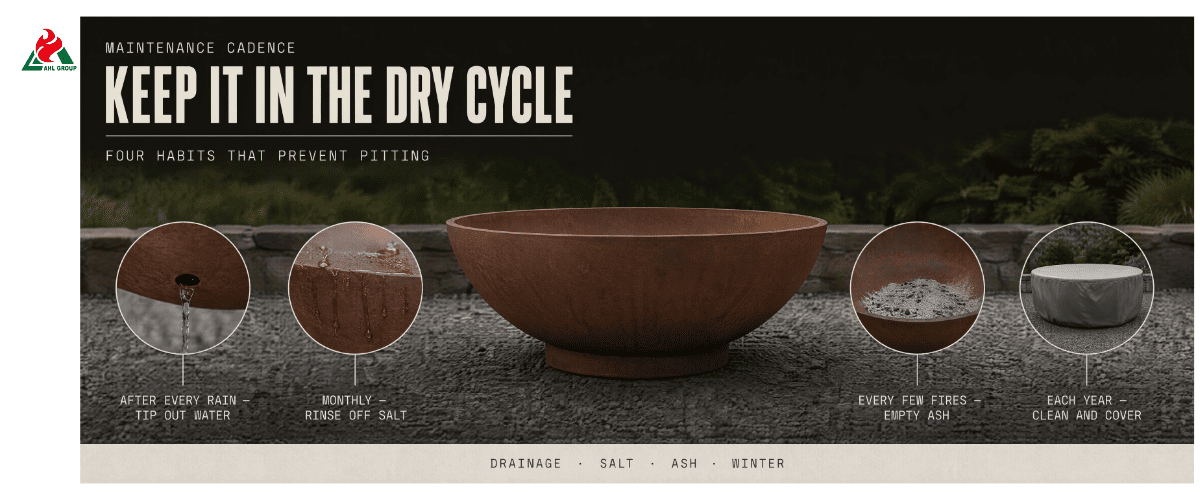
A simple maintenance routine covers most of the essentials: after every heavy rain, pour out any standing water and check the drainage holes; rinse the steel monthly in the coastal air; clear out the ashes after every few fires; and perform a thorough cleaning and winterization once a year.
Once you’ve established these habits, the rust on your Corten fire pit will remain true to its original design intent: merely surface rust, not a countdown to the end of its lifespan. We invite you to browse our collection of weathering steel fire pits or learn more about our Corten steel planters and garden edging, all crafted from the same alloy.

