


When selecting large outdoor planters for commercial landscapes, urban development projects, or high-end residential gardens, structural durability is often the deciding factor. Planters are subjected to long-term exposure to moist soil, sub-freezing temperatures, intense UV radiation, and extreme wet-and-dry cycles.
Among all outdoor materials, weathering steel (Corten steel) and wood remain the two most commonly chosen options. However, their physical performance varies significantly over a 10- to 40-year service life. This guide provides an in-depth analysis comparing weathering steel and various types of wood in terms of weather resistance, structural integrity, life-cycle costs, and plant safety.
Among all outdoor materials, weathering steel (Corten steel) and wood remain the two most commonly chosen options. However, their physical performance varies significantly over a 10- to 40-year service life. This guide provides an in-depth analysis comparing weathering steel and various types of wood in terms of weather resistance, structural integrity, life-cycle costs, and plant safety.
1. Introduction
Why Compare Corten Steel and Wooden Planters
Both weathering steel and natural wood possess a natural, warm aesthetic that blends seamlessly with modern architecture and soft landscape design. However, while wood is widely favored for its low initial cost and classic warmth, weathering steel is engineered for exceptional structural durability. Comparing these two materials ensures that project managers, landscape architects, and property owners can select a solution that meets aesthetic requirements while balancing practical long-term maintenance budgets.
A Brief Answer on Long-Term Durability
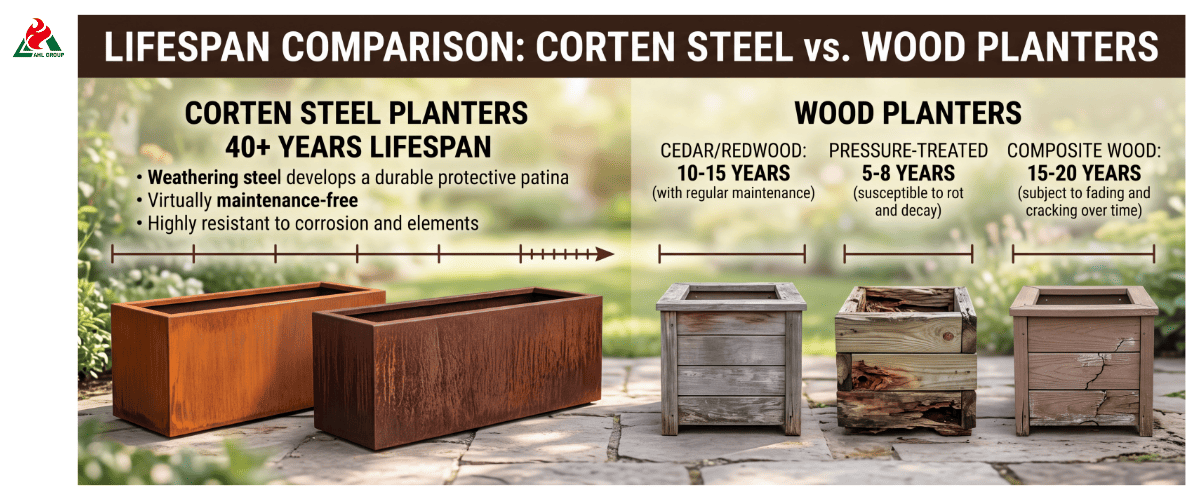
That’s right—high-quality Corten steel planters do indeed have a significantly longer lifespan than wooden planters. A Corten steel planter manufactured to industry standards (2–3 millimeters thick or more) and equipped with a proper drainage system can be expected to last 25 to 50 years or more in outdoor environments without the need for protective sealants. In contrast, high-quality softwood or pressure-treated wooden planters typically last only 5 to 10 years, while high-density hardwoods (such as ipe or teak) have a lifespan of 15 to 25 years with active, routine maintenance.
What This Comparison Will Cover
This article will evaluate the two materials based on key engineering and performance metrics, including: materials science, failure modes, climate adaptability, drainage design, soil safety, total cost of ownership (TCO) over the entire life cycle, and common specification errors.
2. Corten vs. Wood at a Glance
To quickly compare performance characteristics, the table below provides a detailed comparison of weathering steel, cork, and structural hardwood planters:
| Performance Metric | Corten Steel (2–3 mm+) | Standard Wood (Cedar / Treated Pine) | Premium Hardwood (Ipe / Teak) |
| Expected Lifespan | 25 – 50+ Years | 5 – 10 Years | 15 – 25 Years |
| Rot & Insect Resistance | 100% Immune | Moderate to Low (Requires Treatment) | High Natural Resistance |
| UV Degradation | None (Immune) | High (Splits, Fades to Gray) | Moderate (Requires Periodic Oiling) |
| Maintenance Required | Zero structural maintenance | High (Sealer every 1–2 years) | Moderate (Oil/Sealer every 2–3 years) |
| Structural Integrity | Rigid, will not crack or warp | Prone to warping, splitting, joint failure | Stable, but joints loosen over time |
| Upfront Cost | Moderate to High | Low to Moderate | High |
| Lifetime Cost (TCO) | Extremely Low | High (Frequent Replacement) | Moderate to High |
3. How Long Do Corten Planters Last
Typical Service Life of Corten Steel Planters with a Thickness of 2–3 Millimeters
Under typical outdoor conditions, outdoor planters made of 2-millimeter or 3-millimeter-thick (14 to 11 gauge) commercial-grade Corten steel have an expected service life ranging from 25 to more than 50 years. Products with thicker custom specifications (4 to 6 millimeters) specified for large-scale infrastructure projects can easily exceed 50 to 70 years of continuous service.
How the Protective Rust Layer Slows Corrosion
Unlike standard carbon steel, weathering steel (ASTM A588 or A242 atmospheric corrosion-resistant steel) contains specific alloying elements such as copper, chromium, nickel, and phosphorus. When exposed to alternating wet and dry weather cycles, this alloy forms a dense, tightly adherent oxide layer, known as “patina.” This stable surface barrier effectively isolates the underlying structural steel from oxygen and moisture, reducing the corrosion rate to near zero after an initial stabilization period (typically 6 to 18 months).
How Drainage Affects Service Life
Continuous exposure to air is essential for maintaining the oxide layer on Corten steel. If the bottom of a Corten planter is surrounded by standing water and lacks air circulation, its protective rust layer cannot undergo the wet-dry cycle. Instead, the steel will revert to a state of ordinary rusting (flaking and pitting). Proper elevation and dedicated drainage holes are the most critical factors in achieving the longest service life.
Conditions That May Lead to Premature Corrosion
Although weathering steel performs exceptionally well in most outdoor environments, specific microclimates may shorten its service life:
► Submerged environments: Prolonged submersion hinders the stable formation of the oxide layer.
► Severe sea salt exposure/direct salt spray: Salt deposits can damage the protective rust layer, leading to accelerated pitting corrosion.
► Exposure to chlorine or chemicals: Runoff from swimming pool chemicals or de-icing salts can erode the protective layer.
4. How Long Do Wooden Planters Last
Typical Lifespans of Different Wood Species
Wooden planters gradually deteriorate over time because wood is an organic cellulose material that is susceptible to moisture-induced decomposition, fungal rot, and UV damage. Their lifespan varies significantly depending on the type of wood used:
► Untreated softwoods (pine, spruce, fir): 3 to 5 years.
► Pressure-treated wood (SYP): 7 to 12 years.
► Western red cedar/redwood: 10 to 15 years.
► High-density hardwoods (ipé, teak, kumara): 15 to 25 years.
Western Red Cedar, Redwood, Hardwoods, and Treated Wood
► Western red cedar and redwood: Contain natural extracts (tannins) that inhibit fungal decay and insect damage, making them popular choices for mid-range garden construction.
► Pressure-treated wood: Chemical preservatives (such as copper azole or micronized copper azole) extend the service life of softwoods by preventing decay, but the wood may still swell, warp, and crack due to moisture absorption.
► Tropical hardwoods (ipé, teak): Extremely dense and rich in oils, they offer exceptional weather resistance and rot resistance, but come with a high upfront cost comparable to high-grade steel.
How Moisture Causes Rot and Decay
Moist garden soil is in constant contact with the inner walls of wooden planters. Moisture seeps into the wood grain, causing the wood fibers to swell. When the planter dries out in the sun, the wood fibers contract again. This continuous cycle of expansion and contraction creates micro-cracks, weakens the fasteners at the joints, and allows wood-decay fungi (Basidiomycota) to break down the wood structure from the inside out.
The Effects of Insects, Fungi, and Weather
Outdoors, wooden planters face multiple forms of environmental erosion simultaneously. Moisture enables fungi in the soil to break down lignin, while ultraviolet (UV) rays break down the cellulose on the surface, causing the wood to fade, crack, and splinter. In addition, soil-dwelling insects such as termites, carpenter ants, and wood-boring beetles can erode damp wooden frames, thereby compromising their structural integrity.
Why Liners and Coatings Only Delay Replacement
While polyurethane sealants, waterproof coatings, or heavy-duty plastic liners can delay moisture exposure, they cannot eliminate rot. Waterproof sealants age under UV exposure and thermal expansion, requiring reapplication every 1 to 2 years. Plastic liners often trap moisture between the plastic barrier and the inner wooden wall, creating a damp microclimate that accelerates fungal rot behind the liner.
5. Durability Comparison by Factor
Comparison of Weathering Steel and Wood in Humid Climates
In regions with high rainfall (such as coastal temperate or tropical areas), wood remains constantly saturated, which accelerates decay and can shorten its typical service life by up to 50 percent. Weathering steel can easily withstand high rainfall as long as moisture circulation allows the surface to dry periodically. Even in humid environments, weathering steel has a service life far exceeding that of wood.
Comparison of Weathering Steel and Wood Under Freeze-Thaw Conditions
Freeze-thaw cycles pose a severe challenge to structures. When wet soil in a planter pot freezes, it expands, generating powerful outward lateral pressure:
► Wooden Planters: Moisture absorbed into the wood grain freezes and expands, causing the boards to warp, cracks to form around screws, and corner joints to be forced apart.
► Weathering steel planter: The tensile strength of weathering steel allows it to absorb thermal expansion and internal soil pressure without cracking, splitting, or loosening of structural joints.
Performance in Hot and Sunny Environments
Under intense sunlight and high UV index conditions:
► Wood: Surface moisture is rapidly lost, leading to severe cracking (along the grain), warping of the boards, and rapid degradation of the protective varnish.
► Weathering steel: UV radiation has no physical effect on the steel. High temperatures only accelerate the wet-dry cycle, thereby stabilizing the protective rust layer.
Resistance to Impact and Structural Damage
In commercial settings (public squares, outdoor dining areas, office complexes), landscape planters are subject to physical impacts from pedestrian traffic, maintenance equipment, and vandalism:
► Wood: Prone to scratches, chipped corners, dents, or gouged grooves. Damaged panels require manual replacement.
► Weathering Steel: Possesses high yield strength (typically ≥345 MPa). It can withstand heavy impacts without fracturing; superficial scratches on the surface rapidly re-passivate and automatically fuse and heal with the surrounding rust layer.
Performance on Patios, Balconies, and Rooftops
For installations at elevated heights, weight and long-term structural stability are critical:
► Rooftops: Compared to heavy, bulky wooden posts, weathering steel provides structural rigidity with thinner wall thicknesses, enabling sleek structural dimensions while withstanding severe wind loads in high-altitude areas.
► Yards and Patios: Both materials require appropriate bases or posts to prevent moisture buildup underneath. However, weathering steel requires no replacement of structural panels throughout its entire lifespan, eliminating the need for ongoing structural maintenance in hard-to-reach, elevated areas.
6. Maintenance Requirements
Corten Steel Planters: Care and Maintenance
Once installed, Corten metal planters require virtually no maintenance:
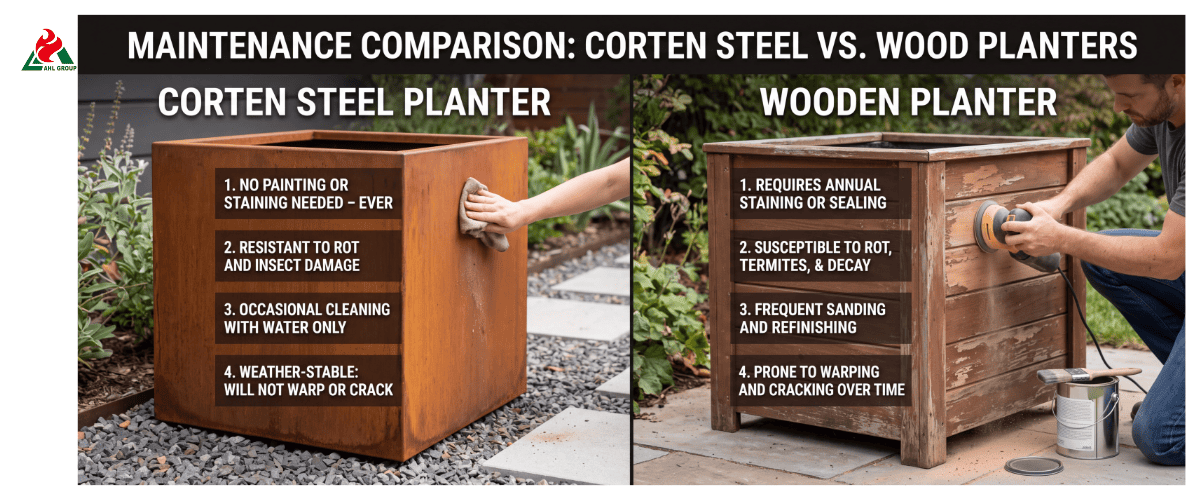
► No Sealing Required: It never needs to be painted, stained, treated for rust, or sealed with liquid sealants.
► Self-Healing: Scratches will naturally re-oxidize after a few wet-dry cycles and blend into the uniform weathered rust patina.
► Routine Cleaning: Simply rinse with clean water occasionally to remove dirt or debris accumulated in the drainage holes.
Maintenance of Wooden Planters
To ensure a wooden planter lasts half as long as a Corten steel planter, active and ongoing maintenance is required:
► Re-sealing/Staining: Every 12 to 24 months, thoroughly clean and sand the surface, then apply oil, wood stain, or a waterproof sealant.
► Tightening Fasteners: As wood shrinks and expands, screws, bolts, and corner braces can become loose and need to be periodically retightened or replaced.
► Inspection for Rot: Rotten bottom panels must be cut out and replaced before structural failure occurs.
Drainage and Waterproofing Management for Both Materials
Regardless of the material chosen, water must be able to drain freely. Standing water rapidly accelerates wood rot and causes localized pitting in weathering steel. The bottom of the planter should have sufficient drainage holes, and internal drainage channels should be kept clear.
Preventing Rust Runoff and Staining of Wood
Both materials release natural compounds during the initial weathering process, which may stain surrounding surfaces:
► Weathering steel runoff: During the first 6 to 18 months of rust formation, rainwater carries dissolved iron particles that may temporarily stain light-colored concrete, limestone, or porous paving bricks.
► Solutions: Pre-weather the steel off-site, apply a chemical weathering accelerator before installation, or install runoff channels on a gravel bed during the initial leaching period.
► Wood Tannin Leaching: Unsealed cedar, redwood, and tropical hardwoods leach dark brown tannins when exposed to rain, leaving yellowish-brown stains on concrete and stone.
Repairing and Replacing Damaged Planters
► Wood: Once structural rot sets in, individual planks weaken, typically leading to the failure of the entire planter within a decade and necessitating replacement.
► Weathering steel: Its extremely long service life means that complete replacement is rarely necessary. Even after decades of use, metal planters can be easily modified or repaired through structural alterations or on-site welding.
7. Drainage and Interior Design
Why Drainage Holes Are Important for Corten Steel
Although Corten garden planters can withstand soil moisture, standing water that accumulates at the bottom can deprive the steel of oxygen. Installing appropriate drainage holes (typically 25 to 50 millimeters in diameter, depending on the bottom surface area of the planter) ensures that excess irrigation water drains completely, allowing the steel at the bottom to form a protective rust layer as intended.
Avoiding Waterlogging and Soil Waterlogging
Soil waterlogging damages plant roots due to oxygen deprivation and subjects the pot walls to constant hydrostatic pressure. Placing a drainage layer around the perimeter of the pot ensures that water flows smoothly toward the drainage holes.
Use Legs, Spacers, or a Gravel Base
Raising the planter 10 to 20 millimeters using built-in legs or non-marking rubber pads offers two key benefits:
► It promotes horizontal airflow beneath the flower pot, keeping the bottom dry.
► It prevents drainage holes from becoming clogged by the paving stones below.
When to Add a Liner
From a structural standpoint, Corten steel does not require a liner to ensure durability. However, in installation environments with high levels of exposure, adding a heavy-duty embossed drainage membrane or an HDPE liner offers the following specific advantages:
► It reduces direct moisture transfer between the soil and the metal, further extending the service life.
► By providing a slight layer of insulation, it keeps the plant’s root zone cool in extreme desert environments.
Choose a Well-Draining Soil Mix
Heavy clay retains moisture for long periods, limiting air circulation inside the planter. Selecting a lightweight, porous landscaping soil mix containing perlite, pumice, well-decomposed bark, and coarse sand ensures rapid drainage and promotes healthy root growth.
8. Safety for Plants and Soil
Is Weathering Steel Safe for Ornamental Plants
Yes, weathering steel is completely safe for trees, shrubs, perennials, and ornamental plants. The trace amounts of rust oxides that seep into the soil are natural micronutrients that plants can easily absorb or tolerate, and they are non-toxic.
Using Weathering Steel for Vegetable and Herb Gardening
Weathering steel contains no synthetic chemical treatments, toxic resins, heavy-metal preservatives, or volatile organic compounds (VOCs). The primary alloying elements (copper, chromium, and nickel) are firmly bound within the steel matrix and do not leach into the soil at hazardous concentrations. Therefore, it is safe to use weathering steel planters to grow edible vegetables, herbs, and fruit trees.
Potential Issues with Treated Wood
Early pressure-treated wood (CCA—chromium-copper-arsenic—used before 2004) contained arsenic, which can leach into the surrounding soil and edible plants. Modern pressure-treated wood uses copper-based chemicals (ACQ, CA-B). Although safer than CCA, copper leaching can still alter soil chemistry; therefore, pressure-treated wood is not suitable for organic vegetable gardening unless lined with food-grade plastic.
Soil Contact, Liners, and Root Protection
Direct contact between moist, organic soil and wood can rapidly accelerate fungal activity. For wooden planters used to grow edible plants, it is essential to use plastic liners (such as virgin polyethylene) that meet food safety standards to isolate the soil from the chemicals in the wood and prolong the wood’s structural integrity. Weathering steel, however, does not require this type of chemical barrier.
When to Take Additional Precautions
In hot regions, exposed steel inner walls can conduct heat to the surrounding root zone under direct afternoon sunlight. For sensitive plant varieties, rigid insulation panels (such as 15-millimeter-thick XPS foam boards) can be installed on the sun-exposed inner metal walls to protect tender absorbent roots from heat stress.
9. Cost and Lifetime Value
Comparison of Purchase Prices for Weathering Steel and Wood
Initial purchase prices typically reflect raw material costs and manufacturing requirements:
► Untreated/treated softwood: Lowest initial purchase price.
► Western red cedar: Moderate initial purchase price.
► Weathering steel (2–3 mm): Moderate to high initial purchase price.
► Premium tropical hardwood (Ipe): Higher initial purchase price (due to material scarcity and labor-intensive joinery, the price is often comparable to that of steel).
Installation and Shipping Costs
Corten outdoor planters are fully welded and assembled at the factory and require only simple positioning. However, heavy-duty commercial Corten planters require adequate lifting equipment or a team of workers. Wooden planters are lighter and easier to transport, but they typically require on-site assembly or reinforcement to withstand the long-term weight of the soil.
Ongoing Treatment and Maintenance Costs
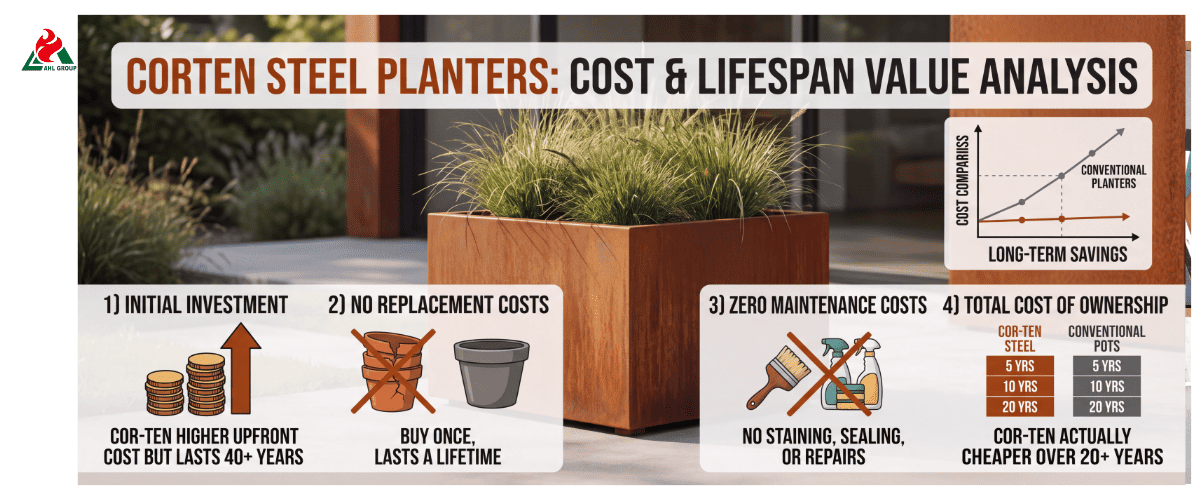
► Weathering steel: $0 in annual maintenance costs. No sealants, paint, or labor required.
► Wooden planters: Require ongoing expenses for wood stain, waterproofing agents, and sanding supplies, as well as maintenance every 1 to 2 years; the cumulative cost over a decade is quite substantial.
Replacement Cycles of 20 to 40 Years
Over 40 years, the choice of material directly determines the frequency of replacement:
► Cork: Requires replacement 4 to 6 times.
► Cedar/Pressure-treated wood: Requires replacement 3 to 4 times.
► High-quality hardwood: Requires replacement 1 to 2 times.
► Weathering steel: No replacement required (service life exceeds 40 years).
When Will the High Upfront Cost of Corten Steel Pay Off
Although the initial investment in Corten steel is higher than that of cork, the economic break-even point typically occurs between the 5th and 8th years. Once the cost of replacing rotted wooden planters—as well as the cost of new soil, replanting labor, and ongoing maintenance—is factored in, the total cost of ownership (TCO) of Corten steel over the project’s lifecycle is significantly lower.
10. Design and Sustainability Considerations
The Natural Patina of Corten Steel
Over time, Corten steel undergoes an elegant transformation, gradually shifting from its original silvery-gray hue to warm amber and deep terracotta tones, eventually developing a rich mahogany-brown patina. This natural, earthy finish complements architectural concrete, stone paving, and lush greenery.
Warm Wood Tones and Natural-Style Gardens
Natural wood brings organic warmth, distinct grain patterns, and traditional craftsmanship to garden spaces. It blends seamlessly into rustic landscapes, traditional residential backyards, and home wood deck settings.
Combining Weathering Steel with Wood and Other Materials
In modern architectural landscapes, these two materials are often combined to strike a balance between structural strength and a warm tactile quality. For example, pairing a thick-gauge Corten modern planter wall with a top-mounted hardwood bench creates a public seating unit that is both comfortable and durable.
Recyclability and Material Lifespan
► Weathering steel: Highly sustainable. Steel is 100% recyclable at the end of its service life without any loss of quality. Additionally, its service life—spanning several decades—minimizes material consumption and manufacturing waste.
► Treated wood: Because it contains chemical preservatives, treated wood is difficult to recycle or incinerate safely, which means discarded treated wooden planters are typically sent to landfills.
Choices Based on Aesthetics and Project Objectives
The choice of material depends on the overall design objectives: if clean architectural lines, structural durability, and long-lasting, maintenance-free performance are desired, choose weathering steel; if a traditional, organic texture is sought in a low-impact residential setting, choose wood.
11. Common Mistakes to Avoid
Assuming All Corten Planters are of the Same Quality
Not all metal planters with a rustic appearance are genuine Corten planters. Many low-priced online products are made of thin-walled standard carbon steel, with surfaces that have undergone a quick chemical treatment to create a rusted appearance. Standard carbon steel lacks alloying elements such as copper and chromium; it will continue to rust until structural failure occurs within 3 to 5 years. Be sure to verify the steel specifications (ASTM A588, A242, or EN 10025-5 / S355J2WP).
Choosing Untreated, Low-Quality Wood
Using untreated pine, spruce, or cheap construction lumber in outdoor planters will inevitably lead to rapid fungal rot in plants and typically result in structural failure within 2 to 4 years.
Neglecting Drainage Issues with Both Materials
If drainage holes are not cleared, water will accumulate inside the planter. Standing water will cause the plant roots to become waterlogged, the wooden base to rot, and prevent Corten steel from undergoing the alternating wet-dry cycles necessary to maintain its protective rust layer.
Placing Planters Directly on Damp Surfaces
Placing durable planters directly on damp soil, grass, or undrained concrete can cause water to pool around the base. Be sure to use risers or a layer of gravel to raise the planter slightly and allow for ventilation at the bottom.
Comparing Only Initial Costs While Ignoring Lifecycle Costs
Evaluating planters based solely on their initial purchase price can lead to long-term budget overruns. When you factor in the labor costs for repainting, wood sealant, the cost of replacing plants, and the expense of replacing the entire planter every 7 to 10 years, you’ll find that, in the long run, low-cost wood is often much more expensive than weathering steel (Corten steel).
12. FAQs
Q1: Do Corten Steel Planters Last Longer Than Wooden Planters?
Yes. Corten steel planters have a lifespan of 25 to 50 years or more, which is 4 to 5 times longer than ordinary wooden planters (5–10 years) and more than twice as long as high-quality hardwood planters (15–25 years).
Q2: How Many Years Will a Weathering Steel Planter Last?
With proper drainage and a sheet thickness of 2 to 3 millimeters, weathering steel outdoor planters typically have a service life of 25 to 50 years in standard outdoor environments.
Q3: How Long Do Traditional Wooden Planters Typically Last?
Untreated softwood lasts 3–5 years; pressure-treated wood lasts 7–12 years; cedar lasts 10–15 years; and high-density tropical hardwoods (such as ipe), when regularly sealed, can last 15–25 years.
Q4: Are Corten Steel Planters Safe for Growing Vegetables?
Yes. Corten steel does not leach harmful synthetic chemicals into the soil. The natural iron oxide it releases is a non-toxic micronutrient, so Corten steel planters are completely safe for edible vegetables, herbs, and fruit trees.
Q5: Do Corten Steel Planters Need a Liner?
No, from the perspective of structural durability, a liner is not necessary. When Corten steel comes into contact with moist soil and air, it naturally forms a protective layer of rust. However, in extremely hot climates, you can add internal thermal insulation foam or dimpled film to prevent heat transfer and protect sensitive plant roots.
Q6: In Rainy Climates, Which Is More Suitable: Weathering Steel or Wood?
Weathering steel performs significantly better in rainy climates. Prolonged rainfall causes wood fibers to absorb water until they become saturated, leading to swelling and rapid decay. As long as the planter has proper drainage and is allowed to dry out regularly, weathering steel can easily withstand heavy rain.
Conclusion: A Clear Answer on Which Material Is More Durable
If your primary goal is long-term outdoor durability with minimal maintenance, Corten landscape planters are generally more durable than wooden ones. The rust layer formed on weathering steel significantly slows atmospheric corrosion, and the material itself is resistant to rot, pests, and UV degradation.
For many residential gardens, a well-crafted, 2–3-millimeter-thick weathering steel planter with good drainage is a practical choice, while larger commercial planters may require thicker steel and reinforced construction.
To achieve the best long-term results, do not evaluate planters based solely on the material itself. You should also examine the steel grade, thickness, drainage design, welded seams, legs or supports, installation conditions, and environmental exposure. These details often determine whether a planter will last for decades or develop problems sooner.
Bottom line: While weathering steel has a higher upfront cost, its long service life and low maintenance requirements make it a superior long-term investment for permanent outdoor landscaping.

