


Water features are the jewels of landscape architecture, seamlessly blending visual movement with auditory tranquility to create a unique sensory experience. However, the success or failure of a water feature’s design hinges almost entirely on its scale and proportion. An oversized fountain can overwhelm a space, transforming a serene garden into a crowded functional area; conversely, a fountain that is too small may appear insignificant, seeming like an afterthought rather than a visual focal point. Selecting the appropriate size is a multifaceted challenge that requires balancing floor area, acoustic effects, and the architectural context of the surrounding environment.
1. Introduction: Why Size is the Deciding Factor in Function and Aesthetics
The size of a water fountain not only determines its placement but also sets the tone for the entire space. In landscape design, we often speak of a fountain’s “presence.” The size of a water feature determines its presence. A large, multi-tiered fountain is majestic and creates a solemn atmosphere, while a small, bubbling bowl-shaped fountain evokes a sense of intimacy and invites quiet reflection. When the size is chosen appropriately, the fountain seems to “grow” naturally within the landscape. It coexists harmoniously with the surrounding plants and hardscape, constructing a coherent visual narrative.
Common mistakes in sizing often stem from a lack of “spatial imagination.” Homeowners frequently see exquisite fountains in spacious showrooms or vast public parks and assume that replicating them on their own patios will yield the same effect. If the proportions are off, a “boulder effect” may result—where the roar of the fountain pump drowns out conversation, or water splashes onto nearby furniture. Conversely, choosing a fountain that is too small often leads to “visual evaporation”—the fountain is so diminutive that it fails to attract attention or provide the expected cooling effect. This guide offers a technical framework to ensure your selection is mathematically sound and aesthetically perfect.
2. Measure Your Space First: Beyond the Tape Measure
Before browsing through product catalogs, you must conduct a thorough assessment of your space. This involves more than just measuring the width of your patio; it requires understanding the difference between “active space” and “static space.” Active space is where you walk, sit, lie down, and move about; static space serves as the visual backdrop. An outdoor courtyard may have a total area of 1,000 square feet, but the actual “display area” might be just a 10-foot-square corner next to a retaining wall. You must measure the “visual cone”—that is, the range of view from where people sit in their favorite garden chairs. If a fountain is too tall, it may block the sunset view; if it is too wide, it may obstruct the path to the barbecue area or lounge.
Indoor spaces demand even stricter control over dimensions. Indoor fountains must account for “vertical height” and “splash radius.” A 4-foot-tall wall-mounted waterfall might fit on a wall, but if placed in a narrow hallway, the acoustic echo could become unbearable. Additionally, the “maintenance radius” must be considered. Every fountain requires a “service zone”—at least 12 to 18 inches of clear space around the base to allow for cleaning, access to the pump, and winter freeze protection. A fountain that completely occupies its footprint with no surrounding clearance is a failure in logistical planning.
3. Match Size to Location: Scaling for the Environment
The size of your space determines the “boundary” for the fountain’s dimensions.
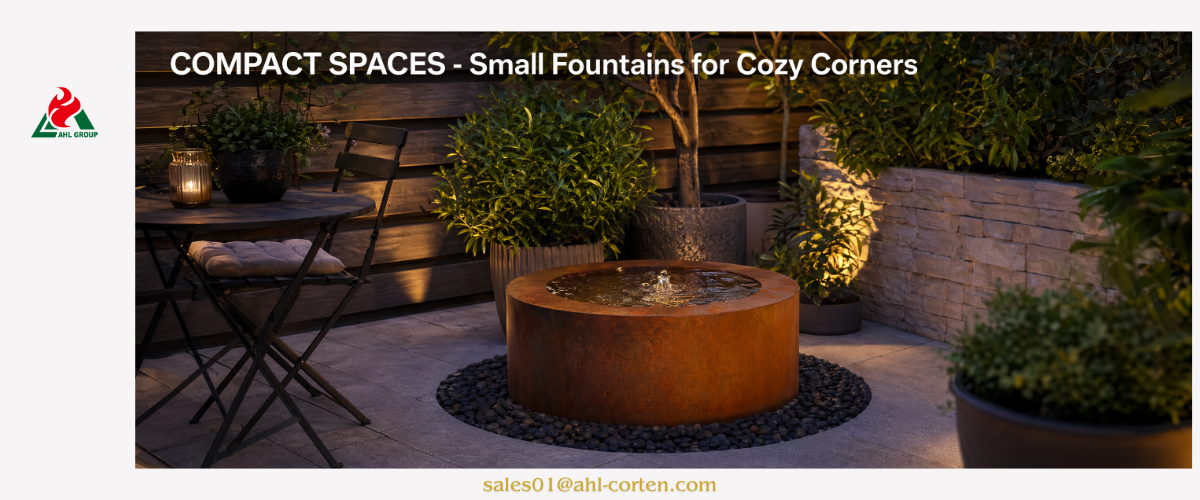
► Small Patios (under 200 square feet): In these intimate spaces, vertical designs are your best bet. Wall-mounted fountains or slender, towering “water screens” made of materials like Corten steel can create maximum visual impact while taking up minimal space. Tabletop fountains are equally effective, but they often lack the acoustic depth needed to mask neighborhood noise.
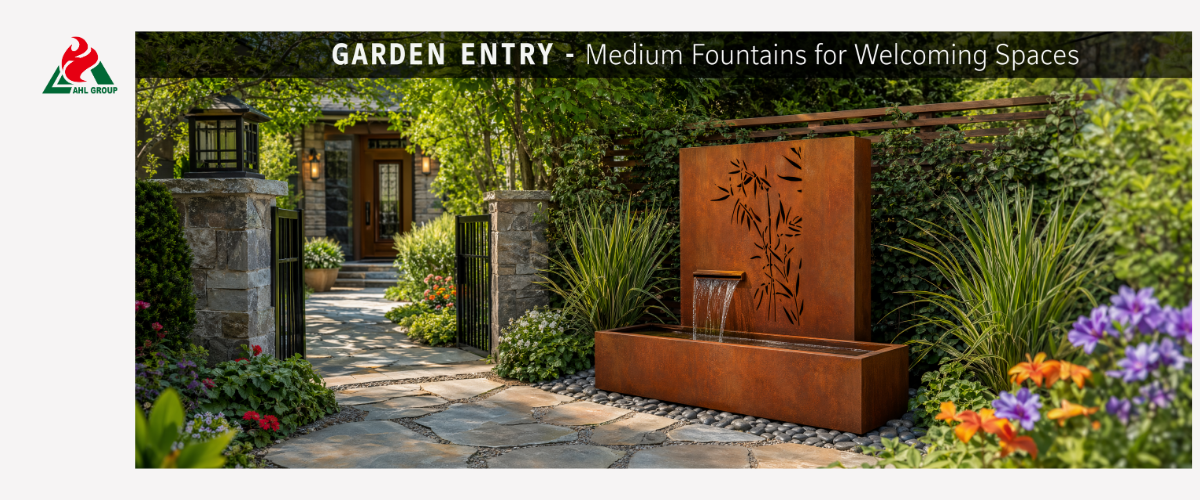
► Medium-sized Courtyards (200–500 square feet): This is the ideal space for free-standing water fountains or single-tier bubbling basins. Landscapes of this scale should serve as visual anchors for the “midground.” Free-standing fountains with diameters of 36 to 48 inches create a majestic presence without requiring specialized plumbing modifications.
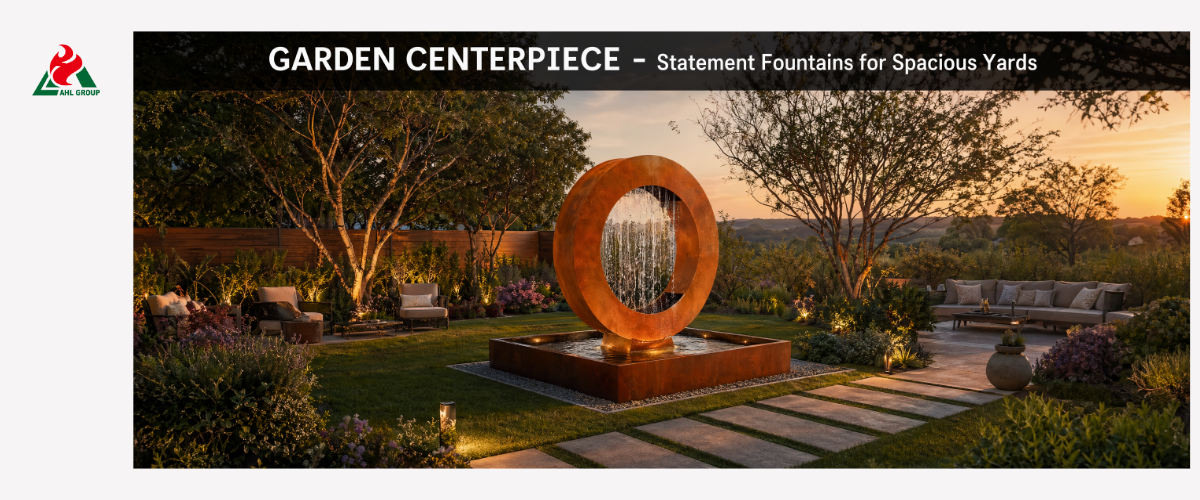
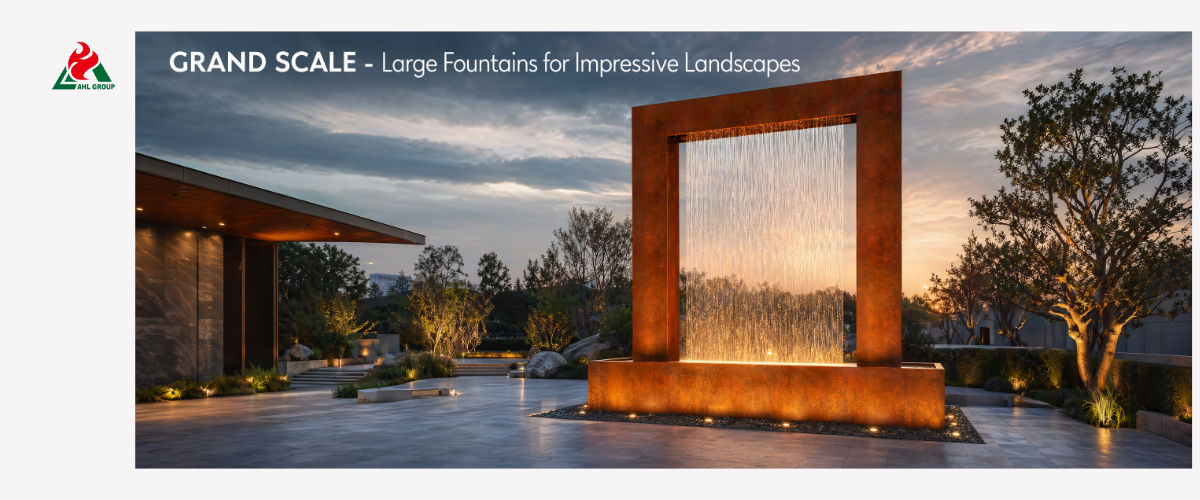
► Large Landscapes (>500 square feet): In this setting, the “scale” of the fountain must match the “vastness” of the sky. Multi-tiered waterfall fountains or large, pool-less waterfalls are essential. In expansive lawns or estate gardens, small fountains look like toys. You need a landscape feature that can be seen and heard from at least 30 to 50 feet away to maintain architectural balance.
4. Scale and Proportion Rules: The Golden Ratios of Water
When designing outdoor water features, designers typically follow the “rule of thirds” or the “30-50 rule.” Generally, a fountain should occupy between one-third and one-half of the surrounding visual space. For example, if you have a circular patio with a diameter of 12 feet, a 4-foot-diameter fountain (occupying 1/3 of the space) falls within the “safe zone,” while a 6-foot-diameter fountain (occupying 1/2 of the space) falls within the “visual focal point zone.” If the fountain exceeds 50% of the space, it creates an overwhelming visual effect, making it appear as though the fountain is “swallowing” the entire patio.
Height is equally crucial. Unless the fountain is designed as a unique, monumental focal point, its height should generally not exceed that of the nearest architectural element (such as a fence or windowsill). The balance between height and width is key to avoiding the “vanishing effect.” On an open lawn, a tall, narrow fountain resembles a needle; in a tall, narrow alleyway, a low, wide fountain basin resembles a puddle. Achieving “volumetric symmetry” ensures the fountain feels firmly rooted to the ground.
5. Water Sound and Flow Considerations: The Acoustic Footprint
The size of a fountain determines its noise level. This is a factor that many buyers often overlook before installing a water feature; it’s only after installation that they realize they can’t even hear each other speak during dinner.
► Small Fountains (Gentle Ripple): Ideal for placement on a balcony or near a bedroom window. These metal fountains produce a high-frequency, low-volume “tinkling” sound designed to provide a relaxing experience at close range.
► Medium-sized Fountains (Moderate Splash): Typically feature a drop height of 6–12 inches. The “white noise” frequency they produce is ideal for masking the hum of nearby air conditioners or the distant roar of traffic.
► Large Fountains (Thundering Waterfalls): These multi-tiered fountains feature a drop of up to 24 inches, producing a deep, rhythmic “roar.” This sound offers the dual benefits of physical cooling and psychological relaxation, but requires sufficient space for the sound to disperse. If placed in an enclosed courtyard, the sound will bounce off the walls, creating an echo chamber that may become irritating over time.
6. Fountain Size by Type: Choosing the Silhouette
Water feature types have an “implicit scale” that must be respected.
► Cascading Fountains: These landscape fountains are inherently grand and majestic. They require a circular “splash guard” basin, typically twice as wide as the top tier, to prevent water from spilling over.
► Water Walls/Water Curtains: These designs are ideal for modern-style spaces with limited room. A 6-foot-tall water wall made of Corten steel, requiring a basin depth of just 12 inches, can create a highly striking visual effect in a narrow side yard.
► Bubble Basins/Basalt Columns: These designs are understated and unobtrusive. Their size is often deceptive, as most of the water reservoir is buried underground. They are perfect for entryways—allowing you to enjoy the sound of water without a massive structure blocking the view from the door.
► Fountain Statues: The size of the statue must be proportional to the basin. A massive lion-head spout facing a small basin looks overwhelming; conversely, a tiny spout facing a large basin appears out of place.
7. Practical Installation Factors: The Physics of Size
The larger the waterfall, the more complex its infrastructure.
► Electrical and Water Connections: Large waterfalls require high-flow pumps, which typically necessitate a dedicated 20-amp ground-fault circuit interrupter (GFCI) circuit. Smaller waterfalls can usually be powered by low-voltage solar panels or connected to a standard outdoor outlet.
► Load-bearing capacity: This is critical for balcony and rooftop installations. Large stone or metal fountains can weigh over 500 pounds even before being filled with water. When filled, a 100-gallon fountain adds 830 pounds of “live load.” You must ensure that your deck or balcony has sufficient load-bearing capacity to support this weight.
► Maintenance Access: You must be able to reach the center of the fountain to clear debris from the pump’s intake. If the fountain is 8 feet wide and you cannot reach the center, maintenance will become extremely cumbersome, ultimately leading to the permanent shutdown of the feature.
8. Style-Specific Size Guidelines: Aesthetics of Dimension
► Modern Minimalist: This style emphasizes “clean proportions.” Modern fountains are typically crafted from Corten steel or polished concrete, featuring simple, fluid forms that seamlessly integrate with the home’s geometric structure, creating a sense of unity with the house’s walls.
► Traditional/European: This style favors a “sense of solidity.” Cascading fountains should appear steady and substantial. They are often used as the visual focal point in “cross-axis” garden designs.
► Zen/Japanese: This style emphasizes a “low, horizontal, and spread-out” aesthetic. Traditional Zen fountains (Tsukubai) sit close to the ground, requiring the viewer to bend down or look downward to gaze at them, symbolizing humility. These fountains should be wide and shallow rather than towering and imposing.
9. Common Size Mistakes: The "Buyer's Remorse" Checklist
The most common mistake is a “Visual Vacuum.” This happens when a garden fountain is placed in a space that’s so vast it loses its impact. If you have a one-acre lawn and put a three-foot-tall fountain right in the middle, it will look like a piece of junk. Instead, place that fountain on a small patio near the back door, where people can truly appreciate its beauty.
The second mistake is “Architectural Clash. ” For example, placing a massive, ornate multi-tiered fountain in front of a small, modern cottage makes the house look even smaller and creates a stylistic mismatch. Finally, ignore the “splash effect” at your own risk. In windy areas, large fountains can lose several gallons of water daily due to wind-driven splashes, which may damage nearby wooden decks or create slippery patches on stone pathways.
Conclusion: Measure Twice, Flow Once
Selecting the right size for a landscape water fountain requires striking a delicate balance between engineering and aesthetic appeal. It is the only element in landscape design where “bigger” isn’t always “better,” and “smaller” often fails to make an impact. The key to a successful installation lies in testing the water volume before making a purchase. Designers often use a “cardboard model”—a simple cardboard box scaled to the fountain’s dimensions—and place it in the garden for 48 hours. This allows you to observe how sunlight falls on the fountain, how it affects foot traffic, and whether it obstructs the view.
Ultimately, your water feature should reflect your lifestyle. If you’re seeking a tranquil reading nook, a small, gentle fountain is your best choice. If you wish to create an entertaining atmosphere and make a bold architectural statement, a large, high-flow fountain crafted from premium materials like weathering steel will provide the durability and “wow factor” you need. By striking a balance between function, aesthetics, and budget, you’ll create a water feature that brings you joy for decades to come.
AHL Group specializes in custom-sized Corten steel water features tailored to your specific landscape needs. From grand architectural waterfalls to minimalist, modern balcony fountains, our engineering team ensures your water feature fits your space perfectly. Contact us today for a custom quote.

