


Selecting the right size for Corten steel garden lights is more than just a design decision—it is a comprehensive consideration of functionality, aesthetics, and technical factors that directly impact the visual appeal and practical performance of your outdoor space at night. If the lights are too small, they will blend into the landscape; if they are too large, they will overwhelm the surroundings, causing glare, visual imbalance, and even safety issues.
Due to its rich rusted texture and strong visual presence, the selection of dimensions is particularly crucial for weathering steel. Unlike plastic or aluminum fixtures, Corten steel lights carry visual weight, meaning their dimensions must be carefully matched to the surrounding plants, pathways, and architectural elements. In this guide, we’ll break down in detail how to choose the right size for your Corten steel garden lights—step by step—so you can achieve a balanced, professional, and high-performance lighting design.
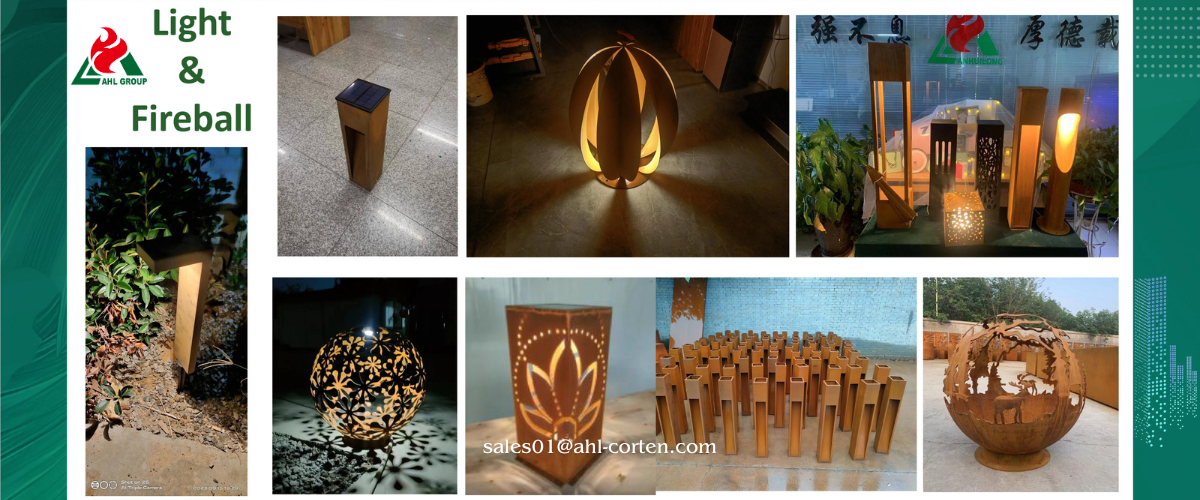
Due to its rich rusted texture and strong visual presence, the selection of dimensions is particularly crucial for weathering steel. Unlike plastic or aluminum fixtures, Corten steel lights carry visual weight, meaning their dimensions must be carefully matched to the surrounding plants, pathways, and architectural elements. In this guide, we’ll break down in detail how to choose the right size for your Corten steel garden lights—step by step—so you can achieve a balanced, professional, and high-performance lighting design.
1. Introduction: Why Size Matters in Landscape Lighting
Balancing Scale: Proportions Between Plants and Paths
In landscape design, scale is everything. Lighting fixtures must exist in harmony with their surroundings, not compete with them. A 30cm bollard placed next to mature shrubs or ornamental grasses over 80cm tall will simply disappear, while a 1-meter light next to a narrow garden path can feel intrusive and visually heavy.
The key is to think of lighting as part of the spatial composition. Lights should align with the height of planting layers, pathway widths, and architec If a 30-centimeter-tall light post is placed next to a mature shrub or ornamental grass over 80 centimeters tall, it will appear insignificant; conversely, a one-meter-tall fixture placed alongside a narrow garden path will seem out of place and visually overwhelming.
The key lies in treating lighting as an integral part of the spatial composition. Garden lights should coordinate with the height of the vegetation layer, the width of the path, and the architectural lines. When handled properly, lighting becomes an invisible guide that enhances the landscape’s aesthetic appeal without overwhelming it.
The Impact of Fixture Height on Light Distribution (Illuminance)
Height directly affects the distribution of light. Taller fixtures produce a wider illumination area, thereby reducing the number of fixtures required; lower fixtures, on the other hand, create a more concentrated beam.
For example, a 90-centimeter-high column light may illuminate a radius of 2 to 3 meters, while a 30-centimeter-high bollard light may only effectively cover 1 meter. Understanding this relationship helps avoid over-illumination (glaring brightness) and under-illumination (dark blind spots).
The Visual Weight of Weathering Steel: Small vs. Large Fixtures
Weathering steel has a heavy, rustic texture, and its visual weight far exceeds that of lighter materials. This means that even medium-sized installations appear quite substantial. Designers must take this into account and carefully consider proportions to ensure that the installation complements its surroundings rather than overwhelming them.
2. Understanding Your Garden’s Scale
The Contrast Between Front Porch Walkways and Spacious Backyards
Narrow front porch walkways typically require compact, low-profile lighting fixtures to maintain a warm and tidy atmosphere. In contrast, spacious backyards or commercial landscapes are better suited to taller, more striking lamps that visually anchor the space.
When considering lamp size, viewing distance must be taken into account. The farther the viewer is, the larger the lamp needs to be to create sufficient visual impact.
Vertical Elements: Matching Fixture Height to Plant Bed Height
Lighting design should harmonize with the garden’s vertical structure. If the average height of planting beds is 40–60 centimeters, outdoor lights should be positioned slightly below the beds (for a subtle effect) or slightly above them (to create a striking visual impact).
Placing lights at the same height as surrounding plants often results in visual clutter and diminished effect, as the light is partially obscured.
Creating Depth: Using Different Heights to Achieve Layered Lighting
Layered lighting is one of the most effective techniques in professional design, using fixtures at varying heights to create depth and visual layers.
For example:
► Place low-profile fixtures along pathways
► Use medium-height fixtures in planting beds
► Employ tall fixtures in focal areas
This layered design creates a dynamic nighttime landscape rather than a flat, uniformly lit space.
3. Choosing Height Based on Application
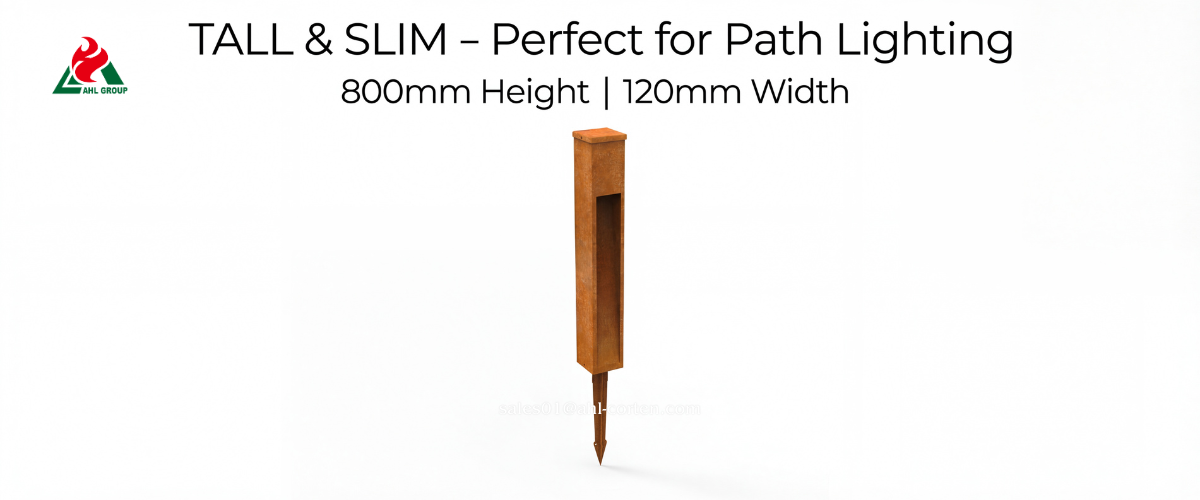
Pathway Light Poles: 30 cm to 50 cm, Ensuring Safe Passage
Pathway lighting should prioritize visibility while avoiding glare. Light poles between 30 and 50 cm in height are ideal because they illuminate the walking surface without appearing obtrusive.
This height ensures that light is directed downward, reducing brightness at eye level and enhancing comfort.
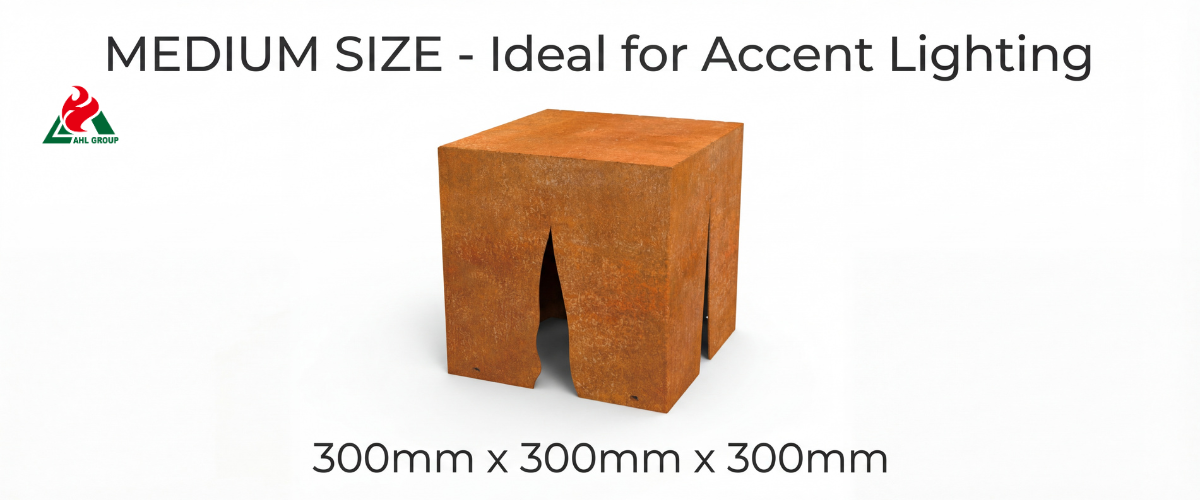
Decorative Bollard Lights: 60 cm to 90 cm, Highlighting Architectural Features
Accent lighting is used to highlight elements such as walls, sculptures, or trees. Fixtures between 60 and 90 cm in height project light outward and upward, creating a dramatic effect without overwhelming the space.
Low-Profile Step Lights: Compact Size, Discreet Safety
Step lights are designed to be low-profile and unobtrusive. Compact fixtures recessed into walls or steps provide directional lighting, ensuring safety without disrupting the overall design.
Driveway Pillars: 100cm+ for Grand Entrances
For large entrances or driveways, taller lights (100 cm or higher) create a grand and impressive visual impact. These fixtures serve as both functional elements and a statement of architectural style.
4. Calculating Light Spread and Spacing
How Height Affects Beam Diameter
Generally speaking, the higher a lamp is installed, the larger the area it illuminates. However, this also depends on the beam angle and lumen output.
A lamp installed higher up but with a narrow beam angle may still produce a focused effect, while a lamp installed lower but with a wide beam angle may cover a larger area than expected.
Calculating Spacing to Avoid “Dark Spots”
Proper spacing ensures lighting continuity. A common practice is to set the spacing between fixtures to 1.5 to 2 times their illumination radius.
For example:
► 1-meter illumination radius → Spacing of 1.5–2 meters
This prevents both lighting blind spots and excessive overlap.
Overlap Lighting vs. Contour Lighting
Overlap lighting creates a soft, continuous glow, making it ideal for pathways and social areas. Contour lighting, on the other hand, is used to define boundaries and is commonly applied in large-scale landscapes.
5. Aesthetics: Choosing the Profile and Footprint
Slim-Profile Bollards for Minimalist Modern Gardens
Slim-profile Corten steel bollard lights are the top choice for modern and minimalist landscapes, which often emphasize visual restraint. These fixtures typically feature a slender cylindrical or rectangular design, allowing them to blend seamlessly with linear pathways and geometric layouts. Their compact footprint ensures they do not obstruct the view, a particularly important consideration in small gardens or urban courtyards where space is limited.
From a design perspective, slender bollards are not visual focal points but rather create a sense of rhythm. They subtly guide the path, acting as visual punctuation along the walkway. However, their understated presence means that dimensions must be carefully considered—if too slender, they may appear insignificant; if too tall, they lose their minimalist appeal. The key lies in selecting proportions that harmonize with the path’s width, paving patterns, and the density of surrounding vegetation.
Chunky, Square Pillars for Bold Industrial Aesthetics
In stark contrast, heavy-duty square bollard lights fully showcase the industrial character of weathering steel. With their bold designs, these lights are often used in locations that require a strong visual impact, such as large gardens, commercial landscapes, or building entrances.
Their large surface area accentuates the rich patina of weathering steel, lending them a sculptural quality and a sense of solidity. These fixtures often serve a decorative purpose during the day, rather than merely functioning as practical elements at night. However, their footprint must be carefully considered. An overly large base may obstruct walkways or create obstacles, particularly in confined spaces.
To make effective use of these fixtures, designers should place them in open areas or at key visual anchor points, such as entrances, corners, or focal points within the landscape. This ensures they enhance the overall composition rather than overshadowing it.
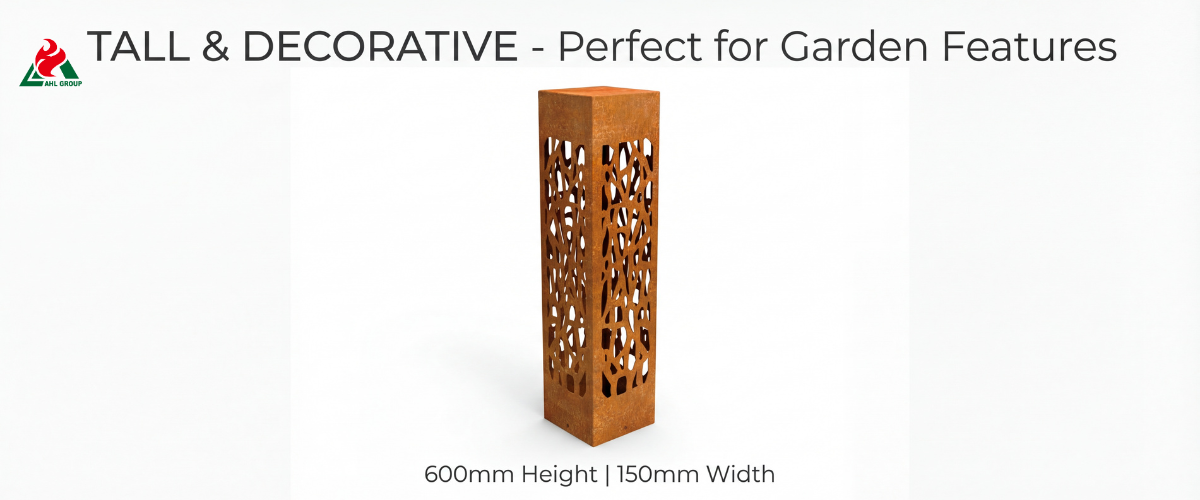
Perforated Patterns: How Size Influences the Intricacy of Light Shadows
Perforated Corten steel lighting opens up a whole new dimension—transforming light into patterns. The size of the fixture directly determines the intricacy and clarity of these patterns. Larger fixtures can showcase more detailed laser-cut designs, producing complex light and shadow effects that vary with viewing angle and distance.
Although smaller fixtures produce a more subtle effect, they can still create elegant patterns of light and shadow; however, due to manufacturing limitations, their patterns tend to be simpler. Another key factor is the distance between the light source and the perforated surface—this affects the clarity of the projected patterns.
Designers must also consider the surrounding environment. In relaxation areas, overly intricate patterns may cause visual distraction or glare; in feature wall settings, however, they can serve as central artistic elements. Ultimately, the luminaire’s size and perforation design should align with the intended experience—whether it be serene ambient lighting or a highly dramatic visual narrative.
6. Practical Installation and Viewing Angles
Viewing from a Distance vs. Close-up Walkway Interaction
When determining the size of a garden light, one of the most easily overlooked factors is how it appears from different distances. A fixture that looks perfectly proportioned up close may seem insignificant when viewed from the other end of the garden. Conversely, a tall fixture that looks stunning in a spacious setting may feel overwhelming when viewed up close.
For this reason, designers typically evaluate lighting effects from multiple perspectives:
► Interaction zones (pathways, patios)
► Mid-range views (garden edges, seating areas)
► Long-distance views (from windows or entrances)
The appropriate size should maintain visual harmony from these perspectives without appearing out of place.
Preventing Glare: Cut-off Height in Rest Areas
Glare is not only uncomfortable but also ruins the entire lighting experience. When fixtures are too high or improperly shielded, the light source becomes visible at eye level, causing discomfort and diminishing the usability of the space.
To avoid this issue, Corten garden lights should feature a downward-facing design with an appropriate glare-control angle. Lower-mounted fixtures (30–60 cm) are generally better suited for seating areas, as they keep the light below eye level. Taller fixtures should be equipped with internal baffles or louvers to control the direction of light.
Appropriate sizing combined with optical design ensures that lighting enhances visibility without causing visual distraction.
Ground Stability: Foundation Requirements for Taller Fixtures
As the height of lighting fixtures increases, so do the requirements for structural stability. Taller weathering steel fixtures, much like small vertical structures, are susceptible to wind loads, accidental impacts, and foundation settlement.
Proper installation requirements include:
► Light fixtures exceeding 80–100 centimeters in height must be installed using a concrete base or anchor bolts.
► Directly buried fixtures must ensure sufficient burial depth.
► Soil type and drainage conditions must be taken into account.
Neglecting these factors may result in tilting, misalignment, or long-term instability of the fixtures, particularly on soft or uneven ground. Properly sized fixtures are not only visually harmonious but also structurally more stable.
7. Material Integration: Corten Finish and Surrounding Elements
How Color Intensity Changes with Surface Area
The rust layer on weathering steel is one of its defining characteristics, but its visual impact is directly proportional to its surface area. Larger components exhibit more rusted surfaces, allowing their color to dominate the landscape. This can either enhance the overall design effect or disrupt the design balance, depending on how well this balance is managed.
In smaller gardens, large Corten steel outdoor lights may appear overly conspicuous, thereby diverting attention away from plants and other materials. However, in larger landscapes, they can serve to anchor the design, creating a striking contrast with greenery and stone.
Understanding how color intensity varies with size helps designers control visual hierarchy, ensuring that lighting complements rather than clashes with the surrounding environment.
Matching Light Size with Other Corten Features (Planters, Screens)
Consistency in material language is essential. If your project already includes weathering steel elements (such as planters, edging, or screens), the dimensions of the lighting fixtures should harmonize with these elements.
For example:
► Large planters pair exceptionally well with medium-to-tall lighting fixtures.
► Slim border elements are better suited to slender, low-profile lighting fixtures.
This creates a sense of cohesion, making all elements appear carefully curated rather than randomly selected. The goal is to establish a unified visual rhythm throughout the space.
8. Common Sizing Mistakes to Avoid
Overwhelming Small Spaces with Oversized Light Fixtures
One of the most common mistakes is using light fixtures that are far too large for the available space. Oversized lighting can overwhelm a small garden, making it feel cramped and unbalanced.
To avoid this, be sure to consider the scale of the space and the proportions of the surrounding elements. When in doubt, slightly smaller fixtures often create a more refined and inviting atmosphere.
“Invisible” Fixtures: When a 20-Centimeter Light Disappears in Tall Grass
At the other extreme, fixtures that are too small may lose their effectiveness. If a 20-centimeter fixture is placed in dense vegetation, it may be completely obscured, rendering it useless both functionally and visually.
Designers must anticipate how plants will grow over time to ensure that the fixtures remain visible and effective even as the landscape matures.
Overlooking “Burying Depth” in Direct-Buried Installations
Many fixtures require partial burial to ensure stability. If this factor is not taken into account, it reduces the fixture’s visible height, significantly altering the intended proportions.
For example, if a 50-centimeter-tall luminaire is buried 10 centimeters underground, only 40 centimeters will be visible above ground. This seemingly minor difference affects both light distribution and visual balance; therefore, installation depth must be factored into the sizing process.
Conclusion: Finding the Solution That Best Suits Your Needs
Selecting the right size hinges on striking a balance between functionality, proportions, light distribution, and the visual impact of materials. Every decision should take into account how the metal lighting fixtures interact with their surroundings, both day and night. For complex landscape settings, standard sizes may not meet the requirements. Customized solutions can precisely align with your design intent, ensuring optimal performance and aesthetic appeal.
AHL Group offers a wide range of customizable lighting solutions designed to meet both architectural and functional requirements. Our expert guidance ensures that your lighting system is not only visually appealing but also technically optimized, paving the way for long-term success.

