


Corten steel water features have become a favorite in modern landscape design due to their striking orange-brown rust patina and industrial aesthetic appeal. However, the most common mistake lies in improper sizing—either too small to draw attention or too large to overwhelm the surrounding space. This guide provides a comprehensive framework to help you select the ideal dimensions for your project.
Introduction: Why Size Matters for Corten Steel Water Features
The dimensions of a water feature are not only about aesthetics but also impact the garden's soundscape, maintenance cycle, and structural requirements. A proportionally balanced water fountain can blend seamlessly with its surroundings, while an improperly sized one will appear jarring and out of place.
2. Step 1: Assess Your Space and Site Conditions
Measure Total Area
Before browsing the product catalog, accurately measure the footprint of the designated installation area. Consider the “viewing distance”—the farther the distance from the feature, the larger its dimensions must be to maintain visual impact.
Determine Primary Viewing Angles
Will the feature be viewed from kitchen windows, patio seating, or while walking along pathways? Ensure height and width proportions are balanced so the water's movement remains clearly visible from these key perspectives.
Consider Vertical and Horizontal Space
In compact urban gardens, vertical water walls conserve ground space while creating a striking visual impact. On expansive lawns, horizontal water bowls or elongated watertroughs help anchor the landscape's foundation.
Step 2: Define the Purpose and Focal Point
Is It the Main Focal Point or an Accent Element
The main focal point should typically occupy 5-10% of the visual field. Accent elements (such as small bubble water bowls hidden among vegetation) require smaller dimensions to avoid visual conflict with primary landscape structures.
Achieving Balance and Proportion
Adhere to the “golden ratio” principle whenever possible. Landscape elements should be sufficiently prominent to establish the spatial tone while avoiding obstruction of pathways or overshadowing other garden highlights.
Step 3: Determine the Desired Sound and Atmosphere
Water Sound Intensity: From Gentle Murmur to Roaring Waterfall
Size directly impacts volume. A large 150cm overflow weir produces intense white noise, perfectly masking traffic sounds; a compact 60cm water bowl creates a subtle, meditative trickle.
Impact of Splash Zone on Surrounding Areas
Greater height differences result in wider splash zones. Ensure surrounding materials (decking, stonework, or plants) can withstand persistent moisture, and that the collection basin has sufficient capacity to contain splashed water.
Step 4: Match Size to Water Feature Type
Self-Contained Vessels: Diameter, Depth, and Water Capacity
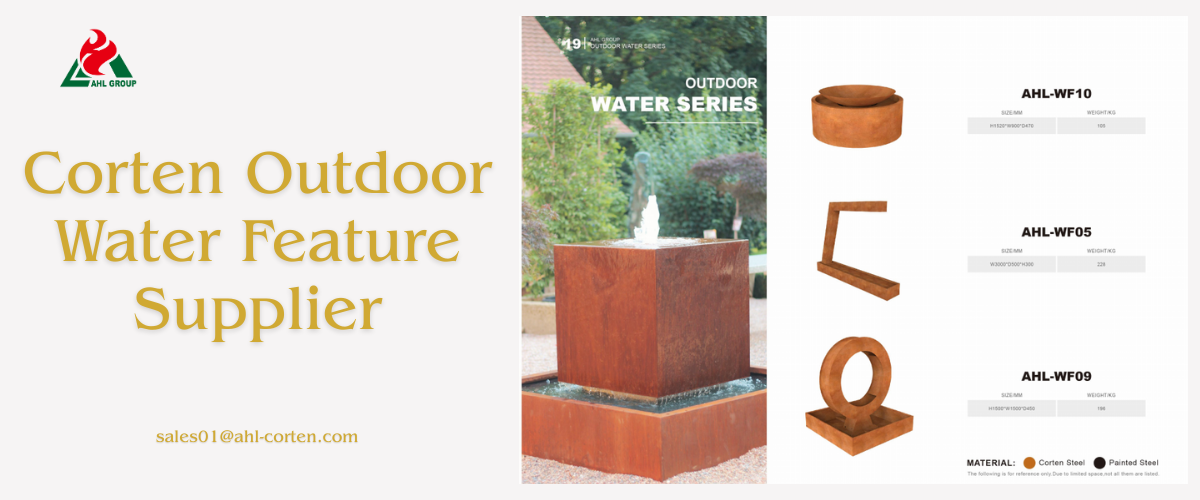
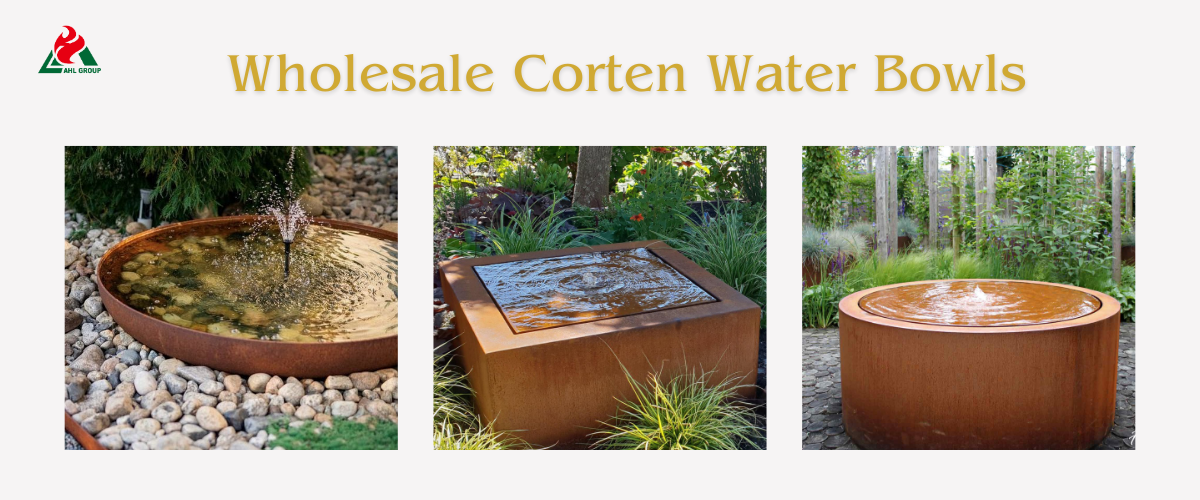
For Corten steel bowls, diameter is the defining dimension. Containers measuring 60–80 cm in diameter suit intimate relaxation zones, while vessels ranging from 100–150 cm serve as focal points in landscapes. Depth must ensure the pump remains fully submerged (typically a minimum of 20–30 cm) to prevent cavitation and overheating.
Cascading and Multi-Level Landscapes: Height, Width, and Water Flow
Design must account for vertical visual impact. Multi-level landscapes require wider reservoirs to contain wind-driven mist. Guideline: The catch basin width should exceed the highest weir width by at least 50% to minimize water loss.
Wall-Mounted Water Features: Proportional Relationship with Walls
Wall-mounted water features should adhere to the horizontal or vertical “rule of thirds.” For a 3-meter-wide wall, a 1-meter-wide weathering steel overflow creates visual balance. Avoid “stamp syndrome”—where miniature water features appear insignificant against large masonry walls.
Pond Landscape Design: Surface Area and Depth Requirements
Large Corten steel ponds require internal support structures to prevent wall deformation under water pressure. For safety and thermal stability, standard depths range from 40 to 60 centimeters, with surface areas proportionate to surrounding hardscape.
Linear and Stream-Pool Landscaping: Length, Width, and Path Integration
Stream-pool designs emphasize directionality. Garden paths typically measure 30 to 50 centimeters in width. Length should align with building contours or garden axes to create purposeful flow.
Step 5: Calculate Water Volume and Pump Requirements
Estimating Water Capacity: Calculation Formulas for Common Shapes (Circular, Square, Rectangular)
► Circular Basin: V = π × r² × Average Depth
► Square/Rectangular Basin: V = Length × Width × Depth
Note: 1 cubic meter = 1000 liters. Knowing the volume is critical for chemical dosing and weight calculations.
Pump Selection Fundamentals: Flow Rate Calculation Based on Landscape Height and Width (LPH/GPH)
To create a smooth “water feature, approximately 1500 liters per hour (LPH) is required per 10 centimeters of weir width. “Head height” (vertical distance from pump to outlet) significantly reduces pump performance; always verify the pump’s flow curve before selection.
Reservoir Capacity: Ensuring Sufficient Water Supply for Continuous Operation
Concealed reservoirs (collection wells) must store adequate “transient water” to both fill the pipeline for waterfall flow and maintain full pump submersion. For large landscapes, reservoir volume should be at least 2 to 3 times the volume of flowing water.
Evaporation Rate: Considering Climate and Seasonal Variations
During summer, large water features may evaporate 2% to 5% of their volume daily. Smaller water features require more frequent water replenishment or installation of automatic fill valves to prevent pump burnout.
Relationship Between Volume and Maintenance Frequency
Large water features exhibit greater thermal stability, slowing the rate at which algae growth turns the water green. However, they demand more extensive drainage and cleaning efforts. Smaller water features are easier to clean but necessitate nearly daily water level monitoring.
Step 6: Consider Installation Logistics and Site Access
Weight Calculation: Empty Load vs. Full Load (Water + Steel + Equipment)
Weathering steel has a relatively high density (7850 kg/m³). An empty bowl-shaped structure with a diameter of 150 cm and a wall thickness of 5 mm weighs approximately 100 kg. When filled with water and decorative river stones, the total weight may increase up to threefold.
Transportation Access: Can Landscape Components Reach the Final Location?
Verify door widths, overhead clearance (for crane or boom operations), and path load-bearing capacity. Most components over 120 cm in width require transport on double-wide pallets and cannot pass through standard side doors.
Lifting and Positioning: Equipment Requirements by Size
Small landscape elements (<50 kg) can be handled manually. Medium-sized elements (50–150 kg) require a four-person team handling or heavy-duty hand trucks. Large, landmark landscape elements necessitate mechanical assistance, such as compact excavators or engine hoists.
Basic Requirements: Load-bearing Capacity for Different Sizes
Small bowl-shaped components may be placed on compacted gravel. Components with a total weight exceeding 200 kilograms require reinforced concrete footings or structural foundations to prevent tilting over time due to ground settlement.
Indoor Installation: Floor Load-Bearing Capacity and Waterproofing Considerations
Consult a structural engineer to verify floor load-bearing capacity for indoor installations. A secondary “safety pad” or waterproof tray is recommended for all indoor weathering steel water features, regardless of size.
.png)
Step 7: Factor in Surrounding Elements and Plantings
Plant Spacing: Prevent Debris Accumulation
Maintain a 50-100 cm buffer zone from overhanging trees. Fallen leaves in small landscapes can rot and contaminate water bodies, requiring ongoing maintenance.
Integration with Rest Areas: Splash Zones and Comfort
To ensure comfort in the “soaking zone,” seating must be positioned at least 1.5 times the waterfall's height away. Weathering steel heats significantly under direct sunlight; ensure large features do not radiate excessive heat toward seating areas.
Lighting Considerations: Scale Impacts Lighting Solutions
Large outdoor water features require multiple light sources to avoid flat illumination. A 2-meter-high wall may need three 3-watt LED lights, while a small water bowl requires only a single submersible disc light.
Future Development: Allow Space for Maturing Landscapes
Designs must account for future garden changes. Mature shrubs may completely overshadow features that complement young trees today in five years.
Size Selection Guide by Garden Type
Small Urban Gardens & Balconies (Under 50 square meters)
► Recommended Landscape Dimensions: Water features 40–60 cm, compact wall-mounted landscapes (width < 80 cm).
► Space-Saving Strategies: Incorporate vertical elements and corner layouts to maximize ground area.
Medium Residential Gardens (50–200 square meters)
► Recommended feature sizes: Planters 60–100 cm, waterfall features 1–1.5 m tall.
► Balancing approach: Define functional zones (e.g., “Zen corners”) to avoid dominating the entire lawn.
Large Estates & Commercial Landscapes (200+ sqm)
► Recommended feature sizes: Signature water features 120+ cm, multi-element installations (e.g., three-tier cascading basins).
► Create visual impact: Use scale to make a design statement—boldly incorporate large-scale structures.
Courtyards & Atriums (Enclosed Spaces)
Special considerations: Acoustic effects (small courtyards prone to echoes), ventilation (moisture buildup), and proportional harmony with surrounding walls.
Climate-Specific Size Considerations
Hot, Dry Climate: Increase Reservoir Volume to Reduce Evaporation
Prioritize deeper reservoirs with smaller surface areas to lower evaporation rates.
Cold Winter Climate: Freeze-Resistant Depth Considerations
Ensure sufficient pump depth (>60 cm) or easy disassembly. Weathering steel resists freezing, but ice expansion may still damage shallow, thin-walled tanks.
High-wind Regions: Lower Profile Height and Reinforce Anchoring
Large, flat vertical components may create a sail effect. In windy areas, opt for low, bowl-shaped components or ensure adequate ballast and bolted foundation anchoring.
High Rainfall Areas: Integrate Overflow Capacity with Drainage Systems
Designs must include dedicated overflow pipes to prevent structural water accumulation and flooding of surrounding gardens during heavy rainfall.
Custom vs. Standard Sizes: Making the Decision
Standard Sizes for Cost-Effective and Quick Delivery
Standard sizes offer proven design solutions with optimized pump configurations at competitive prices.
Custom Solutions for Unique Spaces, Specific Proportions, and Design Concepts
For specialized requirements or precise channel spans, custom fabrication delivers ideal solutions.
Customization Process: Collaboration with AHL Group Design Team
Our team will ensure the structural integrity of custom components based on your CAD files or hand-drawn sketches.
Delivery Timelines and Budget Considerations for Custom Dimensions
Allow an additional 4 to 8 weeks for custom dimensions, factoring in supplementary costs for bespoke engineering design and single-unit production.
Conclusion: Finding the Perfect Fit for Your Outdoor Space
By assessing your space, defining its purpose, calculating technical requirements, and planning logistics, you'll transition from guesswork to precise planning. A properly sized weathering steel water feature doesn't merely adorn your garden—it anchors the landscape, develops a unique patina over time, and delivers a sensory experience you'll cherish for a lifetime.
【Browse our product range to find standard sizes that match your vision. Still unsure? Send us photos of your garden, and our experts will help determine the perfect proportions.】

