


Outdoor privacy protection has become an integral part of modern landscape design. Homeowners, architects, and commercial real estate developers are increasingly seeking solutions that provide seclusion, visual interest, and long-term durability without appearing bulky or contrived. For this reason, Corten steel privacy screens have become a popular choice for gardens, courtyards, balconies, patios, and outdoor living spaces.
Weathering steel, also known as Corten steel, combines strength with natural beauty. It requires no paint or frequent maintenance; its surface naturally develops a protective patina that continues to evolve. This warm appearance allows Corten steel screens to blend seamlessly with plants, stone, wood, concrete, and modern architecture. However, choosing a Corten steel privacy screen is not simply a matter of selecting an aesthetically pleasing panel. The right choice depends on factors such as privacy needs, wind exposure, installation methods, screen dimensions, and surrounding landscape conditions.
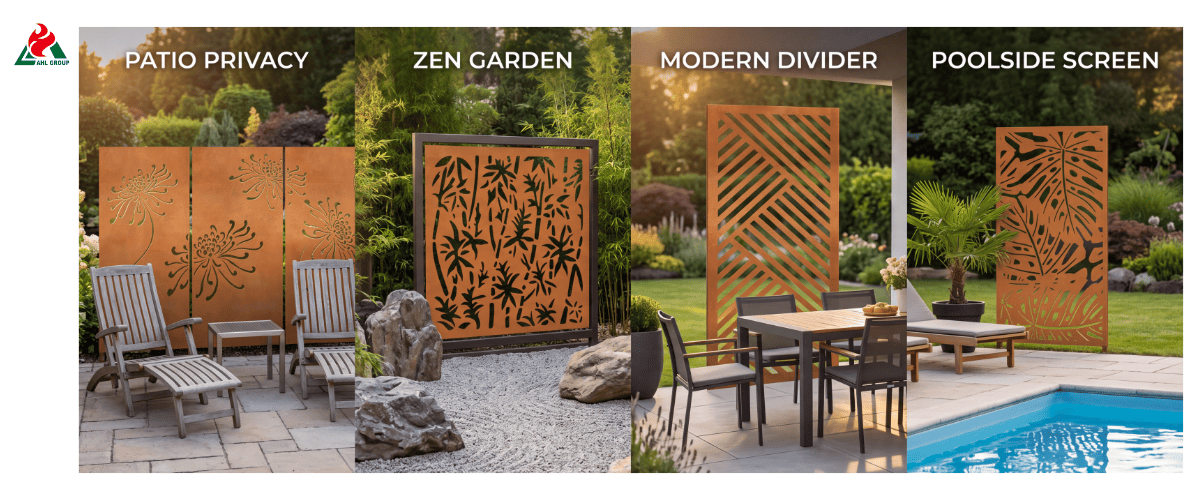
Weathering steel, also known as Corten steel, combines strength with natural beauty. It requires no paint or frequent maintenance; its surface naturally develops a protective patina that continues to evolve. This warm appearance allows Corten steel screens to blend seamlessly with plants, stone, wood, concrete, and modern architecture. However, choosing a Corten steel privacy screen is not simply a matter of selecting an aesthetically pleasing panel. The right choice depends on factors such as privacy needs, wind exposure, installation methods, screen dimensions, and surrounding landscape conditions.
1. Introduction
Why Corten Steel Is a Popular Choice for Privacy Screens
Weathering steel has become a staple material in high-end landscape design and modern architectural envelopes. Property owners and designers choose Corten steel privacy screens not only for their striking, warm rust-colored patina but also for their structural strength and slender profiles. Unlike wood fences, which are prone to rot, or painted aluminum panels, which are susceptible to peeling and fading, Corten steel creates a rich, natural boundary that blends seamlessly with modern architecture, stone elements, and lush outdoor greenery.
This guide will help you make your selection
Choosing the ideal outdoor privacy screen requires balancing structural integrity, aesthetic design, and visual screening effectiveness. This comprehensive guide details optimal panel configurations, structural material grades, installation frame methods, and spatial layout considerations to help you select a Corten steel privacy screen tailored specifically to your property.
2. What Can Be Used as a Corten Privacy Screen
Solid Corten Steel Panels
Solid weathering steel panels completely block the view (100% privacy) and effectively shield against wind. They are ideal for screening garbage rooms, hot tubs, HVAC equipment, or blocking the view from neighboring residences. Since solid steel panels bear the highest wind loads, they require a sturdier structural framework for the support posts and deeper concrete foundations.
Laser-Cut Decorative Weathering Steel Sheets
Laser-cut steel screens strike a balance between privacy and artistic appeal. High-precision CNC lasers cut intricate patterns into the steel sheets—ranging from organic branch motifs to modern geometric grids. These openwork designs filter sunlight into warm, shadowed patterns while maintaining effective boundary screening.
Perforated or Patterned Weathering Steel Sheets
Perforated Corten screens feature a uniform perforation pattern (round, square, or slotted). They offer a stylish, industrial-chic appearance that both diffuses direct sunlight and reduces wind shear, making them ideal for outdoor railings or rooftop terraces.
Modular Corten Steel Screen Sets
The modular screen set consists of standard-sized panels (typically 1.8 meters × 0.9 meters or 6 feet × 3 feet) supported by matching Corten steel posts or channel steel frames. These prefabricated sets simplify the installation process for DIY homeowners and allow for the segmented construction of long screens.
Hybrid Designs: Weathering Steel + Wood, Glass, or Plants
Combining weathering steel with contrasting architectural elements creates rich visual textures:
► Weathering Steel + Hardwood: Warm cedar or ipe wood slats set within a weathering steel frame present a modern, natural aesthetic.
► Weathering Steel + Frosted Glass: Translucent glass panels embedded between weathering steel posts maximize natural light while ensuring a high degree of privacy.
► Weathering Steel + Living Greenery: Metal screens paired with climbing vines or integrated planters blend industrial lines with soft, lush greenery.
3. Material and Thickness Considerations
Weathering Steel Grades (A588 / S355J2W)
Genuine weathering steel meets the following atmospheric corrosion resistance standards:
► ASTM A588 / A606-4: Standard grades for weathering steel plates and sheets used in structural applications in North America.
► EN 10025-5 (S355J2W / S355J0WP): The equivalent European standard grade, featuring high tensile strength and weather resistance.
Typical Thickness Range (2–6 mm)
The thickness of weathering steel screen panels directly determines the panel’s stiffness, weight, and ability to resist wind-induced deformation under long-span conditions.
Standard Garden Screen Thickness: 2–3 mm
Thicknesses ranging from 2 mm to 3 mm (14 to 11 gauge) are the standard choice for residential garden screens. Panels of this thickness require perimeter flanges (20 mm to 40 mm) or a box-type frame to maintain structural flatness at heights up to 1.8 meters (6 feet).
4–6 mm: Suitable for Large Curtain Walls and Windy Locations
For tall frameless architectural installations, large gates, or coastal areas exposed to strong winds, 4 mm to 6 mm (3/16” to 1/4”) steel sheets should be selected. The additional mass provides higher structural rigidity and eliminates the need for transverse bracing in the center of the panels.
How Thickness Affects Stiffness and Wind Resistance
Under gusty winds, solid metal panels act like sails. Thinner panels (<2 mm) may bend, vibrate, or deform under wind pressure. Selecting panel thicknesses of 3 mm or greater, combined with formed side edges, ensures that the screen remains rigid, flat, and quiet during severe storms.
4. Design Patterns and Visual Effects
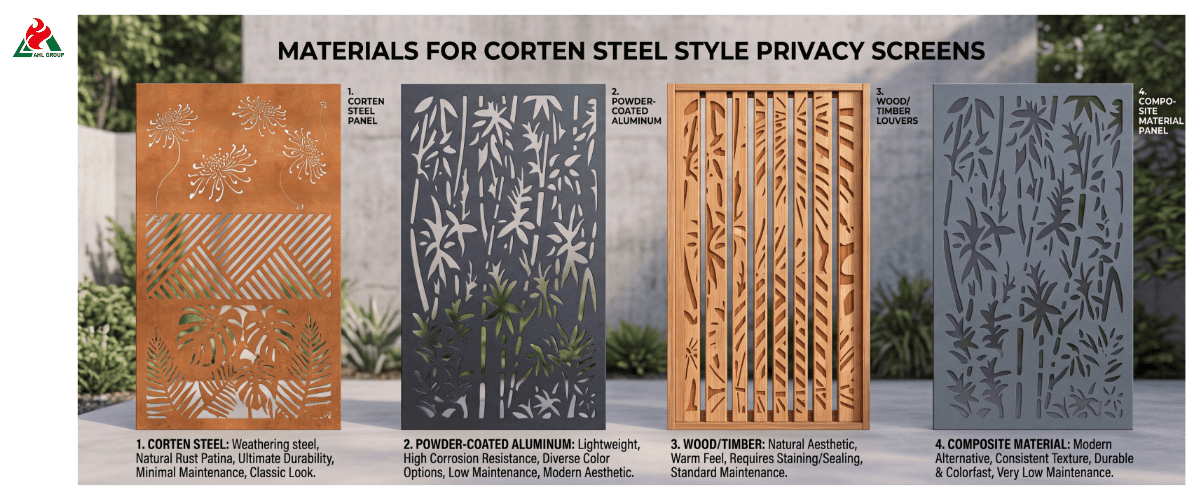
Botanical Patterns (Leaves, Bamboo, Grass)
Laser-cut screens with botanical themes—such as layered palm fronds, bamboo stalks in a forest, or falling autumn leaves—can soften structural lines and blend naturally with the surrounding flower beds.
Geometric Patterns (Circles, Rectangles, Hexagons)
Recurring geometric patterns—such as Islamic latticework, honeycomb patterns, or medieval abstract grids—are commonly used in modern architectural design and complement contemporary building facades.
Abstract and Custom Artwork
CNC laser cutting technology can cut custom vector designs directly into Corten outdoor screens. This capability allows house numbers, corporate logos, or custom artwork to be integrated into privacy screens.
Solid vs. Perforated: Privacy vs. Natural Light and Ventilation
► Solid panels: 100% block sightlines and wind; provide complete privacy but may cast deep shadows.
► Patterned panels (20%–40% open area): Block close-range sightlines while allowing gentle breezes and filtered sunlight to pass through, thereby reducing localized wind vortices.
Shadow Patterns and Day-to-Night Aesthetics
During the day, when backlit by sunlight, laser-cut screens cast intricate shadow patterns on patios and walkways. At night, low-voltage LED uplights installed behind the screens transform the panels into luminous architectural features.
5. Installation Methods
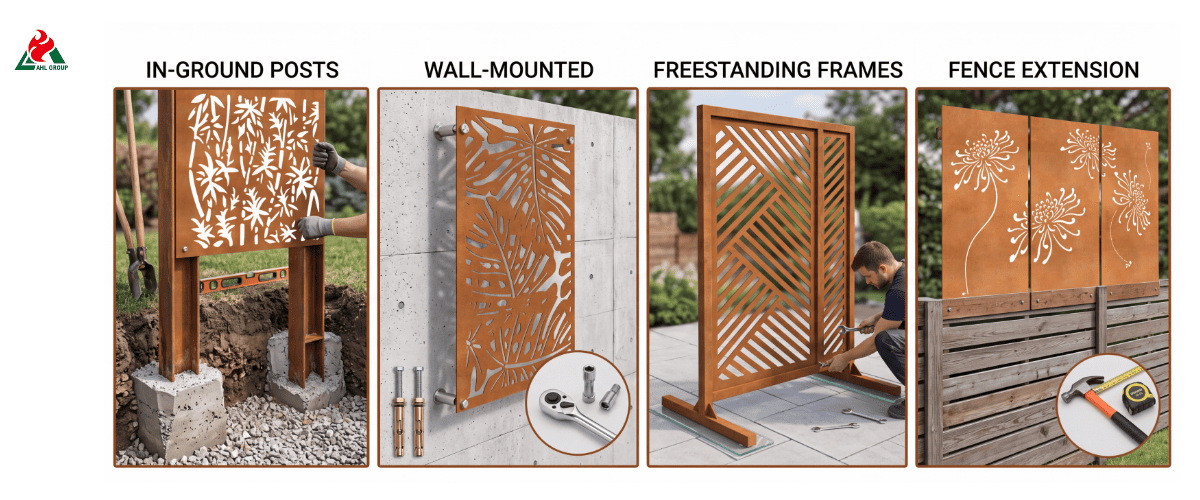
Freestanding Screens with Corten Steel or Steel Posts
Freestanding privacy screens are supported by matching 50 mm × 50 mm or 80 mm × 80 mm square structural posts. These posts can either be embedded in the ground (cast into a foundation) or secured to reinforced concrete footings via a welded heavy-duty base plate for ground-level installation.
Post-and-Panel Systems Anchored in Concrete
To ensure optimal wind resistance, ground-mounted posts should be deeply embedded in concrete footings, with a depth of at least one-third of the screen’s above-ground height (for example, a 1.8-meter-tall screen requires a concrete foundation at least 600 millimeters deep).
Wall-Mounted Installation Using Brackets or Spacers
When installing Corten garden screens on brick, concrete, or wood walls, use 304/316-grade stainless steel spacer brackets (with a gap of 25 to 50 millimeters). These spacers allow air and rainwater to flow past the back of the panels, preventing accumulated moisture from damaging load-bearing walls.
Integration with Existing Fences and Structures
Custom angle steel brackets can be used to mount weathering steel screens onto existing structural posts, pergola frames, or retaining wall blocks.
Bottom Clearance to Ensure Drainage and Rust Water Runoff
Be sure to maintain a 50-millimeter (2-inch) gap between the bottom edge of the Corten metal screen and the ground or paved surface below. This gap prevents contact with standing water and allows initial rust water to drain freely, preventing it from accumulating on the steel surface.
6. Sizing and Layout Planning
Recommended Height for Privacy Screens (1.5–2.2 meters)
► 1.2 to 1.5 meters (4 to 5 feet): Suitable for low patio fences, patio railings, and dividing garden areas without obstructing the view of the horizon.
► 1.8 to 2.2 meters (6 to 7.2 feet): This is the standard height range for blocking views of neighboring yards and street traffic.
Panel Width and Span
Standard panel widths are 0.9 meters (3 feet) and 1.2 meters (4 feet). Installing a post every 1.0 to 1.2 meters keeps the weight of the panels within manageable limits while ensuring the structure has high resistance to wind loads.
Post Spacing
Ensure that the spacing between posts accommodates the panel flanges and allows for thermal expansion and contraction. Leave a 3-millimeter to 5-millimeter expansion gap between the edges of adjacent panels to prevent buckling during hot weather.
Planning for Corners, Gates, and Openings
When planning the continuous installation of multiple panels, use 90° corner posts with pre-drilled mounting holes. For walkways, the Corten privacy screens should be used in conjunction with matching laser-cut doors, which should be fitted with heavy-duty stainless steel hinges and latch hardware.
Measure the Space Before Ordering
Before finalizing your panel order, draw a diagram of the total installation area, calculate the exact number of panels and intermediate posts required, and check for changes in ground elevation along the installation path.
7. Combining Corten Screens with Plants
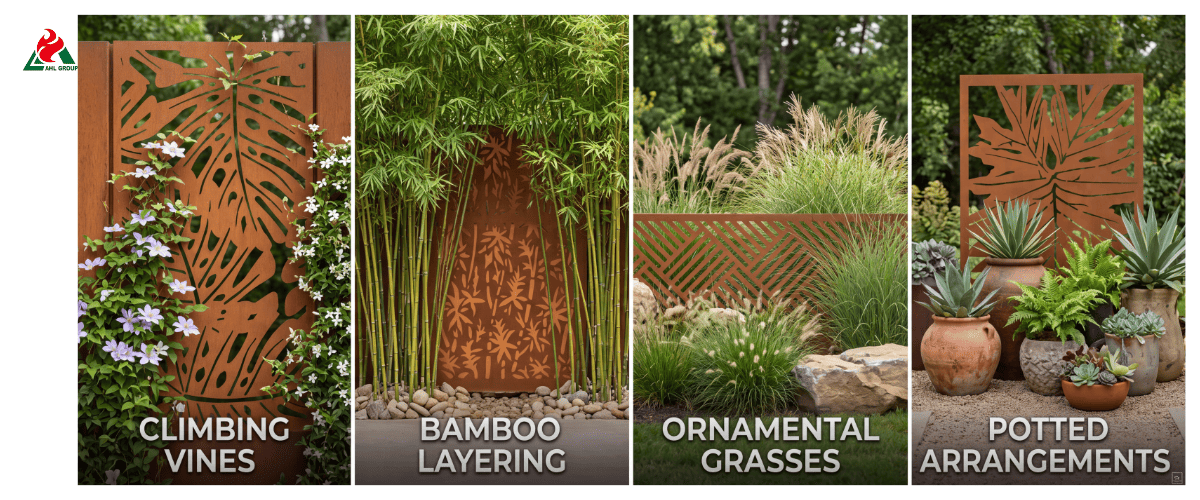
Using Screen Panels as Trellises for Climbing Plants
Laser-cut weathering steel screen panels can effectively serve as structural trellises for climbing plants such as clematis, jasmine, or wisteria. The steel provides a sturdy framework, while the orange patina creates a natural contrast with the green foliage.
Planting Hedges in Front of or Behind the Screen
Planting a deep-green hedge (such as boxwood, yew, or laurel) 300 to 500 millimeters behind the laser-cut privacy screen creates a dark backdrop that highlights the screen’s patterns while filling in any remaining gaps, thereby ensuring complete privacy.
Combining with Planters and Raised Beds
Combining a weathering steel screen with matching Corten steel planters creates a self-supporting, freestanding privacy barrier. This configuration is particularly suitable for apartment balconies or concrete patios where ground anchoring is not possible.
Balancing Greenery and Metal Aesthetics
Maintain a balanced proportion between the metal surface and living plants. Allow greenery to cover 30% to 50% of the screen’s surface area; this preserves the architectural details of the metal while seamlessly integrating this landscape element into the surrounding garden.
Maintenance Considerations for Plant-Screen Combinations
Be sure to regularly prune dense foliage to prevent moist organic debris from accumulating in the crevices of the unweathered metal over time, thereby ensuring a consistent cycle of atmospheric moisture and dryness necessary for patina formation.
8. Performance and Durability
Weather Resistance and the Formation of Patina
Weathering steel must undergo alternating wet and dry weather cycles to form its protective patina. Over a period of 6 to 18 months, exposed steel gradually transforms from a bright yellow-orange color to a dark, stable espresso-brown layer of iron oxide (hematite).
Wind Loads and Structural Stability
Compared to solid walls, perforated or laser-cut panels reduce overall wind resistance. Selecting patterns with an open area ratio between 20% and 40% reduces wind loads on columns and foundations while effectively ensuring visual privacy.
Corrosion in Coastal or Harsh Environments
In coastal areas (within 2 kilometers of salt spray zones) or regions with continuous exposure to high concentrations of atmospheric chlorides, the accumulation of salt deposits may interfere with the formation of the standard weathering steel rust layer. In these environments, thicker steel sheets (4 to 6 millimeters) should be used, or a transparent passivating sealant formulated specifically for weathering steel should be applied.
Expected Service Life of Corten Privacy Screens
Under standard atmospheric exposure conditions, Corten privacy screens with a thickness of 2 to 3 millimeters have an expected service life of 30 to 50 years or more—decades longer than traditional wooden fences—and require no chemical preservative treatment or painting.
Low-Maintenance Advantages Compared to Wood and Painted Steel
Once a stable protective rust layer has formed, Corten privacy screens require no painting, staining, or sealing. Rainwater naturally cleans the surface, making them virtually maintenance-free.
9. Safety and Practical Considerations
Safe Distance from Fire Pits and Grills
Although weathering steel is completely non-combustible (fire rating: Class A1), heat can still be conducted through the metal. Please ensure that solid weathering steel outdoor screens are kept at least 1.0 meters (3.3 feet) away from high-temperature heat sources such as fire pits or grills.
Edge Treatment and Sharpness
Laser-cut metal sheets may have sharp edges or burrs remaining after cutting. Please ensure that your sheet metal supplier deburrs and smooths all cut edges during processing to prevent injury, especially in household areas where children or pets are frequently present.
Stability in High-Wind Areas
In areas exposed to high winds, use structural posts with internal steel reinforcement sleeves, or select panels that are 4 mm thick with a 40 mm folded flange around the perimeter to prevent panel fluttering.
Local Regulations and Height Restrictions
Please review local municipal building codes and homeowners’ association (HOA) guidelines before placing an order. Residential boundary fences typically have a maximum height of 1.8 to 2.0 meters (6 to 6.5 feet) and do not require structural engineering approval.
Preventing Rust Stains on Adjacent Surfaces
During the initial 6- to 12-month weathering period, fine iron oxide particles carried by rainwater runoff may stain light-colored concrete, porous limestone, or light-colored paving bricks.
To prevent staining of light-colored surfaces:
► Lay a 150-millimeter-wide strip of dark gravel or river pebbles beneath the screen to absorb iron-rich runoff.
► Before final on-site installation, pre-weather the panels using a solution of organic salts and vinegar.
► Once the desired rust patina has been achieved, apply a specialized clear sealant for weathering steel.
10. Cost and Budget Factors
How Thickness and Dimensions Affect Price
Price is directly related to the weight of the steel and the processing time. Upgrading from a standard 2-millimeter flat panel to a 3-millimeter panel with custom-folded flanges increases raw material costs by approximately 30% to 45%, but significantly improves structural rigidity.
DIY Installation vs. Professional Installation
For experienced DIY enthusiasts, installing a modular privacy screen kit on a concrete foundation is feasible. However, installing tall screens in areas with strong winds, aligning complex corners, or installing long sections consisting of multiple panels typically requires hiring a professional hardscape contractor.
Long-Term Value Compared to Other Materials
Although the initial material cost of weathering steel privacy screens is higher than that of wood, their maintenance-free nature, rot resistance, and long service life make them more cost-effective over a 20- to 30-year lifespan.
11. Common Mistakes to Avoid
Selecting Panels with Insufficient Thickness for the Span
Installing thin, frameless 1.5-millimeter metal panels in areas where the span exceeds 1 meter can cause the panels to buckle and create a “tank effect” under wind pressure. Be sure to use panels with a thickness of at least 2 to 3 millimeters and with folded edges.
Ignoring Wind Loads and Column Spacing
Failure to calculate wind loads on solid or low-perforation screen walls may result in column loosening or screen wall tilting following severe storms.
Failure to Provide Drainage or a Bottom Clearance During Installation
Installing screen panels directly against soil or damp surface coverings creates areas of persistent water accumulation, disrupting the wet-dry weathering cycle and leading to premature corrosion of the bottom edges.
Failure to Account for Rust Runoff on Light-Colored Surfaces
Installing untreated weathering steel panels directly on light-colored limestone or light-colored concrete pavers—without a gravel drip channel or pre-weathering treatment—may cause iron oxide stains on the surrounding stone.
Failure to Verify Structural Requirements When Purchasing Custom Designs
Selecting complex laser-cut patterns with a high open area ratio (>60%) significantly reduces the amount of structural steel in the central area of the screen panels. Such designs require a sturdier perimeter frame to prevent the screen from warping under load.
12. FAQs
Q1: What is the Ideal Thickness for Corten Steel Privacy Screens?
For standard residential garden screens, a thickness of 2 mm to 3 mm (14 to 11 gauge steel sheet) with a folded edge finish is the ideal choice. For tall architectural screens or environments with strong winds, choose steel sheets ranging from 4 mm to 6 mm (3/16 inch to 1/4 inch).
Q2: Can Corten Steel Screens Be Mounted on Walls?
Yes. Weathering steel garden screens can be mounted on brick, concrete, or wood walls using stainless steel spacer brackets (with a gap of 25 mm to 50 mm). The spacer brackets facilitate air circulation and prevent moisture buildup on the back of the panels.
Q3: Do CORTEN Screens Completely Block the View?
Solid weathering steel panels provide 100% visual privacy. The privacy level of laser-cut decorative panels depends on their open area ratio; patterns with an open area ratio of 15%–25% effectively ensure privacy while allowing light to pass through.
Q4: Do Weathering Steel Privacy Screens Need to Be Painted or Sealed?
No. Weathering steel is specifically designed to form a self-protective rust patina that prevents internal corrosion. While optional clear sealants can lock in a specific color or prevent rust streaking, painting or sealing is not a necessary step to ensure durability.
Q5: How Long Does It Take for the Rust Patina to Form?
Under normal outdoor weather conditions, the rust patina will begin to form within 2 to 4 weeks and will fully stabilize within 6 to 18 months, developing a deep, uniform bronze-brown color.
Conclusion: Choosing the Best Weathering Steel Screen
Selecting the right Corten outdoor privacy screen depends on your primary needs for privacy protection, wind resistance, and aesthetics. Prioritize material thickness (at least 2.5 to 3 millimeters when including folded flanges), use 304/316-grade stainless steel hardware for installation, and ensure the posts are properly embedded in the ground while leaving a 50-millimeter gap for ground drainage. Taking these measures will ensure that your Corten privacy screen maintains long-term durability and structural integrity for decades to come.

