


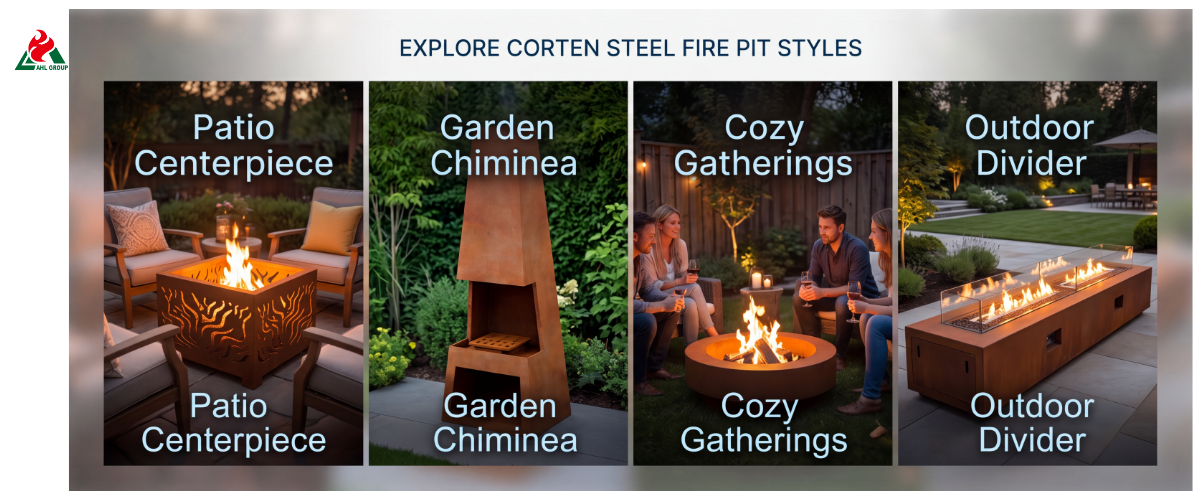
A fire pit is more than just a decorative element in an outdoor space. As a product, it must be able to withstand the harshest conditions found in a backyard environment: extreme heat, repeated temperature fluctuations, rain, moisture, and year-round exposure to the elements. When choosing a Corten steel fire pit, durability is often one of the most important considerations, as replacing a low-quality fire pit is not only costly but also causes significant inconvenience. A durable fire pit should maintain its structural integrity, resist excessive corrosion, and remain safe to use even after years of use. Weathering steel fire pits are widely popular because they are specifically designed for outdoor environments. Unlike ordinary steel, weathering steel forms a stable, protective layer of rust that not only slows further corrosion but also gives the fire pit a unique rust-colored appearance.
1. Introduction
Why Weather Resistance Is Critical for Fire Pits
The environment in which backyard fire pits are located is one of the most destructive that any outdoor product can face: thermal shock coexists with constant exposure to the elements. When wood burns, the temperature inside the fire pit can rapidly soar to over 600°C (1,100°F), causing the metal to expand rapidly. Once the fire dies down, the cold night air and sudden rainfall cause the structure to cool rapidly, triggering severe contraction. Under this cyclical stress, inexpensive metal fire pits often warp, buckle, or even rust through within just one or two seasons. Investing in a highly durable product not only ensures structural integrity and thermal safety but also allows you to enjoy years of outdoor entertaining without the need for frequent replacements.
What Does “Most Durable” Mean for Weathering Steel
For Corten fire pits, durability depends on structural quality, alloy purity, seam integrity, and thermodynamic geometry. True durability does not refer to a surface that remains perpetually shiny and flawless, but rather to a structure that is engineered to harness the controlled oxidation process. The most durable weathering steel fire pits can withstand thousands of thermal cycles, resist structural deformation, and endure harsh freeze-thaw cycles, maintaining their structural integrity for decades even when left uncovered outdoors for extended periods.
This Guide Will Help You Make an Informed Decision
Based on the principles of metallurgy and structural thermal management, this guide provides a detailed explanation of why Corten steel fire pits are so durable. We will analyze the optimal steel plate thickness, compare the performance of different fire pit shapes under high temperatures, conduct a comprehensive evaluation of Corten steel, stainless steel, and cast iron, determine expected service life under various climatic conditions, and offer clear recommendations to help you select a durable fire pit.
2. What Is a Corten Fire Pit
How Weathering Steel Works
Weathering steel—classified under standards such as ASTM A588, A242, or A606-4—is a type of high-strength, low-alloy structural steel produced by adding copper (Cu), chromium (Cr), nickel (Ni), and phosphorus (P). Unlike standard carbon steel, which continues to oxidize until it completely flakes off, weathering steel forms a protective layer when exposed to the elements, preventing rust from penetrating deep into the metal core.
How the Protective Rust Layer Forms
When exposed to atmospheric cycles of alternating wet and dry conditions, Corten steel oxidizes to form a dense, non-porous crystalline surface film known as ferrite. This microscopic rust layer seals off the underlying steel core, preventing further penetration of oxygen and moisture. During the first 6 to 18 months of exposure, the surface gradually changes from a bright, original orange to a rich, velvety deep reddish-brown, forming a protective layer that continuously self-heals in outdoor environments.
Differences Between Corten Steel, Stainless Steel, Painted Steel, and Cast Iron
► Painted Carbon Steel: Relies on high-temperature-resistant paint. Once intense heat burns off the paint, the untreated bare steel reacts with moisture and rapidly flakes off within 1 to 3 years.
► Cast Iron: A brittle material with high thermal capacity. It provides excellent heat retention but is prone to cracking under severe thermal shock (such as when cold rain hits a scorching fire bowl).
► 304 Stainless Steel: A rust-resistant alloy that retains a lustrous appearance, but has a high coefficient of thermal expansion, causing thin-walled stainless steel fire pits to warp easily at high temperatures.
► Weathering Steel: Combines high tensile strength with controlled oxidation characteristics, providing structural stability and extremely high resistance to thermal shock without the need for intricate painting or chemical treatments.
3. What Makes a Corten Fire Pit Durable
Steel Plate Thickness and Specifications
Steel plate thickness is the most critical factor determining the service life of a Corten fire pit. High temperatures, the acidity of ash, and environmental corrosion will gradually erode the metal over the course of several decades.
► 1.5 mm to 2 mm (Thin-Gauge/Retail Grade): Under heavy-duty use, these are prone to warping due to high temperatures and may develop premature rust-through within 3 to 5 years.
► 3 mm (11-Gauge/Standard Grade): Offers an excellent balance between structural rigidity, portability, and service life (15 to 25 years).
► 5 mm to 6 mm and above (3/16 inch to 1/4 inch, heavy-duty commercial grade): The “heavyweights” of structural design. These thick steel plates can withstand extreme thermal expansion forces and offer a service life of 30 to 50 years or more.
Weld Quality and Joint Design
Fire pits rarely fail in the center of the plate; failures typically occur at the seams. High-durability designs employ continuous, full-penetration Gas Metal Arc Welding (GMAW/MIG) or Gas Tungsten Arc Welding (GTAW/TIG), using specialized copper-alloy welding wires (such as E7018-G or ER80S-G) that match the weathering characteristics of the weathering steel base material. Intermittent spot welding or thin-layer spot welding will crack under thermal expansion cycles.
Fire Bowl Shape and Heat Distribution
The geometric shape determines how thermal stresses are redistributed within the structure. Smooth spherical domes and shallow parabolic fire bowls allow heat to radiate outward uniformly in a 360-degree pattern, thereby minimizing localized heat buildup. In contrast, a sharp, square firebox with 90-degree angles creates severe localized stress concentrations, which may cause flat side panels to bulge inward or outward over time.
Base and Leg Structure
The fire pit base must be able to withstand heavy firewood and high temperatures while ensuring the metal fire pit remains stable on soft or uneven ground. Choose a wide, thick base; solid ring-shaped supports; or one-piece tubular legs with thickened, reinforced ribs. Thin-walled, hollow metal plate legs connected with lightweight rivets tend to loosen, wobble, and eventually fail under high temperatures.
Surface Finishes and Pre-weathered Options
Fire pits are sold in two forms: untreated slate-gray rolled steel, or pre-weathered/pre-oxidized products. While pre-weathering provides an immediate rustic appearance, true long-term durability comes from the natural, undisturbed process of atmospheric weathering. Natural weathering allows the metal to adapt to local atmospheric conditions and humidity cycles, forming a denser, more resilient oxide layer directly on-site.
4. Most Durable Corten Fire Pit Designs
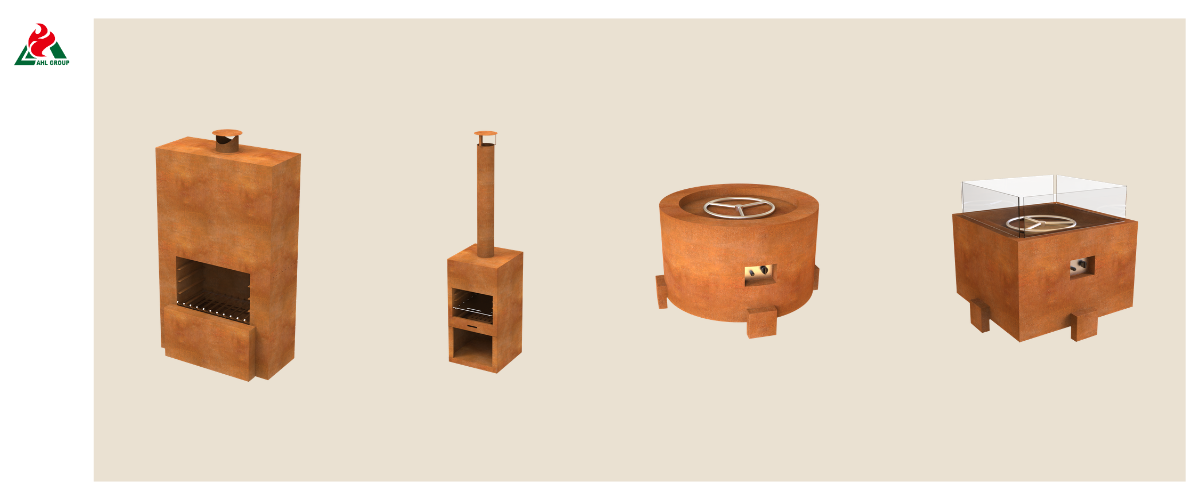
Deep-Bowl Fire Pit
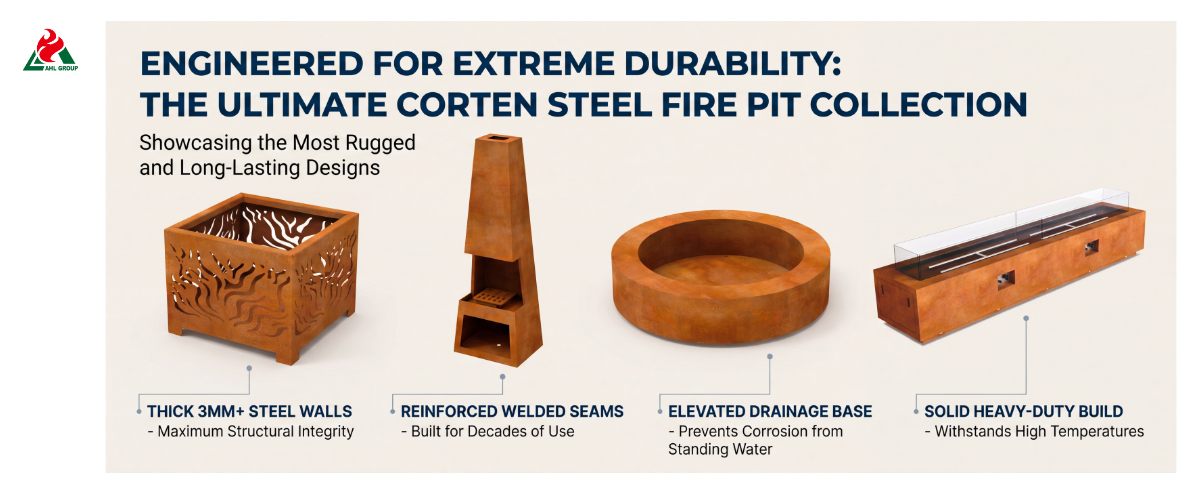
A deep spherical or parabolic bowl made of seamless spun or heavy-duty stamped steel plate (3 to 6 mm thick) represents the gold standard for structural durability. Its smooth, curved geometry distributes thermal stress evenly throughout the structure, thereby preventing local plate buckling. The deep bowl safely shields the charcoal from direct wind while concentrating heat downward to form a stable layer of embers.
Basket-Style Fire Pits
Basket-style or slotted fire pits feature laser-cut vertical ventilation slots along the perimeter walls to maximize airflow. While this design is ideal for low-smoke combustion, these cuts create hundreds of exposed internal edges. If manufactured from thin-gauge metal (<3 mm), the combination of high oxygen exposure and thermal stress may cause the slender vertical panels to warp or burn through over time. When selecting a basket-style design, choose models with a wall thickness of 4 mm or more.
Table-Style Fire Pit
Corten steel fire tables feature a wide horizontal outer rim surrounding a central fire basin. This design keeps temperatures in the outer rim area significantly lower than in the central combustion zone. Since the high-temperature inner basin expands faster than the cooler outer frame, high-quality products incorporate expansion slots or floating fire basins to prevent the top surface from warping or becoming uneven due to thermal expansion and contraction.
Hybrid Design Combining Corten Steel and Stainless Steel
This hybrid design combines a robust weathering steel body with a removable 304 or 316 stainless steel inner combustion liner or ash hopper. This structure isolates the primary combustion zone: the stainless steel liner withstands the direct impact of flames and high-temperature ash, while the weathering steel body provides structural strength and offers an attractive outdoor appearance. This dual-layer design significantly extends the product’s overall service life.
Which Style is the Most Durable Under Heavy Use
The most durable configurations are: a fire bowl made of thick-walled (5 to 6 millimeters) seamless, deep-parabolic weathering steel, mounted on a freestanding, heavy-duty ring base; or a hybrid Corten fire pit equipped with a removable stainless steel combustion chamber. Both designs eliminate stress concentrations at rigid corners, withstand extreme temperatures, and accommodate thermal expansion without causing the frame to deform.
5. Corten vs Other Materials
Corten Steel vs. 304 Stainless Steel
Although 304 stainless steel offers excellent corrosion resistance, weathering steel provides superior structural performance when directly exposed to high-temperature flames.
| Performance Metric | Corten Weathering Steel (A588) | 304 Grade Stainless Steel |
| Yield Strength at Ambient | High (≈345 MPa) | Medium (≈205 MPa) |
| Thermal Expansion Rate | Low (12.0*10-6/K) | High (17.3*10-6/K) |
| Warping Resistance under Fire | Superior | Moderate (Prone to heat bowing) |
| Aesthetic Evolution | Organic amber/espresso patina | Discolors to straw/blue/gray oxide |
| Cost to Strength Ratio | High Value | Premium / High Cost |
Corten Steel vs. Painted Carbon Steel
Standard carbon steel fire pits coated with high-temperature matte paint are considered low-end products on the market. Once firewood scrapes against the painted surface, or the temperature exceeds the coating’s tolerance threshold, oxygen comes into contact with the exposed metal. Rainwater quickly causes the rust to flake off and expand, corroding through a 2-millimeter-thick fire pit in as little as 2 to 3 years. Under the same outdoor conditions, weathering steel has a service life 400% to 600% longer than that of painted carbon steel.
Corten Steel vs. Cast Iron
Cast iron has excellent heat-retention properties, but its crystalline carbon structure makes it hard and brittle. Pouring water onto a red-hot fire or being exposed to a sudden downpour can cause thermal shock, causing a cast iron fire pit to crack instantly. In contrast, the ductile alloy structure of weathering steel can withstand extreme temperature changes without cracking or breaking.
Corten Steel vs. Ceramic or Stone Fire Pits
Concrete, stone-clad, and ceramic fire pits appear sturdy, but moisture trapped within porous stone expands into steam at high temperatures, leading to surface spalling or deep structural cracks over time. Weathering steel is non-porous, completely immune to freeze-thaw spalling, and is easier to safely move or reposition.
6. How Long Do Corten Fire Pits Last
How Thickness Affects Service Life
Since weathering steel oxidizes at a predictable rate once its rust layer has stabilized—typically losing only 0.001 to 0.002 millimeters per year in a normal urban environment—the greater the metal thickness, the longer the service life, extending it by several decades. A 5-millimeter-thick steel plate provides sufficient sacrificial material to withstand natural wear and tear and the acidic erosion of wood ash for more than forty years, while maintaining its structural strength.
How Climate and Exposure Conditions Affect Service Life
► Arid/Semi-arid Climates: The rust layer forms more slowly, but due to low atmospheric humidity, the structure’s service life is virtually unlimited.
► Temperate/Four-Season Climates: Ideal conditions. The alternation of rainfall and sunlight forms a dense, protective patina, maximizing the material’s service life.
► Salt-fog coastal areas (within 1 mile of the sea): Sea salt fog (NaCl) interferes with the formation of protective goethite, leading to accelerated corrosion. Facilities in coastal areas require copper sheets 5 to 6 millimeters thick and must be regularly rinsed with fresh water to maximize their service life.
When Does Perforation Corrosion or Structural Failure Occur
Perforation corrosion very rarely starts from the outer walls; it almost always occurs in the center of the brazier bottom or around the drainage holes. This happens when wet wood ash remains in the brazier for an extended period. Wet wood ash forms an alkaline mixture that traps moisture directly on the metal surface, preventing the steel from drying and leading to premature rusting of the brazier bottom.
Signs a Corten Steel Fire Pit Is Nearing the End of Its Service Life
► When pressed by hand, the base shows noticeable thinning or warping.
► Deep, flaky rust is peeling off the bottom, indicating that the protective rust layer has been damaged due to standing water.
► Hairline cracks appear around the welds of the support legs or structural joints.
7. Key Buying Factors
Choosing the Right Thickness
Never compromise on the thickness of the metal sheet. For long-term outdoor use, the recommended minimum thickness is 3 millimeters (11 gauge), while 4- to 6-millimeter steel sheets are best suited for high-intensity charcoal grilling, permanent installations, and harsh coastal climates. Avoid purchasing thin 1.5-millimeter metal sheet products sold at mass-market retailers.
Size and Heat Output
Choose a modern fire pit that’s the right size for your gathering space and heating needs:
► Compact (24–30 inches in diameter): Ideal for small urban patios (4–6 people); heats up quickly with less firewood.
► Standard (32–40 inches in diameter): The most popular size for backyards (suitable for 6–10 people); easily accommodates whole 16-inch logs.
► Large Architectural Style (42–60+ inches in diameter): Ideal for large resort patios or open spaces; serves as both a striking visual focal point and provides impressive heat output.
Fuel Type Compatibility
► Wood-Burning Models: Provide high temperatures (500–700°C) and produce a layer of charcoal and wood ash. Require heavy-gauge steel (3 mm+), a robust drainage system, and sturdy welded joints.
► Propane/Natural Gas Models: Operate at lower, more stable temperatures and do not produce acidic wood ash. Can be equipped with precision burner kits and decorative lava rock beds, thereby extending the service life of the steel chassis.
Portable and Stationary
Bulky, heavy-duty Corten outdoor fire pits are true structural elements. A 36-inch fire pit made from 6-millimeter-thick steel plate can easily weigh between 60 and 90 kilograms (130–200 pounds). If you plan to store the fire pit during the winter or frequently rearrange your patio furniture, we recommend choosing a model made from a 3-millimeter-thick steel plate with an integrated handle, or one featuring a modular two-piece design.
8. Installation and Setup
Placement of the Corten Steel Fire Pit
Place the outdoor fire pit on an open, level, and well-ventilated outdoor surface. Ensure there are no overhanging tree branches, wooden pergolas, or fabric awnings within a 10- to 15-foot vertical clearance above the flame area.
Base Requirements (Paving Stones, Gravel, Heat-Resistant Mats)
During the first 6 to 18 months, rain will wash away loose iron oxide particles from the surface of a new Corten steel fire pit. Never place an unworn-in new Corten steel fire bowl directly on light-colored travertine, white concrete, porous sandstone, or light-colored wooden deck flooring. It should be placed on a bed of dark gravel, dark granite pavers, compacted crushed stone, or a specialized heat-resistant mat until its rust patina has fully developed.
Clearance from Walls and Building Structures
Maintain a horizontal distance of at least 6 to 10 feet from house walls, vinyl siding, wooden fences, and flammable outdoor furniture to prevent heat damage or accidental ignition from flying embers.
Leveling and Stability
Ensure the ground is completely level. An uneven fire pit will cause burning wood to shift toward the lower side, concentrating high temperatures on one edge and increasing the risk of hot embers falling onto the deck.
Initial Firing and Rust Formation
For the initial firing, use dry hardwood and maintain a moderate, controlled flame. This initial heating cycle helps remove residual manufacturing oils from the steel surface. Avoid burning pressure-treated wood, plastic, or household waste, as the chemical additives in these materials may interfere with rust formation and release toxic fumes.
9. Maintenance and Care
Daily Cleaning and Ash Removal
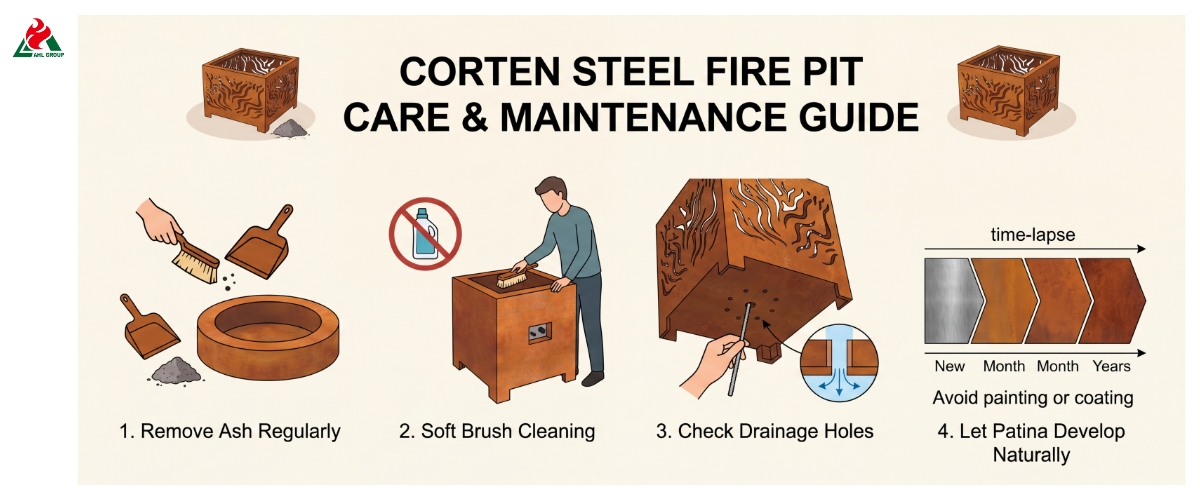
The most important maintenance practice is to promptly remove cooled wood ash. Wood ash contains potassium carbonate (potash); when mixed with rainwater, it forms an alkaline solution that can corrode the bottom of the fire bowl. Please clean out the ashes within 24 to 48 hours after a fire, or store the ashes in a dry metal bucket.
Treating Surface Rust and Patina
If your fire pit develops uneven coloring or dark water stains during the initial period of use, simply scrub the area gently with a stiff nylon brush and then rinse it with clean water. This will remove loose surface rust particles and encourage the formation of a tighter, more uniform patina on the metal surface.
Protecting the Legs and Base from Moisture
Ensure the base of the fire bowl is slightly above the water level. If the base is left submerged in muddy puddles for extended periods, the steel will be unable to come into contact with oxygen to stay dry, which will damage the protective patina. Place flat slate or rubber pads under the legs to ensure good airflow beneath the base.
Covering and Off-Season Storage
Although weathering steel is designed to withstand year-round outdoor use without a cover, during long winters, placing a breathable, waterproof cover over a cooled fire pit will prevent rainwater from entering the fire bowl, keep damp ash from accumulating, and ensure that the internal drainage holes remain clear.
Maintenance and When to Replace Parts
If the internal drainage holes become clogged with ash or molten debris, use a screwdriver or metal drill bit to clear them. If the unsealed base plate has gradually worn thin after decades of heavy use, a local metalworker can easily weld a new 5-millimeter-thick weathering steel patch onto the base, restoring the fire pit to service for another decade.
10. Common Mistakes to Avoid
Using a Corten Steel Fire Pit That Is Too Thin
Purchasing a cheap fire pit made of 1.5-millimeter-thick steel sheet labeled “weathering steel” is bound to lead to disappointment. Thin steel sheets lack the structural strength needed to withstand the high temperatures of a wood fire, which can cause the pit walls to warp and rust through prematurely. Be sure to choose steel sheets that are 3 to 6 millimeters thick.
Placing the Fire Pit on Flammable Surfaces
Never place a fire pit directly on an untreated wooden deck, composite deck, or dry lawn unless it rests on a raised, heat-resistant base or heavy masonry pavers. Direct heat radiation can scorch, warp, or ignite the wood beneath it.
Failure to Provide Proper Drainage at the Bottom of the Fire Pit
A fire pit without sufficient drainage holes will quickly turn into a water bowl during rain. Standing water accelerates internal corrosion and creates muddy ash, which will ruin your next fire-building experience. Please ensure the bottom of your fire pit has built-in drainage holes measuring 1 to 2 inches in diameter.
Using Highly Corrosive Chemicals or Wire Brushes
Never use highly corrosive chemical rust removers, hydrochloric acid, or high-speed wire brush grinders on weathering steel. These aggressive treatments will strip away the protective layer that is forming, re-exposing the bare carbon steel and causing the rusting cycle to start over. Use only mild soap, clean water, and a stiff nylon brush.
Anticipating Complete Rust-Free Conditions Rather Than a Controlled Rusting Effect
If you expect a rusted steel fire pit to remain completely uniform in color or free of any mottling, this indicates a misunderstanding of the material. Corten steel is a “living,” ever-evolving material designed to weather naturally. Embracing its organic color changes is key to enjoying this durable architectural steel.
11. FAQs
Q1: Is Weathering Steel the Most Durable Material for Fire Pits?
For wood-burning outdoor fire pits, thick-gauge weathering steel is currently one of the most durable materials available. Its corrosion resistance rivals that of high-end stainless steel, and compared to cast iron or stone, it performs better in terms of resistance to thermal deformation and cold shock cracking.
Q2: Will a Corten Steel Fire Pit Rust Through?
A well-designed, durable fire pit made from 3- to 6-millimeter-thick steel plates will not rust through for 20 to 50 years or more under normal usage conditions. Rust-through will only occur if a thin-gauge (1.5-millimeter) fire pit is left submerged in standing water for an extended period or buried in damp ashes without proper drainage.
Q3: What Should Be the Thickness of a Durable Corten Fire Pit?
A durable fire pit should be at least 3 mm thick (No. 11 steel plate). For heavy wood burning, permanent installations, or harsh coastal environments, steel plates 4 mm to 6 mm (3/16 inch to 1/4 inch) thick are recommended.
Q4: Can a Weathering Steel Fire Pit Be Left Outside Year-Round?
Yes, weathering steel fire pits are specifically designed to remain outdoors year-round under all weather conditions, including extreme cold and heavy snow in winter, as well as high temperatures in summer.
Q5: Do Weathering Steel Fire Pits Need a Cover?
Structurally speaking, a cover is not necessary, but using a breathable, weather-resistant cover can prevent rain and fallen leaves from entering the fire pit, keep the drainage holes clear, and ensure your firewood stays dry until the next time you light a fire.
Conclusion: Regarding the Most Durable Type of Corten Steel Fire Pit
The most durable Corten fire pit should feature a seamless, deep parabolic bowl-shaped structure or a heavy-duty geometric basin-shaped structure, made from 5- to 6-millimeter-thick ASTM A588/A606-4 steel plate, with continuous, full-penetration welds, an integrated bottom drain, and a separate heavy-duty base or ring-shaped foundation.

