


Corten steel landscape edging has become a popular choice for modern gardens, residential landscapes, and commercial outdoor spaces due to its durability, clean lines, and natural weathered appearance. Unlike traditional edging materials such as plastic, wood, or painted metal, weathering steel develops a protective rust-colored patina that helps it withstand the elements. This unique natural aging process not only adds a sophisticated architectural aesthetic to gardens but also reduces the need for long-term maintenance.
1. Introduction
Why Corten Landscape Borders Are So Popular
Corten steel landscape borders are highly favored by landscape designers and professional gardeners for their clean lines, slim profile, and rich, natural, amber-brown weathered appearance. Unlike bulky concrete curbs or fragile plastic edging strips, weathering steel offers a high-strength, low-alloy alternative that can be easily bent into graceful curves while also creating sharp, defined boundaries between contrasting landscape elements such as lawns, gravel paths, and raised planters. Its durability under UV exposure, freeze-thaw cycles, and high foot traffic makes it a premium, lifetime investment for high-end residential and commercial landscapes.
Questions Addressed in This Guide Regarding Paving Subbases
When planning an installation, a key question arises: Should a paving subbase, compacted gravel, or a sand subbase be used beneath Corten landscape edging? In many DIY videos, installers drive metal posts directly into the raw soil of the backyard, while structural engineering manuals typically recommend detailed subbase preparation. This guide provides a clear and authoritative answer to this question by comprehensively considering the principles of structural physics, soil mechanics, and metallurgical requirements.
When Subgrade Materials Are Critical
The subgrade treatment you choose not only affects the levelness of the metal structure but also directly impacts landscape drainage, frost heave resistance, and the long-term service life of the steel. When borders evolve from simple, low garden edging to structural retaining walls, subgrade materials become critical. Proper subgrade preparation is essential for supporting heavy-duty gravel paths and pavers, or for addressing gardens with unstable soil and a humid climate.
2. What Corten Landscape Edging Is
Performance of Weathering Steel in Outdoor Environments
Weathering steel is a type of steel alloy developed to eliminate the need for painting. When exposed to alternating wet and dry weather conditions, its surface oxidizes to form a dense, highly stable, and non-porous crystalline rust layer known as hematite. This microscopic film seals the bare steel core beneath it, permanently blocking moisture and oxygen. This chemical reaction enables the steel to resist deep, destructive corrosion and structural failure, extending its service life by several decades compared to standard carbon steel.
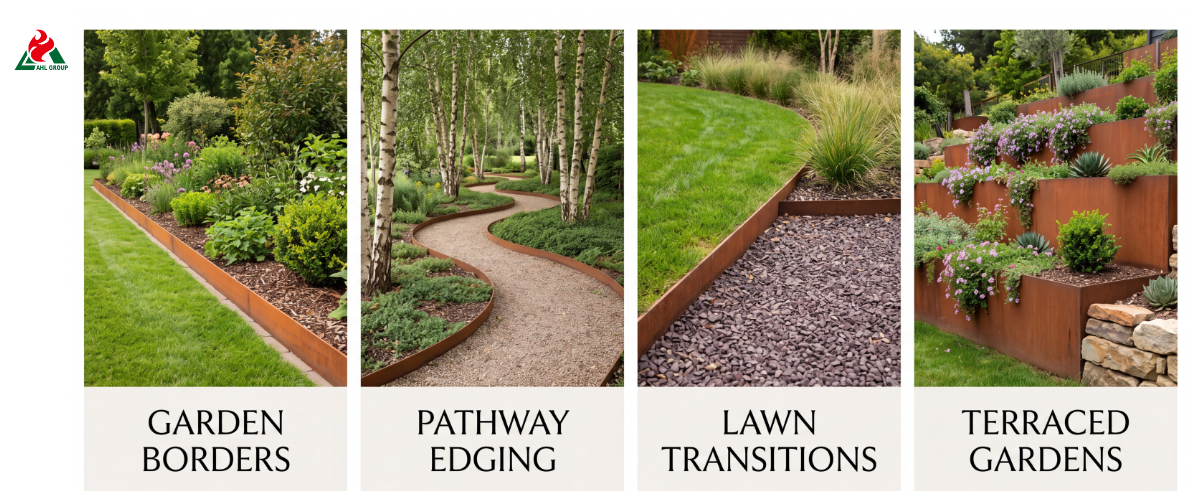
Common Uses in Backyard and Garden Design
Transition Zones Between Lawns and Flower Beds: Creates a clear boundary to prevent grass roots and invasive weeds from encroaching on paved flower beds.
► Securing Gravel Paths: Holds compacted aggregate or loose decorative river stones firmly in place.
► Paving Stone Anchoring: Acts as a sturdy, low-profile anchor to prevent paving stones from sliding outward.
► Low-Profile Terraces: Creates shallow, raised soil steps or planting beds on sloped terrain.
How It Differs from Plastic, Aluminum, and Stone Edging
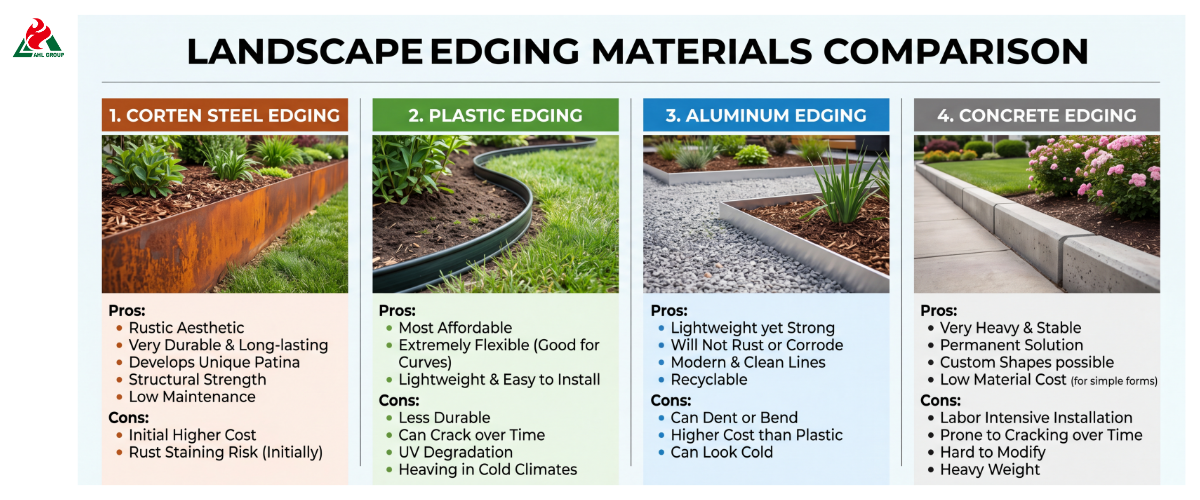
Standard plastic and composite PVC edging becomes brittle and cracks when exposed to the sun’s UV rays, and often lifts off the ground after suffering freeze damage during harsh winters. Although aluminum is lightweight, it lacks structural rigidity and is prone to deformation under the weight of heavy wheelbarrows or soil pressure. Concrete or stone curbs, while extremely durable, are thick and bulky, and require deep trenching and masonry skills to install. Weathering steel, on the other hand, strikes the perfect balance: it is relatively thin (1.5 mm to 3.0 mm), extremely strong, easy to shape, and completely resistant to UV degradation.
3. Do You Need a Base
When Is a Paving Stone Subbase Required
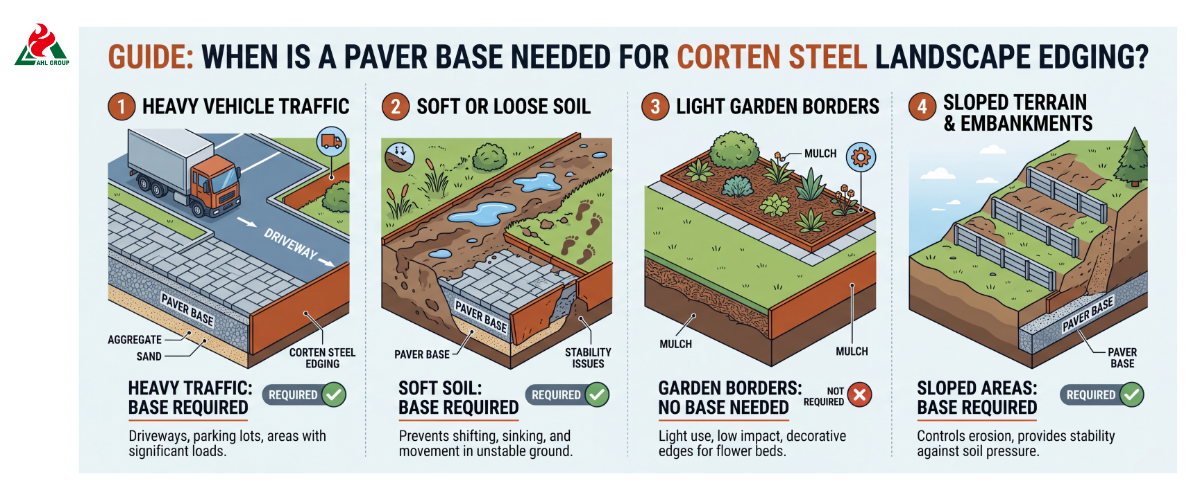
A compacted paving stone subbase is necessary when using Corten steel edging to enclose paving stones or heavy-duty aggregate driveways, or when they are used as structural retaining walls to support elevation differences exceeding 4 inches. Without a compacted gravel base (such as ¾-inch crushed stone and fine sand), the lateral pressure from the pavers and frequent foot traffic will push the vertical steel plates outward, causing the edging to sag and tilt, thereby disrupting the clean lines of your landscape.
Situations Where Soil Alone Is Sufficient
For decorative, low garden borders (2 to 3 inches above ground level) where the soil on both sides of the metal edging is at the same level, an installation using soil alone, without a backing, is entirely sufficient. In dense, well-compacted clay or firm loam, provided the area has good natural drainage, the edging strip and its anchor stakes can be driven directly into a hand-dug trench without the need for additional gravel.
How Curb Height Affects Foundation Requirements
The higher the exposed curb, the greater the structural support required. Low edging (2 to 4 inches) can be secured using standard anchor piles driven into firm soil. However, taller edging (6 to 12 inches) functions as a low retaining wall. These taller edgings are subject to significant lateral soil pressure and therefore require a deep, compacted gravel foundation beneath the trench to prevent the metal edging lawn from tilting over time.
Why Drainage and Stability Are Important
For weathering steel to form a protective, self-healing rust layer, the metal must undergo cycles of wetting and drying. If the bottom edge of the metal remains buried for long periods in waterlogged, compacted clay, it cannot obtain the oxygen needed to form a protective rust layer. This persistently damp environment can lead to premature rusting through of the structure. A compacted gravel base provides a stable structural foundation while allowing water to drain quickly, thereby maintaining the metal’s integrity.
4. Best Base Materials
Compacted Crushed Stone Base
In structural landscaping applications, the absolute gold standard is ¾-inch crushed stone containing fine particles (typically sold as a road base or “Grade 4”). Once compacted, the sharp edges of the crushed stone interlock tightly, forming an extremely stable, indestructible foundation capable of withstanding displacement caused by freeze-thaw cycles and heavy foot traffic.
Gravel Base Course
Clean, angular gravel (such as ¼-inch to ½-inch granite chippings) offers excellent stability and drainage. Unlike rounded river gravel—which rolls like ball bearings under pressure—angular gravel interlocks tightly while still leaving voids, allowing rainwater to drain quickly from beneath the metal edging.
Sand Leveling Layer
Coarse concrete sand is an excellent material for fine-tuning the height of the edging before backfilling. Laying a 1-inch-thick layer of sand over the compacted gravel base allows you to easily tap the metal edging into a perfectly straight, level position. However, never use sand alone as a structural base, as wet sand can be washed away, causing the edging to sag.
Installation in Pure Soil
When installing low-profile garden edging in firm, high-density soil, ensure the ground is completely free of decaying organic matter, loose compost, and large rocks. Before placing the steel edging, thoroughly compact the bottom of the hand-dug trench using a hand tamper to prevent settlement.
What Materials Should Be Avoided Under Corten Edging
► Peat moss and compost rich in organic matter: These materials absorb moisture like a sponge, keeping the steel constantly damp and causing rapid and destructive rusting.
► Rounded pea gravel: It lacks the sharp, interlocking edges needed to form a stable base and is prone to shifting under pressure.
► Biodegradable weed barrier fabric: As the organic material decomposes underground, it creates loose air pockets that cause the edging to shift and sag.
5. How to Install Corten Edging
Mark the Layout
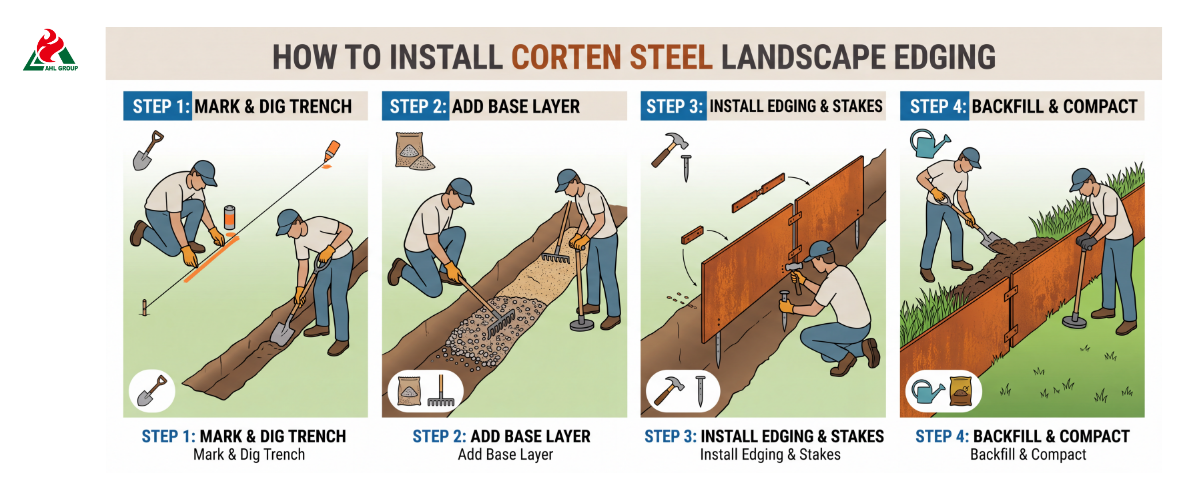
First, use high-visibility spray paint to outline the design on the ground; if you need to draw smooth, flowing curves, use a flexible garden hose. For longer straight sections, stretch a construction chalk line between wooden stakes to ensure the lines are perfectly straight.
Dig the Trench
Using a square-headed shovel, dig a narrow trench along the marked lines. The trench should be twice the width of the edging boards and deep enough to accommodate the base material plus half the vertical height of the steel plates.
Preparing and Compacting the Subgrade
For load-bearing areas, lay a 2-inch-thick layer of crushed stone at the bottom of the trench. Lightly moisten the crushed stone with a garden hose, then thoroughly compact it using a heavy-duty manual compactor or pneumatic compactor until the stone base is completely firm and level.
Installing the Frame
Place the Corten steel panels into the trench and connect the sections using the manufacturer-supplied interlocking clips, sleeve connectors, or heavy-duty stainless steel bolts. Using a level and a soft rubber mallet, gently tap the steel panels into the subgrade until the top edge forms a completely level and even line.
Reinforce the Edges and Backfill
Insert heavy-duty, weathering steel anchor posts through the integrated slots or brackets on the panel and drive them deep into the compacted ground at a slight outward angle to achieve maximum holding power. Finally, backfill both sides of the trench with surrounding soil or decorative stone, and firmly compact the backfill material to securely anchor the panel in place.
6. Factors That Change the Answer
Soft Soil vs. Hard Soil
In loose sandy soil or soft organic silt, all installation projects must include a compacted gravel base. Soft soil cannot securely hold anchor posts in place, which may cause the steel panels to sag or tilt after just one severe storm. Conversely, in hard, high-density clay or solid glacial till, the gravel base can usually be omitted for low garden borders.
Straight Edges vs. Curved Edges
Straight edging is extremely sensitive to displacement; even a slight sag or bend of just 1 inch along a straight edge is easily noticeable to the naked eye. To achieve a perfectly straight line, laying a compacted gravel base helps ensure the edging panels remain aligned. However, curved designs are inherently more robust; bending the steel edging into a smooth arc significantly enhances structural strength, helping the edging resist displacement even in softer soil.
Low-Profile vs. Tall Edging
► Low-profile type (2“ to 3” above ground): Withstands minimal lateral pressure. Can be securely installed directly into firm soil using standard ground stakes.
► Taller type (6“ to 12” above ground): Acts as a structural retaining wall. Requires a compacted gravel base and a deep trench to prevent soil weight from pushing the metal panels over.
Humid Climate vs. Dry Climate
In regions with high annual rainfall or severe freeze-thaw cycles during winter, installing a gravel base is essential. The gravel acts as a drainage layer, allowing excess moisture to drain away from the steel, thereby preventing frost heave from pushing the posts out of the ground. In dry, arid climates, where the risk of water accumulation is low, direct burial in the soil is a much safer installation method.
Decorative Edging vs. Structural Edging
If the metal edging serves only a decorative purpose—such as separating a flower bed covered with organic mulch from an open lawn—direct burial in the soil is entirely sufficient. However, if the edging has a structural function—such as supporting a gravel path, bearing the weight of flagstone paving, or enclosing a driveway—a compacted gravel base must be installed to withstand significant lateral forces.
7. Common Mistakes
Skipping the Compaction Step
Simply pouring loose gravel or crushed stone into the trench without compacting it is a complete waste of time. Loose gravel will shift and settle under the weight of a lawn mower or the soil, causing the edging to sag and deform. Be sure to compact the base material using a heavy-duty manual compactor thoroughly.
Using the Wrong Backfill Material
Filling the trench with loose organic potting soil, mulch, or wood chips causes moisture to pool directly on the metal surface. This persistently damp environment prevents the steel from drying out, hinders the formation of a protective rust layer, and leads to rapid, destructive rusting on the underside of the panels.
Failure to Provide Drainage During Installation
Failure to plan for drainage will result in premature product failure. If boundary strips are installed in low-lying, water-logged areas without a gravel drainage layer or drainage holes, the steel will remain submerged in standing water for extended periods. An oxygen-deprived environment leads to rapid corrosion, thereby shortening the steel’s service life.
Frame Buried Too Shallow
If the trench is dug too shallow, leaving most of the metal panel exposed above ground and lacking sufficient anchoring support, lateral pressure from soil or gravel will quickly push the metal panel over. Be sure to ensure that at least half the height of the metal panel is securely buried underground.
Improper Anchoring of the Frame
Attempting to secure the panels with short, flimsy plastic stakes or cheap, thin wire nails is bound to fail. The shifting forces of frozen ground and the pressure from heavy-duty lawn mowers will easily pull these fragile anchors out. Be sure to use heavy-gauge, weather-resistant steel stakes driven deep into the subgrade.
8. Corten vs Other Edging Types
Corten Steel vs. Paving Stone Edging
Standard plastic paving stone edging is designed to be completely hidden beneath the lawn and secured with plastic stakes. Although inexpensive and easy to install, it lacks visual appeal and is prone to warping over time. Weathering steel serves not only as a sturdy and durable fastener for paving stones but also as an attractive, rustic design element that enhances your hardscape.
Corten Steel vs. Concrete Edging
While concrete curbs offer exceptional strength and durability, they are bulky and require deep trenching, wet mixing, and complex masonry work. Weathering steel maintains the same outstanding service life and structural strength but features a slim, elegant profile that takes up less space and allows for faster installation.
Corten Steel vs. Plastic Edging
Inexpensive plastic or composite garden edging is easy to purchase and install, but it ages rapidly under UV exposure from the sun, developing cracks and warping within just a few seasons. Weathering steel is resistant to UV damage and can easily withstand accidental impacts from lawn mowers. Not only does it have a long service life, but its appearance actually improves with age.
Corten Steel vs. Aluminum Edging
Aluminum edging is lightweight and rust-resistant, but it is too flexible and lacks the structural rigidity required to support heavy paving stones or gravel paths. Weathering steel offers exceptional tensile strength, ensuring that straight sections remain perfectly straight and curved sections remain smooth and sturdy, even under heavy loads.
Comparison Table: Landscape Edging Materials
| Performance Metric | Corten Weathering Steel | Powder-Coated Aluminum | Pour-In-Place Concrete | Heavy-Duty Plastic (PVC) |
| Average Lifespan | 40+ Years | 15–20 Years | 30+ Years | 3–5 Years |
| Tensile Strength | High (400-550 MPa) | Medium (150-250 MPa) | Low (High compression) | Low (30-50 MPa) |
| UV Resistance | Excellent (Immune) | Excellent | Excellent | Poor (Turns brittle) |
| Installation Ease | Moderate (DIY Friendly) | Easy | Hard (Requires masonry) | Very Easy |
| Aesthetic Value | Organic / Architectural | Modern / Industrial | Heavy / Dominant | Low / Utility |
9. FAQs
Q1: Can Corten Steel Edging Be Buried Directly in the Soil?
Yes, you can install low-profile Corten steel garden edging directly into firm, well-drained soil. However, for structural applications—such as securing pavers or supporting heavy-duty gravel paths—it is strongly recommended to lay a compacted gravel base to prevent shifting.
Q2: Will the Rust on Corten Steel Affect Installation?
No, the active rusting process is a good sign that the steel is forming a protective rust layer. However, during the initial 12 to 18 months of natural weathering, rain will wash away a small amount of loose rust dust from the panels. Please avoid installing untreated Corten steel directly against light-colored concrete or stone to prevent staining.
Q3: Is Gravel Better Than Sand for Use Under Curbs?
Yes, compacted angular gravel is far superior to sand as a structural base. The gravel interlocks to form a solid, high-strength foundation that resists displacement and frost heave while draining rainwater more quickly than compacted sand.
Q4: How Deep Should the Trench Be Dug?
The trench depth should equal the thickness of the gravel base (typically 2 inches) plus half the vertical height of the steel edging. This depth ensures that at least half of the edging is securely buried below ground level, providing the necessary support to withstand lateral pressure.
Q5: How Can You Prevent the Edging from Shifting?
To prevent the landscape edging from shifting over time, be sure to thoroughly compact the gravel base, use sturdy interlocking connectors to join the panels together, and drive heavy-duty steel stakes deep into the subgrade at a slight outward angle.
Conclusion: A Clear Answer on Whether a Paving Stone Subbase Is Necessary
Although low, decorative garden edging can be installed directly into firm, well-drained soil, laying a compacted gravel base is strongly recommended for any structural installation. If your edging is used to secure pavers, support a heavy-duty gravel path, or serve as a low retaining wall, taking the time to lay a compacted base is essential.

