


Outdoor lighting is exposed to rain, moisture, UV radiation, temperature fluctuations, dust, and, in some cases, salt spray. For landscape projects, frequent replacement of fixtures not only increases maintenance costs but also disrupts established vegetation or hardscape elements. Therefore, selecting a durable fixture is only part of the decision-making process—electrical components, seals, drainage design, installation methods, and environmental conditions also determine how long Corten outdoor lights will function properly.
For most landscapes, Corten steel lights and well-designed wall-mounted fixtures often offer the best combination of durability and protection. When equipped with high-quality LEDs and adequate weatherproof seals, path lights can also last for many years. Recessed fixtures face a greater risk of moisture ingress, so special attention should be paid to drainage performance and appropriate IP ratings when selecting them.
To ensure long-term performance, do not focus solely on appearance; also check the steel thickness, weathering steel grade, IP rating, quality of the LEDs and drivers, drainage performance, fasteners, and warranty support.
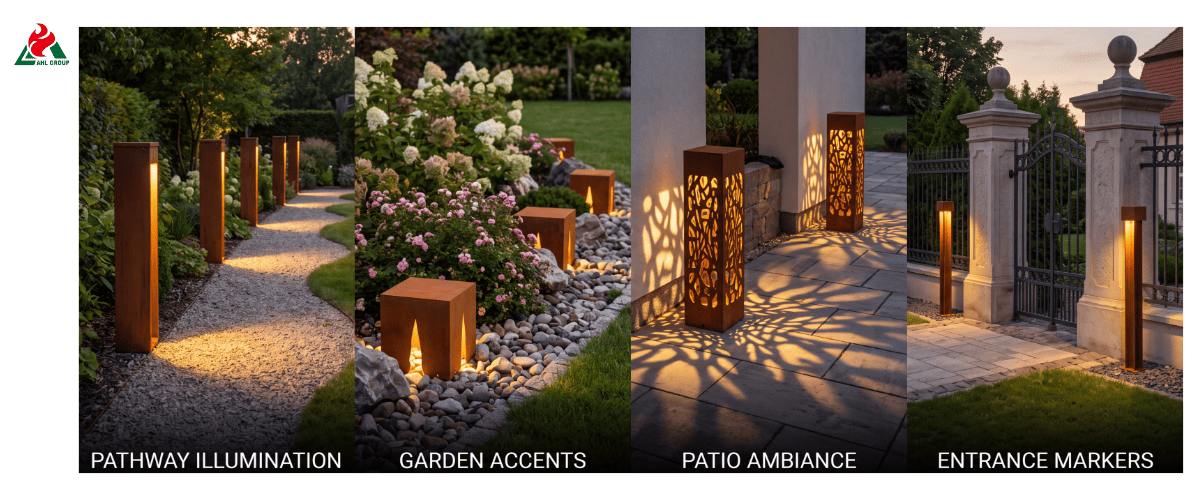
For most landscapes, Corten steel lights and well-designed wall-mounted fixtures often offer the best combination of durability and protection. When equipped with high-quality LEDs and adequate weatherproof seals, path lights can also last for many years. Recessed fixtures face a greater risk of moisture ingress, so special attention should be paid to drainage performance and appropriate IP ratings when selecting them.
To ensure long-term performance, do not focus solely on appearance; also check the steel thickness, weathering steel grade, IP rating, quality of the LEDs and drivers, drainage performance, fasteners, and warranty support.
1. Introduction
Why Durability Is Critical for Outdoor Lighting
Outdoor landscape lighting is constantly subjected to harsh environmental stresses. When exposed to heavy rain, UV radiation, extreme temperature fluctuations, humidity, and chemicals in the soil, low-quality fixtures will deteriorate rapidly. Premature failure not only forces property owners to deal with issues such as short circuits and diminished aesthetics, but also burdens them with high fixture replacement costs and the labor expenses associated with repeated excavation. Investing in ultra-durable outdoor lighting equipment not only ensures the continuous and stable operation of the lighting system and protects the electrical infrastructure but also significantly reduces the total cost of ownership over a service life spanning several decades.
What Makes Corten Steel Lights Unique
Unlike traditional metals that rely on fragile coatings or powder coatings, Corten steel (weathering steel) features a special chemical composition. When exposed to moisture and oxygen in the natural atmosphere, it forms a dense, self-protective oxide layer. This oxide layer shields the structural core from deep oxygen penetration and moisture intrusion, thereby transforming environmental exposure into a protective mechanism rather than a destructive factor.
2. How Corten Outdoor Lights Age Over Time
Protective Rust Layer and Its Formation
When new Corten steel lighting fixtures are installed, the steel begins to undergo atmospheric oxidation cycles. Alternating wet and dry conditions cause an initial porous layer of iron hydroxide to form on the surface. Within 6 to 36 months, this initial oxide film gradually stabilizes and densifies, eventually forming a dense, non-porous layer composed primarily of goethite, which prevents further structural oxidation.
How Rust Self-Repairs After Scratches
If a lawn mower, gardening tool, or hard debris scratches the exterior surface of the light fixture, the exposed steel substrate will immediately react with oxygen and moisture in the environment. Alloying elements—copper, chromium, and nickel—trigger a localized oxidation process, reforming a dense, protective hematite layer at the scratch site without causing the surrounding metal to flake off.
Why No Paint or Sealant Is Needed
Since the hematite film forms an impermeable natural barrier, applying a clear sealant or rust-preventive paint to weathering steel products offers no benefit. Uncoated weathering steel relies on unimpeded atmospheric cycles of moisture and dryness to naturally maintain and regenerate its protective layer.
Typical Appearance Changes Over 1–5 Years
► Months 1–3: Bright, vibrant original orange-yellow hue.
► Months 6–12: Gradually deepens to a warm, rich reddish-brown.
► Years 2–5: Fully stabilizes into a deep, rustic dark coffee-chocolate color with a uniform matte finish.
3. Lifespan of Corten Steel vs Other Materials
Weathering Steel: Enclosure Service Life of 25–100+ Years
When the structural thickness is specified at 3.0 mm or greater, the service life of a weathering steel enclosure can range from 25 to 100+ years. This thick alloy steel plate can withstand severe physical impacts, foot traffic, and structural stress without deforming or developing rust holes.
Stainless Steel: 15–40+ Years, Depending on the Grade
Standard 304-grade stainless steel performs well in low-humidity inland environments, but when exposed to coastal chloride environments, “tea-stain-like” rust spots may appear on the surface. Marine-grade 316 stainless steel offers excellent corrosion resistance (30–50+ years), but the raw material is more expensive and requires regular cleaning to maintain its mirror-like finish.
Aluminum: 10–30+ Years; Lighter But Less Rigid
Die-cast aluminum is lightweight and easy to install. However, its service life depends entirely on the integrity of the powder coating or anodized finish. Once the coating is damaged due to thermal expansion or mechanical scratches, oxidation of the underlying layer causes the finish to rapidly blister and peel.
Plastics/Resins: 3–10 Years, with UV Degradation Issues
Although polycarbonate and ABS plastic lighting fixtures have a lower initial cost, they are prone to degradation due to intense solar radiation. Within 3 to 7 years, intense ultraviolet (UV) radiation can break the chemical bonds in the polymers, causing the lamp body to become brittle, crack, discolor, and lose its waterproof seal.
Corten Steel’s Ranking in Overall Durability
In terms of structural quality, impact resistance, heat resistance, and the service life of the housing, Corten steel ranks first among heavy-duty architectural and landscape materials.
4. Which Corten Light Types Last Longest
Pole Lights: Thick-walled Construction, Protected LED Chips
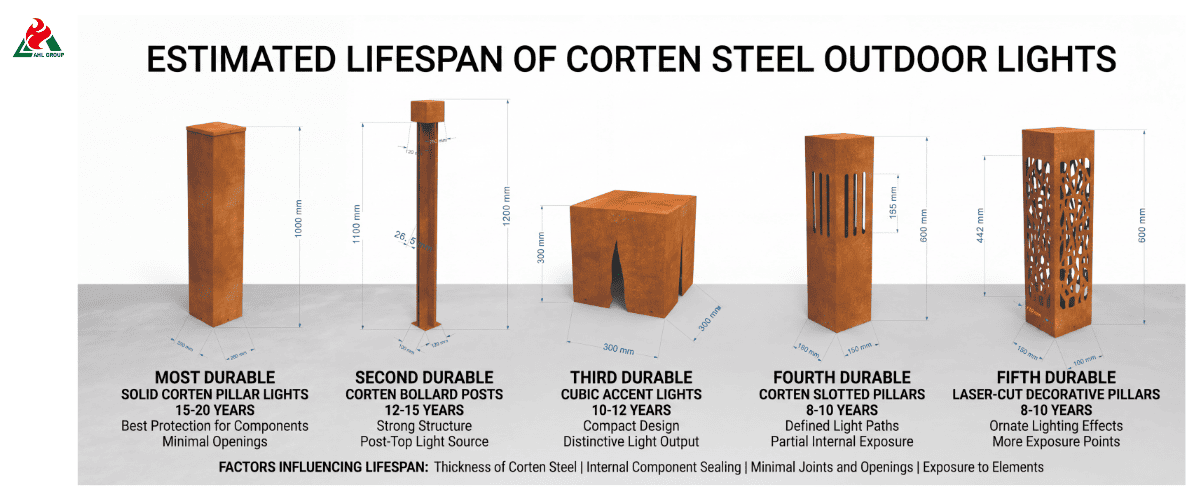
Among the various types of lighting fixtures made from Corten steel, pole lights have the longest service life. Manufactured from thick-walled hollow profiles (3.0 mm to 5.0 mm), bollard lights effectively elevate internal electrical components to a height well above ground moisture and rainwater accumulation. Their robust construction withstands impacts from lawn equipment, while the internal driver compartment easily achieves an IP65 or IP66 protection rating.
Pathway Lights: Compact, Low Heat, Long Service Life
Compact Corten steel pathway lights (wall thickness 2.5 mm to 3.0 mm) use low-wattage LED light sources that generate minimal heat. Their downward-facing optical system protects the lens from direct sunlight and hail impacts; high-quality pathway lights installed above the ground surface can provide 40 to 70 years of reliable service.
Wall Lights: Sheltered Installation, Well-Ventilated
Weathering steel wall lights are installed on vertical building facades, avoiding both constant contact with the soil and accumulated groundwater. Sheltered under eaves, they experience moderate wet-dry cycles and have a service life of 30 to 60 years.
Decorative Sculptural Lighting: Variable Thickness
Custom laser-cut Corten light poles and decorative light boxes feature intricate patterns that create atmospheric light and shadow effects. Since laser cutting exposes more of the steel’s cut edges to the natural environment—and thus to weathering—the steel plates for these fixtures must be at least 3.0 mm thick to ensure the structure remains intact for decades and the cut edges do not thin over time.
In-Ground Lights: Highest Water Exposure with IP67+ Protection Rating Required
In-ground wellhead lights face the most demanding operating conditions. Because they are flush with the ground, they are exposed to standing water, soil acidity, and high foot traffic. While the Corten steel decorative lights offer excellent weather resistance, the internal light fixtures must have an IP67 or IP68 waterproof rating and be installed atop a gravel drainage layer to prevent moisture infiltration.
5. Key Factors That Determine Longevity
Steel Sheet Thickness: 2 mm vs. 3 mm vs. 4 mm+
The thickness of the steel sheet directly determines the structure’s service life under atmospheric corrosion (under standard conditions, material loss is approximately 0.5 mm every 30–40 years):
► 1.5 mm steel sheet: Prone to warping, the “oil drum effect,” and premature rusting at the edges; not recommended for structural landscape features.
► 2.0 mm to 3.0 mm steel plate: Suitable for residential path lights and wall sconces, offering an excellent balance of performance (design service life target of 30–50 years).
► 3.0 mm to 5.0 mm+ steel plate: Suitable for commercial bollards and public light poles, making it an ideal choice (design service life target of 50–100+ years).
LED Driver and Light Source Quality
While weathering steel housings can last a century, the service life of a luminaire’s electronic components depends on its internal LED drivers and light source modules. High-quality luminaires use industrial-grade, fully potted drivers (e.g., Mean Well, Inventronics), with internal surge protection rated for 50,000 to 100,000 hours.
IP Protection Ratings: IP65, IP66, and IP67
The Ingress Protection (IP) rating defines how effectively an electrical enclosure resists the ingress of dust and water:
► IP65: Dust-tight and resistant to low-pressure water jets; suitable for sheltered wall lights.
► IP66: Resistant to powerful water jets and heavy rain; the recommended standard for landscape light poles.
► IP67/IP68: Can be submerged to a depth of 1 meter; this is a mandatory requirement for in-ground well lights and ground-mounted floodlight fixtures.
Environmental Exposure: Coastal, Urban, Rural
Atmospheric chemical conditions determine the oxidation behavior. The mild atmospheric conditions in rural areas are conducive to the formation of a stable and ideal rust layer, while high concentrations of salt fog in coastal areas accelerate the rate of chemical oxidation.
Installation Quality and Drainage
Improper installation is the primary cause of premature luminaire failure. Installing weathering steel luminaires directly on low-lying muddy ground, damp surfaces, or in areas with poor drainage can lead to persistent moisture exposure, thereby hindering the formation of a protective hematite layer on the steel.
6. LED Lifespan Inside Corten Fixtures
Typical LED Rated Lifespan: 15,000–50,000 Hours
High-quality LED light sources have a rated operating time ranging from 30,000 to 50,000 hours. If operated for 8 hours each night, an LED light fixture with a rated lifespan of 50,000 hours can operate stably and reliably for over 17 years before requiring maintenance.
What L70/L80 Mean for Lumen Maintenance
Unlike traditional incandescent bulbs, which burn out suddenly, LEDs gradually dim over time. An L70 rating of 50,000 hours means that after 50,000 hours of continuous operation, the LED fixture will still maintain 70% of its original lumen output. High-quality landscape lighting typically specifies L80 or L90 ratings.
How Thermal Management Affects LED Lifespan
Overheating is the primary cause of premature LED degradation and driver failure. While a thick weathering steel luminaire housing provides structural strength, the thermal conductivity of the steel itself is lower than that of aluminum. Durable weathering steel lamps incorporate aluminum heat sinks that are mechanically secured to the LED circuit board, conducting heat into the surrounding air cavity.
When to Replace LEDs for the First Time
In well-ventilated, high-quality Corten outdoor lights, the driver or LED circuit board is expected to require maintenance around the 12th to 15th year, while the steel housing remains completely intact.
Modular vs. Integrated LED Designs
To maximize the service life of lighting fixtures, designs that are modular and allow for on-site maintenance should be selected. With integrated fixtures, where sealed electronic components are encased within a bonded steel housing, the entire fixture must be discarded if any single electronic component fails. In contrast, modular Corten steel lamps allow for easy replacement of internal drivers or LED circuit boards without having to disassemble the housing, which has already been fully exposed to the elements.
7. Environmental Impact on Corten Light Lifespan
Mild Inland Climate: 30–50+ Years of Service Life at 2–3 mm Thickness
In inland rural or suburban environments with moderate humidity and rainfall, Corten steel lightweight cladding with a thickness of 2.0 mm to 3.0 mm remains stable and durable, with a service life of 30 to 50+ years and virtually no material wear.
Urban/Mild Climates: 25–40 years
Urban environments feature low levels of sulfur dioxide and particulate matter from motor vehicles. Rainfall helps wash away surface deposits and promotes the formation of a healthy rust layer, thereby extending the service life of the housing to 25 to 40 years.
Coastal/High-Salinity Areas: Reduced Service Life; IP66/67 Protection Rating Required
Within 1 to 2 kilometers of the shoreline, the air contains high concentrations of salt, which introduces active chlorides that interfere with the formation of a rust layer. In these environments:
► Thicker steel plates (3.0 mm to 4.0 mm) should be selected.
► Rinse the fixtures with fresh water twice a year to remove salt deposits.
► Ensure that internal electronic components have an IP66 or IP67 protection rating.
Industrial/Polluted Areas: Patina Forms Faster; Close Monitoring Is Required
High concentrations of industrial emissions and acid rain accelerate the early formation of patina. Regular visual inspections ensure that acidic substances in the atmosphere do not accumulate in crevices where drainage is impossible.
When to Consider Using Thicker Steel or Alternative Materials
If the garden light is installed directly on a marine breakwater area continuously exposed to salt spray, or buried in saline-alkali soil, select heavy-duty weathering steel plate of 4.0 mm or thicker, pre-stabilized architectural weathering steel, or marine-grade 316 stainless steel.
8. Maintenance Practices That Extend Lifespan
Clean Once a Year to Remove Dust and Salt Deposits
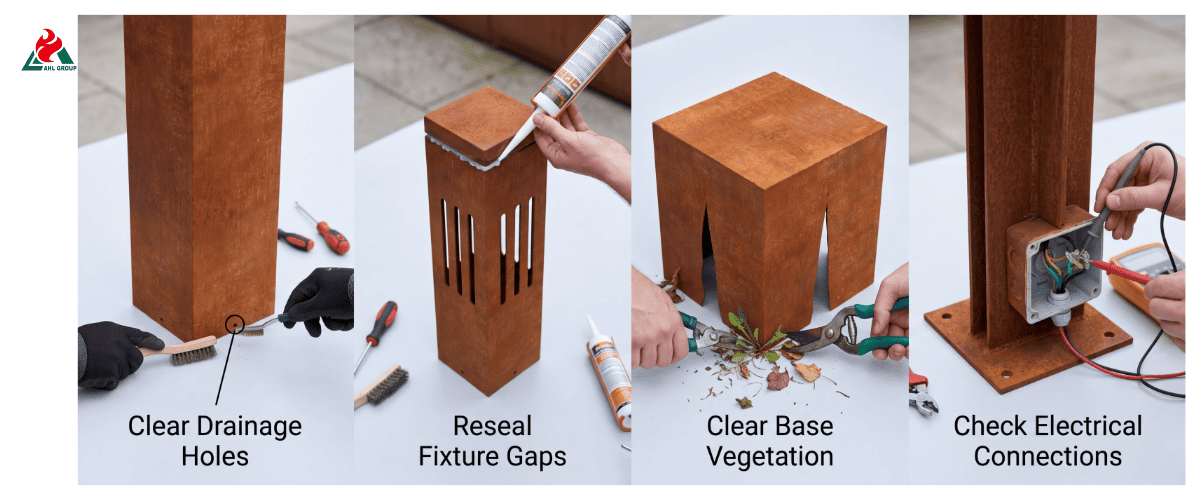
Rinse the Corten steel enclosure once a year with clean tap water and a soft-bristled nylon brush. This simple cleaning removes salt deposits, bird droppings, and industrial grime that accumulate in sheltered areas due to a lack of natural rainfall.
Inspect Seals and Gaskets
Inspect the EPDM rubber or silicone gaskets sealing the optical lens and drive enclosure every 2 to 3 years. Replace any gaskets that are cracked or flattened promptly to maintain the enclosure’s protection against ingress.
Check for Water Ingress and Condensation
If fog or water droplets appear on the internal lens, open the access panel, clear any clogged internal drainage channels, inspect the cable entry crimp connectors, and allow the interior to dry completely before resealing.
Replace LEDs and Drivers as Needed
For large-scale installations, keep spare modular LED drivers on hand. Replacing a faulty driver module takes only a few minutes to restore lighting, without having to disassemble the housing that has already been fully weathered.
Do Not Use: Harsh Cleaners, Wire Brushes
► Never scrub with a wire brush: Metal bristles will strip away the dense goethite oxide layer and scratch the alloy core.
► Never use acidic chemical solvents: Harsh solvents will dissolve the protective iron oxide layer.
► Never use a high-pressure water jet (>1,500 PS) for cleaning: High-pressure water jets will damage rubber seals, force water into electronic components, and strip away the protective surface coating.
9. Common Mistakes That Reduce Lifespan
Using Steel That Is Too Thin in Large or Exposed Fixtures
Fixtures made from thin steel sheets—only 1.0 to 1.2 millimeters thick—lack structural strength. They warp under thermal cycling, are prone to denting, and carry a risk of premature rust-through at the cut edges within 8 to 12 years.
Ignoring the IP Protection Rating of the Installation Site
Installing luminaires designed exclusively for indoor use or with an IP rating of only IP44 in outdoor landscape planters will inevitably lead to early failure. Splashes from the ground and heavy rain can bypass weak seals, causing short circuits in the drivers and LED arrays.
Poor Drainage and Moisture Retention
Encasing the lighting fixture base in solid concrete or burying drainage holes under damp coverings leads to persistent moisture buildup around the steel base. Without adequate air circulation and drying cycles, weathering steel cannot form ferrite, and its corrosion rate will be comparable to that of ordinary carbon steel.
Installation in High-Chloride Areas Without Protective Measures
Placing thin-gauge weathering steel lights near the surface without regular freshwater rinsing will cause the surface to continuously flake off and shorten the service life of the luminaire.
Use of Non-Weathering Steel or Counterfeit Materials
Low-cost counterfeits are typically made from standard carbon steel treated with chemical accelerators. Non-alloy steel lacks copper and chromium additives, causing it to rust continuously until structural failure occurs within 4 to 8 years. Be sure to verify that the material test certificates comply with the ASTM A606-4 or A588 standards.
10. Buying Checklist for Long-Lasting Corten Lights
Confirm the Steel Grade (ASTM A588 / A606 or Equivalent Standard)
Verify that the manufacturer is using genuine weathering steel grades:
► ASTM A606-4: Standard Specification for High-Strength Cold-Rolled Sheets and Strips for Architectural Products.
► ASTM A588: High-Strength Low-Alloy Structural Steel Plates.
► EN 10025-5 (S355J2W / S355J0WP): Recognized European equivalent steel grades.
Check the Product Specifications for Thickness (mm)
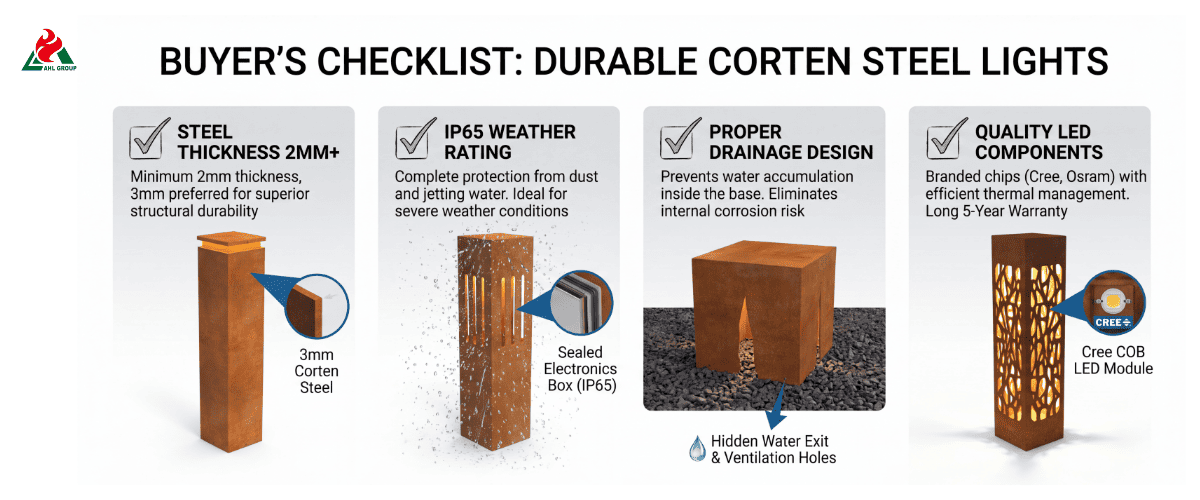
Look for explicit material thickness specifications. Pathway lights must have a thickness of at least 2.5 mm, while structural bollards must have a thickness of 3.0 mm to 4.0 mm.
Verify the IP Protection Rating (IP65 Minimum, IP66/67 Required for Harsh Environments)
Ensure that the optical and electrical enclosures have a certified IP protection rating:
► IP65: Minimum requirement for wall lights.
► IP66: Ideal standard for lawn lights and path lights.
► IP67/IP68: Mandatory requirement for in-ground wellhead lights.
Review the Quality and Warranty Terms of the LEDs and Drivers
Confirm that the internal drivers use components from recognized brands (e.g., Mean Well, Tridonic, Philips), that the warranty period for electronic components is at least 5 years, and that the warranty period for the weather-resistant steel housing is at least 10 years.
Evaluating Brand Reputation and Actual Project Case Studies
Select a supplier that specializes in architectural and landscape lighting and can provide project case studies, photometric data, and verified material certificates.
11. Cost and Long-Term Value
Higher Initial Costs and Lower Lifetime Maintenance Costs
Genuine 3 mm Corten steel lamps carry a higher initial purchase price than thin aluminum or plastic lamps. However, because Corten steel does not require repainting, refinishing, or premature replacement of the lamp body, it results in significant cost savings over the long term.
Comparison of Repainting Cycles with Other Metals
In harsh outdoor environments, powder-coated aluminum and painted steel luminaires are prone to fading, peeling, and corrosion, requiring replacement every 7 to 12 years or time-consuming and labor-intensive repainting. Weathering steel eliminates the need for repainting cycles.
25–50-Year Life Cycle Costs
Over a 30-year landscape life cycle, a modular Corten steel light requires only 1 to 2 driver replacements, resulting in an extremely low total cost of ownership.
When Corten Steel Is Most Cost-Effective
Corten steel lighting delivers the highest economic return in high-traffic commercial developments, public parks, luxury residential communities, and coastal resorts—locations where maintenance is often challenging and luminaire durability is critical.
Resale Value and Architectural Aesthetics
In addition to savings on operating costs, Corten steel lighting offers a high-end, modern aesthetic that complements contemporary architecture, stonework, and natural landscaping, thereby enhancing the overall property value.
12. FAQs
Q1: How Long Do Weathering Steel Outdoor Lights Typically Last?
Provided they are properly designed and have sufficient wall thickness (3.0 mm or more), weathering steel lamp bodies can have a service life of 30 to over 100 years. The internal LED drivers typically operate reliably for 50,000 hours (12 to 15 years) and can be easily replaced in modular fixtures.
Q2: What Thickness is Best for Durable Weathering Steel Lighting?
The ideal specifications are: 2.5 to 3.0 millimeters for path lights and wall sconces, and 3.0 to 4.0 millimeters for commercial bollards and heavy-duty light poles. Products with a thickness of only 1.0 to 1.5 millimeters should be avoided.
Q3: Are Weathering Steel Lights More Durable Than Aluminum or Stainless Steel Fixtures?
Yes. Weathering steel has a longer service life than painted aluminum fixtures because it does not rely on surface coatings that can peel or crack. Its overall weather resistance is comparable to or even superior to that of 304 stainless steel, and it offers excellent impact resistance without the need for surface polishing.
Q4: Can Weathering Steel Lighting Fixtures Be Used in Coastal Areas?
Yes, but they must comply with the relevant technical specifications. In coastal environments within 2 kilometers of the shoreline, thicker steel plates (3.0 mm to 4.0 mm) should be selected, the internal electronic components must meet an IP66 or IP67 protection rating, and the housing should be rinsed with fresh water twice a year to remove accumulated salt.
Q5: Do Corten Steel Lights Require Sealing or Painting?
No. Corten Steel is specifically designed to require neither sealing nor painting. Its alloy composition naturally forms a protective layer of hematite rust, which shields the underlying steel from corrosion. Applying paint or sealant would disrupt this natural atmospheric protection process.
Conclusion: Final Recommendations Based on Environment, Thickness, and Design
For a typical garden setting, a weathering steel housing 2–3 millimeters thick, paired with high-quality LED components and appropriate outdoor sealing measures, is generally a wise choice. For large architectural lights or exposed installations, consider using a structure 3–4 millimeters thick or thicker, and carefully assess wind conditions, humidity, and chloride exposure.
The key purchasing principle is simple: choose a complete lighting system rather than simply pursuing the appearance of weathered steel. Genuine weathering steel enclosures, robust electrical components, appropriate IP ratings, effective drainage systems, and maintenance-friendly designs offer far greater long-term value than fixtures that are structurally weak but visually appealing.

