


Corten steel cladding is increasingly used by architects and building owners seeking both long-term performance and a distinctive architectural appearance. Unlike traditional painted steel, weathering steel forms a stable oxide layer rather than relying entirely on surface coatings for corrosion protection.
When properly selected and installed, weathering steel exterior wall panels can last for decades; in suitable environments, a well-designed system may even remain in service for 50 years or longer. Thickness alone cannot guarantee a specific service life.
For most architectural applications, 2–3 mm-thick panels are typically sufficient, provided the design is appropriate; however, thicker materials may be selected for harsh environments, long-span structures, or situations requiring impact resistance or a longer design life.
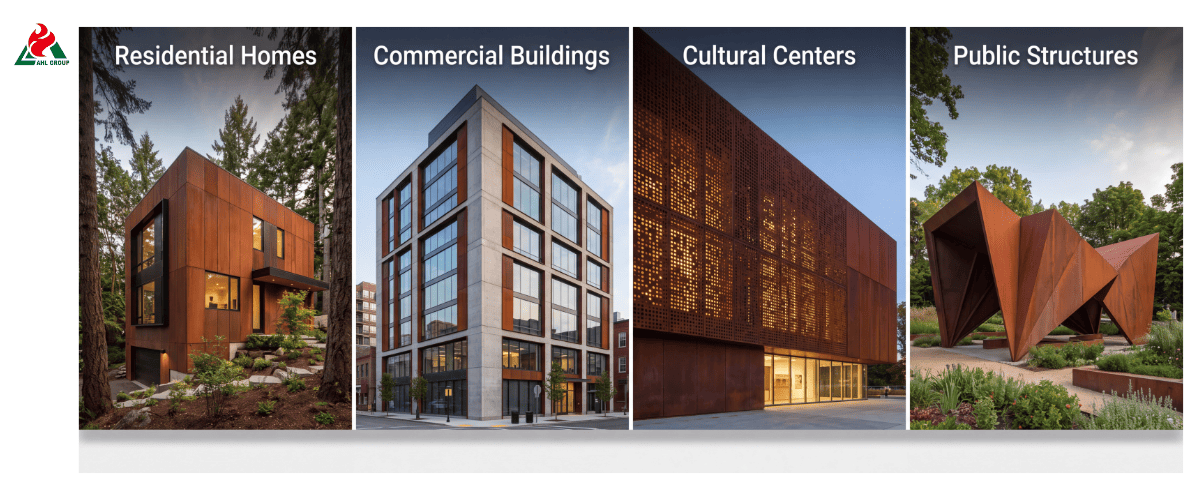
When properly selected and installed, weathering steel exterior wall panels can last for decades; in suitable environments, a well-designed system may even remain in service for 50 years or longer. Thickness alone cannot guarantee a specific service life.
For most architectural applications, 2–3 mm-thick panels are typically sufficient, provided the design is appropriate; however, thicker materials may be selected for harsh environments, long-span structures, or situations requiring impact resistance or a longer design life.
1. Introduction
Why Exterior Wall Cladding Needs to Be Durable
Selecting a building’s exterior envelope is one of the most critical decisions in modern architectural design. Exterior wall cladding serves as the primary barrier against heavy rain, extreme temperature fluctuations, UV radiation, and mechanical impact. When exterior wall materials fail prematurely, building owners face high costs for scaffolding, repairs to structural water damage, and early replacement of materials. Durable exterior wall cladding maintains structural integrity, minimizes long-term operating costs, and preserves property value for decades.
How Does Weathering Steel Differ from Other Metals
Ordinary carbon steel continuously rusts when exposed to oxygen and moisture in the atmosphere, constantly shedding flakes of iron oxide until the core structure is completely eroded. Weathering steel (commonly known as Corten steel), however, reacts quite differently. Its unique chemical composition reacts with the atmosphere to form a dense, tightly adherent oxide layer. Far from damaging the metal, this rust layer actually seals the underlying core, isolating it from oxygen and moisture and transforming corrosion into a self-protective barrier.
2. How Corten Steel Siding Works
What Is Weathering Steel and How Does It Form a Rust Patina
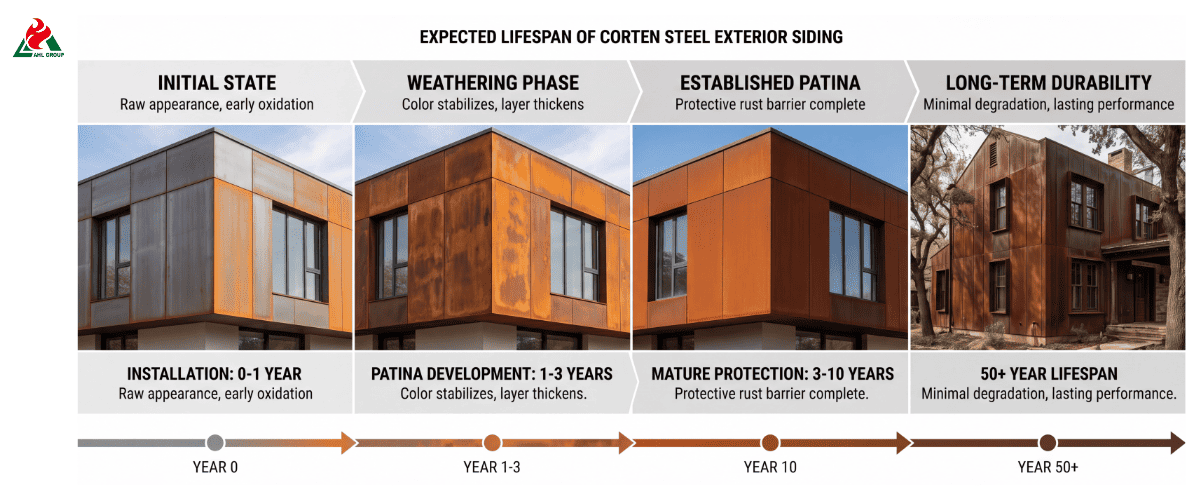
Weathering steel is a type of steel alloy specifically developed to eliminate the need for surface coating. When exposed to the atmosphere and subjected to alternating cycles of wet and dry conditions, the outer layer of the steel oxidizes, forming an initial rust patina. Within 6 to 36 months, this initial oxide layer transforms into a stable, tightly bonded protective coating.
The Chemical Principles Behind the Protective Rust Layer
Corten steel’s exceptional durability stems from its precise alloying with copper, chromium, nickel, and phosphorus. In standard carbon steel, the oxide film is porous, allowing oxygen ions to migrate inward. In Corten steel, however, copper and chromium ions enrich the internal oxidation zone, forming an amorphous layer of goethite. This dense layer blocks electron transfer and seals off the underlying steel matrix.
How Rust Self-Repairs After Scratches
If the protective layer develops scratches, dents, or wear due to wind-blown debris or accidental impact, the exposed steel core is once again exposed to the atmosphere. The alloy elements immediately react with oxygen and moisture in the environment, thereby initiating a new oxidation process that regenerates a hematite layer in the damaged area without flaking or causing subsurface rust to spread.
Why Painting or Sealing Is Unnecessary
Since the rust layer itself acts as a natural, impermeable protective barrier, applying paint, clear sealants, or anti-rust coatings to standard building facades is not only unnecessary but can actually be counterproductive. Unsealed weathering steel (Corten) is able to maintain its self-healing oxide film indefinitely through the natural wet-dry cycles of the atmosphere.
3. Expected Lifespan of Corten Steel Siding
Typical Service Life: 50 to 120 Years in Mild Climates
In temperate, rural, or low-pollution urban environments, Corten steel exterior wall panels can reliably provide a service life of 50 to 120 years. Once the initial rust layer stabilizes, the corrosion rate drops to a nearly negligible level.
40–80 Years as a Conservative Design Target
Architects and structural engineers typically adopt a conservative design target of 40 to 80 years when calculating the service life of Corten steel exterior cladding. This safety margin accounts for potential local microclimates, unexpected atmospheric pollutants, or subtle variations in annual rainfall patterns.
Material Loss Rate (0.5–0.8 mm over 40 Years in Urban Environments)
Long-term field exposure data indicate that atmospheric-induced steel loss slows dramatically once the rust layer has stabilized. In a typical urban environment, total material loss over 40 years averages approximately 0.5 to 0.8 millimeters, ensuring that structural strength remains unaffected for decades.
How Thickness Affects Service Life (2 mm vs. 3 mm vs. 6 mm and Above)
Since steel corrosion is a surface phenomenon measured in millimeters per decade, sheet thickness is directly related to the structure’s service life:
► 2.0 mm Panels: In standard urban environments, the service life is 30 to 50 years.
► 3.0 mm Panels: Under the same conditions, the service life can be extended to 60 to 90 years.
► 6.0 mm and Thicker Panels: Service life exceeds 100 to 150 years, but these are primarily used for heavy-duty structural members or retaining structures, rather than standard wall cladding.
When Can a Service Life Target of 60–80 Years or More Be Achieved
To achieve a service life of 80 years or more, three core design conditions must be met: the panel thickness must be at least 3.0 mm; an engineering-designed ventilated rain screen cavity must be used to ensure complete drying between rainfall events; and the installation environment must not be subject to continuous exposure to salt fog or industrial chemicals.
4. Factors That Influence Longevity
Climate: Urban, Rural, Industrial, Coastal
The formation of the rust layer is determined by the atmospheric classification according to the ISO 9223 standard. Rural environments (C2) are conducive to the formation of an ideal, slow-developing rust layer. In urban and moderately industrial environments (C3), a healthy rust layer can also form as long as rainfall regularly washes away particulate matter deposited on the surface. Heavy industrial areas containing sulfur dioxide (SO₂) require careful inspection.
Wet/Dry Cycles and Air Circulation
The most critical factor for Corten steel’s durability is the balance between wet and dry conditions. If the steel remains continuously damp or submerged in water, a protective hematite oxide layer cannot form, causing the material to corrode at a rate similar to that of ordinary carbon steel.
Chloride Exposure and Salt Spray
Sea salt destroys the crystalline structure of the protective rust layer. In high-chloride environments (within 1 to 2 kilometers of the shoreline), salt deposits in the air absorb moisture and damage the internal oxide layer, leading to continuous flaking.
Pollution Levels and Acid Rain
High concentrations of sulfur dioxide or nitrogen oxides emitted from industrial chimneys can lower the pH of rainwater. Acid rain reduces the stability of the goethite film, thereby accelerating material loss in the early stages.
Installation Quality and Drainage Design
Even the highest-quality weathering steel alloys will fail prematurely if installed improperly. Moisture accumulation behind the panels, improper flashing details, or poor ventilation of wall cavities can all hinder the drying of the panels, underscoring the importance of proper installation design.
5. Corrosion Resistance Compared to Other Claddings
Weathering Steel vs. Painted Carbon Steel
Painted carbon steel relies entirely on its organic coating (polyurethane, PVDF, or polyester) to provide corrosion protection. Once the paint film cracks due to wind-blown debris, hail, or thermal expansion and contraction, moisture seeps beneath the coating, leading to widespread rust propagation and peeling. Weathering steel requires no surface coating and can naturally repair its protective layer when the surface is scratched.
Weathering Steel vs. Aluminum Cladding
Anodized or powder-coated aluminum offers the advantages of light weight and strong resistance to uniform corrosion. However, aluminum has a higher coefficient of thermal expansion than weathering steel, requiring wider expansion joints in long-span structures. Additionally, aluminum lacks the high structural strength and impact resistance of weathering steel.
Weathering Steel vs. Zinc and Copper
Zinc and copper form natural protective rust layers (zinc carbonate and copper carbonate) and have a long service life (80 to 100 years or more). However, weathering steel offers significantly higher yield strength and tensile strength at a lower cost per square meter, giving it structural advantages in heavy-duty curtain wall panels and high-rise building applications.
Weathering Steel vs. Fiber Cement and Wood
Wooden exterior wall cladding requires routine staining or sealing every 3 to 5 years to prevent rot, warping, and insect damage. While fiber cement resists rot, it absorbs moisture over time, making it susceptible to freeze-thaw cracking and edge spalling. Weathering steel, on the other hand, is unaffected by UV radiation, biological growth, and freeze-thaw cycles.
Weathering Steel’s Ranking in Overall Durability
In terms of structural integrity, fire resistance, impact resistance, and durability over its entire life cycle, weathering steel is among the most durable exterior building materials available today.
6. Maintenance Requirements Over Time
Initial Rust Layer Stabilization Period (6 Months to 3 Years)
During the initial weathering period of 6 to 36 months, the color of the steel will gradually change from a bright orange-yellow to a rich, deep espresso brown. During this phase, rainwater runoff contains loose iron oxide particles. Designers must take this runoff into account to protect adjacent light-colored paving or masonry surfaces.
Annual Rinsing to Remove Dust and Salt
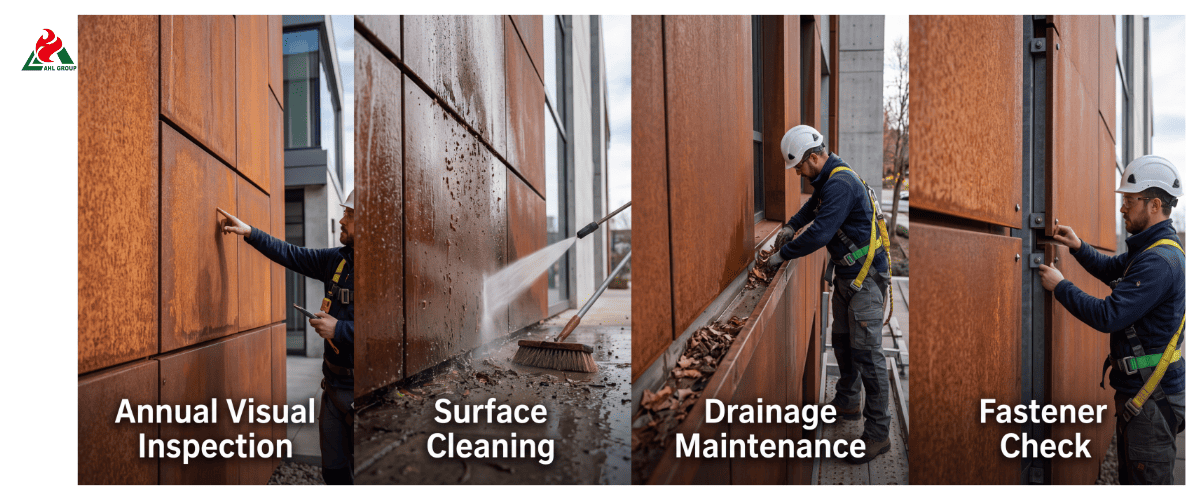
Although Corten steel is essentially maintenance-free, rinsing it once a year with clean, fresh water helps remove dust, organic debris, and airborne salt deposits from shaded areas not directly exposed to rainfall, such as under eaves and overhangs.
Inspect Fasteners and Joints
Routine annual maintenance should include inspecting panel fastening points, joint gaps, and flashing transitions. Ensure that fasteners are secure and that no debris has accumulated in expansion joints.
Address Debris and Standing Water Behind the Panels
Inspect the ventilation cavity, flashing drain holes, and bottom drainage channels twice a year. Remove accumulated fallen leaves, bird nests, or soil buildup to maintain unobstructed vertical airflow behind the cladding panels.
Do Not Use: Harsh Cleaners, Wire Brushes, High-Pressure Water Jets
► Never use wire brushes or abrasive pads: They will strip away the dense hematite layer and scratch the steel surface.
► Never use acidic cleaners or chemical solvents: Acidic substances will dissolve the protective iron oxide layer.
► Never use a high-pressure water jet (>1,500 PSI): High pressure will strip away the fragile patina and force water into hidden cavities within the wall joints.
7. Design and Installation Best Practices
Rain Screen/Ventilated Curtain Wall Principles
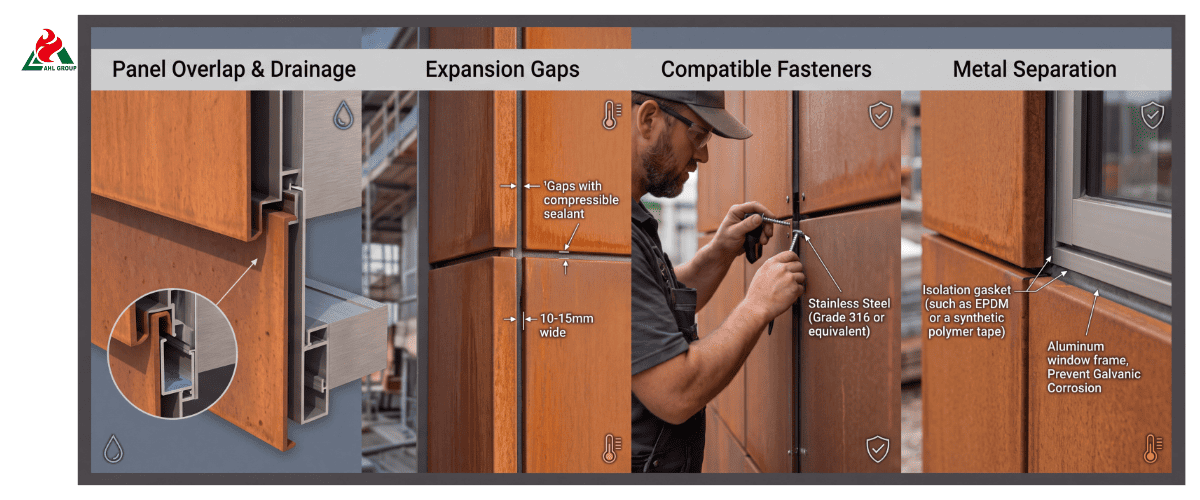
Weathering steel exterior walls should always be installed as part of a ventilated rain screen system. The panels are fastened to vertical or horizontal sub-studs, leaving a continuous air gap of 25 to 50 millimeters between the back of the steel panel and the building’s waterproof and breathable membrane (WRB).
Proper Drainage and Drainage Holes
Design open horizontal joints or provide continuous bottom drainage holes fitted with insect screens. Water entering the panel joints during heavy rain must be able to drain smoothly from the bottom of the air cavity.
Avoid Water Accumulation and Puddles
All panel profiles, window sills, and flashing strips must have a downward slope of at least 5° to 15°. Flat, horizontal eaves accumulate standing water, hindering atmospheric drying and leading to persistent localized rusting.
Managing Rust Runoff on Adjacent Surfaces
To prevent iron oxide runoff from contaminating adjacent porous surfaces (such as white concrete, light-colored travertine, or glass):
► Install a dark-colored gravel catch basin at the base of the wall or use dark-colored powder-coated drip flashings.
► Apply a chemical pre-weathering accelerator to stabilize rust stains before final on-site installation.
► Seal surrounding light-colored masonry surfaces with an oleophobic/hydrophobic silane sealant.
Detailing at Windows, Corners, and Panel Penetrations
Window lintels, frames, and sills must be flashed with compatible, corrosion-resistant materials. Ensure that panel penetrations (such as for exterior lighting or pipe outlets) use EPDM or neoprene gaskets to prevent direct electrochemical contact between metal surfaces.
8. Thickness and Specification Guidelines
2.0–3.0 mm: For Projects with a Design Service Life of 25–40+ Years
For standard 2- to 4-story residential or commercial developments, 2.0 mm to 3.0 mm metal panels provide sufficient structural quality, panel flatness, and corrosion allowance to meet service life requirements of 30 to 60+ years.
3.0–4.0 mm: For Projects with a Design Service Life of 40–60+ Years
For high-rise building facades, high-wind areas, or downtown areas with moderate levels of air pollution, panel thicknesses of 3.0 mm to 4.0 mm should be specified, along with folded-back flanges around the perimeter, to maximize stiffness and service life.
6.0 mm+: For Service Life Targets of 80–120+ Years (Typically Not Cost-Effective)
Steel plates thicker than 6.0 mm are typically used only for large municipal monuments, bridge abutments, or heavy-duty structural columns. For standard exterior wall cladding, using 6.0 mm steel plates increases dead weight and structural framing costs without offering significant functional advantages over 3.0 mm plates.
ASTM A588 / A606 and Equivalent Grades
Genuine weathering steel conforming to international standards should be specified:
► ASTM A606-4: Standard specification for high-strength, low-alloy cold-rolled and hot-rolled steel sheets for architectural exterior cladding.
► ASTM A588: Standard specification for structural weathering steel plates with a thickness not exceeding 100 mm.
► EN 10025-5 (S355J2W / S355J0WP): European standard specifications equivalent to weathering steel plates and sheets.
9. Aesthetic Evolution Over Time
Timeline of Rust Formation (Months to Years)
► Months 1–3: Initial exposure causes the original gray steel to take on a mottled golden-orange hue.
► Months 6–12: As flaking gradually subsides, the rust transforms into a medium-dark reddish-brown texture.
► Months 18–36: The rust stabilizes completely, taking on a rich, deep espresso-chocolate color with a matte finish.
Color Transition from Orange-Brown to Deep Rust
This color change marks the transformation of loose iron hydroxide into dense, stable hematite. The final hue depends on local humidity, sunlight, and atmospheric chemistry.
How the Environment Affects the Final Appearance
Facades exposed to ample sunlight and frequent wind and rain dry quickly, resulting in a lighter, more vibrant amber hue. Leeward north-facing facades or those in humid climates dry more slowly, resulting in a deeper, richer brown patina.
Uniformity and Natural Variation of Rust
Unlike factory-painted surfaces, weathering steel exhibits natural, organic variations between panels from different batches. Facade orientation, rainfall patterns, and shadow lines create subtle color variations, enhancing the material’s rustic aesthetic.
When Is the Appearance Considered “Stable”
The rust layer is considered fully stabilized when touching the steel surface no longer leaves loose rust dust or iron residue on your hands—typically between 18 and 36 months after installation.
10. Cost and Long-Term Value
Higher Initial Costs vs. Lower Total Lifecycle Maintenance Costs
Although the initial material and fabrication costs for weathering steel are higher than those for standard vinyl, wood, or painted metal panels, it eliminates the costs of repainting, re-staining, and surface sealing over its service life.
Comparison of Repainting Cycles with Other Metals
Painted steel curtain walls require repainting every 12 to 15 years, which incurs high costs for scaffolding, pressure washing, surface priming, and topcoat application. Weathering steel eliminates these recurring maintenance costs.
50–80-Year Life Cycle Costs
Over a building’s 50- to 80-year life cycle, weathering steel is one of the most cost-effective metal cladding options available, delivering a lower total cost of ownership.
Most Cost-Effective Applications for Corten Steel
Corten steel delivers the greatest economic value on hard-to-reach high-rise facades, commercial buildings, municipal infrastructure, and in regions with harsh climates, where ongoing maintenance is difficult or costly to perform.
Resale Value and Architectural Aesthetics
In addition to its functional durability, Corten steel’s modern aesthetic adds architectural value to contemporary residential and commercial properties, thereby enhancing their long-term market appeal.
11. FAQs
Q1: How Long Do Corten Steel Cladding Typically Last?
Under standard construction conditions, and with a proper rain screen and ventilation system in place, weathering steel exterior wall panels have a service life of 50 to 120 years. In a typical urban environment, panels with a thickness of 2.0 to 3.0 millimeters can easily last for more than 60 years.
Q2: Do Weathering Steel Exterior Wall Panels Need to Be Painted or Sealed?
No. Weathering steel is specifically designed to be paint-free. Its copper-chromium alloy composition naturally forms a protective layer of hematite rust, which effectively shields the underlying steel from corrosion. Applying paint or sealant is not only unnecessary but also hinders the material’s natural self-healing process.
Q3: Can Corten Steel Exterior Panels Be Used in Coastal Areas?
Yes, but precautions must be taken. In mild coastal areas (2 to 5 kilometers from the surf), thicker panels (3.0 to 4.0 millimeters) should be selected, and the protected eaves should be rinsed with fresh water annually. In harsh marine environments (within 1 kilometer of the surf), a specialized transparent passivating sealant should be applied to protect the steel from salt spray corrosion.
Q4: What Thickness is Best for Durable Corten Exterior Cladding Panels?
Panels with a thickness of 2.0 mm to 3.0 mm (Grade 14 to 11 steel sheets) and folded flanges on all four sides provide an ideal combination of structural flatness, wind load resistance, and long service life for the exterior walls of residential and commercial buildings.
Q5: Will Corten Exterior Panels Rust Through Quickly?
No. Although Corten steel rusts rapidly during the initial 1- to 3-month exposure period, this surface oxide layer quickly transforms into a dense, non-porous layer of goethite, which reduces the corrosion rate to a very low level (approximately 0.5 millimeters over 40 years).
Conclusion: Final Recommendations Based on Climate, Thickness, and Design
For typical residential and building projects, using 2–3 mm thick Corten cladding panels, combined with appropriate rain screen detailing and drainage systems, is generally a practical choice. For projects with more demanding requirements, selecting 3–4 mm or thicker panels may be justified based on structural and environmental requirements.
If a project is located in a coastal area, an industrial zone, or a persistently humid environment, do not select weathering steel solely based on its reputation for durability. Site conditions should be assessed first, and guidance on materials and corrosion should be sought from qualified suppliers or curtain wall specialists.
The key principle is simple: weathering steel is durable not because it “rusts,” but because the correct steel composition, environmental exposure conditions, and curtain wall detailing work together to form a controlled corrosion system.

