


Corten steel edging is widely used to create clear boundaries between lawns, planting beds, gravel areas, paths, and hardscape areas. Compared to plastic or thin aluminum edging, 3mm-thick Corten steel edging offers significantly greater rigidity and a more architectural appearance. The trade-off is that bending it into a curve requires more force.
For landscaping projects, bendability is crucial because not every garden features a linear design. Curved planting beds, circular landscape elements, winding paths, and organic landscape layouts may require edging strips to follow specific bending radii. Selecting the appropriate thickness before installation can help avoid unnecessary cutting, twisting, or fabrication costs.
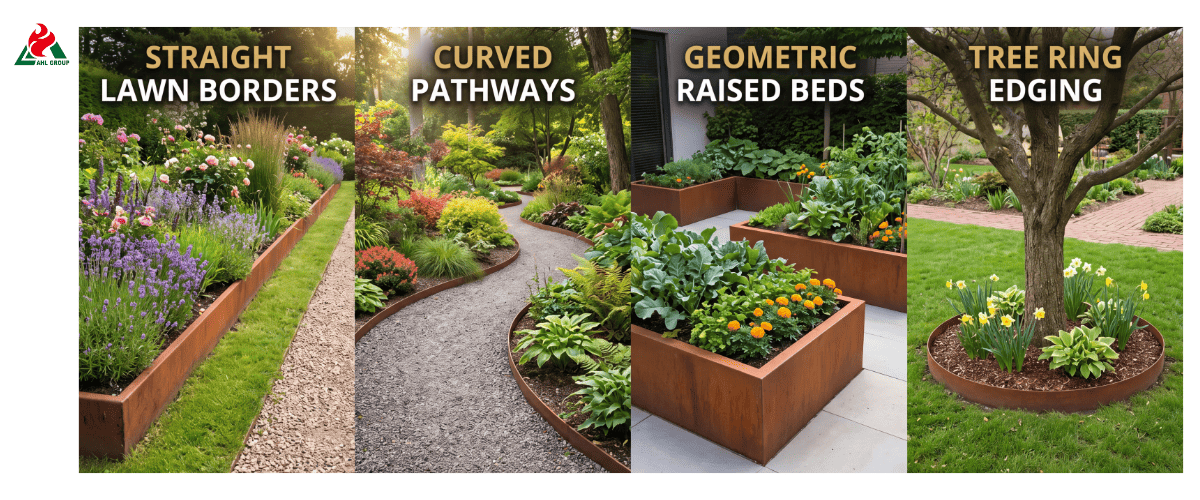
For landscaping projects, bendability is crucial because not every garden features a linear design. Curved planting beds, circular landscape elements, winding paths, and organic landscape layouts may require edging strips to follow specific bending radii. Selecting the appropriate thickness before installation can help avoid unnecessary cutting, twisting, or fabrication costs.
1. Introduction
Why Flexibility Is Essential for Corten Steel Edging
Landscape architects, hardscape contractors, and homeowners choose Corten edging for its rich patina, structural durability, and clean lines. However, real-world garden designs are rarely perfectly straight. Undulating flower beds, curved lawn edges, circular tree borders, and the contours of pathways all require edging materials that can adapt to natural curves. Understanding whether a specific steel sheet thickness—such as 3.0 mm (11-gauge steel)—can be bent on-site without specialized machinery is crucial for project planning, material estimation, and labor allocation.
This Guide Will Help You Make the Following Decisions
This guide provides practical advice on the installation of 3.0-millimeter Corten steel landscape edging. It covers the limits of manual bending, calculating minimum bending radii, step-by-step techniques for on-site operations, required tools, and how to achieve sharp 90° right angles as well as wide, flowing curves.
2. Can You Bend 3 mm Corten Steel Edging
Yes, 3mm Steel Can Be Bent by Hand Into a Gentle Curve
3.0mm weathering steel edging achieves an ideal balance between structural rigidity and manual formability. When working with standard strips ranging from 100 mm to 200 mm (4 to 8 inches) in height, installers can use the principle of leverage and their own body weight directly on-site to shape long sections of material into smooth, flowing curves.
Typical Minimum Bending Radius for 3-mm Steel Strips (Approx. 1 Meter)
For manual on-site bending without aids (i.e., without mechanical rollers or heat treatment), the recommended minimum continuous bending radius for 3.0-millimeter weathering steel is 1.0 meter (3.3 feet). If the metal is forcibly bent by hand beyond this limit, resistance increases exponentially and may result in uneven creases rather than a smooth curve.
When 3mm Steel Proves Too Rigid to Form Tight Curves
When a design calls for small tree rings (e.g., 600 mm in diameter / 300 mm radius) or tight serpentine bends (radius < 500 mm), unprocessed 3.0 mm flat steel is too rigid to be smoothly formed by hand. Failure to apply the appropriate leverage when applying force will result in localized buckling, wavy deformation of the top edge, or sudden slippage of the lever.
Comparison of 3MM, 2MM, and 4MM
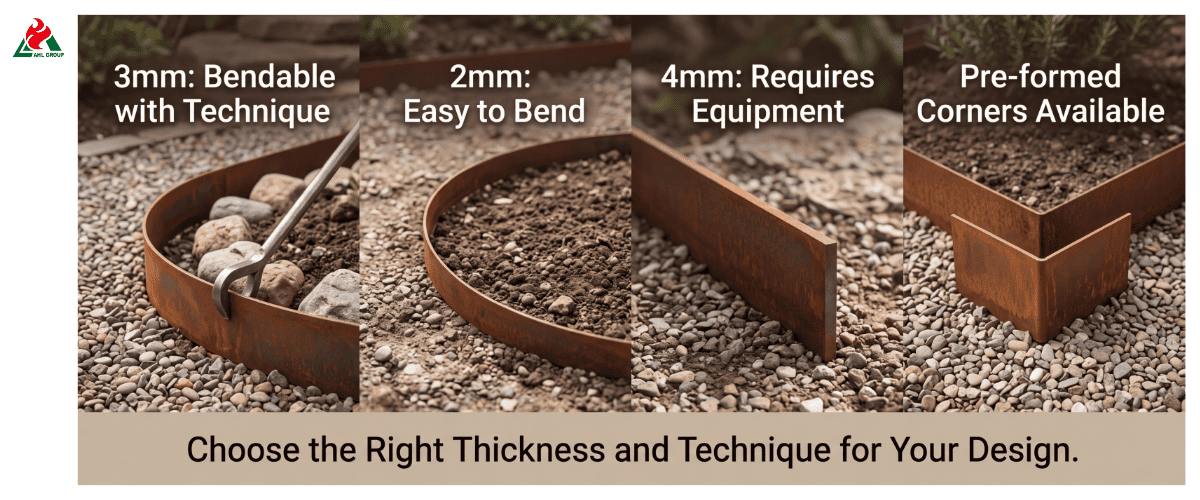
► 2.0 mm edging: Can be easily bent by hand to achieve a smaller radius of curvature (0.5 meters or more); however, they are prone to the “oil drum effect” (wavy deformation of the top edge) on straight sections and is more susceptible to deformation under heavy equipment loads.
► 3.0 mm edging: Maintains straight, smooth lines over long spans while offering sufficient flexibility to accommodate wide garden curves.
► 4.0 mm to 6.0 mm edging: Extremely rigid sheets. Manual bending on-site is nearly impossible; requires the use of a hydraulic sheet metal rolling machine or a factory-based bending machine.
3. Understanding Bend Radius and Curves
The Practical Significance of the Bending Radius
The bending radius is used to measure the curvature of bent strip material; it is calculated as the distance from the center of the arc to the inner surface of the steel plate. A larger radius indicates a gentler curve and greater curvature; conversely, a smaller radius indicates a tighter bend.
Recommended Radius for 3 mm Edge Folding (1 Meter and Above)
For standard landscaping projects, the radius of curves bent on-site should be maintained at 1.0 meter or greater (corresponding to a full circle diameter of 2.0 meters). At this scale, the steel undergoes smooth plastic deformation under gradual application of force, thereby maintaining a uniform curve without structural deformation of the top edge.
Sharp Bends (<0.5 Meters): Preforming or Factory-Bent Solutions
When project specifications require sharp bends (with radii between 0.2 meters and 0.5 meters), factory-preformed curved sections or mechanically roll-formed profiles should be specified. The fabrication shop uses a three-roll pyramid-type sheet metal bending machine to apply continuous pressure, bending 3.0-millimeter-thick steel into precise arcs without surface warping.
Large-Radius Curves (2 meters or more): 3 mm Thickness is Ideal
For gently curving lawn borders (with radii ranging from 2.0 meters to over 5.0 meters), 3.0-millimeter-thick weathering steel is the ideal material. When secured in place with wooden stakes, this steel naturally forms a smooth, continuous curve, thereby avoiding the minor creases commonly found in thinner metal materials.
How Height and Cross-Section Shape Affect Flexibility
The height of the garden edging’s cross-section significantly affects its resistance to bending. Compared to a steel strip of the same thickness but with a height of 200 millimeters (8 inches), a strip with a height of 100 millimeters (4 inches) is noticeably easier to bend, as the wider cross-section increases the structure’s ability to resist lateral deflection.
4. Manual Bending Techniques for 3 mm Edging
Using a Wooden Board as a Lever
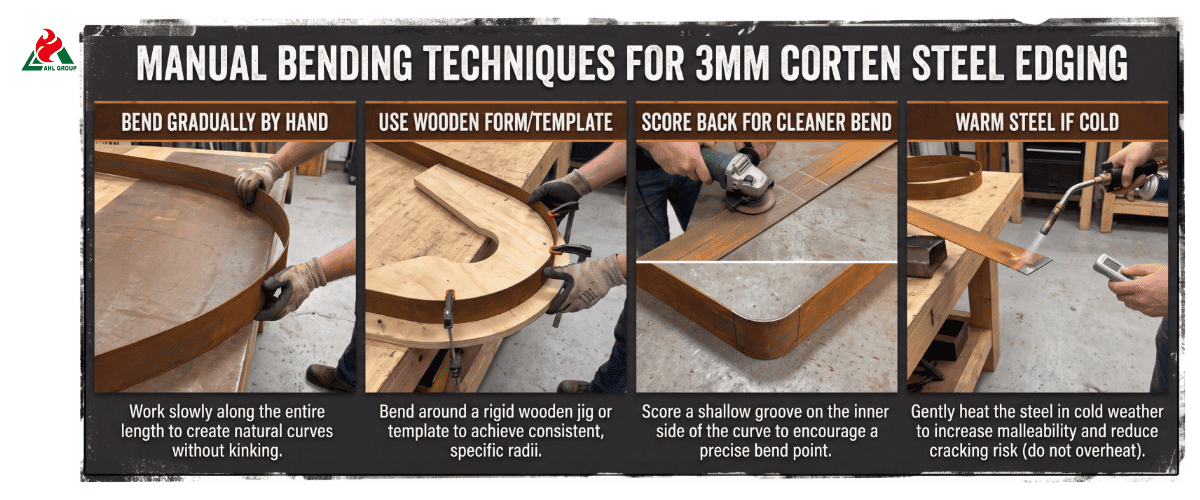
To neatly bend a 3.0 mm metal edging on-site without specialized tools, you can use a 2×4 or 2×6 wooden board as a bending lever. Insert one end of the steel strip under a fixed anchor point (such as between heavy wooden posts or under a vehicle tire), place the board flat against the free end of the steel strip, and then pull smoothly to distribute the force evenly along the entire arc.
Bend in Sections to Achieve a Smooth Curve
Avoid attempting to complete the entire bend at a single point, as this can cause localized creases. Instead, work in sections along the steel strip: first bend the strip slightly, slide your hands or the lever 100 millimeters down the strip, bend it again, and repeat this process along the entire section.
Secure the Curve with Ground Pegs and Rope
For wide, continuous curves, lay out the path directly on the ground:
► Drive heavy-duty steel ground stakes into the ground at 0.5-meter intervals along the desired curve.
► Position the 3.0-millimeter-thick Corten garden edging against the inner side of the ground stakes.
► Use a pry bar to press the steel strip firmly against each ground stake in sequence, and secure it with heavy-duty clamps or binding wire until permanent ground anchors are installed.
Rubber Mallet and Hand-Pressing Method
The hand-pressing method should be used for the main structural forming; heavy recoil-free hammers or rubber mallets should be used only for fine adjustments. Never strike untreated weathering steel directly with a steel sledgehammer, as the impact between metals will cause unsightly surface scratches that remain clearly visible even after rust forms.
Correcting Excessive Bends and Twists
If a section becomes unexpectedly bent:
► Flip the steel edging over so that the apex of the bend faces upward.
► Place a wooden block above the highest point.
► Apply firm, controlled downward pressure with your foot, or tap the wooden block lightly with a rubber mallet to flatten the excess bend.
5. Tools That Make Bending Easier
A Board or 2x4 Lumber as a Bending Lever
A 1.5-meter-long piece of dry, structural 2x4 lumber is one of the most effective tools for bending steel edge strips on-site. It provides leverage while protecting the metal surface from scratches and localized dents.
Rubber Mallet or Non-Rebound Hammer
A 2- to 3-pound non-rebound hammer efficiently transfers force without causing a rebound or damaging the steel surface, making it ideal for fine-tuning panel alignment along the groove line.
Wooden Stakes and Chalk Line
Before bending the steel, use a high-visibility construction chalk line and heavy-duty rebar stakes to mark the curve’s apexes, ensuring a smooth transition over long curved sections.
Pliers or Locking Clamps for Fine-Tuning
Heavy-duty locking C-clamps (Vise-Grips) can hold the ends of adjacent panels together while adjusting joint alignment, ensuring neat transitions between sections.
When to Use a Metal Bending Machine or Pipe Bender
When a project requires the fabrication of dozens of identical short-radius bends or sharp structural corners, manual on-site work becomes inefficient. Renting a portable hydraulic tube or sheet-metal bender, or sending the steel to a sheet-metal fabrication shop, can save a significant amount of installation time.
6. Creating Angles and Sharp Bends
Method for Notching 90° Corners
To create a clean 90° corner on a 3.0 mm-thick Corten metal edging without completely cutting the strip in half, use the V-notch method:
► Mark the inner corner line on the back of the edge strip.
► Using an angle grinder equipped with a 1-millimeter cutting disc, cut a vertical V-shaped groove along the inner corner line to a depth of 75% of the steel’s thickness (approximately 2.2 millimeters), while keeping the outer surface intact.
► Bend the steel strip by hand toward the slotted side to form a precise 90° corner.
Precision Angle Cutting and Welding
For structural retaining edges subjected to significant earth pressure, cut the edge strip completely through at the required angle, chamfer the joint edges, and weld them together using a compatible weathering-steel welding wire (such as AWS E7018-W or ER80S-W).
Using Prefabricated Corner Fittings
Many manufacturers offer prefabricated inside and outside corner fittings equipped with interlocking connection sleeves. Using prefabricated corner fittings speeds up installation and eliminates the need for on-site cutting.
Preventing Stress Cracks in Sharp Bends
Cold bending a 3.0 mm-thick steel plate with an excessively small bending radius may cause microcracks to form on the outer tensile surface. To prevent cracking, ensure that the inner bending radius is at least equal to the steel plate thickness (1t = 3.0 mm).
Finish Cut Edges to Prevent Rust Stains
After cutting or grinding weathering steel, use a flap wheel (80-grit) to smooth out sharp burrs. Removing loose metal debris prevents premature rust runoff from staining adjacent pavers or concrete patios.
7. Pre-Formed vs Field-Bent 3 mm Edging
When to Purchase Pre-bent Profiles
When your landscape design requires precise geometric shapes—such as the perfect circle needed for a tree ring, a tight 90° bend, or a uniform circular flower bed—and these shapes are difficult to achieve consistently by hand, choose pre-bent profiles.
Factory-Pre-bent Arcs and Circles
Factory roll-bending machines apply uniform hydraulic pressure along the entire length of the profile, producing smooth, precise circles and arcs with no straight sections at the ends and no edge distortion.
On-Site Bending for Custom Curves
On-site bending is the preferred method for creating organic, irregular landscape lines. It allows installers to adjust the curve at any time, tailoring the boundary to the site’s topography, tree roots, and existing hardscape.
Advantages and Disadvantages of Each Method
► Advantages of on-site bending: Compact shipping size (flat strips), maximum layout flexibility, and lower material procurement costs.
► Disadvantages of on-site bending: Requires manual labor and is limited to larger radii of curvature (>1.0 meters).
► Advantages of preformed products: Ready for immediate installation, perfect geometric accuracy, and easily accommodates small radii of curvature.
► Disadvantages of preformed products: Higher shipping costs due to volume-based pricing and zero flexibility for on-site adjustments.
Cost and Time Considerations
Although the price of flat, unbent sheet metal is 15% to 30% lower than that of pre-bent profiles, on-site labor costs must be taken into account. For large-scale commercial projects involving numerous consecutive sharp bends, pre-bent profiles are generally more cost-effective overall.
8. Common Mistakes When Bending 3 mm Corten
Attempting to Bend a Curve with an Excessively Small Radius by Hand
Without mechanical assistance, attempting to bend a 3.0-millimeter-thick weathering steel edging lawn into a circular arc with a radius of 0.4 meters will cause a concentration of force, resulting in sharp, irreversible creases that damage the smooth contour of the steel strip.
Bending Too Quickly Causes Creases
Applying sudden and excessive force creates localized stress points. Always move continuously along the strip while applying smooth, gradual pressure to ensure the bending force is distributed evenly.
Ignoring the “Springback” Effect
Like all high-strength low-alloy (HSLA) steels, weathering steel exhibits elasticity. When the force is released, the bent steel strip will spring back by approximately 10% to 15%, returning to its original flat shape. During the initial forming process, this springback effect should be pre-compensated by slightly increasing the bend radius.
Excessive Bending Causes Surface Cracking
Repeated bending at the same point causes work hardening in the steel alloy, thereby weakening its structural strength and leading to surface cracking or complete fracture along the bend line.
Failure to Secure Bent Sections During Installation
Tension remains within the bent steel. If ground anchors are spaced too far apart or installed in soft soil, the steel will gradually push outward over time, causing the lines of your garden design to become distorted.
9. Installation Tips After Bending
Position the Curve Before Final Fixation
Dig a narrow trench that aligns with the planned layout, place the curved 3.0-millimeter weathering steel border into position, and inspect the curve from multiple angles before driving in the permanent ground stakes.
Secure with Ground Pins or Sleeves
On straight sections, install a heavy-duty weathering steel ground pin every 0.8 to 1.0 meters; on curved sections, reduce the spacing to 0.4 to 0.5 meters to counteract internal springback tension and soil pressure.
Maintain a Consistent Radius Throughout the Curved Section
Use a simple radius template (such as a thin string tied to a center pin) to check whether the installed edge strips maintain a consistent radius throughout the curved section.
Neatly Connect Curved Sections
Connect adjacent edging borders using overlapping joint sleeves or interlocking connectors, secured with flush-mounted weather-resistant steel fasteners, to ensure a smooth transition between panels.
Check Alignment and Levelness
During installation, place a long level across the top edges of adjacent panels. Ensure that the edge strips remain vertical and are at a consistent height above the ground to prevent tripping hazards and maintain clean visual lines.
10. When to Choose a Different Thickness
2 mm: Ideal for Extremely Tight Curves and Complex Shapes
If your landscape features intricate, meandering curves, small circular tree borders (diameter < 1.0 meter), or complex geometric shapes, 2.0 mm (14 gauge) weathering steel not only significantly simplifies the manual shaping process but also ensures a long service life.
3 mm: Ideal for Curves and Straight Sections in Most Residential Areas
3.0 mm (11 gauge) steel is the gold standard for high-quality landscape edging. It offers sufficient structural strength to withstand foot traffic, lawnmower traffic, and soil movement, while remaining flexible enough to be bent on-site into wide, flowing curves.
4–6 mm: Ideal for Heavy-Duty or Less Curved Designs
For structural terraces, heavy-duty retaining walls, or high-traffic public parks, choose weathering steel sheets ranging from 4.0 mm to 6.0 mm. Please note that these thicker profiles require factory mechanical rolling when creating curved designs.
Selecting the Appropriate Thickness Based on Design Intent
The appropriate material thickness should be selected based on functional requirements and visual appeal. A 2.0-millimeter thin edging creates a delicate and refined effect, while profiles ranging from 3.0 to 5.0 millimeters can define bold and striking architectural lines.
Balancing Flexibility and Rigidity
When balancing the need for easy manual bending with the requirement for long-term structural straightness, 3.0-millimeter weathering steel performs best in both commercial and residential landscape installations.
.png)
11. FAQs
Q1: Can 3 mm Corten Steel Edging Be Bent by Hand?
Yes. 3.0 mm Corten Steel Edging can be bent by hand on-site using basic leverage principles to form wide arcs with a radius of 1.0 meter (3.3 feet) or greater.
Q2: What is the Minimum Bending Radius for 3-millimeter Weathering Steel?
For on-site bending without auxiliary tools, the recommended minimum radius is 1.0 meter. Attempting smaller manual bends without mechanical tools or prior slotting may result in localized creases and edge deformation.
Q3: Can 3 mm Edging Strips Be Used to Create Tight Circles?
This cannot be achieved by hand alone. To create small, tree-ring-shaped or tight circles (with a diameter less than 1.0 meters) using 3.0mm steel, factory roll forming, notching on the back, or switching to 2.0mm steel is required.
Q4: Do I Need Specialized Tools to Bend 3-Millimeter Weathering Steel?
For gentle curves, no specialized tools are needed—a 2×4 wooden pry bar, ground stakes, and your own body weight are sufficient. For sharp 90° corners, you’ll need an angle grinder equipped with a thin-cutting grinding wheel to create a V-groove.
Q5: Will Bending 3 mm Weathering Steel Cause Cracks?
Smooth, manual bending with a large radius of curvature will not cause weathering steel to crack. Cracks only occur when the metal is cold-bent to an extremely small radius of curvature (inner radius less than 1t) or when it is repeatedly bent at the same location, causing work hardening of the alloy.
Conclusion: A Comprehensive Guide to Bending 3 mm Corten Steel Edging
3.0mm Corten steel landscape edging can be successfully bent on-site to meet the needs of custom landscape installations. It possesses sufficient flexibility to form smooth, flowing curves with a radius of 1.0 meter or greater using simple leverage techniques, while still maintaining the structural strength necessary to retain its straight shape when subjected to soil pressure and impact from equipment.

