


Selecting the right material for structural planters is a critical decision when designing high-end gardens, outdoor patios, or commercial landscapes. Planters are not merely containers for soil; they are fundamental architectural components that must withstand constant moisture, soil pressure, UV exposure, and harsh freeze-thaw cycles. Among the premium options available on the market, Corten steel planters have become an iconic element in high-end modern and naturalistic design schemes.
However, the initial investment in weathering steel is significantly higher than that of traditional alternatives such as wood, plastic, fiberglass, or ordinary carbon steel. This comprehensive analysis aims to evaluate whether the long-term value, lifespan, and low-maintenance characteristics of weathering steel planters truly justify their high upfront cost.
.png)
However, the initial investment in weathering steel is significantly higher than that of traditional alternatives such as wood, plastic, fiberglass, or ordinary carbon steel. This comprehensive analysis aims to evaluate whether the long-term value, lifespan, and low-maintenance characteristics of weathering steel planters truly justify their high upfront cost.
1. Short Answer
When Is It Worth Choosing Corten Steel Planters
For permanent residential properties, high-traffic commercial spaces, public plazas, and urban development projects where long-term durability is a key criterion, Corten planters are undoubtedly a worthwhile investment. If your project has a lifespan of more than five to ten years, the structural integrity and self-healing properties of weathering steel mean you may never need to replace the planters. This permanently eliminates future labor and material procurement costs.
When They May Not Offer the Best Value for Money
Conversely, for short-term rental properties, temporary retail pop-up stores, seasonal exhibitions, or projects with extremely tight initial capital budgets, Corten outdoor planters may not be cost-effective. Additionally, if the installation environment requires frequent adjustments to the planter layout, indoor relocation during winter, or installation on cantilevered balconies with limited load-bearing capacity, lighter and more economical materials such as aluminum or structural fiberglass are more practical in terms of cost-effectiveness and structural suitability.
A Quick Summary for Busy Readers
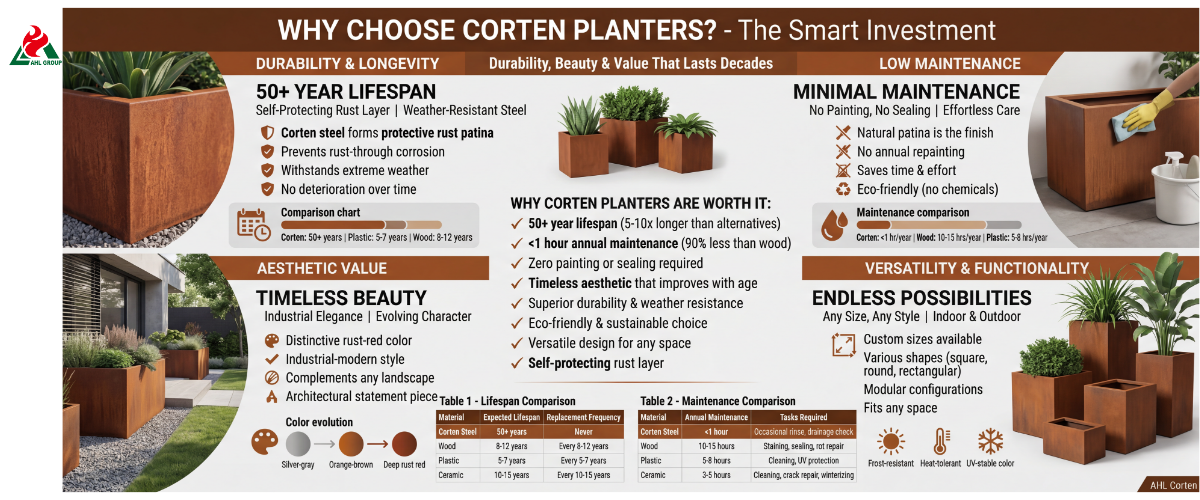
Although the initial cost of Corten metal planters is significantly higher than that of wood or synthetic plastic products, their lifespan can exceed that of these materials by decades. Because a self-protective layer of iron oxide rust forms on the surface, preventing internal corrosion, ongoing maintenance costs such as painting, sealing, or moisture protection are eliminated. Over a 15- to 20-year lifespan, the total cost of ownership (TCO) for weathering steel planters is lower than that of virtually any other planter material on the market.
2. Why Corten Planters Cost More
To understand why weathering steel is so expensive, one must analyze its raw material composition, metallurgical processes, and the industrial complexities involved in manufacturing these heavy-duty vessels.
Materials and Manufacturing Costs
Weathering steel is not ordinary carbon steel. It is a highly specialized alloy containing precise proportions of copper, chromium, nickel, and phosphorus. These alloying elements increase costs for steel mills during raw material extraction and processing. Furthermore, the production of weathering steel requires industrial-grade machinery, specialized welding wire compatible with the steel’s weathering properties, and highly skilled technicians—who must know how to maintain the material’s resistance to chemical corrosion during the welding process.
Thicker Steel, Greater Durability
Inexpensive retail planters are typically stamped from ultra-thin 20- to 24-gauge steel sheets, which quickly warp, dent, and rust through once filled with heavy, wet soil. In contrast, professional-grade Corten garden planters are manufactured from thick-gauge steel sheets—typically 2 mm (14-gauge) to 3 mm (11-gauge) thick. This substantial wall thickness provides exceptional structural strength, preventing the sides from bending and seams from splitting even when subjected to immense outward pressure from compacted soil and expanding root systems.
Design and Surface Finish Quality
Premium Corten planters feature an internally reinforced design with fully welded corners that are seamlessly polished and a solidly folded top edge to ensure maximum structural rigidity and safety. Many commercial-grade products also come equipped with integrated legs to elevate the base, thereby facilitating optimal drainage and irrigation layout—a feature that adds complexity and cost to the initial manufacturing process.
3. Long-Term Value vs Upfront Price
To assess the true value of weathering steel, property owners or landscape architects must shift their focus from the initial retail price to a long-term amortization model spanning decades.
Lifespan Compared to Wood, Plastic, and Ordinary Steel
The typical lifecycle of materials used for outdoor planters highlights a stark contrast in durability:
► Pressure-treated wood: After 5 to 8 years, fungal decay, warping, and moisture absorption lead to compromised structural integrity.
► Standard plastic: After 3 to 6 years, UV radiation causes the polymer to become brittle, leading to powdering, cracking, and further breakage under frost pressure.
► Mild steel: After 2 to 5 years, gradually spreading flaky rust triggers pinholes, structural blistering, and ultimately bottom failure.
► Weathering steel: 30 to 50 years or more. Its dense surface rust layer blocks deep penetration of oxygen and moisture, protecting the internal structural core virtually indefinitely.
Lower Long-Term Maintenance Costs
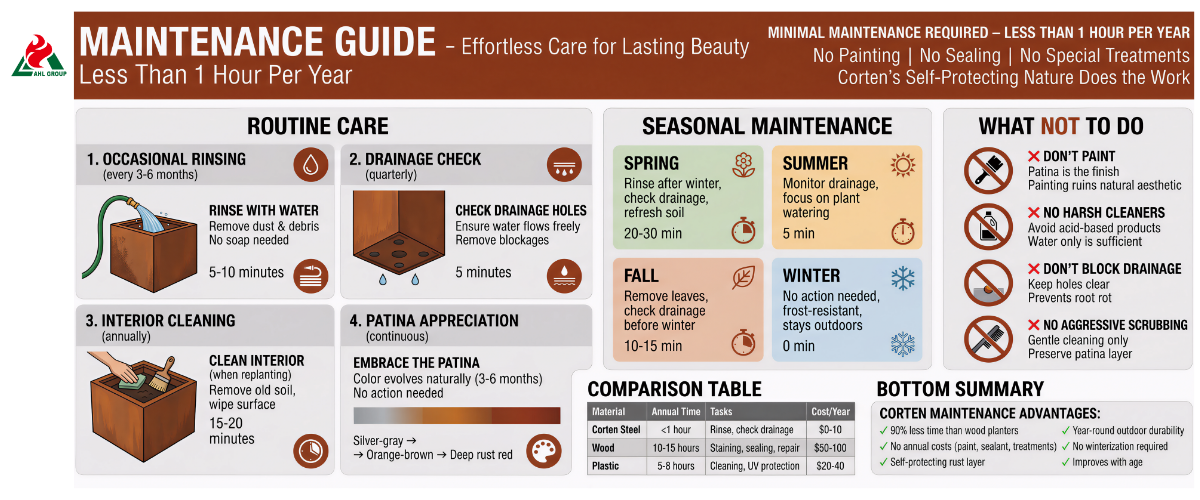
Every alternative material incurs ongoing operational costs. Wood requires pressure washing and drying twice a year, followed by the application of toxic sealants or oil-based stains. Standard steel requires wire-brushing, priming, and high-temperature exterior painting to cover rust spots. Weathering steel eliminates these labor and material costs; its protective properties are built into the steel’s own metallurgical structure.
Replacement Costs vs. Total Life Cycle Costs
Consider a 15-year landscape design project and its total life cycle costs. Low-cost wooden or plastic planters may require purchase, transportation, filling with soil, and planting during this period, followed by emptying and replacement three times.
When factoring in the cumulative cost of replacing flower pots, additional shipping fees, labor costs for transplanting mature plants, and disposal fees for damaged pots, a one-time purchase of a permanent Corten steel landscape planter is clearly the more cost-effective choice.
4. Maintenance Savings Over Time
The design philosophy behind weathering steel can be summarized as “structural passivation.” It is a material specifically designed for outdoor environments that remains in good condition even without maintenance.
No Painting or Sealing Required
Traditional metal products require continuous application of surface coatings to survive in outdoor environments. However, the naturally formed iron oxide rust layer on weathering steel serves as its protective coating. This means you don’t need to sand off peeling paint, apply zinc-rich primers, or perform cosmetic repairs. This material is chemically engineered to maintain its original, authentic, exposed state at all times.
Less Rotting, Cracking, or Warping
In winter, saturated soil expands significantly when it freezes. This frost heave exerts tremendous outward pressure on the inner walls of planters. Brittle plastics and fiberglass are prone to cracking under such stress, while wooden joints can come apart, causing screws to loosen and glue lines to break. Heavy-gauge weathering steel possesses high tensile strength and elasticity, allowing it to absorb these thermal expansion stresses without structural deformation or cracking.
Minimal Cleaning Effort Compared to Other Materials
Synthetic planters, especially white or light gray fiberglass and plastic products, immediately show environmental grime, hard water mineral stains, algae growth, and soot, requiring frequent scrubbing with chemical cleaners. Weathering steel’s mottled, textured, naturally dark brown surface naturally masks dirt, dust, and organic matter; a quick rinse with a garden hose once a year is all that’s needed to remove surface debris.
5. Where Corten Planters Make the Most Sense
Under specific environmental conditions and in architectural applications, the structural advantages and return on investment of weathering steel are fully realized.
Permanent Residential Gardens
For homeowners building their dream homes or investing in permanent backyard renovations, Corten modern planters serve as the foundational anchors of hardscape design. They define clean geometric forms, accentuate the lines of modern architecture, and create a unified design language that complements the property’s mature trees and structural greenery, gracefully revealing their unique character over time.
Commercial Landscapes
Public squares, corporate campus entrances, and street-side dining patios are high-traffic areas prone to accidental pedestrian collisions, runaway shopping carts, and severe vandalism, and they are constantly exposed to harsh de-icing salts. Under such physical stress, thin plastic or softwood materials deteriorate rapidly. Thanks to its extremely high structural density and self-healing properties, Corten steel is virtually indestructible in public spaces.
Roof and Courtyard Projects
Installing large planters on elevated rooftop terraces or deep within enclosed courtyards involves complex and costly logistics—typically requiring crane rentals, road closure permits, and significant manual labor. Replacing a damaged planter on a 20th-floor rooftop terrace would impose a significant financial burden. Therefore, for developers and structural engineers, selecting a “build-it-right-the-first-time” material like Corten steel is a critical risk management decision.
6. When a Lower-Cost Planter May Be Better
Although weathering steel is an exceptional material, it is not a one-size-fits-all solution for every landscape design scenario.
Short-term or Seasonal Use
If you are designing a temporary exhibition garden for a trade show, setting up a seasonal pop-up patio for a restaurant, or staging a home for a quick sale, you will not be able to benefit from the long-term lifecycle cost savings that weathering steel offers. In these cases, low-cost rotomolded plastic or lightweight, pressure-treated pine planters are better suited to the project’s short timeframe.
Weight-Restricted Environments
Weathering steel is extremely heavy. A large rectangular Corten steel planter can easily weigh over 100 pounds before a single scoop of soil or a potted plant is added. If you are designing for residential balconies, aging wooden decks, or historic rooftop terraces with strict structural dead-load limits, the substantial mass of heavy-gauge steel may exceed engineering parameters. In these weight-sensitive applications, marine-grade aluminum alloy or structural fiberglass materials should be used instead.
7. What Affects Cost-Effectiveness
To ensure you get the best value when purchasing weathering steel, you must carefully review the manufacturing specifications and structural details.
► Steel Plate Thickness: Ensure that the steel plates you purchase are at least 2 millimeters thick. Any thinner plates (such as imported products that are 1 millimeter or 1.5 millimeters thick) will bend outward under the weight of soil and may rust through completely within a decade, thereby losing their value.
► Internal Structural Reinforcement: Large rectangular or square planters longer than 3 feet must be equipped with internal steel struts or welded cross-braces to counteract the significant weight of wet soil. Without these reinforcements, the straight walls will gradually deform, becoming bulged and rounded.
► Internal Insulation: In regions with extreme summer heat or winter cold, uninsulated metal walls directly transmit sudden temperature changes to delicate plant roots. Choosing containers lined with insulating foam panels protects root health, thereby reducing the cost of replacing plants.
.png)
8. Comparing Corten with Other Materials
A direct comparison of Corten steel with similar materials makes it clear why it holds a leading position in modern landscape design standards.
| Material | Initial Cost | Expected Lifespan | Maintenance Level | Primary Structural Vulnerability |
| Corten Steel | High | 30 to 50+ Years | Near Zero | Minor superficial runoff staining in year one |
| Treated Wood | Low | 5 to 8 Years | High (Staining/Sealing) | Fungal rot, splitting, and joint pull-out |
| Powder-Coated Aluminum | High | 20 to 30 Years | Very Low | Deep surface scratches can expose bare metal |
| Fiberglass | Moderate | 8 to 12 Years | Low | Micro-cracking from severe frost expansion |
| Rotomolded Plastic | Very Low | 3 to 6 Years | Low | Polymer degradation and fading from UV light |
9. Hidden Costs to Consider
Any assessment of the actual investment required for Corten flower pots must take into account the surrounding installation infrastructure.
Preventing Rust-Stained Water Runoff
During the first 6 to 12 months of exposure to the atmosphere, loose iron oxide particles on the metal surface will be washed away with every rainfall. This rust-stained water runoff can permanently stain porous hardscape materials, such as light gray limestone, white concrete pavers, marble tiles, or light-colored wooden decks.
To avoid the high costs of restoration—such as chemical acid washing or replacing contaminated paving stones—the expense of installing a dedicated drainage system must be factored in. This may include placing the planters on a dark river pebble base, integrating concealed plastic drip pans, or using industrial-grade chemical rust accelerators to lock in the surface finish before final installation.
Structural Drainage and Base Preparation
Since Corten steel planter pots subjected to prolonged standing water can cause root asphyxiation and accelerate localized metal corrosion, the installation base must be professionally designed. This requires constructing a level, compacted base of crushed stone or gravel, using raised structural feet to elevate the drainage holes, and laying high-quality geotextile fabric and coarse-grained drainage aggregate on the interior base surface.
10. How to Decide If It Is Worth It
Before approving an order for luxury durable steel planters, landscape architects and property owners should answer the following three key questions to confirm that the structural layout is appropriate:
► What is the actual lifespan of this landscape design? If the answer is more than 8 years, weathering steel offers greater economic advantages than wood or plastic when considering its lifecycle amortization costs.
► What are the surrounding hardscape materials? If the installation site is directly on top of high-quality, light-colored natural stone pavers, are you prepared to construct a gravel drainage path or use pre-weathered steel to address initial rust bleeding during the first year?
► What is the long-term maintenance budget? If you are designing for a commercial facility or a residential client who requires a completely passive, low-maintenance outdoor environment (with no periodic painting or sealing costs), Corten steel is the material of choice.
Conclusion: A Definitive Assessment of the Value of Corten Steel Planters
Although the higher upfront cost of weathering steel planters may seem surprising at first glance, this is precisely a classic case of “spend now, save later”—by investing in this durable engineering material upfront, you avoid future replacement and maintenance costs. This is an investment that adheres to the principles of architectural durability, transforming your outdoor planters from short-lived consumer goods into permanent, structural hardscape assets. When integrated into permanent, high-end modern residential designs, high-traffic commercial developments, public parks, and logistically complex rooftop installations, the high initial cost is well worth it—because in these scenarios, replacing damaged synthetic materials would incur astronomical labor costs.
When purchasing Corten metal planters, avoid products that compromise on plate thickness by using ultra-thin, low-cost consumer-grade variants. Prioritize professional commercial-grade manufacturers who use 2 mm to 3 mm thick weathering steel sheets, perform fully continuous internal structural welding, and offer structural reinforcement options. By investing upfront in a genuine industrial-grade weathering steel structural planter, you will acquire a timeless, natural, self-healing centerpiece for your garden that will grow more beautiful, richer in color, and more refined in structure over the coming decades.

