


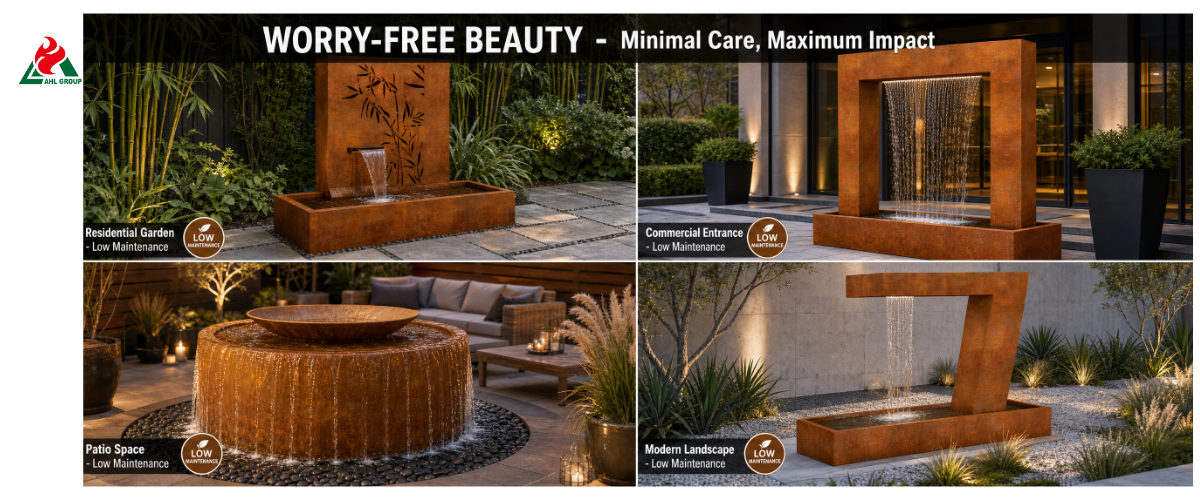
The visual appeal of Corten steel water features is undeniable. The flowing, translucent water contrasts beautifully with the rugged, industrial orange texture of the weathering steel, creating a visual focal point that is both rustic and avant-garde. However, for many property owners and landscape architects, one lingering question remains: Does that layer of “rust” signal an impending maintenance nightmare?
Conventional wisdom holds that metal and water are natural enemies, inevitably raising concerns about constant scrubbing, leaks, and structural corrosion. But in the realm of high-performance metallurgy, weathering steel operates by a different set of rules. This in-depth guide will cut through the fog and reveal the technical truths behind weathering steel water features. We will explore why these landscapes are actually among the lowest-maintenance options on the market, and how to properly manage the critical “settling-in period” to ensure their beauty endures over time.
Conventional wisdom holds that metal and water are natural enemies, inevitably raising concerns about constant scrubbing, leaks, and structural corrosion. But in the realm of high-performance metallurgy, weathering steel operates by a different set of rules. This in-depth guide will cut through the fog and reveal the technical truths behind weathering steel water features. We will explore why these landscapes are actually among the lowest-maintenance options on the market, and how to properly manage the critical “settling-in period” to ensure their beauty endures over time.
1. Short Answer: LOW (15 Min/Year After Setup)
One of the most surprising aspects of Corten steel water fountains is that they are essentially “passive” systems. Unlike painted steel or wooden water features, which require active maintenance to prevent environmental erosion, Cor-Ten steel relies on the environment itself to form a protective layer. Once the initial weathering process is complete, virtually no manual maintenance is required to keep the water feature fully functional and aesthetically pleasing.
Reality vs. Common Misconceptions
The most common misconception is that rust on Corten steel landscape features is a sign of failure. In ordinary carbon steel, the rust layer is porous and prone to flaking, trapping moisture that leads to “pitting” and eventually holes. In weathering steel, however, the rust layer is a dense, amorphous layer of iron oxide known as “patina.” This patina is virtually impermeable to water and acts as a permanent, self-healing sealant. While owners of other landscape elements are busy sanding and repainting, owners of weathering steel need only watch as its color deepens over time. So-called “maintenance” has been replaced by “natural evolution.”
Corten vs. Traditional Materials Comparison
Compared to stone, fiberglass, or stainless steel, weathering steel offers unique maintenance characteristics. Stone components are prone to cracking due to freeze-thaw cycles and typically require specialized chemical cleaners to remove algae from their porous surfaces. Although fiberglass is lightweight, it gradually deteriorates under UV exposure and becomes brittle after 10 to 15 years. Stainless steel, while durable, requires constant wiping to remove “tea stains” (surface oxidation) and fingerprints in order to maintain its “clean” appearance. Weathering steel, on the other hand, is the exact opposite—the more it is exposed to the elements, the stronger its protective layer becomes.
Why the Term “Low-Maintenance” Is Accurate
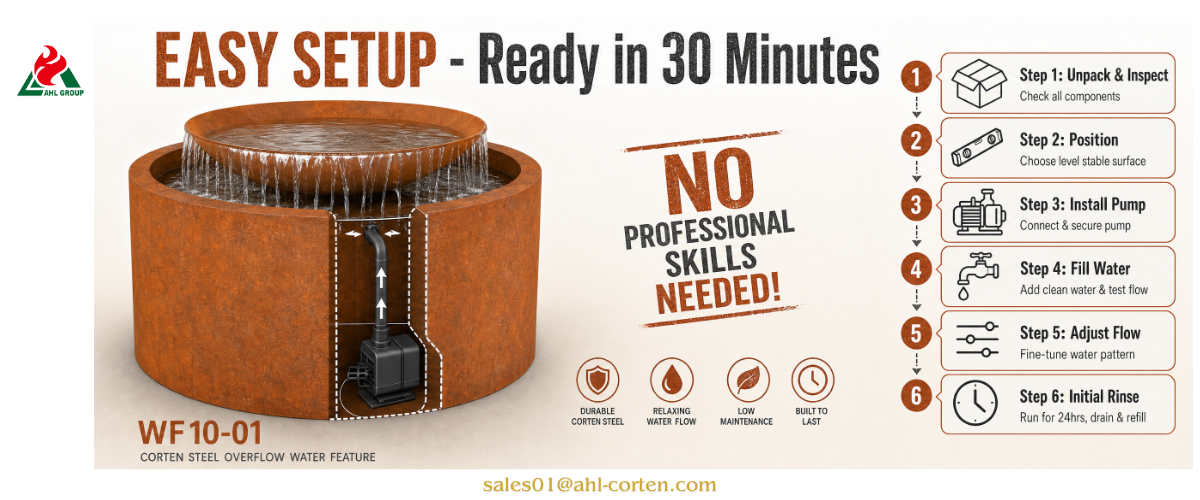
We classify weathering steel as “low-maintenance” because it eliminates the most expensive and time-consuming task in outdoor landscaping: surface refinishing. No painting, no stripping of old paint, and no chemical sealing. The 15 minutes of annual maintenance we refer to is almost entirely focused on mechanical components (pumps and filters), not the steel itself. As long as you know how to use a garden hose and a screwdriver, you have all the skills needed to maintain a professional-grade Corten steel water wall or bowl.
2. Why People THINK They're High Maintenance
The “fear” surrounding Corten outdoor water features often stems from a misunderstanding of the chemical and physical interactions between this alloy and water. Because the material exhibits a “weathered” and “aged” appearance from the very beginning, people often mistakenly believe it is rapidly deteriorating.
Misconception 1: “Rust = Constant Cleaning”
People often assume that since the surface is rusted, it must be “dirty” or “dusty.” They worry that touching the water feature will stain their clothes with orange marks, or that rust will constantly “flake off” onto the surrounding area. While this is indeed the case during the first few months (the “bleeding” phase), the mature rust layer is highly stable. Once the oxide layer forms a dense structure, it does not easily flake off. You are not “cleaning” the rust; you are simply allowing the steel to exist naturally.
Misconception 2: “Water = Continuous Corrosion”
In conventional piping systems, water is the enemy of steel. However, weathering steel was originally developed for heavy industry (such as shipping containers and bridges) and was specifically designed to withstand cycles of wet and dry conditions without the need for protective coatings. When used in water features, the steel is typically 3 millimeters thick or thicker. Even when calculated based on standard atmospheric corrosion rates, it would take over a century for the steel to compromise the structural integrity of the pool. This “corrosion” is controlled and intentional, and eventually becomes a stasis.
Myth 3: "Outdoor = Always Dirty"
It is commonly believed that orange highlights every speck of dust, fallen leaf, or bird droppings. In reality, the textured, mottled surface of the rusted layer serves as the perfect camouflage. Unlike smooth black granite or shiny stainless steel walls—which reveal every water stain and speck of dust—Corten steel’s vibrant texture blends seamlessly with the debris in its surroundings. It is the only material that actually becomes more beautiful as it takes on a slightly “weathered” appearance.
3. Actual Annual Maintenance Breakdown (15 Minutes)
To put the “15-minute” claim to the test, let’s take a look at the actual physical work involved. We’ve broken these tasks down into a “time budget” that any busy homeowner can easily manage.
Monthly Tasks (2 minutes)
The main monthly task is a “visual debris check.” This takes 60 seconds to inspect the Corten water bowl or “drainage hole” to ensure no large leaves or twigs are blocking the flow. If your water feature is a “bubble bowl” type, you may also need to spend another 60 seconds topping off the water to compensate for evaporation. Total: 2 minutes of passive observation and minor adjustments.
Quarterly Task (5 minutes)
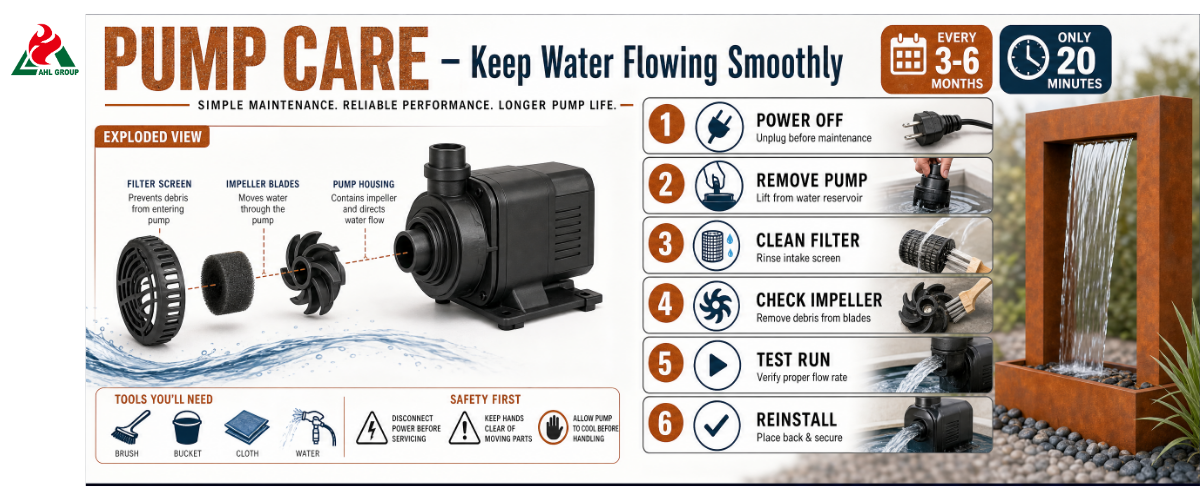
It’s a good idea to rinse the pump filter every three months. Most water feature pumps are housed in a pre-filter cage. Simply reach into the water, pull out the pump (or open the pump compartment), and rinse the foam filter with a garden hose to remove fine silt. This prevents the motor from overloading and keeps the water flowing clear and unobstructed.
Seasonal Deep Cleans (8 Minutes)
Once a year, usually in the spring, you should perform a “deep clean.” This doesn’t mean scrubbing your stainless steel sink! Instead, drain the water, use a wet/dry vacuum or a bucket to remove any sludge that has accumulated at the bottom of the sink, and then refill it with fresh water. This prevents mineral deposits caused by water evaporation, thereby keeping the water from becoming “hard.” Total time: 8 minutes (hands-on time); the rest of the time is spent waiting for the water to refill automatically.
4. Corten Steel Water Feature Maintenance Schedule
| Interval | Task | Purpose | Time |
| Weekly | Water Level Check | Prevent pump from running dry | 30 Sec |
| Monthly | Debris Removal | Maintain clear water flow | 2 Min |
| Quarterly | Pump/Filter Rinse | Extend pump lifespan | 5 Min |
| Annually | Basin Flush | Refresh water chemistry | 8 Min |
5. First-Year Special Care (30 Min Total)
Although long-term maintenance is minimal, the first year is considered an “investment period.” During this time, the steel is at its most chemically active.
Weeks 1–12: Heavy Rust Leaching Period
When you first add water, the steel will undergo a “leaching” process. Rainwater and the splashing of the water itself will wash away loose iron oxide. This orange-colored water may stain porous pavers or light-colored stone. During this phase, you may need to spend 5 minutes every few weeks hosing down the surrounding patio to prevent permanent staining. Pro tip: Use a temporary “drip tray” or a gravel border during this phase to collect the orange water.
Month 3: Patina Stabilization
By the third month, the “bright orange” color will turn into a “burnt orange” or brownish hue. As the oxide layer becomes denser, the amount of rust seeping out will decrease significantly. At this stage, your primary task is to check the water clarity. Due to the large amount of iron dissolved in the water, the water in the basin may appear cloudy. Perform a water change during the third month; as the “iron leaching” slows down, the water clarity will return.
Month 6: Mature, Low-Maintenance Phase
After six months of wet-dry cycles, the rust layer has essentially “cured.” At this point, the rust layer is no longer soluble in water and will not shed large amounts of rust. You can now remove the temporary protective layer from the paving stones. From this point on, the steel enters “maintenance-free” mode, and you need only monitor the operation of the mechanical pump.
6. Pump Maintenance (The REAL Factor)
If a Corten water feature “breaks down,” in 99% of cases, the problem lies not with the steel but with the pump. The pump is the heart of the system, and its lifespan depends entirely on how well you maintain it.
LED Submersible Pumps: 5-Year Service Life
Modern submersible pumps are extremely robust and durable. Most models are rated for continuous operation between 20,000 and 30,000 hours. However, the heat generated by LED lights (if integrated) can place additional strain on electronic components. To ensure a 5-year service life, never allow the pump to run dry or with insufficient water levels, as water serves as a critical cooling medium for the motor.
Flush the Filter Monthly = 10-Year Lifespan
The “silent killers” of water pumps are calcium deposits and sludge. If the impeller (the rotating part) is forced to operate in sandy water, the bearings will wear out. By flushing the filter monthly, you can ensure that the internal mechanical components remain “friction-free.” A clean water pump can easily last 10 years or longer, which will significantly reduce replacement and labor costs.
Winter Storage = 20-Year Lifespan
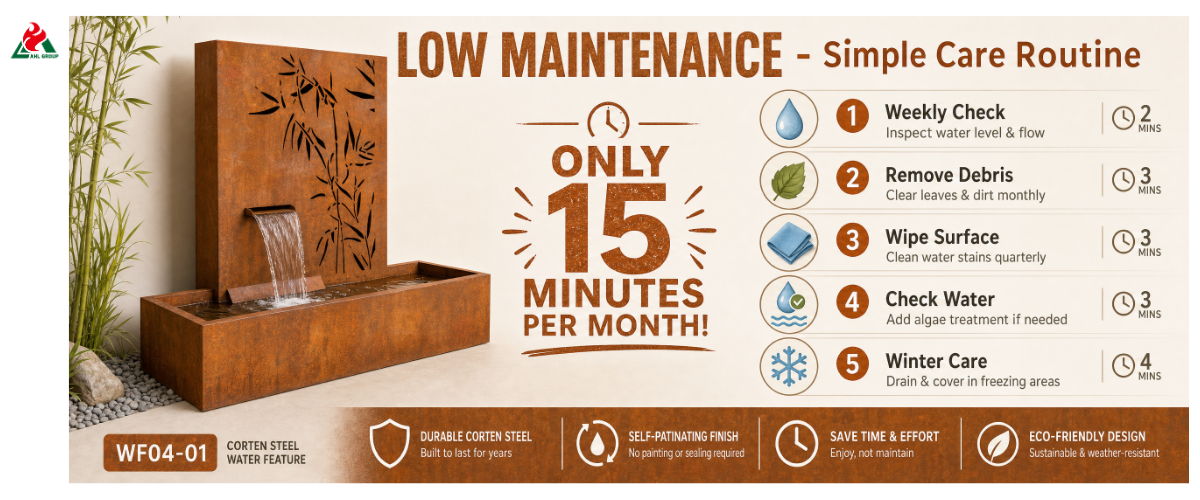
In cold climates, the best maintenance you can perform on your pump is to remove it during the winter. Store it in a bucket filled with fresh water in a frost-free garage or basement. This prevents internal seals from drying out and cracking—the most common reason pumps fail in the spring. This simple 5-minute procedure can double the lifespan of your mechanical investment.
7. Winterizing by Climate Zone
How you “maintain” your landscape water features in winter depends entirely on where you live.
Freezing Zones: Complete Drainage + Pump Storage
If you live in an area where the ground freezes (such as the northern United States, Canada, or Northern Europe), you must drain your landscape water features. The pressure generated by expanding ice is strong enough to bend steel or cause internal pipes to burst. Please drain the pond, remove the pump, and cover the water feature with a heavy-duty waterproof tarp to prevent ice and snow from entering the pipes.
Mild Climates: Keep Running + Antifreeze
In climates where temperatures rarely drop below freezing (such as the UK or the southern U.S.), you can usually keep water fountains running. Moving water is less likely to freeze than standing water. However, keep a close eye on the water level; cold air is very dry and can cause water to evaporate rapidly.
Arid Climates: Monthly Watering Only
In arid regions (such as Arizona, the UAE, and Australia), “winter” is simply a slightly cooler version of summer. Your most important maintenance task is watering. Due to low humidity, water features can lose an inch or more of water per week through evaporation. Ensuring the pump remains submerged at all times is your sole priority during the winter.
8. 5-Year Cost/Time Comparison
| Feature Type | Initial Cost | 5-Year Maintenance Time | |
| Corten Steel | Mid-High | 1.25 Hours | |
| Painted Steel | Low-Mid | 25 Hours (Repainting) | |
| Natural Stone | High | 15 Hours (Algae Scrub) | |
| Fiberglass | Low | 10 Hours (UV Sealing) |
9. Troubleshooting Common Issues (5-Min Fixes)
If your water feature isn’t working properly, don’t panic. Most issues with Corten metal water features can be resolved in just a few minutes.
► Cloudy water: This is common during the first year or during peak pollen season. Solution: Add a moderate amount of barley straw extract, or use a small UV sterilizer to purify the water without resorting to harsh chemicals that may affect the formation of rust patina.
► Pump Noise: If you hear a “squeaking” or “buzzing” sound, it usually means there is air in the pump or the impeller is dirty. Solution: Turn the pump on and off three times (“air-bleeding method”), or remove the impeller and rinse it clean—this should resolve the issue in 30 seconds.
► Algae Growth: In sunny areas, algae may proliferate. Solution: Never use bleach, as it will damage the patina. Use an oxygen-based pond cleaner or add a few aquatic plants to balance nutrients.
► Rust Flakes: If you see small flakes of rust on the bottom of the pond around the fourth month, this is normal. Solution: Simply suck them out with a siphon during your next water change. This is just the “infant” rust layer peeling off the steel, making room for mature patina.
10. The Maintenance Reality Check
Before purchasing, ask yourself: “Can I accept a ‘break-in period’?” This is the only aspect of Corten steel that truly requires maintenance. If expensive white marble tiles are laid directly beneath the landscape feature, you’ll need to seal the stone or provide drainage for the runoff. Once you accept the fact that you’ll need to hose down the surrounding area for the first six months, the landscape feature itself will become a low-maintenance companion.
11. Complete Maintenance Calendar
Daily Checklist (30 seconds)
► Listen for the pump’s “normal humming sound.”
► Visually check the water flow.
Weekly Checklist (1 minute)
► Top off the water level.
► Remove large leaves from the water surface.
Monthly Checklist (5 minutes)
► Remove and rinse the pump’s pre-filter.
► Check the water surface for “biofilm” buildup.
Seasonal Checklist (10 minutes)
► Spring: Perform a complete water change and rinse the basin.
► Winter: Drain the water and store the pump (if in a freezing climate).
Conclusion: Maintain Your Corten Water Features
Corten steel water fountains are a prime example of functional art. By harnessing the natural oxidation process, they eliminate the high-maintenance cycle associated with traditional outdoor materials. Although the “first-year bleeding” phase requires a small amount of time to protect surrounding surfaces, in the long run, you’ll have a water feature that requires virtually no upkeep. With just 15 minutes of annual maintenance on the pump, your weathering steel water feature will retain its stunning rusted appearance for decades, serving as a striking focal point in your garden.

