


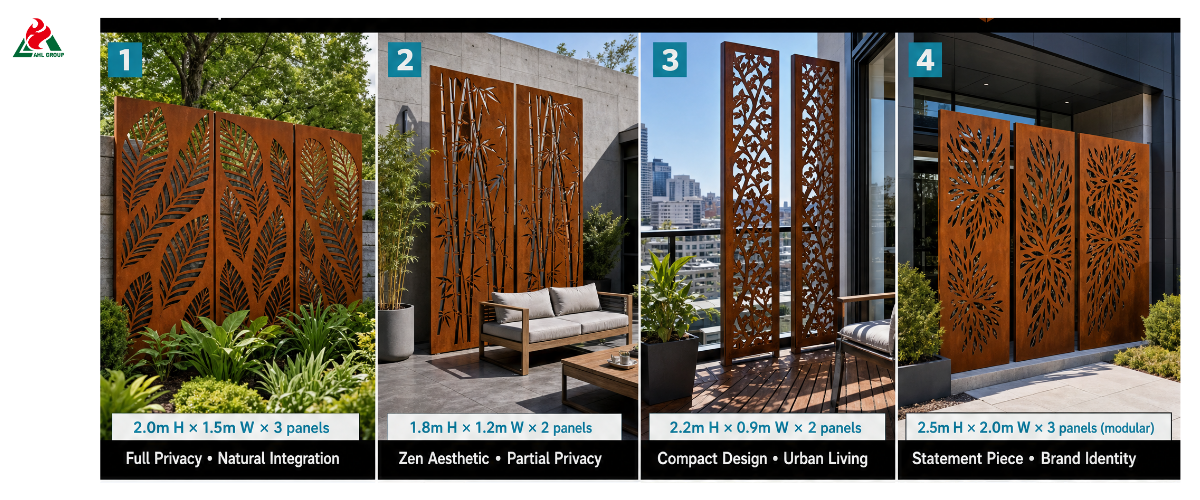
Corten steel screens are widely used in modern landscape design and architecture, but the dimensions of outdoor spaces often do not conform to standard specifications. Therefore, dimensional flexibility becomes a key factor when selecting privacy screens, decorative panels, or fencing systems. In the field of weathering steel fabrication, “cut-to-size” typically refers to panels custom-manufactured according to specific height, width, thickness, and—in some cases—pattern requirements before the weathering process begins. This guide will explain whether weathering steel screens can be cut to size, what customization options are available, what limitations exist, and how to specify the correct dimensions for your project.
1. Introduction
Why Dimensional Flexibility Is Critical for CORTEN Steel Screens
In modern architectural layouts and high-end landscape design, spatial precision is a non-negotiable requirement. Weathering steel screens—highly regarded for their rich, varied amber-brown patina and exceptional structural durability—are often used to define boundaries, conceal utility areas, and infuse outdoor environments with a rugged, industrial-chic aesthetic. However, outdoor spaces are rarely standardized. Screen fence projects may require panels to be embedded between existing masonry columns, installed within precise structural openings, or wrapped around non-standard geometric pool decks. Without dimensional flexibility, even the most stunning architectural panels can become costly bottlenecks during installation.
What Does “Cut-to-Size” Typically Mean
In the fields of architectural metalwork and weathering steel fabrication, “cut-to-size” encompasses two distinct operational processes:
► Factory-Level Customization: Using high-precision industrial computer numerical control (CNC) laser cutting machines, raw steel sheets are formed, cut, and punched to specifications accurate to the millimeter before atmospheric weathering treatment.
► On-site manual modification: Using handheld tools such as plasma cutters, angle grinders, or power saws at the construction site to physically trim, shear, or cut prefabricated, standardized sheets to make them fit, albeit with some difficulty, into unexpected structural openings.
What This Guide Covers
This technical guide provides a detailed analysis of the structural parameters, mechanical constraints, and manufacturing processes that determine the dimensions of Corten screens. We will clarify the key distinctions between factory-level precision cutting and on-site manual modifications. Additionally, this guide details how pattern boundaries, panel thicknesses, and mounting frame configurations change when custom dimensions are introduced, thereby providing specifiers, architects, and building owners with the data needed to optimize procurement and installation workflows.
2. Can Corten Steel Screens Be Cut to Size
Standard Sizes vs. Custom Sizes
While this mass production is highly cost-effective for large-scale commercial fencing, it lacks the flexibility required to achieve complex, custom architectural designs. Custom screen sizes, however, eliminate these fixed constraints and can be adapted to specific spatial limitations by adjusting the width, height, and edge boundaries.
When Custom Sizes Are Available
If custom sizing is performed during the initial manufacturing stage at the factory, it not only ensures high precision but also delivers exceptional structural reliability. When project-specific CAD or BIM files are directly imported into high-performance, industrial-grade CNC fiber laser cutters, the raw metal sheets can be cut to any custom length or width. This process allows automated drafting software to dynamically scale, compress, or compose decorative patterns, ensuring that the finished product maintains structural stability while achieving a visually centered effect.
When Cutting Should Be Restricted to After Processing Is Complete
Once laser-cut Corten steel screens leave the factory and arrive at the construction site, attempting to mechanically cut or trim them poses significant technical risks. If the panels feature complex openwork decorative patterns close to the edges, manually cutting the metal with a handheld angle grinder will not only ruin the aesthetic patterns but also strip away the solid perimeter frame. Such manual intervention weakens the panel’s structural load-bearing capacity, may cause severe hot-edge warping, and often leaves jagged burrs that disrupt the natural, uniform formation of the self-healing protective rust layer.
3. Common Customization Options
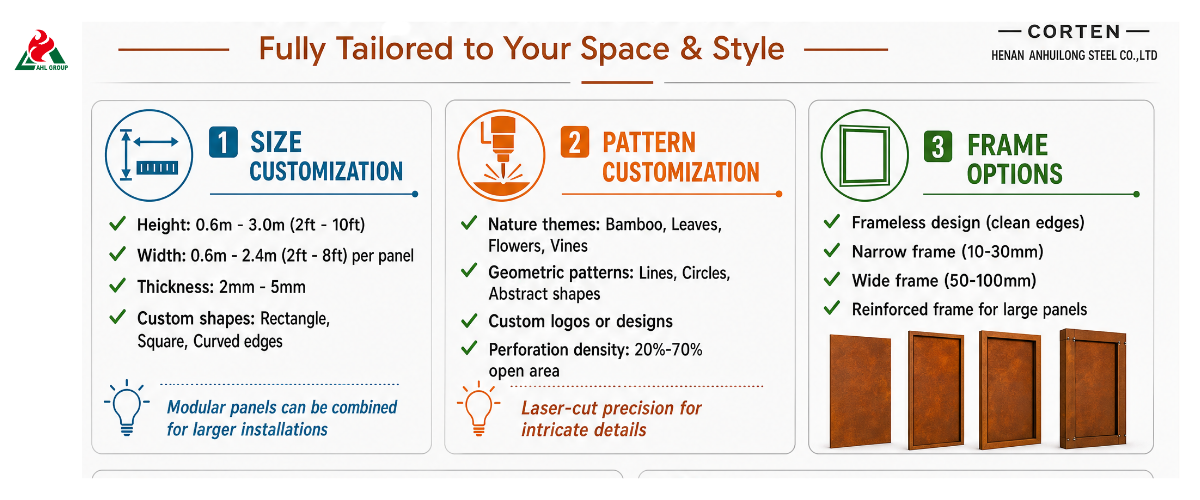
Width and Height Adjustments
Designers and owners can adjust the panels' vertical and horizontal dimensions to ensure they fit seamlessly within the structural framework. Whether your project requires extra-tall vertical columns to conceal multi-story mechanical shafts or extra-wide horizontal layouts to finish off modern concrete retaining walls, factory-level laser cutting ensures that the panels align precisely, eliminating the need for on-site modifications.
Panel Thickness Options
The thickness of Corten outdoor screens determines their wind load resistance, structural rigidity, and weight distribution. By specifying dimensions, designers can precisely select the thickness of raw materials based on the intended application:
► Lightweight wall panels: 1.5 mm to 2 mm (14 gauge)
► Standard structural screens/fences: 3 mm (11 gauge)
► Heavy-duty architectural cladding: 4 mm to 6 mm (1/4 inch)
Patterns and Design Variations
Custom sizing involves not only adjustments to external dimensions but also modifications to internal design elements. When screen panels are ordered in custom sizes, drafting engineers recalculate the pattern density. For projects requiring high privacy, laser-cut paths are narrowed to increase the solid metal surface area. Conversely, if the screen is used as an architectural windbreak or shading structure, the pattern aperture can be enlarged to maximize the passage of ambient airflow and dynamic natural light.
Adjustments to Frames and Installation Methods
Custom-sized screens can be ordered with tailor-made integrated profiles. Manufacturers can weld pre-drilled spacers, integrate rear-mounted box frames, or bend the perimeter edges backward to form a structural box-type tray structure. This integrated framing ensures that custom panels can be bolted directly to structural columns or masonry without the need for on-site welding.
4. Types of Screens That Can Usually Be Sized
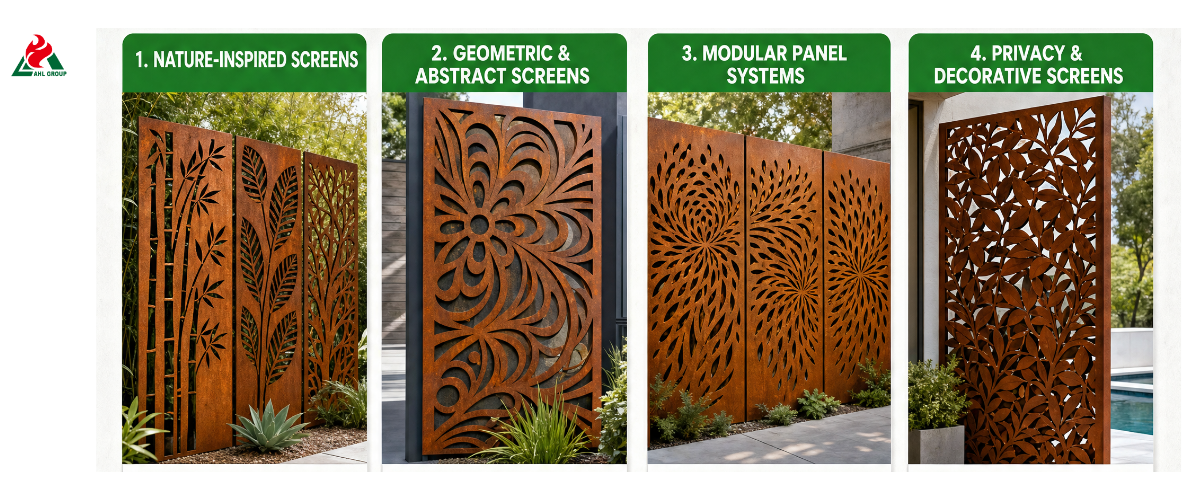
Privacy Screens
Privacy screens are designed to block outside views and protect the privacy of residential patios, spa areas, or commercial mechanical zones. When cut to size at the factory, the solid frames can be flexibly widened at the top, bottom, or sides. This ensures that the screen panels can easily support heavy-duty structural mounting brackets while maintaining the visual integrity of the central decorative pattern.
Decorative Garden Screens
Garden screens primarily serve as sculptural accents, adding depth to manicured lawns and native plant beds. Custom sizing allows these panels to precisely conform to your landscape’s topography, creating stepped heights or specific-width terraces that naturally follow changes in elevation or stone-paved retaining paths.
Fence Panels
Custom panels are essential when replacing standard wood or vinyl fencing with weathering steel. Since property lines and existing end posts rarely align in perfect mathematical increments, factory-cut panels can be calculated to fill non-standard gaps, ensuring clean fence lines and avoiding clunky, crammed end pieces.
Wall-Mounted Screens
Wall-mounted screens serve as durable architectural cladding, covering plain concrete block walls or the exterior facades of commercial buildings. Custom engineering ensures that the screens align perfectly with the layout of window openings, expansion joints, and structural columns, maintaining flawless architectural alignment across the entire building surface.
Freestanding Screens
Freestanding architectural screens are self-supporting structures specifically designed to direct airflow and delineate outdoor dining areas or public plazas. By specifying custom dimensions, engineers can precisely calculate underground anchoring requirements, base plate configurations, and internal support frameworks—all of which are tailored strictly to the panels’ actual height and local wind speed limits.
5. Factors That Affect Cut-to-Size Orders
Material Thickness
As the thickness of weathering steel increases, its resistance to mechanical cutting forces improves significantly. While 1.5-millimeter-thick sheets can be cut relatively quickly on low-power laser cutters, thicker steel plates—such as those 4 or 6 millimeters thick—require specialized high-kilowatt industrial fiber laser cutting equipment to ensure clean, straight cut edges without excessive slag or an overly large heat-affected zone.
Pattern Complexity
The complexity of decorative patterns directly determines programming time and the laser head’s travel speed. Intricate geometric mesh structures or complex organic openwork patterns require thousands of individual laser perforations. This high perforation density prevents melting, ablation, or loss of structural rigidity in narrow steel cross-sections during processing.
Structural Strength
Solid steel plates possess extremely high structural strength. Once 40% to 60% of the metal is removed by laser cutting to form decorative patterns, the internal structural path undergoes a fundamental change. When customizing the dimensions of a metal screen, manufacturers must carefully assess whether the modified panel dimensions retain sufficient solid frame perimeter to ensure the structure does not bend or become unstable under wind loads, thereby enabling it to withstand external loads with ease.
Installation Methods
The installation method you plan to use will significantly impact how the panels are sized and pre-treated at the factory. Panels intended to be suspended within a structural profile frame require precise cutting of their external dimensions with strict tolerances (±1 millimeter). Conversely, panels that are bolted face-outward onto structural columns require wider borders to ensure sufficient clearance around the bolt holes and to prevent mechanical friction from damaging the decorative patterns.
Lead Time and Cost
Custom sizing completely replaces the automated workflows of mass production with specialized engineering processes. Each custom order requires drafting technicians to manually review construction drawings, adjust toolpaths, and run individual nesting and cutting programs. Consequently, compared to standard off-the-shelf panels, custom orders have longer manufacturing lead times and higher unit costs.
6. Benefits of Ordering Custom Sizes
Better Suited to the Space
The greatest advantage of factory-customized dimensions is that they allow for precise, seamless installation within your specific architectural space. There’s no need to design awkward trim gaps, install oversized spacers, or force panels into narrow openings. When the privacy screens arrive on-site, their dimensions have already been precisely calculated to fit perfectly into your layout.
A Cleaner Visual Aesthetic
Forcing standard screen panels into non-standard spaces often disrupts the visual flow. Custom-sized designs ensure that the solid metal frames surrounding the decorative patterns are completely uniform across every panel. This meticulous attention to detail eliminates any sense of visual inconsistency, creating a cohesive, high-end aesthetic for your entire installation.
Easier Installation
Since custom screen panels are designed and manufactured from scratch to perfectly match your project specifications, they eliminate the need for dangerous, noisy, and labor-intensive on-site modifications. Thanks to the integrated mounting frame, pre-drilled holes, and precise dimensional accuracy, the installation team simply needs to hoist the panels into place, align them, and securely bolt them down—thereby reducing on-site installation time and lowering labor costs.
Reduce On-Site Waste and Rework
On-site cutting of prefabricated weathering steel panels generates significant amounts of metal scrap, consumes expensive consumables (such as plasma cutting nozzles and grinding discs), and poses safety hazards due to high-temperature sparks and sharp edges. Ordering factory-precut products ensures zero on-site waste, maximizes material utilization, and maintains a clean and sustainable construction site.
7. Limitations to Keep in Mind
Cutting Laser-Cut Patterns
If you attempt to manually cut standard decorative panels to the desired size on-site, you will inevitably cut straight through the intricate internal patterns. Cutting through these openwork shapes leaves sharp, jagged metal “fingers” protruding outward. This not only disrupts the design’s rhythm but also poses a serious safety hazard to pedestrians and makes the panel edges highly susceptible to bending.
Risk of Reduced Panel Edge Strength
The solid perimeter frame of the screen serves as its primary load-bearing structure. Manually trimming away this solid edge strip will cause the panel to lose its ability to resist lateral deflection. Without this frame to evenly distribute the load, the landscape screen may warp, rattle in strong winds, or even bulge outward, ultimately leading to structural failure.
The Necessity of Edge Finishing
When industrial lasers cut weathering steel in a factory, high-pressure inert gases (such as nitrogen) are used as shielding gases to instantly blow away molten metal, resulting in clean, perfectly square, and burr-free edges. In contrast, manual on-site cutting methods—such as oxy-acetylene torches or high-speed angle grinders—produce excessive slag and cause severe thermal stress. This erodes the alloy’s protective components, requiring extensive manual grinding and sanding to restore a smooth, uncoated edge that will weather uniformly.
Potential Transportation and Manufacturing Constraints
Custom dimensions are subject to the physical limitations of industrial machinery and freight. Standard sheet metal processing tables typically have a maximum width of 1,500 millimeters and a length of 3,000 millimeters. If your custom design requires oversized continuous panels exceeding these dimensions, the screen must be designed as a modular system with concealed interlocking joints to ensure it can be safely manufactured, transported, and assembled on-site.
8. How to Specify the Right Size
Carefully Measure the Opening Dimensions
Never estimate dimensions based solely on architectural drawings; be sure to take precise on-site measurements of the openings in the completed structure before submitting a fabrication order. Record the smallest measured dimensions to ensure the panels can clear any non-vertical structural walls.
Confirm Height, Width, and Thickness
Please specify the required dimensions clearly and in detail using standard metric millimeters (mm) to avoid conversion errors. In addition to height and width, specify the required material thickness based on local wind exposure conditions. For open landscape areas or high-altitude roof installations, it is recommended to increase the thickness to at least 3 millimeters to prevent deformation due to the “oil drum effect” and panel fluttering.
Check Installation and Clearance Requirements
Be sure to account for the actual dimensions of the hardware, rubber vibration-damping washers, and expansion joints. Since weathering steel undergoes slight thermal expansion and contraction during extreme seasonal temperature fluctuations, a dedicated expansion joint of 2 to 3 millimeters should be provided around the perimeter of the screen panel frame to prevent the structure from becoming jammed.
Review Drawings or Prototypes Before Production
Before the factory starts the laser cutting system, carefully review the construction drawings and engineering prototypes provided by the manufacturer. Verify that the bolt hole layout aligns with your support columns, reconfirm that the solid frame dimensions meet your aesthetic preferences, and ensure that the pattern layout is precisely centered on the custom canvas.
9. Custom Size vs Standard Size
When Standard Sizes Are Sufficient
Standard off-the-shelf screens prove highly effective for projects where the support framework around the screens can be flexibly constructed. If you’re building a brand-new wooden or steel privacy fence from scratch on level ground, you can adjust the spacing of the support posts to perfectly match standard 900-millimeter × 1,800-millimeter panels. This approach allows you to take advantage of cost-effective mass-production pricing while completely avoiding custom design fees.
When Custom Sizes Are Worth It
Custom sizes are essential for renovation projects, high-end commercial spaces, and demanding architectural applications. If you need to install screen panels within an existing concrete structural grid, match pre-installed stone columns, clad a specific building facade, or implement a high-end design with zero tolerance for visible gaps, then custom sizes are definitely worth the investment.
Cost vs. Lead Time Comparison
Standard stock panels are typically prefabricated and stored at distribution centers, allowing for immediate shipment and fast delivery. Custom-sized partitions, however, must be added to the current production queue, which extends the lead time by several weeks. Additionally, due to the need for customized CAD engineering, material layout planning, and specialized handling during manufacturing, the price of custom orders is correspondingly higher.
Project Suitability Match
| Project Parameter | Standard Stock Panels | Custom Cut-to-Size Screens |
| Framework Constraint | Flexible (Framework adapts to screen) | Rigid (Screen must adapt to existing space) |
| Visual Aesthetic | Standardized, conventional borders | Premium, tailored edge consistency |
| Upfront Cost | Budget-friendly (Mass production) | Investment premium (Bespoke engineering) |
| Lead Time | Fast (Typically ships in 2-5 days) | Extended (Requires 3-6 weeks production) |
10. Questions to Ask Before Ordering
Q1: Can the Screen Be Custom-sized?
Be sure to confirm whether your chosen supplier offers true factory-level custom fabrication—that is, processing that starts from steel sheet blanks—rather than simply reselling off-the-shelf imported products in standard sizes that cannot be finely modified.
Q2: Can the Pattern Be Adjusted?
Ask the design team whether they will manually adjust, scale, or crop the decorative elements to ensure perfect symmetry within your custom dimensions, or whether the patterns will be abruptly cut off at the edges.
Q3: Can the Frame Be Modified?
Ask about available custom frame options. Can the factory integrate folded edges, welded backplate grooves, or custom spacers directly into the screen’s structure to simplify your on-site installation?
Q4: Can the Panels Be Cut After Delivery?
Please confirm whether the specific panel configuration allows for minor manual adjustments on-site. If on-site cutting is truly unavoidable, consult the manufacturer’s engineering team regarding their recommended cutting tools and edge finishing procedures to preserve the natural oxidation process of the patina.
Q5: What Size Restrictions Apply?
Please confirm the maximum table size of the factory’s laser cutting equipment. If your project requires oversized partition walls, ask the engineering team how they plan to divide the screens into nested modular sections while ensuring the continuity of the pattern remains unaffected.
.png)
11. Frequently Asked Questions
Q1: Can Weathering Steel Screens Be Shortened?
Yes, during the design phase, the factory can easily shorten the screens by reprogramming the laser cutting paths. However, we strongly recommend against manually shortening finished decorative panels on-site using an angle grinder, as this will grind away the sturdy structural edges and compromise the symmetry of the pattern.
Q2: Can Corten Steel Screens Be Widened?
Yes. The factory’s laser cutting system can process sheets up to 1,500 millimeters wide or larger. If your layout requires a width that exceeds the dimensions of standard rolled sheets, the manufacturer will design a multi-panel modular layout with hidden interlocking joints to create a clean, continuous screen wall.
Q3: Do Custom Sizes Affect Durability?
No, provided the factory designs them properly. When structural engineers adjust the width or height of the panels, they correspondingly adjust the material thickness and the width of the perimeter frames to ensure the screen maintains optimal wind load ratings and structural lifespan.
Q4: Are Custom Screens More Expensive?
Yes, custom panels are more expensive than standard stock sizes. This price difference covers the cost of customized CAD design work, optimization of single-sheet panel layout, and the setup of specialized equipment required for a one-time custom production run.
Conclusion: Key Points on Cutting Partitions to Size
The most important point is that Corten metal screens can be cut to any custom size, provided that the size adjustments are made during the factory manufacturing stage. High-precision CNC laser cutters enable manufacturers to easily customize length, width, thickness, and installation methods with millimeter-level accuracy. Attempting to manually modify standard panels on-site using crude handheld cutting tools not only compromises structural integrity and disrupts design symmetry but also alters the natural formation process of the self-healing rust patina.
For any landscape or architectural project requiring absolute spatial precision, high-end edge detailing, and simplified on-site installation, factory-customized dimensions are the preferred solution. By investing in custom engineering during the design phase, you can completely avoid liability risks associated with on-site waste, reduce on-site labor costs, and ensure that your weathering steel screens blend seamlessly into the outdoor environment as durable, aesthetically pleasing, and perfectly fitted architectural assets.

