


Many homeowners and landscape designers choose Corten steel edging because of their unique rust-colored appearance and long outdoor lifespan. However, a common question is: Does Corten steel require specific weather conditions to form a protective rust layer? During the weathering process, a key factor is the balance between wet and dry conditions. Unlike ordinary steel, which continues to deteriorate after coming into contact with water, weathering steel is specifically designed to utilize natural weather cycles to form a stable, protective surface layer. Understanding how the wet-dry cycle affects weathering steel edging helps buyers install it correctly, avoid premature corrosion, and achieve the desired aged appearance.
1. Introduction
Why the Wet-Dry Cycle Is Critical for Corten Steel Edging
When landscape architects, contractors, and homeowners choose Corten steel (weathering steel) for garden edging, they value both its rustic, warm aesthetic and the material’s legendary durability. However, a common misconception is that Corten steel “does not rust” under any conditions. In reality, its ability to withstand the elements year after year without deteriorating depends almost entirely on a specific environmental mechanism: the wet-dry cycle. Without this alternating exposure to moisture and air, the steel cannot activate its protective properties, and what should be a long-lasting landscape feature will ultimately become a costly failure.
The Original Purpose of Weathering Steel
Weathering steel is a high-strength, low-alloy structural steel specifically designed to eliminate the need for paint or secondary protective coatings. From a metallurgical perspective, it is designed to rust—but this rusting process occurs under highly controlled conditions. When exposed to the atmosphere, the alloy forms a dense, tightly adherent layer of iron oxide, known as “patina.” This patina seals the underlying base metal, acting as an impenetrable protective layer that reduces the subsequent corrosion rate to near zero.
What This Guide Covers
This in-depth technical will analyze the critical relationship between Corten garden edging and the atmospheric conditions required to maintain it. We will address the fundamental question of “why alternating wet and dry cycles are necessary,” explain the chemical processes involved in the formation of the rust layer, outline the structural risks posed by soil with chronic waterlogging, and provide field-proven installation guidelines to ensure your landscape edging achieves its maximum service life of 40 to 60 years.
2. Does Corten Edging Need Wet-Dry Cycles
Short Answer
Yes. Corten edging must undergo continuous wet-dry cycles to function as intended. It is not a metal that is “submerged” or “intrinsically moisture-resistant.” If weathering steel is exposed to prolonged moisture, submerged in water, or buried in saturated, oxygen-deprived soil without any drying periods, it will perform exactly like inexpensive carbon steel. It will continue to rust, forming a thick crust of rust that flakes off, causing the structure to thin and eventually leading to catastrophic perforating corrosion.
Why the Alternation Between Wet and Dry Conditions Helps
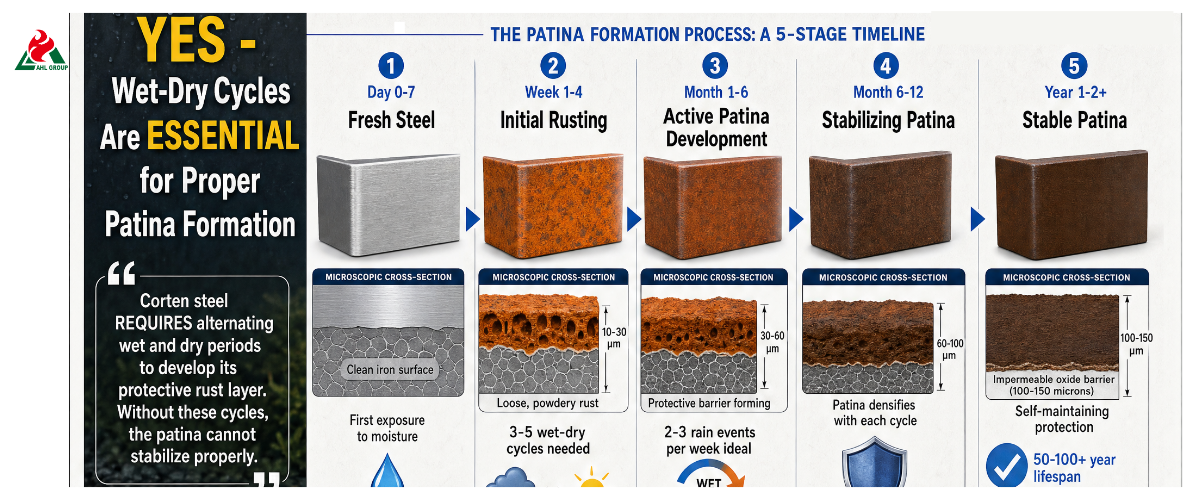
The “magic” of weathering steel lies entirely in the transition from wet to dry. When rain or irrigation water wets the steel, the initial oxidation process begins, dissolving a thin layer of iron. As sunlight hits the metal surface and wind blows across it, evaporation causes the dissolved iron to crystallize with oxygen from the atmosphere, forming a specific, non-porous iron oxide mineral called goethite. Each cycle of wet-to-dry alternation causes these microscopic crystals to bond more tightly together, steadily forming a dense, impermeable protective barrier.
What Happens Without a Drying Period
If the critical drying time required for garden edging treatment is not allowed, the chemical reaction will stall at the degradation stage. The metal will be unable to form dense, protective goethite crystals and will instead continue to produce scaly hematite—a rust layer with an extremely loose, porous, and flaky structure. This flaking rust layer continuously peels away from the steel, exposing the fresh, unoxidized metal beneath to a humid environment. Without a drying period, this cycle repeats indefinitely, accelerating material loss and shortening the product’s lifespan by decades.
3. How the Patina Forms
Weathering Process
The weathering process of Corten edging is a gradual transformation that typically takes 6 to 18 months to fully stabilize, with the exact duration depending on local weather conditions. When first installed, the edging has the raw, deep gray appearance characteristic of standard hot-rolled structural steel. After several weeks of exposure to rain and dew, the surface transforms into a bright, vivid orange-yellow color. Over the following months, this initial rust layer gradually deepens and becomes denser, transforming into a rich, deep chocolate brown or deep plum color, indicating that the rust layer has fully matured and stabilized.
Why Both Moisture and Oxygen Are Required
Rust formation is a typical electrochemical oxidation process that requires three elements: the base material (iron), liquid water (as an electrolyte), and oxygen from the atmosphere. Liquid water is essential for triggering the anodic and cathodic reactions that dissolve iron ions. However, if free gaseous oxygen does not diffuse into the water film during the drying phase, these iron ions cannot be further oxidized to the stable trivalent iron state—a state that is necessary for building a hard, protective rust layer barrier.
How Does the Rust Layer Provide Protection
Ordinary carbon steel lacks the special alloying elements found in Korten steel—specifically, copper (Cu), chromium (Cr), and nickel (Ni). In ordinary steel, rust crystals grow large, irregular, and loose, leaving wide microscopic channels that allow water and oxygen to continuously penetrate deep into the exposed metal surface. In Korten steel, however, copper and chromium ions migrate directly into the rust layer, binding iron oxide crystals into an extremely fine, densely packed amorphous structure. This structure physically fills the microscopic voids, cutting off the supply of oxygen and moisture to the underlying steel core.
4. What Happens in Constantly Wet Conditions
Why Does Water Accumulation Become a Problem
Water accumulation is the number one enemy of weathering steel that has not been sealed. When landscape design causes water to pool directly against weathering steel borders—such as along the edges of terraces with improperly graded slopes or in low-lying areas near drainage ditches—the metal remains submerged for extended periods. Under conditions of prolonged submersion, the protective rust layer cannot dry, compact, or harden. The metal remains in a state of uncontrolled active oxidation, continuously releasing rust particles into the water, which gradually reduces the structural thickness of the edge panels.
How Poor Drainage Affects Steel
Soils with poor drainage—such as compacted silt or unamended clay—act like a wet sponge pressed against the steel’s surface. After a heavy rain, these soils remain damp for days or even weeks. This prolonged dampness keeps the relative humidity on the steel’s surface at a level close to 100%. This “suffocates” the metal by blocking air circulation, thereby preventing the evaporation phase necessary to lock in the protective goethite layer, which ultimately leads to rapid, localized pitting corrosion near the soil contact line.
What Happens When Buried Underground or in Waterlogged Areas
Garden edging is designed to be partially buried underground to hold soil, gravel, or mulch in place. The microclimate of the section of the Corten steel strip that is completely buried underground is vastly different from that of the exposed upper edge. If the surrounding soil remains waterlogged for an extended period, the buried section will be subjected to a severely oxygen-deprived and persistently damp environment. These conditions can trigger rapid anaerobic corrosion, causing the underground portion of the garden lawn edging to rot and disintegrate from below long before any signs of damage appear on the exposed edge above ground.
5. Ideal Conditions for Corten Edging
Exposure to Rain and Air
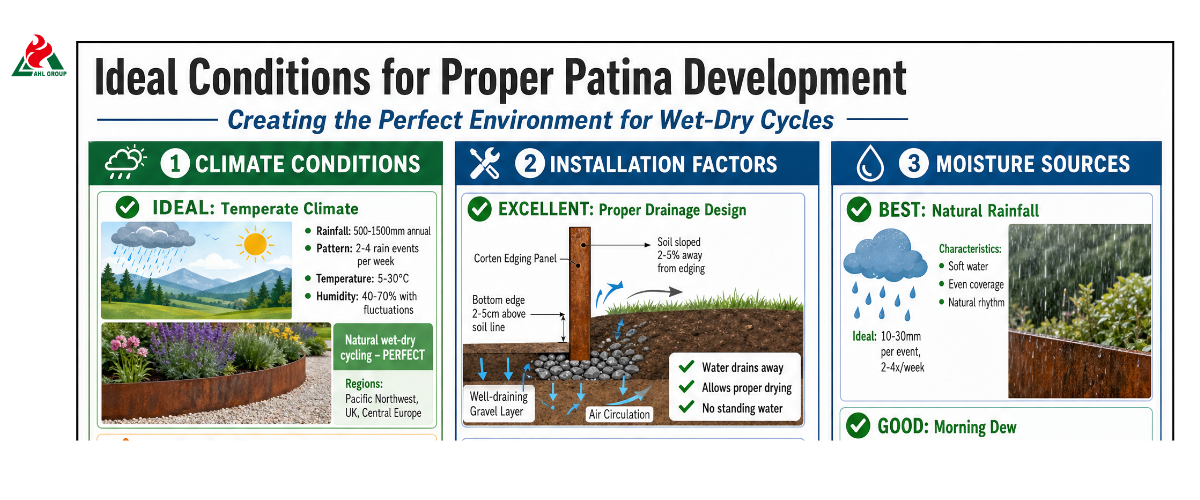
To remain in good condition and achieve their designed service life of several decades, Corten edging must be installed in an open environment where it can interact naturally with local climatic conditions. Natural rainfall washes away loose particles from the surface, while the open-air environment ensures that morning dew evaporates quickly in the sunlight. Free, unobstructed airflow on both sides of the steel sheets is highly beneficial, as wind helps accelerate the drying process after heavy rain.
Good Drainage and Ventilation
For weathering steel installed on the ground, the most critical factor is a substrate with high porosity and good drainage. When it rains or an irrigation system is in operation, water must quickly permeate into the surrounding soil so that the ground directly adjacent to the metal can dry completely within a few hours. Ensuring that the top 50% to 70% of the metal edging is above the soil surface guarantees sufficient convective airflow, which helps regulate the temperature and humidity levels of the metal plates.
Seasonal Dry Periods Between Rainy Seasons
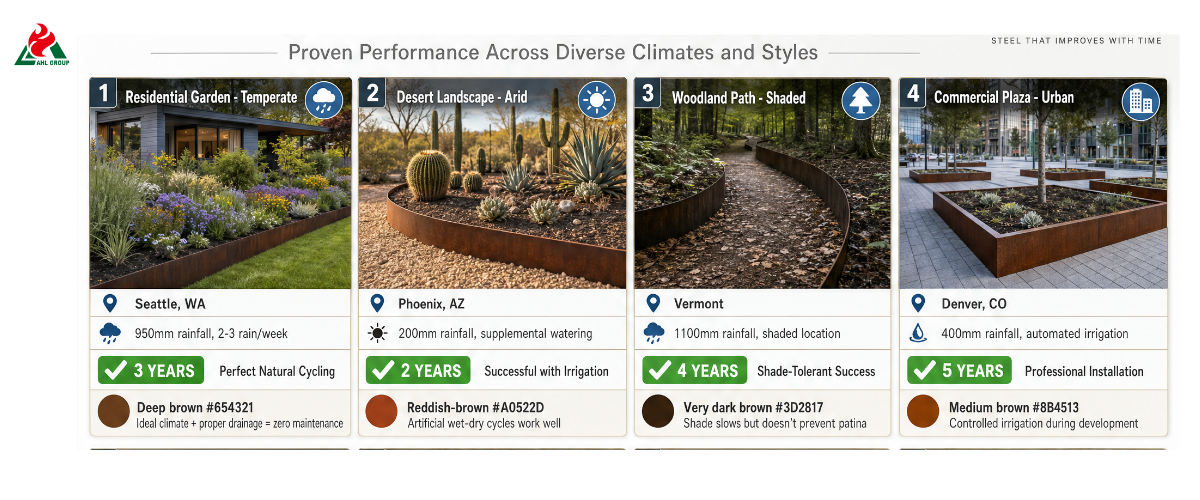
Climates characterized by distinct, alternating rainy and dry seasons—such as those found in the Mediterranean or temperate zones (where winters are rainy and summers are dry and sunny)—provide a textbook-perfect environment for Corten steel. The rainy season triggers a controlled oxidation process and washes away impurities, while the long, dry, warm season bakes and hardens the iron oxide matrix. This seasonal cycle forms a rock-solid, extremely stable dark rust layer that provides optimal long-term atmospheric protection.
6. Environments That Slow Patina Development
Shady, Damp Garden Areas
If Corten steel borders are installed deep within a dense, low-light woodland garden, beneath a low backyard deck, or under dense, overgrown evergreen shrubs, their service life will be compromised. These microclimates receive almost no direct sunlight and experience minimal wind, causing moisture to become trapped in the environment and keeping the steel in a persistently damp state. In these consistently shaded and damp areas, the patina forms extremely slowly and often appears soft, cloudy, and irregular, rather than tight and metallic.
Heavy Clay Soil and Poor Drainage
Heavy clay soil poses a dual threat to weathering steel. Not only does it trap moisture and hinder the drying cycle, but it also expands significantly, pressing tightly against the steel plates and blocking atmospheric oxygen. If untreated, Corten steel borders are buried directly in unamended clay, poor ventilation, and prolonged exposure to moisture often lead to persistent flaking of the buried steel, thereby significantly shortening the service life of the borders.
Coastal Areas or Environments Exposed to Salt Fog
When weathering steel is installed within 2 kilometers (1.2 miles) of the shoreline, sea salt in the air will deposit on the metal surface. Salt is highly hygroscopic; even on dry days, it absorbs moisture directly from the air and forms a persistent electrolyte film on the metal surface. Furthermore, chloride ions actively interfere with the chemical formation of the protective ferrite layer, causing the steel to develop coarse, flaking crystal structures, which in turn lead to deep surface pitting and ongoing material loss.
Areas with Continuous Irrigation
Automatic lawn irrigation systems that are inaccurately positioned or operate too frequently pose a significant risk to Corten metal edging. If sprinklers direct water onto specific areas of the Corten steel edging every night, those areas will not have the necessary drying time. This persistent artificial moisture creates localized “failure zones” within an otherwise healthy landscape, leading to uneven weathering, the spread of severe rust, and localized structural thinning.
7. How to Improve Weathering
Install Edging with Proper Drainage
To maximize the service life of weathering steel edging, you must incorporate drainage considerations directly into your installation plan. When digging the trench, make it 2 inches deeper than required and backfill the bottom of the trench with clean, washed angular gravel or coarse river sand. This creates a dedicated drainage layer directly beneath the steel edging, ensuring that rainwater running down the panels can quickly infiltrate the subsoil rather than pooling at the bottom edge.
Avoid Prolonged Contact with Soil
Although garden edging inevitably must come into contact with the ground to function properly, you can significantly improve its durability by minimizing the surface area of the steel buried underground. As a general principle of engineering standards, ensure that the portion of the steel strip buried underground does not exceed one-third to one-half of its total height. Keeping most of the metal surface exposed to the air ensures that the entire structure can dry efficiently after rain.
Keep the Surface Free of Debris
Throughout the gardening season, fallen leaves, grass clippings, organic mulch, and soil blown by the wind will naturally accumulate at the base of your garden fence. If left to accumulate, this organic matter will form a damp layer that traps moisture directly against the metal surface. Make it a habit to use a leaf blower or rake to remove this accumulated debris during routine seasonal cleanups, allowing the entire metal surface to “breathe” and dry evenly.
Allow the Metal to Weather Naturally
Never use readily available household chemicals—such as vinegar, bleach, or salt solutions—to accelerate or interfere with the formation of patina, whether out of impatience or curiosity. Although these acidic substances will produce rust immediately, they often introduce harmful ions that compromise the long-term stability of the patina. To achieve a beautiful and long-lasting patina, the best approach is to step back and let natural rain, sunlight, wind, and ambient humidity guide the metal through its organic weathering cycle.
8. Common Mistakes to Avoid
Burying the Edge Strips Too Deep
One of the most common installation mistakes is burying 6-inch-high Corten landscape edging 5 inches deep in the ground in an attempt to make it flush with the lawn. This severely restricts airflow, forcing nearly the entire metal strip into a dark, damp, and oxygen-deprived underground environment. Without sufficient sunlight and wind exposure, the buried steel cannot form a protective rust layer, making it highly susceptible to premature damage.
Neglecting Drainage During Installation
Placing untreated steel edging directly into a muddy, hand-dug clay trench—without adding a gravel drainage layer or a sand base—will undoubtedly lead to premature corrosion. If the bottom of the metal edging is chronically submerged in wet clay and standing water, it will corrode rapidly at the same rate as ordinary structural steel, quickly causing the lower edge to become jagged and thinned, and leading to bending and deformation under soil pressure.
Expecting an Instant Patina Effect
Many buyers are surprised when they receive high-end Corten steel borders, as the steel—fresh off the truck—appears either shiny silver or covered in dark mill scale. Those expecting an instant and uniform aged look are often disappointed. The environment needs time to work its magic. Using strong acid washes to forcefully accelerate this process usually damages the steel, so patience is crucial during the initial rusting phase.
Using Sealants That Interfere with the Rusting Process
Applying general-purpose clear coatings, automotive sealants, or oil-based paints to untreated weathering steel in an attempt to lock in its color or prevent early rust loss destroys the material’s natural defense system. These surface sealants degrade when exposed to UV light and crack and peel within a few seasons. Moisture then seeps into these microscopic cracks, creating permanently damp, hidden areas that prevent the steel from forming its natural rust patina, leading to mottled and severe localized corrosion.
9. Maintenance and Monitoring
Items to Check for Long-Term Maintenance
Although Corten steel edging is known for its low-maintenance nature, we strongly recommend conducting a quick visual inspection once or twice a year. Carefully examine the points where the metal meets the soil for signs of thick, flaking rust. Check the alignment of the edging panels to ensure that seasonal ground freezing has not caused any sections to shift, and verify that all interlocking connectors or heavy-duty ground stakes remain securely fastened.
How to Safely Clean the Edging
If your outdoor edging has been splashed with mud from heavy rain or coated with sticky tree sap, cleaning it is very simple. Use a standard garden hose fitted with a gentle nozzle to rinse away loose dirt and debris. If stubborn mud stains remain, gently brush them away with a soft-bristled nylon car wash brush while rinsing the area with clean water.
Important Note: Never use wire brushes, steel wool, or strong acidic cleaners on weathered weathering steel, as these tools will strip away the protective rust layer and scratch the metal core.
When to Be Alert for Abnormal Corrosion
Please watch closely for any signs of “abnormal corrosion,” which typically manifests as large, raised rust patches—these patches can easily flake off the steel surface—or localized pitting that significantly reduces the metal’s thickness. If you notice these signs, it indicates that the local microclimate is too humid. In this case, you should check whether the drainage gutters are clogged, adjust the spray direction of nearby sprinklers, or add gravel to the drainage gutters to help the metal dry thoroughly.
Situations Requiring No Additional Treatment
If your durable steel edging exhibits a uniform, fine-grained texture with a deep matte finish, dark brown color, or classic amber-orange hue, it is in excellent condition. At this stage, the patina has fully matured and stabilized, meaning the steel requires absolutely no additional coatings, chemical treatments, or structural interventions. It has seamlessly integrated with the environment and will easily protect itself for decades to come.
.png)
10. Frequently Asked Questions
Q1: How Long Does It Take for a Rust Layer to Form?
Under standard outdoor conditions with a balance of rain and sunlight, an initial protective rust layer will form within 3 to 6 months. However, it typically takes 12 to 18 months to develop a fully mature, stable, dark brown architectural finish. In very dry or indoor environments, this process is significantly prolonged.
Q2: Are Corten Steel Edging Suitable for Rainy Climates?
Yes, weathering steel edging performs exceptionally well in rainy climates, provided the installation site has good drainage. As long as the surrounding soil allows rainwater to drain quickly, ensuring the metal surface is completely dry between downpours, this steel can withstand heavy rain without any issues.
Q3: Does Garden Watering Affect the Rusting Process?
As long as the soil drains well, routine garden watering will not damage your Corten edging. However, you should avoid setting automatic sprinklers to continuously spray water directly onto the metal surface. Allowing the steel sufficient time to dry completely is crucial for the formation of a durable, protective rust layer.
Q4: Does This Wet-Dry Cycle Need to Be Maintained Indefinitely?
This cycle of wet and dry conditions is most critical during the first few years, when the protective rust layer is actively growing and consolidating its structure. Once the hematite barrier is fully formed and stabilized, the steel will be highly resistant to moisture in the environment. However, the metal must never be left submerged in standing water or buried in waterlogged soil for extended periods, as prolonged exposure to moisture will eventually damage even a mature rust layer.
Conclusion: Optimal Conditions for Ensuring Long-Term Performance
The key point is that alternating wet and dry cycles are crucial to the long-term durability and performance of the Corten garden border. Weathering steel is not an “immortal metal” that can be left unattended in any environment; rather, it is a smart material that relies on a specific environmental rhythm—first exposure to moisture, followed by drying in the open air—to build its own protective barrier.
To achieve optimal results and ensure a service life easily exceeding 50 years, install weathering steel borders in an open, sunny, and well-ventilated area. Be sure to place the bottom of the metal strips on a clean, rinsed bed of gravel or sand, buried to a depth no greater than half the total height of the panels, and choose well-drained soil to ensure the metal can dry completely between rainstorms.
When selecting steel edging for your next project, be sure to purchase genuine, heavy-gauge weathering steel (ideally 2 to 3 millimeters thick), rather than cheap, low-carbon steel that has merely been temporarily rusted. Take the time upfront to prepare a clean, gravel-lined, well-drained trench, and avoid using synthetic sealants—let nature create a stunning, self-healing boundary that stands the test of time.

