


Designing a Corten steel landscape edging system that remains as straight as a laser cut along paths, forms smooth curves around flower beds, and does not warp upward from the ground even after the ground freezes in winter depends on three key engineering parameters: steel sheet thickness (1.6 mm / No. 16 steel sheet for hand-formed curves; 2.0 mm to 3.0 mm / No. 14 to No. 11 for commercial lawn and path borders; 5.0 mm to 6.0 mm / 3/16 inch to 1/4 inch for gravel driveways and low retaining steps), and post spacing (800 mm to 1,000 mm for straight sections, reduced to 450 mm to 600 mm at curves, on ramps and at joints, where posts must be driven 150 mm to 250 mm into undisturbed subsoil), and frost heave prevention measures (burying 50% to 60% of the edging height in a well-drained gravel trench foundation 75 mm to 120 mm deep and securing it with ribbed or barbed posts). When these three mechanical details are matched to local soil and climatic conditions, weathering steel edging compliant with ASTM A606-4 / A588 standards can provide decades of maintenance-free structural containment.
.png)
1. Material Fundamentals: Genuine ASTM A606-4 / A588 Corten vs Raw Mild Steel Edging
Not all rust-colored metal frames sold online are made of genuine weathering steel. Understanding the metallurgical differences between structural weathering steel and ordinary hot-rolled low-carbon steel will determine whether your frame will form a self-sealing rust layer or begin to flake off where it comes into contact with the soil after just a few seasons.
How Atmospheric Wet-Dry Cycling Protects the Above-Ground Border
Genuine weathering steel strips and plates—in accordance with ASTM A606 Type 4 (for cold-rolled and hot-rolled sheets/strips with thicknesses ranging from 1.5 mm to 3.0 mm) or ASTM A588 / Corten A / EN 10025-5 (for heavier-gauge structural flat steel with thicknesses ranging from 3.0 mm to 6.0 mm)— —both contain precisely proportioned alloying elements: copper (0.20%–0.55%), chromium (0.30%–1.25%), nickel, and silicon.
When the exposed upper surface undergoes alternating cycles of wetting by rain and drying by sunlight and wind, these alloying elements reorganize the surface iron oxide into a dense, tightly adherent, amorphous inner barrier of goethite. Unlike ordinary low-carbon mild steel—which forms a coarse, porous hematite rust layer that continuously flakes off in patches—a mature Corten rust layer isolates the underlying steel core from oxygen and moisture. For a more in-depth understanding of this electrochemical mechanism, please refer to our technical guide on whether Corten steel edging needs wet-dry cycles.
The Soil-Line Corrosion Zone: Why Drainage Around the Buried Half Matters
► Landscape edging is subject to a split microclimate: the upper 40% to 50% of the edging strip is exposed to air and sunlight, while the lower 50% to 60% is buried underground to contain the spread of turf roots, mulch, or aggregate.
► Why buried steel corrodes differently: Below the soil line—especially within the top 25-millimeter “soil-air transition zone”—oxygen levels are low, while moisture retention is much higher. If exposed, weathered steel lies directly against waterlogged, unamended clay (which remains wet for weeks), its buried surface will be unable to complete a drying cycle, and its corrosion rate will be comparable to that of carbon steel.
► Two engineering countermeasures: First, install a protective backfill ring composed of well-drained angular gravel or coarse sand around the buried section of the steel strip to allow rainwater to drain rapidly. Second, increase the sacrificial thickness allowance (from 1.6 mm to 2.0 mm, or to 3.0 mm in heavy, moist soils) to ensure that the underground cross-section maintains its structural rigidity for 25 to 40 years or more.
Pre-Weathered vs Mill-Scale (Natural Unrusted) Strips & Hardscape Runoff Control
When ordering products from the factory (such as our flexible Corten metal landscape border supplier), the coil strips are available in two surface finish options:
► Natural roll-rusted surface finish (non-rusted, deep gray-blue): This is the most cost-effective option for large-scale commercial or residential projects, where the strips are installed along the edges of lawns, bark mulch, or dark crushed granite. During the first 4 to 12 weeks of outdoor exposure, rainwater will dissolve the mill scale, causing the strips’ color to gradually change from bright orange to a warm reddish-brown.
► Factory Pre-Oxidized (Pre-Weathered) Surface Finish: Treated before shipment to create a uniform initial rust patina. When edging strips are installed directly alongside light-colored, porous hardscape surfaces (such as travertine, light-colored sandstone, or brushed concrete walkways), using pre-weathered edging strips—or allowing edging strips with factory-applied scale to weather on the lawn for 4 to 6 weeks before installation—can significantly reduce early staining caused by the dissolution of iron oxide in water.
2. Corten Steel Edging Thickness & Gauge Guide (1.6mm / 16ga to 6.0mm / 1/4 Inch)
Since the bending stiffness of a steel strip perpendicular to the plane is proportional to the cube of its thickness, a seemingly minor increase in thickness from 1.6 millimeters to 3.0 millimeters can increase lateral stiffness by more than 6.5 times. If the wrong thickness is chosen, the result will either be a steel strip that is too stiff to be bent by hand and wrapped around the flower bed, or one that is too thin to remain straight on a compacted gravel driveway.
1.5mm–1.6mm (16 Gauge): Flexible Residential Lawn & Curved Flower Bed Borders
► Mechanical Properties: At a thickness of 1.5 mm to 1.6 mm (U.S. 16 Gauge, approximately 0.060 inches), weathering steel achieves an ideal balance between tensile strength and elastic-plastic manual formability. A single installer can smoothly bend 1,075-millimeter or 2,000-millimeter-long steel strips into wide-radius S-curves, kidney-shaped planting beds, and circular tree rings with a minimum bending radius of 300 to 400 millimeters (12 to 16 inches) without creasing and without the need for mechanical rollers.
► Standard profiles: Typically available in heights of 100 mm, 150 mm, or 200 mm, including AHL’s AHL-GE04 (1,075 mm long × 100 mm panel + 100 mm integrated ground spike) and AHL-GE05 (1,075 mm long × 150 mm panel + 100 mm integrated ground spike).
► Applications to Avoid: Avoid using 1.6 mm wide strips in straight building passageways (where even slight variations in backfill pressure can cause visible horizontal ripples) or on gravel driveways.
2.0mm–2.5mm (14 Gauge to 12 Gauge): All-Round Landscape & Commercial Turf Edging
► Mechanical Properties: When the thickness increases to 2.0 mm (14 gauge, approximately 0.075 inches), the bending stiffness nearly doubles (1.95 times higher than that of 1.6 mm), while the stiffness at 2.5 mm (12 gauge, approximately 0.105 inches) is 3.8 times higher. The 2.0-millimeter-wide edging strip is the standard specification for professional residential and commercial landscaping—widely used in our high-strength, weather-resistant steel lawn edging series.
► Why Contractors Prefer the 2.0-Millimeter Specification: It maintains straight lines over medium distances, allows for easy formation of wide landscape curves (minimum manual bending radius ≥600 mm to 900 mm), easily withstands wear from nylon lawn mowers (“weed trimmers”) and impacts from steel garden trowels, and can withstand being run over by the wheels of push-type commercial mowers without denting.
3.0mm (11 Gauge): Architectural Straight Runs, Public Parks & Compacted Aggregate Paths
► Mechanical Properties: At a thickness of 3.0 mm (11 gauge, approximately 1/8 inch), this strip transitions from a flexible, sheet-like edging to a rigid architectural flat bar (with a stiffness 6.59 times that of the 1.6 mm version). The strip cannot be bent by hand into sharp turns (minimum cold-bending radius is ≥1.5 to 2.5 meters), which is precisely why landscape architects specify it for long, straight geometric boundaries adjacent to weathered granite (DG) trails, resin-bound gravel walkways, weathering steel flower bed edging, and tree-lined paths in municipal parks.
► Resistance to compaction: When contractors use a vibratory plate compactor on the crushed stone subbase immediately inside the boundary, the 3.0-millimeter-wide strip effectively prevents lateral bulging (“wavy deformation”) between the stake markers.
4.0mm–6.0mm (8 Gauge to 1/4 Inch): Gravel Driveways, Vehicular Shoulders & Low Terraced Retaining Beds
► Mechanical Properties: Heavy-duty structural flat bars with thicknesses of 4.0 mm, 5.0 mm (3/16 inch), and 6.0 mm (1/4 inch) offer industrial-grade beam strength (with stiffness 15.6 to 52.7 times that of 1.6 mm-thick flat bars).
Primary Applications:
► Gravel and Cobblestone Driveways: Used to secure driveway aggregate; suitable for situations where passenger cars, SUVs, and cargo vans occasionally drive over or apply lateral pressure to the edge of the shoulder.
► Low-terrace elevation differences (150 mm to 300 mm soil steps): When used for higher slope protection zones ranging from 250 mm to 500 mm in height (e.g., AHL-GE01, AHL-GE06, AHL-GE08, and AHL-GE09 models with heights ranging from 300 mm to 500 mm) and anchored using heavy-duty angle steel piles or concrete footings, 4.0 mm to 6.0 mm weather-resistant steel plates can serve as a neat, low-profile stepped retaining structure.
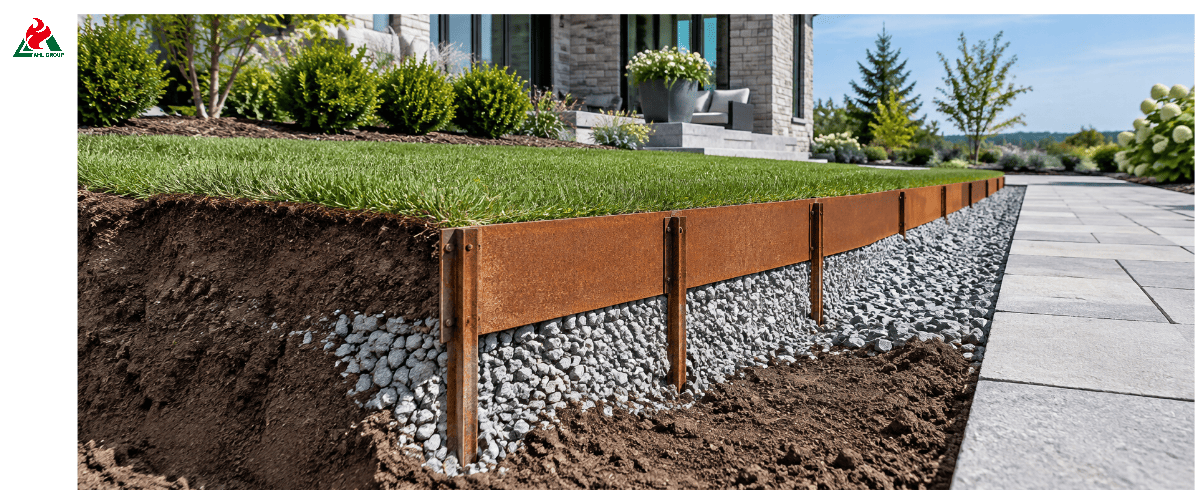
3. Thickness, Gauge, Profile Height & Application Comparison Table
Use the engineering specification table below to match Corten steel edging thickness and strip height to your project requirements:
| Metric Thickness |
US Gauge / Inch Equivalent | Relative Bending Stiffness (vs 1.6mm) | Min Hand-Formed Curve Radius | Recommended Total Strip Height | Max Supported Grade Step (Soil Difference) | Weight per Linear Meter (150mm Height) | Best Landscape Application |
| 1.5–1.6 mm |
16 Gauge (~0.060 in) | 1.0× (Baseline) | 300–400 mm (12–16 in) | 100–150 mm (or 100+100 mm100+100 mm spiked) | Flush (0–30 mm0–30 mm turf/mulch) | ~1.88 kg/m | Sweeping flower beds, tight tree rings, DIY residential lawn borders |
| 2.0 mm |
14 Gauge (~0.078 in) | 1.95× | 600–900 mm (24–36 in) | 100–200 mm (4–8 in) | 30–60 mm | ~2.36 kg/m | Commercial turf borders, gravel garden paths, robotic/riding mower edges |
| 2.5 mm |
12 Gauge (~0.098 in) | 3.81× | 1,000–1,500 mm (40–60 in) | 150–250 mm (6–10 in) | 50–100 mm | ~2.94 kg/m | Heavy pedestrian walkways, estate gardens, raised mulch beds |
| 3.0 mm |
11 Gauge (~1/8 in) | 6.59× | 1,800–2,500 mm (Gentle arcs only) | 150–300 mm (6–12 in) | 75–150 mm | ~3.53 kg/m | Dead-straight architectural runs, compacted DG/gravel paths, public parks |
| 4.0–5.0 mm |
8 Gauge to 3/16 in | 15.6×–30.5× | Shop-rolled or straight only | 200–350 mm (8–14 in) | 120–220 mm | ~4.71–5.89 kg/m | Residential gravel driveways, paver edge restraint, low garden steps |
| 6.0 mm |
1/4 Inch Plate | 52.7× | Shop-rolled or welded corners | 250–500 mm (10–20 in) | 200–300 mm (with heavy stakes/haunch) | ~7.07 kg/m | Commercial driveways, vehicular shoulders, low terraced retaining borders |
Choosing Top Edge Profiles: Rolled Safety Bead, 90° Return Flange vs Flat Bar
In addition to panel thickness, the geometry of the rail’s top edge should be evaluated based on pedestrian and pet traffic:
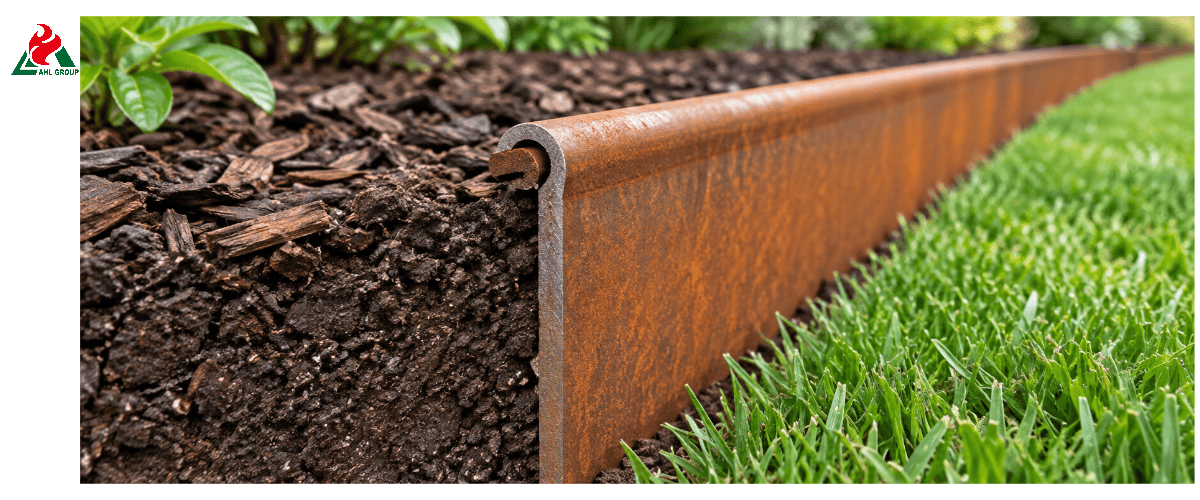
1. Rolled top edge (6 mm to 10 mm rolled edge): A standard configuration for many 1.5 mm to 2.0 mm residential guardrail rails. Rolling the top edge into a smooth, rounded edge eliminates sharp metal corners—protecting children’s knees, dogs’ paws, and garden hoses that might be dragged along—while adding a horizontal reinforcing rib to the top of thin railing profiles.
2. 90° Folded Flange (15 mm to 25 mm L-shaped lip): A horizontally folded lip formed by mechanical bending significantly increases the lateral beam’s rigidity to resist soil pressure and provides a wide, safe 20-millimeter viewing clearance. However, without factory-precut relief notches, the 90° top lip cannot be bent into a curve on-site.
3. Deburred Flat Steel for Construction (3.0 mm to 6.0 mm): When flat steel has a thickness of 3.0 mm to 6.0 mm, its top edge is sufficiently wide (a flat surface of 3 to 6 mm, with chamfered and deburred edges) to no longer be “sharp as a knife,” thereby presenting the minimalist lines favored in contemporary landscape architecture.
4. Profile Height & Embedment Depth Rules (100mm to 500mm Strips)
If the strip height is insufficient to meet the required burial depth in the soil, the garden edging will still appear slanted or wavy, even if the appropriate thickness is selected.
The 50%–60% Underground Embedment Ratio Explained
For freestanding landscape edging, a fundamental geotechnical rule is a burial depth of 50% to 60%: at least one-half to two-thirds of the edging’s total vertical height (plus the length of the longer ground stakes) must be buried below the final ground level.
► A border edging with a total height of 100 millimeters (4 inches): buried 60 to 70 millimeters underground, with 30 to 40 millimeters exposed above the lawn line (ideal for a transition between the lawn and a flower bed that is flush with the mower’s wheels).
► Strips with a total height of 150 mm (6 inches): Bury 85 mm to 100 mm underground, with 50 mm to 65 mm exposed (suitable for flower beds with deep bark mulch, gravel paths, and as a general standard for areas requiring protection against invasive rhizomatous weeds).
► Strips with a total height of 200 to 300 millimeters (8 to 12 inches): buried 110 to 170 millimeters underground, with 80 to 130 millimeters exposed above ground; suitable for raised garden beds or transitions on gentle slopes.
Integral Spiked Edging (100+100mm / 150+100mm) vs Separate Flat Strip + Anchor Stakes
In the AHL product catalog, buyers can choose between two types of structural anchoring:
► One-piece barbed edging (e.g., AHL-GE04 1,075 × 100+100 mm and AHL-GE05 1,075 × 150+100 mm): Made from 1.6 mm or 2.0 mm thick weather-resistant steel sheet that is laser-cut, with triangular, sharpened teeth formed directly along the bottom edge of the panel. These edging strips can be quickly installed in firm, stone-free residential loam—simply cut a narrow slit with a shovel and tap the strip under a wooden block—eliminating the need for separate anchor post hardware.
► Continuous Flat Strip + Separate Deep Anchor Posts: Suitable for stony soil, cold regions prone to frost heave, and commercial borders ranging from 2.5 mm to 6.0 mm. Since the individual stakes (300 mm to 450 mm long) must first be driven into the deep subsoil either individually or using a guide bracket, you can dig a suitable trench filled with gravel and extend the anchorage depth far beyond what the integrated 100-mm teeth can achieve.
When Landscape Edging Crosses Into Retaining Wall Territory (Height Steps > 200mm)
As emphasized in our engineering guide on how to stabilize Corten steel landscape edging, standard 100 mm to 150 mm landscape curbs function solely as material dividers, not as structural retaining walls. Once the vertical height difference between the upper soil layer and the lower walkway exceeds 150 to 200 millimeters (6 to 8 inches), active lateral earth pressure—combined with hydrostatic pressure following heavy rainfall—will push the thin edging strips, secured by slender stakes, outward. For height differences of 200 mm to 500 mm, heavy-duty profiles with a thickness of 3.0 mm to 6.0 mm (and a height of 300 mm to 500 mm, such as AHL-GE01, AHL-GE06, AHL-GE08, or AHL-GE09), equipped with welded rear ribs, deep-structure corner posts, or a low-water-to-cement-ratio concrete support embedded at the rear one-third of the panel’s length.
5. Stake Spacing, Anchor Types & Joint Engineering
Even a heavy 3.0 mm or 5.0 mm Corten strip will bow, lean, or open up at the seams if the anchor stakes are spaced too far apart or driven into loose topsoil. Stakes do not merely hold the strip upright during backfilling—they transfer lateral earth, mower, and thermal expansion loads down into undisturbed native subsoil.
Optimal Stake Spacing by Geometry: Straight Lines, Curves, Corners & Slopes
Professional landscaping contractors do not use a single, arbitrary number of stakes for every strip-shaped area; instead, they calculate stake spacing based on horizontal curvature and lateral loads:
1. Standard straight sections (lawns and mulched flower beds): Center-to-center spacing of anchor stakes is 800 millimeters to 1,000 millimeters (32 to 40 inches). For AHL-standard 1,075-millimeter (42.3-inch) modular strips, use 2 ground anchors per strip; for commercial lengths ranging from 2,400 millimeters to 3,000 millimeters (8 to 10 feet), use 3 to 4 ground anchors per strip.
2. Gentle Curves and Small-Radius Bends (R < 1,200 mm): When 1.6 mm or 2.0 mm strips are flexibly bent into an arc, the internal spring tension constantly attempts to return the metal to a straight state. Reduce the spacing of ground anchors along the curved section to 450 to 600 millimeters (18 to 24 inches), and alternate the placement of ground anchors on both sides (or lock them tightly into the rear guide rings) to prevent the curve from flattening over time.
3. Gravel Driveways and Vibratory Roller Edges: Use heavy-duty tapered V-section or angle steel stakes measuring 3.0 to 5.0 millimeters in thickness, spacing them 500 to 600 millimeters (20 to 24 inches) apart to prevent the top edge from being pushed outward by excessive pressure from vehicle tires.
4. Seam Joints and 90-Degree Corners: Be sure to install specialized anchor stakes either directly through the interlocking joint sleeves at each seam and corner, or within a 75-millimeter to 100-millimeter (3- to 4-inch) radius on both sides of the seams and corners.
Stake Length & Cross-Section: Why Stakes Must Extend 150mm–250mm Below the Trench Bottom
A common on-site failure scenario occurs when construction workers dig a 100-millimeter-deep trench, place a 150-millimeter-wide strip inside it, and use short ground piles that are only 200 millimeters long. Since the bottom of this 200-millimeter-long ground anchor extends only 100 millimeters below ground level, it is entirely embedded in the disturbed backfill of the trench and provides virtually no lateral resistance at its base.
► Rule for Penetrating Deep Subsoil: Anchoring piles must extend downward at least 150 to 250 millimeters (6 to 10 inches) into firm, undisturbed native subsoil below the bottom of the excavated trench.
► Recommended Pile Lengths:
♦ For edge retaining walls 100 mm to 150 mm high: Use 300 mm (12-inch) piles in firm clay/loam; use 380 mm to 450 mm (15 to 18-inch) piles in sandy soil, loose fill, or permafrost zones.
♦ For edges 200 mm to 300 mm high: Use heavy-duty V-groove or T-bar piles 450 mm to 600 mm (18 to 24 inches) long in firm clay/loam.
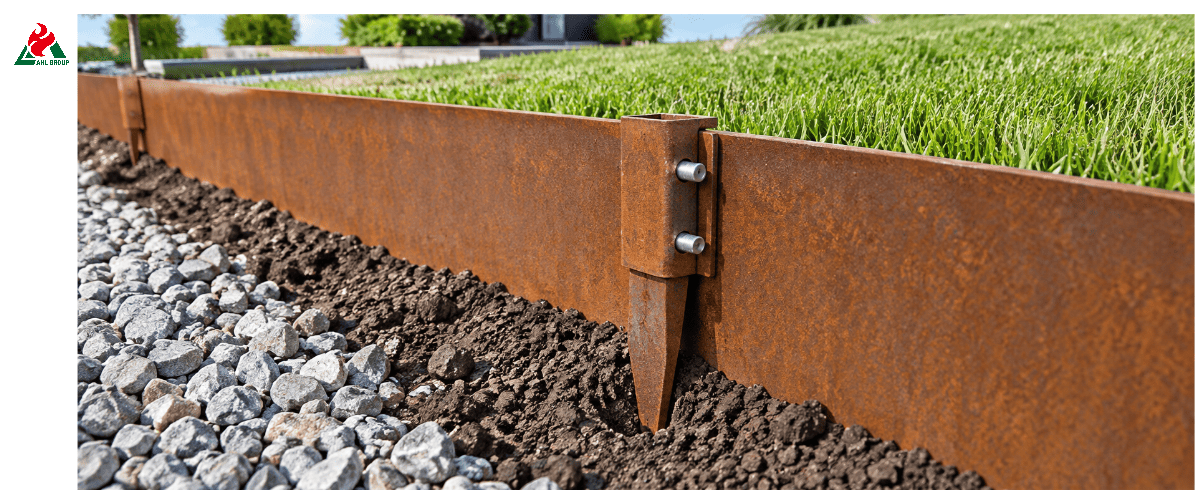
► Comparison of flat steel versus V-shaped/ribbed piles: Avoid using thin flat steel piles, as they are prone to lateral shearing in wet soil. Weather-resistant steel piles bent into a V-shaped cross-section (e.g., 25 × 25 × 3.0 mm angle steel), ribbed rebar piles, or tapered piles with barbs should be selected to maximize soil friction and passive soil wedge resistance.
Interlocking Overlap Tabs, Flush Splice Plates & Thermal Expansion Allowances
► Slotted Joint Panels and Sliding Lap Plates: Instead of butt-welding each steel strip into a single 50-meter-long continuous steel bar—which would cause the steel bar to bend laterally due to thermal expansion, forming serpentine corrugations—use interlocking sliding lap joints or install rear joint plates with slotted bolt holes every 3 to 6 meters, leaving a 2- to 3-millimeter expansion gap at the joints.
► Electrochemical Compatibility of Fasteners: Never use bright zinc-plated (BZP) screws to fasten weathering steel edging strips or ground anchors, as these screws will rapidly undergo sacrificial corrosion in moist soil. Be sure to use matching weathering steel clamping bolts/pins or 316 (A4) marine-grade stainless steel fasteners.
6. Stake Spacing & Anchoring Matrix by Soil Type and Load Class
Use the engineering matrix below to specify strip thickness, stake spacing, stake length, and trench base preparation across different site conditions:
| Site Condition & Load Scenario |
Recommended Strip Thickness | Max Stake Spacing (Center-to-Center) | Min Stake Length | Required Trench Base Detail | Joint Fixation Method |
| Firm Loam / Clay — Straight Lawn & Mulch Border |
1.6–2.0 mm (16–14 ga) | 800–1,000 mm (32–40 in) | 300 mm (12 in) | 50 mm compacted coarse sand or crushed stone | Interlocking tab or stake-pinned overlap |
| Tight Garden Curves & Tree Rings (R<1.0 m) |
1.5–1.6 mm (16 ga) | 450–600 mm (18–24 in) | 300–350 mm (12–14 in) | 50 mm compacted angular screenings | Double-staked overlap splice + rear clamp |
| Sandy, Loose or Newly Backfilled Topsoil |
2.0–2.5 mm (14–12 ga) | 600–750 mm (24–30 in) | 400–450 mm (16–18 in) | 75 mm compacted crushed aggregate (#57 stone) | Bolted rear splice plate + stake at joint |
| Compacted Gravel / Decomposed Granite (DG) Walkway |
3.0 mm (11 ga) | 600–800 mm (24–32 in) | 380–450 mm (15–18 in) | 100 mm compacted road base extending under strip | Rear splice plate with 316 SS bolts |
| Gravel Driveway Shoulder & Light Vehicular Edge |
4.0–6.0 mm (8 ga–1/4 in) | 450–600 mm (18–24 in) | 450–600 mm (18–24 in) V-angle stake | 100–150 mm compacted crushed stone or lean concrete | Heavy rear gusset plate or welded lug |
| Cold Climate Freeze-Thaw / Frost-Susceptible Silt |
2.0–3.0 mm (14–11 ga) | 600–750 mm (24–30 in) | 400–450 mm barbed/ribbed stake | 100–120 mm clean open-graded gravel + geotextile | Slotted expansion splice + deep barbed pin |
7. Frost Heave Prevention: How to Stop Corten Edging From Lifting in Winter
In the northern states of the U.S., Canada, the United Kingdom, Northern Europe, and high-altitude regions, frost heave (winter frost heave) is the primary cause of shallowly buried metal and plastic lawn edging lifting out of the ground in the spring. Fortunately, frost heave requires three conditions to occur simultaneously—fine-grained soil susceptible to frost heave, trapped capillary water, and temperatures below freezing—which means you can completely prevent frost heave by disrupting the water and adhesion mechanisms within the trench.
The Physics of Frost Jacking (Ice Lenses + Adfreeze Grip on Smooth Steel)
Frost heave is not caused solely by the 9% expansion of water in direct contact with steel. In fact, as sub-freezing temperatures penetrate fine-grained silt or clay, capillary action draws liquid water upward from the warmer groundwater table below, thereby feeding a growing horizontal ice lens.
► Tangential Freezing Grip: When moist fine silt or clay freezes in close contact with the vertical surface of a weathering-resistant steel strip buried underground (this interaction is referred to as “tangential freezing stress” in cold-region geotechnical engineering; see the Guide to Shallow Foundations in Cold Climates for details), the expanding ice lens lifts the steel strip and shallow piles upward by 10 to 35 millimeters.
► Why It Doesn’t Settle Back Down in Spring: When the topsoil thaws in early spring, loose, wet soil collapses into the cavity formed beneath the raised bottom edge of the steel strip. Over the course of three to four winters, this ratchet effect causes improperly installed boundary strips to rise higher and higher until the seams separate and a lawnmower’s blade strikes the raised top edge.
Defense 1 — Free-Draining Crushed Stone Trench Base (75mm–120mm Angular Gravel)
The single most effective measure to prevent frost heave is to eliminate capillary water retention around the steel strips:
► Excavate to a depth 75 mm to 120 mm (3 to 5 inches) greater than the burial depth of the steel strip: Do not allow the bottom edge of the Corten edging to come into direct contact with damp native silt or clay; instead, excavate a narrow trench 75 mm to 120 mm deep.
► Lay a non-woven geotextile and backfill with clean, angular gravel: Lay a permeable nonwoven filter fabric in the trench, and compact a layer of clean, washed, angular crushed stone 75 mm to 120 mm thick (e.g., 10 mm to 20 mm / ASTM #57 grade, free of fine dust) at the bottom of the steel strip and within 50 mm of the lower edges on both sides of the strip.
► Why clean gravel prevents ice lens formation: Coarse-grained, open-graded gravel has a large pore space that breaks capillary suction and immediately drains rainwater. Since water cannot adhere to the surface of the steel plate, the ice lens cannot grip or lift the edges.
Defense 2 — Deformed, Ribbed or Barbed Stakes Driven Into Deeper Subsoil
Smooth, short wooden stakes will slide upward along with the frozen surface crust. In USDA Zones 3–6 and cold-climate regions of Europe:
► Use 400-millimeter to 450-millimeter (16- to 18-inch) weather-resistant steel posts that are ribbed, twisted, or barbed. Driving longer posts 200 millimeters to 250 millimeters below the bottom of the trench anchors the lower half of the post in the deeper, denser soil beneath the active ground heave zone.
► Mechanical locking between the posts and the steel strip: Ensure the posts lock securely to the steel strip (achieved through penetrating rear brackets, stamped locking tabs, or welded top hooks). If the posts merely rest loosely against the steel strip without mechanical locking, the steel strip may still slide upward relative to the posts.
Defense 3 — Bilateral Compaction and Top-Edge Mower Clearance
Uncompacted trench backfill acts like a sponge drain, causing snowmelt to accumulate directly along the wire. When backfilling, always backfill in layers on both sides of the strip simultaneously and manually compact the soil or gravel in 50-millimeter (2-inch) layers. Lay the final 50 millimeters of turf or mulch at a slight downward slope away from the top edge so that winter snowmelt can drain away rather than accumulate at the trench joints.
8. Step-by-Step Field Installation & 90° Corner Forming Protocol
Whether you are laying a border bed in a residential garden or a walkway in a commercial park, following the proper construction sequence can effectively prevent wavy deformation in straight sections and deformation at corners caused by rebound.
Step 1: Trenching, String-Line Alignment & Gravel Subbase Preparation
► String-Line and Hose Layout: Drive temporary wooden stakes into the ground along the outer edge of the trench path, then stretch a fine masonry string tightly to mark straight sections (or lay a weighted garden hose to mark smooth curves). Before digging, inspect the string from both ends to eliminate any slight bends.
► Utility Line Inspection and Vertical Trenching: Confirm the locations of underground irrigation lines and low-voltage lighting cables. Using a flat-bladed, square-edged shovel or a mechanical trencher, excavate a trench with vertical walls and clean-cut edges to the target depth (curb burial depth + 50 mm to 100 mm of gravel base).
► Compacting the Subbase: Lay and compact a 50-millimeter to 100-millimeter-thick leveling layer of angular crushed stone or coarse sand, and check with a level to ensure that the top edge aligns smoothly with the surrounding terrain.
Step 2: Forming Smooth Sweeping Curves vs Sharp 90-Degree Corners
As detailed in our dedicated workshop guide on how to bend Corten steel edging to 90 degrees, select the appropriate corner-forming method based on the steel’s thickness:
► Thin, flexible strips (1.5 mm to 2.0 mm / 16-gauge to 14-gauge): Clamp the marked bend line securely between two square hardwood blocks on a sturdy workbench. Bend the free end smoothly by hand, then gently tap the jig square with a rubber mallet (never use a steel chisel hammer) to set the shape.
► Medium-rigidity steel strips (2.5 mm to 3.0 mm / 12-gauge to 11-gauge): Using a 115-millimeter (4.5-inch) angle grinder equipped with a 1.0-millimeter thin-metal cutting disc, score a shallow groove along the inner vertical bend line (depth: 30% to 50% of the wall thickness; for example, 1.0 millimeter deep on a 3.0-millimeter-wide strip), then bend it neatly to 90° on a hardwood block.
► Heavy-gauge structural steel plate (4.0 mm to 6.0 mm / 8 ga to 1/4 inch): Do not attempt to bend this by hand on-site. Order factory-bent 90° and 45° angle pieces, or miter two straight panels and bolt them together using internal weathering steel or 316 stainless steel L-brackets.
Step 3: Driving Stakes with a Rubber Mallet / Hardwood Block & Even Backfilling
► Assemble before driving to final depth: Along the trench, use interlocking clips or rear connecting plates to assemble 2 to 3 adjacent strips, ensuring the entire section forms a continuous beam-like structure, and then drive the ground piles into place.
► Protect the top edges during driving: Never strike the exposed top edges of the Corten steel borders directly with a steel hammer, as this will cause metal deformation and damage the oxide layer. Place a sacrificial hardwood block (such as a 50 × 100 mm scrap piece of lumber) across the top of the pile or strip, and strike this block with a heavy rubber non-rebound mallet or sledgehammer.
► Compact on both sides: Simultaneously backfill clean crushed stone and soil evenly on both sides, compacting each layer to a thickness of 50 mm, and check verticality every 1.5 meters using a torpedo level.
9. Frequently Asked Questions (FAQ)
Q1: What thickness of Corten steel edging is best for lawns vs driveways?
For curved residential lawns, flower beds, and tree rings, 1.6 mm (No. 16) to 2.0 mm (No. 14) is ideal, as this thickness can be easily bent by hand while withstanding wear and tear from lawn mowers and push mowers. For long, straight walkways and commercial lawns, choose 2.5 mm to 3.0 mm (No. 12 to No. 11). For gravel driveways, vehicle shoulders, and low retaining walls, select 4.0 mm to 6.0 mm (No. 8 to 1/4 inch).
Q2: How far apart should stakes be spaced for Corten steel landscape edging?
On straight residential lawns and paved areas, anchor posts should be spaced 800 millimeters to 1,000 millimeters (32 to 40 inches) apart (typically, two anchor posts per 1,075-millimeter-long edge strip, or three anchor posts per 2.4–3.0-meter-long edge strip). On sharp turns, slopes, and gravel driveways, reduce the spacing between ground anchors to 450 to 600 millimeters (18 to 24 inches), and be sure to install ground anchors at every joint and corner or within 100 millimeters of them.
Q3: How deep should Corten steel edging be buried to prevent frost heave?
Bury 50% to 60% of the edging’s total height underground (for example, a 150-millimeter-high edging should be buried 85 to 100 millimeters deep), placing the edging on a compacted, clean, angular gravel base that is 75 to 120 millimeters (3 to 5 inches) thick, clean, angular crushed stone base course wrapped in nonwoven geotextile, and anchor them with ribbed or barbed V-shaped wooden stakes 380 to 450 millimeters (15 to 18 inches) long, driving the stakes deep into undisturbed subsoil. Eliminating standing water around the steel strips prevents ice lenses from gripping and lifting the perimeter.
Q4: Will Corten steel landscape edging rust through underground?
When installed in well-drained soil or surrounded by a gravel drainage trench that allows water to seep away, genuine Corten steel curbs that comply with the ASTM A606-4 / A588 standard typically last 25 to 40 years or more. In heavy, poorly drained clay, increasing the thickness from 1.6 mm to 2.0 mm or 3.0 mm and adding a 50–100 mm layer of crushed stone for drainage can protect the buried portion from anaerobic pitting corrosion.
Q5: Can you bend 3mm or 6mm Corten steel edging by hand?
3.0-millimeter (11 gauge) strip can be bent into wide, gentle landscape curves (radius ≥ 1.8 to 2.5 meters), but to form a sharp 90-degree right angle, a 1.0-millimeter-deep groove must first be scored along the inner bend line using an angle grinder. Structural edging with thicknesses ranging from 4.0 mm to 6.0 mm cannot be bent by hand on-site; instead, factory-prefabricated bent corner pieces should be ordered, or bolted internal corner brackets should be used for assembly.
Q6: Is Corten steel edging safe around children, pets, and lawn mowers?
Yes, as long as the correct top profile and exposure height are selected. For home lawns, dog runs, and play areas, choose 1.6 mm to 2.0 mm edge strips with a rolled-edge safety flange or a 90 ° folded-back flange, or specify 3.0-millimeter to 6.0-millimeter architectural flat bar with chamfered and deburred top edges, and keep the exposed height above the lawn between 25 millimeters and 50 millimeters (1 to 2 inches).
Conclusion: Matching Gauge, Stake Spacing & Subbase to Your Landscape
A crisp, long-lasting Corten steel landscape edging installation is never an accident of material thickness alone—it is the result of pairing the right steel gauge with proper stake spacing and a frost-free drainage trench. Use 1.6 mm to 2.0 mm flexible strips for sweeping garden beds, 3.0 mm architectural flat bar for dead-straight aggregate walkways, and 4.0 mm to 6.0 mm heavy plate for driveways and low terrace steps; anchor straight lines every 800 mm to 1,000 mm (and curves/driveways every 450 mm to 600 mm); and bed the lower half in compacted crushed stone so winter freeze-thaw cycles never lift your sightline.
Whether you are sourcing modular spiked borders from our flexible Corten metal landscape border supplier range or specifying commercial flat bar from our heavy-duty Corten steel lawn edging series, our engineering team can customize strip thickness (1.5 mm to 6.0 mm), height (100 mm to 500 mm), and preformed corners to match your project drawings.
For step-by-step field techniques on stabilizing long runs, forming tight right angles, and managing soil moisture, explore our companion guides on how to stabilize Corten steel landscape edging, how to bend Corten steel edging to 90 degrees, and whether Corten steel edging needs wet-dry cycles.
Need Custom Corten Steel Planters or Landscape Edging?
Factory-direct 2mm-5mm Corten steel planter boxes and flexible lawn borders with pre-drilled drainage and stake anchoring systems.
» Custom Corten Planter Boxes | Corten Landscape Edging | Request a Factory Quote
Factory-direct 2mm-5mm Corten steel planter boxes and flexible lawn borders with pre-drilled drainage and stake anchoring systems.
» Custom Corten Planter Boxes | Corten Landscape Edging | Request a Factory Quote

