


When selecting or customizing a Corten steel plancha grill that provides even cooking, produces minimal smoke, and features a corrosion-resistant base, three key engineering details are essential: a 10-millimeter (3/8-inch) thick, food-grade carbon steel cooking plate (ring-shaped), designed with a slight inward slope of 2 to 4 millimeters to channel grease toward the central heat source rather than contaminating the outer areas; a double-walled fire cone with a main air intake at the bottom and a raised fuel grate that channels oxygen beneath the wood layer to facilitate clean secondary combustion; and a removable, slide-out ash tray, combined with an unobstructed rainwater drainage system, ensuring that alkaline, wet ash never remains on the weathering steel base plate. Although the outer cone and base, made of ASTM A588/Corten A steel, will develop a self-protective architectural-grade rust patina when exposed to the outdoors, it is the cooking ring, airflow channels, and ash drawer that truly determine this grill’s actual performance during open-flame cooking.
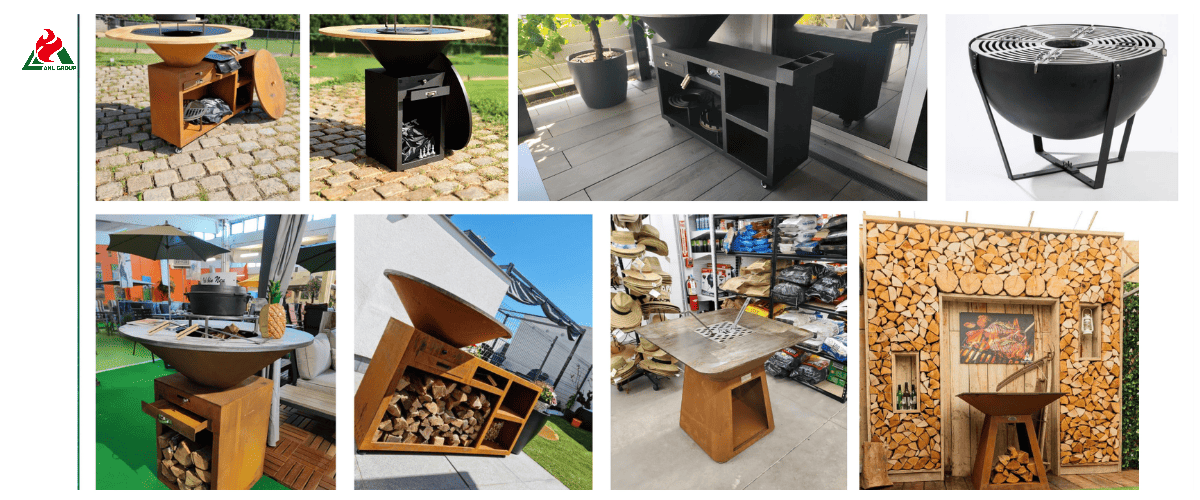
1. Anatomy of a Corten Steel Plancha BBQ Grill: Body vs Cooking Surface
A round or rectangular fire pit-style flat-bottomed grill looks like a weathered metal sculpture, but functionally, it is a heating system composed of various materials. Understanding which parts are made of weathering steel—and which must be made of carbon steel or stainless steel that is safe for food contact—is the foundation of safe and durable outdoor cooking.
Why the Outer Cone and Pedestal Use ASTM A588 / Corten A Weathering Steel
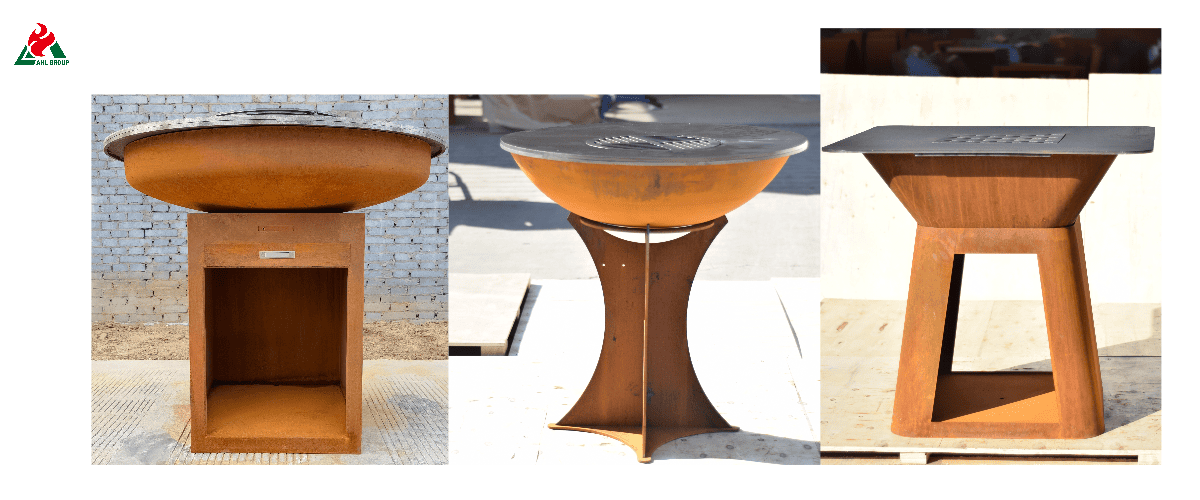
The outer cone (fire bowl shell) and the lower base cabinet—which typically incorporates an open firewood storage compartment, as shown in our Corten steel BBQ grill with wood storage—are both made of weathering steel such as Corten A or ASTM A588/EN 10025-5. By controlling the amounts of copper, chromium, nickel, and phosphorus added, the shell reacts with rainwater and oxygen during repeated wet-dry cycles to form a dense, tightly adherent, dark brown oxide layer (patina).
Unlike painted low-carbon steel cabinets—which bubble, flake, and peel when exposed to the radiant heat of a wood fire—unpainted Corten steel bases and outer cones do not require exterior repainting. In standard commercial and residential configurations (such as AHL’s BG1 through BG20 series), the lower base cabinet is formed from 2.0 mm to 3.0 mm thick structural weathering steel plate to ensure high column rigidity, while the conical fire bowl is made of 4.0 mm thick weathering steel to accommodate periodic thermal expansion.
Why You Never Cook Directly on Raw Corten Steel
A key engineering principle reflected in weathering steel guidelines and outdoor appliance design is that weathering steel is a structural exterior cladding material, not a food-contact cooking surface. Weathering steel relies on its active surface oxide layer to resist atmospheric corrosion; however, scraping spatulas, acidic marinades, animal fats, and localized intense contact heat will continuously strip away this oxide layer and transfer rust particles into the food.
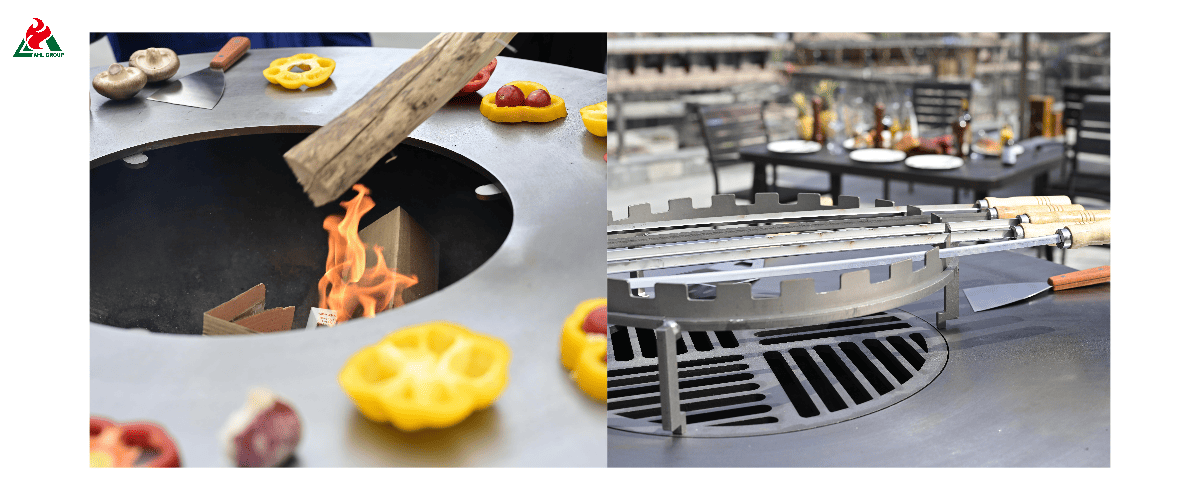
Therefore, every weathering steel plancha BBQ grill designed specifically for grilling is equipped with a separate, thick-gauge food-contact cooking ring (plancha plate) along the outer edge of the fire cone’s top:
► Pickled and oil-treated food-grade carbon steel (standard thickness: 10 mm): High-density hot-rolled carbon steel that has been descaled, precision-leveled, and seasoned with a high-smoke-point food-grade oil to form a natural, cast-iron-like polymerized non-stick surface.
► Food-grade 304 stainless steel (8 mm to 10 mm options available): Designed specifically for coastal dining establishments or buyers who prefer “wash-and-use” corrosion resistance without the need for maintenance or oil seasoning.
For a more comprehensive comparison of the differences between flat-top griddle fire pits and dedicated gas, charcoal, and hybrid grills, please refer to our guide, “Which Corten steel grill is best for home use?”
Key Structural Sub-Assemblies (850mm vs 1,000mm Bowl Configurations)
A complete set of commercial-grade Corten steel BBQ grill consists of six distinct mechanical components:
1. Top-mounted flat griddle cooking ring (10 mm carbon steel or 8–10 mm stainless steel): Typically with an outer diameter of 850 mm (33.5 inches) or 1,000 mm (39.4 inches) and a central fire pit diameter of 400 mm to 450 mm.
2. Raised central grill and accessory mounting base: A removable circular cast-iron or stainless steel grill (or wok ring) positioned directly above the central firewood/charcoal opening for open-flame grilling.
3. Conical fire bowl (4.0 mm weathering steel) + internal combustion liner: Serves as the primary heating chamber, supporting the fuel layer and radiating heat upward to the bottom of the flat-bottomed griddle ring.
4. Elevated fuel grate (charcoal/firewood grate): A heavy-duty steel bar grate located above the bottom of the conical fire bowl, allowing air to circulate beneath the firewood.
5. Pull-out ash pan/ash collection tray: Located beneath the fuel grate opening, it collects falling ashes and embers, making cleaning easy and allowing for tool-free emptying.
6. Base with wood storage compartment and leveling feet (total height 700 mm to 1,000 mm): Provides an ergonomic standing height, counterweights the heavy top ring, and raises the base off the patio surface.
2. 10mm Carbon Steel Cooking Plate (Ring): Thermal Mass, Warping & Grease Slope
When comparing outdoor charcoal grills, the most important specifications in a product spec sheet are the thickness and geometry of the top cooking ring. While entry-level retail models typically feature cooking rings that are 4 to 6 millimeters thick to reduce shipping weight, professional designs generally use 10-millimeter (3/8-inch) thick carbon steel cooking plates.
Why 10mm (3/8 Inch) Is the Sweet Spot for Wood-Fired Plancha Rings
The fire of kindling or charcoal briquettes in the center of a conical, bowl-shaped container cannot heat the top ring structure evenly. The tips of the flames and rising smoke concentrate intense heat on the inner circumference of the ring, while the outer periphery of the 1,000-millimeter-diameter disc is exposed to cooler ambient air. This results in a steep radial temperature gradient across the steel ring.
► Why 4- to 6-millimeter-thick steel plates warp (“potato-chip” deformation): Thin steel rings have a low section modulus, causing their inner edges to heat up rapidly before heat can conduct outward. The inner circumference expands faster than the cooler outer edges, generating circumferential compressive stress that forces the steel plate to buckle upward or twist out of the plane. Once a thin steel ring buckles, cooking oil accumulates unevenly, and the ring wobbles on the edge of the fire bowl.
► Why 10-millimeter carbon steel resists buckling and retains heat: Increasing the steel plate thickness from 5 millimeters to 10 millimeters not only increases out-of-plane bending stiffness eightfold but also doubles the thermal mass per square centimeter. A 10-millimeter-thick ring-shaped plate can absorb the asymmetric temperature peaks generated by a wood fire without experiencing localized buckling, and acts as a thermal flywheel—so when a cold steak or wet vegetables come into contact with the surface, the steel plate does not experience a sudden drop in temperature.
Concentric Heat Zones Across a 1,000mm Cooking Ring
Since carbon steel has a thermal conductivity of approximately 45 to 50 W/(m·K)— nearly three times that of 304 stainless steel (approximately 15 to 16 W/(m·K))—heat is efficiently transferred from the central burner toward the outer edge, creating three natural and simultaneously active cooking zones across a radial width of 300 to 350 millimeters on the ring-shaped cooking surface:
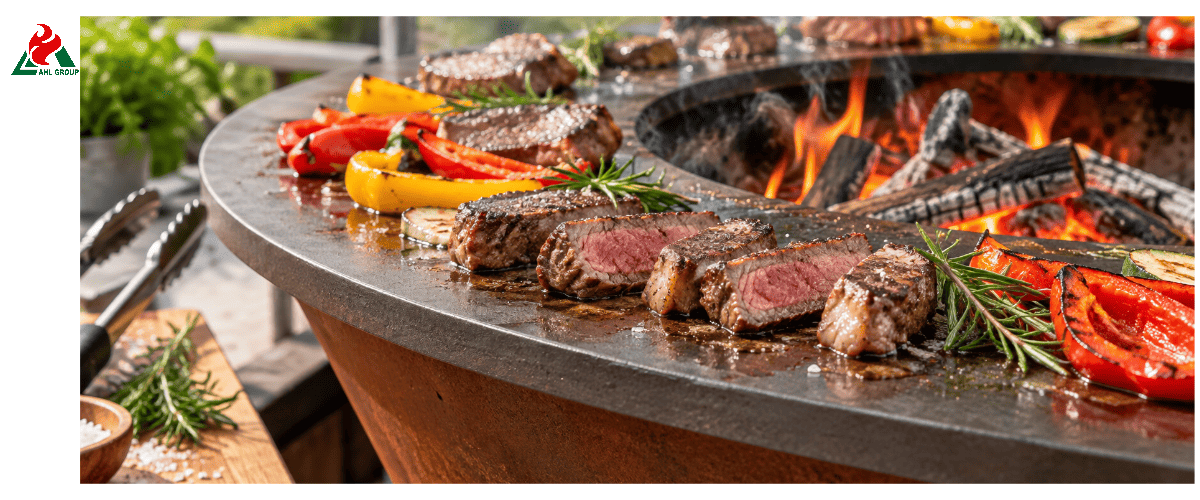
► Inner Searing Zone (280°C to 320°C / 535°F to 610°F): The innermost 80- to 100-millimeter area closest to the central burner provides intense Maillard reaction heat for ribeye steaks, pressed burgers, lamb chops, and skewered meats.
► Central Ring Cooking Zone (200°C to 250°C / 390°F to 480°F): The middle zone provides stable and controllable searing heat, ideal for shrimp, fish fillets, halloumi cheese, asparagus, sliced onions, crepes, and eggs.
► Outer Ring Warm-Hold and Slow-Cooking Zone (150°C to 190°C / 300°F to 375°F): The outer rim, spanning 60 to 80 millimeters, can be used to let cooked meats rest, warm flatbreads or rolls, and keep sauces or cast-iron skillets warm without burning them, while guests can socialize and cook simultaneously along the entire 360-degree perimeter.
Inward Grease Slope (Dish-Down Geometry) and Thermal Expansion Gap
One of the most common complaints from buyers regarding poorly designed flat-topped fire pits is that hot cooking oil drips from the outer edge of the ring stand, staining the weathering steel cone and leaving oil stains on the patio stone. High-quality 10-millimeter flat-bottomed griddle rings solve this problem by incorporating an inward-sloping concave-bottom geometry:
► The griddle ring is either precision-stamped or machined to form a slight inward taper of 1° to 2° (a drop of 2 to 4 millimeters from the outer edge to the inner rim), or designed with support clips and an initial heat treatment process that causes the inner edge to naturally curve downward toward the heat source.
► As a result, excess oil, butter, and marinades naturally flow inward and fall cleanly into the central firebox to burn away, while making the cleanup at the end of cooking a breeze—a gentle push with a flat-headed steel spatula is all it takes to send all residue directly into the embers.
► Peripheral Expansion Gap: The 10-millimeter ring must never be rigidly welded to the 4-millimeter weathering steel firebox. Instead, it should be placed on welded internal support brackets or positioning lugs, with a radial expansion gap of 3 to 5 millimeters and a venting gap of 6 to 10 millimeters, so that the carbon steel ring can expand freely when heated without causing cracks in the welds of the weathering steel cone.
Carbon Steel vs 304 Stainless Steel Plancha Plates
Both materials have their appropriate engineering applications, and buyers should make their choice based on local climate and cooking habits:
► 10 mm Carbon Steel (Standard Model, Favored by Chefs): Offers excellent thermal conductivity with faster radial heat transfer. It reacts with accumulated cooking oil to form a deep black, hydrophobic, and naturally non-stick patina. A thin protective oil film must be maintained on the pan’s surface during use.
► 8 mm to 10 mm 304 Stainless Steel (Optional Upgrade): Requires no seasoning to prevent surface rust during humid coastal winters and can be scrubbed to reveal a bare, shiny metal surface. However, stainless steel conducts heat more slowly (resulting in a greater temperature difference between the inner and outer edges), so slightly more cooking oil is needed during actual grilling to prevent delicate fish or eggs from sticking to the pan.
3. Cooking Plate Thickness & Material Comparison Table (6mm vs 8mm vs 10mm vs 12mm)
Use the engineering matrix below to compare plancha ring specifications when evaluating residential and hospitality models such as our heavy-duty Corten steel BBQ grill for gatherings:
| Plate Spec & Material |
Recommended Max Ring Diameter | Initial Heat-Up Time (Wood Fire) | Warping Resistance Under Live Wood Flame | Heat Retention & Zone Stability | Typical Complete Grill Weight | Best Application | ||
| 6 mm Mild / Carbon Steel |
≤750 mm (29.5 in) | 15–20 minutes | Low — prone to warping if quenched or over-fired | Moderate — temperature drops when loaded with cold food | 45–65 kg | Light occasional backyard use; compact portable bowls | ||
| 8 mm Carbon Steel |
800–850 mm (31.5–33.5 in) | 25–30 minutes | Good for moderate charcoal and small split logs | Good radial gradient for 4–8 guests | 70–95 kg | Standard residential patios and medium family gatherings | ||
| 10 mm Carbon Steel (AHL Standard BG Series) |
850–1,000 mm (33.5–39.4 in) | 30–40 minutes | Excellent — handles intense hardwood fires without buckling | High thermal flywheel; stable 3-zone heat for hours | 101–176 kg (model dependent) | All-season residential estates, glamping resorts & catering | ||
| 12 mm Heavy Carbon Steel |
1,000–1,250 mm (39.4–49.2 in) | 45–55 minutes | Maximum industrial stiffness for multi-hour wood fires | Extreme thermal mass; slow response to fuel changes | 180–260+ kg | High-volume commercial hospitality, hotels & event venues | ||
| 8–10 mm 304 Stainless Steel |
850–1,000 mm (33.5–39.4 in) | 35–45 minutes | High (requires proper stress-relief support tabs) | Moderate conductivity; sharper inner-to-outer heat drop | 105–160 kg | Coastal properties, salt-air zones & low-maintenance rentals | ||
How to Match Bowl Diameter (850mm vs 1,000mm) and Pedestal Height to Your Patio
Among AHL’s factory production lines (models BG1 through BG20), the following two size combinations are the most common in actual installations:
850 mm diameter × 1,000 mm height (approximately 73 kg to 122 kg): Ideal for residential patios hosting gatherings of 4 to 8 people. The 850 mm fire ring heats up about 20% faster and uses less firewood per use, while still providing the spacious and comfortable 1,000 mm standing operating height.
Diameter 1,000 mm × Height 900 mm to 1,000 mm (approximately 105 kg to 176 kg, or 1,300 mm in length for BG3/BG4/BG14/BG15 models equipped with a side prep table): Designed specifically for gatherings of 10 to 25 or more people, outdoor kitchens, and commercial settings. The 900-millimeter to 1,000-millimeter height allows adults to cook while standing upright without experiencing back strain, while the low-profile models ranging from 530 millimeters to 700 millimeters (such as the BG11, BG12, and BG13) are specifically designed for seated social gatherings, where the unit can also serve as a social fire pit.
4. Airflow Engineering: Double-Wall Fire Cone, Draft Control & Low-Smoke Burn
The 10-millimeter-thick carbon steel grilling tray can only reach a stable grilling temperature when the fire cone beneath it receives a continuous, controlled supply of oxygen. Because the flat-bottomed tray ring on top covers 75% to 80% of the fire basin’s opening area, a flat-bottomed tray grill cannot rely on open, top-down air diffusion like an open-air campfire.
Why Single-Wall Unvented Fire Bowls Choke Wood Fires and Produce Heavy Smoke
When firewood or charcoal is placed directly on the sealed base of a single-wall steel cone equipped with a flat-bottomed grill ring, two types of combustion failures occur within 20 to 30 minutes:
► Oxygen Deprivation at the Base: As the first batch of firewood burns out, falling ashes bury the embers at the bottom. Since fresh air can only enter through the central opening at the top of the cooking ring—where rising hot smoke is simultaneously trying to escape—the incoming cold air collides with the rising exhaust gases, causing oxygen deprivation at the base of the fire and producing thick, acrid white smoke.
► Localized overheating of the outer cone: Due to the lack of a lining or air gap, the red-hot firewood comes into direct contact with the outer wall of the 4-millimeter-thick weather-resistant steel cone, creating localized hot spots exceeding 600°C. This not only accelerates the formation of scale on the interior but also radiates excessive heat toward guests’ legs.
Bottom Primary Air Intake & Raised Fire Grate (Charcoal/Log Grid)
This well-designed BBQ grill made of Corten steel creates true vertical chimney draft (“chimney effect”) by introducing primary combustion air from beneath the fuel layer:
► Elevated, heavy-duty fuel grate: A removable perforated plate or thick steel bar grate is positioned 80 to 150 millimeters above the fire cone base plate. Hardwood logs and charcoal briquettes are placed on this grate, while fine ash falls through the gaps into the collection area below, ensuring that the airflow channel beneath the glowing embers remains completely unobstructed.
► Main Air Inlet from the Base to the Firebox: Fresh ambient air enters through ventilation slots concealed within the Corten steel base and flows upward through the opening at the bottom of the cone, located directly beneath the fuel grate. As the hot airflow rises through the center of the cooking ring, it naturally draws cool, oxygen-rich air into the fuel bed.
Double-Wall Inner Liner & Annular Secondary Air Gap
High-end commercial flat-top grills—as well as architectural fire pits designed for extended service life (see our guide on “whether Corten steel can be used for fire pits” for details)—feature an inner combustion cone or combustion basket made of stainless steel or heavy-duty carbon steel, separated from the outer weathering steel shell by a 15-millimeter to 30-millimeter annular air gap:
► Preheated Secondary Combustion: As air rises through the annular gap between the inner fire liner and the outer weathering steel cone, it is preheated and then discharged through the upper air intake located directly below the cooking ring. When this superheated oxygen mixes with the unburned volatile wood vapors rising from the firewood, it triggers secondary combustion—completely burning off the smoke particles before they exit the central ring-shaped opening and raising the temperature at the bottom of the cooking tray.
► Thermal Shielding of the Outer Weathering Steel Shell: This air gap acts as a convective insulation layer, significantly reducing the temperature of the outer weathering steel cone and maintaining a uniform, aesthetically pleasing patina on the exterior of the stove.
Adjustable Draft Dampers and Top-Ring Exhaust Clearance
To allow cooks to precisely control the cooking surface temperature without constantly moving the firewood, please note the following two mechanical airflow control devices:
► Sliding or Rotating Air Inlet Damper: Located at the base of the cone or embedded in the front of the base ash pan, this adjustable damper allows you to fully open the primary air inlet during ignition (to quickly heat a 10-millimeter-thick baking sheet to 300°) and adjust it to 30%–50% open once a thick layer of hardwood coals has formed.
► Perimeter exhaust gap lugs (6–10 mm gap): The 10-mm-thick cooking ring is supported by welded internal lugs that maintain a narrow 6–10 mm perimeter exhaust gap (or dedicated ventilation channel) between the outer edge of the cooking ring and the rim of the weathering steel bowl. This ensures that smoke can escape from the perimeter without extinguishing the flame, even when large paella pans, Dutch ovens, or solid-bottomed skillets are placed over the central opening.
5. Ash Pan, Hopper & Rainwater Drainage Design: Preventing Bowl Floor Corrosion
During field inspections of outdoor metal grills and fire pits, premature corrosion rarely begins on the outer surface of the weathering steel shell. Instead, corrosion begins at the base of the fire cone—where it occurs when wet wood ash becomes trapped with rainwater.
The Chemistry of Wet Wood Ash (Alkaline Lye Paste + Trapped Moisture)
Hardwood and charcoal ashes are highly hygroscopic and rich in potassium carbonate, calcium oxide, and soluble salts. When rainwater enters the central opening of an uncovered flat-bottomed grill and mixes with residual ashes at the base of the cone, it forms a thick, alkaline paste (pH 10 to 12).
As emphasized in structural weathering steel corrosion guidelines and our guide on Corten steel fire pit care to stop rust, Corten steel must be thoroughly dried between rainstorms to maintain its protective oxide layer.
Wet mortar acts like a chemical sponge clinging to the steel base plate: it blocks the entry of oxygen, preventing the steel from drying out for weeks on end, and can cause localized mortar corrosion and crevice corrosion around the bottom welds.
Slide-Out Ash Drawer vs Drop-In Ash Bucket / Hopper Systems
Depending on whether you choose a closed base cabinet, an open firewood storage column, or a low-profile leisure fire pit, the manufacturer will incorporate one of the following two engineered ash removal designs:
Base Pull-Out Ash Drawer (Best Suited for Frequent Cooking and Food Service):
► Directly integrated into the upper portion of the Corten steel base, located directly below the fire cone throat.
► Once the grill has cooled completely, the operator simply sweeps the fine ash from the bottom of the fire cone into the drawer through the central opening, pulls the drawer out from the front or rear of the base, and empties it into a lidded metal ash bucket—without having to lift the 10-millimeter-thick cooking ring, which weighs between 50 and 80 kilograms.
► High-quality pull-out ash pans are equipped with a sloped drip lip or a labyrinth-style splash guard to prevent water running down the inside of the cone from leaking onto the front of the base.
Top-Lift Drop-In Ash Bucket / Internal Hopper (Common on Compact or Low Bowls):
► A cylindrical stainless steel or carbon steel ash bucket with a handle, recessed into the center of the cone beneath the removable fuel grate.
► To empty the ash bucket, first remove the central grate and fuel grate (while keeping the 10-millimeter main outer ring in place), then grasp the handle and lift the ash bucket straight upward.
Dedicated Rainwater Weep Channels and Base Riser Clearance
Even when equipped with an ash tray, outdoor flat-bottomed grills must ensure an unobstructed drainage path to prevent heavy rain from turning the fire bowl into a puddle:
► Unobstructed bottom drainage holes: The base of the cone and the ash tray must have sufficiently large drainage openings (≥15 to 25 millimeters) to ensure that a thin layer of ash cannot completely block them; this must be combined with sloped deflector plates to direct rainwater into the base rather than splashing onto the cook’s shoes.
► Recessed base feet or leveling bolts (15 to 25 mm clearance): Never place a flat-bottomed weather-resistant steel base directly against porous limestone, sandstone, or concrete pavers. Raising the base using 15–25 mm stainless steel adjustable leveling feet or welded weathering steel shims ensures airflow beneath the unit, prevents water accumulation due to capillary action, and levels the 10 mm cooking ring on sloped patio surfaces.
6. Airflow & Ash System Architecture Comparison Table
When comparing plancha grill proposals or customizing an OEM order, evaluate the internal combustion and ash-handling architecture using this breakdown:
| Design Architecture |
Primary Airflow Path | Ash Removal Method | Outer Cone Heat Protection | Rainwater Drainage Control | Maintenance Effort & Best Use Case |
| Single-Wall Sealed Bowl (Entry-Level) |
Top-down only (through center ring opening) | Manual shoveling after lifting off the heavy cooking ring | None — flames contact outer 3–4 mm Corten wall directly | Small center hole easily plugged by wet ash paste | High effort — prone to smoke and wet-ash corrosion; light occasional use only |
| Single-Wall Cone + Elevated Fuel Grid + Drop-In Ash Bucket |
Bottom draft vents through base of cone under fuel grate | Lift out center grate & fuel grid; pull up internal ash bucket | Partial — raised fuel grate keeps glowing coals off the bottom weld | Central drain through ash bucket receiver into pedestal | Low-to-moderate effort — great for 850–1,000 mm home patio grills |
| Double-Wall Cone + Damper + Slide-Out Ash Drawer (Commercial Spec) |
Metered bottom primary intake damper + preheated annular secondary air | Sweep ash through throat; pull out external slide-out drawer (ring stays in place) | Full — inner fire liner shields outer Corten cone and boosts plate heat | Separated ash drawer baffle + dedicated base weep channels | Lowest effort & cleanest burn — ideal for frequent home chefs, resorts & restaurants |
Inspecting Welds, Removable Wear Parts, and Pedestal Wood Storage Ventilation
If your barbecue grill has an integrated firewood storage compartment at the bottom of the base (such as the BG4 model, which measures 1,000 mm × 1,300 mm × 1,000 mm, or the BG2 model, which measures 1,000 mm × 1,000 mm), please ensure the firewood compartment has ventilation slots at the rear or bottom and is equipped with a raised bottom shelf. Stacking damp firewood directly on the unventilated weather-resistant steel floor will cause moisture from the bark to remain on the steel surface. Maintaining an air gap of 15 to 20 millimeters around the firewood storage compartment will accelerate the drying of the firewood and ensure that primary combustion air can always reach the air intake damper in the ash pan above.
7. First Burn-In, Seasoning the 10mm Carbon Steel Ring & Routine Care
The newly delivered 10-millimeter carbon steel cooking rings are made of natural silver-gray machined steel and coated with a thin layer of factory-applied rust-preventive shipping oil; the weathering steel cones and bases, on the other hand, feature a pre-weathered or dark steel slag finish that will naturally rust when left outdoors. Before cooking food for guests, you must complete the initial heat-seasoning and oil-curing cycle.
Factory Protective Oil Removal and First Thermal Conditioning Fire
► Degrease the new cooking ring: Before the first ignition, thoroughly clean both sides of the 10-millimeter carbon steel cooking ring with hot water, mild dish soap, and a clean sponge or cloth to remove all factory shipping oil and workshop dust. Rinse with clean water and dry thoroughly.
► Light a controlled, medium-intensity central fire: Place kiln-dried hardwood logs (such as oak, beech, ash, or hickory) or natural lump charcoal on the raised fuel grate in the center of the cone. Avoid a roaring fire for the first 15 minutes; allow the temperature to rise gradually over 25 to 30 minutes.
► Verify the inward-sloping heat crown: When the inner edge of the 10-millimeter carbon steel ring reaches 250° to 300°, thermal expansion will gently pull the inner circumference down toward the center of the fire by 2 to 4 millimeters, creating a permanent inward drainage slope.
Step-by-Step High-Smoke-Point Oil Seasoning (Polymerized Non-Stick Layer)
Once the cooking ring has been heated evenly across its entire radial width (after 30 minutes of heating):
► Choose a neutral oil with a high smoke point: Use refined grapeseed oil, canola oil, sunflower seed oil, or a specialized carbon steel seasoning wax (smoke point ≥ 200° to 230°). During the initial seasoning process, avoid using butter, unrefined extra virgin olive oil, or salted fats, as these will burn and become sticky at lower temperatures.
► Apply a paper-thin, radial layer of oil: Pour 1 to 2 tablespoons of oil onto the warm outer rim of the 10-millimeter ring, and—wearing heat-resistant gloves—use long tongs to hold a folded, lint-free cotton cloth or thick paper towel to spread an extremely thin film of oil over the entire top surface and inner rim.
► Scrape off and repeat 3 to 4 cycles: Allow the oil film to smoke and polymerize for 10 to 15 minutes, until the steel changes color from bronze to a deep espresso brown, eventually taking on a satin black finish. Gently smooth the surface with a flat-bladed steel scraper to remove any raised areas, then apply 2 to 3 more thin layers of oil. By the fourth layer, the 10-millimeter carbon steel ring will have formed a hard, water-repellent, and naturally non-stick black protective layer.
Post-Cook Scraping, Ash Emptying, and Snuffer Lid / Cover Rules
To ensure that the 10-millimeter carbon steel cooking ring and the weathering steel body remain in optimal condition for decades, please follow the section-by-section cleaning guidelines detailed in our guide, “How to Clean a Corten BBQ Grill Professionally”:
► While the cooking ring is still warm (within 5 minutes after cooking): Using a flat-headed stainless steel spatula, scrape all caramelized food residue and excess grease radially inward toward the central fire pit. If stubborn sugar residue from marinades remains, use a few ice cubes or a small amount of warm water (never pour cold water over the entire grill) to remove the char. After scraping, apply a fresh, ultra-thin layer of cooking oil before the steel plate cools completely.
► After the grill has cooled overnight (12–24 hours later): Sweep the cold ashes into the pull-out ash drawer or built-in ash bucket, transfer them to a lidded metal container in accordance with municipal outdoor grilling fire safety guidelines, and ensure that the rainwater drainage holes at the bottom are completely unobstructed.
► Never apply oil to the weathering steel body, and do not allow moisture to remain trapped under the lid: oil should only be applied to the 10-millimeter carbon steel cooking grate and the cast-iron center grate—never to the weathering steel cone or base. Once the grill has cooled completely and dried, place the steel fire-extinguishing cover (top plate cover) over the 10-millimeter cooking ring to protect the seasoned carbon steel from rain damage, while allowing the outer weathering steel cone to remain exposed to normal outdoor air circulation.
8. Frequently Asked Questions (FAQ)
Q1: Can you cook food directly on a Corten steel cooking plate?
No. Never cook food directly on untreated weathering steel (Corten steel). In a properly designed weathering steel flat-bottomed grill, the weathering steel is used only for the outer fire bowl cone and base, while the top cooking ring—which comes into direct contact with food—is made of 10-millimeter-thick food-grade carbon steel or 304 stainless steel.
Q2: Why is a 10mm carbon steel cooking ring better than a 6mm plate?
A 10-millimeter (3/8-inch) thick carbon steel cooking ring has eight times the out-of-plane bending stiffness of a 5–6-millimeter-thick steel plate and nearly twice the thermal mass. It resists “potato-chip-like” warping under intense heat, maintains stable, concentric temperature zones (280°C to 320°C in the inner grilling zone and 150°C to 190°C at the outer edge), and does not lose heat when cold steaks or seafood are placed on it.
Q3: Does the 10mm carbon steel cooking ring rust when left outdoors?
Since this cooking ring is made of food-grade carbon steel rather than weathering steel, it relies on a seasoned layer of cooking oil (similar to a cast-iron skillet or French carbon steel pan) to prevent surface rust. After each use, scrape the still-warm cooking ring clean, apply a thin layer of high-smoke-point cooking oil, and once it has cooled, cover the top ring with a metal fire-resistant lid. If slight surface rust appears after winter, simply brush it off, oil the cooking ring, and season it again over the fire.
Q4: How often should you empty the ash pan in a Corten BBQ grill?
Clean the pull-out ash tray or built-in ash bucket after every 1 to 3 grilling sessions (once the ashes have cooled overnight for 12 to 24 hours); be sure to clean it thoroughly before heavy rain is forecast or before storing the grill for the season. Removing the ashes keeps the main air intake clear and prevents damp, alkaline ashes from corroding the bottom of the fire bowl.
Q5: How long does it take to heat up a 10mm plancha cooking ring?
Using dry hardwood logs or charcoal briquettes, with the main air intake damper open, a 10-millimeter carbon steel cooking ring mounted on an 850-millimeter to 1,000-millimeter Corten steel flat grill typically reaches grilling temperature (inner ring temperature of 250°C to 300°C) within 30 to 40 minutes. Once preheated, its thermal mass ensures that the cooking temperature remains stable for several hours, requiring only minimal replenishment of firewood.
Conclusion: Specifying a Plancha Grill Built for Decades of Live-Fire Cooking
A sculpture-grade Corten steel plancha BBQ grill is only as good as the thermal and mechanical engineering hidden inside its weathered cone. By specifying a 10 mm food-contact carbon steel cooking ring with an inward grease slope, a double-wall airflow system with an elevated fuel grate and adjustable draft damper, and a removable slide-out ash pan with positive rainwater drainage, you get an outdoor cooking centerpiece that sears effortlessly for 10 to 25+ guests without warping, choking on smoke, or rusting at the base.
Whether you are selecting a 1,000 mm diameter model with integrated log storage like our BG4 Corten steel BBQ grill with wood storage or a commercial hospitality unit like our BG5 heavy-duty Corten steel BBQ grill for gatherings, always verify plate thickness, steel grade (ASTM A588 / Corten A), airflow path, and ash-drawer access before ordering.
For complementary guides on model selection, cleaning, and fire-bowl maintenance, explore our articles on which Corten steel grill is best for home use, how to clean a Corten BBQ grill professionally, whether Corten steel can be used for fire pits, and Corten steel fire pit care: 7 best practices to stop rust.
Looking for a Custom Wood-Fired Corten Steel BBQ Grill?
Explore AHL Corten Group's heavy-duty weathering steel plancha grills with food-grade carbon steel cooking rings and integrated log storage.
» Browse All Corten BBQ Grills | BBQ Grates & Accessories | Get Wholesale Pricing
Explore AHL Corten Group's heavy-duty weathering steel plancha grills with food-grade carbon steel cooking rings and integrated log storage.
» Browse All Corten BBQ Grills | BBQ Grates & Accessories | Get Wholesale Pricing

