


To install a Corten steel water feature that operates quietly, creates a continuous water curtain, and prevents rust from forming on surrounding paved surfaces, the key lies in making the following three engineering decisions: Match the pump flow rate (measured in liters per hour or gallons per hour at the actual head) to the width of the overflow outlet; Use an internal overflow baffle (diffusion chamber) with sharp drip edges to calm turbulence within the piping; and separate the exposed weathering steel surface from the permanently submerged basin—the latter requires a pond-safe waterproof seal and an initial flushing cycle.
Unlike painted steel or precast concrete fountains, weathering steel (Corten) is a “living” building material. Only after undergoing cycles of wetting and drying does its outer surface form a dense, protective oxide layer. In contrast, the humidity conditions in submerged water collection basins, internal welds, and splash zones on light-colored stone pavers are entirely different; therefore, appropriate piping and sealing must be implemented.
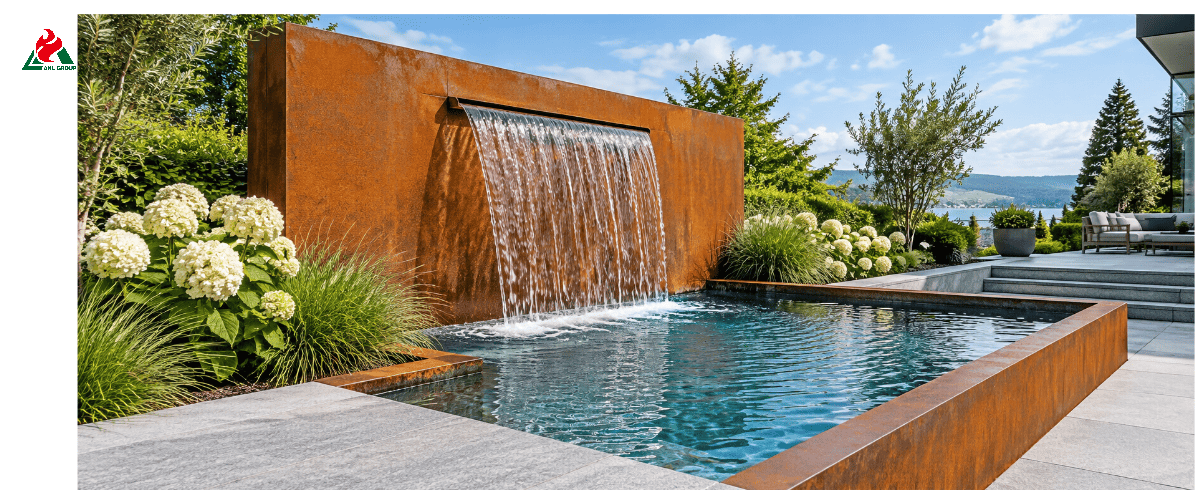
Unlike painted steel or precast concrete fountains, weathering steel (Corten) is a “living” building material. Only after undergoing cycles of wetting and drying does its outer surface form a dense, protective oxide layer. In contrast, the humidity conditions in submerged water collection basins, internal welds, and splash zones on light-colored stone pavers are entirely different; therefore, appropriate piping and sealing must be implemented.
1. How a Corten Steel Water Feature Works as a Closed-Loop System
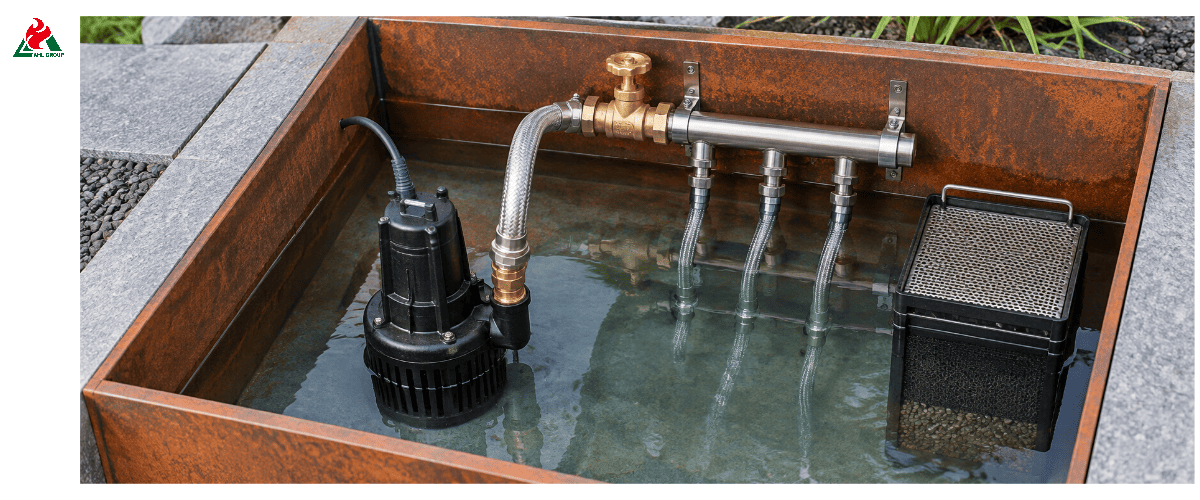
A modern Corten water feature operates using a self-contained, closed-loop hydraulic system. Water stored in the base reservoir—whether an exposed weathering steel reflection trough or a concealed underground pebble pool—is drawn into a submersible pump or in-line pump, transported upward through supply pipes and flow control valves, distributed within the top overflow weir or water level regulation chamber, and finally returns to the pool via the overflow weir plate or bubble jet surface.
The Four Core Components: Reservoir Basin, Recirculating Pump, Plumbing Manifold, and Spillway Body
Every reliable installation system requires a balance among four interdependent components:
► Water Reservoir: Holds the water volume required for operation and provides reserve capacity to account for wind-induced evaporation, natural evaporation, and water lost “in transit” during pump operation.
► Circulation Pump: Overcomes gravity and pipeline friction to deliver the required water volume.
► Piping and Manifold: Connects the pump to the overflow outlet via kink-free piping, fittings, check valves (for high vertical lift), and in-line throttle ball valves.
► Overflow Outlet Body and Internal Baffles: Transform the high-velocity water jet from the piping into a calm, even water curtain or gentle ripples on the water’s surface as it flows over the weather-resistant steel surface.
Why Weathering Steel Behaves Differently in Moving Water vs Open Air
The stable, strongly adherent layer of rust (“rust patina”) on Corten steel, which slows corrosion, requires repeated cycles of wetting and drying in the presence of oxygen.
When water features are programmed to operate on a daily schedule, allowing the steel surface to remain completely dry for several hours each day, exterior wall panels and vertical water curtains that are intermittently wetted by water will develop a rich, dark brown patina.
In contrast, the interior of pools that remain submerged for extended periods and joints that are continuously flooded will never dry out. In the absence of oxygen-rich drying intervals, exposed weathering steel in still water will continue to corrode at a rate similar to that of ordinary carbon steel, releasing suspended iron oxide particles that cause the water to turn orange.
Common Corten Water Feature Styles: Spillway Blades, Water Tables, Sphere/Cube Fountains, and Rill Channels
Different styles of water features vary significantly in terms of water flow and sealing requirements. For a wider range of layout inspiration, please refer to our guide on how to design Corten water features:
► Waterfall Blades (Overflow Vertical Waterfalls): Pump flow rate must be precisely calculated based on every 100 millimeters (4 inches) of overflow width, and the system must be equipped with internal diffuser baffles to prevent the water curtain from being compressed or split.
► Weathering Steel Water Tables and Reflective Blocks: Use low-flow, upward-bubbling nozzles to ensure the water flows evenly across a completely level top surface and gently overflows into the surrounding troughs from all four sides.
► Sculptural Spheres, Cubes, and Cylinders: Rely on a calm, laminar film formed on curved or vertical steel surfaces, resulting in an extremely small splash radius.
► Linear Garden Streams: Water flows along a shallow, horizontal channel between upper and lower basins; the channel slope must be precisely calculated, and the catch basin must have sufficient storage capacity.
2. How to Choose the Right Pump Size: Flow Rate (L/H & GPH) and Head Height
Choosing the wrong pump is the most common cause of excessive fountain noise, water splashing onto patio pavers, and weak or intermittent flow from waterfall curtains.
Why "Max Pump Flow" on the Box Is Not Your Actual Spillway Flow
Every pump manufacturer lists the maximum flow rate (L/H or GPH) on the packaging. This value is measured under zero-head conditions—that is, when the pump discharges horizontally at water level and is not connected to vertical piping. Once the pump is installed at an overflow outlet 800 millimeters, 1,200 millimeters, or 1,800 millimeters above the pool’s water surface, gravity and friction against the pipe walls will reduce the actual output flow rate.
Be sure to select a pump based on the manufacturer’s performance curve (flow-head diagram) to ensure that the pump can deliver the required L/H flow rate at the actual operating head (rather than zero head).
Baseline Flow Rate Reference by Water Feature Type and Spillway Width (L/H and GPH)
Since on-site wind conditions, head height, and required noise levels vary, professional installers will select a pump at the upper limit of the target range and use a ball valve to adjust the water curtain thickness precisely:
► Bubble fountains and single-outlet low-plume fountains: Typically, each bubble nozzle requires 600 to 1,500 L/H (160 to 400 GPH) to form a gentle 25–50 mm water dome without excessive splashing.
► Gentle architectural water curtains/wet-surface film flows: Typically, 900 to 1,500 L/H is required for every 300 mm (12 inches) of overflow weir width—approximately 300 to 500 L/H (80 to 130 GPH) per 100 mm (4 inches)—to maintain uniform wetting of the vertical steel surface.
► Standard free-fall overflow channel (waterfall blade drop up to 900 mm): Typically, 1,500 to 2,400 liters per hour are required for every 300 millimeters (12 inches) of overflow width—approximately 500 to 800 liters per hour (130 to 210 gallons per hour) for every 100 millimeters (4 inches)—to maintain a continuous, uninterrupted water curtain.
► High-drop or larger commercial-grade waterfalls (drop exceeding 1,000 mm): Typically, 2,400 to 3,600 liters per hour are required for every 300 millimeters (12 inches) of width—approximately 800 to 1,200 liters per hour (210 to 315 gallons per hour) for every 100 millimeters (4 inches)—to prevent wind and air resistance from tearing the falling water curtain apart in midair.
Calculating Total Dynamic Head (Vertical Lift + Plumbing Friction)
Before consulting the pump performance curve, you must first calculate the total dynamic head (TDH):
► Measure the vertical static head: Measure the vertical distance (in meters or feet) from the reservoir’s minimum operating water level to the edge of the spillway outlet.
► Add pipeline friction losses: For each 90-degree elbow, check valve, or reducer, add approximately 0.2 to 0.3 meters (0.7 to 1.0 feet) of equivalent head, plus the friction losses generated along the length of the pipe.
► Add a 15% to 25% margin: Select a pump whose flow rate (L/H) is 15% to 25% higher than the minimum target value for the spillway outlet at the calculated total head (TDH). This ensures the pump operates smoothly without overloading, even when leaves or biofilm accumulate in the intake pre-filter between cleanings.
Why Every Corten Water Feature Needs an In-Line Ball Valve and Oversized Piping
Never connect the pump directly to the overflow outlet without installing a flow control valve, and never use narrow tubing to restrict water flow. Select hoses with smooth inner walls, free of kinks, and matching the pump’s maximum discharge size (for example, use a hose with an inner diameter of 25 mm / 1 inch for medium-sized overflow outlets, and a hose with an inner diameter of 32–40 mm / 1.25–1.5 inches for wide commercial blades) to minimize friction losses. Install a PVC or 316 stainless steel straight-through ball valve on the outlet pipe (or use a 24V DC variable-speed pump with an external controller) to precisely adjust the water curtain shape to the patio's specific acoustic and splash-effect requirements.
3. Reference Table: Pump Flow Rate (L/H & GPH) by Spillway Width and Water Effect
Use the engineering reference table below when sizing pumps and supply hoses for residential and commercial Corten steel water features (flows shown are actual delivered flow at the spillway height, not zero-head ratings):
| Water Feature / Spillway Style |
Spillway Width or Outlet Count | Target Delivered Flow Rate (L/H) | Target Delivered Flow Rate (GPH) | Recommended Hose ID (mm / in) | Acoustic & Splash Profile |
| Single Bubbler Water Table |
1 central upwelling nozzle | 800 – 1,500 L/H | 210 – 400 GPH | 19–25 mm (3/4" – 1") | Whisper-quiet ripple; minimal splash |
| Multi-Nozzle Long Water Table |
3 upwelling nozzles (1.5–2.4 m table) | 2,400 – 4,200 L/H total | 630 – 1,100 GPH total | 25–32 mm (1" – 1.25") manifold | Gentle perimeter sheet; low splash |
| Compact 300 mm (12") Spillway Blade |
300 mm (12 in) sheet weir | 1,500 – 2,400 L/H | 400 – 630 GPH | 25 mm (1") | Crisp garden trickle; compact basin |
| Medium 600 mm (24") Spillway Blade |
600 mm (24 in) sheet weir | 3,000 – 4,800 L/H | 800 – 1,270 GPH | 32 mm (1.25") | Full architectural curtain; moderate sound |
| Wide 900 mm (36") Spillway Blade |
900 mm (36 in) sheet weir | 4,500 – 7,200 L/H | 1,190 – 1,900 GPH | 38–40 mm (1.5") or dual inlets | Bold visual sheet; requires wider apron |
| Commercial 1,200 mm (48") Cascade |
1,200 mm (48 in) dual-inlet weir | 6,000 – 9,600+ L/H | 1,585 – 2,535+ GPH | Dual 32–40 mm (1.25" – 1.5") | High acoustic presence; deep catch basin |
4. Spillway Baffle & Weir Design: How to Get Smooth, Even Sheet Flow
Even if the pump is perfectly sized, a chaotic and uneven waterfall will form if there are no internal baffles in the overflow tank.
Why Water Splits, Sputters, or Surges Without an Internal Baffle
When water enters the rear or bottom of a hollow overflow tank through a 25-millimeter or 32-millimeter pipe, it forms a concentrated, high-speed water column. In an overflow trough without baffles, this water column strikes the center of the trough’s edge with great force, causing a thick, foamy bulge to form in the middle while leaving insufficient flow on the left and right sides. As surface tension pulls the edges inward, the waterfall contracts into an hourglass shape or splits into jagged streams.
How a Perforated Spillway Baffle (Diffuser Plenum) Calms Turbulence
Carefully designed Corten steel water cascade blades inside the spillway chamber solve this problem, calming the water flow before it reaches the edge of the visible spillway opening:
► Main Inlet Energy Dissipator: The water flow first enters the rear distribution chamber (energy dissipation chamber) rather than rushing directly toward the edge of the spillway. For spillways wider than 600 millimeters (24 inches), dual rear inlets or a bottom inlet supply water to this distribution chamber in a symmetrical manner.
► Internal Perforated Baffles: One or two laser-perforated internal baffles (typically made of 316 stainless steel or heavy-gauge coated baffles, installed inside the overflow chamber) force the incoming water to spread laterally across the entire width of the distribution chamber, while eliminating rotational vortices and air bubbles.
► Calming Overflow Weir Top: By the time the water rises to the final front chamber, the flow velocity across the entire 300-millimeter to 1,200-millimeter width has become uniform, allowing the water to glide smoothly over the overflow weir as a cohesive, glass-like laminar flow.
Spillway Lip Geometry: Sharp Drip Edge, Protrusion Length, and Dead-Level Installation
Three physical details of the spillway edge determine whether the water film can separate cleanly and sharply:
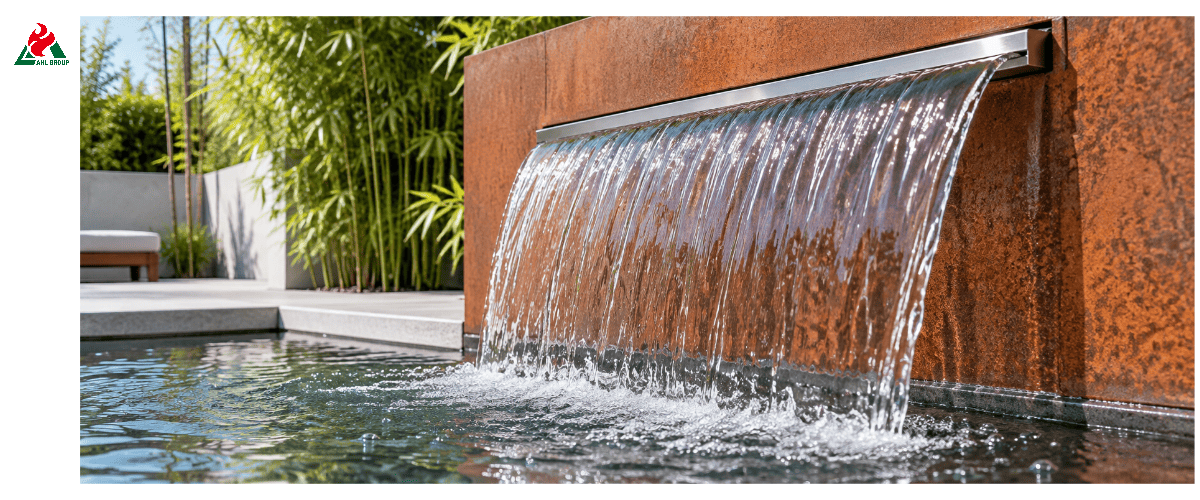
► Sufficient leading-edge projection: The spillway lip must project far enough forward beyond the vertical wall—and feature a sharp downward drip edge or acute angle—so that surface tension cannot pull the water back toward the bottom of the spillway edge, causing the flow to run unevenly down the wall.
► Smooth, burr-free overflow weir edge: The top of the spillway lip must be machined to be perfectly flat, free of weld slag or grinding ripples that could disrupt the water film.
► Laser-Level Installation: A slab-type spillway functions like a precision level. If a 900-millimeter-wide spillway slab is tilted even by just 2 to 3 millimeters from left to right, the deeper side will bear the majority of the flow, while the higher corner will run dry. Be sure to use adjustable shims or threaded leveling feet during installation.
5. Plumbing Hardware & Electrical Safety Details for Home and Commercial Installations
A reliable internal piping system can save you hours of hassle during seasonal cleaning and winter freeze protection preparations.
Selecting Kink-Free Pipe, Barbed/Threaded Bulkhead Fittings, and Unions
Avoid thin-walled, unreinforced vinyl hoses, as these tend to collapse at sharp bends or harden over time. Opt for thick-walled, spiral-reinforced, kink-resistant PVC pond hoses or piping with a rigid No. 40 PVC inner tube, paired with corrosion-resistant 316 stainless steel or heavy-duty polypropylene threaded compartment fittings, secured to the pond wall via welding or sealing. Install a straight-through ball valve and a coupler-type fitting directly above the pump; this allows the pump to be hoisted out for maintenance within two minutes without cutting any hoses.
Automatic Float Valves, Overflow Drains, and Low-Water Pump Protection
Evaporation and wind and waves will continuously lower the water level in any outdoor fountain—especially in warm, windy climates, and even more so with wide waterfall curtains.
► Mechanical or electronic automatic water-top-off valves: Connected to an irrigation or domestic water line (via an approved backflow preventer) to maintain a constant operating water level.
► Riser-Type Overflow Drain: Prevents the Corten steel basin from overflowing during heavy rain, avoiding rust-colored water from flooding the surrounding patio pavers.
► Low-Water Automatic Pump Shut-Off Sensor: Automatically stops the pump when the basin water level drops below the intake strainer, preventing the stator from burning out due to dry running.
Outdoor Electrical Compliance: GFCI/RCD Protection, Cord Glands, and Pump Access Hatches
All electric water feature installations must comply with local electrical codes (e.g., Section 680 of the U.S. National Electrical Code (NEC) or equivalent IEC/local standards). Power to water pumps must be supplied exclusively through outdoor circuits protected by a GFCI (ground-fault circuit interrupter) or RCD (residual current device). The pump power cord should pass through a watertight compression-type cable gland (packing box) located at the bottom or rear wall of the pool, rather than being pinched by sharp steel edges; additionally, a flush-mounted, lockable pump access hatch should be provided to allow maintenance personnel to easily clean the intake filter screen.
6. Rust Runoff, Orange Water & Sealing: How to Prevent Stains on Patios and Pool Decks
Understanding how to control rust-colored water runoff and protect adjacent hardscape elements is key to owning or specifying Corten steel water fountains.
Why New Corten Water Features Release Orange Water During Early Weathering
When unwettered or freshly pre-weathered Corten steel first comes into contact with water, soluble iron ions and loose surface oxides are washed away before the dense inner rust layer stabilizes. In open garden planters, this early runoff seeps into the soil; in closed-loop water features, these initial oxides accumulate in the circulating water, causing the water in the pond to appear bright amber or orange during the first few weeks of operation.
Should You Seal the Inside Reservoir Basin vs the Exterior Corten Body
Many general guidelines offer conflicting advice on this issue. The correct engineering approach should treat the internal water tank—which is submerged in water—and the exposed weathering steel panels differently:
► Seal the internal water reservoir that is submerged in water (a mandatory requirement for maintaining water quality and extending service life): Since the bottom sump is always submerged and never experiences dry periods, leaving the interior of a weathering steel reservoir exposed would result in continuous immersion corrosion and cause the water to remain orange indefinitely. High-specification weathering steel water feature installations should either coat the entire interior water basin and internal welds with a two-component epoxy, polyurea, or elastomer waterproof membrane specifically designed for ponds, or install a concealed high-density polyethylene (HDPE) or 304/316 stainless steel water tank inside the architectural weathering steel shell.
► Keep the exposed Corten steel surfaces subject to alternating cycles of wet and dry conditions (or allow them to cure after the oxide layer has matured): Exposed exterior walls and waterline roof slabs are designed to develop a deep brown rust patina through weathering. Never apply cheap, clear varnish sold at hardware stores to untreated Corten steel surfaces—water runoff and UV exposure will cause the non-breathable clear coating to peel and bubble within a few months. Instead, allow the exposed surfaces to rust naturally through daily cycles of wet and dry conditions; if you need to prevent further staining on delicate light-colored stone surfaces, apply a penetrating, breathable rust stabilizer only after the oxide layer has fully formed. For specific instructions, please refer to our guide on how to seal Corten steel planters and control rust stains.
Pre-Seasoning, Initial Flush Cycles, and Water Clarifier Do's and Don'ts
Before putting new weathering steel water feature installations into regular use, please follow these initial conditioning and rinsing procedures:
► Rinse the exterior steel and subject it to several wet-dry cycles as part of a pre-weathering treatment to remove loose mill scale and initial orange surface dust.
► During the first two to four weeks of operation, fill, run, and drain the tank 2 to 3 times using the bottom drain plug, refilling it each time with clean, pH-neutral water.
► Never add chlorine tablets, bromine tablets, hydrochloric acid, or strong pool disinfectants to Corten water features. Chlorides and strong acids severely erode the protective copper-chromium-nickel oxide film on the surface of weathering steel, causing rapid pitting corrosion and corroding the pump’s elastomeric components. For biological algae control, use only enzyme-based or beneficial bacterial pond treatments that are proven to be safe for metal, chlorine-free, and non-corrosive.
Splash Aprons, Pebble Catchment Zones, and Drip Isolation Over Light Stone or Concrete
If weathering steel water feature installations are placed on light-colored limestone, travertine, porcelain pavers, or architectural concrete:
► Determine the size of the catch basin based on wind drift: As a rule of thumb, the horizontal catchment distance from the waterline at the overflow to the edge of the catch basin should be at least 0.6 to 0.75 times the vertical drop (wider in windy courtyards) to ensure that wind-blown water droplets fall into the catch basin rather than onto the patio.
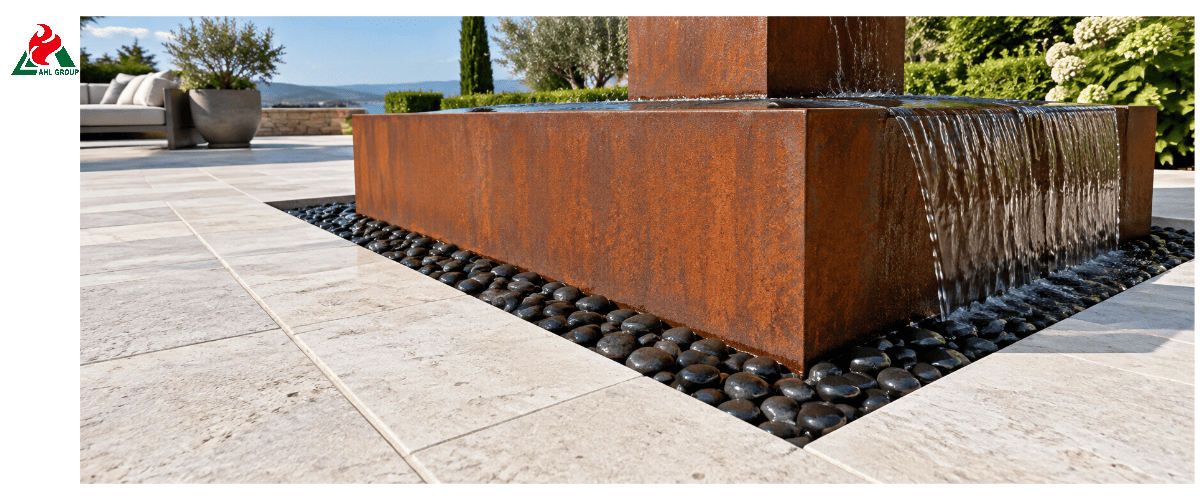
► Use a recessed pebble splash guard or splash guard mesh: Inside the base basin, lay clean river pebbles on a perforated fiberglass/stainless steel support grid to cushion the impact of the falling water curtain and prevent water droplets from rebounding onto adjacent pavers.
► Elevate the base using isolation pads: As with commercial planters, place the water feature base on neoprene or EPDM isolation pads and install recessed drip guards around the perimeter. This ensures that rainwater running down the Corten steel exterior wall falls into a gravel-lined drainage channel rather than seeping and spreading across light-colored stone slabs. For more information on long-term corrosion-resistant edging, please refer to our guide, “How to Prevent Rust-Through in Corten Steel Structures.”
7. Step-by-Step Installation & Commissioning Checklist (15 Verification Points)
Please use this 15-point checklist during manufacturing inspections and on-site installation:
Foundation, Leveling & Catchment Protection
1. Verify structural subgrade support: Confirm that the concrete subgrade, foundation, or base frame has sufficient load-bearing capacity to support the combined weight of the Corten steel structure and the volume of water when filled (1 liter = 1 kg).
2. Protect light-colored paving surfaces: Before installing the unit, create a perimeter gravel drainage channel, install recessed drip pans, or apply a penetrating stone sealer to adjacent porous paving stones.
3. Place on stain-resistant leveling shims or supports: Use EPDM/neoprene shims or stainless steel leveling feet to create an air gap beneath the base, preventing corrosion of the tank bottom caused by standing water.
4. Use a laser level to calibrate the overflow edge and water level: Before filling the tank with water, check the front-to-back slope and left-to-right level of the overflow plate; deviations must be kept within ±1 millimeter.
5. Verify the internal waterproofing measures of the storage tank: Confirm that the submerged areas have been coated with a cured, tank-grade waterproof coating or that a concealed stainless steel/high-density polyethylene (HDPE) liner has been installed.
Pump, Valve, Hose & Spillway Baffle Testing
6. Verify the pump characteristic curve at total dynamic head (TDH): Check whether the pump can deliver the target flow rate and head under actual vertical head plus friction losses in the piping.
7. Install quick-connect fittings and ball valves: Install a throttling ball valve and quick-connect fittings on the pump discharge line in the maintenance room.
8. Use kink-free, reinforced hoses and stainless steel clamps: Secure all barbed connections with 316 stainless steel hose clamps and ensure there are no kinks along the vertical riser.
9. Connect to a circuit with GFCI/RCD protection: Route the power cord through a waterproof compression fitting and test the ground-fault circuit interrupter.
10. Check the alignment of the internal overflow baffle: Ensure there are no shipping residues in the diffusion chamber, and that the edges of the overflow outlet are clean and free of burrs.
Sealing, Initial Flush & Wet–Dry Cycle Programming
11. Perform initial filling and leak testing: Fill the tank to the operating water level and inspect all compartment joints, drain plugs, and seams for 24 hours.
12. Adjust for a thin, even flow using the ball valve: Start the pump and adjust the line valve until the water curtain flows continuously from one corner to the other without splashing over the edge of the basin.
13. Set the automatic daily drying timer: Program a smart outdoor outlet or timer so that the pump shuts off for 4 to 8 hours every 24-hour cycle (typically at night) to allow the wet weathering steel surface to dry and enable the protective rust layer to form fully.
14. Complete 2 to 3 initial rinse cycles: After the initial patina formation period in the first few weeks, drain the pool and refill it until the circulating water remains crystal clear.
15. Explain the chlorine-free maintenance requirements to the owner: Affix a label to the pump cover reminding the owner never to add chlorine tablets, acidic cleaners, or de-icing salt.
8. Frequently Asked Questions (FAQ)
Q1: What size pump (L/H) do I need for a Corten steel water feature?
For a weathering steel water feature with a low-bubble effect, select a pump with a flow rate of 800 to 1,500 L/H (210 to 400 GPH) per nozzle at the height of the water feature. For a horizontal waterfall overflow slab, the target flow rate should be 500 to 800 L/H (130 to 210 GPH per 4 inches) — this equates to 1,500 to 2,400 L/H for a 300-millimeter overflow panel and 3,000 to 4,800 L/H for a 600-millimeter overflow panel at the actual vertical head height — and be sure to install a ball valve in the pipeline to fine-tune the flow rate.
Q2: What does a spillway baffle do in a waterfall blade?
The internal overflow baffle (diffusion chamber) disperses the high-pressure water jet from the supply hose and distributes the water pressure evenly across the entire width of the overflow basin. Without a perforated baffle chamber, water would jet forcefully from the center of the overflow outlet, while the left and right sides would taper inward or run dry.
Q3: How do I stop a Corten steel water feature from turning the water orange?
First, ensure that the internal submerged reservoir has been sealed with a pond-specific waterproof coating (or equipped with a concealed stainless steel/high-density polyethylene (HDPE) liner) to prevent standing water from coming into contact with the exposed steel around the clock. Second, during the first few weeks, while the exposed weathering steel surface is forming its initial rust layer, drain and refill the water 2 to 3 times, and use a daily timer to run the water pump so that the damp steel surface dries overnight.
Q4: Should a Corten water feature run 24/7 or on a timer?
We recommend using a daily timer to control the operation of Corten steel water features (for example, running during the day and in the evening, and shutting down for 6 to 8 hours at night). This daily drying period allows moisture on the Corten steel surface to oxidize and form a dense, stable brown rust layer, rather than a soft, flaky wet rust.
Q5: Can I use chlorine or algaecide in a Corten steel fountain?
Never use chlorine tablets, bromine, hydrochloric acid, or copper sulfate/salt-based pool chemicals in weathering steel water features, as chlorides and acids will damage the rust patina of the weathering steel and corrode the pump seals. Use only chlorine-free, metal-safe biological pond clarifiers or beneficial bacterial treatments, and keep the pond clean by changing the water regularly.
Q6: How do I winterize a Corten steel water feature in freezing climates?
Before the first severe cold snap, disconnect the power to the water pump, open the drain plug at the bottom of the pond, and completely drain all water from the pond and overflow basin; disconnect the pipe fittings to remove the submersible pump (store the pump indoors in a bucket of antifreeze solution to prevent the rubber seals from drying out and cracking); and ensure there is no residual water in the pipes or valves to prevent joints from cracking due to ice expansion.
Conclusion: Balance Hydraulic Sizing, Baffled Flow, and Moisture Boundaries
When the hydraulic piping system of a Corten water feature adheres to both the physical properties of flowing water and the characteristics of weathering steel, it can add unique charm to a building for decades:
► Determine pump specifications based on the delivery flow rate (L/H) under the total dynamic head—for a standard sheet waterfall, the target value should be 500–800 L/H per 100 millimeters of spillway width—and be sure to include in-line ball valves and kink-free hoses to allow for easy flow adjustment.
► Be sure to use internally perforated overflow baffles and laser-leveled drip lips to ensure that the water flows from the blades as a smooth, tranquil water curtain rather than a splashing central water column.
► Use pond-specific waterproofing materials to protect the interior of the underwater reservoir; At the same time, use a daily on/off timer to control the operation of the external water curtain and complete the initial flushing cycle to maintain clear water quality and prevent staining of surrounding stonework.
For related outdoor engineering and care guides, explore our articles on how to design Corten water features, 7 tips to keep your Corten steel planters and garden features looking new, and what environments are not suitable for bare Corten steel.
Planning a residential garden waterfall or a custom commercial Corten steel water curtain? Please provide our engineering team with the overflow width, vertical drop height, and paving layout, and we will provide you with matching pump flow specifications, internal baffle construction drawings, and a pre-sealed reservoir kit.
Planning a Residential Garden Waterfall or Commercial Corten Water Curtain?
Share your spillway width, vertical drop height, and hardscape layout with our engineering team. We provide matched pump flow calculations, internal baffle shop drawings, and pre-sealed reservoir kits.

