


Large commercial Corten steel planters require three structural details that are often overlooked in small residential planters: internal reinforcement to prevent the side walls from buckling under the combined effects of soil saturation, root growth, and freeze-thaw pressure; raised supports (typically 25-millimeter spacers, adjustable bases, or channel steel meeting forklift load-bearing standards) to maintain an air gap beneath the base, facilitating wet-dry corrosion cycles; and a controlled drip drainage system to discharge excess irrigation water while preventing staining of light-colored plaza paving. Simply specifying a grade of weathering steel is by no means sufficient—long-term performance depends on the integrated engineering design of the enclosure, reinforcements, internal root protection, base height, and runoff guidance as a unified system.
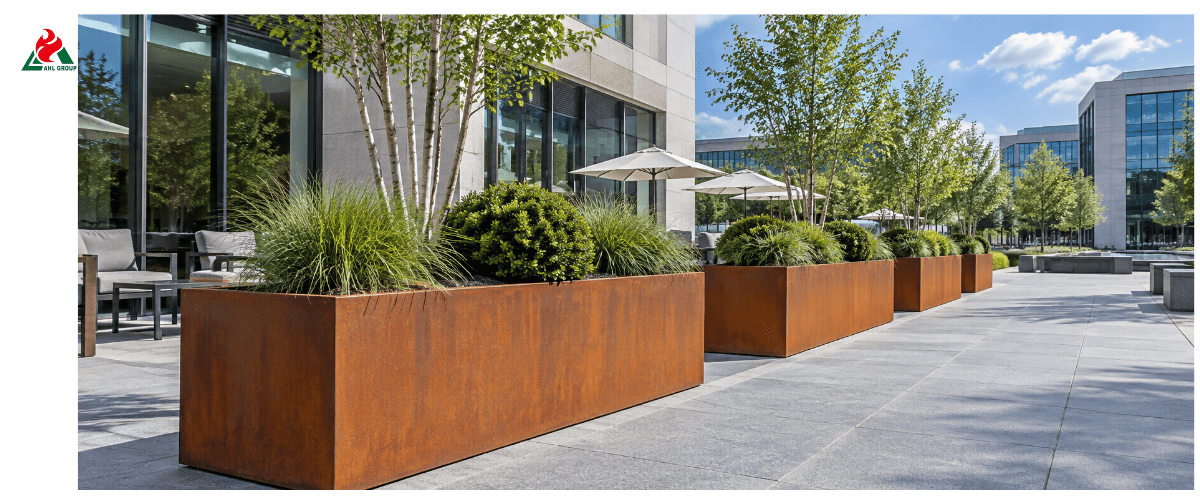
1. Why Large Commercial Planters Cannot Be Built Like Scaled-Up Garden Pots
A compact patio planter and a two-meter-long commercial street landscaping planter may both feature the same warm bronze-brown Corten rust finish, but their structural conditions are vastly different. When manufacturers simply scale up a five-sided metal box without adding an internal frame, increasing the base height, or incorporating a directed drainage system, three predictable failures will occur within the first few seasons of public use:
► “Bulging” deformation of side walls: Saturated planting media, root expansion, and winter frost will push outward against the long side walls, transforming the originally clean architectural lines into visibly bulging panels.
► Corrosion and perforation of the base plate: A flat base placed directly on concrete or stone traps capillary water, leading to oxygen deprivation at the bottom and causing weathering steel to corrode just like ordinary carbon steel.
► Uncontrollable hardscape staining: Iron-rich water seeping from untreated holes in the bottom will spread to porous travertine, granite, or light-colored architectural concrete, leaving permanent orange ring-shaped stains around the base of the planter.
For landscape architects, municipal code makers, hotel developers, and commercial contractors, understanding the interaction between internal bracing, 25-millimeter-high legs, and drip drainage systems is the most reliable way to prevent costly on-site remediation work.
2. Why Large Commercial Corten Planters Need Engineered Detailing
Flower beds in public squares, rooftop terraces, hotel drop-off areas, and median strips along streets are constantly subjected to mechanical loads and humidity gradients—conditions that are rarely encountered in residential garden planters.
Saturated Soil Density, Hydrostatic Pressure, and Root Ball Load
Dry potting mix is relatively lightweight, but commercial planters are typically filled with engineered soil, structured soil, a gravel drainage layer, and mature plants watered according to automated irrigation schedules. Once saturated by heavy rain or drip irrigation, the moist growing medium behaves like a dense granular fluid, exerting both vertical dead weight on the base and lateral earth pressure on the vertical walls.
As shrubs and multi-stemmed trees grow, the radial expansion of their root systems and the swaying of the canopy in the wind generate concentrated outward forces on the upper and middle thirds of the planter’s outer shell. Without internal reinforcement, even thick metal plates will deflect outward when unsupported over long spans.
Freeze-Thaw Expansion and Thermal Cycling in Public Landscapes
In climates with distinct seasons, when temperatures drop below freezing, water in the root zone expands. Since the topsoil typically freezes first, the expansion of the ice pushes the steel side walls outward and presses down on the base plate.
At the same time, dark-colored weathering steel absorbs significant solar radiation on sunny winter afternoons and during summer days. Panels on the sun-facing side expand faster than the shaded rear walls or the lower areas cooled by the soil, thereby imposing cyclic shear stress on corner welds, edge flanges, and internal reinforcement joints.
Wet–Dry Patina Chemistry vs Constant Under-Base Dampness
Weathering steel is often mistakenly referred to as “rust-proof” steel. In reality, high-strength, low-alloy weathering steel forms a protective, tightly adherent oxide scale only when subjected to alternating wet-dry cycles. If the metal remains damp for extended periods, is buried in a moist environment, or lacks air circulation, the protective layer cannot stabilize, and its corrosion rate will revert to that of ordinary structural carbon steel.
In commercial planter pots, the outer walls experience ideal wet-dry cycles in an open-air environment, while the inner walls in contact with soil and the unventilated bottom remain constantly damp unless isolated by a liner and elevated by legs.
Construction Responsibilities for High-Value Hardscape Features
Commercial flower beds are rarely constructed directly on soft garden soil. They are typically installed on natural limestone pavers, precast architectural concrete, wooden boardwalks, or pedestal-style paving brick systems used on the tops of waterproof parking garages. Any structural deformation, tripping hazards caused by uneven settlement, clogged overflow drains, or stains resulting from iron oxide runoff will directly impact the property’s aesthetic appeal and maintenance budget.
3. Internal Bracing Systems: Preventing Sidewall Bowing and Seam Fatigue
The internal reinforcement structure ensures that large rectangular, square, and custom-shaped Corten planters maintain their geometric accuracy even after years of exposure to the weight of wet soil and public use. These carefully designed planters do not rely solely on thick, expensive steel plates covering the entire container; instead, they combine a folded-edge geometry with internal ribs and transverse connectors.
Top Flange and Box-Type Flange Profiles
The upper edge of an architectural planter is the part most visible to pedestrians and the area most prone to deformation if only the original single-sided edge is retained. Folding the top edge inward into a wide flange—or, ideally, into a double-folded rectangular box-type edge—transforms the top perimeter into a continuous horizontal beam.
In addition to enhancing structural rigidity, the box-type flange eliminates sharp edges on metal sheets in public seating areas, covers the top edges of internal insulation panels, and creates a neat visual frame around the planting bed.
Vertical Wall Reinforcements and Ribs in Long Planters
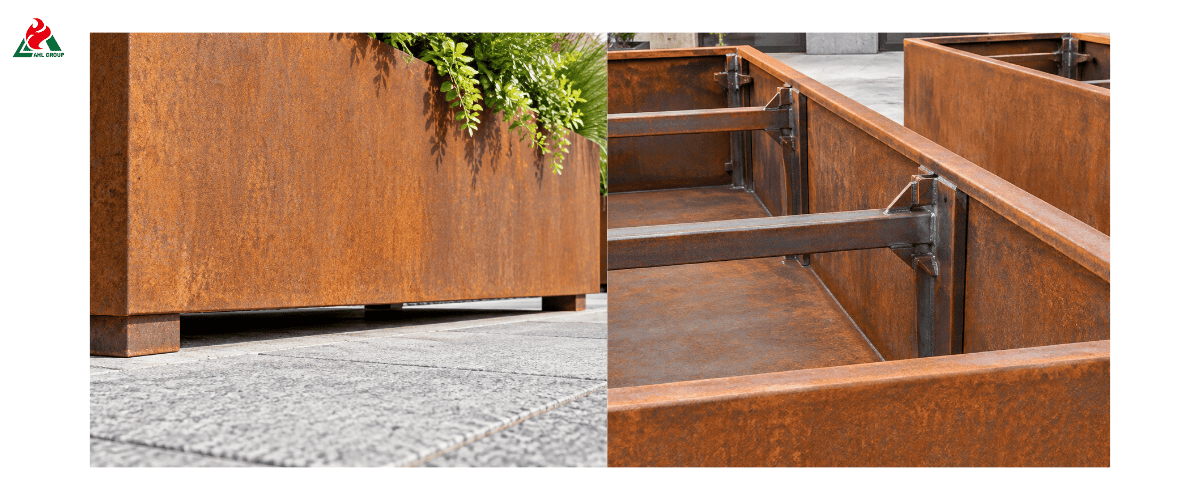
In long, narrow planters, a sturdy top fold alone is insufficient to prevent the middle sections of the side walls from bulging outward. Manufacturers counteract deflection in the center of the panels by welding internal vertical reinforcements—typically bent weather-resistant steel channels, flat steel with upright edges, or angle steel ribs—to the inner surfaces of the long side walls at calculated intervals.
These vertical ribs transfer the lateral pressure from the soil upward to the box-shaped edges and downward to the base frame, thereby dividing a long, single panel into multiple short, rigid structural units.
Transverse Bracing and Removable Tie Rods
When the length or depth of a rectangular planter exceeds medium dimensions, the long walls on opposite sides should be connected by direct tension links extending across the full internal width. Internal transverse bracing—made of weather-resistant flat bar, angle iron, or threaded stainless steel tie rods—connects the vertical wall reinforcements in the center of the planter, thereby preventing either sidewall from bulging outward on its own.
For commercial tree planting boxes, when crane operators place saplings with large, wire-wrapped root balls into the containers, designers should specify bolt-fastened, removable lateral supports or perimeter ring reinforcements below or around the root ball area to ensure the support structure never obstructs planting operations.
Corner Gussets, Base Support Beams, and Full-Penetration Welding
The joints between the side walls and the base plate are subjected to high bending and shear stresses, particularly when moving or leveling the planting containers. Commercial weathering steel planting containers should utilize continuous structural seam welding at the corners and base joints—or fully welded internal corner gussets—rather than light spot welding, as spot welds are prone to cracking as the soil load settles.
Beneath the floor panel, welded base support channels prevent the floor from sagging between the support legs when loaded with saturated soil and stone aggregate.
Selecting Sheet Thickness Based on Planter Span and Depth
Buyers often request a single “standard” thickness in millimeters or a specific gauge for commercial Corten metal planters. In rigorous engineering practice, however, the required sheet thickness always depends on the unsupported span, planter height, edge flange depth, spacing of internal stiffeners, and handling methods.
A compact planter with deep box-style flanges and closely spaced internal stiffeners can achieve high rigidity even with moderate sheet thickness; conversely, extra-deep urban tree planters or minimalist frameless designs require thicker sheets and structural sub-frames. Be sure to comprehensively evaluate sheet thickness and internal reinforcement measures based on the manufacturer’s construction drawings, rather than making decisions based on a single numerical value.
4. 25mm Riser Feet and Base Elevation Systems: How Under-Planter Clearance Protects Both Steel and Paving
Raising the base of a commercial weathering steel planter off the ground is one of the most rewarding details in landscape metalwork. Dedicated 25mm (approximately 1-inch) legs create a recessed shadow gap while addressing issues such as moisture, drainage, and architectural proportions.
Why a 25mm Air Gap Is Critical to the Base Plate’s Lifespan
When flat-bottomed metal planters sit flush against concrete or stone pavers, rainwater and excess irrigation water are drawn into the tiny gaps beneath the base via capillary action. Shielded from sunlight and wind, this trapped layer of water never dries completely.
Elevating the planter stand on 25-millimeter legs completely breaks the capillary connection. Air circulates freely beneath the base, allowing the steel bottom to dry quickly after rain or watering. At the same time, the 25-millimeter gap is high enough to prevent wind-blown leaves and silt from immediately clogging the gap, yet low enough to create an aesthetically pleasing “floating” architectural shadow line around the base.
25mm Fixed Feet and Adjustable Leveling Bases
25mm fixed welded feet (made of heavy-duty weather-resistant steel bar, box section steel, or stainless steel, and equipped with dirt-resistant spacers) are ideal for placing planters on perfectly level concrete slabs, garden curbs, or pre-leveled bases. They have no moving threads that can jam and provide a wide, predictable load-bearing surface.
However, commercial plazas, sidewalks, and rooftop terraces almost always have a drainage slope (typically 1% to 2% or higher) to direct rainwater toward area drains. On sloped pavement surfaces, fixed feet will leave a tapered gap or cause the top edge to slope out of alignment. In these locations, designers should pair recessed bases with heavy-duty threaded adjustable leveling feet, centered with a nominal 25-millimeter protrusion, so that installers can precisely level the top edge even when the slab has a slope.
Forklift Channels and Crane-Lifting Skids for Heavy Tree Planters
While 25mm-high support legs are the optimal choice for tree planters used for on-site emptying and backfilling operations, pre-planted commercial tree planters or movable street landscape dividers require mechanical handling capabilities. Standard forklift tines cannot slide into a 25mm gap without scratching the pavement or damaging the planter base.
For heavy-duty, movable planters, the engineering solution is a hybrid recessed base: structural forklift guide channels (customized to the height and width of the forks) are welded beneath the base plate and set back inward away from the outer walls; meanwhile, the outer skirt extends downward, creating a neat 25-millimeter visual shadow gap above the paved surface. This design conceals the forklift slots from pedestrian view while ensuring adequate ventilation beneath the base and maintaining safe lifting capacity.
Point-Load Distribution on Rooftops, Podium Decks, and Pedestal Pavers
Concentrating the entire weight of a wet, heavy commercial planter on its four small corner feet creates a highly concentrated load. While this typically poses no problem on cast-in-place floor slabs, excessive concentrated pressure on roof base paving tiles, insulation-membrane roofs, or wooden platforms may cause the tiles to crack or compress the roof insulation layer.
When specifying 25-millimeter-high support feet for a pedestal or rooftop landscaping, verify the number of support feet, the contact area of each support foot, and their alignment with the underlying paving base or structural joists. Adding intermediate support feet along the load-bearing grooves of the base allows the dead load to be safely distributed across the sensitive roof structure.
5. Drip Drainage Engineering: Controlling Root Health and Rust Runoff
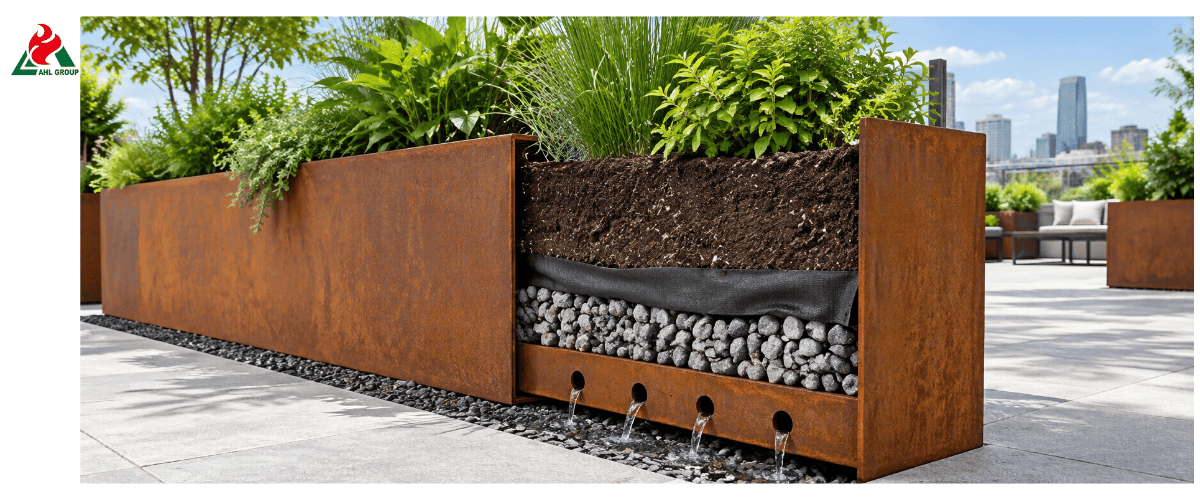
Even the sturdiest reinforced planters mounted on 25mm-high legs will cause stains on the surrounding pavement and suffocate plant roots if their drainage system consists solely of holes haphazardly drilled into a flat steel base. Commercial installations require a controlled drip irrigation drainage system that precisely controls where water flows out of the container.
Why Simple Drilled Holes Cause Staining and Blocked Drains
When water flows out of flat holes drilled directly into a steel base plate, surface tension causes the water droplets to cling to the metal surface and move horizontally before falling. This flowing water carries away soluble iron oxide from the bottom of the planter, which then runs down the legs and deposits directly onto the plaza pavers, forming rust rings. Worse still, without a raised rim or a filtering layer, fine soil particles can be washed into the flat holes, forming compacted mud that clogs them.
Raised Drainage Baffles, Drainage Outlets, and Directional Drip Nozzles
Engineered drip irrigation systems replace flat holes with welded drainage baffles, downward-extending nozzles, or flanged drip lines. A short vertical spout extending from beneath the base plate serves as a continuous drip edge: excess irrigation water is forced to drain cleanly from the tip of the outlet in the 25mm cavity beneath the base plate—or directly into the drainage pipe beneath the base plate—rather than seeping slowly along the surface of the base plate.
For outdoor planters that require a small amount of internal water storage to cope with drought, drainage bosses can be welded so that their water-inlet lips are positioned at a certain height above the base plate, supplemented by drainage holes below to prevent frozen water accumulation in winter when necessary.
Internal Drainage Layer, Geotextile Barrier, and Overflow Weir
Inside the planter, blockage of the drainage outlets must be prevented. Best industry practice is to use each drainage boss in conjunction with a perforated inspection cage or a layer of coarse-grained drainage aggregate (or lightweight geocomposite drainage units on rooftops), wrapped in a nonwoven geotextile filter membrane.
The geotextile allows water to flow freely into the drainage outlets while blocking fine silt and organic potting media particles. In deep tree pits exposed to heavy rainfall, an internal vertical overflow riser connected to the bottom drainage outlet can prevent surface water accumulation when the upper cover layer temporarily forms a crust.
Connecting Planter Drains to Plaza Gullies or Irrigation Overflow Lines
On terraces at high-end hotels, indoor and outdoor atriums, and light-colored limestone plazas where zero surface runoff is required, downward-extending drain outlets allow plumbers or landscape contractors to connect flexible collection pipes or rigid PVC/HDPE drain fittings beneath the planter boxes.
Since the planters are mounted on 25-millimeter-high legs (or on taller base channels when additional slope is required for horizontal pipe installation), excess water is collected at the drain outlets and directed directly into concealed channel drains, perforated terrace drains, or removable stainless steel drip trays.
Managing Early Rust Runoff During the Initial Weathering Months
Weathering steel releases the highest concentrations of iron-containing runoff during the early stages of rust formation—that is, before the oxide layer has become dense.
To protect commercial hardscape from erosion caused by outdoor rainwater runoff during the first few months:
► Order factory-pre-weathered and thoroughly rinsed planters to ensure that the initial patina formation is completed off-site;
► Place planters above recessed gravel drip edges, dark-colored basalt strips, or channeled drainage gutters to collect rainwater flowing down exterior walls;
► Install non-metallic isolation pads (such as high-density EPDM or neoprene gaskets) beneath 25-millimeter-high legs to ensure the steel never comes into direct contact with porous stone and becomes damp;
► Avoid directing rotating lawn sprinklers toward exterior Corten steel walls.
For additional stain prevention tips, please refer to our “Guide to Preventing Rust Stains on Corten Steel” and “How to Prevent Rust-Through in Corten Steel Planters.”
6. Commercial Corten Planter Engineering Comparison Table
Use the matrix below to match internal bracing, riser foot height, and drip drainage detailing to the exact commercial application.
| Planter Scale & Application |
Recommended Bracing Architecture | Base Elevation / Foot System | Drainage & Runoff Configuration | Key Specification Check |
| Long Linear Troughs & Streetscape Dividers |
Box-folded top return rim + full seam welds | Fixed 25 mm riser feet with EPDM isolation pads | Central downward drip spigot + geotextile filter cone | Verify slab flatness & protect pale stone during early weathering |
| Deep Commercial Tree Planters (Plazas & Municipal Streets) |
Box rim + internal vertical wall ribs + mid-span cross-tie braces | Spaced 25 mm riser pads along base bearers (or adjustable leveling feet on sloped walks) | Multiple spaced drip spigots aligned over gravel strip or slot drain | Prevent mid-span sidewall bowing & water pooling at downhill end |
| Rooftop & Podium Deck Planters |
Heavy-gauge shell + perimeter ring stiffeners + bolt-in removable tie bars + sub-base bearer beams | Recessed forklift channels + 25 mm perimeter shadow-gap skirt | High-capacity bottom drain bosses + vertical overflow standpipe | Account for saturated root-ball mass, crane/forklift handling & subterranean tree guying |
| Box-folded top return rim + full seam welds |
Stiffened tray walls + closely spaced vertical ribs + internal XPS thermal insulation | Wide-pad adjustable pedestals aligned over deck framing or paver pedestals | Piped drip manifold connected directly to roof drain or catch pan | Verify structural dead-load limit, point bearing pressure & waterproof membrane protection |
7. Interior Coatings, Root-Zone Insulation, and Soil-Side Protection
Although the internal reinforcement structure, 25-millimeter-high legs, and drip drainage system form the structural backbone of commercial planters, the internal surface in contact with the soil requires equal attention.
Why the Inside of a Corten Planter Faces a Different Environment Than the Outside
A common mistake with basic sheet-metal planters is leaving the inner walls exposed, based on the assumption that weathering steel “will form a protective rust layer even inside the soil.” In reality, moist potting soil, organic acids, fertilizer salts, and the constant moisture from the root system prevent the dry intervals necessary for the formation of a stable weathering steel rust layer. Without internal protection, the surfaces in contact with the soil will continue to corrode out of sight until rust spots or pinholes appear years later.
Bitumen, Epoxy, or Elastomeric Interior Waterproofing Liners
To isolate the external aesthetic from internal soil moisture, the inner walls and base of commercial Corten steel planters should be coated or lined below the soil line. Proven methods include: a thick application of two-component epoxy barrier coating, a solvent-free elastomeric waterproof membrane, an asphalt-based protective coating, or a heavy-duty welded high-density polyethylene (HDPE)/ethylene propylene diene monomer (EPDM) embedded liner, sealed beneath the top flange.
It is critical that the protective liner terminate immediately below the bottom surface of the top box-type folded flange, so that the exposed outer edge and outer wall can naturally weather, while the concealed soil area remains isolated from moist soil.
Rigid XPS Foam Insulation Boards for Root Zone Temperature Buffering
Exposed metal conducts heat rapidly. On a city square under the scorching July sun, an uninsulated steel vertical garden wall can raise the temperature of the top few centimeters of soil to a level high enough to dry out the fine absorbent roots; in January, cold air seeps in from all sides and from above.
Installing closed-cell extruded polystyrene (XPS) insulation boards on the interior vertical walls—between the waterproof steel shell and the growing medium—can buffer against extreme fluctuations in root zone temperature during both summer and winter. Closed-cell XPS is water-resistant, adds virtually no dead weight, and provides a slightly compressible buffer layer to withstand winter soil frost heave.
Root Barrier Layers and Tree Tie-Down Anchors in Large Planters
If left unchecked, the roots of vigorous urban trees and bamboo plants may extend toward corner seams or drainage outlets. Wrapping root barrier fabric inside the insulated liner both guides the roots to grow downward and inward and protects drainage outlets from root intrusion.
In windy street landscapes or on elevated terraces, tall trees planted in containers also require concealed reinforcement measures before their roots penetrate the growing medium. Welding stainless steel underground D-rings or eye bolts to the internal base support beams or lower wall ribs allows landscape architects to securely tie down the root ball without using external guy wires that detract from the aesthetic appeal.
8. Climate, Coastal Exposure, and Site-Placement Factors
Even well-reinforced planters must be adapted to the microclimate of the project site.
Freeze-thaw Conditions and Continuous Winter Drainage
In cold regions, commercial planters fail during winter only when water accumulates at the bottom or inside hollow frame components. Ensure that all internal planter ribs and top flanges are carefully designed to prevent condensation or irrigation water from accumulating inside sealed steel pipes; simultaneously, verify that the bottom drainage outlets are always positioned above the freezing water level so that meltwater can drain during mid-winter thaws.
Hot Urban Microclimates and South-Facing Squares
Under direct afternoon sunlight, the surface temperature of dark weathering steel will be higher than that of white precast concrete or light-colored wood. In south- and west-facing squares, the internal XPS wall insulation should be combined with an automatic drip irrigation system installed beneath the surface covering, and a combination of drought-tolerant and heat-tolerant plants suitable for the container’s microclimate should be selected.
Coastal Salt Fog and De-icing Salt Corridors
High concentrations of airborne chlorides from marine salt fog—as well as winter de-icing salt splashed onto roads and sidewalks—are hygroscopic and can interfere with the normal stabilization process of the rust layer on weathering steel.
► For coastal projects or municipal curbing projects where road de-icing salt is used extensively:
► Confirm with the manufacturer whether unpainted weathering steel is suitable for the site’s salt exposure conditions;
► Specify larger bottom ventilation gaps and unobstructed drip drainage channels in the design to ensure that salt-laden slush never accumulates on the base plate surface;
► Schedule regular freshwater rinsing of exterior walls in the spring to remove accumulated crusts of road de-icing salt;
► Consult our Corten Steel Coastal Environment Guide for site-specific durability limits.
9. Frequently Asked Questions About Commercial Corten Steel Planters
Q1: Why Do Large Corten Steel Planters Need Internal Bracing?
Moist soil, irrigation water, root growth, and winter frost all exert significant outward lateral pressure on the planter walls. Without a box-folded top edge, internal vertical ribs, and transverse reinforcing struts, long or deep metal sheet walls will bulge outward in the middle (“bulging”) and place stress on the corner welds.
Q2: Are 25mm Riser Feet Tall Enough for Commercial Corten Planters?
Yes, for planters placed on flat or gently sloped hardscaped surfaces and when empty, a 25-millimeter (approximately 1-inch) high foot provides an ideal balance: the clearance is sufficient to prevent capillary moisture absorption, allows air circulation at the bottom to keep the planter dry, and accommodates downward-extending drip edges; at the same time, the height is low enough to maintain a smooth, floating shadow line. If planters filled with plants must be moved by a forklift, add a deeper forklift channel beneath the base, in addition to the 25-millimeter perimeter skirt.
Q3: How Does Drip Drainage Stop Corten Planters From Staining Concrete?
Simple holes drilled in a flat bottom allow iron-rich water to adhere to the bottom of the steel and run down the legs, thereby staining the surrounding stone. A drip drainage system uses raised bosses or downward-extending drain fittings to direct excess water directly into gravel channels, trough drains, catch basins, or connected drainpipes, without leaving water marks on the metal base plate.
Q4: Should the Inside of a Commercial Corten Planter Be Sealed or Lined?
Yes. Unlike the outer walls—which dry quickly under sunlight and wind and form a protective rust layer—the inner walls are constantly in contact with moist, slightly acidic soil. Coating the inner walls with waterproof asphalt, epoxy resin, or an elastomeric membrane—and adding closed-cell XPS insulation boards—not only prevents invisible corrosion from the soil but also protects plant roots from extreme heat and cold.
Q5: How Do You Level a Corten Planter on a Sloped Plaza?
When installing on sidewalks, plazas, or base platforms designed with a slope for stormwater drainage, specify the use of recessed threaded adjustable leveling feet instead of fixed shims. Installers can adjust each leveling foot independently to keep the top edge level while maintaining a nominal 25-millimeter ventilation gap beneath the base.
Q6: Do Commercial Corten Planters Arrive Pre-Weathered or Raw?
Manufacturers offer weathering steel planters in two conditions: untreated, mill-finished (a deep gray-blue surface that requires several months of natural on-site weathering); or factory-pre-weathered and rinsed, with a stable orange-brown rust patina already formed. For commercial plazas with light-colored paving, specifying pre-weathered and rinsed planters—in combination with a controlled drip drainage system and isolation pads—can significantly reduce staining during the initial installation period.
Conclusion: Specify Bracing, Elevation, and Drainage as One System
Commercial Corten metal planters can only achieve decades of structural performance when the structural shell and moisture management are designed in a coordinated manner. Internal reinforcement structures—such as box-type flanges, vertical wall ribs, and transverse tie rods—maintain the straightness of long-span structures under the effects of wet soil and frost heave loads. 25-millimeter-high feet (or recessed forklift/base mounts) keep the base plate dry, ensuring the bottom does not become waterlogged. A controlled drip irrigation drainage system—featuring downward-sloping drains, a geotextile barrier, and an internal waterproof/insulating liner—safeguards both plant root health and high-value plaza paving.
For additional guidance on layout, dimensions, and long-term maintenance, please refer to our Corten Steel Planter Dimensions Guide, Corten Steel Rust Layer Guide, and Corten Steel Outdoor Maintenance Guide.
Before approving your commercial planter manufacturing order, please request detailed construction drawings that clearly show sheet thickness, the spacing of internal ribs and transverse connectors, the layout of 25-millimeter-high legs or bases, the structure of the internal waterproofing/insulation layer, and the dimensions of the drip drainage outlets. Carefully verifying these five details on the drawings is the most reliable way to ensure clean lines, healthy vegetation, and stain-free hardscape on-site.
Need Custom Corten Steel Planters or Landscape Edging?
Factory-direct 2mm-5mm Corten steel planter boxes and flexible lawn borders with pre-drilled drainage and stake anchoring systems.
» Custom Corten Planter Boxes | Corten Landscape Edging | Request a Factory Quote
Factory-direct 2mm-5mm Corten steel planter boxes and flexible lawn borders with pre-drilled drainage and stake anchoring systems.
» Custom Corten Planter Boxes | Corten Landscape Edging | Request a Factory Quote

