


In contemporary architectural design, a building’s envelope serves as its primary “point of contact” with the built environment. However, a building’s façade is by no means a static element; rather, it is a “living skin” that continuously interacts with solar radiation, atmospheric humidity, and local microclimates. For architects, developers, and asset managers, one of the most critical lifecycle issues during the design and procurement phases is: how long will it take for the specified exterior cladding to reach its final, stable color?
Unexpected color changes can lead to client dissatisfaction, color inconsistencies in phased construction, or trigger costly remediation projects. Understanding the chemical and physical mechanisms that influence color stability across different material categories is essential for setting realistic performance expectations and developing technical specifications that will stand the test of time.
Unexpected color changes can lead to client dissatisfaction, color inconsistencies in phased construction, or trigger costly remediation projects. Understanding the chemical and physical mechanisms that influence color stability across different material categories is essential for setting realistic performance expectations and developing technical specifications that will stand the test of time.
1. Short Answer — Typical Time Ranges
The timeframe for color stabilization in exterior wall cladding fundamentally depends on whether the material relies on a factory-applied, chemically inert coating or on organic, self-protective atmospheric reactions.
Quick Guide for Decision-Makers
As a general rule, color stabilization can occur within a matter of weeks or take several years. High-quality factory-finished surfaces stabilize almost immediately after installation, while natural, untreated materials require a significant transformation process to reach a state of visual equilibrium.
Fastest: Pre-coated Metal and Ceramic (Weeks to 6 Months)
Materials with factory-sintered coatings or vitrified mineral structures exhibit minimal color change. Any subtle changes observed during the first few weeks to six months are typically attributed to the peeling of protective shipping films, the washing away of fine factory dust, or the initial loss of gloss in high-gloss surface resins due to UV exposure.
Slowest: Corten Steel and Untreated Wood (months to years)
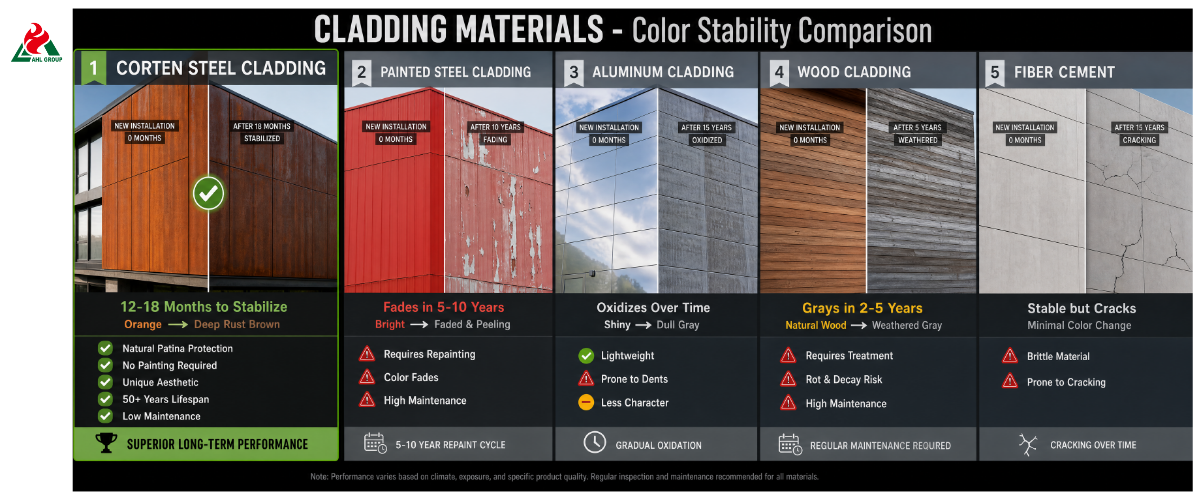
Natural materials rely on atmospheric cycles to form their protective outer layers. Untreated wood will transition from its natural warm tones to a uniform silver-gray within 3 to 24 months. Weathering steel (Corten) requires cycles of wetting and drying to form a dense, protective oxide layer; this process typically takes 2 to 5 years, after which the color fully matures into a stable, deep brown hue.
2. What “Stabilize in Colour” Means
To effectively select exterior cladding materials, it is essential to distinguish between those that have reached a state of natural aesthetic maturity and those that are undergoing systematic degradation.
Visual Stability and Technical Color Fastness (Delta-E)
Visual stability refers to the threshold at which the human eye can no longer perceive daily or monthly color changes under natural ambient light. Technical color fastness, however, is calculated by measuring changes in a three-dimensional color space using a precision spectrophotometer. The total color deviation over time is expressed as a value known as Delta-E. This metric synthesizes changes in lightness, as well as variations along the red-green and blue-yellow axes, into a single score. Technical stability is achieved when the annual color deviation decreases to such an insignificant level that an untrained observer cannot distinguish it.
Patina Formation and Pigment Fading
It is crucial to distinguish between two distinct phenomena:
► Patina formation: A constructive chemical reaction in which the material forms an oxide layer or weathering barrier, thereby protecting the underlying substrate (such as Corten steel or copper).
► Pigment Fading: A destructive process in which ultraviolet (UV) radiation breaks down the molecular bonds or chromophores in organic paint pigments, leading to chalking and a reduction in color saturation.
Practical Conditions for Building Facades
In actual buildings, a facade is considered stable when its visual appearance remains consistent across different orientations (such as north and south facades), and when localized weathering marks caused by rain screens or structural eaves no longer form high-contrast divisions on the building’s exterior.
3. Time Estimates by Material
Each material specification has a corresponding impact on the construction schedule. Managing these varying paces of change is a critical component of successful project delivery.
Pre-coated Metal Panels (PVDF/Polyester) — 0–6 months
Exterior walls finished with polyvinylidene fluoride (PVDF) or high-durability polyester coatings offer exceptional stability. The carbon-fluorine bonds in high-quality PVDF coatings provide outstanding UV resistance. The initial 6-month period of slight color stabilization primarily involves the natural elimination of surface residues generated during manufacturing and installation.
Powder-Coated Metal — 1–3 years (depending on the pigment)
Powder coatings primarily use polyurethane, polyester, or fluoropolymer resins. Although they offer high initial stability, the gloss of these coatings gradually diminishes over the first 12 to 36 months as the outermost resin layer undergoes micro-erosion due to sun exposure, resulting in a slight reduction in the visual depth of the color.
Anodized Aluminum — Weeks to Months (Nearly Instantaneous)
Anodization is an electrochemical process that transforms the aluminum surface into a durable layer of aluminum oxide. Since color is typically achieved by depositing inorganic metal salts deep within the porous oxide structure before sealing, it does not fade in the traditional sense. Once construction dust is washed away, the color stabilizes almost immediately.
Weathering Steel — 6 months to 5 years (typical maturation period is 2 to 3 years)
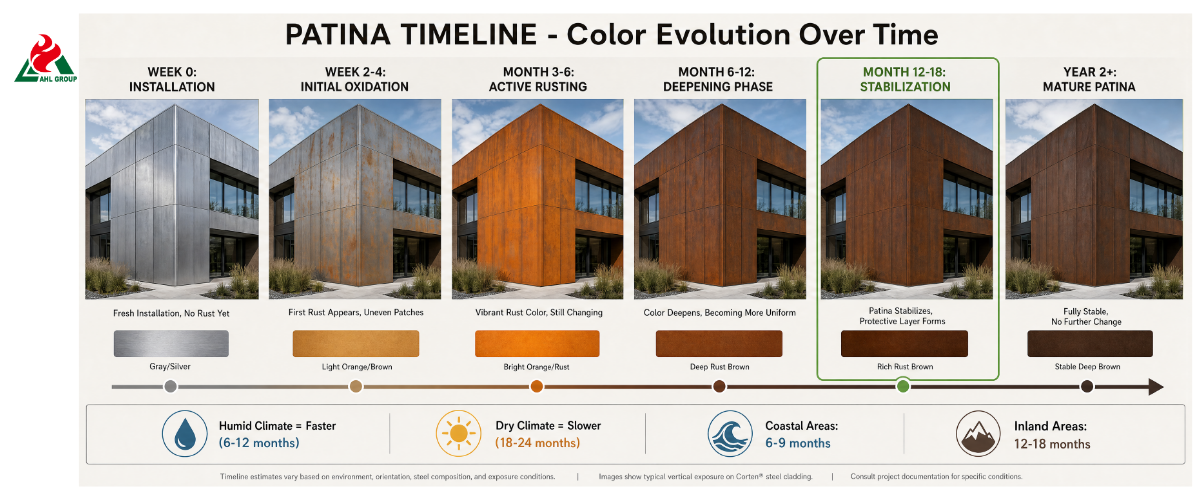
Untreated weathering steel initially appears as a cool, industrial silver-gray. After several weeks of exposure to rain and oxygen, its hue shifts to a bright, unstable orange. Over the following 12 to 24 months, this oxide layer gradually deepens, eventually taking on a rich ochre-brown hue. Full stabilization—when the oxide layer becomes highly dense, non-flaking, and displays a deep, velvety chocolate brown—typically takes 2 to 5 years, depending on environmental humidity cycles.
Wood (Untreated and Heat-Treated) — Several Weeks to 24 Months
Untreated wood is quickly affected by solar radiation. Ultraviolet rays break down the lignin within the wood cells, which is then washed away by rain, leaving behind silvery-gray cellulose. On south-facing facades exposed to intense sunlight, this process can be completed in as little as 12 weeks. The sugar structure of heat-treated wood is altered, which slows the initial rate of moisture absorption; however, if not coated with a UV-resistant sealant, it will still turn into a uniform, faded gray within 12 to 24 months.
HPL/Porcelain/Ceramic Panels — Weeks to Months (Long-Term Stability)
High-pressure laminates (HPL) with acrylic surfaces, as well as engineered ceramic or porcelain panels, exhibit extremely high inertness. Fired porcelain finishes are completely unaffected by UV radiation, as their color derives from mineral oxides fused at extremely high temperatures. They reach a stable state immediately upon installation.
4. Key Factors That Change the Timeline
The weathering timeline is not a fixed standard; it depends largely on the specific physical conditions at the installation site.
UV Exposure and Sun Exposure (South-Facing vs. North-Facing Facades)
In the Northern Hemisphere, south- and west-facing building exteriors are exposed to significantly higher cumulative solar radiation and thermal loads. Consequently, wooden exterior walls on the south facade may take on a silvery-gray hue within three months, while the north facade of the same building may retain its original warm wood tone for over a year, creating a temporary color asymmetry across the building.
Climate: Humidity, Coastal Salinity, Pollution, Freeze-Thaw Cycles
Atmospheric chemistry plays a crucial role in material evolution:
► Marine climate: High concentrations of chloride ions in the air accelerate the oxidation and discoloration of weathering steel, shortening its stabilization period; however, if drainage details are poorly designed, this increases the risk of pitting corrosion in the structure.
► Industrial/urban environments: Sulfur dioxide and nitrogen oxides alter the pH of rainwater, accelerating the etching of certain anodized coatings or altering the patina development of natural copper and steel.
Coating Surface Treatment and Pigment Chemistry (Inorganic and Organic Pigments)
If organic pigments (such as vivid reds, yellows, or blues) are used in exterior coatings, their chromophores are susceptible to UV degradation, leading to accelerated fading in the early stages, followed by a stabilization of the fading rate. Inorganic pigments (such as iron oxides or cobalt blue) possess excellent molecular stability, ensuring true color balance on exterior walls with minimal color variation.
Ventilated Rain Screens, Substrate Temperature, and Thermal Cycling
The physical construction of the wall structure affects color stability. A well-designed, ventilated rain screen maintains continuous airflow behind the cladding panels. This ventilation mechanism reduces peak surface temperatures of the panels during summer heat loads, thereby protecting the chemical binders in the coating and preventing accelerated thermal fading.
Pre-treatment or Factory Pre-weathering
Manufacturers can artificially alter the stabilization process. Weathering steel can be chemically pickled and treated with oxidation accelerators at the factory, ensuring that the material arrives on-site with a fully matured, stable dark brown rust layer, effectively bypassing the unstable orange bloom stage.
5. How to Measure Colour Stabilization
To verify whether Corten exterior cladding materials have achieved color balance, it is necessary to combine on-site observation procedures with precise laboratory measurement metrics.
Practical Inspection: Photographic Documentation and Visual Comparison Cycles
During on-site assessments, installers should establish fixed photography points. Photos should be taken on cloudy days at the same time each day to eliminate glare caused by direct sunlight. Placing physical color reference standards next to the panels provides a clear visual benchmark for monthly or quarterly assessment cycles.
Technological Metrics: Delta-E Thresholds and Color Difference Standards
During project handover, color difference claims are typically adjudicated using portable spectrophotometers. Measurements must be taken at multiple points within a grid covering each cladding area. According to international standards, the cladding is generally considered to have reached a state of technical stability when color differences do not exceed the minimum threshold—which is imperceptible to the naked eye—over a 12-month monitoring period.
Aging Acceleration Tests (Xenon Lamp/UV) and Methods for Interpreting Test Reports
Before procurement, architects should evaluate laboratory reports that detail the results of accelerated aging tests. These tests use xenon lamps or fluorescent UV equipment to simulate years of exposure to sunlight and moisture over the course of thousands of hours. If the test report indicates minimal color shift after thousands of hours of intense exposure, it demonstrates that the material possesses excellent long-term color stability.
6. Specification and Procurement Tips to Control Timeline
Architects and project managers can mitigate color stability risks through precise specification writing and sound procurement strategies.
► Insist on high-sunlight exposure test data: When specifying coated metals or laminates, request test data from actual sites subjected to extreme sunlight exposure. Select coatings that meet the highest architectural standards, which require the coating surface to maintain color integrity over many years.
► Specify factory-applied weathering: For projects using natural metals such as weathering steel that require an immediate, uniform finish (e.g., urban retail storefronts), explicitly specify a factory-applied weathering process that includes an integrated clear topcoat.
► Ensure Batch Consistency: It is essential to ensure that all cladding facade panels on a single facade come from the same production batch or coil batch. Minor variations in composition within powder coatings or anodizing baths can cause panels to weather at slightly different rates, resulting in an inconsistent appearance of the building envelope.
7. Design and Installation Practices That Help Stabilize Appearance Faster
The subtle details in the design drawings directly influence the speed and uniformity with which the building envelope achieves aesthetic maturity.
Reducing Uneven Fading Through Orientation and Shading Strategies
Deep architectural features, such as cantilevered balconies or large window openings, cast permanent shadows on certain sections of the curtain wall. To prevent uneven color development, designers should use highly inert materials (such as ceramics or high-quality fluoropolymers) in heavily shaded areas, while reserving naturally weathering materials for expansive, unshaded surface areas.
Proper Ventilation and Thermal Bridge Treatment to Mitigate Thermal Stress
Rear-ventilated facade systems should feature continuous air intake channels at the base and exhaust channels at the parapet level. Minimizing heat buildup behind dark-colored cladding panels reduces thermal degradation of the coating substrate, ensuring a uniform and predictable curing profile across the entire vertical surface.
Detailing to Avoid Runoff Staining and Differential Weathering
During the active oxidation phase of material weathering, oxide ions become suspended in rainwater runoff. If improper flashing causes rainwater to flow unevenly down the building facade, permanent water stains will form. Therefore, robust drip edges, continuous projecting sills, and dedicated drainage channels must be designed to completely divert rainwater runoff away from adjacent porous surfaces such as concrete or limestone.
8. Maintenance, Repairs and Long‑Term Colour Management
Even weathering-treated facade systems require scientific management throughout their decades-long service life.
When to Allow Natural Evolution, and When to Intervene
Asset managers must understand the design intent of the building envelope. Weathering steel or timber facades are inherently intended to evolve; attempting to remove dark rust stains through sandblasting or applying clear sealants midway through the lifecycle will compromise the material’s natural defense mechanisms and reset its stabilization process. Interventions should be limited to cases where the substrate exhibits localized pitting, mechanical scratches, or chemical contamination.
Repair/Patch-Matching Strategies for Aesthetic Changes
When a single cladding panel requires replacement years after installation due to mechanical damage (such as vehicle impact or maintenance equipment), a newly manufactured, factory-matched panel will initially appear out of place against the weathered building envelope. To mitigate this color discrepancy, designers should collaborate with manufacturers to produce custom color panels calibrated on-site, using spectrophotometric data collected directly from the surrounding weathered panels.
Recoating Schedule for Non-Weather-Resistant Coatings
For painted or powder-coated surfaces that have exceeded their design service life and show signs of systemic chalking, a site-applied architectural recoating system can restore color uniformity. This treatment establishes a new stabilization period of approximately three to six months, during which the site-applied coating must fully cure and stabilize.
9. Example Timelines and Case Studies (Quick Reference)
Urban Office Building—Pre-painted Metal Case Study (Months)
A 15-story commercial building utilized high-quality aluminum composite panels with a metal finish. Post-installation monitoring showed that the initial gloss decreased by less than 3% during the first 90 days due to the washing away of installation lubricants. By the sixth month, the facade had fully stabilized, presenting a uniform appearance from all angles.
Residential Building — Wooden Exterior Case Study (12–24 Months)
A coastal residential project utilized untreated ship-plank-style wooden siding. The west facade, directly exposed to sea breezes and afternoon sunlight, gradually transformed into a uniform driftwood silver tone within five months. The shaded north facade, in contrast, took 22 months to develop a matching silver appearance, highlighting the impact of the sun’s path.
Public Plaza — Corten Cladding Case Study (2–5 Years)
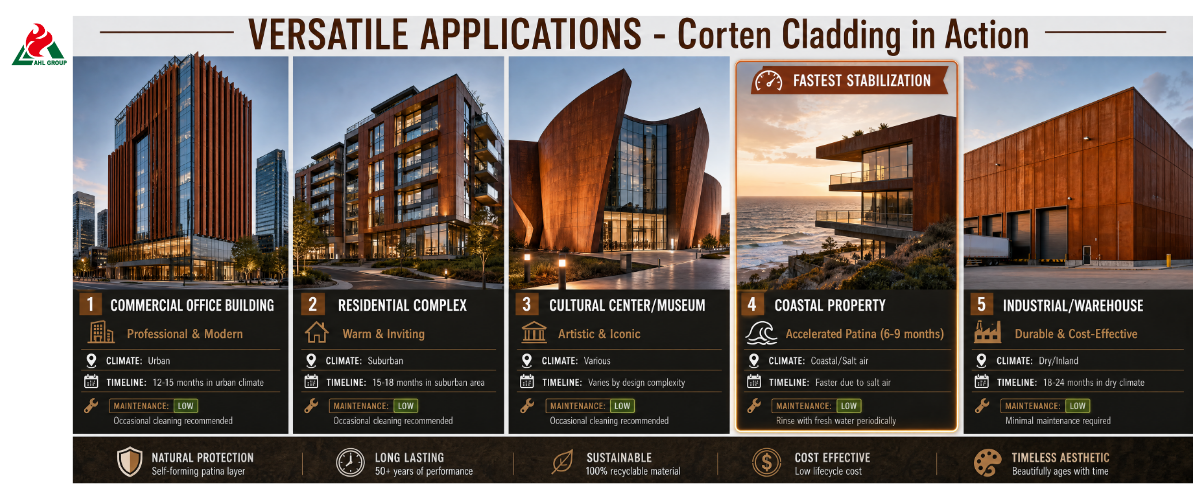
A cultural center features a geometric, laser-cut Corten metal cladding. The untreated panels shed significant amounts of orange oxide during the first winter, requiring a protective gravel layer to be laid at the base to collect runoff. By the 18th month, the color had deepened to an opaque reddish-brown. By the third year, the material had fully stabilized and ceased shedding oxide, ultimately forming a dark, structurally stable oxide layer.
10. Practical Recommendation & Observation Schedule
To ensure a smooth transition from project handover to long-term operation, the asset manager should implement a structured monitoring program.
Recommended Inspection Schedule
► Month 1: Conduct a baseline inspection immediately after the protective scaffolding is removed. Determine the reference positions for the spectrophotometer.
► Month 6: Evaluate initial washability performance. Inspect gutters and flashing for early signs of staining.
► Month 12: Evaluate color variations influenced by orientation (verify differences between north and south orientations).
► Annually (Years 2–5): Monitor the stabilization process until color variation falls below the annual stabilization threshold.
Simplified On-Site Testing and Photography Protocol
A standardized color chart kit must be used during inspections. Place a neutral gray card in the frame of all monitoring photographs to enable precise post-processing white balance correction, ensuring that variations in daylight tones do not distort the historical record of the facade’s true color evolution.
Contents of the Client Handover Documentation
To avoid disputes after occupancy, the as-built documentation must include a clear ‘Facade Color Change Specification.’ This document outlines the expected visual changes in the specified material category, defines the anticipated stabilization period for the local climate zone, and includes the original laboratory accelerated aging test report to assure the client that initial color changes are a normal part of the material’s aging process and not a sign of premature failure.
.png)
Conclusion—Patterns of Final Appearance Formation
Engineered ceramic and coated metal exterior wall systems achieve full color stability within a few weeks of installation, whereas natural weathering steel and wood require up to five years of atmospheric exposure to develop their final, stable architectural patina.

