


How do you choose between 2mm and 3mm (or 4mm–5mm) Corten steel screen thickness, and which laser-cut pattern opacity actually blocks neighbor sightlines without turning your fence into a wind sail? For wall-mounted decorative panels, indoor room dividers, sheltered patio frames, or 1800 mm × 900 mm panels stiffened with a 90° folded box-return flange, 2.0 mm (14 gauge, weighing ~18–21 kg theoretical estimate after laser cutting) is the optimal, lightweight choice. For freestanding post-mounted garden privacy screens (1.8 m to 2.5 m tall), exposed windbreak fences, unframed flat sheets, or large custom spans, upgrade to 3.0 mm (11 gauge, which delivers 3.375× greater flexural stiffness than 2.0 mm) or 4.0 mm–5.0 mm heavy architectural plate. For laser-cut pattern selection, choose 75%–85% privacy opacity (15%–25% open cutout area) to block direct neighbor views day and night, 50%–70% opacity for semi-private garden zoning and wind filtering, or 30%–50% opacity for backlit LED wall art and climbing-plant trellises.
Because a laser-cut Corten steel garden screen removes between 15% and 65% of the solid steel sheet to create its pattern, panel thickness, edge folding, and cutout geometry work as a single interconnected structural system. Specifying a delicate botanical pattern with paper-thin metal bridges on an unframed 2.0 mm sheet in a windy coastal backyard will result in panel vibration and oil-canning—whereas pairing the right thickness (2.0 mm vs. 3.0 mm–5.0 mm) with load-sharing geometric or reinforced botanical bridges guarantees a rock-solid, zero-maintenance architectural screen for decades.
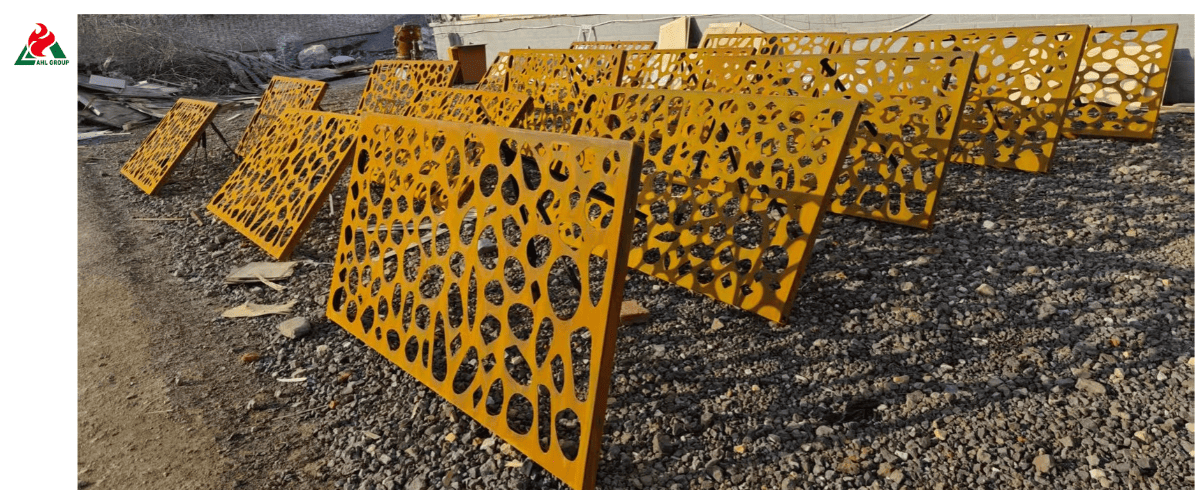
This engineering and design specification guide breaks down the exact stiffness math, theoretical weight calculations on standard 1800 mm (L) × 900 mm (W) panels, flat vs. folded box-frame profiles, daytime vs. nighttime privacy opacity ratios, and CNC laser-cutting bridge rules across AHL's AHL-SP01 to AHL-SP41 (39+ standard designs and custom patterns).
Have a Specific Screen Design? Request a Custom Screen Quote!
1. The Physics of 2mm vs 3mm (and 4mm–5mm) Corten Steel Screens: Stiffness, Weight & Cost
When browsing weathering steel privacy panels and garden dividers, most homeowners and contractors look at "2mm" and "3mm" and assume 3.0 mm is simply 50% stronger than 2.0 mm. In structural plate mechanics, the difference is far more dramatic.
The Cubic Flexural Rigidity Law (D ∝ t3): Why 3.0 mm Is 3.375× Stiffer Than 2.0 mm
When wind gusts press perpendicularly against a vertical 1800 mm × 900 mm privacy screen, the panel resists bowing and fluttering through its flexural rigidity (D), which is governed by the cube of the steel plate thickness (t):
Flexural Rigidity Formula: D = (E · t3) / [12 · (1 − ν2)]
Where E is the Young's modulus of Corten A / B steel (200 GPa), ν is Poisson's ratio (0.3), and t is the sheet thickness. Because thickness is cubed (t3), even a 1.0 mm step up in gauge transforms how the screen behaves in the wind:
1.5 mmEconomy Sheet (Common in Thin Retail Imports): Relative stiffness baseline = (1.5 / 2.0)3 = 0.42× (less than half the rigidity of AHL's2.0 mmstandard; prone to audible metallic drumming and flexing in moderate breezes).2.0 mmStandard Architectural Screen (14 Gauge— AHL Baseline): Relative stiffness =1.00×. At2.0 mmquality thickness—already thicker than many consumer-grade alternatives on the market—the panel resists casual impacts and stays taut when wall-mounted, captured in a 4-sided frame, or folded into a box tray.3.0 mmHeavy-Duty Structural Screen (11 Gauge— AHL Freestanding Standard): Relative stiffness = (3.0 / 2.0)3 = 3.375× (237.5%stiffer than2.0 mm, and8.0×stiffer than1.5 mm!). A3.0 mmCorten screen refuses to bow or flutter across a900 mmto1,200 mmpost span even when installed as a flat unframed plate.4.0 mmto5.0 mmCommercial / Coastal Plate (8 Gauge to 3/16"): Relative stiffness =8.0×(4.0 mm) to15.6×(5.0 mm) stiffer than2.0 mm. Specified for oversized commercial panels (>2,000 mmtall), public park landmarks, security gates, and hurricane/typhoon wind zones.
Dead Weight Calculations on a Standard 1800 mm (L) × 900 mm (W) Panel (AHL-SP01 to AHL-SP41)
While thicker steel increases wind rigidity, it also increases dead weight—which directly affects whether one or two installers are needed (two-person handling is recommended for all large panels), how strong your wall masonry anchors must be, and how much international freight costs.
Using the theoretical density of Corten steel (ρ = 7.85 kg/m2 per mm of thickness), a standard 1800 mm × 900 mm (1.62 m² gross area) panel has the following estimated mass:
| Steel Thickness (t) | US Gauge Equivalent | Theoretical Solid Sheet Weight (1800×900 mm) |
Est. Weight at 80% Opacity (20% Cutout) |
Est. Weight at 65% Opacity (35% Cutout) |
Relative Bending Stiffness (t3) |
|---|---|---|---|---|---|
2.0 mm (AHL Standard) |
14 Gauge |
~25.4 kg (56 lbs) |
~20.3 kg (45 lbs) |
~16.5 kg (36 lbs) |
1.00× (Baseline) |
3.0 mm (AHL Heavy Standard) |
11 Gauge |
~38.2 kg (84 lbs) |
~30.5 kg (67 lbs) |
~24.8 kg (55 lbs) |
3.38× (+238% Stiffer) |
4.0 mm (Custom Structural) |
8 Gauge |
~50.9 kg (112 lbs) |
~40.7 kg (90 lbs) |
~33.1 kg (73 lbs) |
8.00× (+700% Stiffer) |
5.0 mm (Max Commercial) |
~3/16 inch |
~63.6 kg (140 lbs) |
~50.9 kg (112 lbs) |
~41.3 kg (91 lbs) |
15.63× (Maximum Rigidity) |
(Note: Standard panel dimensions 1800mm(L) × 900mm(W), standard thicknesses 2.0mm or 3.0mm (2.0mm to 5.0mm full range), and model codes AHL-SP01 to AHL-SP41 are sourced directly from AHL's official Garden Screen product specifications. All panel weights shown above are theoretical weight estimates calculated from standard steel density (7.85 kg/m2 per mm thickness over a 1.62 m2 panel area) at illustrative cutout ratios; fold depths (30–50 mm) and bridge widths (10–20 mm) are general engineering fabrication guidelines—please confirm exact crated weights and custom shop drawings with AHL's engineering team.)
Key Takeaway from the Weight Table:
- At
2.0 mmthickness (~16.5 to 20.3 kgtheoretical estimate after laser cutting), a1800 × 900 mmscreen is light enough to hang safely on exterior brick, concrete, or timber stud walls using stainless steel standoff bolts without overloading the facade. - At
3.0 mmthickness (~24.8 to 30.5 kgtheoretical estimate after laser cutting), the extra8–10 kgof steel mass gives a freestanding post-mounted garden divider a solid, architectural feel that never rattles when a gate closes or a storm rolls through.
2. Flat Sheet vs. 90° Folded Box-Frame Panels: How Edge Folding Changes the Thickness Equation
Before you automatically pay more for 4.0 mm or 5.0 mm plate to get a rigid screen, you need to understand a secret of architectural sheet-metal fabrication: edge profile geometry (Flat Sheet vs. Folded Box Tray).
Unframed Flat Laser-Cut Sheets (Requires 3.0 mm–5.0 mm or Slotted Perimeter Framing)
A flat laser-cut sheet is a single plane of Corten steel cut to 1800 mm × 900 mm with flat borders around all four edges:
- When
2.0 mmFlat Sheet Works: If you slide all four edges of a2.0 mmflat sheet into a continuous slotted steel or timber picture-frame channel, or mount it flush against a solid masonry wall with 6 to 8 standoff pins,2.0 mmflat sheet performs beautifully at the lowest material cost. - When
2.0 mmFlat Sheet Fails: If you bolt a2.0 mmflat unframed sheet only at its four corners between two freestanding fence posts spaced900 mmapart, the unsupported1,800 mmvertical edges can bow slightly under wind gusts. For flat, unframed post-mounted panels, always specify3.0 mmminimum (or 4.0 mm–5.0 mmfor wider1,200 mmspans).
90° Double-Folded Box-Flange Panels (25mm–50mm Return Lip Design Guideline)
What if you want the low weight and cost of a 2.0 mm or 3.0 mm panel, combined with the ultra-rigid stiffness of heavy structural plate? Specify a 90° Folded Box-Frame Profile:
- How It Is Fabricated: The raw Corten sheet is laser-cut slightly wider and taller (for example,
1880 mm × 980 mmas a typical shop layout), and a CNC press brake folds a30 mm to 50 mmdeep90°return flange (or a double-foldedC-channelreturn lip) around all four perimeter edges of the finished1800 × 900 mmpanel. - Over
500%Gain in Edge Bending Stiffness: In structural mechanics, turning a2.0 mmflat edge into a40 mmdeep90°L-flange or C-channel shifts steel mass away from the neutral bending axis—multiplying perimeter rigidity by more than5× to 8×without adding heavy plate weight! - Concealed Side-Flange Post Mounting: Pre-punched bolt slots hidden inside the side return flanges let you bolt the screen directly to square Corten posts with zero visible brackets on the front face and a deep, three-dimensional shadow line.
3. Complete Thickness & Mounting Selection Matrix (2.0mm to 5.0mm Across 7 Project Scenarios)
Use the engineering decision matrix below to match your installation type, height (1.5 m seated privacy vs. 1.8 m–2.5 m standing privacy), and wind exposure to the exact thickness and edge profile:
| Project Scenario & Mounting Method | Typical Panel Size / Height | Recommended Corten Thickness | Recommended Edge Profile | Why This Combination Works Best |
|---|---|---|---|---|
| 1. Exterior Wall-Mounted Art & Facade Cladding (Brick, concrete, or rendered walls) |
1800 × 900 mm (or modular tiles) |
2.0 mm |
Flat Sheet (on stainless steel standoffs) or Folded Box | Wall absorbs wind load; lightweight ~16.5–20.3 kg estimated panel mass reduces pull-out load on wall anchors (see wall mounting guide) |
| 2. Indoor Room Divider & Hospitality Partition (Restaurants, hotels, lobbies) |
1800 × 900 mm (or custom height) |
2.0 mm (Pre-weathered & clear-sealed) |
Folded Box Frame or Caster Frame | Zero wind load; folded edges provide smooth, snag-free borders for indoor pedestrian traffic |
| 3. Seated Patio & Balcony Privacy Screen (Sheltered suburban courtyard) |
1.5 m (1500 × 900 mm) |
2.0 mm (Folded) or 3.0 mm (Flat) |
Folded Box (for 2mm) / Flat (for 3mm) |
1.5 m height blocks seated dining/lounge sightlines while keeping wind overturning moment low |
| 4. Full Standing Backyard Privacy Fence (Post-mounted in concrete footings) |
1.8 m – 2.5 m (1800 × 900 mm panels) |
3.0 mm (Standard Structural) |
Folded Box or Slotted Post Frame | 3.38× stiffer than 2mm; withstands open backyard wind gusts across 1.8m–2.5m standing height (see post & wind load guide) |
| 5. Freestanding Portable Planter Screen (Base-weighted on timber deck or terrace) |
1800 × 900 mm (mounted on Corten planter base) |
2.0 mm – 3.0 mm |
Folded Box Frame | Lowers top-heavy center of gravity over the weighted planter base while maintaining crisp box rigidity |
| 6. Swing / Sliding Garden Gate Insert & Commercial Branding Sign | 1800 × 900 mm or Custom Size |
3.0 mm – 4.0 mm |
Welded into Structural Box Tube Frame | Resists repeated gate slamming torsion and protects intricate laser-cut corporate logos |
| 7. Coastal Windbreak, Rooftop Terrace & Public Park Landmark | 1800 × 900 mm up to 2.5 m Height |
4.0 mm – 5.0 mm |
Heavy Flat Plate or Folded Box + Gussets | Maximum corrosion allowance for salt-air environments plus 8×–15.6× flexural rigidity against gale-force winds |
4. Decoding Laser-Cut Screen Patterns: Privacy Opacity Ratio (% Blockout) Day vs. Night
Once you have selected 2.0 mm or 3.0 mm thickness, the next decision across AHL's 39+ standard laser-cut screen patterns (AHL-SP01 to AHL-SP41) is the Privacy Opacity Ratio (Blockout Percentage)—defined as the percentage of solid Corten steel remaining vs. the percentage of open laser-cut voids (Open Area %).
The 4 Privacy Opacity Tiers (40%, 60%, 75%–85%, and 90%+ Blockout)
Choosing the wrong opacity ratio is the #1 design regret among first-time buyers: pick a pattern that is too open (40% blockout), and your neighbors can still see straight into your hot tub; pick a nearly solid pattern (95% blockout), and you lose airflow, dappled sunlight shadows, and low wind-load drag.
Here is how the four optical privacy tiers perform in real outdoor spaces:
- Tier 1 — High-Privacy Sanctuary (
75% to 85% Solid Steel/15%–25% Open Cutouts):- Best For: Hot tub and spa enclosures, outdoor showers, pool changing areas, and boundary fences facing a close neighbor's patio (
<3 metersaway). - Optical Physics: Because human eyes naturally focus on the bright, high-contrast foreground surface of the warm rust-orange steel rather than the small apertures, a
75%–85%opacity screen blocks90% to 95%of oblique sightlines (any viewing angle above 30°) while still letting15%–25%of wind pressure bleed through the panel.
- Best For: Hot tub and spa enclosures, outdoor showers, pool changing areas, and boundary fences facing a close neighbor's patio (
- Tier 2 — Balanced Garden Zoning & Patio Divider (
60% to 70% Solid Steel/30%–40% Open Cutouts):- Best For: Separating outdoor dining zones from lounge areas, balcony windbreaks, front-yard entrance statements, and cafe/restaurant terrace partitions (custom decorative Corten steel screen panels).
- Optical Physics: Breaks up direct views so passersby cannot make out facial details, while casting rich, moving geometric or botanical shadow patterns across patio paving and maintaining refreshing summer cross-breezes.
- Tier 3 — Equipment Enclosure & Trellis Backdrop (
45% to 55% Solid Steel/45%–55% Open Cutouts):- Best For: Hiding air-conditioning condensers (
HVAC units), pool filtration pumps, and heat pumps (which require≥45%–50% open free-air areaso compressor fans do not overheat), as well as vertical garden backdrops for climbing jasmine, clematis, and ivy.
- Best For: Hiding air-conditioning condensers (
- Tier 4 — Sculptural Feature & Backlit Light Art (
30% to 40% Solid Steel/60%–70% Open Cutouts):- Best For: Wall-mounted facade art and interior/exterior sculptural frames where visual openness and dramatic silhouette lines matter more than sightline blocking.
The Nighttime Backlighting Paradox ("Fishbowl Effect") & How to Position LED Lights
Here is an optical phenomenon that surprises many homeowners: a 65%–75% opacity laser-cut screen that provides complete privacy in bright afternoon sunlight can become partially see-through at night if you place your patio lights in the wrong spot!
- Why the "Fishbowl Effect" Happens: Human vision always looks through a dark perforated screen toward the brighter light source. At night, if the neighbor's yard is dark, the Corten screen itself is unlit (dark), and you turn on bright overhead lights right above your dining table or hot tub behind the screen, your illuminated patio acts like a stage behind a dark mesh curtain.
- The 2-Step Lighting Fix for 100% Nighttime Privacy:
- Wash the Exterior/Front Face of the Corten Screen with Warm LED Grazing Light (
2700K–3000K): Install a low-glare linear LED bar or ground spike spotlight at the base of the Corten screen so light grazes upward across the rust patina. When the Corten steel surface is brighter than the seating area behind it, the viewer's eye pupil constricts to the glowing orange steel and cannot see through the dark cutouts into your patio!- Use Frosted Acrylic Backer Diffusers for LED Lightbox Walls: If you are using a laser-cut Corten screen as a dedicated illuminated garden lighting feature and want zero visibility from either side at night, sandwich a UV-stabilized frosted opal polycarbonate/acrylic (
PMMA) diffuser sheet inside the rear folded flange of the screen.
- Use Frosted Acrylic Backer Diffusers for LED Lightbox Walls: If you are using a laser-cut Corten screen as a dedicated illuminated garden lighting feature and want zero visibility from either side at night, sandwich a UV-stabilized frosted opal polycarbonate/acrylic (
5. Pattern Geometry vs. Structural Integrity: Botanical, Geometric & Custom Logo Rules (AHL-SP01 to AHL-SP41)
Does a laser-cut pattern weaken a Corten steel panel? As noted in our engineering FAQ on customizing a Corten steel screen, precision CNC fiber-laser cutting does not weaken the panel—provided the pattern geometry matches the sheet thickness (2.0 mm vs. 3.0 mm–5.0 mm) and follows strict structural web-bridge rules.
Comparing the 4 Pattern Families in AHL's 39+ Design Catalog (AHL-SP01 to AHL-SP41)
Across AHL's AHL-SP01 through AHL-SP41 catalog, laser-cut patterns fall into four structural families, each with distinct stiffness characteristics:
1. Repeating Geometric & Moroccan Fretwork Lattices (Highest Structural Rigidity)
- Geometry: Interlocking hexagons, diamonds, Arabesque stars, overlapping circles, or triangulated honeycomb grids.
- Structural Behavior: Because every cutout is surrounded by continuous diagonal and orthogonal steel webs that run unbroken from all four outer borders of the
1800 × 900 mmpanel, geometric lattices act like a 2D Warren truss. Wind load applied to the center of the panel is distributed evenly in all directions to the mounting posts. - Recommended Thickness: Works exceptionally well in
2.0 mm(folded box or framed) and3.0 mm(freestanding post-mounted).
2. Botanical, Bamboo & Organic Tree-Branch Motifs (Requires Reinforced Bridges or 3.0mm)
- Geometry: Flowing rust bamboo Corten steel garden screens, ginkgo leaves, palm fronds, forest canopies, and dandelion silhouettes.
- Structural Behavior: Organic patterns often feature long vertical or diagonal cutout slots (such as bamboo stalks or tree trunks) and semi-isolated leaf shapes ("cantilevered peninsulas" attached at only one stem). If cut into thin
1.5 mmsteel, long cantilevered leaves can vibrate in strong winds or snag on garden hoses. - Recommended Thickness & Detailing: For freestanding outdoor bamboo or tree screens (
1800 × 900 mm), specify3.0 mmthickness (or2.0 mmwith a folded box border) and ensure every large leaf tip is tied across to an adjacent branch with at least two connection tabs (dual-tie bridging) so no metal peninsula hangs unsupported.
3. Linear Horizontal/Vertical Slats & Louver-Effect Cutouts (Directional Privacy)
- Geometry: Parallel horizontal or vertical slot arrays of varying widths.
- Structural Behavior: Long uninterrupted slots reduce bending stiffness perpendicular to the slots unless interrupted by vertical tie-bars.
- Recommended Thickness & Detailing: Break long horizontal slots into shorter segments with vertical stiffening bridges, and specify
3.0 mmthickness for post-mounted Corten steel fence panels.
4. Custom Commercial Branding, Corporate Logos & Typography (Hotels, Cafes & Retail)
- Geometry: Custom CAD vector lettering, family crests, wayfinding arrows, or hospitality brand emblems centered inside a solid or patterned Corten panel.
- Structural Behavior: Closed-loop letters (
A, B, D, O, P, Q, R, 0, 4, 6, 8, 9) contain internal "islands" (counters) that will fall out on the laser bed unless connected to the main plate via stencil bridges. - Recommended Thickness:
3.0 mm to 4.0 mmthickness so fine typographic strokes and stencil bridges stay perfectly flat without thermal laser distortion.
Pattern Family (AHL-SP01 to AHL-SP41) |
Typical Privacy Opacity (% Solid) |
Load-Sharing Truss Efficiency | Minimum Recommended Thickness (Wall / Framed) |
Minimum Recommended Thickness (Freestanding Post) |
Best Landscape & Architectural Application |
|---|---|---|---|---|---|
| Geometric & Moroccan Lattices | 65% – 85% |
Highest (Multi-directional web truss) | 2.0 mm |
3.0 mm (or 2.0mm Folded Box) |
Boundary privacy fences, windy patios, modern villa dividers |
| Botanical, Bamboo & Tree Motifs | 55% – 80% |
Medium–High (With dual-tied leaf bridges) | 2.0 mm |
3.0 mm |
Garden feature walls, spa/hot-tub backdrops, backlit LED art |
| Linear Slats & Modern Minimalist | 70% – 90% |
High (With staggered intermediate tie-bars) | 2.0 mm – 3.0 mm |
3.0 mm |
Contemporary horizontal fencing, second-story sightline blocking |
| Custom Logos & Fine Artwork | 75% – 90% |
High (Solid field around central cutout) | 2.0 mm – 3.0 mm |
3.0 mm – 5.0 mm |
Hotel/cafe entrance statements, corporate signage, estate gates |
The Minimum Laser-Cut Bridge Width & Kerf Rule (Engineering Design Guideline: ≥ 10mm–15mm Bridges)
When preparing a custom DXF/DWG vector file or scaling an existing pattern onto a 1800 × 900 mm Corten sheet, two CNC fabrication rules govern long-term durability:
- The Thermal Distortion Rule (
Minimum Metal Bridge ≥ 3× to 5× Plate Thickness): High-power fiber lasers cut Corten steel with a narrow kerf at extreme localized temperatures. If the solid steel strip ("bridge" or "web") between two adjacent cutouts is narrower than3 mm to 4 mm, heat builds up inside the thin strip during cutting, causing it to twist or warp slightly.- Recommended Design Guideline: For
1800 × 900 mmoutdoor privacy screens, design patterns with a minimum interior web bridge width of10 mm to 20 mm(3/8" to 3/4") and a solid outer perimeter border of40 mm to 60 mmaround all four sides of the pattern.
- Recommended Design Guideline: For
- The Atmospheric Corrosion Allowance Rule: Because both the front and back surfaces—plus the laser-cut inner edges—of a Corten screen weather simultaneously over the first
6 to 12 monthsto form their protective goethite (α-FeOOH) oxide layer, a10 mm–15 mmwide bridge on a2.0 mmor3.0 mmpanel retains over98%of its structural cross-section for decades outdoors. - Corner Radius Relief (
R ≥ 1.5 mm–2.0 mmon Internal Cutout Corners): Sharp90°or acute internal corners in laser-cut metal act as stress risers under wind flexing and can hold hanging water droplets. Rounding internal cutout corners slightly (1.5 mm to 2.0 mmradius) eliminates fatigue cracking and lets rainwater shed cleanly off the pattern.
6. Matching Screen Height (1.5m vs 1.8m–2.5m), Finish & Hardware to Your Site
Choosing 2.0 mm vs. 3.0 mm thickness and pattern opacity is only complete when paired with the right screen height, surface pre-treatment, and corrosion-compatible fasteners.
Seated Patio Privacy (1.5 m) vs. Standing Boundary Privacy (1.8 m–2.5 m)
Before ordering all panels at a single height, measure the eye-level sightline geometry between your patio and the point of view you want to block:
- Seated Dining & Lounge Privacy (
1.5 m / 1,500 mmHeight): The eye level of an adult seated in an outdoor dining chair or lounge sofa is approximately1.15 m to 1.25 mabove the patio floor. Per AHL's height planning guidelines, a1.5 mtall screen blocks seated views while keeping wind overturning force on the posts significantly lower than a taller screen—often allowing you to use2.0 mmfolded-box panels. - Full Standing & Boundary Privacy (
1.8 m to 2.5 m / 1,800 mm–2,500 mmHeight): For full standing privacy along boundary fences, poolside showers, and elevated neighbor decks, AHL's installation guidelines recommend1.8 m to 2.5 mheight—using1,800 mm × 900 mmstandard panels or custom panels up to2.5 min3.0 mm to 5.0 mmthickness.
Natural Mill Steel vs. Factory Pre-Weathered Service (6–9 Month Runoff Control & Stainless Fasteners)
When your screens arrive on-site, how should the surface be finished, and what bolts should hold them up?
- Natural Mill Finish vs. AHL Pre-Weathered (
Anti-Rust Pre-Oxidized) Service:- Natural Unweathered Corten: Ships with a mill surface and naturally develops its warm rust patina over its first
6 to 12 monthsoutdoors. During the initial6 to 9 monthsweathering period, minor reddish-brown runoff may occur—so we recommend placing unweathered screens on a gravel base or using a protective waterproof barrier beneath the panels. - AHL Factory Pre-Weathered Service: We provide pre-weathering / anti-rust treatment service for fence panels before shipment. If you are mounting screens over light-colored patio pavers, timber decking, or indoor floors, opting for pre-weathered material (or sealed finishes for indoor use) prevents initial staining on flooring.
- Natural Unweathered Corten: Ships with a mill surface and naturally develops its warm rust patina over its first
- Fastener Compatibility (
Stainless Steel Hardware): As detailed in our technical guide on what fasteners are compatible with Corten steel panels, always use stainless steel hardware to prevent corrosion staining—never cheap zinc-plated screws that rust prematurely.
7. 10-Point Corten Screen Specification & Pattern Pre-Order Checklist
Run through this 10-point engineering checklist before finalizing your standard AHL-SP01–SP41 or custom laser-cut screen order:
- 1. Mounting Method Confirmed: Selected Wall-Mounted (
2.0mmflat or folded), Freestanding Post-Mounted (3.0mmor2.0mmfolded box), or Heavy Coastal/Gate (4.0mm–5.0mm). - 2. Edge Profile Selected: Decided between Flat Unframed Sheet (for slotted posts/wall standoffs) and
90°Folded Box-Frame (stiffer perimeter with concealed side mounting slots). - 3. Panel Height Matched to Sightline: Verified
1.5 mfor seated lounge zones vs.1.8 m–2.5 m(1800 × 900 mmstandard panel) for full standing privacy. - 4. Daytime Privacy Opacity Targeted: Chosen
75%–85%solidity for high privacy,60%–70%for balanced garden zoning, or45%–55%for HVAC airflow/trellis backdrops. - 5. Nighttime Lighting Direction Planned: Positioned warm LED grazing lights on the front/viewer side of the screen (or added frosted acrylic backing) to prevent the nighttime fishbowl effect.
- 6. Minimum Web Bridge Width Verified: Checked custom CAD patterns to ensure adequate metal bridge widths (
≥10mm–15mmguideline) and no unsupported long cantilevered leaf islands. - 7. Solid Outer Perimeter Border: Confirmed a continuous uncut steel frame border around all four edges for bolt holes and structural integrity.
- 8. Pre-Weathered vs. Natural Mill Finish Selected: Ordered factory pre-weathered panels (or planned a gravel base/barrier for the first
6–9 months) if installing over light-colored pavers or decks. - 9. Stainless Steel Hardware Specified: Matched mounting bolts, wall standoffs, and post clamps to corrosion-resistant stainless steel.
- 10. Two-Person Handling & Underground Utility Check: Planned a two-person crew for handling large panels and contacted local utility locating services before digging post footings (`24–48 hours` concrete curing before panel attachment).
8. Frequently Asked Questions (FAQ)
Q1: Is 2mm or 3mm better for a standard 1800mm × 900mm Corten steel privacy screen?
A: Both are excellent when matched to the right mounting style:
- Choose
2.0 mm(14 gauge,~16.5–20.3 kgtheoretical weight after cutouts) if the screen will be wall-mounted, used indoors, inserted into a 4-sided slotted post frame, or fabricated with a90°folded box return flange (which multiplies edge stiffness by over5×). - Choose
3.0 mm(11 gauge,~24.8–30.5 kgtheoretical weight after cutouts,3.375×stiffer than2.0 mm) if the screen will be mounted between freestanding outdoor fence posts in an open backyard, used as a flat unframed sheet, or exposed to strong winds.
Q2: When do I need 4mm or 5mm thick Corten steel screen panels?
A: Standard AHL panels range from 2.0 mm to 5.0 mm. Upgrade from 2.0mm–3.0mm to 4.0 mm or 5.0 mm when: (1) fabricating large freestanding installations or oversized custom panels without intermediate cross-rails; (2) installing public park sculptures, commercial entrance gates, or security barriers subject to frequent pedestrian contact; or (3) building rooftop or coastal windbreaks in high-wind zones.
Q3: Do laser-cut patterns weaken a Corten steel screen in high winds?
A: No. Advanced CNC laser-cutting technology achieves intricate designs while maintaining the material's structural integrity—and laser-cut apertures actually reduce total wind drag force compared to a solid sheet-metal fence by allowing wind gusts to bleed through the panel.
Q4: What laser-cut opacity percentage gives the best backyard privacy from neighbors?
A: An opacity ratio of 75% to 85% solid steel (15% to 25% open cutout area) is the architectural sweet spot for backyard privacy. It blocks 90% to 95% of neighbor sightlines (especially from oblique angles) while still allowing dappled sunlight and cooling airflow into your patio.
Q5: How do I stop people from seeing through a laser-cut Corten screen at night?
A: At night, eyes can only see through a perforated screen if the area behind the screen is brightly lit while the screen itself is dark. To guarantee nighttime privacy, aim a warm 2700K–3000K LED uplight or linear grazing bar onto the exterior face of the Corten screen (or dim the lights directly behind it), or attach a frosted opal polycarbonate diffuser sheet inside the rear flange of the panel.
Q6: Can AHL laser-cut my own custom pattern, corporate logo, or house number into a 2mm or 3mm screen?
A: Yes. AHL offers 39+ standard patterns (AHL-SP01 to AHL-SP41) and welcomes custom designs—from abstract art to family crests to corporate logos for cafes, hotels, and retail spaces. Before cutting, our engineers review your artwork to add necessary stencil bridges and match bridge widths to your chosen 2.0 mm to 5.0 mm plate thickness.
Q7: Will a 2mm or 3mm Corten screen rust through at the narrow laser-cut bridges?
A: No. Corten steel's defining characteristic is its controlled rust formation. Over the first 6 to 12 months outdoors, it develops a stable, self-protecting patina that acts as a barrier against further corrosion—eliminating the need for painting or ongoing maintenance for decades.
Q8: How do I prevent initial rust runoff from staining my patio pavers under a new screen?
A: During the initial weathering period (first 6–9 months), some reddish-brown runoff may occur. To protect light-colored surfaces, we recommend placing screens on a gravel base, using a waterproof barrier, or opting for AHL's pre-weathered material (or a sealed finish for indoor use). Once the stable patina forms, runoff ceases.
Conclusion: Match Gauge, Edge Profile & Opacity for a Long-Lasting Architectural Screen
Choosing the right Corten steel screen comes down to three simple engineering rules: pick 2.0 mm (14 gauge, ~16.5–20.3 kg theoretical mass per 1800 × 900 mm panel after cutouts) for wall-mounted facade art, indoor hospitality partitions, and 90° folded box-frame panels in sheltered courtyards; step up to 3.0 mm (11 gauge, 3.375× stiffer than 2.0 mm) or 4.0 mm–5.0 mm heavy plate for freestanding post-mounted boundary fences, coastal windbreaks, and unframed spans; and match your laser-cut pattern opacity (75%–85% solid for neighbor privacy, 60%–70% for balanced garden zoning, or 45%–55% for HVAC equipment ventilation) with front-grazing 2700K–3000K LED lighting for complete day-and-night seclusion.
At AHL Corten Group, we design and manufacture Corten Steel Garden Screens & Laser-Cut Privacy Panels (AHL-SP01 to AHL-SP41) across 39+ standard botanical, geometric, and contemporary designs as well as custom CAD patterns. Available in 2.0 mm to 5.0 mm thicknesses, standard 1800 × 900 mm or bespoke project dimensions, flat or folded box frames, and optional factory pre-weathered finishes, our screens ship worldwide in secure crating. Contact our engineering team today for custom DXF pattern reviews and factory-direct wholesale pricing.
AHL Corten Group fabricates custom ASTM A588/A242 architectural panels with pre-punched fixing holes and concealed clip systems.
» View Corten Cladding Specs | Custom Laser-Cut Privacy Screens | Request a Free CAD Quote

