


An excellent charcoal grill is not just about generating high temperatures; it’s also about controlling the direction of heat distribution and ensuring that heat is conducted evenly to the cooking surface. With a Corten steel charcoal grill, heat distribution depends on several factors, including the arrangement of the charcoal, airflow, grill design, steel plate thickness, the grill’s geometry, and cooking techniques.
Uneven heat distribution can cause some food to burn while other parts remain undercooked. Fortunately, most heat distribution issues can be resolved without replacing the grill. By understanding how heat transfers within the grill and learning how to create controlled cooking zones, you can achieve more predictable cooking results.
This guide will explain in detail how to optimize heat distribution on a Corten charcoal grill, covering aspects such as charcoal placement, airflow control, grill grate design, and temperature management.
Uneven heat distribution can cause some food to burn while other parts remain undercooked. Fortunately, most heat distribution issues can be resolved without replacing the grill. By understanding how heat transfers within the grill and learning how to create controlled cooking zones, you can achieve more predictable cooking results.
This guide will explain in detail how to optimize heat distribution on a Corten charcoal grill, covering aspects such as charcoal placement, airflow control, grill grate design, and temperature management.
1. Why Heat Distribution Matters
How Uneven Heat Distribution Affects Cooking
Uneven heat distribution is the primary cause of food being charred on the outside but undercooked on the inside, inconsistent cooking times for cuts of meat from the same part, and sudden flare-ups that burn the food. When heat distribution across the cooking surface is extremely uneven, barbecue masters are forced to constantly move the food to prevent charring, which leads to moisture loss and uneven protein contraction. Achieving even heat distribution is essential to ensuring a predictable Maillard reaction, precise internal cooking temperatures, and consistent results across the entire grill.
Direct vs. Indirect Heat
To master charcoal grilling, you must understand the fundamental operational differences between direct and indirect heat setups:
► Direct Heat: Place food directly over glowing coals (400°F to 700°F+ / 204°C to 371°C+; radiant heat transfer). This method is suitable for foods that cook quickly—within 20 minutes—such as thin steaks, hamburgers, pork chops, and vegetable skewers, which benefit from high heat to seal in juices.
► Indirect cooking: Push the coals to one side or separate them with a heat shield so that radiant heat warms the surrounding air (225°F to 350°F / 107°C to 177°C; convective heat transfer). Food cooks slowly as it is exposed to circulating hot air, making this setup ideal for large cuts of meat, whole chickens, ribs, and delicate fish fillets.
2. How Does a Corten Charcoal BBQ Distribute Heat
Radiant Heat, Conduction, and Convection
Weathering steel (Corten steel) grills transfer heat through three parallel physical mechanisms:
► Radiant Heat: Glowing embers emit infrared electromagnetic waves directly toward the surface of the food and the interior steel walls.
► Conduction Heat: Heat from the heavy, preheated grill or the one-piece Corten steel griddle ring is transferred directly to the food’s contact surface through physical conduction.
► Convection Heat: Hot air flows circulate naturally within the enclosed firebox chamber, evenly enveloping the food in the surrounding hot air.
How Corten Steel Thickness Affects Heat Retention
The wall thickness of a Corten steel grill plays a fundamental role in its thermal stability. Standard thin-gauge metal grills (1 mm to 1.5 mm) rapidly lose heat to the outdoor air, causing drastic fluctuations in internal temperature whenever the wind blows. High-performance Corten grills use thick sheets—typically ranging from 3 mm to 6 mm or more (1/8 inch to 1/4 inch).
Thick weathering steel acts like a massive thermal battery: it absorbs the initial radiant energy released by the charcoal fire, stores it within its dense metal structure, and re-radiates gentle, even infrared heat into the cooking chamber. This high thermal mass effectively suppresses drastic temperature fluctuations, reduces overall fuel consumption, and maintains a stable temperature inside the cooking chamber even in cold or windy weather conditions.
3. How to Arrange Charcoal for Even Heat
Two-Zone Firing Method
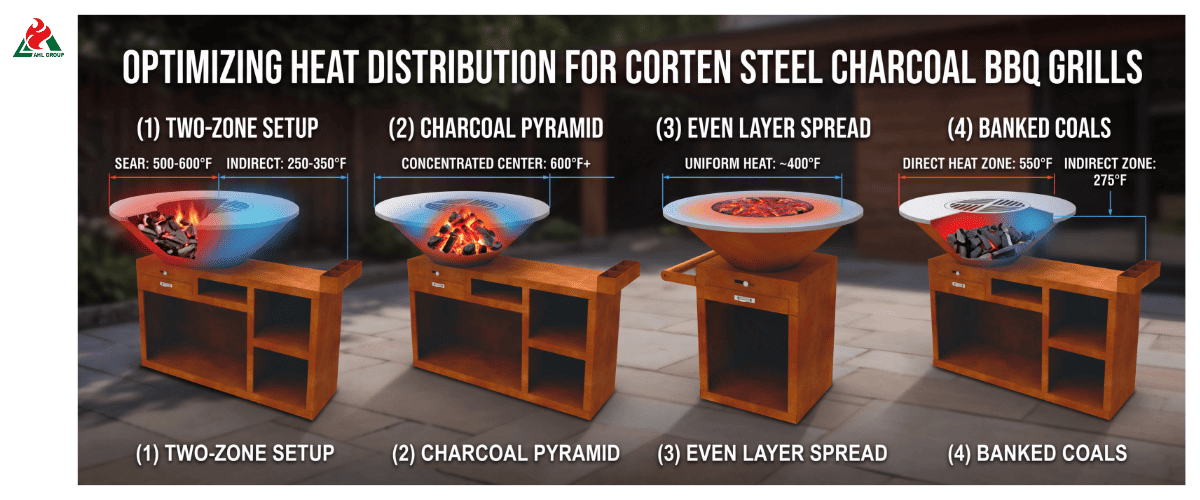
The two-zone layout is the foundation of versatile outdoor charcoal grilling. To set up a two-zone layout, pile all the lit charcoal briquettes or charcoal pieces tightly on one half of the bottom of the firebox, leaving the other half completely free of fuel.
This creates a high-temperature “searing zone” directly above the coals, while the unlit side forms a medium-temperature “safe/convection zone.” If open flames appear in the direct-heat zone or the food begins to brown too quickly, simply slide the food over to the indirect-heat zone to safely finish cooking via convection.
Creating High, Medium, and Low-Temperature Zones
For complex cooking that requires handling multiple ingredients simultaneously, build a three-tiered, sloped charcoal bed:
► High-Temperature Zone (3 layers of charcoal): 500°F to 700°F+ (260°C to 371°C+). Used for intense, rapid searing to create a crispy crust.
► Medium-Temperature Zone (single layer of charcoal): 350°F to 450°F (177°C to 232°C). Use this zone for cooking burgers, sausages, and poultry pieces to ensure they are cooked through without burning.
► Low-temperature/cooling zone (no charcoal): 225°F to 300°F (107°C to 149°C). Use this zone for melting cheese, warming bread, keeping cooked meats warm, or indirect smoking.
Choosing the Right Amount of Charcoal
► Hardwood briquettes: Burn at higher temperatures (800°F+), ignite faster, but burn out more quickly. Ideal for high-heat searing and short cooking times. For high-heat cooking, use 1 full chimney starter (3 to 4 pounds).
► Charcoal Bricks: Specially formulated to ensure uniform size and density. They burn at slightly lower temperatures (500°F to 600°F) but provide steady, predictable heat for 2 to 4 hours. Ideal for indirect cooking, such as low-and-slow roasting. For indirect cooking, use half to three-quarters of a chimney starter’s worth.
4. How to Control Airflow and Temperature
Adjust the Vents to Control the Temperature
The combustion of charcoal depends entirely on the oxygen supply, not the volume of fuel. The Corten BBQ grill regulates airflow through the bottom air intake and the top exhaust vent:
► Bottom Air Intake: Controls the amount of oxygen delivered to the fuel. Opening the bottom air intake supplies oxygen to the embers, thereby increasing the combustion temperature; Closing the bottom air intake restricts the oxygen supply, lowering the temperature.
► Top exhaust vent: Controls the rate at which hot air is expelled and the strength of the draft. During cooking, the exhaust vent should remain open at least 1/4 to 1/2 of the way to allow fresh oxygen to enter through the bottom air intake and prevent stagnant, bitter-tasting tar fumes from adhering to the food.
Dealing with Wind and Outdoor Conditions
Strong winds can blow excess air into the lower air intake and carry away heat from the thin-walled shell, thereby affecting the grill’s stability. The thick, weather-resistant steel construction acts as a natural heat sink, protecting against wind and cold. However, in gusty conditions, the outdoor grill should be positioned so that the main air intake faces away from the prevailing wind direction to prevent abnormal temperature fluctuations.
How to Use a Grill Thermometer
Relying solely on the built-in dome thermometer often results in inaccurate readings, because the sensor on the lid is typically located 4 to 8 inches above the actual cooking surface, and its reading may be 25°F to 50°F higher or lower than the surface temperature of the grill. Be sure to use a dual-probe digital remote thermometer: clip one probe directly onto the grill surface (1 inch away from the food) and insert the other probe into the thickest part of the meat.
5. How Cooking Grate Design Affects Heat
A Comparison of Cast Iron and Stainless Steel Grills
Heavy-duty cast iron grills: These metal grills have extremely high heat capacity and thermal conductivity. They absorb a large amount of direct heat, resulting in deep, distinct grill marks. However, cast iron requires ongoing maintenance to prevent rust, and it takes longer to adjust the temperature when lowering the oven temperature.
304 Stainless Steel Grills (solid rods with a diameter of 8 mm or more): Highly corrosion-resistant, easy to clean, and do not react chemically with acidic marinades. Stainless steel conducts heat slightly more slowly than cast iron, so the resulting grill marks are distributed more evenly across the surface rather than appearing in localized spots.
Why Grill Thickness and Height Are Critical
Thin-wire grates (2 mm to 4 mm) rapidly lose heat upon contact with cold meat, causing food to stick and resulting in a grayish-white, steamed appearance on the surface of the protein. In contrast, solid steel grates with a thickness of 8 mm to 12 mm retain heat upon contact, ensuring immediate caramelization of the surface.
Furthermore, according to the “inverse square law” of radiation, adjusting the vertical distance between the grill grate and the charcoal bed directly controls heat intensity. Lowering the grill grate close to the embers maximizes direct heat for rapid searing, while raising it reduces radiation intensity for gentler cooking.
Adjustable Grill for More Precise Temperature Control
This high-end weathering steel charcoal grill is equipped with an integrated hand-crank height adjustment mechanism or a multi-position slot system. By raising or lowering the entire grill, barbecue masters can instantly fine-tune the heat intensity during cooking without having to touch the sensitive vents or move the scorching-hot coals.
6. How to Find and Fix Hot Spots
A Simple Hot Spot Test Method
Due to differences in airflow paths and firebox geometry, there will be subtle temperature variations in the layout of each grill. By performing the “toast test” or “cookie test,” you can visually map out your grill’s unique heat distribution:
► Arrange inexpensive slices of white toast tightly side by side across the entire grill, forming a dense grid.
► Preheat the grill to medium heat (350°F), ensuring the coals are evenly distributed beneath it.
► Toast the bread for 2 to 3 minutes, then flip each slice in turn.
► The relative degree of browning on each slice will clearly reveal the hot spots, cold spots, and airflow distribution on the grill.
Adjust the Charcoal Placement
If the test reveals overheated hot spots along the back or side walls, use a long-handled ash rake to spread out the charcoal concentrated in that area and move it toward cooler zones to even out the temperature differences across the entire charcoal bed.
Moving Food Between Different Heat Zones
Use a dynamic cooking rotation method: First, place the steak directly on a confirmed high-temperature zone to sear it quickly, creating a deep red, crispy crust. Then, immediately move it to the medium- or low-temperature zones identified during the toast test, allowing the internal temperature to rise slowly while preventing the crust from burning.
7. How to Optimize Heat for Different Foods
Steaks and Burgers
► Target grill temperature: 550°F to 700°F+ (288°C to 371°C+).
► Strategy: Build a dense, two-zone direct charcoal bed. For thick-cut steaks (1.5 inches or thicker), use the “reverse searing” method: Place the meat in the low-temperature indirect zone (250°F) until the internal temperature reaches 115°F (46°C). Then, move it directly to the high-temperature searing zone and sear each side for 60 seconds to achieve even sear marks.
Chicken and Fish
► Target grill temperature: 325°F to 400°F (163°C to 204°C).
► Strategy: Bone-in chicken and delicate fish fillets can quickly char over high heat due to melting fat and tender skin. Cook primarily in the indirect heat zone of a dual-zone setup, keeping the lid closed. For the final 3 to 5 minutes, move the chicken skin-side down to the direct heat zone over medium heat to safely crisp the skin without causing the fat to catch fire.
Large Cuts and Slow Roasting
► Target grill temperature: 225°F to 275°F (107°C to 135°C).
► Strategy: For ingredients requiring long, slow roasting (beef brisket, pork shoulder, spare ribs), use the “Small Army Method” or the “Snake Method.” Arrange two layers of unlit charcoal around the perimeter of the Korten steel firebox to form a semicircular ring, and place a small amount of lit charcoal at one end. The flames will slowly spread in a “snake-like” pattern over 8 to 12 hours, maintaining stable, low-temperature convection heat and preventing sudden temperature spikes.
8. Common Heat Distribution Mistakes
1. Using Too Much Charcoal
This can cause the charcoal fire to go out due to a lack of oxygen, leading to an extreme and uncontrollable spike in temperature.
Overfilling the firebox with raw charcoal blocks restricts necessary airflow, causing a buildup of soot and generating uncontrollable high temperatures. This results in the outside of the food becoming charred while the inside remains undercooked. Please fill the fuel chamber according to your target cooking time.
2. Neglecting Airflow and Completely Closing the Exhaust Vent
This leads to oxygen deprivation and the formation of bitter-tasting wood tar deposits.
Closing the top exhaust flap traps oxygen-deprived wood smoke inside the cooking chamber, which not only deposits bitter-tasting black wood tar on the surface of the food but also causes the charcoal bed to go out. Heat should primarily be regulated through the bottom air intake.
3. Opening the Grill Lid Too Frequently
Causes convective heat accumulated within the thick, weathering steel body to escape
Repeatedly opening the BBQ grill lid expels the convective hot air accumulated inside the cooking chamber. This not only significantly increases cooking time but also causes fluctuations in airflow, leading to sudden fat flare-ups.
4. Improper Ash Disposal and Blocked Vents
A suffocating layer of ash can block the bottom air intake channels.
Allowing old wood ash to accumulate at the bottom of the firebox will block the lower air intakes, causing the charcoal to lack oxygen and trapping corrosive moisture on the Corten steel base plate during storage.
9. What Features Should You Look for in a Corten Charcoal BBQ
Heavy-Gauge Weathering Steel
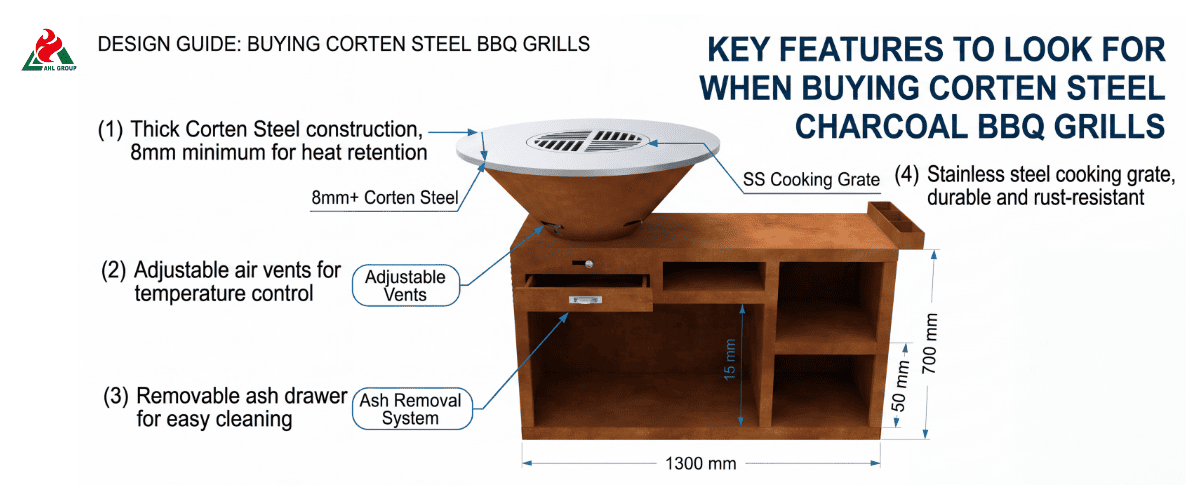
Some models are manufactured using weathering steel plates with thicknesses ranging from at least 3 mm (11 gauge) to 6 mm (1/4 inch). Heavy-gauge materials offer exceptional structural durability, effectively resist thermal deformation, and provide outstanding heat retention, enabling extended periods of indirect grilling.
Adjustable Grates
Prioritize designs equipped with multi-position grill slots or an integrated hand-crank height adjustment system. The ability to adjust the distance between the fuel bed and the grill allows for immediate and precise heat control.
Multi-Zone Design
Select a spacious firebox equipped with removable fire baffles or a partitioned coal basket. The firebox partition design enables independent dual-zone and triple-zone configurations within the same footprint.
Efficient Airflow and Firebox Design
Ensure the grill is equipped with precision-machined air intake dampers, adjustable exhaust dampers, and a raised lower coal rack with a separate ash tray. The elevated position of the lower coal rack suspends the fuel above the ash, maintaining a continuous airflow to the burning embers.
10. Frequently Asked Questions
Q1: Does Weathering Steel Conduct Heat Evenly?
Yes. The high structural density and wall thickness (3 to 6 millimeters) of weathering steel allow it to absorb initial heat and radiate it evenly into the interior cooking chamber, thereby minimizing the hot spots commonly found in thin-metal grills.
Q2: How Do You Control the Temperature of a Corten Charcoal Grill?
Temperature is primarily controlled by adjusting the air intake vents at the bottom to regulate the oxygen supply to the charcoal. Adjusting the distance between the grill grate and the charcoal bed, along with using a dual-heat-zone charcoal layout, allows for further fine-tuning of the heat applied to the food’s surface.
Q3: How Do I Create Two Heat Zones?
Pile all the lit charcoal on one side of the firebox floor, leaving the other side empty. This creates a high-temperature direct-grilling zone above the charcoal and an indirect convection zone above the empty area.
Q4: Why Do Hot Spots Occur on the Charcoal Grill?
Hot spots are caused by uneven charcoal density, localized airflow resulting from fully open air vents, uneven ash buildup obstructing airflow, or rapid heat loss through the outer walls due to the thin metal construction.
Q5: Can a Corten Steel Charcoal Grill Be Used for Low-Temperature Slow Cooking?
Yes. The thick walls of Corten steel provide excellent thermal insulation. When using the “snake” or “little helper” charcoal arrangement and partially closing the air intake damper, the convection temperature can be maintained steadily between 225°F and 250°F for several hours.
Conclusion: How to Achieve Even Heat Distribution on a Weathering Steel Charcoal Grill
To optimize heat distribution on a Corten steel outdoor grill, the key lies in understanding thermodynamic principles: balancing the three modes of heat transfer—radiation, conduction, and convection. By leveraging the high heat capacity of thick Corten steel, setting up a distinct dual-zone charcoal layout, regulating airflow with precision air intake dampers, and equipping the grill with heavy-duty grates, you can eliminate inconsistent hot spots and achieve uniform, restaurant-quality cooking results every time.

