


Corten steel cladding panels are highly regarded for their unique weathered appearance, architectural character, and resistance to atmospheric corrosion. However, when a project requires custom-sized panels, hidden joints, fabricated corner pieces, support frames, or repairs, an important question arises: Can Corten steel cladding panels be welded?
Yes, it is possible. Weathering steel can generally be welded using conventional welding processes, such as MIG/GMAW, TIG/GTAW, and manual metal arc welding (SMAW). However, welding weathering steel is not as simple as joining two pieces of ordinary low-carbon steel. The welding process, filler metal, heat input, joint preparation, drainage design, and post-weld treatment all affect the long-term appearance and corrosion resistance of the exterior wall panels.
In architectural applications, the goal is not only to form a structurally sound weld but also to ensure the finished joint can weather naturally and avoid visible, corrosion-prone areas. Therefore, you may need to use filler metals with appropriate weathering properties, especially when the weld will be exposed for an extended period.
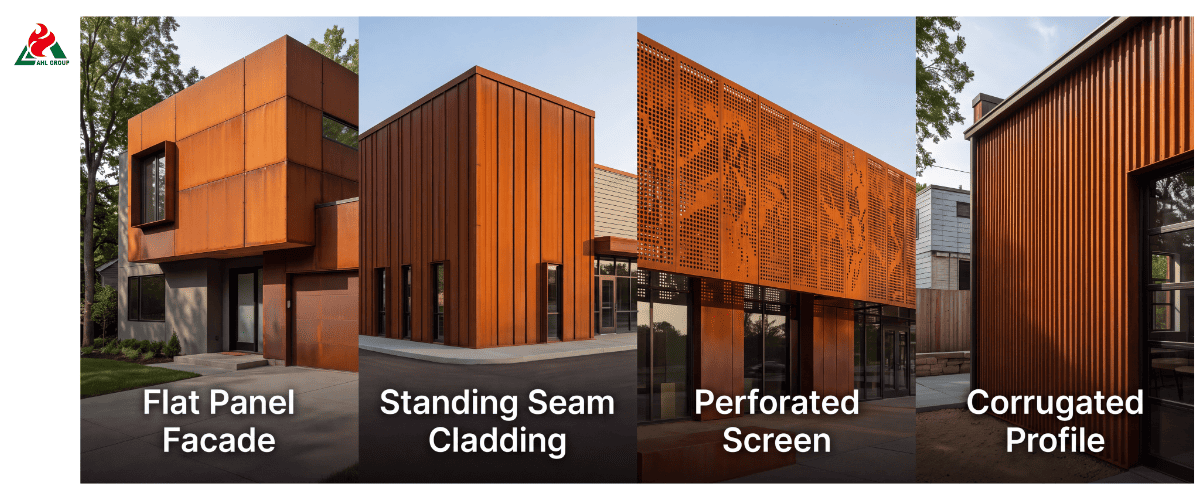
Yes, it is possible. Weathering steel can generally be welded using conventional welding processes, such as MIG/GMAW, TIG/GTAW, and manual metal arc welding (SMAW). However, welding weathering steel is not as simple as joining two pieces of ordinary low-carbon steel. The welding process, filler metal, heat input, joint preparation, drainage design, and post-weld treatment all affect the long-term appearance and corrosion resistance of the exterior wall panels.
In architectural applications, the goal is not only to form a structurally sound weld but also to ensure the finished joint can weather naturally and avoid visible, corrosion-prone areas. Therefore, you may need to use filler metals with appropriate weathering properties, especially when the weld will be exposed for an extended period.
1. Quick Answer
Yes, Standard Welding Methods Can Be Used
Yes, weathering steel (ASTM A588, A606-4, or EN 10025-5) cladding panels can be successfully welded using standard structural arc welding processes. Since weathering steel is a low-alloy carbon steel containing copper, chromium, nickel, and phosphorus, its weldability is similar to that of conventional structural steel, provided that appropriate procedures are followed.
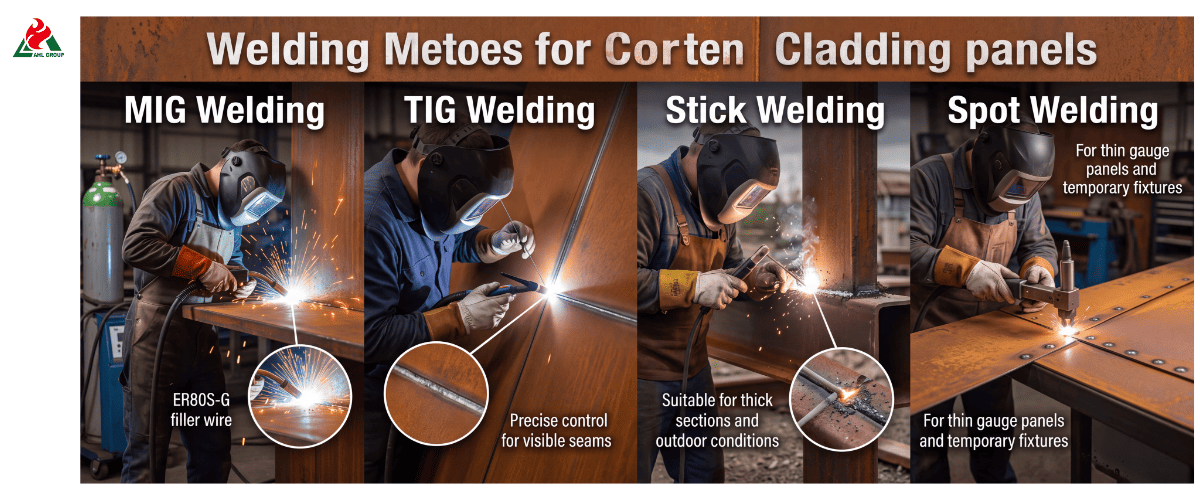
MIG, TIG, and Manual Arc Welding
MIG (GMAW) welding can be used to improve production efficiency, TIG (GTAW) welding for precise architectural detailing, or manual arc welding (SMAW) for on-site installation and adjustments.
Use of Weathering Steel Welding Consumables
To ensure long-term corrosion resistance along the entire length of the weld, weathering-grade welding consumables (containing copper and nickel alloys) must be selected. Standard low-carbon steel welding consumables may cause the weld to corrode at different rates and result in uneven rusting.
Maintain a CRI ≥ 6.0
Engineers use the Corrosion Resistance Index (CRI) to evaluate the performance of metals under atmospheric exposure conditions. The weld metal and heat-affected zone (HAZ) must achieve a CRI of 6.0 or higher (calculated according to ASTM G101) to match the service life of the Corten base material.
2. Welding Methods
MIG (GMAW)
Gas Metal Arc Welding (MIG) is the preferred process for manufacturing Corten steel architectural panels. This process offers advantages such as high deposition rates, minimal distortion of steel sheets ranging from 1.5 mm to 3.0 mm in thickness, and the ability to maintain high travel speeds along long perimeter welds.
Best Suited for Thin to Medium-Thickness Sheets
MIG welding performs exceptionally well on thin to medium-thickness sheets (1.5 mm to 5.0 mm), which are commonly used for exterior wall cladding, rain screens, and window flashings.
Long Welds and Panel Assembly
When assembling long vertical panel joints or installing rear reinforcement caps, pulsed MIG welding with an 80% argon / 20% carbon dioxide shielding gas mixture reduces spatter and minimizes post-weld cleanup.
TIG (GTAW)
Tungsten Inert Gas (TIG) welding offers exceptional arc control and minimal thermal distortion, making it the ideal process for visible fillet joints, decorative laser-cut panels, and intricate architectural cornices.
Precise Control, Visible Seams
TIG welding produces flawless welds with virtually no spatter, ensuring that seam lines on striking architectural entrances or interior feature walls remain visually smooth and seamless.
Decorative Details
When joining perforated or custom laser-cut weathering steel sheets, TIG welding prevents burn-through along the delicate sheet edges while forming structurally sound corner joints.
Manual Metal Arc Welding (SMAW)
Manual Metal Arc Welding (SMAW) is primarily used for installations at outdoor construction sites, joining heavy-duty structural frames, or joining thick plates (> 6.0 mm).
On-site Repairs, Thick-walled Workpieces
Manual Metal Arc Welding can easily handle thick-walled structural steel pipes and heavy-duty mounting brackets, and penetrate surface scale during outdoor installation.
Windy Outdoor Environments
Because SMAW uses a flux coating that generates its own protective gas barrier, it is unaffected by outdoor wind—which often disrupts the arc during gas-shielded MIG or TIG welding on construction scaffolding.
Spot Welding
Resistance spot welding provides a fast, fastener-free method for securing rear reinforcements and cap channels to thin weathering steel cladding panels without burning through the front architectural finish.
3. Filler Metals
MIG: ER80S-G, ER70S-G
When performing MIG welding on weathering steel, use ER80S-G (or ER70S-G) alloy welding wire that complies with the AWS A5.28 standard, with a copper content of approximately 0.5% and a nickel content of approximately 0.8%. This chemical composition ensures that the oxidation rate of the weld bead matches that of the adjacent steel plate and forms the same deep orange-brown rust layer.
TIG: ER80S-G, ER70S-2
To achieve high-strength, color-matched TIG welds, use ER80S-G cut-to-length wire. For single-pass, non-structural joints in thin sheets (< 2.0 mm), standard ER70S-2 wire may be used if the dilution effect of the base metal provides sufficient copper alloy for the smaller weld pool.
Manual Arc Welding: E8018-W, E7018
For manual arc welding, select AWS A5.5 E8018-W2 electrodes, which are specially formulated with added nickel, copper, and chromium. For hidden root passes in multi-pass welds on thick plates, low-hydrogen E7018 electrodes may be used, provided that the cover pass uses E8018-W2.
Requirement: CRI ≥ 6.0
Be sure to verify the steel mill’s certificate to confirm that the Corrosion Resistance Index (CRI) of the deposited weld metal in an atmospheric environment is ≥ 6.0.
Matching Base Metal Composition
Matching alloying elements (Cu, Ni, Cr, P) prevents the formation of localized electrochemical cells between the weld and the heat-affected zone.
Avoid Using Standard Low-Carbon Steel Welding Wire
Using standard carbon steel welding wire (such as ER70S-6 or E6010) on multi-pass welds exposed to the elements will cause the weld bead to corrode faster than the surrounding weathering steel plate, leading to structural undercut and bright yellow rust spots.
4. Pre-Weld Preparation
Removing the 10–20 mm Thick Oxidation Layer
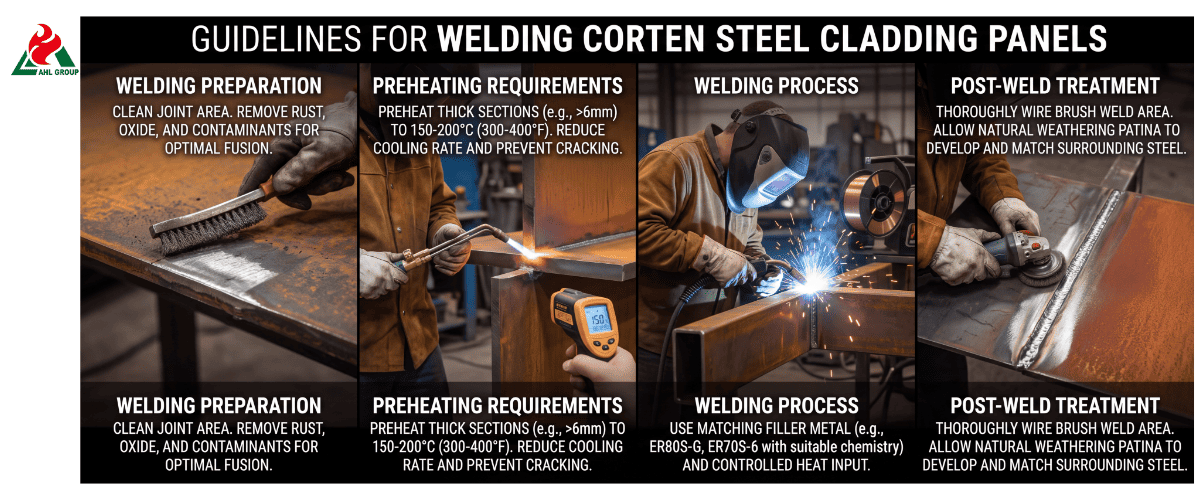
Before striking the arc, use mechanical grinding to remove any compacted scale or existing rust within a 10 mm to 20 mm range on both sides of the joint to be welded.
Removing Oil, Grease, and Rust
Thoroughly remove oil from the joint using acetone or a specialized metal cleaner. Any hydrocarbons, grease, or moisture remaining under the arc will cause porosity and hydrogen-induced cracks.
Grind to a Metallic Luster
Use a clean flap disc or grinding wheel specifically designed for weathering steel or carbon steel to grind the surface to a bright, smooth metallic luster.
Ensure the Surface Is Dry (Moisture Content < 0.05%)
If the ambient temperature is low or humidity is high, use a propane torch to gently preheat the joint area to remove any residual moisture from the surface before welding.
Use Low-hydrogen Consumables
Store electrodes in a heated electrode oven (120°C) and keep MIG wire spools sealed until use to eliminate hydrogen contamination in the weld metal.
5. Preheat Requirements
50–150°C, Depending On Thickness
Although thin weathering steel panels (< 3.0 mm) generally do not require preheating when the ambient temperature is above 15°C, thicker panels (> 6.0 mm) or constrained joints require preheating to 50°C to 150°C (120°F to 300°F).
A606-4 Specification: 150–200°F
For ASTM A606 Type 4 steel plates, maintaining a preheat temperature of at least 150°F (65°C) during cold-weather operations prevents rapid quenching in the heat-affected zone.
Measure 3 Inches from the Joint
Use a calibrated infrared thermometer or Tempilstik temperature pen to measure 75 millimeters (3 inches) from the weld centerline to verify the preheat temperature.
Interpass Temperature Below 400°F
During multi-pass welding, the interpass temperature should be maintained below 200°C (400°F) to prevent excessive grain growth and thermal distortion in thin-welded components.
Preventing Cold Cracks
Preheating slows the cooling rate of the weld pool, allowing dissolved hydrogen to escape safely and preventing the formation of the hard martensitic microstructure that causes cold cracks.
6. Post-Weld Treatment
Grinding Weld Seams
To ensure the surface of the architectural panels is smooth, first use a 40-grit coarse grinding disc to grind down the raised weld reinforcement layer, then gradually switch to a 120-grit fine grinding disc for further grinding.
Removing Spatter and Burrs
Scrape off all loose weld slag and sharp burrs. Loose slag balls can absorb moisture, causing uneven stains on the surrounding wall sections.
Smoothing the Surface
Blend the edges of the ground welds smoothly into the surrounding panel surfaces to eliminate the striped visual effect that appears under natural light.
Phosphoric Acid Cleaning
Spray a mild phosphoric acid solution or a mist of cleaning fluid onto the surface of the newly ground weld metal to remove residual oil and induce rapid, uniform surface oxidation.
Accelerating Rust Formation
Since polished, exposed steel takes several weeks to rust naturally, the use of organic rust accelerators (such as vinegar, hydrogen peroxide, and salt solutions) can speed up the process of achieving a matching initial color tone.
6–12 Months to Form a Complete Rust Patina
Even with the use of chemical accelerators, it still takes 6 to 12 months of a weathering transition period for new welds to blend seamlessly with factory-weathered panels.
7. Patina Matching
The Appearance of New Welds Is Different
Freshly ground welds appear silvery-gray, while newly rusted filler metal initially forms a bright orange oxide layer that contrasts sharply with the darker, weathered weathering steel plate.
Gradual Blending Over Time
As the copper-nickel alloy components in ER80S-G or E8018-W welds react with the alternating dry and wet cycles of the atmosphere, the oxide layer gradually darkens, eventually forming a rich, velvety-smooth dark brown surface that complements the base metal’s hue.
Chemical Treatment
► To accelerate color blending on commercial building facades, professional installers use a mild chemical mist containing copper sulfate and iron oxide reagents.
► Water Mist Spraying (for 10 Consecutive Days, 2–3 Times Daily)
► Spraying the ground welds with clean tap water 2 to 3 times daily for 10 consecutive days promotes the rapid formation of a dense oxide layer.
Managing Client Expectations
Architects, developers, and clients should be informed as early as possible that newly welded exterior cladding panel joints will exhibit slight color variations during the first few months of exposure to the atmosphere before stabilizing into a uniform surface appearance.
8. Factory vs Field Welding
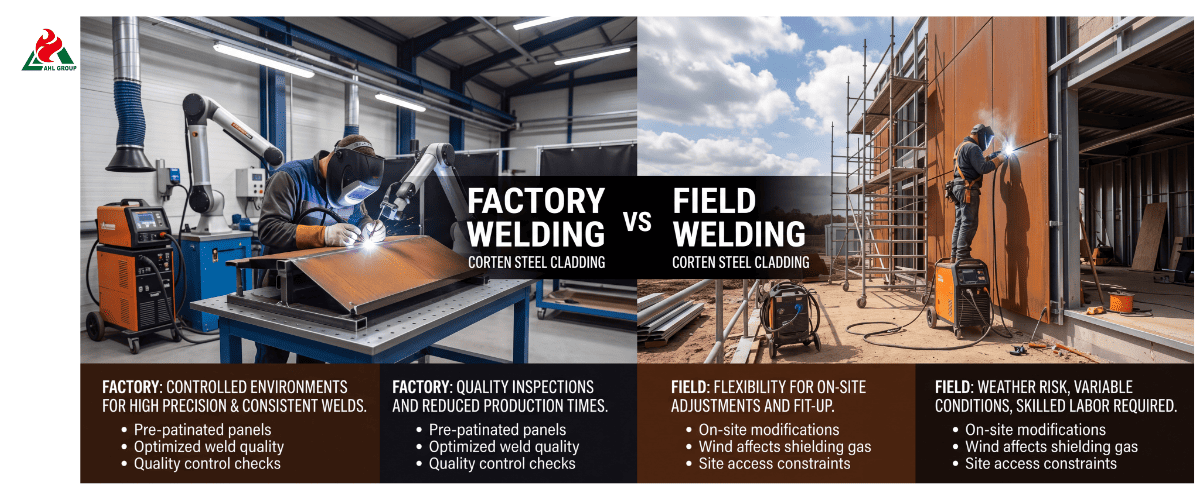
Factory: Controlled Environment
Performing shop fabrication in a controlled factory environment ensures exceptional weld quality, precise heat control, and minimizes environmental pollution.
Appropriate Preheating Equipment
The factory environment facilitates the use of induction heating mats, positioning fixtures, and automated pulse MIG welders, thereby reducing thermal distortion on long cladding plates.
Post-Weld Grinding
Grinding, surface treatment, and initial chemical rust acceleration treatment can all be performed in a controlled, well-ventilated, and safely enclosed workshop environment.
On-Site: Variable Conditions
On-site welding is subject to factors such as wind, rain, temperature fluctuations, and limited working space on scaffolding.
Protecting the Surrounding Environment
When welding installed Corten steel cladding walls on-site, flame-retardant welding blankets should be used to protect the glass curtain walls, stone copings, and adjacent finishes below from high-temperature spatter.
Planning for Rust Color Variations
Ensure that on-site welds are located in shaded recesses, recessed joints, or at panel edges to minimize visual contrast during the on-site rust maturation process.
9. Corrosion Resistance
Maintain a CRI ≥ 6.0
To prevent structural failure over the 50-year design life of the building, the Combined Corrosion Index (CRI) of the base metal, heat-affected zone, and weld must remain at or above 6.0 at all times.
Match the Welding Material to the Base Metal
Matching the chemical alloy composition prevents localized electrochemical corrosion and ensures that the oxidation rate of the weld metal is consistent with that of the surrounding cladding.
Proper Drainage Design
When designing welded joint details, ensure that rainwater drains away quickly. Never allow standing water to remain on horizontal welds, as prolonged immersion hinders the formation of a protective oxide scale.
Avoid Standing Water
Eliminate sharp crevices or unsealed lap joints where rainwater and airborne salts may accumulate to prevent localized crevice corrosion in the weld zone.
Long-Term Performance
Provided that weathering-grade filler metal is used, and the joint geometry is correct, welded weathering steel cladding structures can provide a maintenance-free service life of up to several decades.
10. FAQs
Q1: Can Corten Steel Cladding Be Welded?
Yes, as long as a weathering-grade filler metal is used, Corten steel cladding walls can be welded using standard MIG, TIG, or SMAW processes.
Q2: What Is the Best Welding Method?
MIG (GMAW) is best suited for high-speed assembly of sheet metal in a workshop, while TIG (GTAW) is more suitable for precise, visible architectural corner joints.
Q3: Which Filler Metals Should Be Used?
For MIG/TIG welding, use AWS ER80S-G welding wire; for manual arc welding, use E8018-W2 electrodes to ensure proper matching of the copper-nickel alloy.
Q4: Is Preheating Required?
Thin-gauge coated plates (< 3.0 mm) generally do not require preheating unless the ambient temperature is below 15°C. Thicker plates (> 6.0 mm) should be preheated to 50°C–150°C.
Q5: Can Thin Sheets Be Welded?
Yes, thin weathering steel sheets (1.5 mm to 2.0 mm) can be easily joined using short-circuit or pulsed MIG and TIG processes without burn-through.
Q6: Should Standard Carbon Steel Filler Metal Be Used?
Standard carbon steel filler metal should only be used for single-pass welds where the dilution ratio of the base metal exceeds 75%, or for backing members in concealed structures.
Q7: Post-Weld Treatment?
Use a beveling grinder to grind the weld flush with the base metal, remove spatter, and spray a small amount of water or acid mist to promote uniform oxidation.
Conclusion: Following Best Practices
Welding Corten metal siding panels is a proven construction technique for creating sturdy, seamless wall assemblies and rain screen modules.
Proper selection of weathering-grade filler metal (ER80S-G / E8018-W2) is critical, as it ensures atmospheric corrosion resistance comparable to that of the base material while matching the base material’s aesthetic rust patina.
Thoroughly cleaning the weld, removing moisture, properly controlling heat input, and performing post-weld grinding ensure that the weld maintains structural integrity while visually blending with the base material.
Adhering to established preheating, low-hydrogen treatment, and chemical oxidation procedures ensures the construction of high-performance Corten steel façades that provide decades of maintenance-free durability.

